

Brain–phenotype models fail for individuals who defy sample stereotypes
Open accessThe DOI matches its Crossref record; 137 of the 137 references it cites were found in a registry or an index.
Abstract
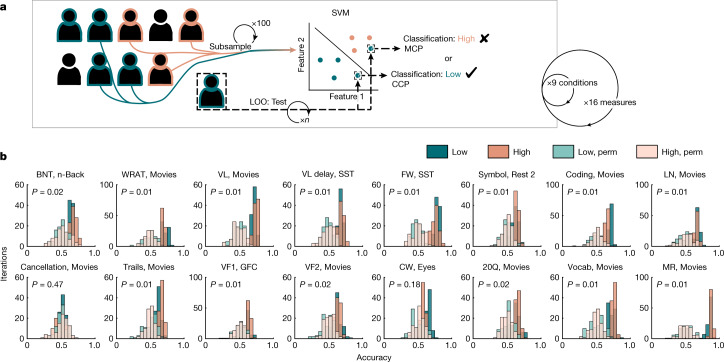
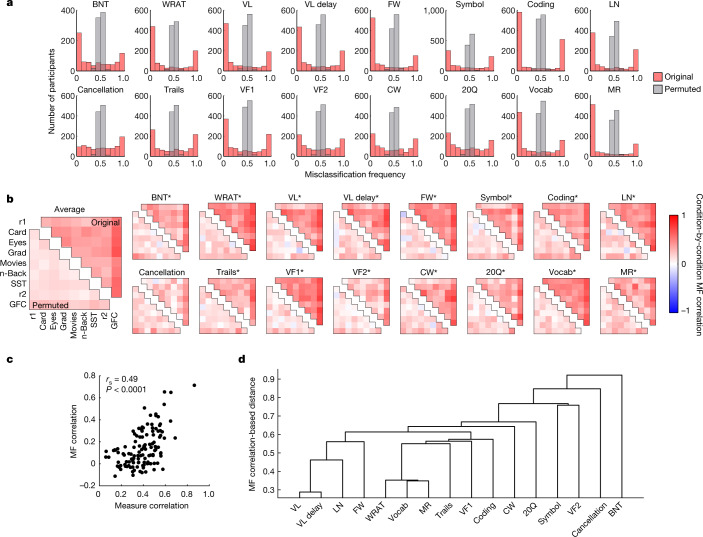
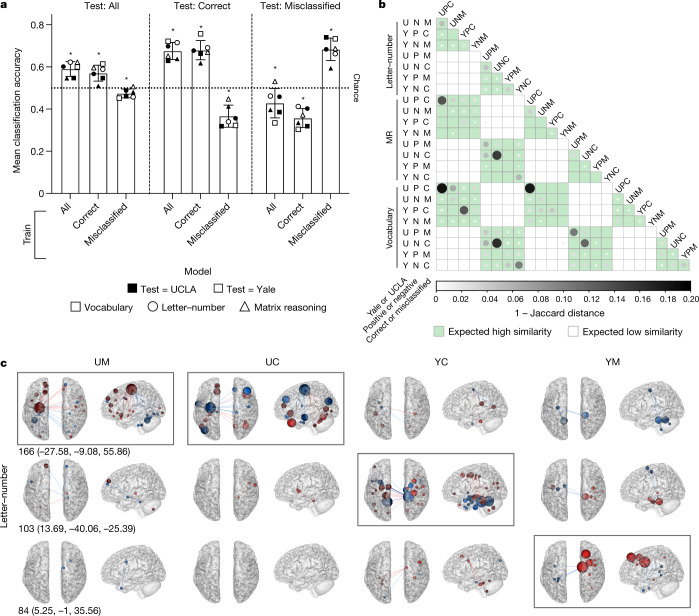
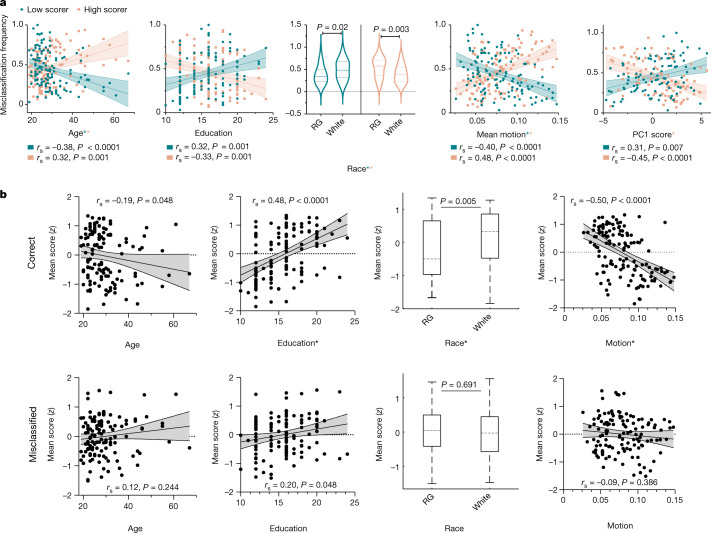
Individual differences in brain functional organization track a range of traits, symptoms and behaviours 1–12 . So far, work modelling linear brain–phenotype relationships has assumed that a single such relationship generalizes across all individuals, but models do not work equally well in all participants 13,14 . A better understanding of in whom models fail and why is crucial to revealing robust, useful and unbiased brain–phenotype relationships. To this end, here we related brain activity to phenotype using predictive models—trained and tested on independent data to ensure generalizability 15 —and examined model failure. We applied this data-driven approach to a range of neurocognitive measures in a new, clinically and demographically heterogeneous dataset, with the results replicated in two independent, publicly available datasets 16,17 . Across all three datasets, we find that models reflect not unitary cognitive constructs, but rather neurocognitive scores intertwined with sociodemographic and clinical covariates; that is, models reflect stereotypical profiles, and fail when applied to individuals who defy them. Model failure is reliable, phenotype specific and generalizable across datasets. Together, these results highlight the pitfalls of a one-size-fits-all modelling approach and the effect of biased phenotypic measures 18–20 on the interpretation and utility of resulting brain–phenotype models. We present a framework to address these issues so that such models may reveal the neural circuits that underlie specific phenotypes and ultimately identify individualized neural targets for clinical intervention.
Overview
The claims and statistics of this paper haven’t been checked yet.
Free: it reads the open-access text and checks the first 5 claims that cite a source we can check. Create a free account to check every claim.
Integrity signals
Registry
Cites
Statistics
Figures
Verification
Claims the paper makes
The claims and statistics of this paper haven’t been checked yet.
Free: it reads the open-access text and checks the first 5 claims that cite a source we can check. Create a free account to check every claim.
Claims other papers make about this one
Each is checked against this paper’s own text: does it say what the citing paper says it does?
The source backs part of the claim, not all of it — or backs it for a different population, condition or comparison.
In the citing paper
“The FCS alterations in these regions have been proven to be related to the regulation of widespread cognitive, emotional, and executive control functions in patients with MDD [6, 42-50].”
From Mapping neurophysiological subtypes of major depressive disorder using normative models of the functional connectome (2023) · cites this paper as [48]
Experimental — accuracy not yet measuredThe cited source says what the claim attributes to it.
In the citing paper
“A recent Nature paper reported that the confounding covariates, especially age and head motion (FD), were associated with worse model accuracy [11] in functional connectivity based neuroimaging classification.”
From Confound Controlled Multimodal Neuroimaging Data Fusion and Its Application to Developmental Disorders (2025) · cites this paper as [11]
The check wasn’t confident either way, so it gives no verdict — never disputed.
In the citing paper
“The two-step process does not guarantee joint optimum and may result in worse performance in either fusion or regression procedures [10, 11].”
From Confound Controlled Multimodal Neuroimaging Data Fusion and Its Application to Developmental Disorders (2025) · cites this paper as [11]
Experimental — accuracy not yet measured
Self-check
Percentages, sums and reported differences re-computed from the paper’s own numbers.
The self-check needs the paper’s full text.
Citations
Cites
The assessment and analysis of handedness: The Edinburgh inventory
Oldfield, R. C. (1971) · Neuropsychologia · doi:10.1016/0028-3932(71)90067-4 · Cited by 35,900
The Pittsburgh Sleep Quality Index: a new instrument for psychiatric practice and research
Buysse, D. J., Reynolds, C. F., Monk, T. H., Berman, S. R., & Kupfer, D. J. (1989) · Psychiatry Research · doi:10.1016/0165-1781(89)90047-4 · Cited by 35,234
A Global Measure of Perceived Stress
Cohen, S., Kamarck, T., & Mermelstein, R. (1983) · Journal of Health and Social Behavior · doi:10.2307/2136404 · Cited by 32,807
Brainard, D. H. (1997) · Spatial Vision · doi:10.1163/156856897x00357 · Cited by 19,702
Breiman, L. (1996) · Machine Learning · doi:10.1007/bf00058655 · Cited by 16,325
Advances in functional and structural MR image analysis and implementation as FSL
Smith, S. M., Jenkinson, M., Woolrich, M. W., Beckmann, C. F., Behrens, T. E. J., Johansen-Berg, H., Bannister, P. R., De Luca, M., Drobnjak, I., Flitney, D. E., et al. (2004) · NeuroImage · doi:10.1016/j.neuroimage.2004.07.051 · Cited by 13,630
The weirdest people in the world?
Henrich, J., Heine, S. J., & Norenzayan, A. (2010) · Behavioral and Brain Sciences · doi:10.1017/s0140525x0999152x · Cited by 12,641
Measuring individual differences in empathy: Evidence for a multidimensional approach.
Davis, M. H. (1983) · Journal of Personality and Social Psychology · doi:10.1037/0022-3514.44.1.113 · Cited by 10,272
(1998) · PubMed · Cited by 10,216
The organization of the human cerebral cortex estimated by intrinsic functional connectivity
Thomas Yeo, B. T., Krienen, F. M., Sepulcre, J., Sabuncu, M. R., Lashkari, D., Hollinshead, M., Roffman, J. L., Smoller, J. W., Zöllei, L., Polimeni, J. R., et al. (2011) · Journal of Neurophysiology · doi:10.1152/jn.00338.2011 · Cited by 9,182
Research works printed but not linked: 7
- Wang L-I Race as proxy: situational racism and self-fulfilling stereotypes DePaul Law Rev. 2004 53 1013 1110
- Wilkinson, G. S. & Robertson, G. J. Wide Range Achievement Test (WRAT5) (Pearson, 2017).
- Derogatis, L. R. Brief Symptom Inventory (Pearson, 1993).
- Watson D Clark L The PANAS-X manual for the Positive and Negative Affect Schedule-Expanded Form Iowa Res. Online 1999 277 1 27
- Sheslow, D. & Adams, W. Wide Range Assessment of Memory and Learning 2nd edn (Pearson, 2003).
- Frackowiak, R. S. J. et al. (eds) Human Brain Function (Academic Press, 2004).
- First, M., Spitzer, R., Gibbon, M. & Williams, J. Structured Clinical Interview for DSM-IV-TR Axis I Disorders, Research Version, Patient Edition (Biometrics Research, New York State Psychiatric Institute, 2002).
Cited by
Items 101–176 of 176
Asian Cohort for Alzheimer Disease (ACAD) Pilot Study: Vietnamese Americans
Peavy, G. M., Võ, N., Revta, C., Lu, A. T., Lupo, J., Nam, P., Nguyễn, K. H., Wang, L., & Feldman, H. (2024) · Alzheimer Disease & Associated Disorders · doi:10.1097/wad.0000000000000631 · Cited by 5
Morrone, J. M., Mellor, R., Grosprêtre, S., Pedlar, C. R., & Cimadoro, G. (2025) · Brain and Behavior · doi:10.1002/brb3.70448 · Cited by 5
Cost Efficiency of fMRI Studies Using Resting‐State Vs. Task‐Based Functional Connectivity
Zhang, X., Hulvershorn, L. A., Constable, R. T., Zhao, Y., & Wang, S. (2025) · Human Brain Mapping · doi:10.1002/hbm.70260 · Cited by 5
Self-citationEvans, T., Vilor-Tejedor, N., Operto, G., Falcón, C., Hofman, A., Ibáñez, A., Seshadari, S., Tan, L. C., Weiner, M., Alladi, S., et al. (2024) · Biological Psychiatry: Cognitive Neuroscience and Neuroimaging · doi:10.1016/j.bpsc.2024.07.019 · Cited by 3
The intersectional implications of a quantitative epistemology in pain care and research
Charette, M., & Schaffzin, G. (2024) · Canadian Journal of Pain · doi:10.1080/24740527.2025.2454672 · Cited by 5
Age differences in neural discriminability of rumination and worry
Misaki, M., Tsuchiyagaito, A., Guinjoan, S. M., & Paulus, M. P. (2026) · Communications Biology · doi:10.1038/s42003-025-09498-3 · Cited by 5
O’Neill, A. G., Pax, M., Parent, J. H., Sepulcre, J., Camprodon, J. A., Noble, S., Roffman, J. L., & Eryilmaz, H. (2025) · NPP—Digital Psychiatry and Neuroscience · doi:10.1038/s44277-025-00032-1 · Cited by 4
Self-citationThe landscape of dementia research, diagnosis, treatment, and care in Latin America
Suemoto, C. K., Custodio, N., Aguilar, D., Ávila‐Funes, J. A., Báez, S., Bagnati, P., Barnes, L. L., Brucki, S. M. D., Calandri, I. L., Caramelli, P., et al. (2026) · Alzheimer s & Dementia · doi:10.1002/alz.71309 · Cited by 4
Embracing the suboptimal organization of the human brain
Fakhar, K., & Astle, D. E. (2026) · Trends in Cognitive Sciences · doi:10.1016/j.tics.2026.04.008 · Cited by 5
Marotta, J., Aggarwal, S., Osayande, N., Saltoun, K., Kopál, J., Holmes, A. J., Yip, S. W., & Bzdok, D. (2025) · PLoS ONE · doi:10.1371/journal.pone.0327729 · Cited by 4
Optimizing functional connectivity scanning conditions for predicting autistic traits
Horien, C. L., Mandino, F., Greene, A. S., Shen, X., Powell, K. K., Vernetti, A., O'Connor, D., Adkinson, B. D., Tejavibulya, L., McPartland, J. C., et al. (2026) · Nature Mental Health · doi:10.1038/s44220-026-00623-7 · Cited by 4
Self-citationSamardzija, A., Shen, X., Luo, W., Greene, A. S., Mehta, S., Tokoglu, F., Arora, J., Woods, S. W., Katz, R. B., Sanacora, G., et al. (2026) · Nature Communications · doi:10.1038/s41467-026-73941-0 · Cited by 4
Self-citationCross-domain analogical reasoning ability links functional connectome to creativity
Yang, L., Zeng, R., Wang, X., Chen, J., Gu, J., Fan, J., Qiu, J., & Cao, G. (2025) · Thinking Skills and Creativity · doi:10.1016/j.tsc.2025.101808 · Cited by 4
Liang, C., Silva, R. F., Adali, T., Jiang, R., Zhang, D., Qi, S., & Calhoun, V. D. (2025) · IEEE Transactions on Image Processing · doi:10.1109/tip.2025.3597045 · Cited by 3
“A recent Nature paper reported that the confounding covariates, especially age and head motion (FD), were associated with worse model accuracy [11] in functional connectivity based neuroimaging classification.”
Polo-like kinase 1 maintains transcription and chromosomal accessibility during mitosis
Shen, Z., Adams, K. K., Moreno, R., Lera, R. F., Kaufman, E. L., Lang, J. D., & Burkard, M. E. (2025) · Molecular Biology of the Cell · doi:10.1091/mbc.e25-02-0053 · Cited by 3
Regularized CCA identifies sex-specific brain-behavior associations in adolescent psychopathology
Milecki, L., González, C., Adeli, E., Nooner, K. B., Sabuncu, M. R., Kuceyeski, A. F., & Zhao, Q. (2025) · Translational Psychiatry · doi:10.1038/s41398-025-03678-9 · Cited by 3
Latent space-based network analysis for brain–behavior linking in neuroimaging
Wang, S., Zhang, X., Liu, Y., Xu, W., Tian, X., & Zhao, Y. (2025) · Nature Methods · doi:10.1038/s41592-025-02896-9 · Cited by 3
From maps to models: A survey on the reliability of small studies of task-based fMRI
Sadil, P. S., & Lindquist, M. A. (2026) · Imaging Neuroscience · doi:10.1162/imag.a.1076 · Cited by 3
Lutz, G., Smerconish, S., Roalf, D. R., Neale, M. C., & Schmitt, J. E. (2025) · Human Brain Mapping · doi:10.1002/hbm.70300 · Cited by 4
Tansey, R. C., Graff, K., Rai, S., Merrikh, D., Godfrey, K. J., Vanderwal, T., & Bray, S. (2024) · Neuroscience & Biobehavioral Reviews · doi:10.1016/j.neubiorev.2024.105729 · Cited by 4
Bergmann, E., & Kahn, I. (2023) · Elsevier eBooks · doi:10.1016/b978-0-323-91688-2.00023-0 · Cited by 3
Zhou, Z.-X., & Zuo, X. (2022) · arXiv (Cornell University) · doi:10.48550/arxiv.2212.04195 · Cited by 3
Ricard, J. A., Poldrack, R. A., & Humphreys, K. N. (2025) · bioRxiv (Cold Spring Harbor Laboratory) · doi:10.1101/2025.09.04.674267 · Cited by 3
Brain clocks capture diversity and disparity in aging and dementia
(2024) · doi:10.21203/rs.3.rs-4150225/v1 · Cited by 2
Broadening the Use of Machine Learning in Psychiatry
Adkinson, B. D., & Chekroud, A. M. (2022) · Biological Psychiatry · doi:10.1016/j.biopsych.2022.10.006 · Cited by 2
Saraiva, L. C., Sato, J. R., Sebenius, I., Džinalija, N., del Río-Torné, C., Godinho, F. L. F., Lopes, A. C., Fernandez, T. V., Lima, M. O., Ramos, V. R., et al. (2026) · Nature Communications · doi:10.1038/s41467-026-74153-2 · Cited by 2
Connection & context: The variable neural architecture of social relationships
Merritt, H., Rakesh, D., & Betzel, R. F. (2026) · Neuroscience & Biobehavioral Reviews · doi:10.1016/j.neubiorev.2026.106930 · Cited by 2
Neuroimaging Insights Into the Neurophysiological Subtypes of Major Depressive Disorder
Sun, X., He, Y., & Xia, M. (2026) · Biological Psychiatry · doi:10.1016/j.biopsych.2026.02.018 · Cited by 2
Seo, J., Lee, E., Kim, B., Kim, G., Joo, Y. Y., & Cha, J. (2026) · Imaging Neuroscience · doi:10.1101/2023.07.24.23293075 · Cited by 2
Latin American brain-health research requires regional data and tailored models
(2024) · Nature Aging · doi:10.1038/s43587-024-00656-6 · Cited by 2
The role of age in the relationship between brain structure and cognition: moderator or confound?
Griffin, B., Gohil, C., Woolrich, M. W., Smith, S. M., & Vidaurre, D. (2026) · Cerebral Cortex · doi:10.1093/cercor/bhag024 · Cited by 2
Ramduny, J., Vanderwal, T., & Kelly, C. A. M. (2026) · Aperture Neuro · doi:10.52294/001c.162435 · Cited by 2
Editorial: Insights in Alzheimer's disease and related dementias
Ibáñez, A. M., Reiss, A. B., Custodio, N., & Alladi, S. (2022) · Frontiers in Aging Neuroscience · doi:10.3389/fnagi.2022.1068156 · Cited by 2
Predictive Analysis and Deep Learning of Functional MRI in Alzheimer's Disease
Karker, M. A. (2022) · Deep Blue (University of Michigan) · doi:10.7302/6898 · Cited by 2
Author response: Evidence for embracing normative modeling
Rutherford, S. E., Barkema, P., Tso, I. F., Sripada, C., Beckmann, C. F., Ruhé, H. G., & Marquand, A. F. (2023) · eLife · doi:10.7554/elife.85082.sa2 · Cited by 2
GenBrain: A Generative Foundation Model of Multimodal Brain ImagingPreprint
Chang, Y., Feng, J., Beckmann, C. F., Smith, S. M., & Gong, W. (2025) · medRxiv · doi:10.64898/2025.12.19.25342614 · Cited by 2
Using a deep generation network reveals neuroanatomical specificity in hemispheres
Wang, G., Jiang, N., Ma, Y., Suo, D., Liu, T., Funahashi, S., & Yan, T. (2024) · Patterns · doi:10.1016/j.patter.2024.100930 · Cited by 1
Sex-dependent hippocampal atrophy among people with methamphetamine-use experience
Schwarb, H. D., Roy, R. J., Schaefer, A. L., Blair, J., & Hubbard, N. A. (2025) · Addiction Neuroscience · doi:10.1016/j.addicn.2025.100225 · Cited by 1
Jani, S., Hassel, S., Foster, J. A., Turecki, G., Bock, N. A., Churchill, N. W., Müller, D. J., Lam, R. W. M., Taylor, V. H., Milev, R. V., et al. (2025) · Biological Psychiatry Global Open Science · doi:10.1016/j.bpsgos.2025.100649 · Cited by 1
Revamping neuroimaging analysis to reveal biomarkers of adolescent mental health
Busch, E. L., Turk‐Browne, N. B., & Baskin-sommers, A. R. (2026) · Nature Mental Health · doi:10.1038/s44220-026-00610-y · Cited by 1
Defining ‘successful’ episodic memory ageing: Implications of methodological heterogeneity
Garo-Pascual, M., Frank, D., Ramponi, C., & Draganski, B. (2026) · Neuroscience & Biobehavioral Reviews · doi:10.1016/j.neubiorev.2026.106707 · Cited by 1
Feasibility of precision functional mapping in youth multi-echo fMRI data
Treves, I. N., Pagliaccio, D., Patel, G. H., Tamimi, R., Kimerty, J. A., Auerbach, R. P., & Marusak, H. A. (2026) · Developmental Cognitive Neuroscience · doi:10.1016/j.dcn.2026.101789 · Cited by 1
A Contrastive Framework for Modeling Brain Heterogeneity in Precision Mental Health
Tong, X., Zhao, K., Lin, F. V., & Zhang, Y. (2026) · Biological Psychiatry · doi:10.1016/j.biopsych.2026.07.022 · Cited by 1
Norwood, M. F., Pretty, D., Marsh, C., Shirota, C., Gillet, C., Zeeman, H., & Kendall, E. (2024) · Springer eBooks · doi:10.1007/978-3-031-64699-7_15 · Cited by 1
Paschali, M., Jiang, Y. Y., Siegel, S., González, C., Pohl, K. M., Chaudhari, A. S., & Zhao, Q. (2024) · Lecture notes in computer science · doi:10.1007/978-3-031-74561-4_3 · Cited by 1
Bottenhorn, K. L., Sukumaran, K., Giacco, A. C. D., Ahmadi, H., Corbett, J. D., de Jesus, A. V., Cardenas‐Iniguez, C., Habre, R., Hackman, D. A., Schwartz, J. D., et al. (2026) · Journal of Environmental Psychology · doi:10.1016/j.jenvp.2026.103166 · Cited by 1
NeuroLIP: Interpretable and Fair Cross-Modal Alignment of fMRI and Phenotypic TextPreprint
Yang, Y., & Li, X. (2025) · arXiv (Cornell University) · doi:10.48550/arxiv.2503.21964 · Cited by 1
Feature overlap in models of sustained attention and autism symptomsPreprint
Horien, C. L., Mandino, F., Corriveau, A., Greene, A. S., O'Connor, D., Shen, X., Keller, A. S., Baller, E. B., Chun, M. M., Finn, E. S., et al. (2026) · medRxiv · doi:10.64898/2026.04.01.26349372 · Cited by 1
Self-citationBoyes, A., Han, L. K. M., Crethar, M., Silk, T. J., Vijayakumar, N., & Hermens, D. F. (2026) · bioRxiv (Cold Spring Harbor Laboratory) · doi:10.64898/2026.07.31.741967 · Cited by 1
Neuroimaging of intimate partner violence can underrepresent the most affected survivorsPreprint
McFarland, C. W., Kucyi, A., & Valera, E. M. (2026) · bioRxiv (Cold Spring Harbor Laboratory) · doi:10.64898/2026.09.23.753381 · Cited by 1
Tracy, D. K., Joyce, D. W., Albertson, D. N., & Shergill, S. S. (2022) · The British Journal of Psychiatry · doi:10.1192/bjp.2022.137
Understanding Posttraumatic Stress Disorder With Clues From the Dynamic Brain
Goldfarb, E. V. (2023) · Biological Psychiatry Cognitive Neuroscience and Neuroimaging · doi:10.1016/j.bpsc.2023.01.006
Do Personality Traits Evolve Individually? (Rather than Carved at Nature's Joints?)Preprint
Johnson, W. (2024) · PsyArXiv (OSF Preprints) · doi:10.31234/osf.io/7xjev
Seo, J., Lee, E.-J., Kim, B., Kim, G., Joo, Y. Y., & Cha, J. (2024) · SSRN Electronic Journal · doi:10.2139/ssrn.4805320
Paz, R., Kalfon, L., Bergmann, E., Eran, A., Aharon‐Peretz, J., Falik‐Zaccai, T. C., & Kahn, I. (2024) · medRxiv · doi:10.1101/2024.09.25.24314362
Functional MRI: Applications in Cognitive Neuroscience
Pernet, C. R., & Fisher, P. M. (2025) · Neuromethods · doi:10.1007/978-1-0716-4438-6_12
McCurdy, L. Y., Cheng, A., Potenza, M. N., & Zhao, Y. (2025) · Journal of Addiction Medicine · doi:10.1097/adm.0000000000001569
Variability is the rule: Neurophysiology and contextual visual processing in schizophrenia
Gordillo Lopez, D. A. (2024) · Infoscience (Ecole Polytechnique Fédérale de Lausanne) · doi:10.5075/epfl-thesis-10582
Deep learning reveals that social status drives population variation in 11,875 US participant cohort
Marotta, J. (2024) · eScholarship@McGill (McGill) · doi:10.82308/6732
Aggarwal, S. (2025) · eScholarship@McGill (McGill) · doi:10.82308/3964
GenBrain: A Generative Foundation Model of Multimodal Brain ImagingPreprint
Gong, W., Yang, C. Y., Feng, J., Beckmann, C. F., & Smith, S. M. (2026) · Research Square · doi:10.21203/rs.3.rs-8404638/v1
Han, Z., Wang, K., Liu, T., Zhao, F., Ma, Y., Li, W., Yang, G., & Yan, T. (2026) · Research · doi:10.34133/research.1143
Relearning the epistemology, history, and future of neuropsychiatry
Martínez, J. C. C., Rodríguez, F. B., Ramírez‐Bermúdez, J., Bell, V., Lugo, G. F. O., Escudero, J. M. S., Iragorri, A. M., Camprodon, J. A., LAWLOR, B. A., & Santamaría-García, H. (2026) · Frontiers in Human Neuroscience · doi:10.3389/fnhum.2026.1727506
Mechanism Matters: Advancing Beyond Descriptive Psychiatry?
Hyman, S. E. (2026) · Cambridge University Press eBooks · doi:10.1017/9781009390620.035
Kendler, K. S., Parnas, J., & Zachar, P. (2026) · Cambridge University Press eBooks · doi:10.1017/9781009390620.033
Compressing the Brain: Bridging Scales, Phenotypes, and Development
Monaghan, A. (2025) · Apollo (University of Cambridge) · doi:10.17863/cam.130153
Iannone, S., Tang, K. Y., Samardzija, A., Simon, A. J., Parra, F., Cutts, S. A., Mehta, S., Tokoglu, F., Arora, J., Shen, X., et al. (2026) · Research Square · doi:10.21203/rs.3.rs-9696300/v1
Self-citationA-Z of Memory: 160 Essential Concepts
Aggleton, J. P. (2026) · Routledge eBooks · doi:10.4324/9781003613596
Fields, C. T., Rosenblatt, M., Aina, J., Thind, J. K., Harper, A., Bellamy, C. D., Zhou, X., Potter, A., Garavan, H., Allgaier, N. A., et al. (2026) · Research Square · doi:10.21203/rs.3.rs-9557211/v1
Self-citationWu, J., Li, J., Eickhoff, S. B., Yeo, B. T. T., & Genon, S. (2026) · Research Square · doi:10.21203/rs.3.rs-10604176/v1
Simon, A. J., Iannone, S., Samardzija, A., Cutts, S. A., Parra, F., Segal, A., Smith, S. E., Tang, K. Y., Tokoglu, F., Arora, J., et al. (2026) · bioRxiv (Cold Spring Harbor Laboratory) · doi:10.64898/2026.08.10.744027
Self-citationMesocorticolimbic Dopamine‐Reward Tract Alterations and the ‘Dark Side’ of Methamphetamine Addiction
Roy, R. J., Wakabayashi, K. T., Blair, J., & Hubbard, N. A. (2026) · Addiction Biology · doi:10.1111/adb.70186
Sibille, K. T., Mickle, A. M., Hamilton, K. R., Wijayabahu, A. T., Pratscher, S. D., Pezzullo, L. G., Esser, K. A., Coombes, S. A., & Tanner, J. J. (2026) · Biomedicines · doi:10.3390/biomedicines14102217
Connectome-wide dysconnectivity signature tracks clinical status in major depressive disorder
Gruber, M., Libedinsky, I., Ahrens, K. F., Rehm, P., Staub, H., Fischer, S., Timm, F., Thanarajah, S. E., Flinkenflügel, K., Borgers, T., et al. (2026) · Nature Mental Health · doi:10.1038/s44220-026-00747-w
Methamphetamine-related behavioral and neural alterations in the tracking of reward availability
Roy, R. J., Decker, A. L., Wakabayashi, K. T., Blair, R. J., & Hubbard, N. A. (2026) · Addiction Neuroscience · doi:10.1016/j.addicn.2026.100291
Zhang, E., Zhang, R., Deng, A., Hou, Y., Xu, B., Guo, S., Liao, J., Wang, Y., & Dong, D. (2026) · medRxiv · doi:10.64898/2026.10.30.26366891
Metadata
- Authors
- Greene, A. S., Shen, X., Noble, S., Horien, C., Hahn, C. A., Arora, J., Tokoglu, F., Spann, M. N., Carrión, C. I., Barron, D. S., Sanacora, G., Srihari, V. H., Woods, S. W., Scheinost, D., & Constable, R. T.
- Affiliations
- Yale University (US)
- Columbia University Irving Medical Center (US)
- Brigham and Women's Hospital (US)
- Corresponding author
- Greene, Abigail S.
- Constable, R. Todd
- ORCID
- Venue
- Nature
- Published
- 2022-08-24
- Volume
- 609
- Issue
- 7925
- Pages
- 109-118
- ISSN
- 0028-0836 (ISSN-L)
- 1476-4687
- PMC
- PMC9433326
- OpenAlex
- W4293004881
- Semantic Scholar
- d6715d38bdf3f82b173c06d8008f5e0ff6aa9961
- Cited by
- 167
- References
- 129
- Citations by year
- 2026: 26 · 2025: 38 · 2024: 59 · 2023: 36 · 2022: 8
- FWCI
- 18.17
- Type
- journal article
- Language
- en
- Open access
- hybrid
- doi.org
- Licence
- cc-by
- creativecommons.org/licenses/by/4.0 (tdm)
- creativecommons.org/licenses/by/4.0 (vor)
- Locations
- Nature (publishedVersion, cc-by)
- PubMed Central (publishedVersion, cc-by)
- PubMed (publishedVersion)
- RePEc: Research Papers in Economics (submittedVersion)
- Funders
- National Institutes of Health (5u54mh091657-05, 1U54‐MH‐091657, UL1TR001863, TL1TR001864)
- McDonnell Center for Systems Neuroscience (1U54MH091657)
- National Institute on Aging (P30AG066508)
- National Institute of Mental Health (R01MH103831, R01MH121095, MH121095, 1U54 MH091657, U54-MH091657, T32 MH 19961, T32MH019961)
- National Institute of General Medical Sciences (T32GM007205)
- NIH Blueprint for Neuroscience Research (1U54-MH-091657)
- National Center for Advancing Translational Sciences
- Topics
- Life Sciences › Neuroscience › Cognitive Neuroscience › Functional Brain Connectivity Studies
- Health Sciences › Medicine › Radiology, Nuclear Medicine and Imaging › Advanced Neuroimaging Techniques and Applications
- Life Sciences › Neuroscience › Cognitive Neuroscience › Neural and Behavioral Psychology Studies
- Keywords
- model failure, individual differences, neurocognitive measures, clinical covariates, predictive modeling, generalizability, neural circuits
- MeSH terms
- Mental Status and Dementia Tests, Brain, Computer Simulation, Humans, Individuality, Models, Biological, Phenotype, Stereotyping, Datasets as Topic
About these checks
Registry, retraction, Cites and statistics results are computed, not judged, with one exception: a printed reference that no index lists is read once by a model before it counts as a citation error. Claims are extracted by a model and kept only when their quote appears verbatim in the text; each cited source is then checked, with a model’s help, for whether it says what the claim relies on. Those verdicts can be wrong — read the claim’s quote and the cited source before relying on one.
Statistics and arithmetic are recomputed, not judged.
Confidence bands are shown only for fields calibrated on our annotated test set. None is calibrated yet, so no band is shown.
What counts as a claim ›How we measure confidence ›How we check this ›
Are you an author, or do you see a problem with this page? Request a review
Data sources
Bibliographic data: Semantic Scholar, OpenAlex, Crossref.
Contains information from the Semantic Scholar Academic Graph Datasets, made available under the ODC Attribution License (ODC-BY 1.0).
Semantic Scholar’s data is described in: Kinney, R., et al. (2023). The Semantic Scholar Open Data Platform. arXiv:2301.10140.
