

The DOI matches its Crossref record; 79 of the 79 references it cites were found in a registry or an index.
Increased mutation and gene conversion within human segmental duplications
Open accessAbstract
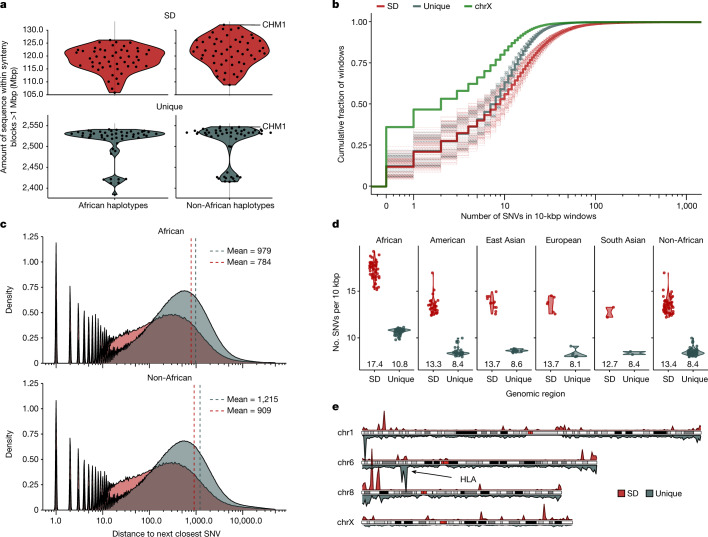
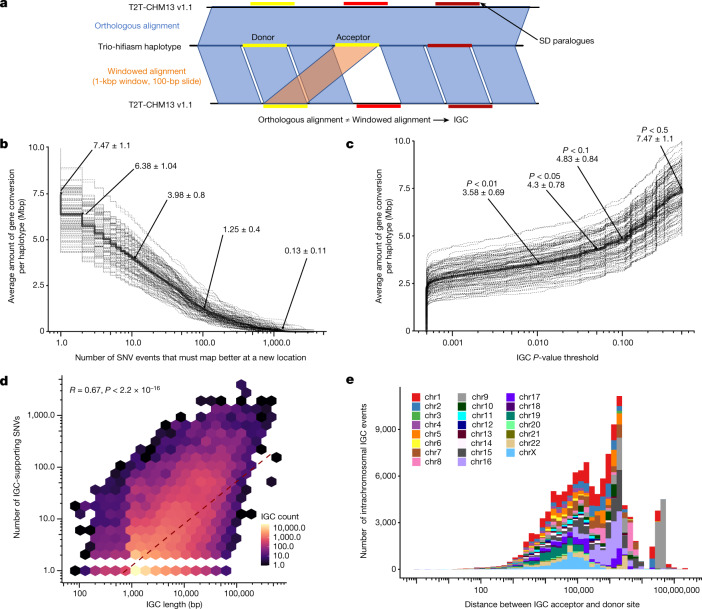
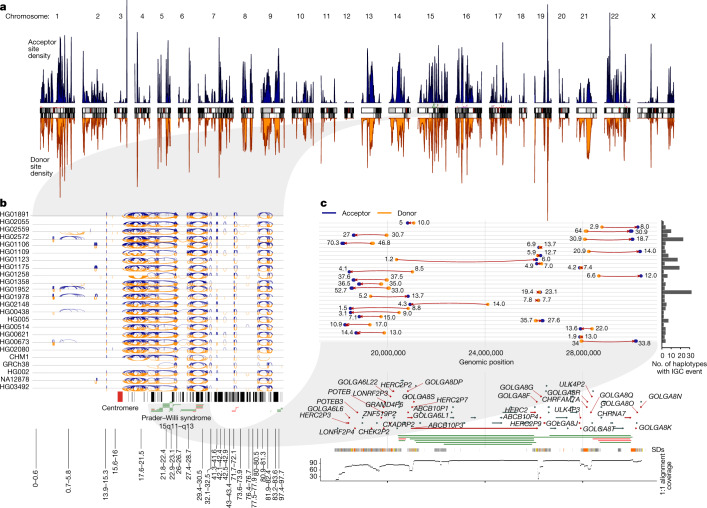
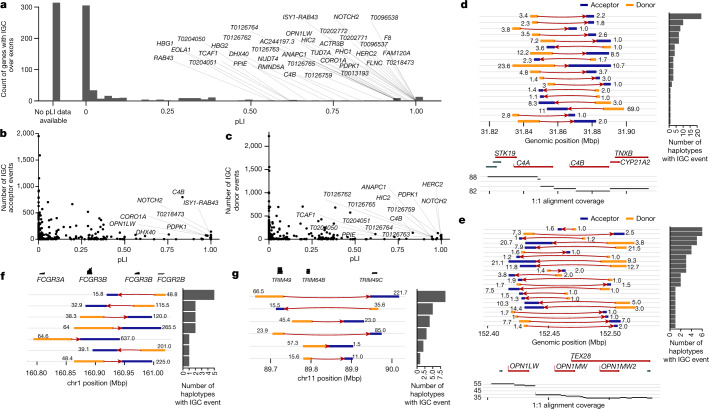
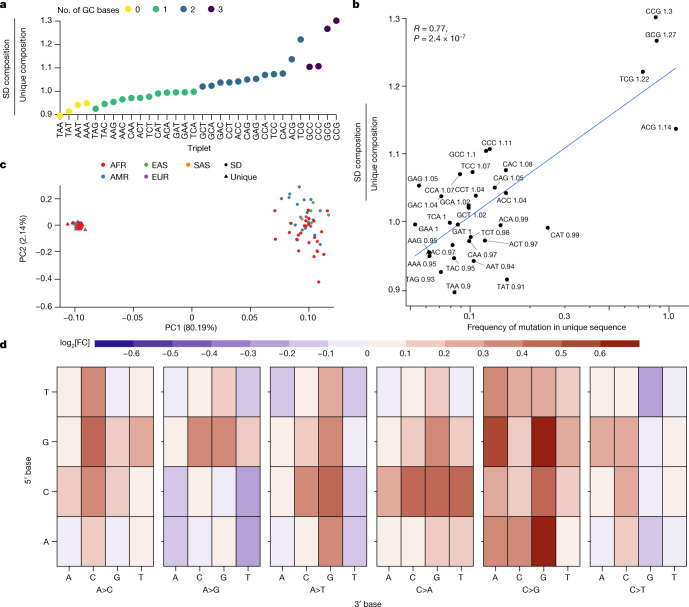
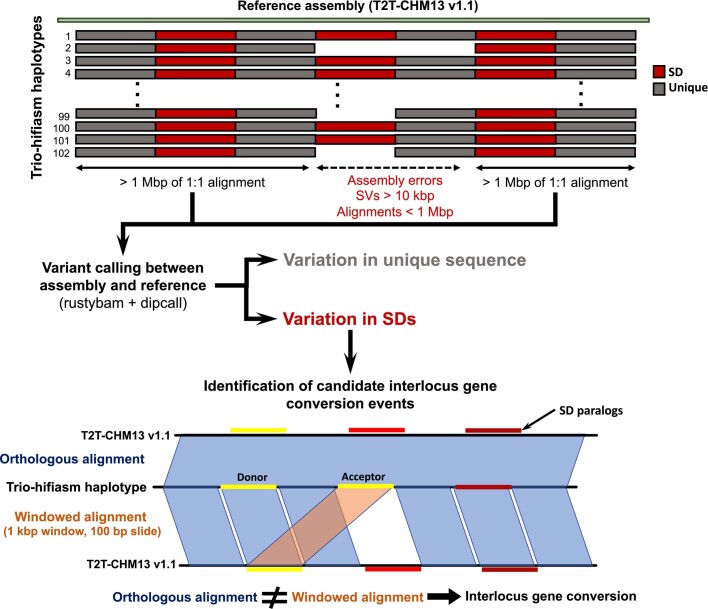
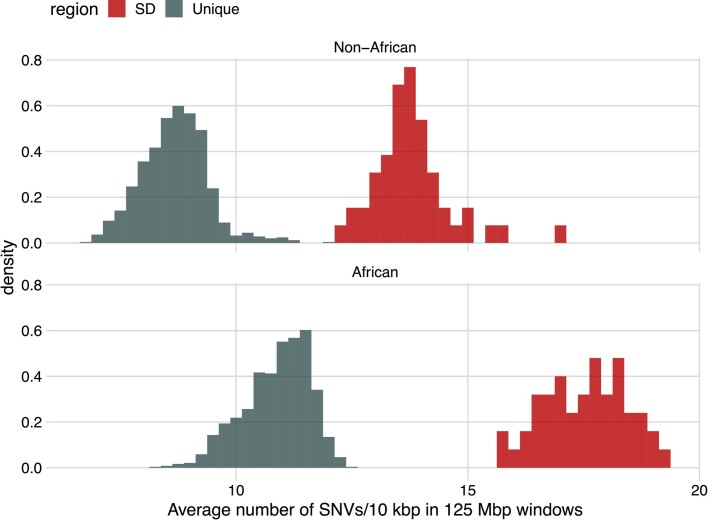
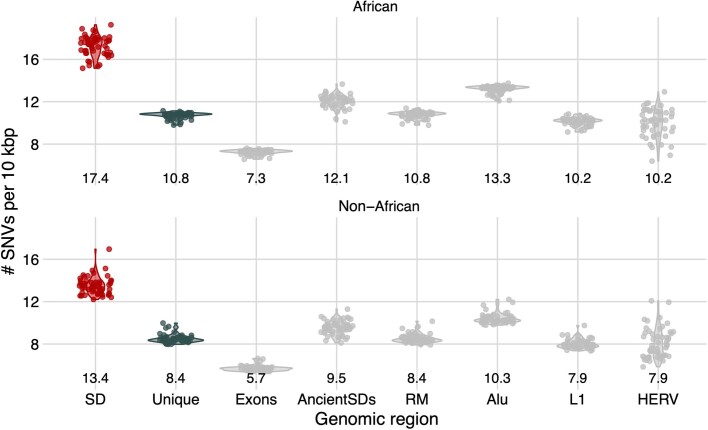
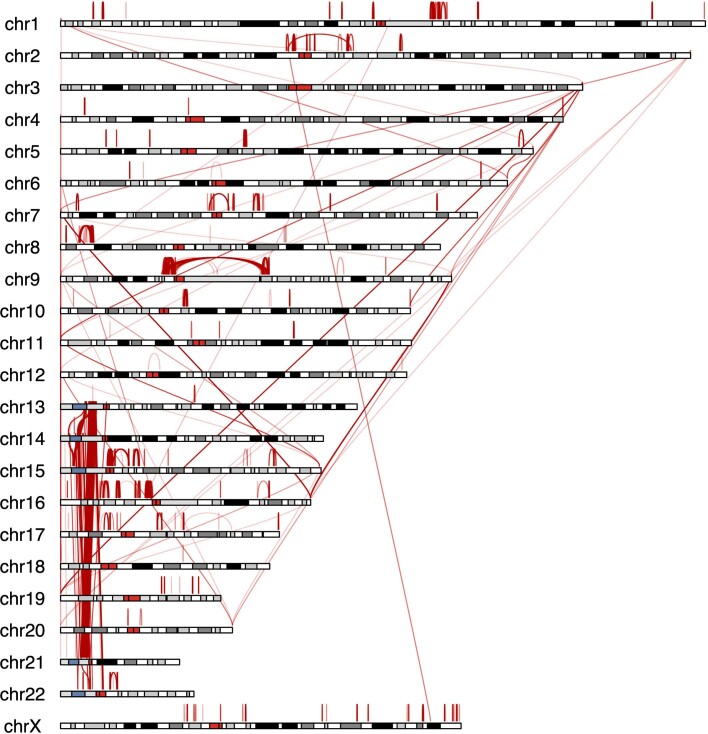
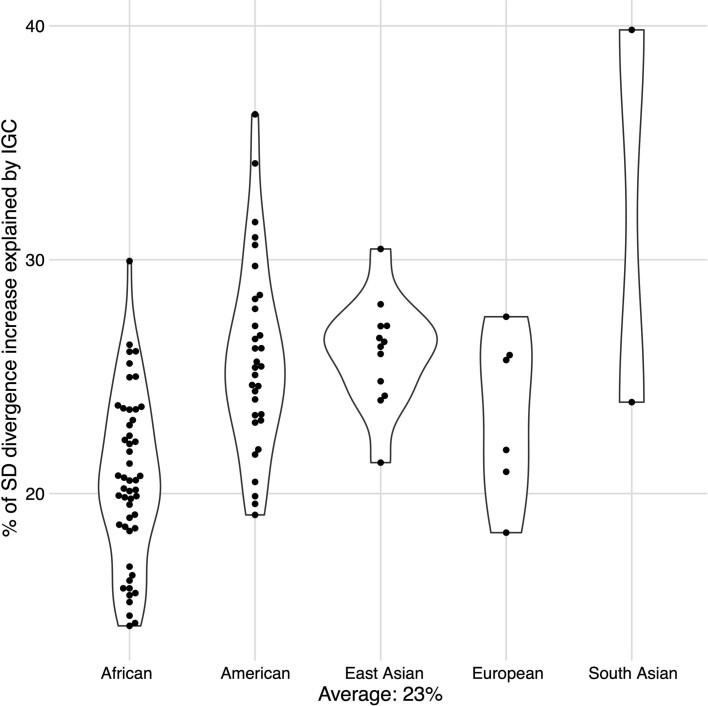
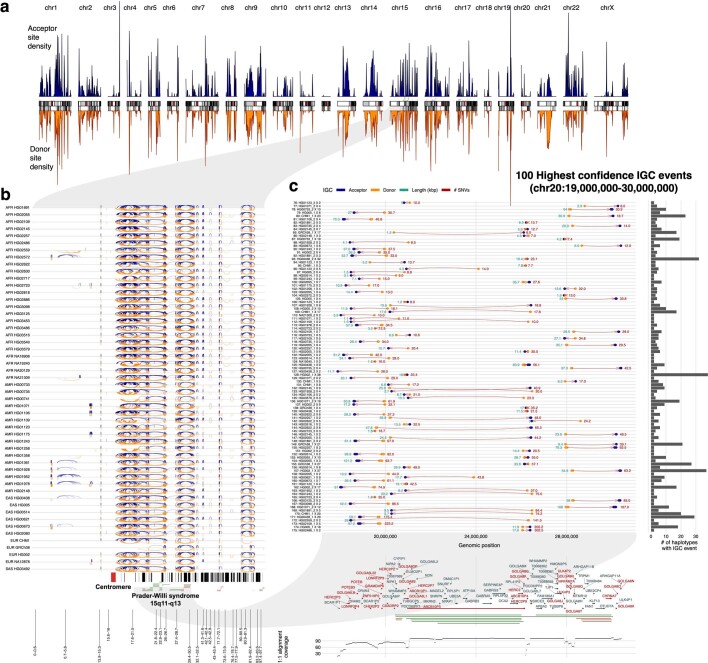
Single-nucleotide variants (SNVs) in segmental duplications (SDs) have not been systematically assessed because of the limitations of mapping short-read sequencing data 1,2 . Here we constructed 1:1 unambiguous alignments spanning high-identity SDs across 102 human haplotypes and compared the pattern of SNVs between unique and duplicated regions 3,4 . We find that human SNVs are elevated 60% in SDs compared to unique regions and estimate that at least 23% of this increase is due to interlocus gene conversion (IGC) with up to 4.3 megabase pairs of SD sequence converted on average per human haplotype. We develop a genome-wide map of IGC donors and acceptors, including 498 acceptor and 454 donor hotspots affecting the exons of about 800 protein-coding genes. These include 171 genes that have ‘relocated’ on average 1.61 megabase pairs in a subset of human haplotypes. Using a coalescent framework, we show that SD regions are slightly evolutionarily older when compared to unique sequences, probably owing to IGC. SNVs in SDs, however, show a distinct mutational spectrum: a 27.1% increase in transversions that convert cytosine to guanine or the reverse across all triplet contexts and a 7.6% reduction in the frequency of CpG-associated mutations when compared to unique DNA. We reason that these distinct mutational properties help to maintain an overall higher GC content of SD DNA compared to that of unique DNA, probably driven by GC-biased conversion between paralogous sequences 5,6 .
Overview
The claims and statistics of this paper haven’t been checked yet.
Run the check — free, no account needed. It reads the open-access text and checks the sources it cites.
Integrity signals
Registry
Cites
Statistics
Figures
Verification
Claims the paper makes
The claims and statistics of this paper haven’t been checked yet.
Run the check — free, no account needed. It reads the open-access text and checks the sources it cites.
Claims other papers make about this one
Each is checked against this paper’s own text: does it say what the citing paper says it does?
The cited source says what the claim attributes to it.
In the citing paper
“Moreover, for KCNE1, we provide calls and frequencies in a 40 kb region, spanning 3 exons, that could not be previously assessed owing to the presence of a false duplication in GRCh38 (Supplementary Fig. 19; see also an associated article53 for genome-wide analysis of interlocus gene conversion).”
From A draft human pangenome reference. (2023) · cites this paper as [53]
The cited source says what the claim attributes to it.
In the citing paper
“Although the focus of this effort was to build a reference resource, highly accurate haplotype-resolved assemblies enabled us to access previously inaccessible regions, highlighting new forms of genetic variation and providing new insights into mutational processes such as interlocus gene conversion53.”
From A draft human pangenome reference. (2023) · cites this paper as [53]
Self-check
Percentages, sums and reported differences re-computed from the paper’s own numbers.
The self-check needs the paper’s full text.
Citations
Cites
The Sequence Alignment/Map format and SAMtools
Li, H., Handsaker, B., Wysoker, A., Fennell, T., Ruan, J., Homer, N., Marth, G., Abecasis, G., Durbin, R., & 1000 Genome Project Data Processing Subgroup (2009) · Bioinformatics · doi:10.1093/bioinformatics/btp352 · Cited by 62,041
Self-citationInitial sequencing and analysis of the human genome
International Human Genome Sequencing Consortium, Whitehead Institute for Biomedical Research, C. F. G. R., Lander, E. S., Linton, L. M., Birren, B., Nusbaum, C., Zody, M. C., Baldwin, J., Devon, K., Dewar, K., et al. (2001) · Nature · doi:10.1038/35057062 · Cited by 24,216
Self-citationTwelve years of SAMtools and BCFtools
Danecek, P., Bonfield, J., Liddle, J., Marshall, J., Ohan, V., Pollard, M., Whitwham, A., Keane, T., McCarthy, S., Davies, R. M., et al. (2021) · GigaScience · doi:10.1093/gigascience/giab008 · Cited by 15,856
Self-citationMinimap2: Pairwise alignment for nucleotide sequences
Li, H. (2018) · Bioinformatics · doi:10.1093/bioinformatics/bty191 · Cited by 14,807
Self-citationThe sequence of the human genome
Venter, J. C., Adams, M. D., Myers, E. W., Li, P. W., Mural, R. J., Sutton, G. G., Smith, H. O., Yandell, M., Evans, C. A., Holt, R. A., et al. (2001) · Science · doi:10.1126/science.1058040 · Cited by 13,909
Analysis of protein-coding genetic variation in 60,706 humans
Exome Aggregation Consortium, Lek, M., Karczewski, K. J., Minikel, E. V., Samocha, K. E., Banks, E., Fennell, T., O’Donnell-Luria, A. H., Ware, J. S., Hill, A. J., et al. (2016) · Nature · doi:10.1038/nature19057 · Cited by 9,587
Tandem repeats finder: a program to analyze DNA sequences
Benson, G. (1999) · Nucleic Acids Research · doi:10.1093/nar/27.2.573 · Cited by 9,374 · cited 1×
“For both SDs and unique regions, variants in tandem repeat elements as identified by Tandem Repeats Finder 52 were excluded because many SNVs called in these regions are ultimately alignment artefacts.”
BackgroundAn integrated map of genetic variation from 1,092 human genomes
The 1000 Genomes Project Consortium (2012) · Nature · doi:10.1038/nature11632 · Cited by 7,711
Self-citationThe International HapMap Project
†The International HapMap Consortium, Genotyping centres: Baylor College of Medicine and ParAllele BioScience, Gibbs, R. A., Belmont, J. W., Hardenbol, P., Willis, T. D., Yu, F., Chinese HapMap Consortium, Yang, H., Ch'ang, L.-Y., et al. (2003) · Nature · doi:10.1038/nature02168 · Cited by 6,057
Haplotype-resolved de novo assembly using phased assembly graphs with hifiasm
Cheng, H., Concepcion, G. T., Feng, X., Zhang, H., & Li, H. (2021) · Nature Methods · doi:10.1038/s41592-020-01056-5 · Cited by 5,859
Self-citation
Research works printed but not linked: 1
- Sudmant, P. H. et al. Diversity of human copy number. Science 11184, 2–7 (2010).
Cited by
Sorted by citations
A draft human pangenome reference.
Liao, W.-W., Asri, M., Ebler, J., Doerr, D., Haukness, M., Hickey, G., Lu, S., Lucas, J. K., Monlong, J., Abel, H. J., et al. (2023) · Nature · doi:10.1038/s41586-023-05896-x · Cited by 1,129
Self-citationGarrison, E., Guarracino, A., Heumos, S., Villani, F., Bao, Z., Tattini, L., Hagmann, J., Vorbrugg, S., Marco-Sola, S., Kubica, C., et al. (2024) · Nature Methods · doi:10.1038/s41592-024-02430-3 · Cited by 277
Self-citationGenome assembly in the telomere-to-telomere era
Li, H., & Durbin, R. M. (2024) · Nature Reviews Genetics · doi:10.1038/s41576-024-00718-w · Cited by 259
“1a), a near-complete assembly can be produced with HiFi and ultra-long data; a small number of gaps may remain in the most challenging regions of the genome, such as ribosome DNA arrays 36,66,67 , satellite repeats 68 and recent long segmental duplications 69 .”
Self-citationLian, Q., Hüettel, B., Walkemeier, B., Mayjonade, B., Lopez‐Roques, C., Gil, L., Roux, F., Schneeberger, K., & Mercier, R. (2024) · Nature Genetics · doi:10.1038/s41588-024-01715-9 · Cited by 156
“…a single reference and have allowed researchers to determine the natural phenotypic variation of a species 15–18 , as recently shown in plant and animal species, including soybean 19 , tomato 20,21 , potato 22 , rice 23–25 , maize 26 , barley 27 , wheat 28 , apple 29 , silkworm 12 and human 30,31 .”
Human de novo mutation rates from a four-generation pedigree reference
Porubskỳ, D., Dashnow, H., Sasani, T. A., Logsdon, G. A., Hallast, P., Noyes, M. D., Kronenberg, Z. N., Mokveld, T., Koundinya, N., Nolan, C., et al. (2025) · Nature · doi:10.1038/s41586-025-08922-2 · Cited by 118
“Further details are provided in Supplementary Note 10.”
InfluentialSelf-citation
Metadata
- Authors
- Vollger, M. R., Dishuck, P. C., Harvey, W. T., DeWitt, W. S., Guitart, X., Goldberg, M. E., Rozanski, A. N., Lucas, J., Asri, M., Human Pangenome Reference Consortium, Abel, H. J., Antonacci-Fulton, L. L., Baid, G., Baker, C. A., Belyaeva, A., Billis, K., Bourque, G., Buonaiuto, S., Carroll, A., Chaisson, M. J. P., Chang, P.-C., Chang, X. H., Cheng, H., Chu, J., Cody, S., Colonna, V., Cook, D. E., Cook-Deegan, R. M., Cornejo, O. E., Diekhans, M., Doerr, D., Ebert, P., Ebler, J., Eizenga, J. M., Fairley, S., Fedrigo, O., Felsenfeld, A. L., Feng, X., Fischer, C., Flicek, P., Formenti, G., Frankish, A., Fulton, R. S., Gao, Y., Garg, S., Garrison, E., Garrison, N. A., Giron, C. G., Green, R. E., Groza, C., Guarracino, A., Haggerty, L., Hall, I. M., Haukness, M., Haussler, D., Heumos, S., Hickey, G., Hourlier, T., Howe, K., Jain, M., Jarvis, E. D., Ji, H. P., Kenny, E. E., Koenig, B. A., Kolesnikov, A., Korbel, J. O., Kordosky, J., Koren, S., Lee, H., Li, H., Liao, W.-W., Lu, S., Lu, T.-Y., Lucas, J. K., Magalhães, H., Marco-Sola, S., Marijon, P., Markello, C., Marschall, T., Martin, F. J., McCartney, A., McDaniel, J., Miga, K. H., Mitchell, M. W., Monlong, J., Mountcastle, J., Mwaniki, M. N., Nattestad, M., Novak, A. M., Nurk, S., Olsen, H. E., Olson, N. D., Paten, B., Pesout, T., Phillippy, A. M., Popejoy, A. B., Prins, P., Puiu, D., Rautiainen, M., Regier, A. A., Rhie, A., Sacco, S., Sanders, A. D., Schneider, V. A., Schultz, B. I., Shafin, K., Sibbesen, J. A., Sirén, J., Smith, M. W., Sofia, H. J., Abou Tayoun, A. N., Thibaud-Nissen, F., Tomlinson, C., Tricomi, F. F., Villani, F., Vollger, M. R., Wagner, J., Walenz, B., Wang, T., Wood, J. M. D., Zimin, A. V., Zook, J. M., Munson, K. M., Lewis, A. P., Hoekzema, K., Logsdon, G. A., Porubsky, D., Paten, B., Harris, K., Hsieh, P., & Eichler, E. E.
- Affiliations
- University of Washington (US)
- University of California, Santa Cruz (US)
- Washington University in St. Louis (US)
- Google (United States) (US)
- European Bioinformatics Institute (GB)
- Kyoto University (JP)
- Institute of Genetics and Biophysics (IT)
- University of Southern California (US)
- Harvard University (US)
- Dana-Farber Cancer Institute (US)
- University of Tennessee Health Science Center (US)
- Washington Center (US)
- Heinrich Heine University Düsseldorf (DE)
- Rockefeller University (US)
- National Institutes of Health (US)
- Children's Hospital of Philadelphia (US)
- Novo Nordisk Foundation (DK)
- University of California, Los Angeles (US)
- McGill University (CA)
- Yale University (US)
- Howard Hughes Medical Institute (US)
- Quantitative Biology Center (DE)
- Wellcome Sanger Institute (GB)
- Northeastern University (US)
- Stanford Medicine (US)
- Icahn School of Medicine at Mount Sinai (US)
- University of California, San Francisco (US)
- National Institute of Standards and Technology (US)
- Coriell Institute For Medical Research (US)
- University of Pisa (IT)
- University of California, Davis (US)
- Johns Hopkins University (US)
- Max Delbrück Center (DE)
- University of Copenhagen (DK)
- Corresponding author
- Eichler, Evan E.
- ORCID
- Dishuck, Philip C.
- Harvey, William T.
- DeWitt, William S.
- Guitart, Xavi
- Goldberg, Michael E.
- Rozanski, Allison N.
- Asri, Mobin
- Abel, Haley J.
- Baid, Gunjan
- Belyaeva, Anastasiya
- Billis, Konstantinos
- Bourque, Guillaume
- Buonaiuto, Silvia
- Carroll, Andrew
- Chaisson, Mark J. P.
- Chang, Pi-Chuan
- Chang, Xian H.
- Cheng, Haoyu
- Chu, Justin
- Colonna, Vincenza
- Cook, Daniel E.
- Cook-Deegan, Robert M.
- Cornejo, Omar E.
- Diekhans, Mark
- Doerr, Daniel
- Ebert, Peter
- Ebler, Jana
- Eizenga, Jordan M.
- Fairley, Susan
- Fedrigo, Olivier
- Feng, Xiaowen
- Fischer, Christian
- Flicek, Paul
- Formenti, Giulio
- Frankish, Adam
- Fulton, Robert S.
- Gao, Yan
- Garg, Shilpa
- Garrison, Erik
- Garrison, Nanibaa’ A.
- Green, Richard E.
- Groza, Cristian
- Guarracino, Andrea
- Haggerty, Leanne
- Hall, Ira M.
- Haukness, Marina
- Haussler, David
- Heumos, Simon
- Hickey, Glenn
- Hourlier, Thibaut
- Howe, Kerstin
- Jain, Miten
- Jarvis, Erich D.
- Ji, Hanlee P.
- Kenny, Eimear E.
- Koenig, Barbara A.
- Kolesnikov, Alexey
- Korbel, Jan O.
- Koren, Sergey
- Lee, HoJoon
- Li, Heng
- Liao, Wen-Wei
- Lu, Shuangjia
- Lu, Tsung-Yu
- Magalhães, Hugo
- Marijon, Pierre
- Markello, Charles
- Marschall, Tobias
- Martin, Fergal J.
- McDaniel, Jennifer
- Miga, Karen H.
- Mitchell, Matthew W.
- Monlong, Jean
- Mountcastle, Jacquelyn
- Mwaniki, Moses Njagi
- Nattestad, Maria
- Novak, Adam M.
- Nurk, Sergey
- Olsen, Hugh E.
- Olson, Nathan D.
- Pesout, Trevor
- Phillippy, Adam M.
- Popejoy, Alice B.
- Prins, Pjotr
- Puiu, Daniela
- Rautiainen, Mikko
- Regier, Allison A.
- Rhie, Arang
- Sacco, Samuel
- Sanders, Ashley D.
- Shafin, Kishwar
- Sibbesen, Jonas A.
- Sirén, Jouni
- Smith, Michael W.
- Sofia, Heidi J.
- Tomlinson, Chad
- Tricomi, Francesca Floriana
- Villani, Flavia
- Wagner, Justin
- Walenz, Brian
- Wang, Ting
- Wood, Jonathan M. D.
- Zimin, Aleksey V.
- Zook, Justin M.
- Munson, Katherine M.
- Lewis, Alexandra P.
- Hoekzema, Kendra
- Logsdon, Glennis A.
- Porubsky, David
- Harris, Kelley
- Hsieh, PingHsun
- Eichler, Evan E.
- Venue
- Nature
- Published
- 2023-05-10
- Volume
- 617
- Issue
- 7960
- Pages
- 325-334
- ISSN
- 0028-0836 (ISSN-L)
- 1476-4687
- PMC
- PMC10172114
- OpenAlex
- W4376133061
- Cited by
- 104
- References
- 76
- Citations by year
- 2026: 29 · 2025: 26 · 2024: 35 · 2023: 14
- FWCI
- 17.07
- Type
- journal article
- Language
- en
- Open access
- hybrid
- doi.org
- Locations
- Nature (publishedVersion, cc-by)
- PubMed Central (publishedVersion, cc-by)
- PubMed (publishedVersion)
- MDC Repository (Max-Delbrueck-Center for Molecular Medicine) (acceptedVersion)
- RePEc: Research Papers in Economics (submittedVersion)
- eScholarship (California Digital Library) (submittedVersion, cc-by)
- Technical University of Denmark, DTU Orbit (Technical University of Denmark, DTU) (submittedVersion, cc-by)
- UPCommons institutional repository (Universitat Politècnica de Catalunya) (submittedVersion, cc-by-nc-nd)
- Funders
- Howard Hughes Medical Institute
- James S. McDonnell Foundation
- National Institutes of Health (5r00hg011041-04)
- National Human Genome Research Institute (R01HG010485, U01HG010973, U01HG010971, R00 HG011041, K99HG011041, R01HG002385, U24HG007234, U24HG010262)
- National Institute of General Medical Sciences (R35GM133428, T32GM007454)
- National Institute of Allergy and Infectious Diseases (F31AI150163)
- Topics
- Life Sciences › Biochemistry, Genetics and Molecular Biology › Genetics › Genomic variations and chromosomal abnormalities
- Life Sciences › Biochemistry, Genetics and Molecular Biology › Genetics › Chromosomal and Genetic Variations
- Life Sciences › Biochemistry, Genetics and Molecular Biology › Genetics › Genome Rearrangement Algorithms
- Keywords
- segmental duplication, single nucleotide variants, mutation spectrum, transversions, GC content, paralogs, coalescent analysis, genome rearrangement
- MeSH terms
- Cytosine, Exons, Gene Conversion, Guanine, Haplotypes, Humans, Mutation, Genome, Human, CpG Islands, Polymorphism, Single Nucleotide, Segmental Duplications, Genomic
About these checks
Registry, retraction, Cites and statistics results are computed, not judged, with one exception: a printed reference that no index lists is read once by a model before it counts as a citation error. Claims are extracted by a model and kept only when their quote appears verbatim in the text; each cited source is then checked, with a model’s help, for whether it says what the claim relies on. Those verdicts can be wrong — read the claim’s quote and the cited source before relying on one.
Statistics and arithmetic are recomputed, not judged.
Confidence bands are shown only for fields calibrated on our annotated test set. None is calibrated yet, so no band is shown.
What counts as a claim ›How we measure confidence ›How we check this ›
Are you an author, or do you see a problem with this page? Request a review
