

Non-Abelian braiding of graph vertices in a superconducting processor
Open accessThe DOI matches its Crossref record; 46 of the 47 references it cites were found in a registry or an index.
Abstract
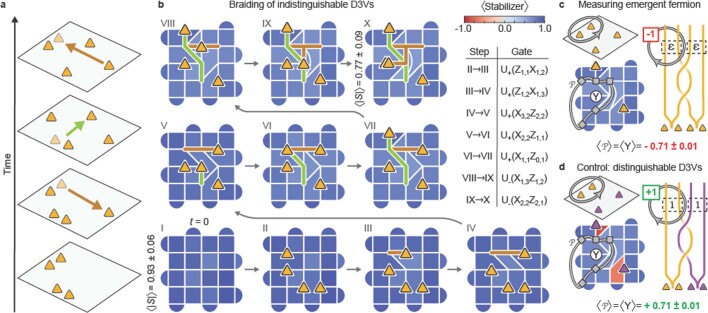
Indistinguishability of particles is a fundamental principle of quantum mechanics 1 . For all elementary and quasiparticles observed to date—including fermions, bosons and Abelian anyons—this principle guarantees that the braiding of identical particles leaves the system unchanged 2,3 . However, in two spatial dimensions, an intriguing possibility exists: braiding of non-Abelian anyons causes rotations in a space of topologically degenerate wavefunctions 4–8 . Hence, it can change the observables of the system without violating the principle of indistinguishability. Despite the well-developed mathematical description of non-Abelian anyons and numerous theoretical proposals 9–22 , the experimental observation of their exchange statistics has remained elusive for decades. Controllable many-body quantum states generated on quantum processors offer another path for exploring these fundamental phenomena. Whereas efforts on conventional solid-state platforms typically involve Hamiltonian dynamics of quasiparticles, superconducting quantum processors allow for directly manipulating the many-body wavefunction by means of unitary gates. Building on predictions that stabilizer codes can host projective non-Abelian Ising anyons 9,10 , we implement a generalized stabilizer code and unitary protocol 23 to create and braid them. This allows us to experimentally verify the fusion rules of the anyons and braid them to realize their statistics. We then study the prospect of using the anyons for quantum computation and use braiding to create an entangled state of anyons encoding three logical qubits. Our work provides new insights about non-Abelian braiding and, through the future inclusion of error correction to achieve topological protection, could open a path towards fault-tolerant quantum computing.
Overview
The claims and statistics of this paper haven’t been checked yet.
Free: it reads the open-access text and checks the first 5 claims that cite a source we can check. Create a free account to check every claim.
Integrity signals
Registry
Cites
Statistics
Figures
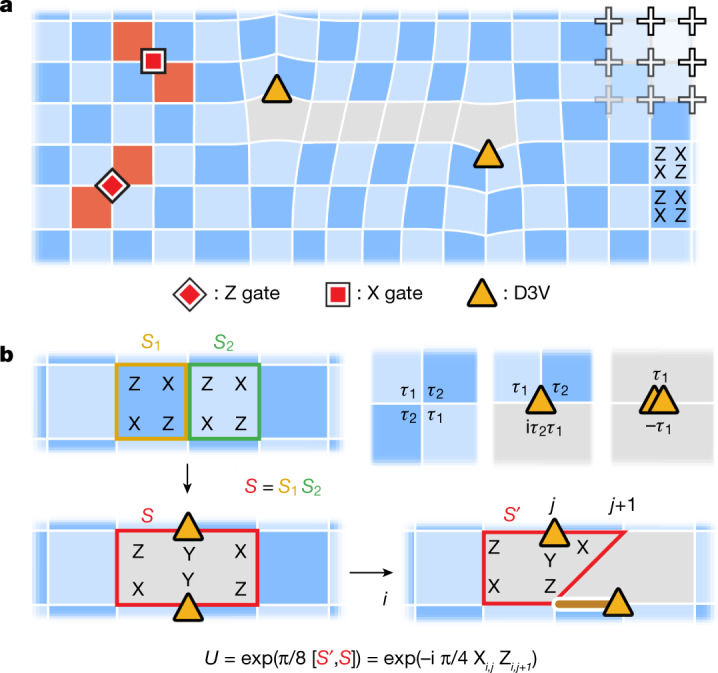
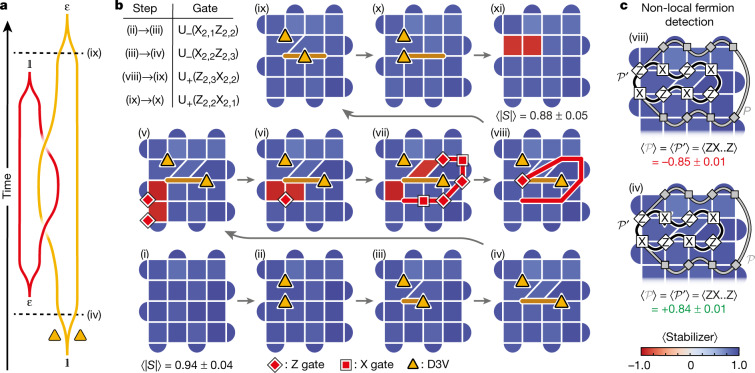
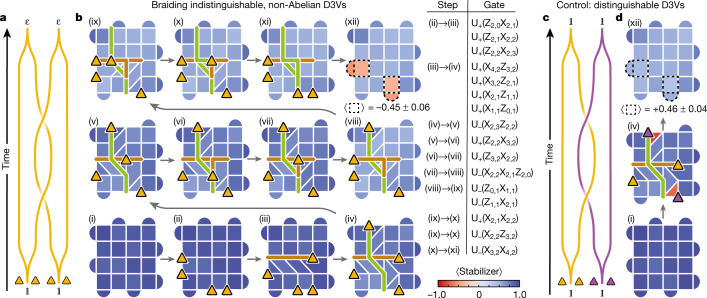
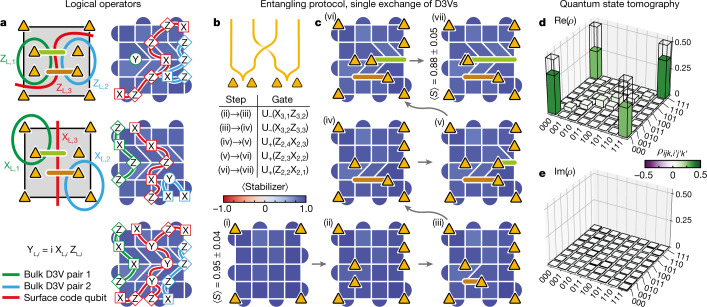
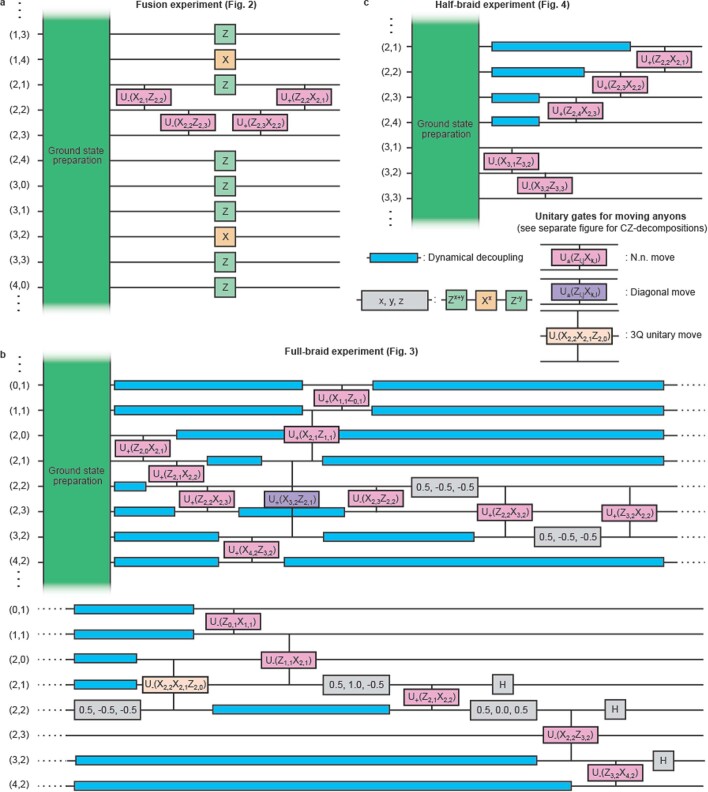
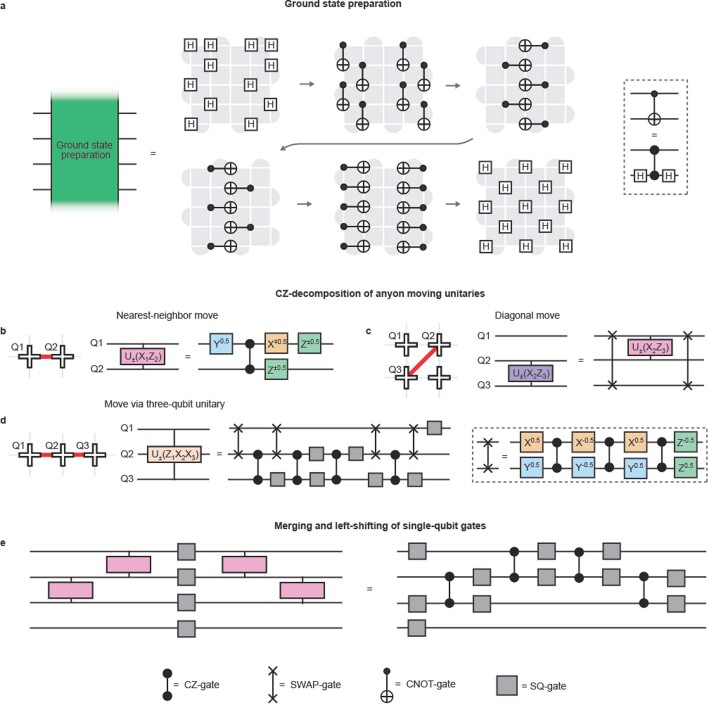
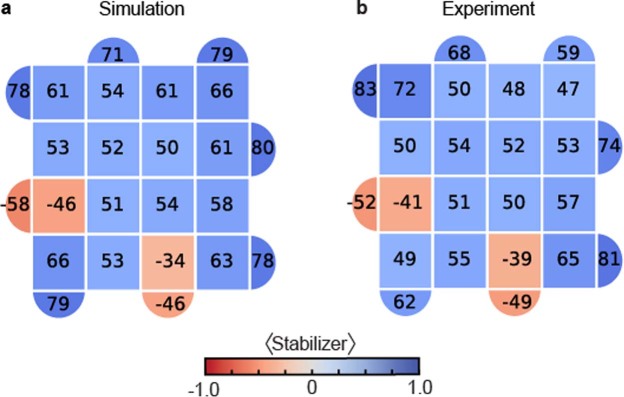
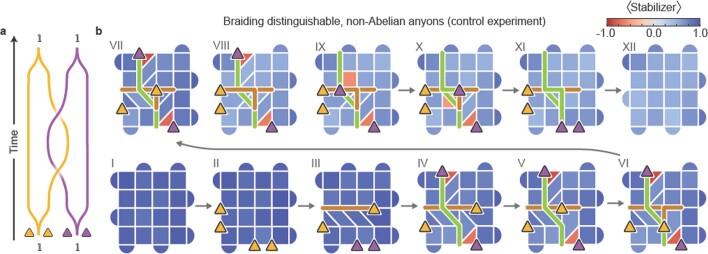
Verification
Claims the paper makes
The claims and statistics of this paper haven’t been checked yet.
Free: it reads the open-access text and checks the first 5 claims that cite a source we can check. Create a free account to check every claim.
Claims other papers make about this one
Each is checked against this paper’s own text: does it say what the citing paper says it does?
The cited source says what the claim attributes to it.
In the citing paper
“Recent experiments have achieved milestone demonstrations of two logical qubits and one entangling gate5,6 and explorations of new encodings25–28.”
From Logical quantum processor based on reconfigurable atom arrays (2024) · cites this paper as [28]
Self-check
Percentages, sums and reported differences re-computed from the paper’s own numbers.
The self-check needs the paper’s full text.
Citations
Cites
Quantum supremacy using a programmable superconducting processor
Arute, F., Arya, K., Babbush, R., Bacon, D., Bardin, J. C., Barends, R., Biswas, R., Boixo, S., Brandao, F. G. S. L., Buell, D. A., et al. (2019) · Nature · doi:10.1038/s41586-019-1666-5 · Cited by 7,720
Self-citationFault-tolerant quantum computation by anyons
Kitaev, A. Y. (2003) · Annals of Physics · doi:10.1016/s0003-4916(02)00018-0 · Cited by 7,238
Self-citationNon-Abelian anyons and topological quantum computation
Nayak, C., Simon, S. H., Stern, A., Freedman, M., & Das Sarma, S. (2008) · Reviews of Modern Physics · doi:10.1103/revmodphys.80.1083 · Cited by 6,861
Anyons in an exactly solved model and beyond
Kitaev, A. (2006) · Annals of Physics · doi:10.1016/j.aop.2005.10.005 · Cited by 5,245
Self-citationSignatures of Majorana Fermions in Hybrid Superconductor-Semiconductor Nanowire Devices
Mourik, V., Zuo, K., Frolov, S. M., Plissard, S. R., Bakkers, E. P. A. M., & Kouwenhoven, L. P. (2012) · Science · doi:10.1126/science.1222360 · Cited by 4,163
Read, N., & Green, D. (2000) · Physical Review B · doi:10.1103/physrevb.61.10267 · Cited by 3,476
Lutchyn, R. M., Sau, J. D., & Das Sarma, S. (2010) · Physical Review Letters · doi:10.1103/physrevlett.105.077001 · Cited by 3,435
Helical Liquids and Majorana Bound States in Quantum Wires
Oreg, Y., Refael, G., & von Oppen, F. (2010) · Physical Review Letters · doi:10.1103/physrevlett.105.177002 · Cited by 3,167
Nonabelions in the fractional quantum hall effect
Moore, G., & Read, N. (1991) · Nuclear Physics B · doi:10.1016/0550-3213(91)90407-o · Cited by 2,968
Observation of Majorana fermions in ferromagnetic atomic chains on a superconductor
Nadj-Perge, S., Drozdov, I. K., Li, J., Chen, H., Jeon, S., Seo, J., MacDonald, A. H., Bernevig, B. A., & Yazdani, A. (2014) · Science · doi:10.1126/science.1259327 · Cited by 2,023
Self-citation
Research works printed but not linked: 3
- Sakurai, J. J. Modern Quantum Mechanics (Addison-Wesley, 1993).
- Barkeshli M Qi X-L Topological nematic states and non-Abelian lattice dislocations Phys. Rev. X 2012 2 031013
- Brown BJ Laubscher K Kesselring MS Wootton JR Poking holes and cutting corners to achieve clifford gates with the surface code Phys. Rev. X 2017 7 021029
Cited by
Items 201–224 of 224
Ferry, D. K. (2024) · Synthesis lectures on engineering, science, and technology · doi:10.1007/978-3-031-62925-9_7
Andersen, T. I., & Mi, X. (2024) · Nature Physics · doi:10.1038/s41567-024-02578-x
Self-citationNon-Abelian braiding in three-fold degenerate subspace and the acceleration
Liu, H., Huang, J., Han, Z.-W., Liang, J., Chen, Z., Fu, Z.-X., He, Z.-R., Ming, Y., Lv, Q.-X., & Du, Y.-X. (2024) · Journal of the Optical Society of America B · doi:10.1364/josab.533864
Self-citationNon-Measurability TheoryPreprint
Li, Z. (2024) · SSRN Electronic Journal · doi:10.2139/ssrn.5000893
Observation of the Exceptional Skin Effect on a Non-Hermitian Flat bandPreprint
Wang, D., Zhang, R.-Y., Lee, C., Ding, K., & Ma, G. (2024) · arXiv (Cornell University) · doi:10.48550/arxiv.2412.19034
“…on certain sites, forming compact localized states with highly degenerate energy levels 8,13,14 , thus creates high-dimensional Hilbert subspace which is the physical basis for novel phenomena including topological braidings 16–18 , thouless pumping 19,20 , non-Abelian dynamics 21–23 , etc.”
Physicists describe exotic ‘paraparticles’ that defy categorization
Castelvecchi, D. (2025) · Nature · doi:10.1038/d41586-025-00030-5
Non-Measurability TheoryPreprint
Li, Z. (2025) · Preprints.org · doi:10.20944/preprints202505.1720.v2
Compact localized fermions and Ising anyons in a chiral spin liquid
Bauer, T., & Reuther, J. (2026) · Physical review. B./Physical review. B · doi:10.1103/dgyy-rbcn
“These braiding experiments were based on the stabilization of toric-code or string-net states in superconducting [6–8] or trapped-ion [9, 10] quantum processors comprising between 20 and 70 qubits or qudits.”
Enconding qubits in valleytronic states in chiral lattices
Yuan, J., Deng, J., & Wang, D. (2025) · AVS Quantum Science · doi:10.1116/5.0304854
Dynamics and phases of matter in open quantum many-body systems
Sang, S. (2024) · UWSpace (University of Waterloo)
Tarkkojen alkeisoperaatioiden implementointi suprajohtavissa kvanttitietokoneissa
Hyyppä, E. (2024) · Aaltodoc (Aalto University)
Sun, B.-Y., Bermond, B., Gavensky, L. P., Bukov, M., Zhou, Z.-W., & Goldman, N. (2026) · Physical Review Research · doi:10.1103/wbvr-9z8t
High spin correlations in topological and rainbow lattices
Byles, L. S. (2025) · White Rose eTheses Online (University of Leeds, The University of Sheffield, University of York)
Signature of paraparticles: a minimal GedankenexperimentPreprint
Toppan, F. (2026) · arXiv (Cornell University) · doi:10.48550/arxiv.2604.22178
“Significant experimental steps are presented in [30] (the first experimental evidence of anyons), [31] (the first detection of non-abelian anyons transforming under higher dimensional representations of the braid group) and [32] (the first experimental evidence of one-dimensional anyons).”
Ayeni, B. M. (2026) · arXiv (Cornell University) · doi:10.48550/arxiv.2605.25913
“For topological and projector-dominated problems hosted on qubit-based processors [13, 21–23], the key question is not only whether a native observable basis is physically natural, but whether it remains advantageous after compilation to the host hardware.”
InfluentialNon-Abelian braiding of multiple high-order photonic modes in silicon waveguides
TIAN, Y., Shan, Z., & Zhang, X. (2026) · Optics Letters · doi:10.1364/ol.603157
Reconstructing non-Abelian braiding and fusion without anyon transportPreprint
Byles, L., Horner, M. D., Varcoe, B. T. H., & Pachos, J. K. (2026) · arXiv (Cornell University) · doi:10.48550/arxiv.2608.04103
“Recent experiments on programmable quantum processors and photonic platforms have begun to access non-Abelian anyonic physics in controlled settings [20–23].”
Valenzuela, M. (2026) · arXiv (Cornell University) · doi:10.48550/arxiv.2608.29931
Variational preparation and characterization of chiral spin liquids in quantum circuits
Zhang, Z.-Y., Kim, D.-H., & Chen, J.-Y. (2026) · Physical review. B./Physical review. B · doi:10.1103/s2ds-5n5k
“Among them, topological phases with long-range entanglement are particularly in-triguing, for which digital quantum devices provide a versatile platform to create, braid and fuse their anyonic excitations [9– 11].”
Reconstructing non-Abelian braiding and fusion without anyon transportPreprint
Pachos, J. K., Byles, L., Horner, M. D., & Varcoe, B. T. H. (2026) · Research Square · doi:10.21203/rs.3.rs-10607154/v1
Scalable Simulation of Quantum Dynamics on Topological Quantum HardwarePreprint
Polley, K., & Tuckerman, M. E. (2026) · arXiv (Cornell University) · doi:10.48550/arxiv.2609.19484
“26 Recently, Microsoft reported progress towards a Majorana zero mode based quantum processor, although the topological nature of the reported devices remains under active scientific debate.”
Rewire and reset are all you need: Minimal resources for manipulating non-AbelionsPreprint
Lo, C. F. B., Sajith, R., Lyons, A., Vishwanath, A., & Verresen, R. (2026) · arXiv (Cornell University) · doi:10.48550/arxiv.2610.06845
Structural Conditions for Distributed Quantum AdvantagePreprint
Drăgoi, S., Garces, M. G., & Pira, L. (2026) · arXiv (Cornell University) · doi:10.48550/arxiv.2610.04393
“8b (b) Extensive seam [38, 42, 72] (2 , ≤ 6) –”
The Compendium of Super-Quadratic Computational Quantum AdvantagesPreprint
Kammerlander, P., O’Brien, T. E., King, R., Somma, R. D., Kieferová, M., Lackey, B., Schmidhuber, A., Jain, S., Gu, A., Alexeev, Y., et al. (2026) · arXiv (Cornell University) · doi:10.48550/arxiv.2610.32595 · Cited by 1
Self-citation
Metadata
- Authors
- Collaborators, G. Q. A. A., Andersen, T. I., Lensky, Y. D., Kechedzhi, K., Drozdov, I. K., Bengtsson, A., Hong, S., Morvan, A., Mi, X., Opremcak, A., Acharya, R., Allen, R., Ansmann, M., Arute, F., Arya, K., Asfaw, A., Atalaya, J., Babbush, R., Bacon, D., Bardin, J. C., Bortoli, G., Bourassa, A., Bovaird, J., Brill, L., Broughton, M., Buckley, B. B., Buell, D. A., Burger, T., Burkett, B., Bushnell, N., Chen, Z., Chiaro, B., Chik, D., Chou, C., Cogan, J., Collins, R., Conner, P., Courtney, W., Crook, A. L., Curtin, B., Debroy, D. M., Del Toro Barba, A., Demura, S., Dunsworth, A., Eppens, D., Erickson, C., Faoro, L., Farhi, E., Fatemi, R., Ferreira, V. S., Burgos, L. F., Forati, E., Fowler, A. G., Foxen, B., Giang, W., Gidney, C., Gilboa, D., Giustina, M., Gosula, R., Dau, A. G., Gross, J. A., Habegger, S., Hamilton, M. C., Hansen, M., Harrigan, M. P., Harrington, S. D., Heu, P., Hilton, J., Hoffmann, M. R., Huang, T., Huff, A., Huggins, W. J., Ioffe, L. B., Isakov, S. V., Iveland, J., Jeffrey, E., Jiang, Z., Jones, C., Juhas, P., Kafri, D., Khattar, T., Khezri, M., Kieferová, M., Kim, S., Kitaev, A., Klimov, P. V., Klots, A. R., Korotkov, A. N., Kostritsa, F., Kreikebaum, J. M., Landhuis, D., Laptev, P., Lau, K.-M., Laws, L., Lee, J., Lee, K. W., Lester, B. J., Lill, A. T., Liu, W., Locharla, A., Lucero, E., Malone, F. D., Martin, O., McClean, J. R., McCourt, T., McEwen, M., Miao, K. C., Mieszala, A., Mohseni, M., Montazeri, S., Mount, E., Movassagh, R., Mruczkiewicz, W., Naaman, O., Neeley, M., Neill, C., Nersisyan, A., Newman, M., Ng, J. H., Nguyen, A., Nguyen, M., Niu, M. Y., O’Brien, T. E., Omonije, S., Petukhov, A., Potter, R., Pryadko, L. P., Quintana, C., Rocque, C., Rubin, N. C., Saei, N., Sank, D., Sankaragomathi, K., Satzinger, K. J., Schurkus, H. F., Schuster, C., Shearn, M. J., Shorter, A., Shutty, N., Shvarts, V., Skruzny, J., Smith, W. C., Somma, R., Sterling, G., Strain, D., Szalay, M., Torres, A., Vidal, G., Villalonga, B., Heidweiller, C. V., White, T., Woo, B. W. K., Xing, C., Yao, Z. J., Yeh, P., Yoo, J., Young, G., Zalcman, A., Zhang, Y., Zhu, N., Zobrist, N., Neven, H., Boixo, S., Megrant, A., Kelly, J., Chen, Y., Smelyanskiy, V., Kim, E.-A., Aleiner, I., & Roushan, P.
- Affiliations
- Google (United States) (US)
- University of Technology Sydney (AU)
- University of California, Riverside (US)
- Corresponding author
- Kim, E.-A.
- Roushan, P.
- ORCID
- Andersen, T. I.
- Lensky, Y. D.
- Kechedzhi, K.
- Drozdov, I. K.
- Bengtsson, A.
- Hong, S.
- Morvan, A.
- Mi, X.
- Acharya, R.
- Allen, R.
- Ansmann, M.
- Arute, F.
- Arya, K.
- Asfaw, A.
- Atalaya, J.
- Babbush, R.
- Bacon, D.
- Bardin, J. C.
- Bortoli, G.
- Bourassa, A.
- Bovaird, J.
- Broughton, M.
- Buckley, B. B.
- Burkett, B.
- Bushnell, N.
- Cogan, J.
- Collins, R.
- Crook, A. L.
- Curtin, B.
- Del Toro Barba, A.
- Demura, S.
- Dunsworth, A.
- Eppens, D.
- Erickson, C.
- Farhi, E.
- Fatemi, R.
- Forati, E.
- Fowler, A. G.
- Foxen, B.
- Giustina, M.
- Gosula, R.
- Dau, A. G.
- Gross, J. A.
- Habegger, S.
- Harrigan, M. P.
- Harrington, S. D.
- Hoffmann, M. R.
- Huang, T.
- Huggins, W. J.
- Ioffe, L. B.
- Iveland, J.
- Jeffrey, E.
- Jiang, Z.
- Juhas, P.
- Kafri, D.
- Khattar, T.
- Khezri, M.
- Kieferová, M.
- Kim, S.
- Kitaev, A.
- Klimov, P. V.
- Kreikebaum, J. M.
- Landhuis, D.
- Lee, J.
- Lee, K. W.
- Lester, B. J.
- Lill, A. T.
- Liu, W.
- Locharla, A.
- Lucero, E.
- Martin, O.
- McClean, J. R.
- McCourt, T.
- McEwen, M.
- Miao, K. C.
- Mohseni, M.
- Montazeri, S.
- Movassagh, R.
- Mruczkiewicz, W.
- Naaman, O.
- Neeley, M.
- Neill, C.
- Newman, M.
- Ng, J. H.
- Niu, M. Y.
- O’Brien, T. E.
- Potter, R.
- Pryadko, L. P.
- Quintana, C.
- Rubin, N. C.
- Sank, D.
- Sankaragomathi, K.
- Satzinger, K. J.
- Schurkus, H. F.
- Shearn, M. J.
- Shutty, N.
- Smith, W. C.
- Somma, R.
- Sterling, G.
- Szalay, M.
- Vidal, G.
- Villalonga, B.
- Heidweiller, C. V.
- White, T.
- Woo, B. W. K.
- Yao, Z. J.
- Yeh, P.
- Yoo, J.
- Zalcman, A.
- Zhang, Y.
- Zhu, N.
- Zobrist, N.
- Neven, H.
- Boixo, S.
- Megrant, A.
- Kelly, J.
- Chen, Y.
- Smelyanskiy, V.
- Kim, E.-A.
- Aleiner, I.
- Roushan, P.
- Venue
- Nature
- Published
- 2023-05-11
- Volume
- 618
- Issue
- 7964
- Pages
- 264-269
- ISSN
- 0028-0836 (ISSN-L)
- 1476-4687
- PMC
- PMC10247379
- OpenAlex
- W4376134240
- Semantic Scholar
- 8ed6e18f9048087a5eb5a89effff304fb758344c
- Cited by
- 108
- References
- 45
- Citations by year
- 2026: 16 · 2025: 41 · 2024: 38 · 2023: 13
- FWCI
- 10.17
- Type
- journal article
- Language
- en
- Open access
- hybrid
- doi.org
- Licence
- cc-by
- creativecommons.org/licenses/by/4.0 (tdm)
- creativecommons.org/licenses/by/4.0 (vor)
- Locations
- Nature (publishedVersion, cc-by)
- PubMed Central (publishedVersion, cc-by)
- PubMed (publishedVersion)
- eScholarship (California Digital Library) (submittedVersion, cc-by)
- Funders
- National Science Foundation (2118310, 160761, 920665, PHY-160761)
- Aspen Center for Physics (PHY-160761)
- Ewha Womans University (Frontier 10-10)
- Topics
- Physical Sciences › Computer Science › Artificial Intelligence › Quantum Computing Algorithms and Architecture
- Physical Sciences › Physics and Astronomy › Atomic and Molecular Physics, and Optics › Quantum Information and Cryptography
- Physical Sciences › Physics and Astronomy › Atomic and Molecular Physics, and Optics › Quantum many-body systems
- Keywords
- non-Abelian anyons, anyon braiding, superconducting quantum processors, Ising anyons, stabilizer codes, exchange statistics, topological quantum computation, logical qubits, entanglement, fault-tolerant quantum computing, topological protection
About these checks
Registry, retraction, Cites and statistics results are computed, not judged, with one exception: a printed reference that no index lists is read once by a model before it counts as a citation error. Claims are extracted by a model and kept only when their quote appears verbatim in the text; each cited source is then checked, with a model’s help, for whether it says what the claim relies on. Those verdicts can be wrong — read the claim’s quote and the cited source before relying on one.
Statistics and arithmetic are recomputed, not judged.
Confidence bands are shown only for fields calibrated on our annotated test set. None is calibrated yet, so no band is shown.
What counts as a claim ›How we measure confidence ›How we check this ›
Are you an author, or do you see a problem with this page? Request a review
Data sources
Bibliographic data: Semantic Scholar, OpenAlex, Crossref.
Contains information from the Semantic Scholar Academic Graph Datasets, made available under the ODC Attribution License (ODC-BY 1.0).
Semantic Scholar’s data is described in: Kinney, R., et al. (2023). The Semantic Scholar Open Data Platform. arXiv:2301.10140.
