

Non-Abelian braiding of graph vertices in a superconducting processor
Open accessThe DOI matches its Crossref record; 47 of the 47 references it cites were found in a registry or an index.
Abstract
Indistinguishability of particles is a fundamental principle of quantum mechanics 1 . For all elementary and quasiparticles observed to date—including fermions, bosons and Abelian anyons—this principle guarantees that the braiding of identical particles leaves the system unchanged 2,3 . However, in two spatial dimensions, an intriguing possibility exists: braiding of non-Abelian anyons causes rotations in a space of topologically degenerate wavefunctions 4–8 . Hence, it can change the observables of the system without violating the principle of indistinguishability. Despite the well-developed mathematical description of non-Abelian anyons and numerous theoretical proposals 9–22 , the experimental observation of their exchange statistics has remained elusive for decades. Controllable many-body quantum states generated on quantum processors offer another path for exploring these fundamental phenomena. Whereas efforts on conventional solid-state platforms typically involve Hamiltonian dynamics of quasiparticles, superconducting quantum processors allow for directly manipulating the many-body wavefunction by means of unitary gates. Building on predictions that stabilizer codes can host projective non-Abelian Ising anyons 9,10 , we implement a generalized stabilizer code and unitary protocol 23 to create and braid them. This allows us to experimentally verify the fusion rules of the anyons and braid them to realize their statistics. We then study the prospect of using the anyons for quantum computation and use braiding to create an entangled state of anyons encoding three logical qubits. Our work provides new insights about non-Abelian braiding and, through the future inclusion of error correction to achieve topological protection, could open a path towards fault-tolerant quantum computing.
Overview
The claims and statistics of this paper haven’t been checked yet.
Free: it reads the open-access text and checks the first 5 claims that cite a source we can check. Create a free account to check every claim.
Integrity signals
Registry
Cites
Statistics
Figures
Verification
Claims the paper makes
The claims and statistics of this paper haven’t been checked yet.
Free: it reads the open-access text and checks the first 5 claims that cite a source we can check. Create a free account to check every claim.
Claims other papers make about this one
Each is checked against this paper’s own text: does it say what the citing paper says it does?
The cited source says what the claim attributes to it.
In the citing paper
“Recent experiments have achieved milestone demonstrations of two logical qubits and one entangling gate5,6 and explorations of new encodings25–28.”
From Logical quantum processor based on reconfigurable atom arrays (2024) · cites this paper as [28]
Self-check
Percentages, sums and reported differences re-computed from the paper’s own numbers.
The self-check needs the paper’s full text.
Citations
Cites
Quantum supremacy using a programmable superconducting processor
Arute, F., Arya, K., Babbush, R., Bacon, D., Bardin, J. C., Barends, R., Biswas, R., Boixo, S., Brandao, F. G. S. L., Buell, D. A., et al. (2019) · Nature · doi:10.1038/s41586-019-1666-5 · Cited by 7,720
Self-citationFault-tolerant quantum computation by anyons
Kitaev, A. Y. (2003) · Annals of Physics · doi:10.1016/s0003-4916(02)00018-0 · Cited by 7,238
Self-citationNon-Abelian anyons and topological quantum computation
Nayak, C., Simon, S. H., Stern, A., Freedman, M., & Das Sarma, S. (2008) · Reviews of Modern Physics · doi:10.1103/revmodphys.80.1083 · Cited by 6,861
Anyons in an exactly solved model and beyond
Kitaev, A. (2006) · Annals of Physics · doi:10.1016/j.aop.2005.10.005 · Cited by 5,245
Self-citationSignatures of Majorana Fermions in Hybrid Superconductor-Semiconductor Nanowire Devices
Mourik, V., Zuo, K., Frolov, S. M., Plissard, S. R., Bakkers, E. P. A. M., & Kouwenhoven, L. P. (2012) · Science · doi:10.1126/science.1222360 · Cited by 4,163
Read, N., & Green, D. (2000) · Physical Review B · doi:10.1103/physrevb.61.10267 · Cited by 3,476
Lutchyn, R. M., Sau, J. D., & Das Sarma, S. (2010) · Physical Review Letters · doi:10.1103/physrevlett.105.077001 · Cited by 3,435
Helical Liquids and Majorana Bound States in Quantum Wires
Oreg, Y., Refael, G., & von Oppen, F. (2010) · Physical Review Letters · doi:10.1103/physrevlett.105.177002 · Cited by 3,167
Nonabelions in the fractional quantum hall effect
Moore, G., & Read, N. (1991) · Nuclear Physics B · doi:10.1016/0550-3213(91)90407-o · Cited by 2,968
Observation of Majorana fermions in ferromagnetic atomic chains on a superconductor
Nadj-Perge, S., Drozdov, I. K., Li, J., Chen, H., Jeon, S., Seo, J., MacDonald, A. H., Bernevig, B. A., & Yazdani, A. (2014) · Science · doi:10.1126/science.1259327 · Cited by 2,023
Self-citationNon-Abelian Statistics of Half-Quantum Vortices inp-Wave Superconductors
Ivanov, D. A. (2001) · Physical Review Letters · doi:10.1103/physrevlett.86.268 · Cited by 1,930
On the theory of identical particles
Leinaas, J. M., & Myrheim, J. (1977) · Il Nuovo Cimento B Series 11 · doi:10.1007/bf02727953 · Cited by 1,747 · cited 5×
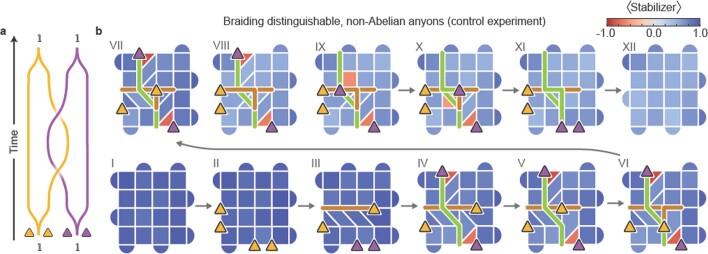
“Notably, the observation of steps (2-4) requires measurements of multi-anyon states, via fusion or non-local measurements.”
BackgroundMethodInfluentialQuantum mechanics of fractional-spin particles
Wilczek, F. (1982) · Physical Review Letters · doi:10.1103/physrevlett.49.957 · Cited by 1,694 · cited 4×
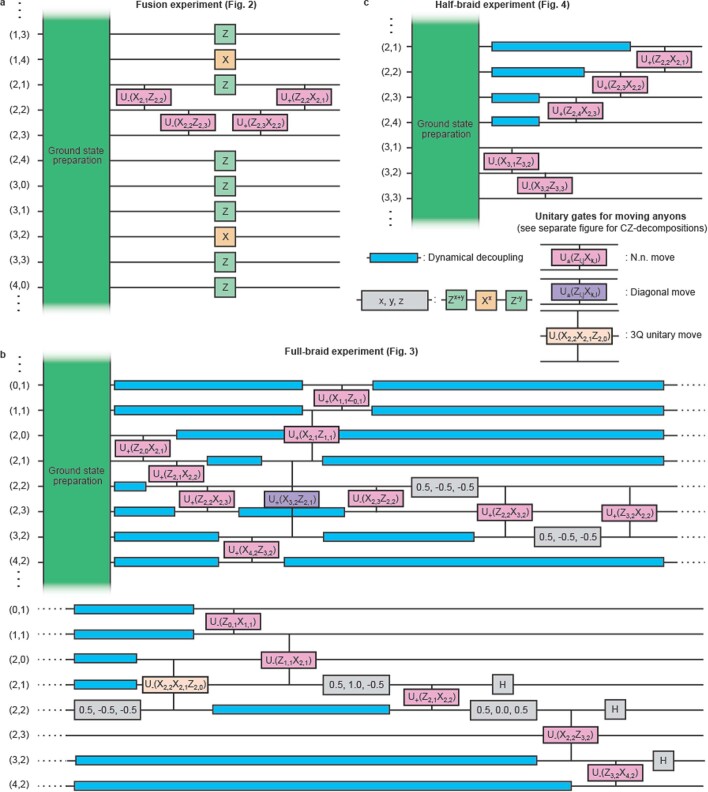
“(3,1) (3,2) (3,3) (4,0) U-(X2,1Z2,2) U-(X2,2Z2,3) Z”
BackgroundMethodInfluentialFractional Statistics and Anyon Superconductivity
Wilczek, F. (1990) · Series on Directions in Condensed Matter Physics · doi:10.1142/0961 · Cited by 1,070 · cited 4×
“We formulate the necessary requirements for experimentally certifying a physical system as a platform for topological quantum computation(5,26): (1) create an anyon pair; (2) verify the rules that govern the ”collision” of two anyons, known as the fusion rules; (3) verify the non-Abelian braiding statistics reflected…”
BackgroundMethodInfluentialMajorana quantization and half-integer thermal quantum Hall effect in a Kitaev spin liquid
Kasahara, Y., Ohnishi, T., Mizukami, Y., Tanaka, O., Ma, S., Sugii, K., Kurita, N., Tanaka, H., Nasu, J., Motome, Y., et al. (2018) · Nature · doi:10.1038/s41586-018-0274-0 · Cited by 873
Stabilizer Codes and Quantum Error Correction
Gottesman, D. (1997) · arXiv · doi:10.48550/arxiv.quant-ph/9705052 · Cited by 753
Realizing topologically ordered states on a quantum processor
Satzinger, K. J., Liu, Y.-J., Smith, A., Knapp, C., Newman, M., Jones, C., Chen, Z., Quintana, C., Mi, X., Dunsworth, A., et al. (2021) · Science · doi:10.1126/science.abi8378 · Cited by 632
Self-citationSymmetry fractionalization, defects, and gauging of topological phases
Barkeshli, M., Bonderson, P., Cheng, M., & Wang, Z. (2019) · Physical Review B · doi:10.1103/physrevb.100.115147 · Cited by 533
Direct observation of anyonic braiding statistics
Nakamura, J., Liang, S., Gardner, G. C., & Manfra, M. J. (2020) · Nature Physics · doi:10.1038/s41567-020-1019-1 · Cited by 501
Fractional statistics in anyon collisions
Bartolomei, H., Kumar, M., Bisognin, R., Marguerite, A., Berroir, J.-M., Bocquillon, E., Plaçais, B., Cavanna, A., Dong, Q., Gennser, U., et al. (2020) · Science · doi:10.1126/science.aaz5601 · Cited by 456
Data for "Realizing topologically ordered states on a quantum processor"
Satzinger, K. J. (2021) · Zenodo (CERN European Organization for Nuclear Research) · doi:10.5281/zenodo.5570481 · Cited by 423
Self-citationQuantum Orders in an Exact Soluble Model
Wen, X.-G. (2003) · Physical Review Letters · doi:10.1103/physrevlett.90.016803 · Cited by 422
Introduction to Topological Quantum Computation
Pachos, J. K. (2012) · Cambridge University Press eBooks · doi:10.1017/cbo9780511792908 · Cited by 409
Observation of half-integer thermal Hall conductance
Banerjee, M., Heiblum, M., Umansky, V., Feldman, D. E., Oreg, Y., & Stern, A. (2018) · Nature · doi:10.1038/s41586-018-0184-1 · Cited by 403
Anyons and the quantum Hall effect—A pedagogical review
Stern, A. (2008) · Annals of Physics · doi:10.1016/j.aop.2007.10.008 · Cited by 402
Topological Order with a Twist: Ising Anyons from an Abelian Model
Bombin, H. (2010) · Physical Review Letters · doi:10.1103/physrevlett.105.030403 · Cited by 369
Detecting Non-Abelian Statistics in theν=5/2Fractional Quantum Hall State
Bonderson, P., Kitaev, A., & Shtengel, K. (2006) · Physical Review Letters · doi:10.1103/physrevlett.96.016803 · Cited by 355
Self-citationTopological Quantum Computation—From Basic Concepts to First Experiments
Stern, A., & Lindner, N. H. (2013) · Science · doi:10.1126/science.1231473 · Cited by 342
Majorana quantization and half-integer thermal quantum Hall effect in a Kitaev spin liquid
Kasahara, Y., Ohnishi, T., Mizukami, Y., et al. (2018) · Kyoto University Research Information Repository (Kyoto University) · Cited by 336
Twist defects and projective non-Abelian braiding statistics
Barkeshli, M., Jian, C.-M., & Qi, X.-L. (2013) · Physical Review B · doi:10.1103/physrevb.87.045130 · Cited by 275
P/NP, and the quantum field computer
Freedman, M. H. (1998) · Proceedings of the National Academy of Sciences · doi:10.1073/pnas.95.1.98 · Cited by 221
Theory of twist liquids: Gauging an anyonic symmetry
Teo, J. C. Y., Hughes, T. L., & Fradkin, E. (2015) · Annals of Physics · doi:10.1016/j.aop.2015.05.012 · Cited by 186
Three-dimensional topological lattice models with surface anyons
von Keyserlingk, C. W., Burnell, F. J., & Simon, S. H. (2013) · Physical Review B · doi:10.1103/physrevb.87.045107 · Cited by 175
Projective non-Abelian statistics of dislocation defects in a ZN rotor model
You, Y., & Wen, X.-G. (2012) · Physical Review B · doi:10.1103/physrevb.86.161107 · Cited by 151
Willett, R. L., Pfeiffer, L. N., & West, K. W. (2010) · Physical Review B · doi:10.1103/physrevb.82.205301 · Cited by 135
e/3 Laughlin Quasiparticle Primary-Filling ν=1/3 Interferometer
Camino, F., Zhou, W., & Goldman, V. J. (2007) · Physical Review Letters · doi:10.1103/physrevlett.98.076805 · Cited by 129
Shortest Route to Non-Abelian Topological Order on a Quantum Processor
Tantivasadakarn, N., Verresen, R., & Vishwanath, A. (2023) · Physical Review Letters · doi:10.1103/physrevlett.131.060405 · Cited by 129
Introduction to topological quantum computation with non-Abelian anyons
Field, B., & Simula, T. (2018) · Quantum Science and Technology · doi:10.1088/2058-9565/aacad2 · Cited by 124
Hormozi, L., Zikos, G., Bonesteel, N. E., & Simon, S. H. (2007) · Physical Review B · doi:10.1103/physrevb.75.165310 · Cited by 111
Nakamura, J., Liang, S., Gardner, G. C., & Manfra, M. J. (2022) · Nature Communications · doi:10.1038/s41467-022-27958-w · Cited by 91
Simulations of Quantum Circuits with Approximate Noise using qsim and CirqPreprint
Isakov, S. V., Kafri, D., Martin, O., Heidweiller, C. V., Mruczkiewicz, W., Harrigan, M. P., Rubin, N. C., Thomson, R., Broughton, M., Kissell, K., et al. (2021) · arXiv (Cornell University) · doi:10.48550/arxiv.2111.02396 · Cited by 82
Self-citationUnconventional fusion and braiding of topological defects in a lattice model
Teo, J. C. Y., Roy, A., & Chen, X. (2014) · Physical Review B · doi:10.1103/physrevb.90.115118 · Cited by 52
Demonstrating non-Abelian statistics of Majorana fermions using twist defects
Zheng, H., Dua, A., & Jiang, L. (2015) · Physical Review B · doi:10.1103/physrevb.92.245139 · Cited by 41
Quantum origami: Transversal gates for quantum computation and measurement of topological order
Zhu, G., Hafezi, M., & Barkeshli, M. (2020) · Physical Review Research · doi:10.1103/physrevresearch.2.013285 · Cited by 41
Observing and braiding topological Majorana modes on programmable quantum simulators
Harle, N., Shtanko, O., & Movassagh, R. (2023) · Nature Communications · doi:10.1038/s41467-023-37725-0 · Cited by 32
Self-citationGraph gauge theory of mobile non-Abelian anyons in a qubit stabilizer code
Lensky, Y. D., Kechedzhi, K., Aleǐner, I. L., & Kim, E.-A. (2023) · Annals of Physics · doi:10.1016/j.aop.2023.169286 · Cited by 19 · cited 1×
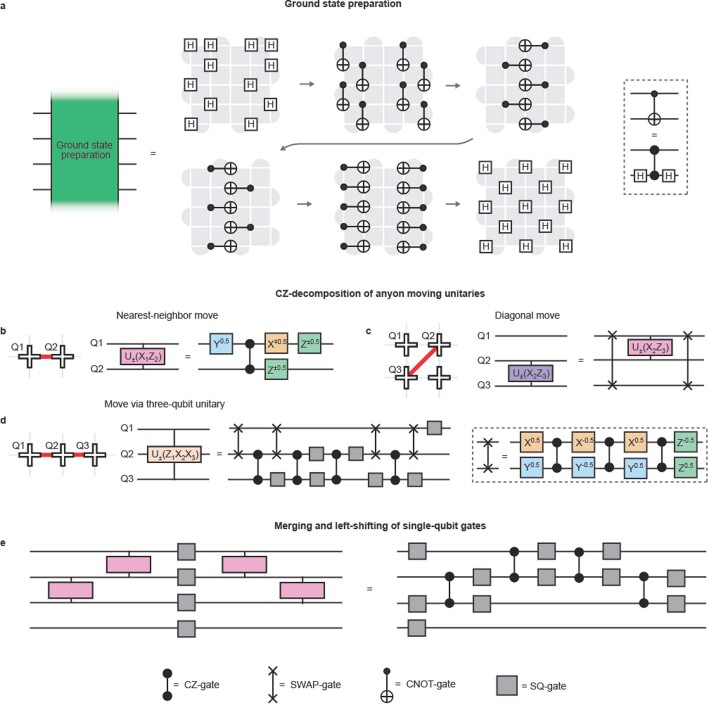
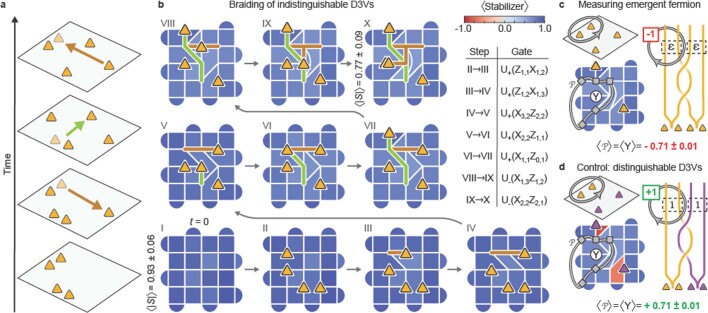
“Here, we will employ a specific protocol recently proposed by Lensky et al.23 for deforming the stabilizer graph (and thus moving the anyons) using local two-qubit Clifford gates.”
MethodSelf-citationNon-Abelian statistics with mixed-boundary punctures on the toric code
Benhemou, A., Pachos, J. K., & Browne, D. E. (2022) · Physical Review A · doi:10.1103/physreva.105.042417 · Cited by 11
Research works printed but not linked: 3
- Sakurai, J. J. Modern Quantum Mechanics (Addison-Wesley, 1993).
- Barkeshli M Qi X-L Topological nematic states and non-Abelian lattice dislocations Phys. Rev. X 2012 2 031013
- Brown BJ Laubscher K Kesselring MS Wootton JR Poking holes and cutting corners to achieve clifford gates with the surface code Phys. Rev. X 2017 7 021029
Cited by
Logical quantum processor based on reconfigurable atom arrays
Bluvstein, D., Evered, S. J., Geim, A. A., Li, S. H., Zhou, H., Manovitz, T., Ebadi, S., Cain, M., Kalinowski, M., Hangleiter, D., et al. (2024) · Nature · doi:10.1038/s41586-023-06927-3 · Cited by 1,119
“We use systems of up to 280 atomic qubits, combining high-fidelity two-qubit gates 8 , enabled by fast excitation into atomic Rydberg states interacting through robust Rydberg blockade 32 , with arbitrary connectivity enabled by atom transport by means of 2D acousto-optic deflectors (AODs) 7 .”
MethodDiagnostics of Mixed-State Topological Order and Breakdown of Quantum Memory
Fan, R., Bao, Y., Altman, E., & Vishwanath, A. (2024) · PRX Quantum · doi:10.1103/prxquantum.5.020343 · Cited by 189
Non-Abelian topological order and anyons on a trapped-ion processor
Iqbal, M., Tantivasadakarn, N., Verresen, R., Campbell, S. L., Dreiling, J. M., Figgatt, C., Gaebler, J. P., Johansen, J., Mills, M., Moses, S. A., et al. (2024) · Nature · doi:10.1038/s41586-023-06934-4 · Cited by 182
Topological order from measurements and feed-forward on a trapped ion quantum computer
Iqbal, M., Tantivasadakarn, N., Gatterman, T. M., Gerber, J. A., Gilmore, K., Gresh, D., Hankin, A. M., Hewitt, N., Horst, C. V., Matheny, M., et al. (2024) · Communications Physics · doi:10.1038/s42005-024-01698-3 · Cited by 180
Measurement-induced entanglement and teleportation on a noisy quantum processor
Collaborators, G. Q. A. A., Hoke, J. C., Ippoliti, M., Rosenberg, E., Abanin, D., Acharya, R., Andersen, T. I., Ansmann, M., Arute, F., Arya, K., et al. (2023) · Nature · doi:10.1038/s41586-023-06505-7 · Cited by 175
Self-citation
Metadata
- Authors
- Collaborators, G. Q. A. A., Andersen, T. I., Lensky, Y. D., Kechedzhi, K., Drozdov, I. K., Bengtsson, A., Hong, S., Morvan, A., Mi, X., Opremcak, A., Acharya, R., Allen, R., Ansmann, M., Arute, F., Arya, K., Asfaw, A., Atalaya, J., Babbush, R., Bacon, D., Bardin, J. C., Bortoli, G., Bourassa, A., Bovaird, J., Brill, L., Broughton, M., Buckley, B. B., Buell, D. A., Burger, T., Burkett, B., Bushnell, N., Chen, Z., Chiaro, B., Chik, D., Chou, C., Cogan, J., Collins, R., Conner, P., Courtney, W., Crook, A. L., Curtin, B., Debroy, D. M., Del Toro Barba, A., Demura, S., Dunsworth, A., Eppens, D., Erickson, C., Faoro, L., Farhi, E., Fatemi, R., Ferreira, V. S., Burgos, L. F., Forati, E., Fowler, A. G., Foxen, B., Giang, W., Gidney, C., Gilboa, D., Giustina, M., Gosula, R., Dau, A. G., Gross, J. A., Habegger, S., Hamilton, M. C., Hansen, M., Harrigan, M. P., Harrington, S. D., Heu, P., Hilton, J., Hoffmann, M. R., Huang, T., Huff, A., Huggins, W. J., Ioffe, L. B., Isakov, S. V., Iveland, J., Jeffrey, E., Jiang, Z., Jones, C., Juhas, P., Kafri, D., Khattar, T., Khezri, M., Kieferová, M., Kim, S., Kitaev, A., Klimov, P. V., Klots, A. R., Korotkov, A. N., Kostritsa, F., Kreikebaum, J. M., Landhuis, D., Laptev, P., Lau, K.-M., Laws, L., Lee, J., Lee, K. W., Lester, B. J., Lill, A. T., Liu, W., Locharla, A., Lucero, E., Malone, F. D., Martin, O., McClean, J. R., McCourt, T., McEwen, M., Miao, K. C., Mieszala, A., Mohseni, M., Montazeri, S., Mount, E., Movassagh, R., Mruczkiewicz, W., Naaman, O., Neeley, M., Neill, C., Nersisyan, A., Newman, M., Ng, J. H., Nguyen, A., Nguyen, M., Niu, M. Y., O’Brien, T. E., Omonije, S., Petukhov, A., Potter, R., Pryadko, L. P., Quintana, C., Rocque, C., Rubin, N. C., Saei, N., Sank, D., Sankaragomathi, K., Satzinger, K. J., Schurkus, H. F., Schuster, C., Shearn, M. J., Shorter, A., Shutty, N., Shvarts, V., Skruzny, J., Smith, W. C., Somma, R., Sterling, G., Strain, D., Szalay, M., Torres, A., Vidal, G., Villalonga, B., Heidweiller, C. V., White, T., Woo, B. W. K., Xing, C., Yao, Z. J., Yeh, P., Yoo, J., Young, G., Zalcman, A., Zhang, Y., Zhu, N., Zobrist, N., Neven, H., Boixo, S., Megrant, A., Kelly, J., Chen, Y., Smelyanskiy, V., Kim, E.-A., Aleiner, I., & Roushan, P.
- Affiliations
- Google (United States) (US)
- University of Technology Sydney (AU)
- University of California, Riverside (US)
- Corresponding author
- Kim, E.-A.
- Roushan, P.
- ORCID
- Andersen, T. I.
- Lensky, Y. D.
- Kechedzhi, K.
- Drozdov, I. K.
- Bengtsson, A.
- Hong, S.
- Morvan, A.
- Mi, X.
- Acharya, R.
- Allen, R.
- Ansmann, M.
- Arute, F.
- Arya, K.
- Asfaw, A.
- Atalaya, J.
- Babbush, R.
- Bacon, D.
- Bardin, J. C.
- Bortoli, G.
- Bourassa, A.
- Bovaird, J.
- Broughton, M.
- Buckley, B. B.
- Burkett, B.
- Bushnell, N.
- Cogan, J.
- Collins, R.
- Crook, A. L.
- Curtin, B.
- Del Toro Barba, A.
- Demura, S.
- Dunsworth, A.
- Eppens, D.
- Erickson, C.
- Farhi, E.
- Fatemi, R.
- Forati, E.
- Fowler, A. G.
- Foxen, B.
- Giustina, M.
- Gosula, R.
- Dau, A. G.
- Gross, J. A.
- Habegger, S.
- Harrigan, M. P.
- Harrington, S. D.
- Hoffmann, M. R.
- Huang, T.
- Huggins, W. J.
- Ioffe, L. B.
- Iveland, J.
- Jeffrey, E.
- Jiang, Z.
- Juhas, P.
- Kafri, D.
- Khattar, T.
- Khezri, M.
- Kieferová, M.
- Kim, S.
- Kitaev, A.
- Klimov, P. V.
- Kreikebaum, J. M.
- Landhuis, D.
- Lee, J.
- Lee, K. W.
- Lester, B. J.
- Lill, A. T.
- Liu, W.
- Locharla, A.
- Lucero, E.
- Martin, O.
- McClean, J. R.
- McCourt, T.
- McEwen, M.
- Miao, K. C.
- Mohseni, M.
- Montazeri, S.
- Movassagh, R.
- Mruczkiewicz, W.
- Naaman, O.
- Neeley, M.
- Neill, C.
- Newman, M.
- Ng, J. H.
- Niu, M. Y.
- O’Brien, T. E.
- Potter, R.
- Pryadko, L. P.
- Quintana, C.
- Rubin, N. C.
- Sank, D.
- Sankaragomathi, K.
- Satzinger, K. J.
- Schurkus, H. F.
- Shearn, M. J.
- Shutty, N.
- Smith, W. C.
- Somma, R.
- Sterling, G.
- Szalay, M.
- Vidal, G.
- Villalonga, B.
- Heidweiller, C. V.
- White, T.
- Woo, B. W. K.
- Yao, Z. J.
- Yeh, P.
- Yoo, J.
- Zalcman, A.
- Zhang, Y.
- Zhu, N.
- Zobrist, N.
- Neven, H.
- Boixo, S.
- Megrant, A.
- Kelly, J.
- Chen, Y.
- Smelyanskiy, V.
- Kim, E.-A.
- Aleiner, I.
- Roushan, P.
- Venue
- Nature
- Published
- 2023-05-11
- Volume
- 618
- Issue
- 7964
- Pages
- 264-269
- ISSN
- 0028-0836 (ISSN-L)
- 1476-4687
- PMC
- PMC10247379
- OpenAlex
- W4376134240
- Cited by
- 108
- References
- 45
- Citations by year
- 2026: 16 · 2025: 41 · 2024: 38 · 2023: 13
- FWCI
- 10.17
- Type
- journal article
- Language
- en
- Open access
- hybrid
- doi.org
- Licence
- cc-by
- creativecommons.org/licenses/by/4.0 (tdm)
- creativecommons.org/licenses/by/4.0 (vor)
- Locations
- Nature (publishedVersion, cc-by)
- PubMed Central (publishedVersion, cc-by)
- PubMed (publishedVersion)
- eScholarship (California Digital Library) (submittedVersion, cc-by)
- Funders
- National Science Foundation (2118310, 160761, 920665, PHY-160761)
- Aspen Center for Physics (PHY-160761)
- Ewha Womans University (Frontier 10-10)
- Topics
- Physical Sciences › Computer Science › Artificial Intelligence › Quantum Computing Algorithms and Architecture
- Physical Sciences › Physics and Astronomy › Atomic and Molecular Physics, and Optics › Quantum Information and Cryptography
- Physical Sciences › Physics and Astronomy › Atomic and Molecular Physics, and Optics › Quantum many-body systems
- Keywords
- non-Abelian anyons, anyon braiding, superconducting quantum processors, Ising anyons, stabilizer codes, exchange statistics, topological quantum computation, logical qubits, entanglement, fault-tolerant quantum computing, topological protection
About these checks
Registry, retraction, Cites and statistics results are computed, not judged, with one exception: a printed reference that no index lists is read once by a model before it counts as a citation error. Claims are extracted by a model and kept only when their quote appears verbatim in the text; each cited source is then checked, with a model’s help, for whether it says what the claim relies on. Those verdicts can be wrong — read the claim’s quote and the cited source before relying on one.
Statistics and arithmetic are recomputed, not judged.
Confidence bands are shown only for fields calibrated on our annotated test set. None is calibrated yet, so no band is shown.
What counts as a claim ›How we measure confidence ›How we check this ›
Are you an author, or do you see a problem with this page? Request a review
Data sources
Bibliographic data: Semantic Scholar, OpenAlex, Crossref.
Contains information from the Semantic Scholar Academic Graph Datasets, made available under the ODC Attribution License (ODC-BY 1.0).
Semantic Scholar’s data is described in: Kinney, R., et al. (2023). The Semantic Scholar Open Data Platform. arXiv:2301.10140.
