

Faster sorting algorithms discovered using deep reinforcement learning
Open accessThe DOI matches its Crossref record; 64 of the 64 references it cites were found in a registry or an index.
Abstract
Fundamental algorithms such as sorting or hashing are used trillions of times on any given day 1. As demand for computation grows, it has become critical for these algorithms to be as performant as possible. Whereas remarkable progress has been achieved in the past 2, making further improvements on the efficiency of these routines has proved challenging for both human scientists and computational approaches. Here we show how artificial intelligence can go beyond the current state of the art by discovering hitherto unknown routines. To realize this, we formulated the task of finding a better sorting routine as a single-player game. We then trained a new deep reinforcement learning agent, AlphaDev, to play this game. AlphaDev discovered small sorting algorithms from scratch that outperformed previously known human benchmarks. These algorithms have been integrated into the LLVM standard C++ sort library 3. This change to this part of the sort library represents the replacement of a component with an algorithm that has been automatically discovered using reinforcement learning. We also present results in extra domains, showcasing the generality of the approach.
Overview
The claims and statistics of this paper haven’t been checked yet.
Free: it reads the open-access text and checks the first 5 claims that cite a source we can check. Create a free account to check every claim.
Integrity signals
Registry
Cites
Statistics
Figures
Verification
Claims the paper makes
The claims and statistics of this paper haven’t been checked yet.
Free: it reads the open-access text and checks the first 5 claims that cite a source we can check. Create a free account to check every claim.
Self-check
Percentages, sums and reported differences re-computed from the paper’s own numbers.
The self-check needs the paper’s full text.
Citations
Cites
Vaswani, A., Shazeer, N., Parmar, N., Uszkoreit, J., Jones, L., Gomez, A. N., Kaiser, L., & Polosukhin, I. (2017) · arXiv · doi:10.48550/arxiv.1706.03762 · Cited by 120,404
Language Models are Few-Shot Learners
Brown, T. B., Mann, B., Ryder, N., Subbiah, M., Kaplan, J., Dhariwal, P., Neelakantan, A., Shyam, P., Sastry, G., Askell, A., et al. (2020) · arXiv · doi:10.48550/arxiv.2005.14165 · Cited by 23,372 · cited 1×
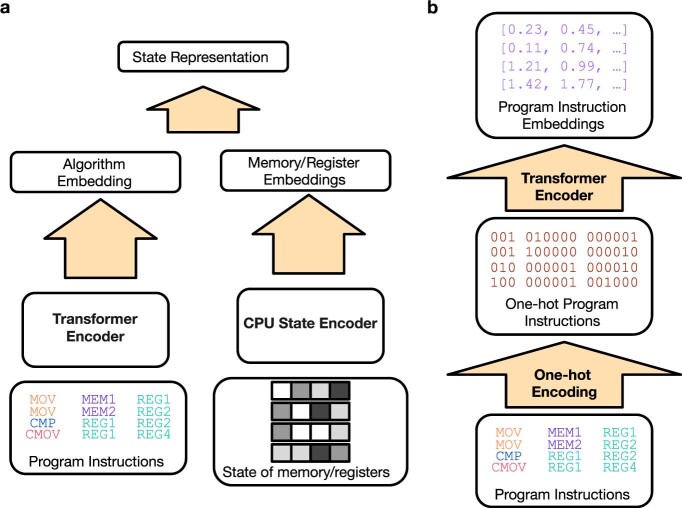
“Transformers are natural text encoders and have had much success with language models recently 14,34,41 .”
BackgroundMastering the game of Go with deep neural networks and tree search
Silver, D., Huang, A., Maddison, C. J., Guez, A., Sifre, L., van den Driessche, G., Schrittwieser, J., Antonoglou, I., Panneershelvam, V., Lanctot, M., et al. (2016) · Nature · doi:10.1038/nature16961 · Cited by 15,612
Self-citationA general reinforcement learning algorithm that masters chess, shogi, and Go through self-play
Silver, D., Hubert, T., Schrittwieser, J., Antonoglou, I., Lai, M., Guez, A., Lanctot, M., Sifre, L., Kumaran, D., Graepel, T., et al. (2018) · Science · doi:10.1126/science.aar6404 · Cited by 3,562 · cited 2×
“AlphaZero 33 is an RL algorithm that leverages MCTS as a policy improvement operator.”
MethodSelf-citationEvaluating Large Language Models Trained on Code
Chen, M., Tworek, J., Jun, H., Yuan, Q., Pinto, H. P. D. O., Kaplan, J., Edwards, H., Burda, Y., Joseph, N., Brockman, G., et al. (2021) · arXiv · doi:10.48550/arxiv.2107.03374 · Cited by 1,436
Mastering Atari, Go, chess and shogi by planning with a learned model
Schrittwieser, J., Antonoglou, I., Hubert, T., Simonyan, K., Sifre, L., Schmitt, S., Guez, A., Lockhart, E., Hassabis, D., Graepel, T., et al. (2020) · RePEc: Research Papers in Economics · Cited by 1,310
Self-citationMastering Atari, Go, chess and shogi by planning with a learned model
Schrittwieser, J., Antonoglou, I., Hubert, T., Simonyan, K., Sifre, L., Schmitt, S., Guez, A., Lockhart, E., Hassabis, D., Graepel, T., et al. (2020) · Nature · doi:10.1038/s41586-020-03051-4 · Cited by 1,214 · cited 3×
“Then, the true dynamics or dynamics network (for MuZero) as well as the prediction network f pred ( h t ) are used to simulate several trajectories that fill out a search tree, by sampling state transitions.”
MethodInfluentialSelf-citationMastering Atari, Go, Chess and Shogi by Planning with a Learned Model
Schrittwieser, J., Antonoglou, I., Hubert, T., Simonyan, K., Sifre, L., Schmitt, S., Guez, A., Lockhart, E., Hassabis, D., Graepel, T., et al. (2019) · arXiv · doi:10.48550/arxiv.1911.08265 · Cited by 1,214
Self-citationCompetition-level code generation with AlphaCode
Li, Y., Choi, D., Chung, J., Kushman, N., Schrittwieser, J., Leblond, R., Eccles, T., Keeling, J., Gimeno, F., Dal Lago, A., et al. (2022) · Science · doi:10.1126/science.abq1158 · Cited by 1,043
Self-citationCompetition-Level Code Generation with AlphaCode
Li, Y., Choi, D., Chung, J., Kushman, N., Schrittwieser, J., Leblond, R., Eccles, T., Keeling, J., Gimeno, F., Lago, A. D., et al. (2022) · arXiv · doi:10.48550/arxiv.2203.07814 · Cited by 1,043
Self-citationEvaluating large language models trained on code
Chen, M. (2024) · TIB Data Manager · doi:10.57702/wbv3e61b · Cited by 737
Language to Logical Form with Neural Attention
Dong, L., & Lapata, M. (2016) · Proceedings of the 54th Annual Meeting of the Association for Computational Linguistics (Volume 1: Long Papers) · doi:10.18653/v1/p16-1004 · Cited by 700
Alur, R., Bodik, R., Juniwal, G., Martin, M. M. K., Raghothaman, M., Seshia, S. A., Singh, R., Solar-Lezama, A., Torlak, E., & Udupa, A. (2013) · 2013 Formal Methods in Computer-Aided Design · doi:10.1109/fmcad.2013.6679385 · Cited by 656
XXII. Programming a computer for playing chess
Shannon, C. E. (1950) · The London, Edinburgh, and Dublin Philosophical Magazine and Journal of Science · doi:10.1080/14786445008521796 · Cited by 615
Solving Mixed Integer Programs Using Neural NetworksPreprint
Nair, V. B., Bartunov, S., Gimeno, F., von Glehn, I., Lichocki, P., Lobov, I., O’Donoghue, B., Sonnerat, N., Tjandraatmadja, C., Wang, P., et al. (2020) · arXiv (Cornell University) · doi:10.48550/arxiv.2012.13349 · Cited by 469
Self-citationVinyals, O., Kaiser, L., Koo, T., Petrov, S., Sutskever, I., & Hinton, G. (2014) · arXiv · doi:10.48550/arxiv.1412.7449 · Cited by 464 · cited 2×
“These include enumerative search techniques 4–7 and stochastic search 5,6,8–10 as well as the more recent trend of using deep learning in program synthesis for generating correct programs 11–16 .”
BackgroundMethodSelf-citationSpatiotemporal Contrastive Video Representation Learning
Qian, R., Meng, T., Gong, B., Yang, M.-H., Wang, H., Belongie, S., & Cui, Y. (2021) · 2021 IEEE/CVF Conference on Computer Vision and Pattern Recognition (CVPR) · doi:10.1109/cvpr46437.2021.00689 · Cited by 443
Applied Mechanics and Materials Vol. 906
Minafò, G., & Koutsonas, S. (. (2022) · Applied Mechanics and Materials · doi:10.4028/b-o7pu5q · Cited by 409
Collision Free Hash Functions and Public Key Signature Schemes
Damgård, I. B. (2010) · Lecture Notes in Computer Science · doi:10.1007/3-540-39118-5_19 · Cited by 339
ManySAT: a Parallel SAT Solver
Hamadi, Y., Jabbour, S., & Sais, L. (2009) · Journal on Satisfiability, Boolean Modeling and Computation · doi:10.3233/sat190070 · Cited by 319
From program verification to program synthesis
Srivastava, S., Gulwani, S., & Foster, J. S. (2010) · Proceedings of the 37th annual ACM SIGPLAN-SIGACT symposium on Principles of programming languages · doi:10.1145/1706299.1706337 · Cited by 267
Synthesis of loop-free programs
Gulwani, S., Jha, S., Tiwari, A., & Venkatesan, R. (2011) · ACM SIGPLAN Notices · doi:10.1145/1993316.1993506 · Cited by 237
Learning to rank for recommender systems
Karatzoglou, A., Baltrunas, L., & Shi, Y. (2013) · ACM Conference on Recommender Systems (RecSys) · doi:10.1145/2507157.2508063 · Cited by 179
Wolsey, L. A. (2008) · Wiley eBooks · doi:10.1002/9780470050118.ecse244 · Cited by 158
Why Google stores billions of lines of code in a single repository
Potvin, R., & Levenberg, J. (2016) · Communications of the ACM · doi:10.1145/2854146 · Cited by 157
Towards String-To-Tree Neural Machine Translation
Aharoni, R., & Goldberg, Y. (2017) · Proceedings of the 55th Annual Meeting of the Association for Computational Linguistics (Volume 2: Short Papers) · doi:10.18653/v1/p17-2021 · Cited by 147
Souper: A Synthesizing SuperoptimizerPreprint
Sasnauskas, R., Chen, Y., Collingbourne, P., Ketema, J., Lup, G., Taneja, J., & Regehr, J. D. (2017) · arXiv (Cornell University) · doi:10.48550/arxiv.1711.04422 · Cited by 122
Fast Transformer Decoding: One Write-Head is All You Need
Shazeer, N. (2019) · arXiv · doi:10.48550/arxiv.1911.02150 · Cited by 101
AA-Sort: A New Parallel Sorting Algorithm for Multi-Core SIMD Processors
Inoue, H., Moriyama, T., Komatsu, H., & Nakatani, T. (2007) · International Conference on Parallel Architectures and Compilation Techniques · doi:10.1109/pact.2007.12 · Cited by 98
The design of divide and conquer algorithms
Smith, D. R. (1985) · Science of Computer Programming · doi:10.1016/0167-6423(85)90003-6 · Cited by 96
AA-Sort: A New Parallel Sorting Algorithm for Multi-Core SIMD Processors
Inoue, H., Moriyama, T., Komatsu, H., & Nakatani, T. (2007) · International Conference on Parallel Architectures and Compilation Techniques (PACT) · doi:10.1109/pact.2007.4336211 · Cited by 93
Neuro-Symbolic Program Synthesis
Parisotto, E., Mohamed, A., Singh, R. K., Li, L. C., Zhou, D., & Kohli, P. (2016) · arXiv (Cornell University) · doi:10.48550/arxiv.1611.01855 · Cited by 92
Self-citationRobustFill: Neural Program Learning under Noisy I/O
Devlin, J., Uesato, J., Bhupatiraju, S., Singh, R. K., Mohamed, A., & Kohli, P. (2017) · arXiv (Cornell University) · doi:10.48550/arxiv.1703.07469 · Cited by 91
Self-citationPetaBricks: a language and compiler for algorithmic choice
Ansel, J., Chan, C. P., Wong, Y. L., Olszewski, M., Zhao, Q., Edelman, A. S., & Amarasinghe, S. P. (2009) · ACM SIGPLAN Notices · doi:10.1145/1543135.1542481 · Cited by 86
A Generalist Neural Algorithmic LearnerPreprint
Ibarz, B., Kurin, V., Papamakarios, G., Nikiforou, K., Bennani, M., Csordás, R., Dudzik, A., Bošnjak, M., Vitvitskyi, A., Rubanova, Y., et al. (2022) · arXiv (Cornell University) · doi:10.48550/arxiv.2209.11142 · Cited by 86
Spatiotemporal Contrastive Video Representation LearningPreprint
Qian, R., Meng, T., Gong, B., et al. (2020) · arXiv (Cornell University) · doi:10.48550/arxiv.2008.03800 · Cited by 80
On the Design and Evaluation of Job Scheduling Algorithms
Krallmann, J., Schwiegelshohn, U., & Yahyapour, R. (1999) · Lecture notes in computer science · doi:10.1007/3-540-47954-6_2 · Cited by 78
Phothilimthana, P. M., Thakur, A., Bodík, R., & Dhurjati, D. (2016) · International Conference on Architectural Support for Programming Languages and Operating Systems (ASPLOS) · doi:10.1145/2872362.2872387 · Cited by 78
From relational verification to SIMD loop synthesis
Barthe, G., Crespo, J. M., Gulwani, S., Kunz, C., & Marron, M. (2013) · ACM SIGPLAN Symposium on Principles and Practice of Parallel Programming · doi:10.1145/2442516.2442529 · Cited by 75
A Randomized Parallel Sorting Algorithm with an Experimental Study
Helman, D. R., Bader, D. A., & JáJá, J. F. (1998) · Journal of Parallel and Distributed Computing · doi:10.1006/jpdc.1998.1462 · Cited by 73
Write, Execute, Assess: Program Synthesis with a REPL
Ellis, K., Nye, M., Pu, Y., Sosa, F., Tenenbaum, J., & Solar-Lezama, A. (2019) · arXiv · doi:10.48550/arxiv.1906.04604 · Cited by 65 · cited 1×
“Kevin Ellis et al. 62 learn a policy and value function to write and evaluate code, as well as performing a Monte Carlo-style search strategy during inference.”
BackgroundBundala, D., & Závodný, J. (2014) · Lecture notes in computer science · doi:10.1007/978-3-319-04921-2_19 · Cited by 61
Randomized Shellsort: A Simple Oblivious Sorting Algorithm
Goodrich, M. T. (2010) · ACM-SIAM Symposium on Discrete Algorithms (SODA) · doi:10.1137/1.9781611973075.101 · Cited by 61
Multi-Collision Resistant Hash Functions and Their Applications
Berman, I., Degwekar, A., Rothblum, R. D., & Vasudevan, P. N. (2018) · Lecture notes in computer science · doi:10.1007/978-3-319-78375-8_5 · Cited by 49
Leveraging Grammar and Reinforcement Learning for Neural Program Synthesis
Bunel, R., Hausknecht, M., Devlin, J., Singh, R. K., & Kohli, P. (2018) · arXiv (Cornell University) · doi:10.48550/arxiv.1805.04276 · Cited by 42
Self-citationAutomating reinforcement learning architecture design for code optimization
Wang, H., Tang, Z., Zhang, C., Zhao, J., Cummins, C., Leather, H., & Wang, Z. (2022) · ACM SIGPLAN International Conference on Compiler Construction (CC) · doi:10.1145/3497776.3517769 · Cited by 40
Splitsort—an adaptive sorting algorithm
Levcopoulos, C., & Petersson, O. (1991) · Information Processing Letters · doi:10.1016/0020-0190(91)90181-g · Cited by 34
Learning to superoptimize programs
Bunel, R., Desmaison, A., Kumar, M., Torr, P. H. S., & Kohli, P. (2016) · Oxford University Research Archive (ORA) (University of Oxford) · doi:10.48550/arxiv.1611.01787 · Cited by 33
Self-citationChlorophyll: synthesis-aided compiler for low-power spatial architectures
Phothilimthana, P. M., Jelvis, T., Shah, R., Totla, N., Chasins, S., & Bodík, R. (2014) · ACM SIGPLAN Notices · doi:10.1145/2666356.2594339 · Cited by 31
Schkufza, E., Sharma, R., & Aiken, A. (2013) · ACM SIGPLAN Notices · doi:10.1145/2499368.2451150 · Cited by 28
Vectorized and performance‐portable quicksort
Wassenberg, J., Blacher, M., Giesen, J., & Sanders, P. (2022) · Software Practice and Experience · doi:10.1002/spe.3142 · Cited by 28
Efficient Parallel Sort on AVX-512-Based Multi-Core and Many-Core Architectures
Yin, Z., Zhang, T., Muller, A., Liu, H., Wei, Y., Schmidt, B., & Liu, W. (2019) · IEEE International Conference on High Performance Computing and Communications; IEEE International Conference on Smart City; IEEE International Conference on Data Science and Systems (HPCC/SmartCity/DSS) · doi:10.1109/hpcc/smartcity/dss.2019.00038 · Cited by 19
Examining Zero-Shot Vulnerability Repair with Large Language Models
Pearce, H., Tan, B., Ahmad, B., Karri, R., & Dolan-Gavitt, B. (2021) · arXiv · doi:10.48550/arxiv.2112.02125 · Cited by 17
PetaBricks: A Language and Compiler for Algorithmic Choice
Ansel, J., Chan, C. P., Wong, Y. L., Olszewski, M., Zhao, Q., Edelman, A. S., & Amarasinghe, S. P. (2009) · eScholarship (California Digital Library) · Cited by 14
Automatic generation of peephole superoptimizers
Bansal, S., & Aiken, A. (2006) · ACM SIGARCH Computer Architecture News · doi:10.1145/1168919.1168906 · Cited by 13
Algorithms and Data Structures: Foundations and Probabilistic Methods for Design and Analysis
Knebl, H. (2020) · Springer eBooks · doi:10.1007/978-3-030-59758-0 · Cited by 13
Engineering faster sorters for small sets of items
Bingmann, T., Marianczuk, J., & Sanders, P. (2020) · Software Practice and Experience · doi:10.1002/spe.2922 · Cited by 10
Learning to Superoptimize Real-world ProgramsPreprint
Shypula, A., Yin, P., Lacomis, J., Goues, C. L., Schwartz, E. J., & Neubig, G. (2021) · arXiv (Cornell University) · doi:10.48550/arxiv.2109.13498 · Cited by 7
Phothilimthana, P. M., Thakur, A., Bodík, R., & Dhurjati, D. (2016) · ACM SIGOPS Operating Systems Review · doi:10.1145/2954680.2872387 · Cited by 5
Generating a novel sort algorithm using Reinforcement Programming
White, S. K., Martinez, T. R., & Rudolph, G. (2010) · IEEE Congress on Evolutionary Computation (CEC) · doi:10.1109/cec.2010.5586457 · Cited by 4
Vectorized and performance-portable QuicksortPreprint
Blacher, M., Giesen, J., Sanders, P. W., et al. (2022) · arXiv (Cornell University) · doi:10.48550/arxiv.2205.05982 · Cited by 4
Chlorophyll: Synthesis-Aided Compiler for Low-Power Spatial Architectures
Phothilimthana, P. M. (2015) · UC Berkeley · Cited by 3
Study on Information Retrieval Sorting Algorithm in Network-Based Manufacturing Environment
Yang, J. Y., Zhang, B., & Mao, Y. L. (2014) · Applied Mechanics and Materials · doi:10.4028/www.scientific.net/amm.484-485.183 · Cited by 2
Nasm (Intel) Assembly Language Syntax
Bartlett, J. (2021) · Apress eBooks · doi:10.1007/978-1-4842-7437-8_23 · Cited by 2
Research works printed but not linked: 11
- Cormen, T. H. et al. Introduction to Algorithms (MIT Press, 2022).
- Chen, X., Liu, C. & Song, D. Towards synthesizing complex programs from input-output examples. In Proc. International Conference on Learning Representations (ICLR, 2018).
- Mehlhorn, K., Sanders, P. & Sanders, P. Algorithms and Data Structures: The Basic Toolbox Vol. 55. (Springer, 2008).
- Irvine, K. R. et al. Assembly Language for Intel-Based Computers (Prentice Hall, 2003).
- Sutton, R. S. & Barto, A. G. Reinforcement Learning: An Introduction 2nd edn (MIT Press, 2018).
- Maillard, O.-A., Ryabko, D. & Munos, R. Selecting the state-representation in reinforcement learning. Adv. Neural Inform. Proc. Syst.24, 2627–2635 (2011).
- Hahn, G. J. & Meeker, W. Q. Statistical Intervals: A Guide for Practitioners Vol. 92 (John Wiley & Sons, 2011).
- Warren, H. S. Hacker’s Delight (Pearson Education, 2013).
- Chen, X., Liu, C. & Song, D. Execution-guided neural program synthesis. In Proc. International Conference on Learning Representations (ICLR, 2018).
- Chen, X., Song, D. & Tian, Y. Latent execution for neural program synthesis beyond domain-specific languages. Adv. Neural Inform. Proc. Syst.34, 22196–22208 (2021).
- Ellis, K., Solar-Lezama, A. & Tenenbaum, J. Sampling for Bayesian program learning. Adv. Neural Inform. Proc. Syst.29, 1297–1305 (2016).
Cited by
AI Alignment: A Contemporary Survey
Ji, J., Qiu, T., Chen, B., Zhou, J., Zhang, B., Hong, D., Lou, H., Wang, K., Duan, Y., He, Z., et al. (2025) · ACM Computing Surveys · doi:10.1145/3770749 · Cited by 816
The STARD-AI reporting guideline for diagnostic accuracy studies using artificial intelligence
Sounderajah, V., Guni, A., Liu, X., Collins, G. S., Karthikesalingam, A., Markar, S. R., Golub, R. M., Denniston, A. K., Shetty, S., Moher, D., et al. (2025) · Nature Medicine · doi:10.1038/s41591-025-03953-8 · Cited by 592
Mathematical discoveries from program search with large language models
Romera-Paredes, B., Barekatain, M., Novikov, A., Balog, M., Kumar, M. P., Dupont, E., Ruiz, F. J. R., Ellenberg, J. S., Wang, P., Fawzi, O., et al. (2024) · Nature · doi:10.1038/s41586-023-06924-6 · Cited by 544
“We also note that reinforcement learning has recently been applied to discover new faster algorithms for fundamental operations such as matrix multiplication 89 and sorting 90 .”
MethodSelf-citationMulti-Agent Risks from Advanced AI
Hammond, L., Chan, A., Clifton, J., Hoelscher-Obermaier, J., Khan, A., McLean, E., Smith, C., Barfuss, W., Foerster, J., Gavenčiak, T., et al. (2025) · arXiv · doi:10.48550/arxiv.2502.14143 · Cited by 305
Synthetic Data Generation Using Large Language Models: Advances in Text and Code
Nadas, M. D., Dioşan, L. S., & Tomescu, A. (2025) · IEEE Access · doi:10.1109/access.2025.3589503 · Cited by 227
Metadata
- Authors
- Mankowitz, D. J., Michi, A., Zhernov, A., Gelmi, M., Selvi, M., Paduraru, C., Leurent, E., Iqbal, S., Lespiau, J.-B., Ahern, A., Köppe, T., Millikin, K., Gaffney, S., Elster, S., Broshear, J., Gamble, C., Milan, K., Tung, R., Hwang, M., Cemgil, T., Barekatain, M., Li, Y., Mandhane, A., Hubert, T., Schrittwieser, J., Hassabis, D., Kohli, P., Riedmiller, M., Vinyals, O., & Silver, D.
- Affiliations
- Google DeepMind (United Kingdom) (GB)
- Google (United States) (US)
- Corresponding author
- Mankowitz, Daniel J.
- ORCID
- Venue
- Nature
- Published
- 2023-06-07
- Volume
- 618
- Issue
- 7964
- Pages
- 257-263
- ISSN
- 0028-0836 (ISSN-L)
- 1476-4687
- PMC
- PMC10247365
- OpenAlex
- W4379739787
- Cited by
- 177
- References
- 58
- Citations by year
- 2026: 38 · 2025: 68 · 2024: 53 · 2023: 18
- FWCI
- 16.66
- Type
- journal article
- Language
- en
- Open access
- hybrid
- doi.org
- Licence
- cc-by
- creativecommons.org/licenses/by/4.0 (tdm)
- creativecommons.org/licenses/by/4.0 (vor)
- Locations
- Nature (publishedVersion, cc-by)
- PubMed Central (publishedVersion, cc-by)
- PubMed (publishedVersion)
- RePEc: Research Papers in Economics (submittedVersion)
- Funders
- DeepMind
- Topics
- Physical Sciences › Computer Science › Artificial Intelligence › Evolutionary Algorithms and Applications
- Physical Sciences › Computer Science › Artificial Intelligence › Artificial Intelligence in Games
- Physical Sciences › Computer Science › Information Systems › Software Engineering Research
- Keywords
- algorithm discovery, sorting algorithms, deep reinforcement learning, C++ standard library, performance optimization
About these checks
Registry, retraction, Cites and statistics results are computed, not judged, with one exception: a printed reference that no index lists is read once by a model before it counts as a citation error. Claims are extracted by a model and kept only when their quote appears verbatim in the text; each cited source is then checked, with a model’s help, for whether it says what the claim relies on. Those verdicts can be wrong — read the claim’s quote and the cited source before relying on one.
Statistics and arithmetic are recomputed, not judged.
Confidence bands are shown only for fields calibrated on our annotated test set. None is calibrated yet, so no band is shown.
What counts as a claim ›How we measure confidence ›How we check this ›
Are you an author, or do you see a problem with this page? Request a review
Data sources
Bibliographic data: Semantic Scholar, OpenAlex, Crossref.
Contains information from the Semantic Scholar Academic Graph Datasets, made available under the ODC Attribution License (ODC-BY 1.0).
Semantic Scholar’s data is described in: Kinney, R., et al. (2023). The Semantic Scholar Open Data Platform. arXiv:2301.10140.
