

Benchmarking highly entangled states on a 60-atom analogue quantum simulator
Open accessThe DOI matches its Crossref record; 67 of the 67 references it cites were found in a registry or an index.
Abstract
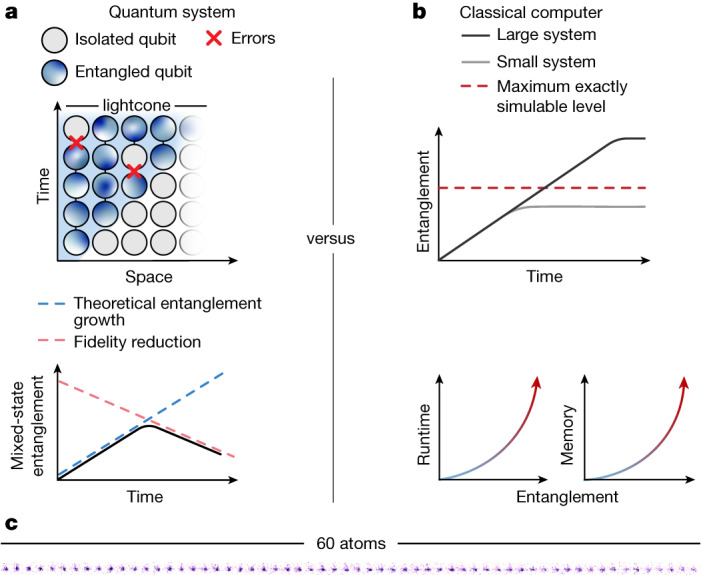
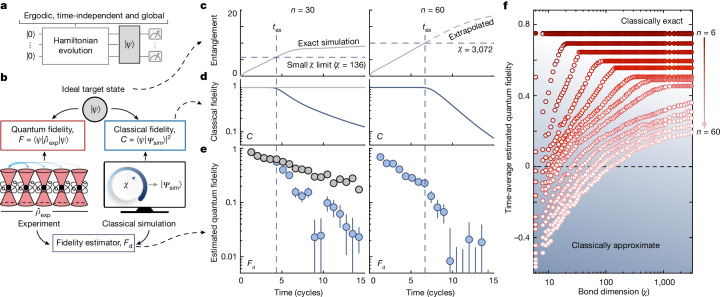
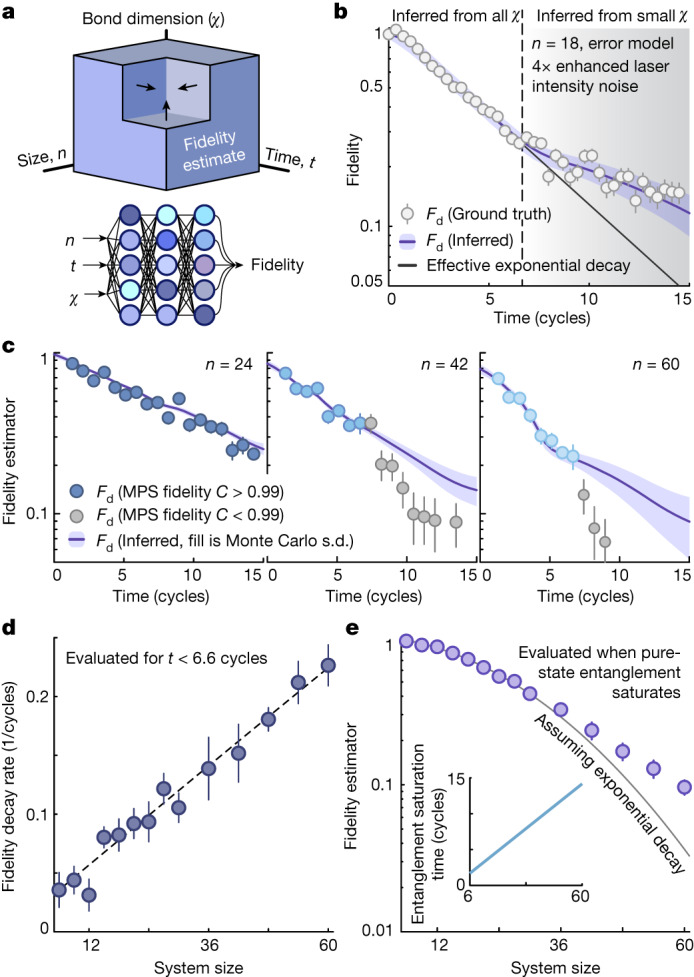
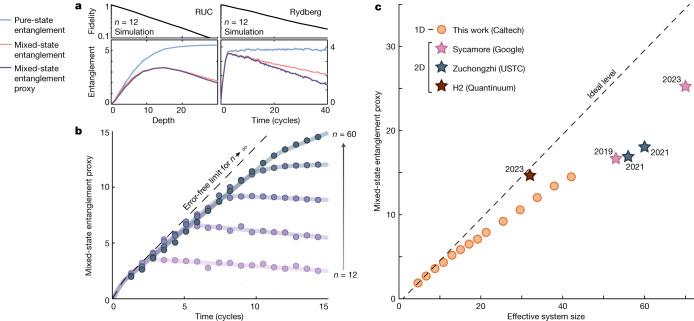
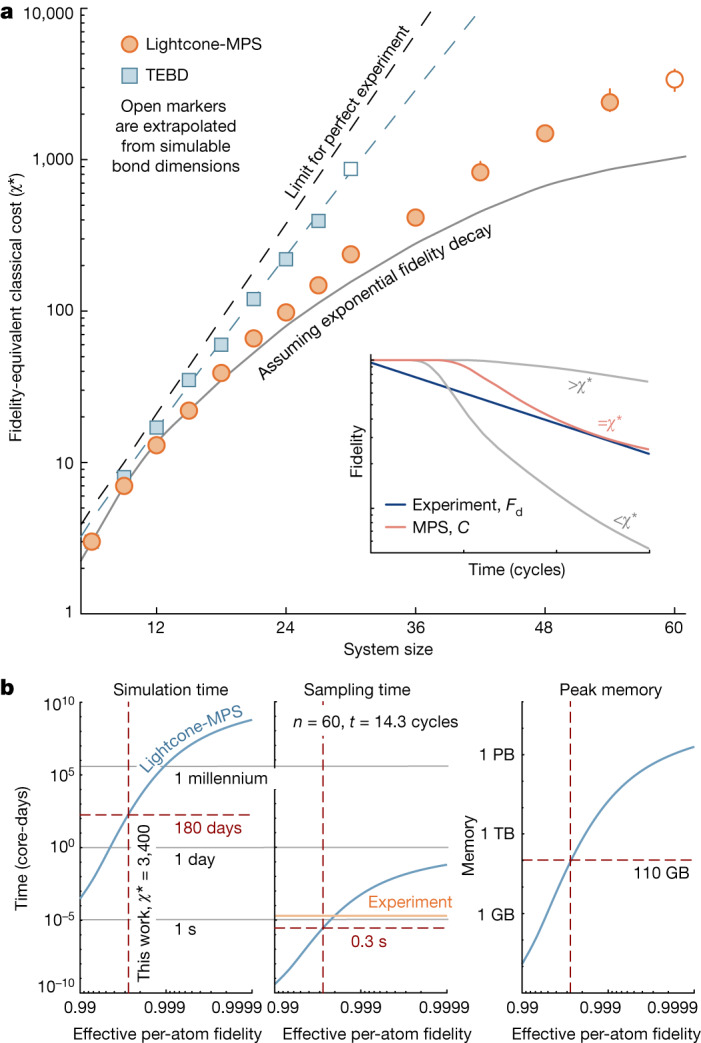
Quantum systems have entered a competitive regime in which classical computers must make approximations to represent highly entangled quantum states 1,2. However, in this beyond-classically-exact regime, fidelity comparisons between quantum and classical systems have so far been limited to digital quantum devices 2–5, and it remains unsolved how to estimate the actual entanglement content of experiments 6. Here, we perform fidelity benchmarking and mixed-state entanglement estimation with a 60-atom analogue Rydberg quantum simulator, reaching a high-entanglement entropy regime in which exact classical simulation becomes impractical. Our benchmarking protocol involves extrapolation from comparisons against an approximate classical algorithm, introduced here, with varying entanglement limits. We then develop and demonstrate an estimator of the experimental mixed-state entanglement 6, finding our experiment is competitive with state-of-the-art digital quantum devices performing random circuit evolution 2–5. Finally, we compare the experimental fidelity against that achieved by various approximate classical algorithms, and find that only the algorithm we introduce is able to keep pace with the experiment on the classical hardware we use. Our results enable a new model for evaluating the ability of both analogue and digital quantum devices to generate entanglement in the beyond-classically-exact regime, and highlight the evolving divide between quantum and classical systems.
Overview
The claims and statistics of this paper haven’t been checked yet.
Free: it reads the open-access text and checks the first 5 claims that cite a source we can check. Create a free account to check every claim.
Integrity signals
Registry
Cites
Statistics
Figures
Verification
Claims the paper makes
The claims and statistics of this paper haven’t been checked yet.
Free: it reads the open-access text and checks the first 5 claims that cite a source we can check. Create a free account to check every claim.
Self-check
Percentages, sums and reported differences re-computed from the paper’s own numbers.
The self-check needs the paper’s full text.
Citations
Cites
Quantum Computing in the NISQ era and beyond
Preskill, J. (2018) · Quantum · doi:10.22331/q-2018-08-06-79 · Cited by 8,830
Quantum supremacy using a programmable superconducting processor
Arute, F., Arya, K., Babbush, R., Bacon, D., Bardin, J. C., Barends, R., Biswas, R., Boixo, S., Brandao, F. G. S. L., Buell, D. A., et al. (2019) · Nature · doi:10.1038/s41586-019-1666-5 · Cited by 7,720
Self-citationComputable measure of entanglement
Vidal, G., & Werner, R. F. (2002) · Physical Review A · doi:10.1103/physreva.65.032314 · Cited by 4,896
Colloquium : Area laws for the entanglement entropy
Eisert, J., Cramer, M., & Plenio, M. B. (2010) · Reviews of Modern Physics · doi:10.1103/revmodphys.82.277 · Cited by 2,873
Efficient Classical Simulation of Slightly Entangled Quantum Computations
Vidal, G. (2003) · Physical Review Letters · doi:10.1103/physrevlett.91.147902 · Cited by 2,368
Noisy intermediate-scale quantum algorithms
Bharti, K., Cervera-Lierta, A., Kyaw, T. H., Haug, T., Alperin-Lea, S., Anand, A., Degroote, M., Heimonen, H., Kottmann, J. S., Menke, T., et al. (2022) · Reviews of Modern Physics · doi:10.1103/revmodphys.94.015004 · Cited by 2,231
Ensemble deep learning: A review
Ganaie, M. A., Hu, M., Malik, A. K., Tanveer, M., & Suganthan, P. N. (2022) · Engineering Applications of Artificial Intelligence · doi:10.1016/j.engappai.2022.105151 · Cited by 2,143
Efficient Simulation of One-Dimensional Quantum Many-Body Systems
Vidal, G. (2004) · Physical Review Letters · doi:10.1103/physrevlett.93.040502 · Cited by 1,779 · cited 2×
“We consider several classical algorithms (for example, time-evolving block decimation, TEBD 45 ), all of which become impractical at moderate system sizes.”
Average Entropy of a Subsystem
Page, D. N. (1993) · arXiv · doi:10.48550/arxiv.gr-qc/9305007 · Cited by 1,578
Average entropy of a subsystem
Page, D. N. (1993) · Physical Review Letters · doi:10.1103/physrevlett.71.1291 · Cited by 1,578 · cited 10×
“For each case we provide numeric or analytic evidence showing that at worst our entanglement-proxy lower bound is potentially violated by an O(1) amount.”
Influential
Research works printed but not linked: 5
- Zhou Y Stoudenmire EM Waintal X What limits the simulation of quantum computers? Phys. Rev. X 2020 10 41038
- Nielsen, M. A. & Chuang, I. L. Quantum Computation and Quantum Information (Cambridge Univ. Press, 2010).
- Haah J Hastings MB Kothari R Low GH Quantum algorithm for simulating real time evolution of lattice Hamiltonians SIAM J. Comput. 2021 52 6
- Haah J Harrow AW Ji Z Wu X Yu N Sample-optimal tomography of quantum states IEEE Trans. Inform. Theory 2017 63 5628
- Li Y Benjamin SC Efficient variational quantum simulator incorporating active error minimization Phys. Rev. X 2017 7 21050
Cited by
Logical quantum processor based on reconfigurable atom arrays
Bluvstein, D., Evered, S. J., Geim, A. A., Li, S. H., Zhou, H., Manovitz, T., Ebadi, S., Cain, M., Kalinowski, M., Hangleiter, D., et al. (2024) · Nature · doi:10.1038/s41586-023-06927-3 · Cited by 1,119
“To characterize the distribution overlap, we use the cross-entropy benchmark (XEB) 18,47 , which is a weighted sum between the measured probability distribution and the ideal calculated distribution, normalized such that XEB = 1 corresponds to perfectly reproducing the ideal distribution and XEB =…”
MethodA tweezer array with 6,100 highly coherent atomic qubits
Manetsch, H. J., Nomura, G., Bataille, E., Lv, X., Leung, K. H., & Endres, M. (2025) · Nature · doi:10.1038/s41586-025-09641-4 · Cited by 491
Self-citationPhase transitions in random circuit sampling
Morvan, A., Villalonga, B., Mi, X., Mandrà, S., Bengtsson, A., Klimov, P. V., Chen, Z., Hong, S., Erickson, C., Drozdov, I., et al. (2024) · Nature · doi:10.1038/s41586-024-07998-6 · Cited by 354
Self-citationQuantum dynamics in Krylov space: Methods and applications
Nandy, P., Matsoukas-Roubeas, A. S., Martínez-Azcona, P., Dymarsky, A. Y., & del Campo, A. (2025) · Physics Reports · doi:10.1016/j.physrep.2025.05.001 · Cited by 345
Random unitaries in extremely low depth
Schuster, T., Haferkamp, J., & Huang, H.-Y. (2025) · Science · doi:10.1126/science.adv8590 · Cited by 303
Metadata
- Authors
- Shaw, A. L., Chen, Z., Choi, J., Mark, D. K., Scholl, P., Finkelstein, R., Elben, A., Choi, S., & Endres, M.
- Affiliations
- California Institute of Technology (US)
- The NSF AI Institute for Artificial Intelligence and Fundamental Interactions (US)
- Massachusetts Institute of Technology (US)
- Corresponding author
- Shaw, Adam L.
- Choi, Soonwon
- Endres, Manuel
- ORCID
- Venue
- Nature
- Published
- 2024-03-20
- Volume
- 628
- Issue
- 8006
- Pages
- 71-77
- ISSN
- 0028-0836 (ISSN-L)
- 1476-4687
- PMC
- PMC10990925
- OpenAlex
- W4392984773
- Cited by
- 64
- References
- 54
- Citations by year
- 2026: 19 · 2025: 34 · 2024: 10
- FWCI
- 9.26
- Type
- journal article
- Language
- en
- Open access
- hybrid
- doi.org
- Licence
- cc-by
- creativecommons.org/licenses/by/4.0 (tdm)
- creativecommons.org/licenses/by/4.0 (vor)
- Locations
- Nature (publishedVersion, cc-by)
- PubMed Central (publishedVersion, cc-by)
- PubMed (publishedVersion)
- arXiv (Cornell University) (submittedVersion)
- RePEc: Research Papers in Economics (submittedVersion)
- arXiv (Cornell University)
- Funders
- National Science Foundation (2016245, 1733907, 2237244, CAREER, 1753386)
- U.S. Department of Energy (DESC0021951)
- California Institute of Technology (PHY-1733907, 1733907)
- Deutsche Akademie der Naturforscher Leopoldina - Nationale Akademie der Wissenschaften (LPDS 2021-02)
- Defense Advanced Research Projects Agency (W911NF2010021, 134371-5113608)
- Office of Science
- Advanced Research Projects Agency
- Multidisciplinary University Research Initiative (W911NF2010136)
- Walter Burke Institute for Theoretical Physics
- Institute for Quantum Information and Matter, California Institute of Technology (PHY-1733907)
- Air Force Office of Scientific Research (FA9550-, FA9550-19-1-0044)
- Army Research Office (2016245, W911NF2010136)
- Topics
- Physical Sciences › Computer Science › Artificial Intelligence › Quantum Computing Algorithms and Architecture
- Physical Sciences › Physics and Astronomy › Atomic and Molecular Physics, and Optics › Quantum many-body systems
- Physical Sciences › Physics and Astronomy › Atomic and Molecular Physics, and Optics › Quantum Information and Cryptography
- Keywords
- analog quantum simulation, entanglement entropy, quantum-classical comparison
About these checks
Registry, retraction, Cites and statistics results are computed, not judged, with one exception: a printed reference that no index lists is read once by a model before it counts as a citation error. Claims are extracted by a model and kept only when their quote appears verbatim in the text; each cited source is then checked, with a model’s help, for whether it says what the claim relies on. Those verdicts can be wrong — read the claim’s quote and the cited source before relying on one.
Statistics and arithmetic are recomputed, not judged.
Confidence bands are shown only for fields calibrated on our annotated test set. None is calibrated yet, so no band is shown.
What counts as a claim ›How we measure confidence ›How we check this ›
Are you an author, or do you see a problem with this page? Request a review
Data sources
Bibliographic data: Semantic Scholar, OpenAlex, Crossref.
Contains information from the Semantic Scholar Academic Graph Datasets, made available under the ODC Attribution License (ODC-BY 1.0).
Semantic Scholar’s data is described in: Kinney, R., et al. (2023). The Semantic Scholar Open Data Platform. arXiv:2301.10140.
