

Benchmarking highly entangled states on a 60-atom analogue quantum simulator
Open accessThe DOI matches its Crossref record; 67 of the 67 references it cites were found in a registry or an index.
Abstract
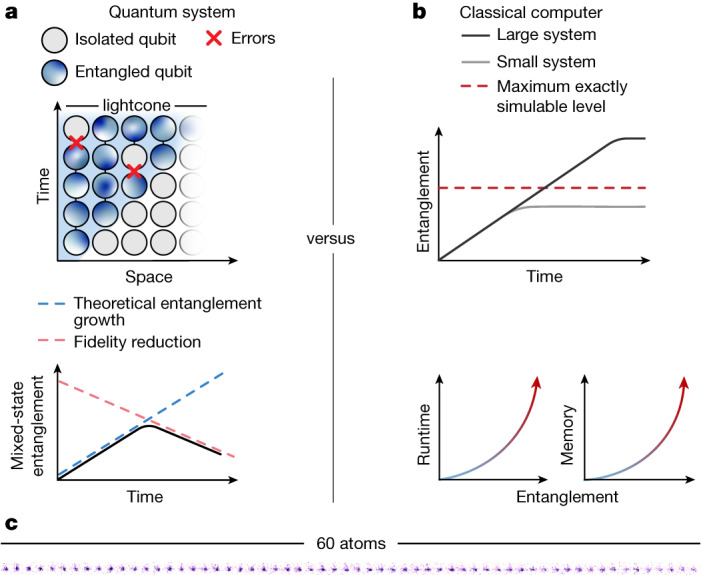
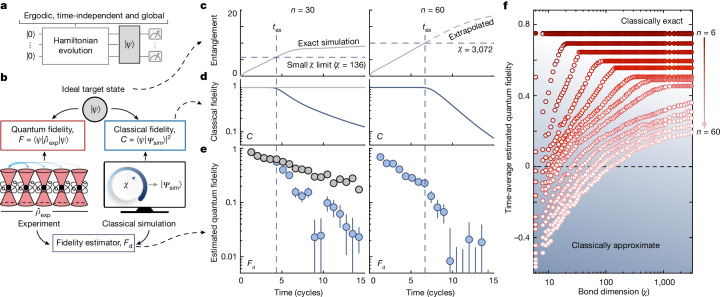
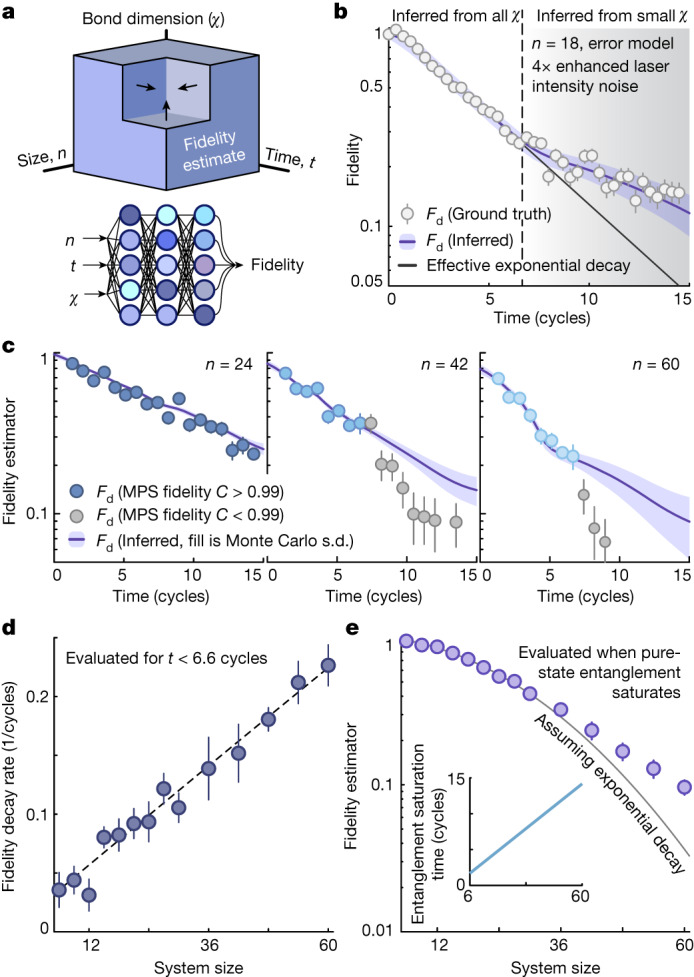
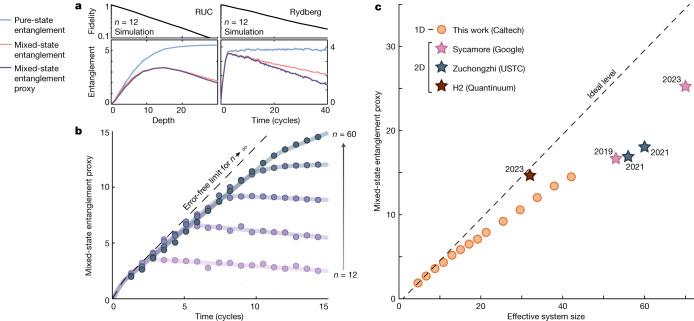
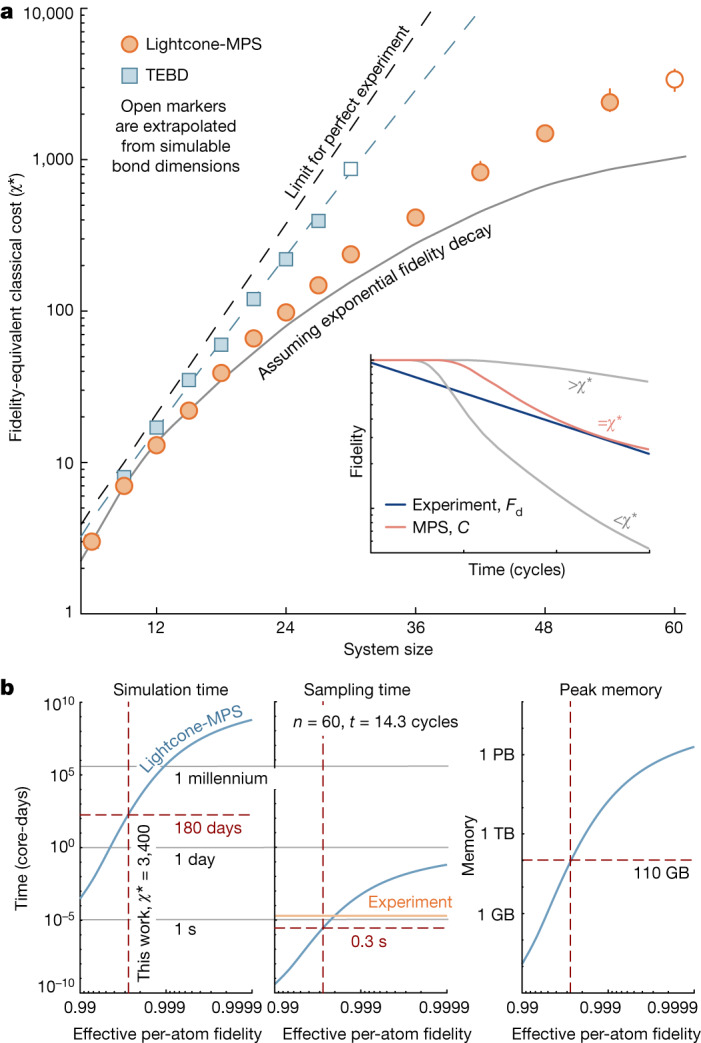
Quantum systems have entered a competitive regime in which classical computers must make approximations to represent highly entangled quantum states 1,2. However, in this beyond-classically-exact regime, fidelity comparisons between quantum and classical systems have so far been limited to digital quantum devices 2–5, and it remains unsolved how to estimate the actual entanglement content of experiments 6. Here, we perform fidelity benchmarking and mixed-state entanglement estimation with a 60-atom analogue Rydberg quantum simulator, reaching a high-entanglement entropy regime in which exact classical simulation becomes impractical. Our benchmarking protocol involves extrapolation from comparisons against an approximate classical algorithm, introduced here, with varying entanglement limits. We then develop and demonstrate an estimator of the experimental mixed-state entanglement 6, finding our experiment is competitive with state-of-the-art digital quantum devices performing random circuit evolution 2–5. Finally, we compare the experimental fidelity against that achieved by various approximate classical algorithms, and find that only the algorithm we introduce is able to keep pace with the experiment on the classical hardware we use. Our results enable a new model for evaluating the ability of both analogue and digital quantum devices to generate entanglement in the beyond-classically-exact regime, and highlight the evolving divide between quantum and classical systems.
Overview
The claims and statistics of this paper haven’t been checked yet.
Free: it reads the open-access text and checks the first 5 claims that cite a source we can check. Create a free account to check every claim.
Integrity signals
Registry
Cites
Statistics
Figures
Verification
Claims the paper makes
The claims and statistics of this paper haven’t been checked yet.
Free: it reads the open-access text and checks the first 5 claims that cite a source we can check. Create a free account to check every claim.
Self-check
Percentages, sums and reported differences re-computed from the paper’s own numbers.
The self-check needs the paper’s full text.
Citations
Cites
Quantum Computing in the NISQ era and beyond
Preskill, J. (2018) · Quantum · doi:10.22331/q-2018-08-06-79 · Cited by 8,830
Quantum supremacy using a programmable superconducting processor
Arute, F., Arya, K., Babbush, R., Bacon, D., Bardin, J. C., Barends, R., Biswas, R., Boixo, S., Brandao, F. G. S. L., Buell, D. A., et al. (2019) · Nature · doi:10.1038/s41586-019-1666-5 · Cited by 7,720
Self-citationComputable measure of entanglement
Vidal, G., & Werner, R. F. (2002) · Physical Review A · doi:10.1103/physreva.65.032314 · Cited by 4,896
Colloquium : Area laws for the entanglement entropy
Eisert, J., Cramer, M., & Plenio, M. B. (2010) · Reviews of Modern Physics · doi:10.1103/revmodphys.82.277 · Cited by 2,873
Efficient Classical Simulation of Slightly Entangled Quantum Computations
Vidal, G. (2003) · Physical Review Letters · doi:10.1103/physrevlett.91.147902 · Cited by 2,368
Noisy intermediate-scale quantum algorithms
Bharti, K., Cervera-Lierta, A., Kyaw, T. H., Haug, T., Alperin-Lea, S., Anand, A., Degroote, M., Heimonen, H., Kottmann, J. S., Menke, T., et al. (2022) · Reviews of Modern Physics · doi:10.1103/revmodphys.94.015004 · Cited by 2,231
Ensemble deep learning: A review
Ganaie, M. A., Hu, M., Malik, A. K., Tanveer, M., & Suganthan, P. N. (2022) · Engineering Applications of Artificial Intelligence · doi:10.1016/j.engappai.2022.105151 · Cited by 2,143
Efficient Simulation of One-Dimensional Quantum Many-Body Systems
Vidal, G. (2004) · Physical Review Letters · doi:10.1103/physrevlett.93.040502 · Cited by 1,779 · cited 2×
“We consider several classical algorithms (for example, time-evolving block decimation, TEBD 45 ), all of which become impractical at moderate system sizes.”
Average Entropy of a Subsystem
Page, D. N. (1993) · arXiv · doi:10.48550/arxiv.gr-qc/9305007 · Cited by 1,578
Average entropy of a subsystem
Page, D. N. (1993) · Physical Review Letters · doi:10.1103/physrevlett.71.1291 · Cited by 1,578 · cited 10×
“For each case we provide numeric or analytic evidence showing that at worst our entanglement-proxy lower bound is potentially violated by an O(1) amount.”
InfluentialLogarithmic Negativity: A Full Entanglement Monotone That is not Convex
Plenio, M. B. (2005) · Physical Review Letters · doi:10.1103/physrevlett.95.090503 · Cited by 1,530 · cited 2×
“An alternative, computable measure of mixed-state entanglement is the log negativity 6 , N E , which is an upper bound to the distillable entanglement of the system 37 .”
Quantum simulations with ultracold atoms in optical lattices
Gross, C., & Bloch, I. (2017) · Science · doi:10.1126/science.aal3837 · Cited by 1,527
Error Mitigation for Short-Depth Quantum Circuits
Temme, K., Bravyi, S., & Gambetta, J. M. (2017) · Physical Review Letters · doi:10.1103/physrevlett.119.180509 · Cited by 1,379
Many-body physics with individually controlled Rydberg atoms
Browaeys, A., & Lahaye, T. (2020) · Nature Physics · doi:10.1038/s41567-019-0733-z · Cited by 1,166
Measuring entanglement entropy in a quantum many-body system
Islam, R., Ma, R., Preiss, P. M., Eric Tai, M., Lukin, A., Rispoli, M., & Greiner, M. (2015) · Nature · doi:10.1038/nature15750 · Cited by 1,158
Quantum thermalization through entanglement in an isolated many-body system
Kaufman, A. M., Tai, M. E., Lukin, A., Rispoli, M., Schittko, R., Preiss, P. M., & Greiner, M. (2016) · Science · doi:10.1126/science.aaf6725 · Cited by 1,116
Strong Quantum Computational Advantage Using a Superconducting Quantum Processor
Wu, Y., Bao, W.-S., Cao, S., Chen, F., Chen, M.-C., Chen, X., Chung, T.-H., Deng, H., Du, Y., Fan, D., et al. (2021) · Physical Review Letters · doi:10.1103/physrevlett.127.180501 · Cited by 1,059
Quantum phases of matter on a 256-atom programmable quantum simulator
Ebadi, S., Wang, T. T., Levine, H., Keesling, A., Semeghini, G., Omran, A., Bluvstein, D., Samajdar, R., Pichler, H., Ho, W. W., et al. (2021) · Nature · doi:10.1038/s41586-021-03582-4 · Cited by 995
Self-citationQuantum Phases of Matter on a 256-Atom Programmable Quantum Simulator
Ebadi, S., Wang, T. T., Levine, H., Keesling, A., Semeghini, G., Omran, A., Bluvstein, D., Samajdar, R., Pichler, H., Ho, W. W., et al. (2020) · arXiv · doi:10.48550/arxiv.2012.12281 · Cited by 995
Self-citationGoals and opportunities in quantum simulation
Cirac, J. I., & Zoller, P. (2012) · Nature Physics · doi:10.1038/nphys2275 · Cited by 891 · cited 2×
“However, in the beyond-classically-exact regime, these protocols have only been applied to digital quantum devices, with no such demonstrations on analogue quantum simulators 17 , that is, quantum devices tailored to efficiently encode select problems of interest 18–20 .”
Time-Dependent Variational Principle for Quantum Lattices
Haegeman, J., Cirac, J. I., Osborne, T. J., Pižorn, I., Verschelde, H., & Verstraete, F. (2011) · Physical Review Letters · doi:10.1103/physrevlett.107.070601 · Cited by 865 · cited 1×
“(48), we show the maximum possible violation of the lower bound provided by EP (i.”
Quantum phases of matter on a 256-atom programmable quantum simulator
Ebadi, S., Wang, T. T., Levine, H., Keesling, A., Semeghini, G., Omran, A., Bluvstein, D., Samajdar, R., Pichler, H., Ho, W. W., et al. (2020) · RePEc: Research Papers in Economics · Cited by 765
Self-citationValidating quantum computers using randomized model circuits
Cross, A. W., Bishop, L. S., Sheldon, S., Nation, P. D., & Gambetta, J. M. (2019) · Physical Review A · doi:10.1103/physreva.100.032328 · Cited by 704
Quantum simulation of 2D antiferromagnets with hundreds of Rydberg atoms
Scholl, P., Schuler, M., Williams, H. J., Eberharter, A. A., Barredo, D., Schymik, K.-N., Lienhard, V., Henry, L.-P., Lang, T. C., Lahaye, T., et al. (2021) · Nature · doi:10.1038/s41586-021-03585-1 · Cited by 688
Self-citationPractical quantum advantage in quantum simulation
Daley, A. J., Bloch, I., Kokail, C., Flannigan, S., Pearson, N., Troyer, M., & Zoller, P. (2022) · Nature · doi:10.1038/s41586-022-04940-6 · Cited by 669
Probing Rényi entanglement entropy via randomized measurements
Brydges, T., Elben, A., Jurcevic, P., Vermersch, B., Maier, C., Lanyon, B. P., Zoller, P., Blatt, R., & Roos, C. F. (2019) · Science · doi:10.1126/science.aau4963 · Cited by 611
Self-citationQuantum Simulators: Architectures and Opportunities
Altman, E., Brown, K. R., Carleo, G., Carr, L. D., Demler, E., Chin, C., DeMarco, B., Economou, S. E., Eriksson, M. A., Fu, K.-M. C., et al. (2021) · PRX Quantum · doi:10.1103/prxquantum.2.017003 · Cited by 559
A blueprint for demonstrating quantum supremacy with superconducting qubits
Neill, C., Roushan, P., Kechedzhi, K., Boixo, S., Isakov, S. V., Smelyanskiy, V., Megrant, A., Chiaro, B., Dunsworth, A., Arya, K., et al. (2018) · Science · doi:10.1126/science.aao4309 · Cited by 458
Self-citationHand-waving and interpretive dance: an introductory course on tensor networks
Bridgeman, J. C., & Chubb, C. T. (2017) · Journal of Physics A: Mathematical and Theoretical · doi:10.1088/1751-8121/aa6dc3 · Cited by 407
Phase transitions in random circuit sampling
Morvan, A., Villalonga, B., Mi, X., Mandrà, S., Bengtsson, A., Klimov, P. V., Chen, Z., Hong, S., Erickson, C., Drozdov, I., et al. (2024) · Nature · doi:10.1038/s41586-024-07998-6 · Cited by 354
Self-citationQuantum computing and the entanglement frontier
Preskill, J. (2012) · arXiv · doi:10.48550/arxiv.1203.5813 · Cited by 308
Mixed-State Entanglement from Local Randomized Measurements
Elben, A., Kueng, R., Huang, H.-Y. (., van Bijnen, R., Kokail, C., Dalmonte, M., Calabrese, P., Kraus, B., Preskill, J., Zoller, P., et al. (2020) · Physical Review Letters · doi:10.1103/physrevlett.125.200501 · Cited by 292
Self-citationQuantum computational advantage via 60-qubit 24-cycle random circuit sampling
Zhu, Q., Cao, S., Chen, F., Chen, M.-C., Chen, X., Chung, T.-H., Deng, H., Du, Y., Fan, D., Gong, M., et al. (2022) · Science Bulletin · doi:10.1016/j.scib.2021.10.017 · Cited by 263
High-fidelity gates and mid-circuit erasure conversion in an atomic qubit
Ma, S., Liu, G., Peng, P., Zhang, B., Jandura, S., Claes, J., Burgers, A. P., Pupillo, G., Puri, S., & Thompson, J. D. (2023) · Nature · doi:10.1038/s41586-023-06438-1 · Cited by 228 · cited 1×
“Finally, we have studied the equivalent classical cost of our experiment on the level of global fidelity, which we note could be greatly increased through the use of erasure conversion 21,56,57 .”
Erasure conversion for fault-tolerant quantum computing in alkaline earth Rydberg atom arrays
Wu, Y., Kolkowitz, S., Puri, S., & Thompson, J. D. (2022) · Nature Communications · doi:10.1038/s41467-022-32094-6 · Cited by 196
Convex-roof extended negativity as an entanglement measure for bipartite quantum systems
Lee, S., Chi, D. P., Oh, S. D., & Kim, J. (2003) · Physical Review A · doi:10.1103/physreva.68.062304 · Cited by 183
O'Donnell, R., & Wright, J. (2016) · Proceedings of the forty-eighth annual ACM symposium on Theory of Computing · doi:10.1145/2897518.2897544 · Cited by 181
0.5 petabyte simulation of a 45-qubit quantum circuit
Häner, T., & Steiger, D. S. (2017) · Proceedings of the International Conference for High Performance Computing, Networking, Storage and Analysis · doi:10.1145/3126908.3126947 · Cited by 180
A superconducting quantum simulator based on a photonic-bandgap metamaterial
Zhang, X., Kim, E., Mark, D. K., Choi, S., & Painter, O. J. (2023) · Science · doi:10.1126/science.ade7651 · Cited by 168
Self-citationNoisy intermediate-scale quantum (NISQ) algorithms
Bharti, K., Cervera-Lierta, A., Kyaw, T. H., Haug, T., Alperin-Lea, S., Anand, A., Degroote, M., Heimonen, H., Kottmann, J. S., Menke, T., et al. (2021) · arXiv · doi:10.48550/arxiv.2101.08448 · Cited by 166
Preparing random states and benchmarking with many-body quantum chaos
Choi, J., Shaw, A. L., Madjarov, I. S., Xie, X., Finkelstein, R., Covey, J. P., Cotler, J. S., Mark, D. K., Huang, H.-Y., Kale, A., et al. (2023) · Nature · doi:10.1038/s41586-022-05442-1 · Cited by 155
Self-citationCross-Platform Verification of Intermediate Scale Quantum Devices
Elben, A., Vermersch, B., van Bijnen, R., Kokail, C., Brydges, T., Maier, C., Joshi, M. K., Blatt, R., Roos, C. F., & Zoller, P. (2020) · Physical Review Letters · doi:10.1103/physrevlett.124.010504 · Cited by 151
Self-citationEntanglement Negativity at Measurement-Induced Criticality
Sang, S., Li, Y., Zhou, T., Chen, X., Hsieh, T. H., & Fisher, M. P. A. (2021) · PRX Quantum · doi:10.1103/prxquantum.2.030313 · Cited by 151
Measuring the capabilities of quantum computers
Proctor, T., Rudinger, K., Young, K., Nielsen, E., & Blume-Kohout, R. (2022) · Nature Physics · doi:10.1038/s41567-021-01409-7 · Cited by 146 · cited 2×
“One such approach is to study the fidelity of preparing a highly entangled target state of interest 2 , with several efficient fidelity estimators 12–16 having been introduced in recent years.”
Entanglement negativity and topological order
Lee, Y. A., & Vidal, G. (2013) · Physical Review A · doi:10.1103/physreva.88.042318 · Cited by 143
Erasure conversion in a high-fidelity Rydberg quantum simulator
Scholl, P., Shaw, A. L., Tsai, R. B.-S., Finkelstein, R., Choi, J., & Endres, M. (2023) · Nature · doi:10.1038/s41586-023-06516-4 · Cited by 141
Self-citationPhase transition in Random Circuit Sampling
Morvan, A., Villalonga, B., Mi, X., Mandrà, S., Bengtsson, A., Klimov, P. V., Chen, Z., Hong, S., Erickson, C., Drozdov, I. K., et al. (2023) · arXiv · doi:10.48550/arxiv.2304.11119 · Cited by 138
Self-citationDetecting Topological Order at Finite Temperature Using Entanglement Negativity
Lu, T.-C., Hsieh, T. H., & Grover, T. (2020) · Physical Review Letters · doi:10.1103/physrevlett.125.116801 · Cited by 130
Theoretical and Experimental Perspectives of Quantum Verification
Carrasco, J. A., Elben, A., Kokail, C., Kraus, B., & Zoller, P. (2021) · PRX Quantum · doi:10.1103/prxquantum.2.010102 · Cited by 127
Self-citationLocality and Digital Quantum Simulation of Power-Law Interactions
Tran, M. C., Guo, A. Y., Su, Y., Garrison, J. R., Eldredge, Z., Foss‐Feig, M., Childs, A. M., & Gorshkov, A. V. (2019) · Physical Review X · doi:10.1103/physrevx.9.031006 · Cited by 127
Measuring the Rényi entropy of a two-site Fermi-Hubbard model on a trapped ion quantum computer
Linke, N. M., Johri, S., Figgatt, C., Landsman, K. A., Matsuura, A. Y., & Monroe, C. (2018) · Physical Review A · doi:10.1103/physreva.98.052334 · Cited by 112
Quantum advantage and stability to errors in analogue quantum simulators
Trivedi, R., Franco-Rubio, A., & Cirac, J. I. (2024) · Nature Communications · doi:10.1038/s41467-024-50750-x · Cited by 103
Cross-platform comparison of arbitrary quantum states
Zhu, D., Cian, Z.-P., Noel, C., Risinger, A., Biswas, D., Egan, L., Zhu, Y., Green, A., Alderete, C. H., Nguyen, N. H., et al. (2022) · Nature Communications · doi:10.1038/s41467-022-34279-5 · Cited by 82
Benchmarking Quantum Simulators Using Ergodic Quantum Dynamics
Mark, D. K., Choi, J., Shaw, A. L., Endres, M., & Choi, S. (2023) · Physical Review Letters · doi:10.1103/physrevlett.131.110601 · Cited by 80
Self-citationWhole‐Device Entanglement in a 65‐Qubit Superconducting Quantum Computer
Mooney, G. J., White, G. A. L., Hill, C. D., & Hollenberg, L. C. L. (2021) · Advanced Quantum Technologies · doi:10.1002/qute.202100061 · Cited by 79
Scalable Randomized Benchmarking of Quantum Computers Using Mirror Circuits
Proctor, T., Seritan, S., Rudinger, K., Nielsen, E., Blume-Kohout, R., & Young, K. (2022) · Physical Review Letters · doi:10.1103/physrevlett.129.150502 · Cited by 68
Effective quantum volume, fidelity and computational cost of noisy quantum processing experiments
Kechedzhi, K., Isakov, S. V., Mandrà, S., Villalonga, B., Mi, X., Boixo, S., & Smelyanskiy, V. (2024) · Future Generation Computer Systems · doi:10.1016/j.future.2023.12.002 · Cited by 42
Entanglement between two subsystems, the Wigner semicircle and extreme-value statistics
Bhosale, U. T., Tomsovic, S., & Lakshminarayan, A. (2012) · Physical Review A · doi:10.1103/physreva.85.062331 · Cited by 37
Density Matrix Renormalization Group with Tensor Processing Units
Ganahl, M., Beall, J., Hauru, M., Lewis, A. G. M., Wojno, T., Yoo, J. H., Zou, Y., & Vidal, G. (2023) · PRX Quantum · doi:10.1103/prxquantum.4.010317 · Cited by 37
Dark-State Enhanced Loading of an Optical Tweezer Array
Shaw, A. L., Scholl, P., Finklestein, R., Madjarov, I. S., Grinkemeyer, B., & Endres, M. (2023) · Physical Review Letters · doi:10.1103/physrevlett.130.193402 · Cited by 30
Self-citationComplexity Phase Transitions Generated by Entanglement
Ghosh, S., Deshpande, A., Hangleiter, D., Gorshkov, A. V., & Fefferman, B. (2023) · Physical Review Letters · doi:10.1103/physrevlett.131.030601 · Cited by 25
Hauru, M., Morningstar, A., Beall, J., Ganahl, M., Lewis, A. G. M., & Vidal, G. (2021) · arXiv (Cornell University) · doi:10.48550/arxiv.2111.10466 · Cited by 20
Negativity of random pure states
Datta, A. (2010) · Physical Review A · doi:10.1103/physreva.81.052312 · Cited by 16
Quantum Computational Advantage via 60-Qubit 24-Cycle Random Circuit SamplingPreprint
Zhu, Q., Cao, S., Chen, F., et al. (2021) · arXiv (Cornell University) · doi:10.48550/arxiv.2109.03494 · Cited by 14
Benchmarking Quantum Simulators using Ergodic Quantum Dynamics
Mark, D. K., Choi, J., Shaw, A. L., et al. (2022) · PubMed · doi:10.48550/arxiv.2205.12211 · Cited by 10
Self-citationErasure conversion in a high-fidelity Rydberg quantum simulatorPreprint
Scholl, P., Shaw, A. L., Tsai, R. B.-S., et al. (2023) · arXiv (Cornell University) · doi:10.48550/arxiv.2305.03406 · Cited by 7
Self-citationRandom quantum circuits transform local noise into global white noisePreprint
Dalzell, A. M., Hunter-Jones, N., & Brandão, F. G. S. L. (2021) · arXiv (Cornell University) · doi:10.48550/arxiv.2111.14907
Research works printed but not linked: 5
- Zhou Y Stoudenmire EM Waintal X What limits the simulation of quantum computers? Phys. Rev. X 2020 10 41038
- Nielsen, M. A. & Chuang, I. L. Quantum Computation and Quantum Information (Cambridge Univ. Press, 2010).
- Haah J Hastings MB Kothari R Low GH Quantum algorithm for simulating real time evolution of lattice Hamiltonians SIAM J. Comput. 2021 52 6
- Haah J Harrow AW Ji Z Wu X Yu N Sample-optimal tomography of quantum states IEEE Trans. Inform. Theory 2017 63 5628
- Li Y Benjamin SC Efficient variational quantum simulator incorporating active error minimization Phys. Rev. X 2017 7 21050
Cited by
Logical quantum processor based on reconfigurable atom arrays
Bluvstein, D., Evered, S. J., Geim, A. A., Li, S. H., Zhou, H., Manovitz, T., Ebadi, S., Cain, M., Kalinowski, M., Hangleiter, D., et al. (2024) · Nature · doi:10.1038/s41586-023-06927-3 · Cited by 1,119
“To characterize the distribution overlap, we use the cross-entropy benchmark (XEB) 18,47 , which is a weighted sum between the measured probability distribution and the ideal calculated distribution, normalized such that XEB = 1 corresponds to perfectly reproducing the ideal distribution and XEB =…”
MethodA tweezer array with 6,100 highly coherent atomic qubits
Manetsch, H. J., Nomura, G., Bataille, E., Lv, X., Leung, K. H., & Endres, M. (2025) · Nature · doi:10.1038/s41586-025-09641-4 · Cited by 491
Self-citationPhase transitions in random circuit sampling
Morvan, A., Villalonga, B., Mi, X., Mandrà, S., Bengtsson, A., Klimov, P. V., Chen, Z., Hong, S., Erickson, C., Drozdov, I., et al. (2024) · Nature · doi:10.1038/s41586-024-07998-6 · Cited by 354
Self-citationQuantum dynamics in Krylov space: Methods and applications
Nandy, P., Matsoukas-Roubeas, A. S., Martínez-Azcona, P., Dymarsky, A. Y., & del Campo, A. (2025) · Physics Reports · doi:10.1016/j.physrep.2025.05.001 · Cited by 344
Random unitaries in extremely low depth
Schuster, T., Haferkamp, J., & Huang, H.-Y. (2025) · Science · doi:10.1126/science.adv8590 · Cited by 303
Metadata
- Authors
- Shaw, A. L., Chen, Z., Choi, J., Mark, D. K., Scholl, P., Finkelstein, R., Elben, A., Choi, S., & Endres, M.
- Affiliations
- California Institute of Technology (US)
- The NSF AI Institute for Artificial Intelligence and Fundamental Interactions (US)
- Massachusetts Institute of Technology (US)
- Corresponding author
- Shaw, Adam L.
- Choi, Soonwon
- Endres, Manuel
- ORCID
- Venue
- Nature
- Published
- 2024-03-20
- Volume
- 628
- Issue
- 8006
- Pages
- 71-77
- ISSN
- 0028-0836 (ISSN-L)
- 1476-4687
- PMC
- PMC10990925
- OpenAlex
- W4392984773
- Cited by
- 64
- References
- 54
- Citations by year
- 2026: 19 · 2025: 34 · 2024: 10
- FWCI
- 9.26
- Type
- journal article
- Language
- en
- Open access
- hybrid
- doi.org
- Licence
- cc-by
- creativecommons.org/licenses/by/4.0 (tdm)
- creativecommons.org/licenses/by/4.0 (vor)
- Locations
- Nature (publishedVersion, cc-by)
- PubMed Central (publishedVersion, cc-by)
- PubMed (publishedVersion)
- arXiv (Cornell University) (submittedVersion)
- RePEc: Research Papers in Economics (submittedVersion)
- arXiv (Cornell University)
- Funders
- National Science Foundation (2016245, 1733907, 2237244, CAREER, 1753386)
- U.S. Department of Energy (DESC0021951)
- California Institute of Technology (PHY-1733907, 1733907)
- Deutsche Akademie der Naturforscher Leopoldina - Nationale Akademie der Wissenschaften (LPDS 2021-02)
- Defense Advanced Research Projects Agency (W911NF2010021, 134371-5113608)
- Office of Science
- Advanced Research Projects Agency
- Multidisciplinary University Research Initiative (W911NF2010136)
- Walter Burke Institute for Theoretical Physics
- Institute for Quantum Information and Matter, California Institute of Technology (PHY-1733907)
- Air Force Office of Scientific Research (FA9550-, FA9550-19-1-0044)
- Army Research Office (2016245, W911NF2010136)
- Topics
- Physical Sciences › Computer Science › Artificial Intelligence › Quantum Computing Algorithms and Architecture
- Physical Sciences › Physics and Astronomy › Atomic and Molecular Physics, and Optics › Quantum many-body systems
- Physical Sciences › Physics and Astronomy › Atomic and Molecular Physics, and Optics › Quantum Information and Cryptography
- Keywords
- analog quantum simulation, entanglement entropy, quantum-classical comparison
About these checks
Registry, retraction, Cites and statistics results are computed, not judged, with one exception: a printed reference that no index lists is read once by a model before it counts as a citation error. Claims are extracted by a model and kept only when their quote appears verbatim in the text; each cited source is then checked, with a model’s help, for whether it says what the claim relies on. Those verdicts can be wrong — read the claim’s quote and the cited source before relying on one.
Statistics and arithmetic are recomputed, not judged.
Confidence bands are shown only for fields calibrated on our annotated test set. None is calibrated yet, so no band is shown.
What counts as a claim ›How we measure confidence ›How we check this ›
Are you an author, or do you see a problem with this page? Request a review
Data sources
Bibliographic data: Semantic Scholar, OpenAlex, Crossref.
Contains information from the Semantic Scholar Academic Graph Datasets, made available under the ODC Attribution License (ODC-BY 1.0).
Semantic Scholar’s data is described in: Kinney, R., et al. (2023). The Semantic Scholar Open Data Platform. arXiv:2301.10140.
