

Space radiation measurements during the Artemis I lunar mission
Open accessThe DOI matches its Crossref record; 41 of the 46 references it cites were found in a registry or an index; 6 of the 37 sources its claims cite were checked for support.
Abstract
Abstract Space radiation is a notable hazard for long-duration human spaceflight 1 . Associated risks include cancer, cataracts, degenerative diseases 2 and tissue reactions from large, acute exposures 3 . Space radiation originates from diverse sources, including galactic cosmic rays 4 , trapped-particle (Van Allen) belts 5 and solar-particle events 6 . Previous radiation data are from the International Space Station and the Space Shuttle in low-Earth orbit protected by heavy shielding and Earth’s magnetic field 7,8 and lightly shielded interplanetary robotic probes such as Mars Science Laboratory and Lunar Reconnaissance Orbiter 9,10 . Limited data from the Apollo missions 11–13 and ground measurements with substantial caveats are also available 14 . Here we report radiation measurements from the heavily shielded Orion spacecraft on the uncrewed Artemis I lunar mission. At differing shielding locations inside the vehicle, a fourfold difference in dose rates was observed during proton-belt passes that are similar to large, reference solar-particle events. Interplanetary cosmic-ray dose equivalent rates in Orion were as much as 60% lower than previous observations 9 . Furthermore, a change in orientation of the spacecraft during the proton-belt transit resulted in a reduction of radiation dose rates of around 50%. These measurements validate the Orion for future crewed exploration and inform future human spaceflight mission design.
Overview
CoChat Summary
## TL;DR
Artemis I radiation measurements inside Orion showed strong shielding-dependent differences during belt passages, with up to a fourfold spread in dose rate and a 50% reduction when the spacecraft rotated to place thicker structures into the incoming proton field. In interplanetary cruise, GCR dose equivalent rates were 0.96–1.24 mSv d−1, with total mission dose equivalents of 26.7–35.4 mSv.
## Key findings
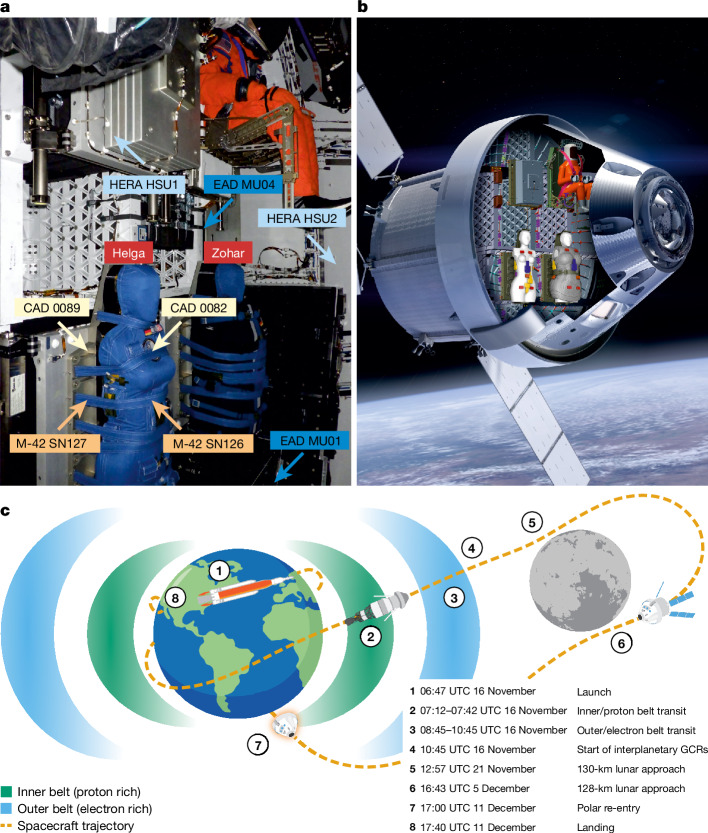
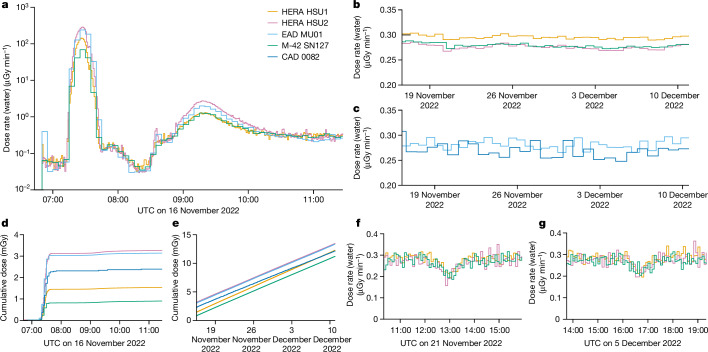
- During inner proton-belt passes, dose rates differed by up to fourfold across Orion: 69 µGy min−1 at the most shielded location (M-42 SN127) versus 240 µGy min−1 (EAD MU01) and 287 µGy min−1 (HERA HSU2) at the least shielded locations.
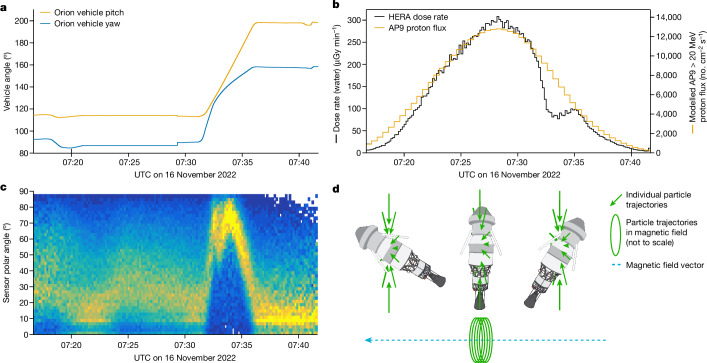
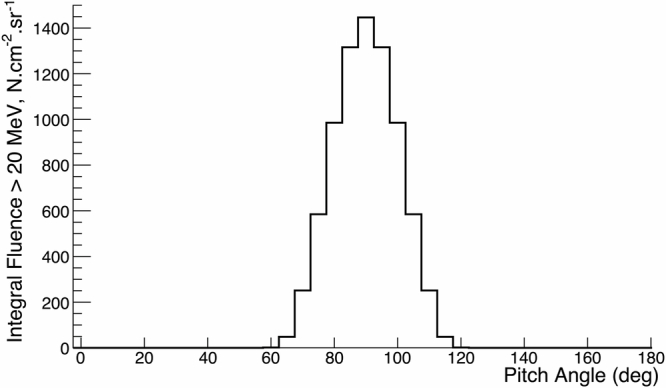
- Orion’s 90° rotation during trans-lunar injection reduced dose rate by about 50%; HERA measurements showed a 90° shift in proton pitch angle toward Orion’s long axis, and the authors attribute the reduction to bulkier parts moving into the proton plane.
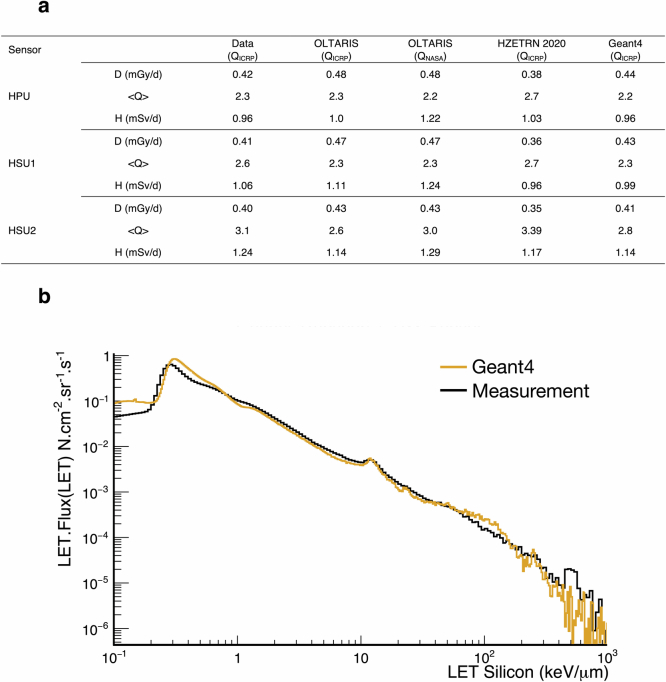
- In the 25-day interplanetary GCR phase, dose rates were similar across instruments, and HERA mean quality factors were 2.30, 2.63, and 3.06 in different locations.
- GCR dose equivalent rates were 0.96–1.24 mSv d−1, which the authors say is lower than MSL-RAD (1.58 mSv d−1) and CRaTER (1.55 mSv d−1), and total mission dose equivalents were 26.7–35.4 mSv, with 1.80–3.94 mSv from belt passes.
## Methods
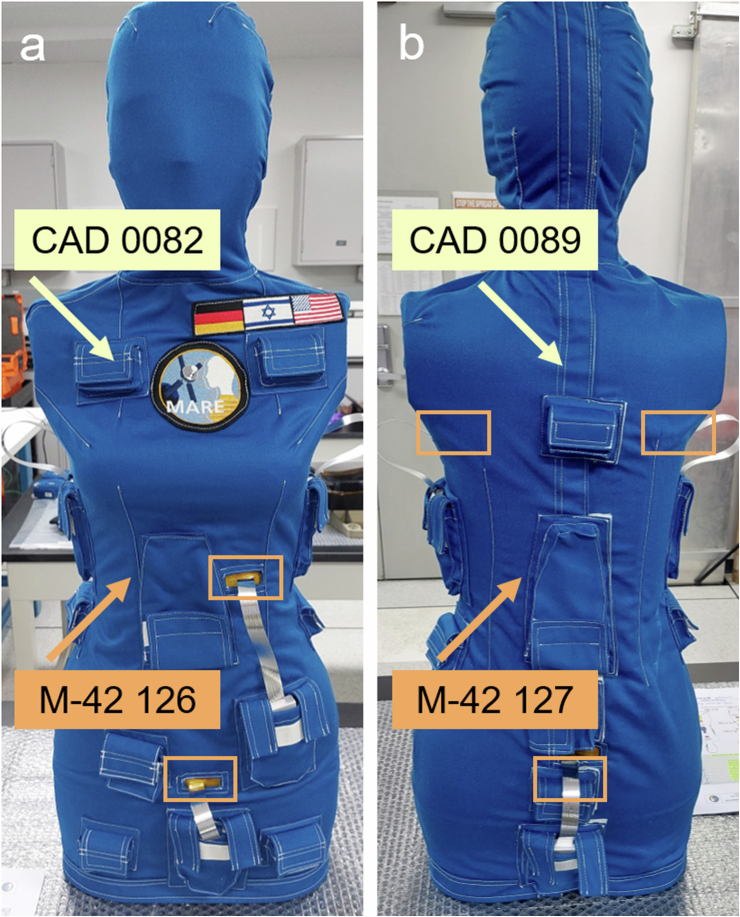
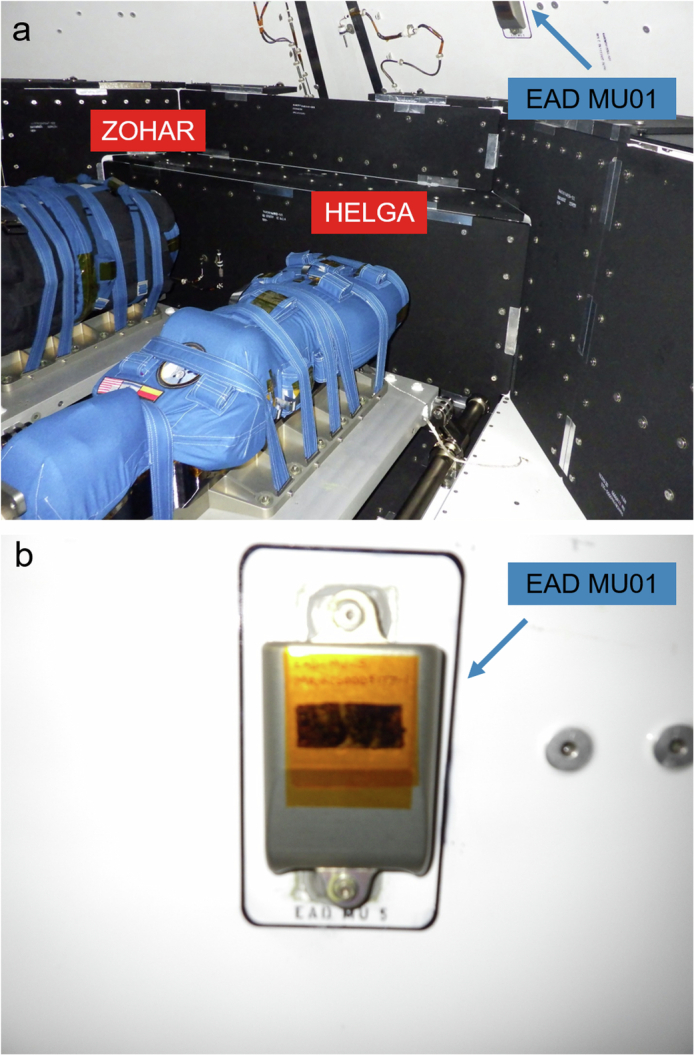
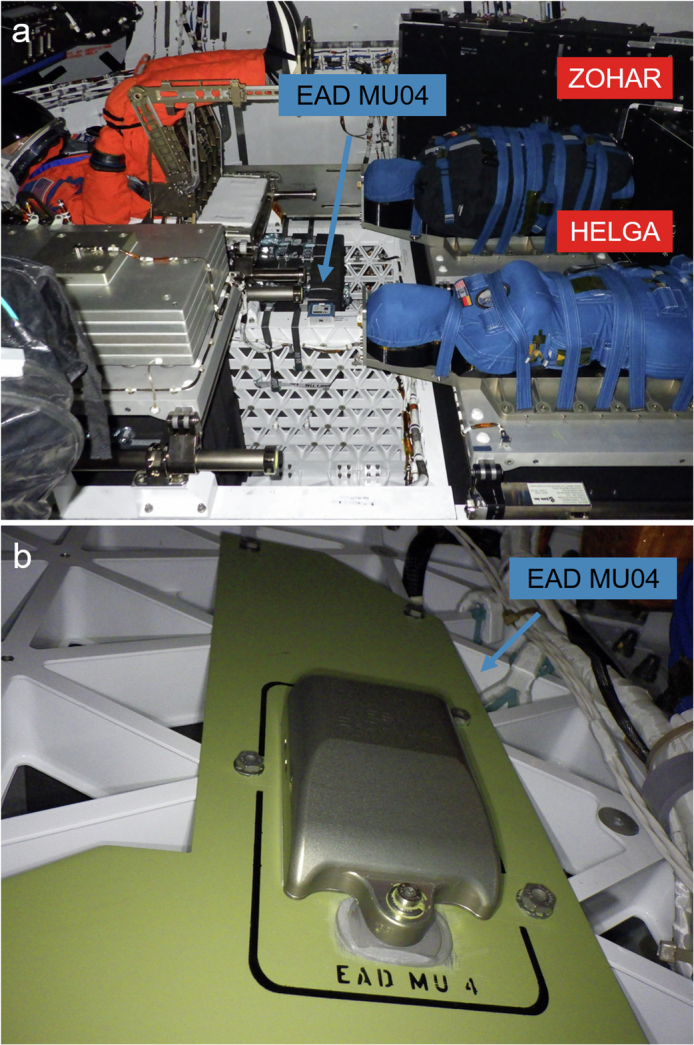
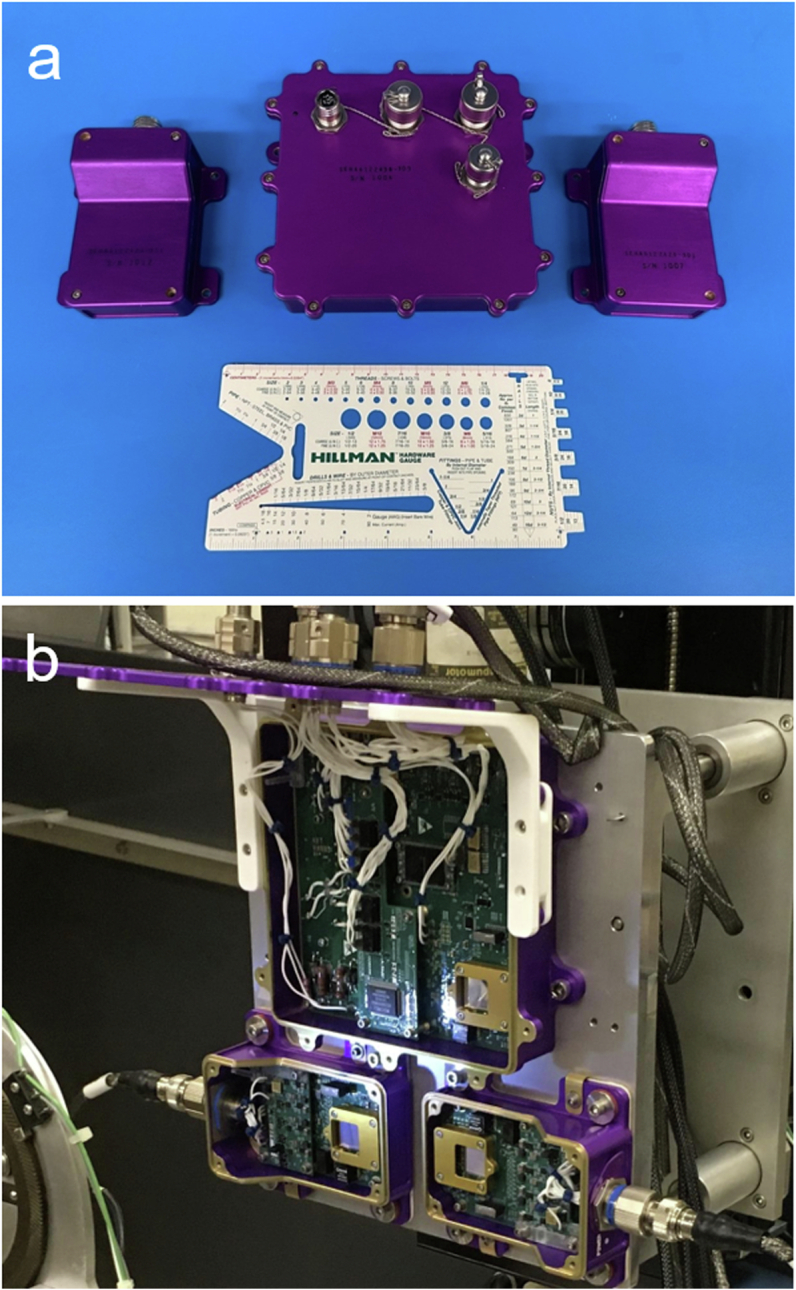
- Radiation was measured throughout the uncrewed Artemis I mission in Orion using fixed-location detectors: NASA HERA, ESA EAD, DLR M-42, and NASA CAD, including detectors on or inside the MARE female phantoms Helga and Zohar.
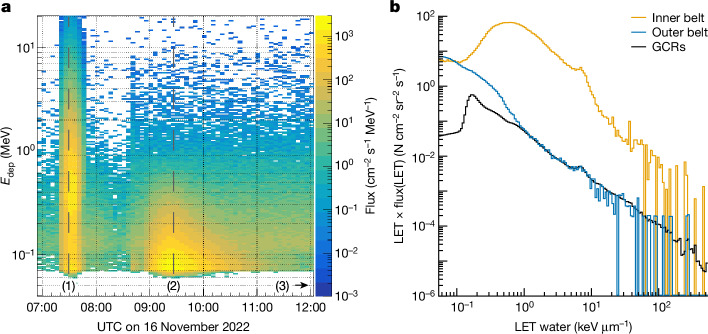
- Main analyses used time-resolved absorbed dose, LET spectra, and quality-factor calculations from detector data, plus Monte Carlo bootstrapping for uncertainty in quality factors and dose equivalent.
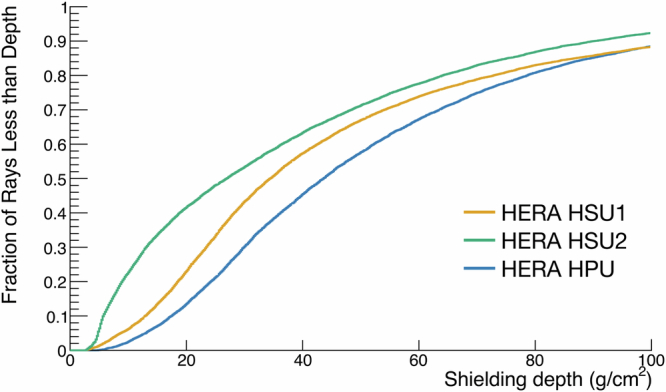
- The paper also compared measurements with transport simulations using OLTARIS/HZETRN and Geant4, with Orion shielding estimated from high-fidelity CAD models and ray tracing.
## Limitations
- The paper states a 10% systematic error for all detectors and a 5% uncertainty for the Si/H2O conversion, giving an estimated 11.1% systematic error in dose rate.
- It also notes that the quality-factor uncertainty was estimated by Monte Carlo bootstrapping with assumptions about systematic, counting, and per-hit energy-resolution errors; this is a methodological limitation stated in the paper.
- Evident from the text: not all detector data were used in the study—e.g., only 2 of 18 CAD systems, 2 of 5 EAD units, and 7 of 16 M-42 detectors were analyzed here, so results reflect selected instruments rather than the full detector suite.
Model-written summary. Check it against the paper before relying on it.
Integrity signals
Registry
Cites
Statistics
Figures
Verification
Claims the paper makes
5 Valid · 0 Not valid · 18 Not checked · 27 Own results and interpretations
The sources with a verdict support this claim; the rest weren’t checked yet, have no full text we could read, or their verdicts aren’t rated yet.
In the paper
“We compared Artemis I measurements with four different modelling solutions using the HZETRN28–31 and the Geant4 (ref. 32) transport codes that transported the Badhwar-O’Neill model33 of GCR flux through shielding and show broad agreement with experimental data (Extended Data Fig. 7).”
§ Space radiation measurements during the Artemis I lunar mission > Main
What the sources say
- Not checked — no full text of the sourcecites [28] Wilson, J. W., Slaba, T. C., Badavi, F. F., Reddell, B. D. & Bahadori, A. A. Advances in NASA radiation transport research: 3DHZETRN. Life Sci. Space Res. 2, 6–22 (2014). source
- Not checked — no full text of the sourcecites [29] Slaba, T. C., Wilson, J. W., Werneth, C. M. & Whitman, K. Updated deterministic radiation transport for future deep space missions. Life Sci. Space Res. 27, 6–18 (2020). 34756231 source
- Not checked — no full text of the sourcecites [30] Norbury, J. W., Slaba, T. C., Sobolevsky, N. & Reddell, B. Comparing HZETRN, SHIELD, FLUKA and GEANT transport codes. Life Sci. Space Res. 14, 64–73 (2017). PMC7757342 28887946 source
- Not checked — no full text of the sourcecites [31] Singleterry, R. C. et al. OLTARIS: on-line tool for the assessment of radiation in space. Acta Astronaut. 68, 1086–1097 (2011). source
- Not checked — no full text of the sourcecites [32] Agostinelli, S. et al. GEANT4—a simulation toolkit. Nucl. Instrum. Methods Phys. Res. A 506, 250–303 (2003). source
- Supportedcites [33] Slaba, T. C. & Whitman, K. The Badhwar-O’Neill 2020 GCR model. Space Weather 18, e2020SW002456 (2020). source
Citation 33 is attached specifically to the Badhwar-O’Neill model, not to the Artemis I comparison or the transport codes. The Introduction identifies the Badhwar-O’Neill model as a model of the galactic cosmic ray environment, so the citation supports that identification. (LLM, conf=0.93)
plainstates an association- Asserted: passes — The authors put it forward as true.
- Checkable: passes — It can be checked against evidence.
- Load-bearing: passes — The paper’s conclusions depend on it.
- Based: passes — The paper gives a reason why it holds.
The cited sources support only part of this claim — read each source’s verdict below.
In the paper
“These include orbits with frequent belt passes, such as an Artemis abort scenario, as well as the onset of solar-particle events27.”
§ Space radiation measurements during the Artemis I lunar mission > Main
What the sources say
- Partly supportedcites [27] van den Berg, J., Strauss, D. T. & Effenberger, F. A primer on focused solar energetic particle transport. Space Sci. Rev. 216, 146 (2020). sourceExperimental — accuracy not yet measured
Section 2.2 (p. 6) says solar energetic particle events are anisotropic, and Section 3.3.3 (p. 24) discusses particle propagation direction during an event. Those passages support a directional aspect of solar-particle events, but the paper does not say that preferential spacecraft orientations apply at their onset or to frequent radiation-belt passes, including an Artemis abort scenario. (LLM, conf=0.82)
plainstates an association- Asserted: passes — The authors put it forward as true.
- Checkable: passes — It can be checked against evidence.
- Load-bearing: passes — The paper’s conclusions depend on it.
- Based: passes — The paper gives a reason why it holds.
- Partly supported
A result the paper reports from its own data — it cites no other source for it, so there is none to check. The quote shows it is in the paper.
In the paper
“No solar-particle events occurred during the Artemis I mission”
- Also stated in: § Main · plain
“No solar-particle events occurred during the Artemis I mission and the only changes in the environment were dose reductions of the GCR values of a third owing to the solid angle blocked by the Moon during close approaches (Fig. 2f,g).”
§ Space radiation measurements during the Artemis I lunar mission > Main
plain- Asserted: passes — The authors put it forward as true.
- Checkable: passes — It can be checked against evidence.
- Load-bearing: passes — The paper’s conclusions depend on it.
- Based: passes — The paper gives a reason why it holds.
- Also stated in: § Main · plain
A result the paper reports from its own data — it cites no other source for it, so there is none to check. The quote shows it is in the paper.
In the paper
“Measurements of the proton pitch angle by HERA show a 90° shift towards the long axis of Orion (Fig. 3c).”
§ Space radiation measurements during the Artemis I lunar mission > Main
plainstates a cause- Asserted: passes — The authors put it forward as true.
- Checkable: passes — It can be checked against evidence.
- Load-bearing: passes — The paper’s conclusions depend on it.
- Based: passes — The paper gives a reason why it holds.
In the paper
“Measurements with M-42 (Table 1) inside and outside the MARE Helga phantom show that inner proton belt doses vary roughly twofold from the least (right lung) to the most (spine) shielded internal organs and the front skin dose has a threefold increase compared with the spine.”
§ Space radiation measurements during the Artemis I lunar mission > Main
What the sources say
- Not matchedcites Table 1
This doesn’t read as a citation we can look up.
plainstates an associationSingle case- Asserted: passes — The authors put it forward as true.
- Checkable: passes — It can be checked against evidence.
- Load-bearing: unclear — It is unclear whether the paper’s conclusions depend on it.
- Based: passes — The paper gives a reason why it holds.
- Not matched
27 more claims
Create a free account to see all 50 claims and to verify the 1 reference still open.
- Probably not a substantial claim. 4
- It may state two separate claims as one. 14
Claims other papers make about this one
Each is checked against this paper’s own text: does it say what the citing paper says it does?
The source backs part of the claim, not all of it — or backs it for a different population, condition or comparison.
In the citing paper
“In addition, the AE9/AP9 models do not account for the directionality of the trapped radiation, which has been shown by a companion study using MARE data to have a nonnegligible impact on dose (36).”
From First evaluation of wearable radiation protection for human deep space exploration, as flown on Artemis I (2026) · cites this paper as [36]
Experimental — accuracy not yet measuredThe check wasn’t confident either way, so it gives no verdict — never disputed.
In the citing paper
“The phantom at seat 4, provided by DLR, was named Helga and was not equipped with a vest, serving as the radiation exposure baseline (Helga was not an exact experimental control as the median aluminum shielding was 24.84 g/cm2 at seat 4 versus 24.40 g/cm2 at seat 3) (35, 36).”
From First evaluation of wearable radiation protection for human deep space exploration, as flown on Artemis I (2026) · cites this paper as [36]
Experimental — accuracy not yet measured
Citations
Cites
Agostinelli, S., Allison, J., Amako, K., Apostolakis, J., Araujo, H., Arce, P., Asai, M., Axen, D., Banerjee, S., Barrand, G., et al. (2003) · Nuclear Instruments and Methods in Physics Research Section A: Accelerators, Spectrometers, Detectors and Associated Equipment · doi:10.1016/s0168-9002(03)01368-8 · Cited by 25,106 · cited 1×
“32) transport codes that transported the Badhwar-O’Neill model 33 of GCR flux through shielding and show broad agreement with experimental data (Extended Data Fig.”
Self-citationLlopart, X., Ballabriga, R., Campbell, M., Tlustos, L., & Wong, W. (2007) · Nuclear Instruments and Methods in Physics Research Section A: Accelerators, Spectrometers, Detectors and Associated Equipment · doi:10.1016/j.nima.2007.08.079 · Cited by 1,046 · cited 1×
“Each HERA sensor contains a Timepix hybrid pixel detector 42,43 .”
Mars' surface radiation environment measured with the Mars Science Laboratory's Curiosity rover
Hassler, D. M., Zeitlin, C., Wimmer-Schweingruber, R. F., Ehresmann, B., Rafkin, S., Eigenbrode, J. L., Brinza, D. E., Weigle, G., Böttcher, S., Böhm, E., et al. (2014) · Science · doi:10.1126/science.1244797 · Cited by 727
Self-citationMeasurements of energetic particle radiation in transit to Mars on the Mars Science Laboratory
Zeitlin, C., Hassler, D. M., Cucinotta, F. A., Ehresmann, B., Wimmer-Schweingruber, R. F., Brinza, D. E., Kang, S., Weigle, G., Böttcher, S., Böhm, E., et al. (2013) · Science · doi:10.1126/science.1235989 · Cited by 641
Self-citationHuman exploration of Mars, Design Reference Architecture 5.0
Drake, B. G., Hoffman, S. J., & Beaty, D. W. (2010) · 2010 IEEE Aerospace Conference · doi:10.1109/aero.2010.5446736 · Cited by 595 · cited 1×
“…do not approach this limit owing to their similar duration to Artemis I. Artemis I measurements can be extrapolated to exemplary Mars missions 36 for a similar point in the solar cycle, as the GCR field is approximately constant outside the Cumulative absorbed dose ( D in mGy) split by…”
Large gradual solar energetic particle events
Desai, M., & Giacalone, J. (2016) · Living Reviews in Solar Physics · doi:10.1007/s41116-016-0002-5 · Cited by 531
Patel, Z. S., Brunstetter, T. J., Tarver, W. J., Whitmire, A. M., Zwart, S. R., Smith, S. M., & Huff, J. L. (2020) · npj Microgravity · doi:10.1038/s41526-020-00124-6 · Cited by 373
Space Radiation Cancer Risks and Uncertainties for Mars Missions
Cucinotta, F. A., Schimmerling, W., Wilson, J. W., Peterson, L. E., Badhwar, G. D., Saganti, P. B., & Dicello, J. F. (2001) · Radiation Research · doi:10.1667/0033-7587(2001)156[0682:srcrau]2.0.co;2 · Cited by 328
Effects of the March 1989 solar activity
Allen, J., Sauer, H., Frank, L., & Reiff, P. (1989) · Eos, Transactions American Geophysical Union · doi:10.1029/89eo00409 · Cited by 286 · cited 1×
“Large solar-particle events 24,25 and the inner belt have similar peak fluxes, predicted dose rates, spectral shapes and consist almost entirely of protons (Supplementary Fig.”
Precise energy calibration of pixel detector working in time-over-threshold mode
Jakubek, J. (2011) · Nuclear Instruments and Methods in Physics Research Section A: Accelerators, Spectrometers, Detectors and Associated Equipment · doi:10.1016/j.nima.2010.06.183 · Cited by 279 · cited 1×
“Each Timepix is calibrated over a wide energy range from a minimum detectable threshold of 5-keV X-rays through to heavy ions of 500 keV µm −1 to ensure performance measuring the GCR environment 45–47 .”
Research works printed but not linked: 2
- Berger, T. et al. NASA Artemis I mission and the MARE Experiment (NASA, 2023); https://wrmiss.org/workshops/twentysixth/Berger_MARE.pdf.
- International Commission on Radiological Protection 1990 Recommendations of the International Commission on Radiological Protection ICRP Publication 60 (Pergamon Press, 1991).
Cited by
Regolith-based lunar habitat for astronaut radiation protection and organ dose assessment
Blunier, S., Athanasopoulos, D., Dittmar, C., Thoresen, F., Cowley, A., & Fogtman, A. (2025) · Planetary and Space Science · doi:10.1016/j.pss.2025.106116 · Cited by 16
Review of Passive Shielding Materials for High-Energy Charged Particles in Earth’s Orbit
Wang, M. X., Wang, Q., Xiao, Y., Wang, M., Wang, J., Wang, H., & Chen, Z. (2025) · Materials · doi:10.3390/ma18112558 · Cited by 57
“This issue is particularly critical given the growing duration and distance of modern space missions, exposing the spacecraft to prolonged periods of radiation [7,8].”
Hierarchical basalt metayarn for ergonomic protective space textiles
Xia, Z., Xu, A., Xia, Z., et al. (2025) · Matter · doi:10.1016/j.matt.2025.102481 · Cited by 7
Hammond, T. G., Panikkanvalappil, S. R., Allen, P., Gaikani, H. K., Nislow, C., Giaever, G. N., Zhang, Y., Levine, H. G., Gaza, R., Dimapilis, D. I., et al. (2025) · Scientific Reports · doi:10.1038/s41598-025-05419-w · Cited by 5
“Two ‘phantoms’ of the Matroshka AstroRad Radiation Experiment (MARE) flew in two passenger seats in the Orion capsule and allowed detailed definition of the linear energy transfer spectrum the samples were exposed to 48,49 .”
Self-citationLi, S., Gan, Y., Zhou, C., Zhou, Y., & Ding, L. (2026) · The Innovation Life · doi:10.59717/j.xinn-life.2026.100193 · Cited by 4
Houri, J. M., Berger, T., Gaza, R., Hussein, H., Schwarz, S., Waterman, G., Matthiä, D., Marsalek, K., Przybyla, B., Aeckerlein, J., et al. (2026) · Science Advances · doi:10.1126/sciadv.adz1892 · Cited by 2
“In addition, the AE9/AP9 models do not account for the directionality of the trapped radiation, which has been shown by a companion study using MARE data to have a nonnegligible impact on dose ( 36 ).”
InfluentialSelf-citationRyzhkov, N. V., Janssen, P., & Braun, A. (2025) · Astrobiology · doi:10.1177/15311074251365212 · Cited by 2
“…[Berger et al., 2020] 380 140 Apollo 10 to 17 lunar missions [Benton and Parnell, 1988], [Benton and Benton, 2001] 520 190 Artemis lunar fl y-bys (21d) [George et al., 2024] 500 – 640 c 180 – 235 ISS onboard [Reitz et al., 2005], [Nariciet al., 2015], [Berger et al., 2017] [Berger et al.,…”
InfluentialGulacsi, E., Sabou, M., & Olsen, T. (2025) · International Journal of Radiation Biology · doi:10.1080/09553002.2025.2550438 · Cited by 2
“According to dosimeters on board, the heavy shielding materials on the Orion capsule, which are more robust than those on the ISS, can lower the overall radiation dose but not the biological damage that the radiation causes (George et al. 2024).”
Evaluation of shielding materials against galactic cosmic rays for protecting astronauts
Li, X., He, Y., Han, H., & Chen, Z. (2025) · Radiation Protection Dosimetry · doi:10.1093/rpd/ncaf022 · Cited by 3
Increasing fidelity in lunar and martian analogs for behavioral health and performance research
Rahill, K. M., Mulavara, A. P., George, K. A., Gore, B. F., & Whitmire, A. M. (2025) · Frontiers in Space Technologies · doi:10.3389/frspt.2025.1505823 · Cited by 3
A button-sized wearable dosimeter for astronaut radiation exposure monitoring in real-time
Sumesh, M. A., Sirisha, J., & Karanth, S. P. (2025) · ISSS Journal of Micro and Smart Systems · doi:10.1007/s41683-025-00144-y · Cited by 1
“Given the ele - vated radiation levels in space, the deployment of personal dosimeters is indispensable for continuous individual dose on the phantom including M-42, Crew Personal Active Detector (CPAD), ESA Active Dosimeter (EAD), Dose Distribution Inside the International Space Station (DOSIS) and Passive Dosimeter…”
Augusto, R. D. S., Schaefer, C. W., Lee, R. J., Ferrari, A., & SALA, P. R. (2025) · Radiation Physics and Chemistry · doi:10.1016/j.radphyschem.2025.113531 · Cited by 2
Radiation risk mitigation in human space exploration: a primer, a vision, and the state of the art
Narici, L., Baiocco, G., Cenci, G., Micco, V. D., Fraboni, B., Tessa, C. L., Ottolenghi, A., Vincenzo, P., Pugliese, M., Rea, G., et al. (2026) · The European Physical Journal Plus · doi:10.1140/epjp/s13360-025-07199-8 · Cited by 9
“Personal shielding vests are being studied and tested also for full-time use and protection [192].”
InfluentialA dosimetry innovation using hybrid pixel detectors in interventional theatres
Genetay, T., Otto, T., Bochud, F. O., Carbonez, P., & Damet, J. (2026) · Scientific Reports · doi:10.1038/s41598-026-49696-5 · Cited by 2
“They have already contributed to greatly improve dosimetry of space crews 34,35 , notably during the Artemis I lunar mission 36 .”
Ye, Z., Liu, B., Dobynde, M. I., Guo, J., & Xu, X. G. (2026) · Life Sciences in Space Research · doi:10.1016/j.lssr.2026.06.006 · Cited by 3
Spaceflight modulates neurodegeneration-associated transcriptomic pathways across brain cell types
Piekarski, D. J., Guarnieri, J. W., Arif, S., Aslinger, E., & McNerney, M. W. (2026) · Life Sciences in Space Research · doi:10.1016/j.lssr.2026.08.007 · Cited by 3
Smolyanskiy, P., Bergmann, B. L., Bezerra, F., Burian, P., Cintas, H., Mihai, R. E., & Rizzo, M. (2025) · Journal of Instrumentation · doi:10.1088/1748-0221/20/03/c03011 · Cited by 1
“…increased per-pixel energy range allows for improved space radiation dosimetry, where high-energy heavy ions (such as Galactic Cosmic Rays) can deliver substantial radiation doses to humans and electronics, potentially causing a health hazard for astronauts or upsets of electronics systems [3, 4].”
A galactic cosmic ray cavity in Earth-Moon spacePreprint
Shi, Q., Shang, W., Liu, J., et al. (2024) · Research Square · doi:10.21203/rs.3.rs-5447254/v1
Hays, Z. B., Chandra, S., Erickson, P. A., & Whittle, R. S. (2025) · AIAA SciTech Forum · doi:10.2514/6.2025-0912 · Cited by 1
La radioprotection : enjeu majeur pour la vie dans l’espace
Bottollier-Depois, J. F. (2025) · Annales des Mines - Responsabilité et environnement · doi:10.3917/re1.117.0077
Potential survivable niches for microbial life on the lunar south pole
Saxena, P., Bertone, S., Graham, H. V., Curran, N. M., Regberg, A. B., Needham, A. W., Pugel, B., & Petro, N. E. (2026) · Science Advances · doi:10.1126/sciadv.aec0811
“In-situ observations of energetic particle flux on the lunar surface ( 92 ) and in orbit near the Moon ( 93 ) indicate that on the timescales of interest, total energetic particle dosage is likely to be many orders of magnitude below this.”
Comparison of Solar Energetic Particle Flux Measurements by CRaTER and GOES
Zeitlin, C. J., Johnson, A. S., Schwadron, N. A., Spence, H. E., Wilson, J. K., Case, A. W., Lee, K. T., Looper, M. D., & Mazur, J. E. (2025) · Space Weather · doi:10.1029/2025sw004367
“Crewed missions to the Moon are planned to resume in the next few years (Smith et al., 2020), and radiation safety remains an important concern for astronaut health (George et al., 2024; National Academies of Sciences, Engineering, and Medicine et al., 2021).”
Self-citationEmerging respiratory challenges in space and long-duration missions
Péquignot, B., Thierry, S., Prisk, G. K., & Lescroart, M. (2025) · Respiratory Medicine and Research · doi:10.1016/j.resmer.2025.101188
Beyond Earth, Beyond Time: Preserving Female Fertility in Space Missions
Marin, L., Bordin, L., Sabbadin, C., Ambrosini, G., & Andrisani, A. (2025) · Journal of Clinical Medicine · doi:10.3390/jcm14175975 · Cited by 2
“Another relevant mission is Artemis I, which includes the BioSentinel spacecraft, an astrobiology experiment launched to operate in the deep space radiation environment [64].”
A neural-network framework for tracking and identifying cosmic-ray nuclei in the RadMap Telescope
Meyer-Hetling, L., Losekamm, M. J., Paul, S. M., & Pöschl, T. (2026) · Journal of Space Weather and Space Climate · doi:10.1051/swsc/2026001
Granja, C. D. S., Marek, L., Walsh, S., L'Huiller, M., Sabia, M., Báča, T., Vuolo, M., & Jakubek, J. (2026) · Journal of Instrumentation · doi:10.1088/1748-0221/21/01/c01013
“Timepix measurements in space also include deployments on manned missions in LEO onboard the International Space Station [21–24] and in CIS-Lunar orbit onboard Artemis and ORION NASA flights [25–27].”
Hybrid active–passive Galactic Cosmic Ray simulator: In-silico design and optimization
Lunati, L., Pierobon, E., Weber, U. A., Wagner, T., Pfuhl, T., Durante, M., & Schuy, C. (2026) · Life Sciences in Space Research · doi:10.1016/j.lssr.2026.02.003 · Cited by 2
“Errors represent the standard deviation obtained from Monte Carlo bootstrapping/resampling of the simulation results following a similar procedure also used in [45].”
LeBlanc, D. P., Butterfield, B., Jimenez‐Chavez, L., Zwart, S. R., Smith, S., Mao, X. W., Macias, B. R., & Wu, H. (2026) · npj Microgravity · doi:10.1038/s41526-026-00565-5
A galactic cosmic ray cavity in Earth-Moon space
Shang, W., Liu, J., Xu, Z., Yue, C., Guo, R., Xiao, C., Shi, Q., Wimmer-Schweingruber, R. F., Guo, J., Degeling, A. W., et al. (2026) · Science Advances · doi:10.1126/sciadv.adv1908
“With growing human activity focused on the Earth-Moon system, a clear understanding of the radiation environment in this region is essential for the success of future manned deep-space missions ( 10 ).”
Shi, W., Fu, X., (41392), L. Z., et al. (2026) · Ceramics International · doi:10.1016/j.ceramint.2026.03.448
Burke, M., Kara, G., Holcomb, M., Mason, C. E., & Villapol, S. (2026) · bioRxiv (Cold Spring Harbor Laboratory) · doi:10.64898/2026.04.09.717543
“…depends on radiation quality, we selected doses informed by mission-relevant effective dose estimates and by differences between absorbed dose and LET-weighted risk 1,43,44 , while acknowledging that low-LET X-rays do not fully recapitulate high-LET HZE components of galactic cosmic rays (GCR).”
Zakharyan, R., Stepanyan, A., Minasyan, A., Davitavyan, S., Lazaryan, G., Hakobyan, S., Brojakowska, A., Bisserier, M., Sahoo, S., Zhang, S., et al. (2026) · Current Stem Cell Reports · doi:10.1007/s40778-026-00255-8
Automated behavioral segmentation and markerless pose tracking of mice during spaceflightPreprint
Kiffer, F. C., Scott, R. T., Martens, M. T., Mayo, A., Li, Y., Mendoza, M., Gautam, S., Huang, J., Bathwal, M., Jaikumar, S., et al. (2026) · bioRxiv (Cold Spring Harbor Laboratory) · doi:10.64898/2026.04.30.721950 · Cited by 1
Hagedorn, M., Comizzoli, P., Parenti, L. R., Craddock, R. A., Mabee, P., Meinke, B. K., Bischof, J. C., Sandlin, R. D., Tessier, S. N., Toner, M., et al. (2026) · Journal of Heredity · doi:10.1093/jhered/esag030
“Using a theoretically determined dosage of radiation that the samples might experience during transit to the moon and integrating possible delays in deposition of the samples into the biorepos - itor y ( George et al. 2024), we will test radiation sensitivity on Earth prior to major collections.”
Kosmische Strahlung und ihre Bedeutung für die Luftfahrt
Sammito, S., Lamkowski, A., & Nestler, K. (2026) · Flugmedizin · Tropenmedizin · Reisemedizin - FTR · doi:10.1055/a-2833-7308
“So haben Studien ergeben, dass die Strah - lenbelastung auf der Internationalen Raumstation bei 0,68 mSv/Tag liegt [38] und dass Astronauten in einer niedrigen Mondumlauf-bahn, wie sie für zukünftige Mondmissionen geplant sind, darüber - hinausgehende Strahlenbelastungen von 1,55 mSv/Tag ausgesetzt…”
Tokhy, H. H., Abdo, H. M., Bashter, I. I., et al. (2026) · Radiation Physics and Chemistry · doi:10.1016/j.radphyschem.2026.114128
Thomson, J. E., Angelos, E. R., Gaza, R., Dimapilis, D. I., Zhang, Y., Scott, K., O'Keefe, J., & Brandizzí, F. (2026) · Research Square · doi:10.21203/rs.3.rs-9226546/v1
Self-citationExpanding Astrobiology: The Case for a Lunar Biorepository
Hagedorn, M., Parenti, L. R., Craddock, R. A., Comizzoli, P., Mabee, P., Meinke, B. K., Wolf, S., Bischof, J. C., Sandlin, R. D., Tessier, S. N., et al. (2026) · New Space · doi:10.1177/21680256261468245
Genetay, T., Bolzonella, R., Bochud, F., et al. (2026) · Nuclear Instruments and Methods in Physics Research Section A Accelerators Spectrometers Detectors and Associated Equipment · doi:10.1016/j.nima.2026.171844
SpaceXray: Feasibility and Diagnostic Capabilities of On-Orbit Medical Radiography
Gifford, S. E., Pohlen, M., Wang, A., Lerner, D. J., Wadhwa, A., Cairnie, M., Walter, J., Karim, K. S., Tilley, S., Karnick, A., et al. (2026) · Radiology · doi:10.1148/radiol.260258 · Cited by 2
Riaz, M. H., Sani, S. F. A., Hasnan, H. K., & Manan, N. S. A. (2026) · Physics Reports · doi:10.1016/j.physrep.2026.07.006
Bradley, D. A., & Taheri, A. (2026) · Radiation Physics and Chemistry · doi:10.1016/j.radphyschem.2026.114301
Perovskite Radiation Detectors: Emerging Applications, Testing Protocols, and Radiation Hardness
Bataju, S., Ji, R., Montazeri, M., Pan, L., Cao, L. R., Tsai, H., & Nie, W. (2026) · Chemical Reviews · doi:10.1021/acs.chemrev.5c00927 · Cited by 1
Bilski, P., Kilian, A., Sankowska, M., Horwacik, T., & Berger, T. (2026) · Radiation Measurements · doi:10.1016/j.radmeas.2026.107806
Self-citationPazianotto, M. T., Frigi, F. L., & Federico, C. A. (2026) · Astroparticle Physics · doi:10.1016/j.astropartphys.2026.103301
Radiation adaptive hydrogel via incorporating radiation sensitive bonds
Chen, X., Huang, Z., Liu, Q., Dou, R., Huang, W., Mozhen, W., & Chen, H. (2026) · Polymer Degradation and Stability · doi:10.1016/j.polymdegradstab.2026.112508
Bartoloni, A., Rafiei, M. M., & Strigari, L. (2026) · Radiation and Environmental Biophysics · doi:10.1007/s00411-026-01249-0
Metadata
- Authors
- George, S. P., Gaza, R., Matthiä, D., Laramore, D., Lehti, J., Campbell-Ricketts, T., Kroupa, M., Stoffle, N., Marsalek, K., Przybyla, B., Abdelmelek, M., Aeckerlein, J., Bahadori, A. A., Barzilla, J., Dieckmann, M., Ecord, M., Egeland, R., Eronen, T., Fry, D., Jones, B. H., Hellweg, C. E., Houri, J., Hirsh, R., Hirvonen, M., Hovland, S., Hussein, H., Johnson, A. S., Kasemann, M., Lee, K., Leitgab, M., McLeod, C., Milstein, O., Pinsky, L., Quinn, P., Riihonen, E., Rohde, M., Rozhdestvenskyy, S., Saari, J., Schram, A., Straube, U., Turecek, D., Virtanen, P., Waterman, G., Wheeler, S., Whitman, K., Wirtz, M., Vandewalle, M., Zeitlin, C., Semones, E., & Berger, T.
- Affiliations
- National Aeronautics and Space Administration (US)
- Johnson Space Center (US)
- Deutsches Zentrum für Luft- und Raumfahrt e. V. (DLR) (DE)
- ASRO (Finland) (FI)
- Los Alamos National Laboratory (US)
- KBR (United States) (US)
- Kansas State University (US)
- European Space Agency (FR)
- Oceaneering International (United States) (US)
- Lockheed Martin (United States) (US)
- The Aerospace Corporation (US)
- Abbott (United States) (US)
- University of Houston (US)
- European Astronaut Centre (DE)
- Corresponding author
- George, Stuart P.
- Berger, Thomas
- ORCID
- George, Stuart P.
- Gaza, Ramona
- Matthiä, Daniel
- Laramore, Diego
- Lehti, Jussi
- Kroupa, Martin
- Stoffle, Nicholas
- Marsalek, Karel
- Przybyla, Bartos
- Aeckerlein, Joachim
- Bahadori, Amir A.
- Barzilla, Janet
- Egeland, Ricky
- Eronen, Timo
- Fry, Dan
- Hellweg, Christine E.
- Houri, Jordan
- Kasemann, Moritz
- Lee, Kerry
- Milstein, Oren
- Pinsky, Lawrence
- Rozhdestvenskyy, Sergiy
- Straube, Ulrich
- Turecek, Daniel
- Waterman, Gideon
- Whitman, Kathryn
- Wirtz, Michael
- Zeitlin, Cary
- Berger, Thomas
- Venue
- Nature
- Published
- 2024-09-18
- Volume
- 634
- Issue
- 8032
- Pages
- 48-52
- ISSN
- 0028-0836 (ISSN-L)
- 1476-4687
- PMC
- PMC11446838
- OpenAlex
- W4402585736
- Cited by
- 47
- References
- 46
- Citations by year
- 2026: 30 · 2025: 16 · 2024: 1
- FWCI
- 13.56
- Type
- journal article
- Language
- en
- Open access
- hybrid
- doi.org
- Licence
- cc-by
- creativecommons.org/licenses/by/4.0 (tdm)
- creativecommons.org/licenses/by/4.0 (vor)
- Locations
- Nature (publishedVersion, cc-by)
- PubMed Central (publishedVersion, cc-by)
- PubMed (publishedVersion)
- elib (German Aerospace Center) (acceptedVersion, other-oa)
- OSTI OAI (U.S. Department of Energy Office of Scientific and Technical Information) (submittedVersion, other-oa)
- RePEc: Research Papers in Economics (submittedVersion)
- Funders
- U.S. Department of Energy (#89233218CNA000001)
- National Aeronautics and Space Administration (89233218CNA000001, NNJ15HK11B)
- CERN
- European Space Agency
- Deutsches Zentrum für Luft- und Raumfahrt (2475019)
- National Synchrotron Radiation Laboratory
- National Nuclear Security Administration (89233218C-NA000001)
- Kennedy Space Center
- Advanced Exploration Systems
- Brookhaven National Laboratory
- Los Alamos National Laboratory (89233218CNA 000001)
- Topics
- Physical Sciences › Physics and Astronomy › Radiation › Radiation Therapy and Dosimetry
- Health Sciences › Medicine › Physiology (medical) › Spaceflight effects on biology
- Health Sciences › Medicine › Radiology, Nuclear Medicine and Imaging › Effects of Radiation Exposure
- Keywords
- space radiation, Artemis I, Orion spacecraft, radiation dose rate, solar energetic particle events, galactic cosmic rays, spacecraft shielding, spacecraft orientation
- MeSH terms
- Adult, Cosmic Radiation, Female, Humans, Protons, Radiation Dosage, Radiation Monitoring, Radiation Protection, Space Flight, Reproducibility of Results, Moon, Astronauts, Spacecraft
About these checks
Registry, retraction, Cites and statistics results are computed, not judged, with one exception: a printed reference that no index lists is read once by a model before it counts as a citation error. Claims are extracted by a model and kept only when their quote appears verbatim in the text; each cited source is then checked, with a model’s help, for whether it says what the claim relies on. Those verdicts can be wrong — read the claim’s quote and the cited source before relying on one.
The claim verdicts this report counts are experimental: their accuracy is not yet measured.
A language model drew the claims from the paper on 2026-09-30, under version 3 of the claim definition (model deepseek-v4.1-flash, prompt extract-v3).
A second model labelled each claim on 2026-09-30 (model jev-1.13-20260917, definition revision gold-guideline-v0.2).
Cited sources are checked with a language model’s help (gpt-6-sol).
Statistics and arithmetic are recomputed, not judged.
Confidence bands are shown only for fields calibrated on our annotated test set. None is calibrated yet, so no band is shown.
What counts as a claim ›How we measure confidence ›How we check this ›
Are you an author, or do you see a problem with this page? Request a review
Data sources
Bibliographic data: Semantic Scholar, OpenAlex, Crossref.
Contains information from the Semantic Scholar Academic Graph Datasets, made available under the ODC Attribution License (ODC-BY 1.0).
Semantic Scholar’s data is described in: Kinney, R., et al. (2023). The Semantic Scholar Open Data Platform. arXiv:2301.10140.
