

Accurate predictions on small data with a tabular foundation model
Open accessThe DOI matches its Crossref record; 64 of the 64 references it cites were found in a registry or an index; 1 of the 31 sources its claims cite were checked for support.
Abstract
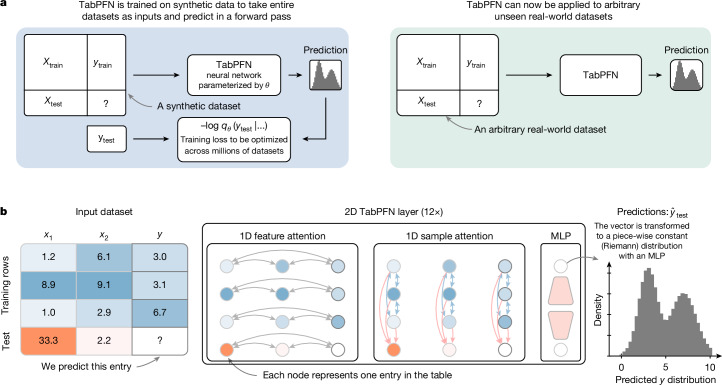
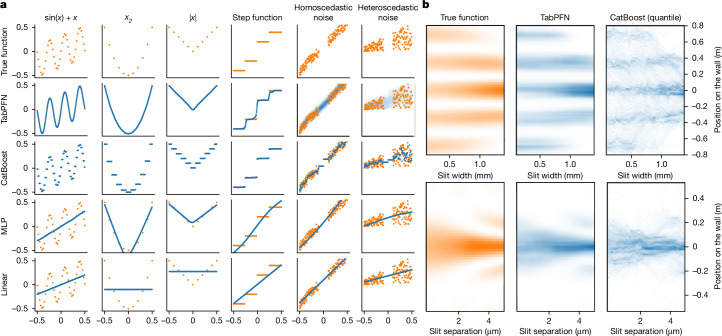
Tabular data, spreadsheets organized in rows and columns, are ubiquitous across scientific fields, from biomedicine to particle physics to economics and climate science 1,2. The fundamental prediction task of filling in missing values of a label column based on the rest of the columns is essential for various applications as diverse as biomedical risk models, drug discovery and materials science. Although deep learning has revolutionized learning from raw data and led to numerous high-profile success stories 3–5, gradient-boosted decision trees 6–9 have dominated tabular data for the past 20 years. Here we present the Tabular Prior-data Fitted Network (TabPFN), a tabular foundation model that outperforms all previous methods on datasets with up to 10,000 samples by a wide margin, using substantially less training time. In 2.8 s, TabPFN outperforms an ensemble of the strongest baselines tuned for 4 h in a classification setting. As a generative transformer-based foundation model, this model also allows fine-tuning, data generation, density estimation and learning reusable embeddings. TabPFN is a learning algorithm that is itself learned across millions of synthetic datasets, demonstrating the power of this approach for algorithm development. By improving modelling abilities across diverse fields, TabPFN has the potential to accelerate scientific discovery and enhance important decision-making in various domains.
Overview
CoChat Summary
TL;DR
TabPFN is a tabular foundation model pretrained on millions of synthetic datasets that uses in-context learning to outperform prior methods on small- to medium-sized tabular data up to 10,000 samples and 500 features. It delivers strong classification and regression performance in a single forward pass and also supports fine-tuning, data generation, density estimation, reusable embeddings, and interpretability.
Key findings
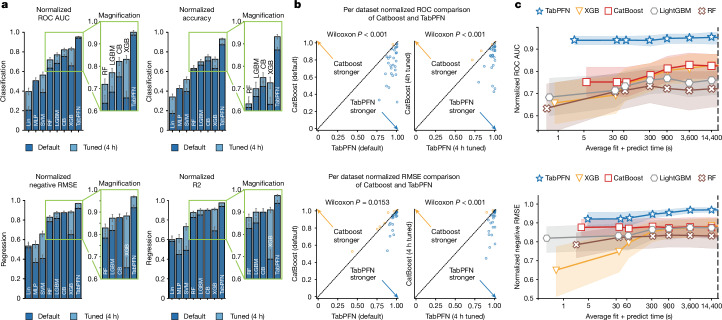
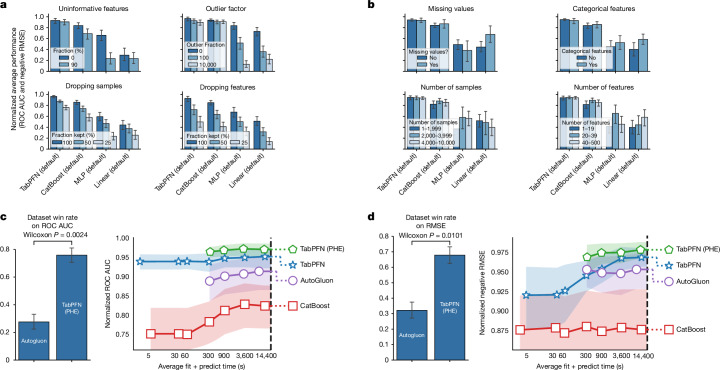
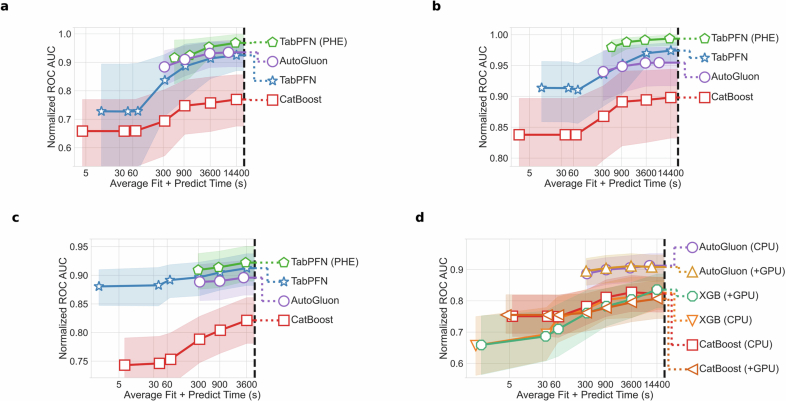
- On benchmarks with 29 classification and 28 regression datasets up to 10,000 samples, 500 features, and 10 classes, TabPFN outperformed tuned baselines. Classification normalized ROC AUC: TabPFN default 0.939 vs CatBoost default 0.752; tuned TabPFN 0.952 vs tuned CatBoost 0.822. Regression normalized RMSE: TabPFN default 0.923 vs CatBoost default 0.872; tuned TabPFN 0.968 vs tuned CatBoost 0.875.
- TabPFN default took 2.8 s for classification and 4.8 s for regression on average, outperforming baselines tuned for 4 h—a speedup of 5,140× for classification and 3,000× for regression. TabPFN (PHE) reached average normalized ROC AUC 0.971 vs 0.939 for TabPFN default and 0.914 for AutoGluon; for regression, TabPFN (PHE) outperformed AutoGluon allowed 4 h after a 300 s tuning budget, a 48× speedup.
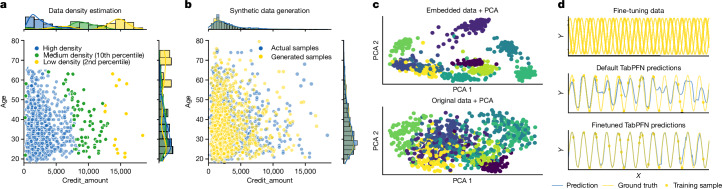
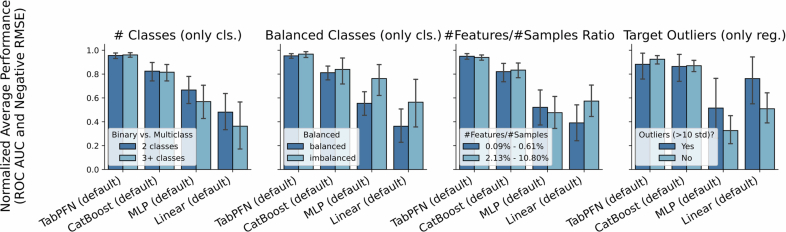
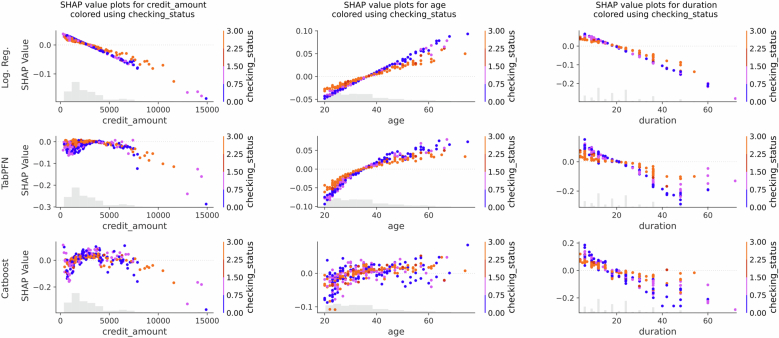
- TabPFN was robust to uninformative features and outliers, and with half the samples it performed as well as the next best method using all samples. It also demonstrated foundation-model abilities including density estimation, synthetic data generation, learned embeddings, fine-tuning, and SHAP-based feature importance.
Methods
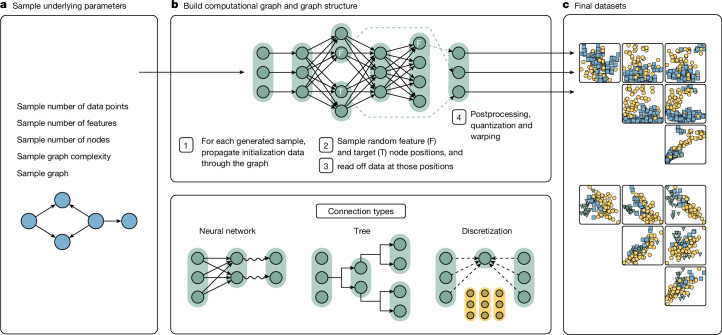
- TabPFN was pretrained on synthetic tabular datasets generated from structural causal models: around 100 million synthetic datasets per model training, with final models trained for approximately 2,000,000 steps at batch size 64 datasets, corresponding to around 130,000,000 synthetically generated datasets each.
- The architecture is a transformer encoder variant that treats each table cell as a separate position and uses two-way attention: each cell attends to other features in its row, then to the same feature across its column. At inference, training samples are provided as context and predictions are made in a single forward pass via in-context learning; train-state caching enables reuse for multiple test inferences.
- Evaluation used the AutoML Benchmark and OpenML-CTR23, with 29 classification and 28 regression datasets up to 10,000 samples, 500 features, and 10 classes. Each dataset and method was run for 10 repetitions with different random seeds and 90% train/10% test splits; hyperparameters were tuned by random search with five-fold cross-validation using time budgets from 30 s to 4 h. Metrics were ROC AUC and accuracy for classification, and R² and negative RMSE for regression, normalized per dataset.
Limitations
- The paper states that TabPFN inference may be slower than highly optimized approaches such as CatBoost; memory usage scales linearly with dataset size and can be prohibitive for very large datasets; and evaluation focused on datasets with up to 10,000 samples and 500 features, so scalability to larger datasets requires further study.
- The paper also states TabPFN is not optimized for real-time inference: for a dataset with 10,000 rows and 10 columns, it requires 0.2 s (0.6 s without GPU) to predict one sample, whereas CatBoost default can do so in 0.0002 s.
- The paper notes that for larger datasets and highly non-smooth regression datasets, CatBoost, XGBoost, or AutoGluon are likely to outperform TabPFN, and that natively the method is limited to predicting at most 10 classes unless pretrained on more classes or adapted with approaches such as one-vs-one, one-vs-rest, or ECOC.
Model-written summary. Check it against the paper before relying on it.
Integrity signals
Registry
Cites
Statistics
Figures
Verification
Claims the paper makes
1 Valid · 6 Not valid · 17 Not checked · 72 Own results and interpretations
The sources with a verdict support this claim; the rest weren’t checked yet, have no full text we could read, or their verdicts aren’t rated yet.
In the paper
“For larger datasets and highly non-smooth regression datasets, approaches such as CatBoost9, XGB7 or AutoGluon40 are likely to outperform TabPFN.”
§ Accurate predictions on small data with a tabular foundation model > Methods > User guide
What the sources say
- Check pendingcites [9] Prokhorenkova, L., Gusev, G., Vorobev, A., Dorogush, A. & Gulin, A. CatBoost: unbiased boosting with categorical features. In Proc. 30th International Conference on Advances in Neural Information Processing Systems (eds Bengio, S. et al.) 6639–6649 (Curran Associates, 2018). source
- Supportedcites [7] Chen, T. & Guestrin, C. Xgboost: A scalable tree boosting system. In Proc. 22nd ACM SIGKDD International Conference on Knowledge Discovery and Data Mining (eds Krishnapuram, B. et al.) 785–794 (ACM Press, 2016). source
The citation is offered to identify the system 'XGB' named in the citing sentence, and our copy is that system's paper: the Abstract and Introduction (KDD '16) describe XGBoost as 'a scalable end-to-end tree boosting system' that 'scales beyond billions of examples using far fewer resources than existing systems', used 'to achieve state-of-the-art results on many machine learning challenges'. The Introduction (p.1) further notes 17 of 29 Kaggle winning solutions in 2015 used XGBoost, and the evaluation sections report it running >10x faster than Spark MLLib/H2O on the 1.7-billion-example Criteo data, consistent with the 'larger datasets' framing. The head-to-head comparison against TabPFN and the 'highly non-smooth regression' qualification are the citing authors' own conclusion (TabPFN postdates this source) and are not attributed to this paper, so nothing here is unsupported for the part this citation carries. (LLM, conf=0.85)
- Check pendingcites [40] Erickson, N. et al. Autogluon-tabular: robust and accurate automl for structured data. Preprint at https://arxiv.org/abs/2003.06505 (2020). source
hedgedstates a possible cause- Asserted: passes — The authors put it forward as true.
- Checkable: passes — It can be checked against evidence.
- Load-bearing: unclear — It is unclear whether the paper’s conclusions depend on it.
- Based: passes — The paper gives a reason why it holds.
A result the paper states — it cites no source for it, so there is none to check. The quote shows it is in the paper.
In the paper
“This new supervised tabular learning method can be applied to any small- to moderate-sized dataset and yields dominant performance for datasets with up to 10,000 samples and 500 features.”
§ Accurate predictions on small data with a tabular foundation model > Main
plainstates a causen = 10,000- Asserted: passes — The authors put it forward as true.
- Checkable: passes — It can be checked against evidence.
- Load-bearing: passes — The paper’s conclusions depend on it.
- Based: passes — The paper gives a reason why it holds.
A result the paper reports from its own data — it cites no other source for it, so there is none to check. The quote shows it is in the paper.
In the paper
“We extract and visualize learned embeddings from the mfeat-factors dataset in Fig. 6c, showing improved class separation compared with the raw data on the first two principal components.”
§ Accurate predictions on small data with a tabular foundation model > Foundation model with interpretability
plainstates a cause- Asserted: passes — The authors put it forward as true.
- Checkable: passes — It can be checked against evidence.
- Load-bearing: unclear — It is unclear whether the paper’s conclusions depend on it.
- Based: passes — The paper gives a reason why it holds.
A result the paper reports from its own data — it cites no other source for it, so there is none to check. The quote shows it is in the paper.
In the paper
“we found that pre-processing inputs can help performance”
§ Accurate predictions on small data with a tabular foundation model > Methods > Details on the neural architecture
plainstates a possible cause- Asserted: passes — The authors put it forward as true.
- Checkable: passes — It can be checked against evidence.
- Load-bearing: unclear — It is unclear whether the paper’s conclusions depend on it.
- Based: passes — The paper gives a reason why it holds.
In the paper
“As our models are not fully permutation invariant, for each ensemble member, we shuffle the feature order, approximating order invariance64.”
§ Accurate predictions on small data with a tabular foundation model > Methods > Inference details
What the sources say
- Not checked yetcites [64] Murphy, R. L., Srinivasan, B., Rao, V. A. & Ribeiro, B. Janossy pooling: learning deep permutation-invariant functions for variable-size inputs. In Proc. 7th International Conference on Learning Representations (ICLR, 2019). source
plain- Asserted: passes — The authors put it forward as true.
- Checkable: passes — It can be checked against evidence.
- Load-bearing: passes — The paper’s conclusions depend on it.
- Based: passes — The paper gives a reason why it holds.
25 more claims
Create a free account to see all 96 claims and to verify the 28 references still open.
- Probably not a substantial claim. 32
- It may state two separate claims as one. 47
Self-check
Percentages, sums and reported differences re-computed from the paper’s own numbers.
Each contradiction between two passages listed here was confirmed by an independent check.
Rated minor: it would not touch a result — a value no result rests on, a p-value that stays on the same side of the significance level, or a conflict that is clerical, resolved elsewhere in the paper, or outside its own findings.
In the paper
§ Accurate predictions on small data with a tabular foundation model > Quantitative analysis > Comparison with tuned ensemble methods
“In just 2.8 s, TabPFN (default) outperforms AutoGluon for classification tasks, even if AutoGluon is allowed up to 4 h, a 5.140× speedup.”
§ Accurate predictions on small data with a tabular foundation model > Quantitative analysis > Comparison with state-of-the-art baselines
“The default of TabPFN, taking 2.8 s on average for classification and 4.8 s for regression, outperforms all baselines, even when tuning them for 4 h—a speedup of 5,140× and 3,000×, respectively.”
Rated minor: it would not touch a result — a value no result rests on, a p-value that stays on the same side of the significance level, or a conflict that is clerical, resolved elsewhere in the paper, or outside its own findings.
In the paper
§ Accurate predictions on small data with a tabular foundation model > Quantitative analysis
“TabPFN was pre-trained once using eight NVIDIA RTX 2080 GPUs over 2 weeks”
§ Accurate predictions on small data with a tabular foundation model > Methods > Training details
“One training run requires around 2 weeks on one node with eight Nvidia RTX 2080 Ti GPUs.”
Rated minor: it would not touch a result — a value no result rests on, a p-value that stays on the same side of the significance level, or a conflict that is clerical, resolved elsewhere in the paper, or outside its own findings.
In the paper
§ Accurate predictions on small data with a tabular foundation model > An architecture designed for tables
“This design enables the architecture to be invariant to the order of both samples and features”
§ Accurate predictions on small data with a tabular foundation model > Methods > Inference details
“As our models are not fully permutation invariant, for each ensemble member, we shuffle the feature order, approximating order invariance64.”
Citations
Cites
Breiman, L. (2001) · Machine Learning · doi:10.1023/a:1010933404324 · Cited by 133,538
Vaswani, A., Shazeer, N., Parmar, N., Uszkoreit, J., Jones, L., Gomez, A. N., Kaiser, L., & Polosukhin, I. (2017) · arXiv · doi:10.48550/arxiv.1706.03762 · Cited by 120,404
Distinctive Image Features from Scale-Invariant Keypoints
Lowe, D. G. (2004) · International Journal of Computer Vision · doi:10.1023/b:visi.0000029664.99615.94 · Cited by 62,647 · cited 2×
“Hand-designed features in computer vision, such as SIFT (Scale Invariant Feature Transform) 10 and HOG (Histogram of Oriented Gradients) 11 , have been replaced by learned convolutions; grammar-based approaches in natural language processing have been replaced by learned transformers 12 ; and the design of customized…”
Cortes, C., & Vapnik, V. (1995) · Machine Learning · doi:10.1007/bf00994018 · Cited by 59,421
XGBoost: A Scalable Tree Boosting System
Chen, T., & Guestrin, C. (2016) · Proceedings of the 22nd ACM SIGKDD International Conference on Knowledge Discovery and Data Mining · doi:10.1145/2939672.2939785 · Cited by 54,569
Highly accurate protein structure prediction with AlphaFold
Jumper, J., Evans, R., Pritzel, A., Green, T., Figurnov, M., Ronneberger, O., Tunyasuvunakool, K., Bates, R., Žídek, A., Potapenko, A., et al. (2021) · Nature · doi:10.1038/s41586-021-03819-2 · Cited by 43,764
Histograms of Oriented Gradients for Human Detection
Dalal, N., & Triggs, B. (2005) · 2005 IEEE Computer Society Conference on Computer Vision and Pattern Recognition (CVPR'05) · doi:10.1109/cvpr.2005.177 · Cited by 33,584
Greedy function approximation: A gradient boosting machine
Friedman, J. H. (2001) · The Annals of Statistics · doi:10.1214/aos/1013203451 · Cited by 30,731 · cited 2×
“The list of development datasets can be found in Supplementary Tables 5 and 6.”
Language Models are Few-Shot Learners
Brown, T. B., Mann, B., Ryder, N., Subbiah, M., Kaplan, J., Dhariwal, P., Neelakantan, A., Shyam, P., Sastry, G., Askell, A., et al. (2020) · arXiv · doi:10.48550/arxiv.2005.14165 · Cited by 23,372 · cited 1×
“We build on a preliminary version of TabPFN 23 , which demonstrated the applicability of in-context-learning 17 for tabular data in principle but had many limitations that rendered it inapplicable in most cases.”
Quinlan, J. R. (1986) · Machine Learning · doi:10.1007/bf00116251 · Cited by 21,439
Research works printed but not linked: 11
- van Breugel, B. & van der Schaar, M. Position: why tabular foundation models should be a research priority. In Proc. 41st International Conference on Machine Learning 48976–48993 (PMLR, 2024).
- Akyürek, E., Schuurmans, D., Andreas, J., Ma, T. & Zhou, D. What learning algorithm is in-context learning? Investigations with linear models. In Proc. The Eleventh International Conference on Learning Representations (ICLR, 2023).
- Müller, S., Hollmann, N., Pineda-Arango, S., Grabocka, J. & Hutter, F. Transformers can do Bayesian inference. In Proc.The Tenth International Conference on Learning Representations (ICLR, 2022).
- Kingma, D. & Ba, J. Adam: A method for stochastic optimization. In Proc. International Conference on Learning Representations (ICLR, 2015).
- Bahdanau, D., Cho, K. & Bengio, Y. Neural machine translation by jointly learning to align and translate. In Proc. 3rd International Conference on Learning Representations (eds Bengio, Y. & LeCun, Y.) (ICLR, 2015).
- Gorishniy, Y., Rubachev, I., Khrulkov, V. & Babenko, A. Revisiting deep learning models for tabular data. In Proc. Advances in Neural Information Processing Systems 34 (eds Ranzato, M. et al.) 18932–18943 (NeurIPS, 2021).
- Fischer, S. F., Feurer, M. & Bischl, B. OpenML-CTR23 – a curated tabular regression benchmarking suite. In Proc. AutoML Conference 2023 (Workshop) (AutoML, 2023).
- Lundberg, S. M. & Lee, S.-I. A unified approach to interpreting model predictions. In Proc.Advances in Neural Information Processing Systems (eds Guyon, I. et al.) Vol. 30, 4765–4774 (Curran Associates, 2017).
- Nagler, T. Statistical foundations of prior-data fitted networks. In Proc. 40th International Conference on Machine Learning (eds Krause, A. et al.) Vol. 202, 25660–25676 (PMLR, 2023).
- Müller, S., Feurer, M., Hollmann, N. & Hutter, F. PFNS4BO: in-context learning for Bayesian optimization. In Proc. 40th International Conference on Machine Learning 25444–25470 (PMLR, 2023).
- Loshchilov, I. & Hutter, F. SGDR: Stochastic gradient descent with warm restarts. In Proc. 5th International Conference on Learning Representations (ICLR, 2017).
Cited by
Items 1,001–1,100 of 2,324
Smagulova, A., Vakanski, A., Merickel, J. W., Lee, I., Purushotham, C., Tang, Y., Cerpa, A., Xu, F., & Song, R. (2026) · Frontiers in Manufacturing Technology · doi:10.3389/fmtec.2026.1811951 · Cited by 1
Atoms to Processes: The Role of Artificial Intelligence and Machine Learning in Chemical Engineering
Bâldea, M., Broadbelt, L. J., Ierapetritou, M., Jain, A., Kumar, A., Kwan, T. A., Llovell, F., Medford, A. J., Mitrai, I., Paulson, J. A., et al. (2026) · Industrial & Engineering Chemistry Research · doi:10.1021/acs.iecr.6c01806 · Cited by 1
Xue, L., Wang, Y., Zhong, N., Xue, Y., Wu, L., Huang, K., & Luo, J. (2026) · Journal of environmental chemical engineering · doi:10.1016/j.jece.2026.124035 · Cited by 1
Communication Breakdown and Evolution of the Cancer CellPreprint
Fard, L. A. N., Arora, C., Miglionico, P., Varisco, M., Bisceglia, L., Vukotic, R., & Raimondi, F. (2025) · bioRxiv (Cold Spring Harbor Laboratory) · doi:10.1101/2025.08.15.670478 · Cited by 1
Sørensen, I. F., & Sørensen, P. (2025) · medRxiv · doi:10.1101/2025.07.30.25332448 · Cited by 1
RFOD: Random Forest-Based Outlier Detection for Mixed-Type Tabular Data
Ang, Y., Yao, P., Bao, Y., Feng, Y., Huang, Q., Tung, A. K. H., & Huang, Z. (2026) · IEEE International Conference on Data Engineering (ICDE) · doi:10.1109/icde65706.2026.00165 · Cited by 1
Heo, S. J., Park, H., Lee, S., & Kim, Y. M. (2026) · Bioresource Technology · doi:10.1016/j.biortech.2026.135732 · Cited by 1
Tan, W. C., Dong, Y., Shi, Y., Chen, N., Ye, S., Zhang, H., Chen, P., Zuo, Y., & Du, H. (2026) · Molecular Therapy — Nucleic Acids · doi:10.1016/j.omtn.2026.103029 · Cited by 1
How 'Foundational' Are Current Molecular Foundation Models?Preprint
Grisoni, F. (2026) · arXiv (Cornell University) · doi:10.48550/arxiv.2609.37550 · Cited by 1
Uncertainty-Aware Foundation Models for Clinical DataPreprint
Zhou, Q., Zhang, Y., & Li, S. (2026) · arXiv · doi:10.48550/arxiv.2604.04175 · Cited by 1
Liu, J., Cai, A., Zhang, H., Zhang, Y., & Pang, Q. (2026) · Chemometrics and Intelligent Laboratory Systems · doi:10.1016/j.chemolab.2026.105873 · Cited by 1
Zhu, Q., Tao, S., & Wik, T. (2026) · Applied Energy · doi:10.1016/j.apenergy.2026.128702 · Cited by 1
Barak, N., Bhattacharya, H., Asnicar, F., Sung, J., Segata, N., & Yassour, M. (2025) · bioRxiv (Cold Spring Harbor Laboratory) · doi:10.1101/2025.06.12.658885 · Cited by 1
Wu, Z.-K., Zhao, J.-N., Zeng, N.-N., Huang, L.-J.-C., Li, Y.-Y., Dong, G.-H., Wang, M., Di, J.-Z., & Zheng, H. (2026) · Molecular Psychiatry · doi:10.1038/s41380-026-03747-5 · Cited by 1
Meta-Learning for Return Prediction in Shifting Market RegimesPreprint
Wang, Y., & Lera, S. C. (2024) · SSRN Electronic Journal · doi:10.2139/ssrn.5022829 · Cited by 1
How AI Can Advance Mathematical Biology: Opportunities, Challenges, and Future Directions
Rabiei, K., Rempała, G. A., Laubenbacher, R., & Hao, W. (2026) · Bulletin of Mathematical Biology · doi:10.1007/s11538-026-01744-x · Cited by 1
Uncertainty-aware prediction intervals for compressive-strength estimation of geopolymer concrete
Parakhiya, D., Jagad, G., & Thoriya, A. (2026) · Next Materials · doi:10.1016/j.nxmate.2026.103027 · Cited by 1
Early post-publication behavioural signals of misinformation on social media
Westlake, T., Lindelauf, R. H. A., Čule, B., Sweijs, T., & Postma, M. (2026) · Computers in Human Behavior Reports · doi:10.1016/j.chbr.2026.101302 · Cited by 1
Privacy Preserving Federated Gradient Boosting for Single Record Patient DevicesPreprint
Specht, B., Garbaya, S., Ermiş, O., Schneider, R., Chavarriaga, R., Khadraoui, D., & Tayeb, Z. (2026) · medRxiv · doi:10.64898/2026.02.10.26345891 · Cited by 1
T2SPO: Trajectory-to-Step Policy Optimization for Agentic Reinforcement LearningPreprint
Zhang, B.-W., He, J., Liu, M., Li, F., Lv, S., Ma, W., Lin, R., Zhong, S., & Guo, L.-Z. (2026) · arXiv (Cornell University) · doi:10.48550/arxiv.2610.00388 · Cited by 1
Why Large Language Models Fail at Tabular PredictionPreprint
Garnelo, M., & Czarnecki, W. M. (2026) · arXiv (Cornell University) · doi:10.48550/arxiv.2608.02412 · Cited by 1
Towards One-for-All Foundation Model for Attributed Graph ClusteringPreprint
Liu, Y., Jin, X., Zhang, K., An, D., Xing, Y., Song, T., Liu, J., & He, T. (2026) · arXiv (Cornell University) · doi:10.48550/arxiv.2610.07778 · Cited by 1
Few-Shot Bioactivity Prediction with Meta-Learning under Assay HeterogeneityPreprint
Kmicikiewicz, M., Rochussen, T., Fortuin, V., & Szczurek, E. (2026) · arXiv (Cornell University) · doi:10.48550/arxiv.2610.07079 · Cited by 1
Training Fair Tabular Foundation ModelsPreprint
Kenfack, P. J., Cresswell, J. C., Caterini, A. L., Kahou, S. E., & Aïvodji, U. (2026) · arXiv (Cornell University) · doi:10.48550/arxiv.2608.14211 · Cited by 1
iStructTab: Structured Feature Sequencing for Multimodal Learning of Image and Tabular Data
Habib, A. Z. S. B., Ahamed, M. Y., Gyawali, P., Doretto, G., & Adjeroh, D. (2026) · Lecture notes in computer science · doi:10.1007/978-3-032-31404-8_43 · Cited by 1
TabPATE: Differentially Private Tabular In-Context Learning Without Public DataPreprint
Wahdany, D., Jagielski, M., Cresswell, J. C., Dziedzic, A., & Boenisch, F. (2026) · arXiv (Cornell University) · doi:10.48550/arxiv.2606.31474 · Cited by 1
Polewczyk, M., Schambach, M., Spinaci, M., Thelin, S., & Höhne, J. (2026) · arXiv (Cornell University) · doi:10.48550/arxiv.2606.30336 · Cited by 1
Carvalho, T., & Cordy, M. (2026) · arXiv (Cornell University) · doi:10.48550/arxiv.2606.26021 · Cited by 1
Ba, D. M., Sadr, A. V., Zhang, Y., Hart, P. A., Raja-Khan, N. T., Zhou, R., Siddiqui, A., Qiu, T., Maranki, J. L., Chinchilli, V. M., et al. (2026) · BMJ Public Health · doi:10.1136/bmjph-2025-004661 · Cited by 1
Auditing Protein-Protein Interaction Signals with Sparse Autoencoder FingerprintsPreprint
Zhu, W., Wang, S., Liu, X., Xue, Y., Shen, H.-B., Chen, B., & Pan, X. (2026) · bioRxiv (Cold Spring Harbor Laboratory) · doi:10.64898/2026.09.27.754758 · Cited by 1
Xing, J., Tan, X. H., Guo, M., Guo, P., Wang, Y., & Jin, D. (2026) · Materials · doi:10.3390/ma19163408 · Cited by 1
Handling Learnwares From Heterogeneous Feature and Label Spaces With Explicit Label Exploitation
Tan, P. H., Tan, Z.-H., Liu, H.-T., & Zhou, Z. (2026) · IEEE Transactions on Pattern Analysis and Machine Intelligence · doi:10.1109/tpami.2026.3723272 · Cited by 1
Foundation Models Meet Agriculture: Challenges Beyond PretrainingPreprint
Nedungadi, V., Xiong, X., Rußwurm, M., & Athanasiadis, I. N. (2026) · arXiv (Cornell University) · doi:10.48550/arxiv.2608.30392 · Cited by 1
Is Real-World Training Data Necessary for Generalist Graph Anomaly Detection?Preprint
Liu, Y., Liu, Y., Tan, Y., Cao, X., Liew, A. W., Shen, H. T., & Pan, S. (2026) · arXiv (Cornell University) · doi:10.48550/arxiv.2610.12167 · Cited by 1
LLM-Inspired Pretrain-Then-Finetune for Small-Data, Large-Scale OptimizationPreprint
Zhang, Z., Han, J., Hu, M., & Peng, Y. (2026) · arXiv (Cornell University) · doi:10.48550/arxiv.2602.03690 · Cited by 1
Dzik, R., Chwał, J., & Tkacz, E. (2026) · European Journal of Cell Biology · doi:10.1016/j.ejcb.2026.151566 · Cited by 1
A Pan-Cancer Ex Vivo Drug Screen Atlas for Functional Precision OncologyPreprint
Pichotta, K., White, J. B., Quinn, J. F., Markus, A., Tosh, C., de Mathelin, A., Coyne, E. M., Huang, F., & Tansey, W. (2026) · bioRxiv (Cold Spring Harbor Laboratory) · doi:10.64898/2026.02.14.705918 · Cited by 1
Accelerating Ground‐Based Aerosol Retrieval From Shortwave Radiation Using Tabular Foundation Models
Yang, D., Kong, Y., Fu, D., Chen, Y., Ding, Z., Xia, X., & Shi, H. (2026) · Geophysical Research Letters · doi:10.1029/2026gl123459 · Cited by 1
Hc, P., Kim, K., Lee, J., Han, S. Y., Cho, C. M., Lee, D. W., Heo, J., Jung, M., Nam, H. S., Gahm, J. K., et al. (2026) · Research Square · doi:10.21203/rs.3.rs-8736730/v1 · Cited by 1
Zheng, W., Hao, X. I. A. O., & Pei, W. (2026) · SSRN Electronic Journal · doi:10.2139/ssrn.6626020 · Cited by 1
Hou, X., Gou, B., Chen, D., Chu, J., Ma, L., & Duan, X. (2026) · Reliability Engineering & System Safety · doi:10.1016/j.ress.2026.113256 · Cited by 1
Guided synthesis of EMT zeolites by machine learning
Olanrewaju, E. A., Adhikari, S., Niu, Z., Nikolaou, M., Palmer, J. C., Rimer, J. D., & Wen, M. (2026) · Physical Review Materials · doi:10.1103/v2yp-ylxm · Cited by 1
Li, X., Gao, P., Zhou, J., Xu, X., & Li, X. (2025) · International Conference on Simulation, Modeling and Big Data (SMBD) · doi:10.1145/3768740.3768798 · Cited by 1
Open‐source AI at scale: Establishing an enterprise AI strategy through modular frameworks
Kadıoğlu, S. (2025) · AI Magazine · doi:10.1002/aaai.70032 · Cited by 1
TabCUQ: Context-Uncertainty Quantification for Tabular Foundation ModelsPreprint
Shi, Y., Liu, M., & Guo, Z. (2026) · arXiv (Cornell University) · doi:10.48550/arxiv.2610.39558 · Cited by 1
Sparse Foundation Models for Continous-Time EHRsPreprint
Ferrel, W., Chang, T. S., & Lawrence, S. (2026) · Research Square · doi:10.21203/rs.3.rs-8819405/v1 · Cited by 1
Markovian Representation Learning for Longitudinal Electronic Health RecordsPreprint
Lawrence, S., Zhang, Y., & Wang, M. (2026) · Research Square · doi:10.21203/rs.3.rs-8935515/v1 · Cited by 1
Castellanos, M. A., MacDermott-Opeskin, H., Ainsley, J., Swain, J. A., Colby, S., West, D., Channing, G., Good, A., Bourque, É., Vogeti, L., et al. (2026) · ChemRxiv · doi:10.26434/chemrxiv.15009342/v1 · Cited by 1
iML: Executable, Problem-Grounded, and Broadly Exploratory Code-Driven AutoMLPreprint
Le, D., Le, D., Nguyen, A.-S., Bui, T.-D., Nguyen, T.-T., Nguyen, S. H., & Vo, H. D. (2026) · arXiv (Cornell University) · doi:10.48550/arxiv.2602.13937 · Cited by 1
Huryol, C., Sulaimanov, U., Yüce, M., Şanlıer, N., Öztürk, F., Ozturk, O., Altun, I., Ismayilova, G., Bozkurt, H., Altunkaya, T. Y., et al. (2026) · Journal of Neuro-Oncology · doi:10.1007/s11060-026-05827-6 · Cited by 1
Bootstrap-Conditioned Action Selection with Tabular Foundation ModelsPreprint
Gupta, D., Tavker, S., Efimov, D., Sathyanarayana, S., Bhutani, G., & Oreshkin, B. N. (2026) · arXiv (Cornell University) · doi:10.48550/arxiv.2608.06559 · Cited by 1
Fung, S.-H., Zhang, Z., Wang, R., Chen, M., Wong, B. S., Li, K. Y., Hong, C., Zhou, J., Yip, K. Y., Tsui, S. K., et al. (2026) · Genome biology · doi:10.1186/s13059-026-04240-6 · Cited by 1
Tabular foundation models for non-tabular tasksPreprint
Nakerst, G., Brennan, J., Beugeling, W., & Haque, M. (2026) · arXiv (Cornell University) · doi:10.48550/arxiv.2608.22594 · Cited by 1
Small Data Explainer -- The impact of small data methods in everyday lifePreprint
Hackenberg, M., Connor, S. G., Kabus, F., Brawner, J., Markham, E., Hardalupas, M., Chowdhury, A., Backofen, R., Köttgen, A., Rohde, A., et al. (2025) · arXiv (Cornell University) · doi:10.48550/arxiv.2507.11773 · Cited by 1
Pan, X., Wang, H., Guo, J., Zhao, Z., Dong, S., & Lu, J. (2026) · arXiv (Cornell University) · doi:10.48550/arxiv.2608.02157 · Cited by 1
Wang, Z., Chen, S. J., Zhao, T. S., Xu, B., & Chen, Z. (2026) · Applied Energy · doi:10.1016/j.apenergy.2026.128381 · Cited by 1
LLM Flow Processes for Text-Conditioned RegressionPreprint
Biggs, F., & Willis, S. (2026) · arXiv (Cornell University) · doi:10.48550/arxiv.2601.06147 · Cited by 1
Breaking the Quality-Privacy Tradeoff in Tabular Data Generation via In-Context LearningPreprint
Han, X., Lu, Y., Lin, X., Jiang, Y., Wang, Y., Li, X., Zou, W., & Zhang, X. (2026) · arXiv (Cornell University) · doi:10.48550/arxiv.2605.04911 · Cited by 1
CLUBench: A Clustering Benchmark
Xiao, F., Fu, D., Ding, C. H. Q., & Fan, J. (2026) · ACM SIGKDD Conference on Knowledge Discovery and Data Mining (KDD) · doi:10.1145/3770855.3817483 · Cited by 1
China’s Digitalization of Public Diplomacy: Navigating Panda and Wolf Warrior Styles
Huang, Z. A. (2026) · Routledge eBooks · doi:10.4324/9781042027590 · Cited by 1
Evaluating LLM Understanding via Structured Tabular Decision SimulationsPreprint
Li, S., Xu, X., & Li, X. (2025) · arXiv (Cornell University) · doi:10.48550/arxiv.2511.10667 · Cited by 1
GHGbench: A Unified Multi-Entity, Multi-Task Benchmark for Carbon Emission PredictionPreprint
Duan, Y., Zheng, S., Li, L., Xue, C., & Salim, F. D. (2026) · arXiv (Cornell University) · doi:10.48550/arxiv.2605.13743 · Cited by 1
Proxy-Based Approximation of Shapley and Banzhaf InteractionsPreprint
Thies, S. M. A. R., Baniecki, H., Witter, R. T., Hüllermeier, E., Muschalik, M., & Fumagalli, F. (2026) · arXiv (Cornell University) · doi:10.48550/arxiv.2605.22738 · Cited by 1
Synthesizability: The Open Question in Digital MOF Discovery
Coudert, F. (2026) · ACS Materials Letters · doi:10.1021/acsmaterialslett.6c00911 · Cited by 1
Zhang, W., Xu, J., Zhang, Z., Liu, M., Sun, R., Al‐Lazikani, B., Shen, X., Kopetz, S., Wu, L., Zhao, B., et al. (2026) · bioRxiv (Cold Spring Harbor Laboratory) · doi:10.64898/2026.09.24.754137 · Cited by 1
Toward Privileged Foundation Models:LUPI for Accelerated and Improved LearningPreprint
Ding, X., & Akoglu, L. (2026) · arXiv (Cornell University) · doi:10.48550/arxiv.2605.07799 · Cited by 1
Gao, H., Schneider, S., Harris, J., Hernandez, R., Junghaenel, D. U., Kapteyn, A., Lee, P.-J., Stone, A. A., Zelinski, E. M., Maupin, D. J., et al. (2026) · Nature Communications · doi:10.1038/s41467-026-76071-9 · Cited by 1
GeneICL: A Tabular Foundation Model for Bulk TranscriptomicsPreprint
Bohl, M., Theus, A., Wissel, D., & Boeva, V. (2026) · arXiv (Cornell University) · doi:10.48550/arxiv.2610.08694 · Cited by 1
Zeng, W., Fan, Z., Sun, Y., Chen, W., Hong, Q., Shen, Z., Zeng, G., & Chen, Y. (2026) · Optics & Laser Technology · doi:10.1016/j.optlastec.2026.115911 · Cited by 1
Rejections Based on Predictive Uncertainty Enable Reliable Routine Soil SpectroscopyPreprint
Schmidinger, J., Gebbers, R., Gasser, M., Barkov, V., Wu, G. M., & Adamchuk, V. I. (2026) · arXiv (Cornell University) · doi:10.48550/arxiv.2606.21179 · Cited by 1
SALT-KG: A Benchmark for Semantics-Aware Learning on Enterprise TablesPreprint
Mulang, I. O., Sasaki, F., Klein, T., Kolk, J., Grechanov, N., & Hoffart, J. (2026) · arXiv (Cornell University) · doi:10.48550/arxiv.2601.07638 · Cited by 1
Physics-informed neural network for modeling thermo-induced gelation kinetics of plant proteins
Chu, J., Kapoor, T., & Ma, Y. (2026) · Future Foods · doi:10.1016/j.fufo.2026.101207 · Cited by 1
Contextures: The Mechanism of Representation Learning
Zhai, R. (2025) · arXiv (Cornell University) · doi:10.1184/r1/29304965 · Cited by 1
Retrieval-Based In-Context Learning: A Domain Adaptation FrameworkPreprint
Zhu, Y., Deng, N., Li, Y., Shi, N., & Scott, C. D. (2026) · arXiv (Cornell University) · doi:10.48550/arxiv.2610.05717 · Cited by 1
Towards Cross-Modal Error Detection with Tables and ImagesPreprint
Ovcharenko, O., & Schelter, S. (2025) · arXiv (Cornell University) · doi:10.48550/arxiv.2510.12383 · Cited by 1
Modular Multimodal Classification Without Fine-Tuning: A Simple Compositional ApproachPreprint
Bergström, H., Mehrotra, A., & Krishnan, R. G. (2026) · arXiv (Cornell University) · doi:10.48550/arxiv.2605.20674 · Cited by 1
Ying, C., Long, J., Zhu, J., Ou, L., Lin, H., & Liu, H. (2026) · Applied Spatial Analysis and Policy · doi:10.1007/s12061-026-09971-4 · Cited by 1
Jiang, M., Chen, K., Wang, Y., Zhao, Y., Dai, Z., Liu, Y., Li, Z., Zhang, Q., Nie, H., Zhu, H., et al. (2025) · arXiv (Cornell University) · doi:10.48550/arxiv.2509.09960 · Cited by 1
Wang, H., Mao, J., Wang, L., Zhang, Q., Elbatel, M., Qin, Y., Hu, H., Li, B., Deng, W., Qin, W., et al. (2025) · arXiv (Cornell University) · doi:10.48550/arxiv.2505.03380 · Cited by 1
Xu, Z., Wang, Z., Sun, Y., & Wang, X. (2026) · arXiv (Cornell University) · doi:10.48550/arxiv.2605.17406 · Cited by 1
FEAT: A Linear-Complexity Foundation Model for Extremely Large Structured DataPreprint
Song, Z., Qian, T., Chen, L., Li, Y., Hu, Z., Fang, B., Song, Y., Zhao, J., Zhang, S., & Li, T. (2026) · arXiv (Cornell University) · doi:10.48550/arxiv.2603.16513 · Cited by 1
Is TabPFN the Silver Bullet for Insurance Pricing?Preprint
Deprez, B., Verbeke, W., & Verdonck, T. (2026) · arXiv (Cornell University) · doi:10.48550/arxiv.2605.22892 · Cited by 1
Smakova, N., Iskakov, Е. М., Burnayev, Z. R., Zhexenbinov, B., Kalyshev, A. T., Karmyssova, G. A., Makipov, A., & Seksenbayeva, R. B. (2026) · Information · doi:10.3390/info17111095 · Cited by 1
Toward Structured Financial Foundation ModelsPreprint
Raman, N., Mishra, S., Potluru, V. K., & Ganesh, S. (2026) · arXiv (Cornell University) · doi:10.48550/arxiv.2610.26516 · Cited by 1
Li, Z., Teng, L., Li, W., & Huo, W. (2026) · SSRN Electronic Journal · doi:10.2139/ssrn.6862081 · Cited by 1
Kehinde, T. O., Khan, W. A., Chung, S.-H., Orisaremi, K. K., Akpan, J. S., & Piya, S. (2026) · Archives of Computational Methods in Engineering · doi:10.1007/s11831-026-10737-x · Cited by 1
Coherence in the Leak and Storage Kurtosis control Ergotropy in Quantum BatteriesPreprint
Thakuria, B. R., Kalita, T., Sarmah, M. J., & Goswami, H. P. (2025) · arXiv (Cornell University) · doi:10.48550/arxiv.2511.08063 · Cited by 1
Quan, W., Henault, D., Zhang, A. X. W., Jang, G.-H., Hasnain, S. M., Bevacqua, D., Deng, Y., Figueroa, E. F., Ni, K., Light, N. D., et al. (2026) · medRxiv · doi:10.64898/2026.08.24.26360900 · Cited by 1
DynaTab: Dynamic Feature Ordering as Neural Rewiring for High-Dimensional Tabular DataPreprint
Habib, A. Z. S. B., Doretto, G., & Adjeroh, D. (2026) · arXiv (Cornell University) · doi:10.48550/arxiv.2605.03430 · Cited by 1
Multidimensional Light Detection with Symmetry-engineered HeterojunctionsPreprint
Lin, Y., Zhou, Y., Tian, R., Ahmed, F., Liapis, A. C., Huang, Y., Dai, Y., Chen, Y., Cai, W., Yang, Z., et al. (2026) · arXiv (Cornell University) · doi:10.48550/arxiv.2609.02161 · Cited by 1
Physics-guided residual correction of α -decay half-lives based on the effective liquid drop model
Yuan, Q., Xiao, X., Qi, P., Yang, A., Yu, G., Yang, H.-T., Li, Z., & Cai, Y. (2026) · Physical Review C · doi:10.1103/7gm3-2y7f · Cited by 1
BOCoDe: Engineering-Centered Benchmarking for Bayesian OptimizationPreprint
Yu, R. T.-Y., Hatterer, C., Narayanan, A., Picard, C., & Ahmed, F. (2026) · arXiv (Cornell University) · doi:10.48550/arxiv.2608.15073 · Cited by 1
Do Tabular Foundation Models Still Need Feature Engineering?Preprint
Yifan, W. U., Dong, P., Tao, J., & Jiang, B. (2026) · arXiv (Cornell University) · doi:10.48550/arxiv.2609.13202 · Cited by 1
Feature attention model attention for basic oxygen furnace endpoint temperature prediction
Li, P., Zhan, D., Huang, B., Chang, S., Jiang, Z., Zhang, H., & Li, P. (2026) · International Journal of Minerals Metallurgy and Materials · doi:10.1007/s12613-026-3487-5 · Cited by 1
Revisiting Chebyshev Polynomial and Anisotropic RBF Models for Tabular RegressionPreprint
Gerber, L., & Lloyd, H. (2026) · arXiv (Cornell University) · doi:10.48550/arxiv.2602.22422 · Cited by 1
PolyMon: A Unified Framework for Polymer Property PredictionPreprint
Ren, G., Yang, Y., Zhou, J., & Jelfs, K. E. (2026) · arXiv (Cornell University) · doi:10.48550/arxiv.2603.13303 · Cited by 1
TabPFN-MT: A Natively Multitask In-Context Learner for Tabular DataPreprint
Cureton, C., & Armanfard, N. (2026) · arXiv (Cornell University) · doi:10.48550/arxiv.2605.20234 · Cited by 1
KnowsTFM: Knowledge-Informed Fine-Tuning of Small Tabular Foundation ModelsPreprint
Koloski, B., Jiang, X., Pollak, S., Škrlj, B., Jamnik, M., & Simidjievski, N. (2026) · arXiv (Cornell University) · doi:10.48550/arxiv.2606.30258 · Cited by 1
Qin, Q., Li, E., Wei, T., Huang, Z., Qin, Z., Wang, W., & Sun, Y. (2026) · arXiv (Cornell University) · doi:10.48550/arxiv.2609.23574 · Cited by 1
Data-Driven Discovery of Boronic Acid Catalysts for Amidation ReactionsPreprint
Weller, H., & Schnitzer, T. (2026) · ChemRxiv · doi:10.26434/chemrxiv.15003365/v4 · Cited by 1
Metadata
- Authors
- Hollmann, N., Müller, S., Purucker, L., Krishnakumar, A., Körfer, M., Hoo, S. B., Schirrmeister, R. T., & Hutter, F.
- Affiliations
- University of Freiburg (DE)
- Corresponding author
- Hollmann, Noah
- Müller, Samuel
- Hutter, Frank
- ORCID
- Venue
- Nature
- Published
- 2025-01-08
- Volume
- 637
- Issue
- 8045
- Pages
- 319-326
- ISSN
- 0028-0836 (ISSN-L)
- 1476-4687
- PMC
- PMC11711098
- OpenAlex
- W4406170795
- Semantic Scholar
- 6b238b17e419c7dd3912b9845449496bfb0a571a
- Cited by
- 2,323
- References
- 63
- Citations by year
- 2026: 1829 · 2025: 487
- FWCI
- 417.80
- Type
- journal article
- Language
- en
- Open access
- hybrid
- doi.org
- Licence
- cc-by
- creativecommons.org/licenses/by/4.0 (tdm)
- creativecommons.org/licenses/by/4.0 (vor)
- Locations
- Nature (publishedVersion, cc-by)
- PubMed Central (publishedVersion, cc-by)
- PubMed (publishedVersion)
- RePEc: Research Papers in Economics (submittedVersion)
- Funders
- European Commission (101045765)
- Deutsche Forschungsgemeinschaft (INST 39/963-1, “INST 39/963-1 FUGG”, SFB1597, 417962828, 39/963-1, 499552394)
- Hector Stiftung
- Topics
- Physical Sciences › Computer Science › Artificial Intelligence › Machine Learning and Data Classification
- Physical Sciences › Computer Science › Artificial Intelligence › Neural Networks and Applications
- Physical Sciences › Computer Science › Artificial Intelligence › Domain Adaptation and Few-Shot Learning
- Keywords
- tabular data, tabular foundation models, TabPFN, missing data estimation, small data, generative transformers, synthetic data, fine-tuning, density estimation, embeddings, gradient boosting decision tree, tabular data classification
About these checks
Registry, retraction, Cites and statistics results are computed, not judged, with one exception: a printed reference that no index lists is read once by a model before it counts as a citation error. Claims are extracted by a model and kept only when their quote appears verbatim in the text; each cited source is then checked, with a model’s help, for whether it says what the claim relies on. Those verdicts can be wrong — read the claim’s quote and the cited source before relying on one.
A language model drew the claims from the paper on 2026-11-24, under version 3 of the claim definition (model deepseek-v4.1-flash, prompt extract-v3).
A second model labelled each claim on 2026-11-24 (model jev-1.13-20260917, definition revision gold-guideline-v0.2).
Cited sources are checked with a language model’s help (qwen3.8-omni-flash).
Statistics and arithmetic are recomputed, not judged.
Confidence bands are shown only for fields calibrated on our annotated test set. None is calibrated yet, so no band is shown.
What counts as a claim ›How we measure confidence ›How we check this ›
Are you an author, or do you see a problem with this page? Request a review
Data sources
Bibliographic data: Semantic Scholar, OpenAlex, Crossref.
Contains information from the Semantic Scholar Academic Graph Datasets, made available under the ODC Attribution License (ODC-BY 1.0).
Semantic Scholar’s data is described in: Kinney, R., et al. (2023). The Semantic Scholar Open Data Platform. arXiv:2301.10140.
