

The DOI matches its Crossref record; 37 of the 38 references it cites were found in a registry or an index, and 1 are not checked yet.
Towards accurate differential diagnosis with large language models
Open accessAbstract
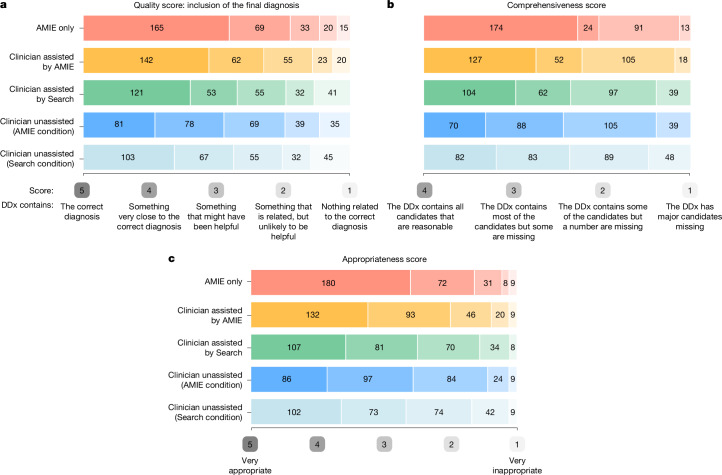
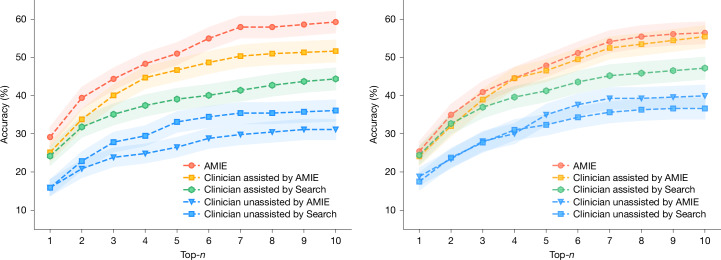
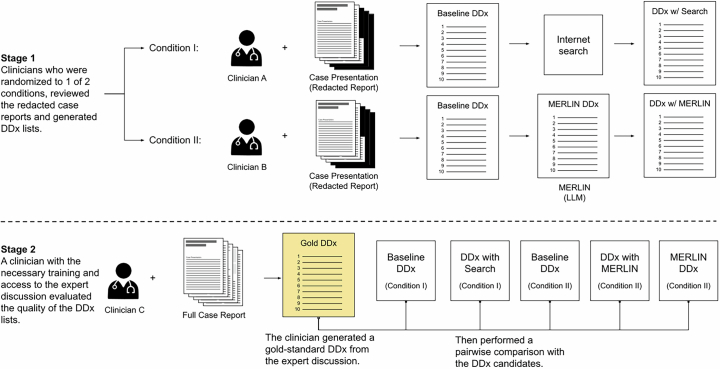
A comprehensive differential diagnosis is a cornerstone of medical care that is often reached through an iterative process of interpretation that combines clinical history, physical examination, investigations and procedures. Interactive interfaces powered by large language models present new opportunities to assist and automate aspects of this process 1 . Here we introduce the Articulate Medical Intelligence Explorer (AMIE), a large language model that is optimized for diagnostic reasoning, and evaluate its ability to generate a differential diagnosis alone or as an aid to clinicians. Twenty clinicians evaluated 302 challenging, real-world medical cases sourced from published case reports. Each case report was read by two clinicians, who were randomized to one of two assistive conditions: assistance from search engines and standard medical resources; or assistance from AMIE in addition to these tools. All clinicians provided a baseline, unassisted differential diagnosis prior to using the respective assistive tools. AMIE exhibited standalone performance that exceeded that of unassisted clinicians (top-10 accuracy 59.1% versus 33.6%, P = 0.04). Comparing the two assisted study arms, the differential diagnosis quality score was higher for clinicians assisted by AMIE (top-10 accuracy 51.7%) compared with clinicians without its assistance (36.1%; McNemar’s test: 45.7, P < 0.01) and clinicians with search (44.4%; McNemar’s test: 4.75, P = 0.03). Further, clinicians assisted by AMIE arrived at more comprehensive differential lists than those without assistance from AMIE. Our study suggests that AMIE has potential to improve clinicians’ diagnostic reasoning and accuracy in challenging cases, meriting further real-world evaluation for its ability to empower physicians and widen patients’ access to specialist-level expertise.
Overview
The claims and statistics of this paper haven’t been checked yet.
Run the check — free, no account needed. It reads the open-access text and checks the sources it cites.
Integrity signals
Registry
Cites
Statistics
Figures
Verification
Claims the paper makes
The claims and statistics of this paper haven’t been checked yet.
Run the check — free, no account needed. It reads the open-access text and checks the sources it cites.
Claims other papers make about this one
Each is checked against this paper’s own text: does it say what the citing paper says it does?
The source backs part of the claim, not all of it — or backs it for a different population, condition or comparison.
In the citing paper
“Previous health-related benchmarks graded short responses, extracted fixed entities from responses, or used weakly correlated natural language generation metrics (Jain et al., 2021; Fleming et al., 2024; McDuff et al., 2025).”
From HealthBench: Evaluating Large Language Models Towards Improved Human Health (2025) · cites this paper as McDuff et al., 2025
Experimental — accuracy not yet measured
Self-check
Percentages, sums and reported differences re-computed from the paper’s own numbers.
The self-check needs the paper’s full text.
Citations
Cites
The Measurement of Observer Agreement for Categorical Data
Landis, J. R., & Koch, G. G. (1977) · Biometrics · doi:10.2307/2529310 · Cited by 81,148
MIMIC-III, a freely accessible critical care database
Johnson, A. E. W., Pollard, T. J., Shen, L., Lehman, L.-W. H., Feng, M., Ghassemi, M., Moody, B., Szolovits, P., Anthony Celi, L., & Mark, R. G. (2016) · Scientific Data · doi:10.1038/sdata.2016.35 · Cited by 8,141
Dissecting racial bias in an algorithm used to manage the health of populations
Obermeyer, Z., Powers, B., Vogeli, C., & Mullainathan, S. (2019) · Science · doi:10.1126/science.aax2342 · Cited by 7,137 · cited 1×
“Deep learning tools have shown considerable promise in many areas of medicine, but are overwhelmingly used as assistive rather than autonomous tools 24 , given the safety-critical nature of medical practice and the many issues of robustness 25 and fairness 26–28 seen in deployment.”
Large language models encode clinical knowledge
Singhal, K., Azizi, S., Tu, T., Mahdavi, S. S., Wei, J., Chung, H. W., Scales, N., Tanwani, A., Cole-Lewis, H., Pfohl, S., et al. (2023) · Nature · doi:10.1038/s41586-023-06291-2 · Cited by 4,083
Self-citationLarge Language Models Encode Clinical Knowledge
Singhal, K., Azizi, S., Tu, T., Mahdavi, S. S., Wei, J., Chung, H. W., Scales, N., Tanwani, A., Cole-Lewis, H., Pfohl, S., et al. (2022) · arXiv · doi:10.48550/arxiv.2212.13138 · Cited by 4,083
Self-citationLlama 2: Open Foundation and Fine-Tuned Chat Models
Touvron, H., Martin, L., Stone, K., Albert, P., Almahairi, A., Babaei, Y., Bashlykov, N., Batra, S., Bhargava, P., Bhosale, S., et al. (2023) · arXiv · doi:10.48550/arxiv.2307.09288 · Cited by 2,604
Reasoning Foundations of Medical Diagnosis
Ledley, R. S., & Lusted, L. B. (1959) · Science · doi:10.1126/science.130.3366.9 · Cited by 998
LLaVA-Med: Training a Large Language-and-Vision Assistant for Biomedicine in One Day
Li, C., Wong, C., Zhang, S., Usuyama, N., Liu, H., Yang, J., Naumann, T., Poon, H., & Gao, J. (2023) · Advances in Neural Information Processing Systems 36 · doi:10.52202/075280-1240 · Cited by 986
Seyyed-Kalantari, L., Zhang, H., McDermott, M. B. A., Chen, I. Y., & Ghassemi, M. (2021) · Nature Medicine · doi:10.1038/s41591-021-01595-0 · Cited by 928
A deep learning system for differential diagnosis of skin diseases
Liu, Y., Jain, A., Eng, C., Way, D. H., Lee, K., Bui, P., Kanada, K., de Oliveira Marinho, G., Gallegos, J., Gabriele, S., et al. (2020) · Nature Medicine · doi:10.1038/s41591-020-0842-3 · Cited by 853
Self-citation
Research works printed but not linked: 2
- Hong, J., Levine, S. & Dragan, A. Zero-shot goal-directed dialogue via RL on imagined conversations. In Proc. Foundation Models for Decision Making Workshop at NeurIPS 2023 (eds Yang, S. et al.) 77 (NeurIPS, 2023).
- Umapathi, L. K., Pal, A. & Sankarasubbu, M. Med-HALT: medical domain hallucination test for large language models. In Proc. 27th Conference on Computational Natural Language Learning (CoNLL) (eds Jiang, J. et al.) 314–334 (Association for Computational Linguistics, 2023).
Cited by
Sorted by citations
Evaluation and mitigation of the limitations of large language models in clinical decision-making
Hager, P., Jungmann, F., Holland, R., Bhagat, K., Hubrecht, I., Knauer, M., Vielhauer, J., Makowski, M., Braren, R., Kaissis, G., et al. (2024) · Nature Medicine · doi:10.1038/s41591-024-03097-1 · Cited by 798
Large Language Model Influence on Diagnostic Reasoning: A Randomized Clinical Trial
Goh, E., Gallo, R., Hom, J., Strong, E., Weng, Y., Kerman, H., Cool, J. A., Kanjee, Z., Parsons, A. S., Ahuja, N., et al. (2024) · JAMA Network Open · doi:10.1001/jamanetworkopen.2024.40969 · Cited by 724
Towards conversational diagnostic artificial intelligence
Tu, T., Schaekermann, M., Palepu, A., Saab, K., Freyberg, J., Tanno, R., Wang, A., Li, B., Amin, M., Cheng, Y., et al. (2025) · Nature · doi:10.1038/s41586-025-08866-7 · Cited by 366
“Previous research has shown that AI systems may match or exceed human diagnostic performance in specific, narrow tasks 21,22 in retrospective evaluation.”
Self-citationCurrent applications and challenges in large language models for patient care: a systematic review
Busch, F., Hoffmann, L., Rueger, C., van Dijk, E. H., Kader, R., Ortiz-Prado, E., Makowski, M. R., Saba, L., Hadamitzky, M., Kather, J. N., et al. (2025) · Communications Medicine · doi:10.1038/s43856-024-00717-2 · Cited by 358
The Opportunities and Risks of Large Language Models in Mental Health
Lawrence, H. R., Schneider, R. A., Rubin, S. B., Matarić, M. J., McDuff, D. J., & Jones Bell, M. (2024) · JMIR Mental Health · doi:10.2196/59479 · Cited by 235
Self-citation
Metadata
- Authors
- McDuff, D., Schaekermann, M., Tu, T., Palepu, A., Wang, A., Garrison, J., Singhal, K., Sharma, Y., Azizi, S., Kulkarni, K., Hou, L., Cheng, Y., Liu, Y., Mahdavi, S. S., Prakash, S., Pathak, A., Semturs, C., Patel, S., Webster, D. R., Dominowska, E., Gottweis, J., Barral, J., Chou, K., Corrado, G. S., Matias, Y., Sunshine, J., Karthikesalingam, A., & Natarajan, V.
- Affiliations
- Google (United States) (US)
- Google (Switzerland) (CH)
- Google (United Kingdom) (GB)
- Corresponding author
- McDuff, Daniel
- Schaekermann, Mike
- Karthikesalingam, Alan
- Natarajan, Vivek
- ORCID
- McDuff, Daniel
- Schaekermann, Mike
- Tu, Tao
- Palepu, Anil
- Wang, Amy
- Singhal, Karan
- Azizi, Shekoofeh
- Cheng, Yong
- Liu, Yun
- Mahdavi, S. Sara
- Prakash, Sushant
- Pathak, Anupam
- Semturs, Christopher
- Patel, Shwetak
- Webster, Dale R.
- Dominowska, Ewa
- Gottweis, Juraj
- Barral, Joelle
- Chou, Katherine
- Corrado, Greg S.
- Matias, Yossi
- Sunshine, Jake
- Karthikesalingam, Alan
- Natarajan, Vivek
- Venue
- Nature
- Published
- 2025-04-09
- Volume
- 642
- Issue
- 8067
- Pages
- 451-457
- ISSN
- 0028-0836 (ISSN-L)
- 1476-4687
- PMC
- PMC12158753
- OpenAlex
- W4409283616
- Cited by
- 311
- References
- 34
- Citations by year
- 2026: 172 · 2025: 108
- FWCI
- 67.40
- Type
- journal article
- Language
- en
- Open access
- hybrid
- doi.org
- Locations
- Nature (publishedVersion, cc-by)
- PubMed Central (publishedVersion, cc-by)
- PubMed (publishedVersion)
- arXiv (Cornell University) (submittedVersion, other-oa)
- arXiv (Cornell University)
- Funders
- Massachusetts Medical Society
- DeepMind
- Topics
- Health Sciences › Medicine › Health Informatics › Artificial Intelligence in Healthcare and Education
- Physical Sciences › Computer Science › Artificial Intelligence › Machine Learning in Healthcare
- Health Sciences › Health Professions › Health Information Management › Artificial Intelligence in Healthcare
- Keywords
- differential diagnosis, large language models, diagnostic reasoning, clinical decision support, clinician performance, AI-assisted diagnosis, medical knowledge retrieval
- MeSH terms
- Case Reports as Topic, Large Language Models, Artificial Intelligence, Diagnosis, Differential, Humans, Language
About these checks
Registry, retraction, Cites and statistics results are computed, not judged, with one exception: a printed reference that no index lists is read once by a model before it counts as a citation error. Claims are extracted by a model and kept only when their quote appears verbatim in the text; each cited source is then checked, with a model’s help, for whether it says what the claim relies on. Those verdicts can be wrong — read the claim’s quote and the cited source before relying on one.
Statistics and arithmetic are recomputed, not judged.
Confidence bands are shown only for fields calibrated on our annotated test set. None is calibrated yet, so no band is shown.
What counts as a claim ›How we measure confidence ›How we check this ›
Are you an author, or do you see a problem with this page? Request a review
