

End-to-end data-driven weather prediction
Open accessThe DOI matches its Crossref record; 81 of the 81 references it cites were found in a registry or an index; none of the 19 sources its claims cite is checked for support yet.
Abstract
Weather prediction is critical for a range of human activities, including transportation, agriculture and industry, as well as for the safety of the general public. Machine learning transforms numerical weather prediction (NWP) by replacing the numerical solver with neural networks, improving the speed and accuracy of the forecasting component of the prediction pipeline 1–6 . However, current models rely on numerical systems at initialization and to produce local forecasts, thereby limiting their achievable gains. Here we show that a single machine learning model can replace the entire NWP pipeline. Aardvark Weather, an end-to-end data-driven weather prediction system, ingests observations and produces global gridded forecasts and local station forecasts. The global forecasts outperform an operational NWP baseline for several variables and lead times. The local station forecasts are skilful for up to ten days of lead time, competing with a post-processed global NWP baseline and a state-of-the-art end-to-end forecasting system with input from human forecasters. End-to-end tuning further improves the accuracy of local forecasts. Our results show that skilful forecasting is possible without relying on NWP at deployment time, which will enable the realization of the full speed and accuracy benefits of data-driven models. We believe that Aardvark Weather will be the starting point for a new generation of end-to-end models that will reduce computational costs by orders of magnitude and enable the rapid, affordable creation of customized models for a range of end users.
Overview
CoChat Summary
TL;DR
Aardvark Weather is an end-to-end data-driven weather prediction system that ingests raw observations and produces global gridded forecasts and local station forecasts without relying on numerical weather prediction at deployment time. It is competitive with operational NWP baselines for several variables and lead times, and its local forecasts are skilful up to 10 days.
Key findings
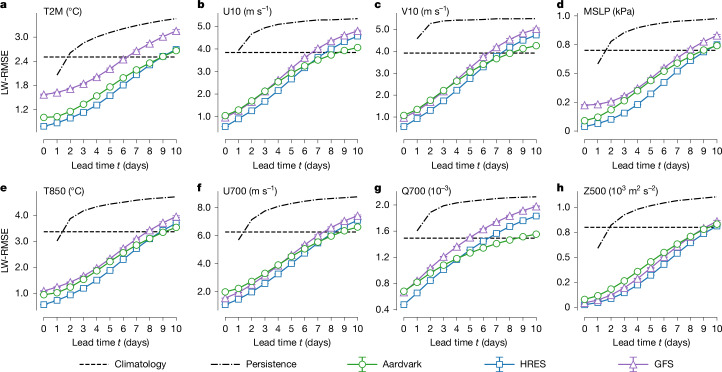
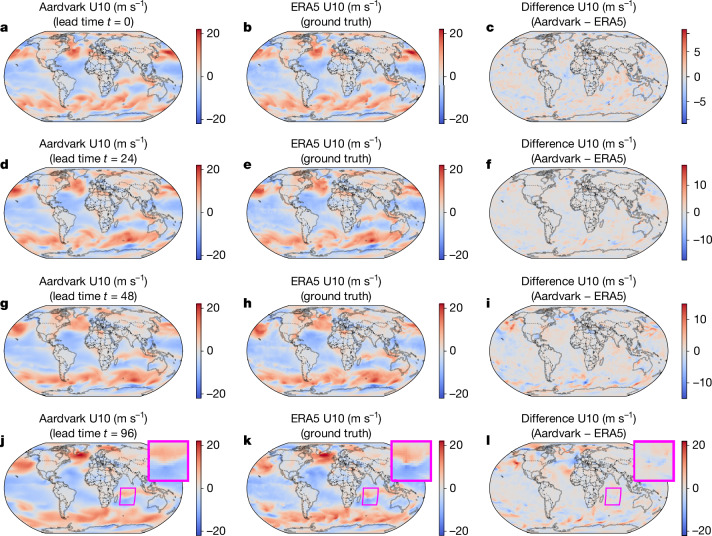
- On a global 1.50° grid, Aardvark matched or outperformed GFS across most lead times, with the only exception being geopotential at 500 hPa, and approached HRES performance for most variables; errors were larger at higher atmospheric levels and shorter lead times, and forecasts tended to become spectrally blurred at longer lead times.
- Aardvark ingests approximately 8% of the observations available to conventional NWP systems, and generating a full forecast from observational data takes approximately 1 s on four NVIDIA A100 GPUs, compared with approximately 1,000 node hours required by HRES for data assimilation and forecasting alone.
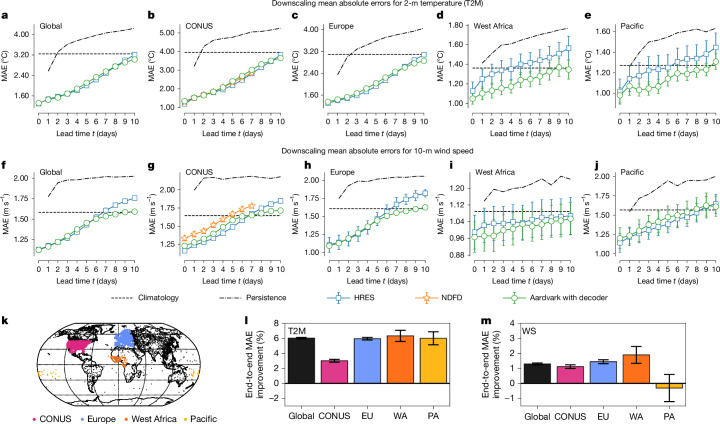
- Station forecasts for 2-m temperature and 10-m wind speed were skilful up to 10 days; for temperature, Aardvark was competitive with station-corrected HRES over CONUS and Europe, matched NDFD over CONUS, and outperformed station-corrected HRES in West Africa and the Pacific at all lead times; for wind speed, it had higher errors than station-corrected HRES over CONUS, significantly outperformed NDFD, was similar to station-corrected HRES over Europe up to 4 days and better thereafter, generally outperformed station-corrected HRES over West Africa, and performed slightly worse over the Pacific.
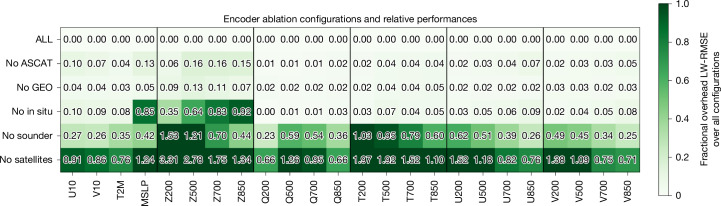
- End-to-end fine-tuning reduced 2-m temperature MAE by 6% over Europe, West Africa, the Pacific and globally, and by 3% over CONUS; for 10-m wind speed, improvements were 1–2% for all regions except the Pacific. Encoder ablations showed satellite data are crucial, with LEO sounder data most important, while in situ observations are most important for surface variables and also play a surprisingly large role in geopotential at lower levels.
Methods
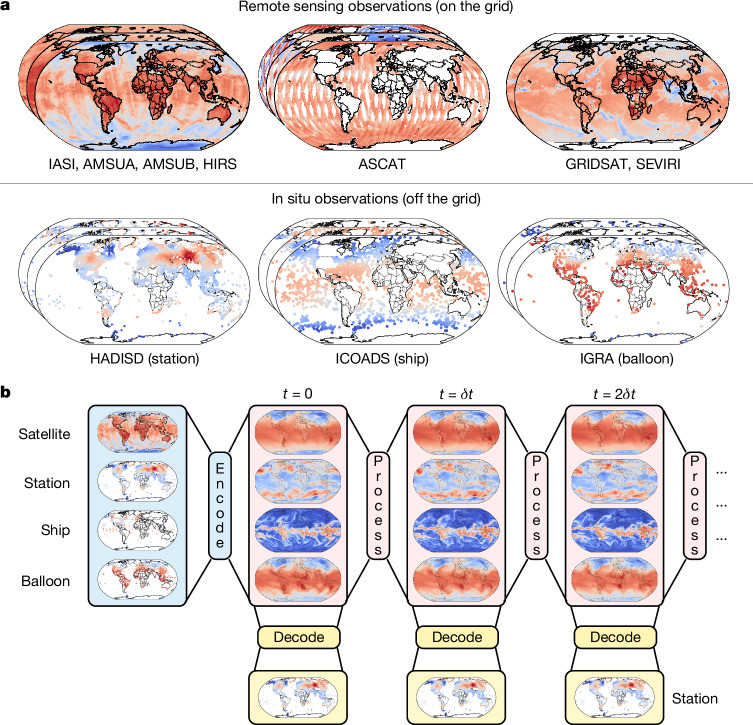
- Aardvark consists of three modules: an encoder that estimates a gridded initial atmospheric state from raw observations, a processor that autoregressively produces 24-h global forecasts out to 10 days, and task-specific decoders that produce local station forecasts; the architecture is a neural process combining SetConv layers with vision transformers for encoder and processor, and a lightweight U-Net plus SetConv and MLP for the decoder.
- Inputs include remote sensing data (ASCAT scatterometer, AMSU-A/B, MHS, HIRS/4, IASI, GridSat geostationary) and in situ data (HadISD land stations, ICOADS marine observations, IGRA radiosondes), plus temporal and orographic variables; training used ERA5 reanalysis for pretraining, with data before 2018 for training, 2018 as test and 2019 as validation.
- Global forecasts were evaluated against persistence, climatology, HRES and GFS using latitude-weighted RMSE with ERA5 as ground truth; station forecasts were evaluated against per-station persistence and climatology, station-corrected HRES, and NDFD over CONUS using MAE; end-to-end fine-tuning jointly optimized encoder, processor and decoder for specific variables and regions.
Limitations
- The paper states that Aardvark does not yet run at the resolution of IFS; further studies are required to increase grid resolution and produce forecast ensembles, for example through diffusion; further observational modalities will probably increase skill; integrating new instruments without training data may require simulated data; and observation drift can be mitigated by regularly fine-tuning all modules with recent data.
- The text makes evident that evaluation uses ERA5 as ground truth, although HRES analysis is of higher quality than ERA5, with discrepancies limited for the 2018 test year; Aardvark’s errors are larger at higher atmospheric levels and shorter lead times than operational baselines, possibly due to higher observation concentration near the surface; and forecasts tend to become spectrally blurred at longer lead times.
- The text also makes evident that the station-corrected HRES baseline is not necessarily state-of-the-art in downscaling, NDFD is only available over CONUS, the study considered a single downstream decoder for station forecasting, and the system operates at 1.50° resolution with five vertical levels.
Model-written summary. Check it against the paper before relying on it.
Integrity signals
Registry
Cites
Statistics
Figures
Verification
Claims the paper makes
0 Valid · 1 Not valid · 15 Not checked · 58 Own results and interpretations
A result the paper reports from its own data — it cites no other source for it, so there is none to check. The quote shows it is in the paper.
In the paper
“Over Europe, Aardvark had similar errors with the station-corrected HRES up to 4 days of lead time and outperformed it thereafter.”
§ End-to-end data-driven weather prediction > Evaluation of station forecasting
plain- Asserted: passes — The authors put it forward as true.
- Checkable: passes — It can be checked against evidence.
- Load-bearing: unclear — It is unclear whether the paper’s conclusions depend on it.
- Based: passes — The paper gives a reason why it holds.
A result the paper states — it cites no source for it, so there is none to check. The quote shows it is in the paper.
In the paper
“Aardvark Weather is a deep learning model that provides forecasts of eastward wind, northward wind, specific humidity, geopotential and temperature (at 200, 500, 700 and 850 hPa pressure levels), 10-m eastward wind, 10-m northward wind, 2-m temperature and mean sea level pressure on a dense global grid, and station forecasts for 2-m temperature and 10-m wind speed.”
§ End-to-end data-driven weather prediction > Aardvark Weather
plain- Asserted: passes — The authors put it forward as true.
- Checkable: passes — It can be checked against evidence.
- Load-bearing: passes — The paper’s conclusions depend on it.
- Based: passes — The paper gives a reason why it holds.
A result the paper states — it cites no source for it, so there is none to check. The quote shows it is in the paper.
In the paper
“We present Aardvark Weather, an end-to-end data-driven weather forecasting system capable of generating predictions with no input from conventional NWP by instead learning a mapping from raw input observations to output forecasts.”
§ End-to-end data-driven weather prediction > Main
plainstates a cause- Asserted: passes — The authors put it forward as true.
- Checkable: passes — It can be checked against evidence.
- Load-bearing: passes — The paper’s conclusions depend on it.
- Based: passes — The paper gives a reason why it holds.
A result the paper reports from its own data — it cites no other source for it, so there is none to check. The quote shows it is in the paper.
In the paper
“Aardvark successfully captured the large-scale features of the atmospheric state, both in the mid-latitudes and the tropics.”
§ End-to-end data-driven weather prediction > Evaluation of global forecasting
plain- Asserted: passes — The authors put it forward as true.
- Checkable: passes — It can be checked against evidence.
- Load-bearing: passes — The paper’s conclusions depend on it.
- Based: passes — The paper gives a reason why it holds.
A result the paper states — it cites no source for it, so there is none to check. The quote shows it is in the paper.
In the paper
“Overall, Aardvark’s errors were larger at higher atmospheric levels and shorter lead times than those of the operational baselines.”
§ End-to-end data-driven weather prediction > Evaluation of global forecasting
plainstates an association- Asserted: passes — The authors put it forward as true.
- Checkable: passes — It can be checked against evidence.
- Load-bearing: unclear — It is unclear whether the paper’s conclusions depend on it.
- Based: passes — The paper gives a reason why it holds.
35 more claims
Create a free account to see all 74 claims and to verify the 19 references still open.
- It may state two separate claims as one. 22
- Probably not a substantial claim. 19
- The quote only partly states this claim. 1
Citations
Cites
U-Net: Convolutional Networks for Biomedical Image Segmentation
Ronneberger, O., Fischer, P., & Brox, T. (2015) · Lecture notes in computer science · doi:10.1007/978-3-319-24574-4_28 · Cited by 99,404
An Image is Worth 16x16 Words: Transformers for Image Recognition at Scale
Dosovitskiy, A., Beyer, L., Kolesnikov, A., Weissenborn, D., Zhai, X., Unterthiner, T., Dehghani, M., Minderer, M., Heigold, G., Gelly, S., et al. (2020) · arXiv · doi:10.48550/arxiv.2010.11929 · Cited by 47,472 · cited 2×
“Embeddings for each patch use a multi-layer perceptron following a previous study 27 .”
Matplotlib: a 2D graphics environment
Hunter, J. D. (2007) · Computing in Science & Engineering · doi:10.1109/mcse.2007.55 · Cited by 39,249
Hersbach, H., Bell, B., Berrisford, P., Hirahara, S., Horányi, A., Muñoz‐Sabater, J., Nicolas, J., Peubey, C., Radu, R., Schepers, D., et al. (2020) · Quarterly Journal of the Royal Meteorological Society · doi:10.1002/qj.3803 · Cited by 31,882 · cited 4×
“34), which remained operational until 2017.”
InfluentialOn the difficulty of training recurrent neural networks
Pascanu, R., Mikolov, T., & Bengio, Y. (2012) · arXiv · doi:10.48550/arxiv.1211.5063 · Cited by 4,310 · cited 1×
“Owing to the complexities of training recurrent neural networks, including the need for a spin-up period and gradient instabilities 26 , we opted for a non-recurrent approach.”
5th International Conference on Learning Representations (ICLR 17)
Havrylov, S., & Titov, I. (2017) · Cited by 3,503
International Conference on Learning Representations (ICLR 2013)
松尾, 豊. (2013) · 人工知能学会誌 = Journal of Japanese Society for Artificial Intelligence · Cited by 2,932
Accurate medium-range global weather forecasting with 3D neural networks
Bi, K., Xie, L., Zhang, H., Chen, X., Gu, X., & Tian, Q. (2023) · Nature · doi:10.1038/s41586-023-06185-3 · Cited by 1,670 · cited 3×
“…to a processor module, which produces a gridded forecast at a lead time of 24 h. Forecasts at subsequent lead times are produced by autoregressively feeding the predictions of the processor module back to it as an input, similar to the existing approaches in data-driven weather forecasting 1,6 .”
Learning skillful medium-range global weather forecasting
Lam, R., Sanchez-Gonzalez, A., Willson, M., Wirnsberger, P., Fortunato, M., Alet, F., Ravuri, S., Ewalds, T., Eaton-Rosen, Z., Hu, W., et al. (2023) · Science · doi:10.1126/science.adi2336 · Cited by 1,466 · cited 7×
“This phenomenon is commonly observed in data-driven weather forecasting systems 1,6,35 .”
InfluentialFirst- and Second-Order Conservative Remapping Schemes for Grids in Spherical Coordinates
Jones, P. W. (1999) · Monthly Weather Review · doi:10.1175/1520-0493(1999)127<2204:fasocr>2.0.co;2 · Cited by 842 · cited 1×
“33), in which both datasets were coarsened to 1.50° resolution using first-order conservative re-gridding 61 .”
Influential
Research works printed but not linked: 3
- Gelsthorpe, R., Schied, E. & Wilson, J. ASCAT-Metop’s advanced scatterometer. ESA Bull. 102, 19–27 (2000).
- Vaughan, A., Lane, N. D. & Herzog, M. Multivariate climate downscaling with latent neural processes. In Tackling Climate Change with Machine Learning ICML Workshop (2021).
- Nguyen, T., Brandstetter, J., Kapoor, A., Gupta, J. K. & Grover, A. In Proceedings of the 40th International Conference on Machine Learning, 25904–25938 (PMLR, 2023).
Cited by
A foundation model for the Earth system
Bodnar, C., Bruinsma, W. P., Lucic, A., Stanley, M., Allen, A., Brandstetter, J., Garvan, P., Riechert, M., Weyn, J. A., Dong, H., et al. (2025) · Nature · doi:10.1038/s41586-025-09005-y · Cited by 267
Self-citationLang, S. T. K., Alexe, M., Clare, M., Roberts, C. D., Adewoyin, R. A., Bouallègue, Z. B., Chantry, M., Dramsch, J. S., Dueben, P. D., Hahner, S., et al. (2026) · npj Artificial Intelligence · doi:10.1038/s44387-026-00073-7 · Cited by 236
“Work is ongoing at ECMWF 47,48 and elsewhere 49 – 51 to explore observation-based training and initialisation, but currently these do not outperform physics-based data assimilation systems.”
Self-citationJournal of Advances in Modeling Earth Systems
(2018) · Journal of Advances in Modeling Earth Systems · doi:10.1002/(issn)1942-2466 · Cited by 179
A data-to-forecast machine learning system for global weather
Sun, X., Zhong, X., Xu, X., Huang, Y., Li, H., Neelin, J. D., Chen, D., Feng, J., Han, W., Wu, L., et al. (2025) · Nature Communications · doi:10.1038/s41467-025-62024-1 · Cited by 91
“Aardvark Weather 44 processes raw observations for forecasts but falls short of the accuracy achieved by ECMWF HRES.”
Subich, C. J., Husain, S. Z., Šeparović, L., & Yang, J. (2025) · International Conference on Machine Learning · doi:10.48550/arxiv.2501.19374 · Cited by 79
Metadata
- Authors
- Allen, A., Markou, S., Tebbutt, W., Requeima, J., Bruinsma, W. P., Andersson, T. R., Herzog, M., Lane, N. D., Chantry, M., Hosking, J. S., & Turner, R. E.
- Affiliations
- University of Cambridge (GB)
- University of Toronto (CA)
- Microsoft Research (United Kingdom) (GB)
- British Antarctic Survey (GB)
- European Centre for Medium-Range Weather Forecasts (GB)
- Corresponding author
- Markou, Stratis
- Turner, Richard E.
- ORCID
- Venue
- Nature
- Published
- 2025-03-20
- Volume
- 641
- Issue
- 8065
- Pages
- 1172-1179
- ISSN
- 0028-0836 (ISSN-L)
- 1476-4687
- PMC
- PMC12119340
- OpenAlex
- W4408657432
- Cited by
- 312
- References
- 80
- Citations by year
- 2026: 221 · 2025: 77
- FWCI
- 77.98
- Type
- journal article
- Language
- en
- Open access
- hybrid
- doi.org
- Licence
- cc-by
- creativecommons.org/licenses/by/4.0 (tdm)
- creativecommons.org/licenses/by/4.0 (vor)
- Locations
- Nature (publishedVersion, cc-by)
- PubMed Central (publishedVersion, cc-by)
- PubMed (publishedVersion)
- arXiv (submittedVersion, cc-by)
- NERC Open Research Archive (Natural Environment Research Council) (submittedVersion, cc-by)
- RePEc: Research Papers in Economics (submittedVersion)
- Apollo (University of Cambridge) (submittedVersion, cc-by)
- Zenodo (CERN European Organization for Nuclear Research) (submittedVersion)
- Apollo (cc-by)
- Funders
- National Science Foundation
- Alan Turing Institute (Y028880/1)
- UK Research and Innovation (AI4ER, EP/S022961/1)
- DeepMind
- University of Cambridge
- Met Office
- Cambridge Trust
- University of Toronto
- European Centre for Medium-Range Weather Forecasts
- National Oceanic and Atmospheric Administration
- Engineering and Physical Sciences Research Council (EP/S022961/1, EP/Y028880/1, EP/T005386/1, EP/W002965/1)
- National Environmental Satellite, Data, and Information Service
- British Antarctic Survey
- Topics
- Physical Sciences › Earth and Planetary Sciences › Atmospheric Science › Meteorological Phenomena and Simulations
- Physical Sciences › Environmental Science › Environmental Engineering › Hydrological Forecasting Using AI
- Social Sciences › Transportation › Traffic Prediction and Management Techniques
- Keywords
- numerical weather prediction, forecast skill, computational complexity reduction, meteorological observations
About these checks
Registry, retraction, Cites and statistics results are computed, not judged, with one exception: a printed reference that no index lists is read once by a model before it counts as a citation error. Claims are extracted by a model and kept only when their quote appears verbatim in the text; each cited source is then checked, with a model’s help, for whether it says what the claim relies on. Those verdicts can be wrong — read the claim’s quote and the cited source before relying on one.
A language model drew the claims from the paper on 2026-11-28, under version 3 of the claim definition (model deepseek-v4.1-flash, prompt extract-v3).
A second model labelled each claim on 2026-11-28 (model jev-1.13-20260917, definition revision gold-guideline-v0.2).
Statistics and arithmetic are recomputed, not judged.
Confidence bands are shown only for fields calibrated on our annotated test set. None is calibrated yet, so no band is shown.
What counts as a claim ›How we measure confidence ›How we check this ›
Are you an author, or do you see a problem with this page? Request a review
How to cite
Cite CoChat for the checks on this page, and the paper for its own findings.
- This page
- CoChat. (2026). Citation check: End-to-end data-driven weather prediction. https://app.cochat.ai/papers/10.1038/s41586-025-08897-0
- The paper
- Allen, A., Markou, S., Tebbutt, W., Requeima, J., Bruinsma, W. P., Andersson, T. R., Herzog, M., Lane, N. D., Chantry, M., Hosking, J. S., & Turner, R. E. (2025). End-to-end data-driven weather prediction. Nature. https://doi.org/10.1038/s41586-025-08897-0
Data sources
Bibliographic data: Semantic Scholar, OpenAlex, Crossref.
Contains information from the Semantic Scholar Academic Graph Datasets, made available under the ODC Attribution License (ODC-BY 1.0).
Semantic Scholar’s data is described in: Kinney, R., et al. (2023). The Semantic Scholar Open Data Platform. arXiv:2301.10140.
