

End-to-end data-driven weather prediction
Open accessThe DOI matches its Crossref record; 81 of the 81 references it cites were found in a registry or an index; none of the 19 sources its claims cite is checked for support yet.
Abstract
Weather prediction is critical for a range of human activities, including transportation, agriculture and industry, as well as for the safety of the general public. Machine learning transforms numerical weather prediction (NWP) by replacing the numerical solver with neural networks, improving the speed and accuracy of the forecasting component of the prediction pipeline 1–6 . However, current models rely on numerical systems at initialization and to produce local forecasts, thereby limiting their achievable gains. Here we show that a single machine learning model can replace the entire NWP pipeline. Aardvark Weather, an end-to-end data-driven weather prediction system, ingests observations and produces global gridded forecasts and local station forecasts. The global forecasts outperform an operational NWP baseline for several variables and lead times. The local station forecasts are skilful for up to ten days of lead time, competing with a post-processed global NWP baseline and a state-of-the-art end-to-end forecasting system with input from human forecasters. End-to-end tuning further improves the accuracy of local forecasts. Our results show that skilful forecasting is possible without relying on NWP at deployment time, which will enable the realization of the full speed and accuracy benefits of data-driven models. We believe that Aardvark Weather will be the starting point for a new generation of end-to-end models that will reduce computational costs by orders of magnitude and enable the rapid, affordable creation of customized models for a range of end users.
Overview
CoChat Summary
TL;DR
Aardvark Weather is an end-to-end data-driven weather prediction system that ingests raw observations and produces global gridded forecasts and local station forecasts without relying on numerical weather prediction at deployment time. It is competitive with operational NWP baselines for several variables and lead times, and its local forecasts are skilful up to 10 days.
Key findings
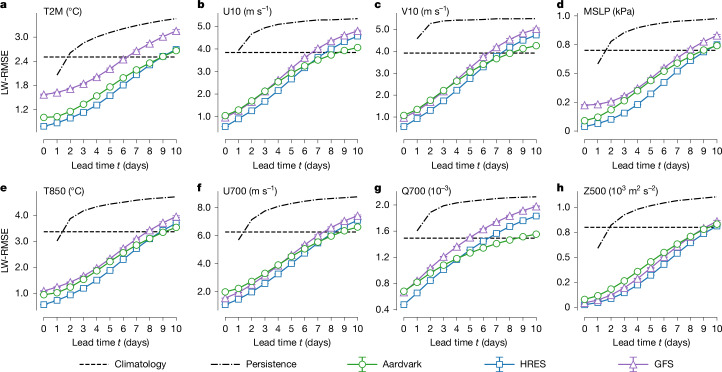
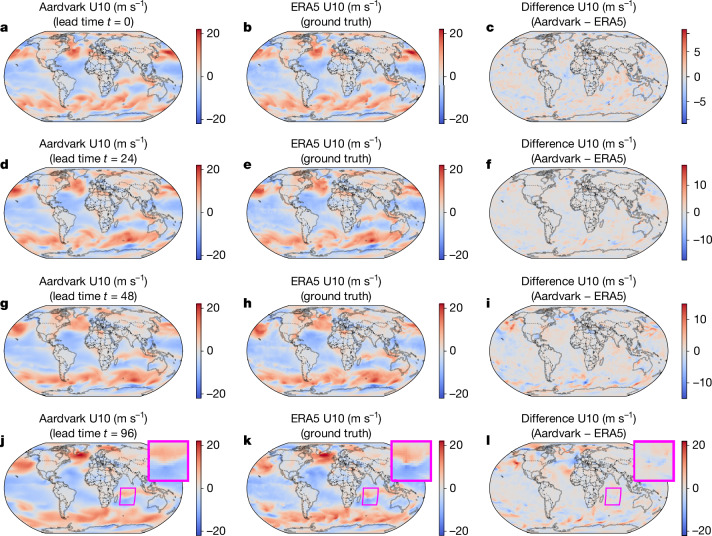
- On a global 1.50° grid, Aardvark matched or outperformed GFS across most lead times, with the only exception being geopotential at 500 hPa, and approached HRES performance for most variables; errors were larger at higher atmospheric levels and shorter lead times, and forecasts tended to become spectrally blurred at longer lead times.
- Aardvark ingests approximately 8% of the observations available to conventional NWP systems, and generating a full forecast from observational data takes approximately 1 s on four NVIDIA A100 GPUs, compared with approximately 1,000 node hours required by HRES for data assimilation and forecasting alone.
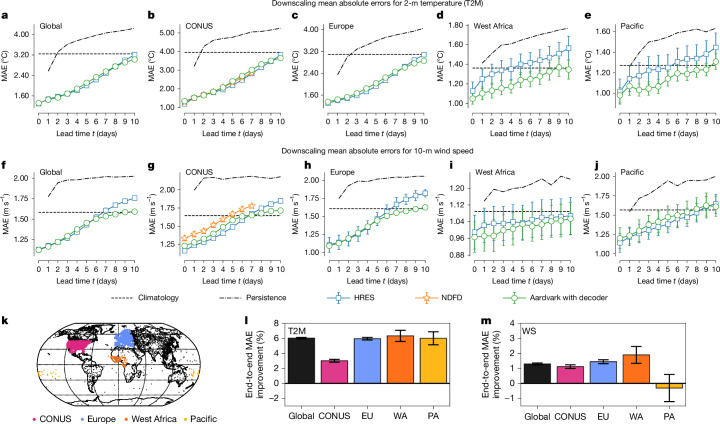
- Station forecasts for 2-m temperature and 10-m wind speed were skilful up to 10 days; for temperature, Aardvark was competitive with station-corrected HRES over CONUS and Europe, matched NDFD over CONUS, and outperformed station-corrected HRES in West Africa and the Pacific at all lead times; for wind speed, it had higher errors than station-corrected HRES over CONUS, significantly outperformed NDFD, was similar to station-corrected HRES over Europe up to 4 days and better thereafter, generally outperformed station-corrected HRES over West Africa, and performed slightly worse over the Pacific.
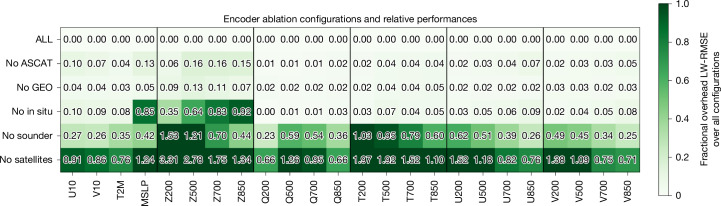
- End-to-end fine-tuning reduced 2-m temperature MAE by 6% over Europe, West Africa, the Pacific and globally, and by 3% over CONUS; for 10-m wind speed, improvements were 1–2% for all regions except the Pacific. Encoder ablations showed satellite data are crucial, with LEO sounder data most important, while in situ observations are most important for surface variables and also play a surprisingly large role in geopotential at lower levels.
Methods
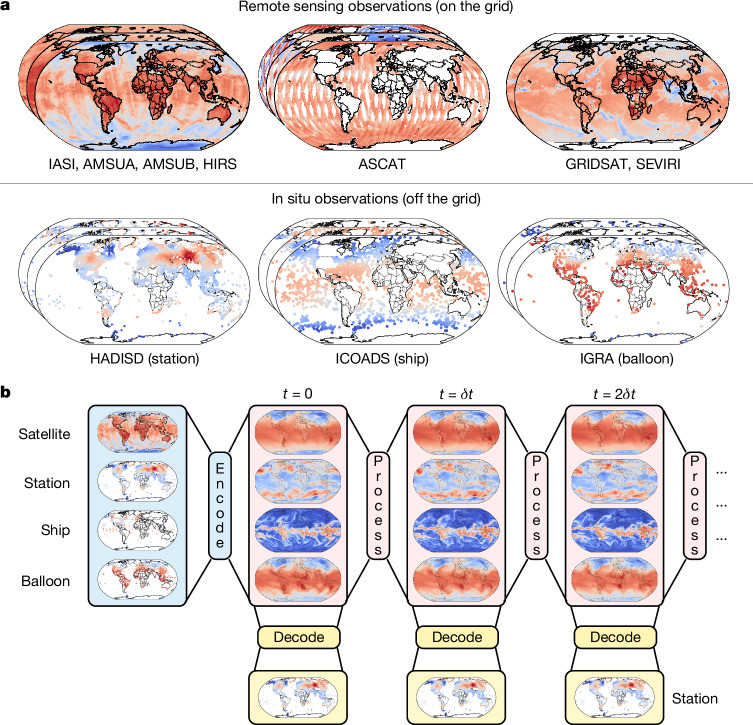
- Aardvark consists of three modules: an encoder that estimates a gridded initial atmospheric state from raw observations, a processor that autoregressively produces 24-h global forecasts out to 10 days, and task-specific decoders that produce local station forecasts; the architecture is a neural process combining SetConv layers with vision transformers for encoder and processor, and a lightweight U-Net plus SetConv and MLP for the decoder.
- Inputs include remote sensing data (ASCAT scatterometer, AMSU-A/B, MHS, HIRS/4, IASI, GridSat geostationary) and in situ data (HadISD land stations, ICOADS marine observations, IGRA radiosondes), plus temporal and orographic variables; training used ERA5 reanalysis for pretraining, with data before 2018 for training, 2018 as test and 2019 as validation.
- Global forecasts were evaluated against persistence, climatology, HRES and GFS using latitude-weighted RMSE with ERA5 as ground truth; station forecasts were evaluated against per-station persistence and climatology, station-corrected HRES, and NDFD over CONUS using MAE; end-to-end fine-tuning jointly optimized encoder, processor and decoder for specific variables and regions.
Limitations
- The paper states that Aardvark does not yet run at the resolution of IFS; further studies are required to increase grid resolution and produce forecast ensembles, for example through diffusion; further observational modalities will probably increase skill; integrating new instruments without training data may require simulated data; and observation drift can be mitigated by regularly fine-tuning all modules with recent data.
- The text makes evident that evaluation uses ERA5 as ground truth, although HRES analysis is of higher quality than ERA5, with discrepancies limited for the 2018 test year; Aardvark’s errors are larger at higher atmospheric levels and shorter lead times than operational baselines, possibly due to higher observation concentration near the surface; and forecasts tend to become spectrally blurred at longer lead times.
- The text also makes evident that the station-corrected HRES baseline is not necessarily state-of-the-art in downscaling, NDFD is only available over CONUS, the study considered a single downstream decoder for station forecasting, and the system operates at 1.50° resolution with five vertical levels.
Model-written summary. Check it against the paper before relying on it.
Integrity signals
Registry
Cites
Statistics
Figures
Verification
Claims the paper makes
0 Valid · 1 Not valid · 15 Not checked · 58 Own results and interpretations
A result the paper reports from its own data — it cites no other source for it, so there is none to check. The quote shows it is in the paper.
In the paper
“Over Europe, Aardvark had similar errors with the station-corrected HRES up to 4 days of lead time and outperformed it thereafter.”
§ End-to-end data-driven weather prediction > Evaluation of station forecasting
plain- Asserted: passes — The authors put it forward as true.
- Checkable: passes — It can be checked against evidence.
- Load-bearing: unclear — It is unclear whether the paper’s conclusions depend on it.
- Based: passes — The paper gives a reason why it holds.
A result the paper states — it cites no source for it, so there is none to check. The quote shows it is in the paper.
In the paper
“Aardvark Weather is a deep learning model that provides forecasts of eastward wind, northward wind, specific humidity, geopotential and temperature (at 200, 500, 700 and 850 hPa pressure levels), 10-m eastward wind, 10-m northward wind, 2-m temperature and mean sea level pressure on a dense global grid, and station forecasts for 2-m temperature and 10-m wind speed.”
§ End-to-end data-driven weather prediction > Aardvark Weather
plain- Asserted: passes — The authors put it forward as true.
- Checkable: passes — It can be checked against evidence.
- Load-bearing: passes — The paper’s conclusions depend on it.
- Based: passes — The paper gives a reason why it holds.
A result the paper states — it cites no source for it, so there is none to check. The quote shows it is in the paper.
In the paper
“We present Aardvark Weather, an end-to-end data-driven weather forecasting system capable of generating predictions with no input from conventional NWP by instead learning a mapping from raw input observations to output forecasts.”
§ End-to-end data-driven weather prediction > Main
plainstates a cause- Asserted: passes — The authors put it forward as true.
- Checkable: passes — It can be checked against evidence.
- Load-bearing: passes — The paper’s conclusions depend on it.
- Based: passes — The paper gives a reason why it holds.
A result the paper reports from its own data — it cites no other source for it, so there is none to check. The quote shows it is in the paper.
In the paper
“Aardvark successfully captured the large-scale features of the atmospheric state, both in the mid-latitudes and the tropics.”
§ End-to-end data-driven weather prediction > Evaluation of global forecasting
plain- Asserted: passes — The authors put it forward as true.
- Checkable: passes — It can be checked against evidence.
- Load-bearing: passes — The paper’s conclusions depend on it.
- Based: passes — The paper gives a reason why it holds.
A result the paper states — it cites no source for it, so there is none to check. The quote shows it is in the paper.
In the paper
“Overall, Aardvark’s errors were larger at higher atmospheric levels and shorter lead times than those of the operational baselines.”
§ End-to-end data-driven weather prediction > Evaluation of global forecasting
plainstates an association- Asserted: passes — The authors put it forward as true.
- Checkable: passes — It can be checked against evidence.
- Load-bearing: unclear — It is unclear whether the paper’s conclusions depend on it.
- Based: passes — The paper gives a reason why it holds.
35 more claims
Create a free account to see all 74 claims and to verify the 19 references still open.
- It may state two separate claims as one. 22
- Probably not a substantial claim. 19
- The quote only partly states this claim. 1
Citations
Cites
U-Net: Convolutional Networks for Biomedical Image Segmentation
Ronneberger, O., Fischer, P., & Brox, T. (2015) · Lecture notes in computer science · doi:10.1007/978-3-319-24574-4_28 · Cited by 99,404
An Image is Worth 16x16 Words: Transformers for Image Recognition at Scale
Dosovitskiy, A., Beyer, L., Kolesnikov, A., Weissenborn, D., Zhai, X., Unterthiner, T., Dehghani, M., Minderer, M., Heigold, G., Gelly, S., et al. (2020) · arXiv · doi:10.48550/arxiv.2010.11929 · Cited by 47,472 · cited 2×
“Embeddings for each patch use a multi-layer perceptron following a previous study 27 .”
Matplotlib: a 2D graphics environment
Hunter, J. D. (2007) · Computing in Science & Engineering · doi:10.1109/mcse.2007.55 · Cited by 39,249
Hersbach, H., Bell, B., Berrisford, P., Hirahara, S., Horányi, A., Muñoz‐Sabater, J., Nicolas, J., Peubey, C., Radu, R., Schepers, D., et al. (2020) · Quarterly Journal of the Royal Meteorological Society · doi:10.1002/qj.3803 · Cited by 31,882 · cited 4×
“34), which remained operational until 2017.”
InfluentialOn the difficulty of training recurrent neural networks
Pascanu, R., Mikolov, T., & Bengio, Y. (2012) · arXiv · doi:10.48550/arxiv.1211.5063 · Cited by 4,310 · cited 1×
“Owing to the complexities of training recurrent neural networks, including the need for a spin-up period and gradient instabilities 26 , we opted for a non-recurrent approach.”
5th International Conference on Learning Representations (ICLR 17)
Havrylov, S., & Titov, I. (2017) · Cited by 3,503
International Conference on Learning Representations (ICLR 2013)
松尾, 豊. (2013) · 人工知能学会誌 = Journal of Japanese Society for Artificial Intelligence · Cited by 2,932
Accurate medium-range global weather forecasting with 3D neural networks
Bi, K., Xie, L., Zhang, H., Chen, X., Gu, X., & Tian, Q. (2023) · Nature · doi:10.1038/s41586-023-06185-3 · Cited by 1,670 · cited 3×
“…to a processor module, which produces a gridded forecast at a lead time of 24 h. Forecasts at subsequent lead times are produced by autoregressively feeding the predictions of the processor module back to it as an input, similar to the existing approaches in data-driven weather forecasting 1,6 .”
Learning skillful medium-range global weather forecasting
Lam, R., Sanchez-Gonzalez, A., Willson, M., Wirnsberger, P., Fortunato, M., Alet, F., Ravuri, S., Ewalds, T., Eaton-Rosen, Z., Hu, W., et al. (2023) · Science · doi:10.1126/science.adi2336 · Cited by 1,466 · cited 7×
“This phenomenon is commonly observed in data-driven weather forecasting systems 1,6,35 .”
InfluentialFirst- and Second-Order Conservative Remapping Schemes for Grids in Spherical Coordinates
Jones, P. W. (1999) · Monthly Weather Review · doi:10.1175/1520-0493(1999)127<2204:fasocr>2.0.co;2 · Cited by 842 · cited 1×
“33), in which both datasets were coarsened to 1.50° resolution using first-order conservative re-gridding 61 .”
Influential
Research works printed but not linked: 3
- Gelsthorpe, R., Schied, E. & Wilson, J. ASCAT-Metop’s advanced scatterometer. ESA Bull. 102, 19–27 (2000).
- Vaughan, A., Lane, N. D. & Herzog, M. Multivariate climate downscaling with latent neural processes. In Tackling Climate Change with Machine Learning ICML Workshop (2021).
- Nguyen, T., Brandstetter, J., Kapoor, A., Gupta, J. K. & Grover, A. In Proceedings of the 40th International Conference on Machine Learning, 25904–25938 (PMLR, 2023).
Cited by
A foundation model for the Earth system
Bodnar, C., Bruinsma, W. P., Lucic, A., Stanley, M., Allen, A., Brandstetter, J., Garvan, P., Riechert, M., Weyn, J. A., Dong, H., et al. (2025) · Nature · doi:10.1038/s41586-025-09005-y · Cited by 267
Self-citationLang, S. T. K., Alexe, M., Clare, M., Roberts, C. D., Adewoyin, R. A., Bouallègue, Z. B., Chantry, M., Dramsch, J. S., Dueben, P. D., Hahner, S., et al. (2026) · npj Artificial Intelligence · doi:10.1038/s44387-026-00073-7 · Cited by 236
“Work is ongoing at ECMWF 47,48 and elsewhere 49 – 51 to explore observation-based training and initialisation, but currently these do not outperform physics-based data assimilation systems.”
Self-citationJournal of Advances in Modeling Earth Systems
(2018) · Journal of Advances in Modeling Earth Systems · doi:10.1002/(issn)1942-2466 · Cited by 179
A data-to-forecast machine learning system for global weather
Sun, X., Zhong, X., Xu, X., Huang, Y., Li, H., Neelin, J. D., Chen, D., Feng, J., Han, W., Wu, L., et al. (2025) · Nature Communications · doi:10.1038/s41467-025-62024-1 · Cited by 91
“Aardvark Weather 44 processes raw observations for forecasts but falls short of the accuracy achieved by ECMWF HRES.”
Subich, C. J., Husain, S. Z., Šeparović, L., & Yang, J. (2025) · International Conference on Machine Learning · doi:10.48550/arxiv.2501.19374 · Cited by 79
Alexe, M., Boucher, E., Lean, P., Pinnington, E., Laloyaux, P., McNally, A. P., Lang, S., Chantry, M., Burrows, C., Chrust, M., et al. (2024) · arXiv · doi:10.48550/arxiv.2412.15687 · Cited by 74
Self-citationDiscovery Learning predicts battery cycle life from minimal experiments
Zhang, J., Zhang, Y., Yi, B., Ren, Y., Jiao, Q., Bai, H., Jiang, W., & Song, Z. (2026) · Nature · doi:10.1038/s41586-025-09951-7 · Cited by 60
Data driven weather forecasts trained and initialised directly from observationsPreprint
McNally, A. P., Lessig, C., Lean, P., Boucher, E., Alexe, M., Pinnington, E., Chantry, M., Lang, S., Burrows, C., Chrust, M., et al. (2024) · arXiv · doi:10.48550/arxiv.2407.15586 · Cited by 56
Self-citationArtificial Intelligence Index Report 2026Preprint
Sajadieh, S., Fattorini, L., Perrault, R., Gil, Y., Parli, V., Santarlasci, L., Pava, J., Maslej, N., Altman, R. B., Brynjolfsson, E., et al. (2026) · arXiv · doi:10.48550/arxiv.2606.15708 · Cited by 53
Towards an end-to-end artificial intelligence driven global weather forecasting systemPreprint
Chen, K., Bai, L., Ling, F., Ye, P., Chen, T., Fan, H., Chen, H., Xiao, Y., Chen, K., Han, T., et al. (2023) · arXiv · doi:10.48550/arxiv.2312.12462 · Cited by 50
What if? Numerical weather prediction at the crossroads
Bauer, P. (2024) · Journal of the European Meteorological Society. · doi:10.1016/j.jemets.2024.100002 · Cited by 43
Adamov, S., Oskarsson, J., Denby, L., Landelius, T., Hintz, K. S., Christiansen, S. S., Schicker, I., Osuna, C., Lindsten, F., Fuhrer, O., et al. (2025) · arXiv · doi:10.48550/arxiv.2504.09340 · Cited by 36
Machine Learning for Inverse Problems and Data AssimilationPreprint
Bach, E., Baptista, R., Sanz-Alonso, D., & Stuart, A. M. (2024) · arXiv · doi:10.48550/arxiv.2410.10523 · Cited by 35
Generative assimilation and prediction for weather and climate
Yang, S., Nai, C., Liu, X., Li, W., Chao, J., Wang, J., Wang, L., Li, X., Li, X., Chen, X., et al. (2026) · npj Climate and Atmospheric Science · doi:10.1038/s41612-026-01585-4 · Cited by 32
Assimilating Observed Surface Pressure Into ML Weather Prediction Models
Slivinski, L., Whitaker, J. S., Frolov, S., Smith, T. A., & Agarwal, N. (2025) · Geophysical Research Letters · doi:10.1029/2024gl114396 · Cited by 31
Bocquet, M., Farchi, A., Finn, T. S., Durand, C., Cheng, S. L., Chen, Y., Pasmans, I., & Carrassi, A. (2024) · Chaos An Interdisciplinary Journal of Nonlinear Science · doi:10.1063/5.0230837 · Cited by 31
On the foundations of Earth foundation models
Zhu, X. X., Xiong, Z., Wang, Y., Stewart, A. J., Heidler, K., Wang, Y., Yuan, Z., Dujardin, T., Xu, Q., & Shi, Y. (2026) · Communications Earth & Environment · doi:10.1038/s43247-025-03127-x · Cited by 26
AI for atmosphere–ocean sciences: advancements, challenges and ways forward
Luo, J., Xia, J., Pan, B., Ham, Y.-G., Li, X., Shangguan, W., Xue, W., Wang, Y., Mu, B., Hong, Y., et al. (2026) · National Science Review · doi:10.1093/nsr/nwag063 · Cited by 26
“An integration of diverse data sources enhances the prediction accuracy of the data-driven model by utilizing in situ and remote sensing measurements as well as reanalysis [106 ,107 ].”
Physics-Informed Stochastic Neural Operators for Climate and Earth-System Prediction
Pasupuleti, M. K. (2026) · International Journal of Academic and Industrial Research Innovations(IJAIRI) · doi:10.62311/nesx/rp2oct-30102026 · Cited by 25
Local Off‐Grid Weather Forecasting With Multi‐Modal Earth Observation Data
Yang, Q., Giezendanner, J., Civitarese, D., Jakubik, J., Schmitt, E., Chandra, A., Vila, J. P., Hohl, D., Hill, C., Watson, C., et al. (2025) · Journal of Advances in Modeling Earth Systems · doi:10.1029/2025ms005207 · Cited by 24
“Graph Neural Network for Physical Simulation Graph neural networks (GNNs) are a type of deep learning model designed to operate on data structured as graphs, where entities are represented as nodes and their relationships as edges.”
Operational tropical cyclone forecasting with AI
Alet, F., Andersson, T. R., Price, I., Markou, S., El-Kadi, A., Masters, D. A., Li, A., Merchant, S., Williams, N., Thornton, G., et al. (2026) · Nature · doi:10.1038/s41586-026-10953-2 · Cited by 23
Self-citationHaji-Aghajany, S., Rohm, W., Lipiński, P., & Kryza, M. (2025) · Engineering Applications of Artificial Intelligence · doi:10.1016/j.engappai.2025.112335 · Cited by 21
Estimating Interventional Distributions with Uncertain Causal Graphs through Meta-Learning
Dhir, A., Diaconu, C., Lungu, V., Requeima, J., Turner, R. E., & van der Wilk, M. (2025) · neural information processing systems · doi:10.52202/085713-4681 · Cited by 21
Self-citationPerspectives on Systematic Cloud Microphysics Scheme Development With Machine Learning
Lamb, K. D., Singer, C. E., Loftus, K., Morrison, H., Powell, M., Ko, J., Buch, J., Hu, A. Z., van Lier‐Walqui, M., & Gentine, P. (2025) · Journal of Advances in Modeling Earth Systems · doi:10.1029/2025ms005341 · Cited by 20
“…numerical weather prediction (NWP) does not explicitly include parameterizations for sub‐grid‐scale processes (cloud microphysics, turbulence, or convection), but instead trains models to predict total physics tendencies (Allen et al., 2025; Bi et al., 2023; Lam et al., 2023; Price et al., 2025).”
Kotsuki, S., Shiraishi, K., & Okazaki, A. (2025) · Geoscientific model development · doi:10.5194/gmd-18-7215-2025 · Cited by 19
Tu, S., Fei, B., Yang, W., Ling, F., Chen, H., Liu, Z., Chen, K., Fan, H., Ouyang, W., & Bai, L. (2025) · IEEE Computer Society Conference on Computer Vision and Pattern Recognition/Proceedings - IEEE Computer Society Conference on Computer Vision and Pattern Recognition/Proceedings · doi:10.1109/cvpr52734.2025.02614 · Cited by 19
WeatherReal: A Benchmark Based on In-Situ Observations for Evaluating Weather ModelsPreprint
Jin, W., Weyn, J. A., Zhao, P., Xiang, S., Bian, J., Fang, Z., Dong, H., Sun, H., Thambiratnam, K., & Zhang, Q. (2024) · arXiv · doi:10.48550/arxiv.2409.09371 · Cited by 19
Learning Optimal Filters Using Variational InferencePreprint
Bach, E., Baptista, R., Luk, E., & Stuart, A. M. (2024) · arXiv · doi:10.48550/arxiv.2406.18066 · Cited by 18
“Throughout this paper, we assume that time-series of observations { y 2) is available for this purpose, in addition to access to P ; some work uses paired time-series 2) [2], while other work uses only data from (1.2) without requiring knowledge of the forecast nor observation model [49, 1].”
InfluentialLupin-Jimenez, L. C., Darman, M., Hazarika, S., Wu, T., Gray, M., He, R., Wong, A., & Chattopadhyay, A. (2025) · Journal of Geophysical Research Machine Learning and Computation · doi:10.1029/2025jh000851 · Cited by 17
Mid‐Latitude Versus Tropical Scales of Predictability and Their Implications for Forecasting
Keane, R. J., Parker, D. J., Dunn‐Sigouin, E., Kolstad, E. W., & Marsham, J. H. (2025) · Meteorological Applications · doi:10.1002/met.70055 · Cited by 17
Exploring the design space of deep-learning-based weather forecasting systemsPreprint
Siddiqui, S. A., Kossaifi, J., Bonev, B., Choy, C., Kautz, J., Krueger, D., & Azizzadenesheli, K. (2024) · arXiv · doi:10.48550/arxiv.2410.07472 · Cited by 16
ERA5 overestimates land drying trend from 1980 to 2023 by more than 100%
Wang, K., Mou, W., Cai, H., Yin, C., Li, Y., Allan, R. P., Beck, H. E., Dai, A., Miralles, D. G., Ryu, D., et al. (2026) · Science Bulletin · doi:10.1016/j.scib.2026.01.045 · Cited by 16
Using Diffusion Models to Do Data Assimilation
Hodyss, D., & Morzfeld, M. (2025) · Monthly Weather Review · doi:10.1175/mwr-d-25-0125.1 · Cited by 15
HealDA: Highlighting the importance of initial errors in end-to-end AI weather forecastsPreprint
Gupta, A., Subramaniam, A., Pritchard, M. S., Kashinath, K., Frolov, S., Lieberman, K., Miller, C., Silverman, N., & Brenowitz, N. (2026) · arXiv · doi:10.48550/arxiv.2601.17636 · Cited by 15
“…seem obvious that a DA system should seek to minimize initial-condition error to lie within the uncertainty of modern reanalyses, a scan of the recent ML DA literature ([15, 16, 17, 18]) and our results below show that current ML-based DA systems, including our own, still exhibit errors that…”
InfluentialSpectral Convolutional Conditional Neural Processes
Mohseni, P., & Duffield, N. G. (2025) · neural information processing systems · doi:10.52202/085713-1350 · Cited by 15
The convergence of machine learning and data assimilation in Earth system science
Arcucci, R., Healy, S. B., Dance, S. L., Lei, L., Bach, E., Weaver, A., Miyoshi, T., Dillon, M. E., Draper, C. S., Schneider, R., et al. (2026) · npj Artificial Intelligence · doi:10.1038/s44387-026-00107-0 · Cited by 14
Tensor-Var: Efficient Four-Dimensional Variational Data Assimilation
Yang, Y., Cheng, X., Giles, D., Cheng, S. L., He, Y., Xiao, X., Chen, B., & Hu, Y. (2025) · International Conference on Machine Learning · doi:10.48550/arxiv.2501.13312 · Cited by 14
OMG-HD: A High-Resolution AI Weather Model for End-to-End Forecasts from ObservationsPreprint
Zhao, P., Bian, J., Ni, Z., Jin, W., Weyn, J. A., Fang, Z., Xiang, S., Dong, H., Zhang, B., Sun, H., et al. (2024) · arXiv · doi:10.48550/arxiv.2412.18239 · Cited by 13
WeatherNext 3: Increasing resolution and performance of global weather models with raw observationsPreprint
Rasp, S., Babenko, B., Masters, D. A., El-Kadi, A., Merchant, S., Shalev, G., Price, I., Zyda, F., Lam, R., Shysheya, S., et al. (2026) · arXiv · doi:10.48550/arxiv.2609.03582 · Cited by 12
Self-citationLearning from nature: insights into GraphDOP's representations of the Earth SystemPreprint
Lean, P., Alexe, M., Boucher, E., Pinnington, E., Lang, S. T. K., Laloyaux, P., Bormann, N., & McNally, A. (2025) · arXiv · doi:10.48550/arxiv.2508.18018 · Cited by 12
“Unlike other studies that rely on a combination of observational and analysis datasets [Andrychowicz et al., 2023, Yuval et al., 2024, Allen et al., 2025], a r X i v : 2 5 08 .”
FloeNet: A Mass‐Conserving Global Sea Ice Emulator That Generalizes Across Climates
Gregory, W. K., Bushuk, M., Duncan, J., Wu, E., Subel, A., Clark, S. K., Hurlin, W. J., Watt‐Meyer, O., Adcroft, A., Bretherton, C. S., et al. (2026) · Geophysical Research Letters · doi:10.1029/2026gl122981 · Cited by 12
“…models have built on the success of data-driven numerical weather prediction models (Pathak et al., 2022; Lam et al., 2023; Kochkov et al., 2024; Allen et al., 2025), now with global-scale climate emulators of the atmosphere (Chapman et al., 2025; Watt-Meyer et al., 2025; Perkins et al., 2025),…”
Özdemir, F., Cheng, Y., Mohebi, S., Lehmann, F., Adamov, S., Zhang, Z., Trentini, L., Grund, D., Fuhrer, O., Hoefler, T., et al. (2026) · arXiv · doi:10.48550/arxiv.2605.00850 · Cited by 12
AIFS-DOP: End-to-End Medium-Range Weather Prediction from Observations Alone with Machine LearningPreprint
Pinnington, E., Lean, P., Alexe, M., Boucher, E., Lang, S. T. K., Laloyaux, P., Mertes, G., Kráľ, T., de Rosnay, P., Chantry, M., et al. (2026) · arXiv · doi:10.48550/arxiv.2606.19093 · Cited by 12
“…shown skillful forecasts achieved through training on a combination of observations and the ERA5 reanalysis dataset [Andrychowicz et al., 2023, Yuval et al., 2024, Allen et al., 2025, Ni et al., 2025], thus being able to produce forecasts without relying on inputs from a physics-based NWP model.”
Self-citationAI for operational methane emitter monitoring from spacePreprint
Vaughan, A., Mateo‐García, G., Irakulis‐Loitxate, I., Watine-Guiu, M., Fernandez-Poblaciones, P., Turner, R. E., Requeima, J., Gorroño, J., Randles, C. A., Caltagirone, M., et al. (2024) · arXiv · doi:10.48550/arxiv.2408.04745 · Cited by 12
Self-citationTian, X., Holdaway, D., & Kleist, D. T. (2026) · Geophysical Research Letters · doi:10.1029/2025gl119402 · Cited by 11
“…developments in direct observation‐based systems represent an alternative paradigm that attempts to learn mappings directly from observations to forecasts, bypassing the need for state estimation and TL/AD models that our study examines (Alexe et al., 2024; Allen et al., 2025; Xiao et al., 2023).”
Using data assimilation tools to dissect GraphDOPPreprint
Laloyaux, P., Alexe, M., Boucher, E., Lean, P., Pinnington, E., Lang, S. T. K., Necker, T., & McNally, A. P. (2025) · arXiv · doi:10.48550/arxiv.2510.27388 · Cited by 11
“Learning directly from observational data has been also investigated to some extent by other research groups [Allen et al., 2025, Vandal et al., 2024, Keller and Potthast, 2024, Sun et al., 2024].”
Seasonal forecasting using the GenCast probabilistic machine learning model
Antonio, B., Strømmen, K., & Christensen, H. M. (2026) · Climate Dynamics · doi:10.1007/s00382-026-08077-4 · Cited by 10
“…of machine-learnt weather prediction (MLWP) models that are competitive with conventional physics-based models at medium-range weather forecasting, for both deterministic (Lam et al. 2023; Bi et al. 2023; Allen et al. 2025) and probabilistic forecasts (Price et al. 2025; Lang et al. 2024).”
Bröcker, J., Driscoll, S., Necker, T., Rodríguez, J. M., Dacre, H., Harvey, N. J., & Bouallègue, Z. B. (2026) · Journal of the European Meteorological Society. · doi:10.1016/j.jemets.2026.100032 · Cited by 10
Weather forecasting in a changing climate: the rise of AI and Machine learning?
Rabier, F., Brown, A., Chantry, M., & Pappenberger, F. (2026) · Journal of the European Meteorological Society. · doi:10.1016/j.jemets.2026.100040 · Cited by 10
Self-citationOn the Effective Resolution of AI Weather Prediction Models
Selz, T., Allén, A., Bruinsma, W. P., Craig, G. C., Markou, S., & Turner, R. E. (2026) · Artificial Intelligence for the Earth Systems · doi:10.1175/aies-d-25-0121.1 · Cited by 9
Self-citationAI-Based Forecasting in Renewable-Rich Microgrids: Challenges and Comparative Insights
Osifeko, M. O., & Munda, J. L. (2025) · IEEE Access · doi:10.1109/access.2025.3591091 · Cited by 9
Align-DA: Align Score-based Atmospheric Data Assimilation with Multiple Preferences
Sun, J., Fan, H., Gong, J., Fei, B., Chen, K., Ling, F., Zhang, W., Xu, W., Yan, L., Gentine, P., et al. (2025) · neural information processing systems · doi:10.52202/085713-2134 · Cited by 9
Gridded Transformer Neural Processes for Spatio-Temporal Data
Ashman, M., Diaconu, C., Langezaal, E., Weller, A., & Turner, R. E. (2025) · International Conference on Machine Learning · Cited by 9
Self-citationNi, Z., Weyn, J. A., Zhang, H., Xiang, Y., Bian, J., Jin, W., Thambiratnam, K., Zhang, Q., Dong, H., & Sun, H. (2025) · arXiv · doi:10.48550/arxiv.2508.18486 · Cited by 9
“A few end-to-end data-driven DA systems have been proposed, such as Aardvark [6], FuXi Weather [7] and GraphDOP [8], but none of them has so far been able to match the forecast skill of state-of-the-art NWP competitors when coupled with a weather prediction model, highlighting the challenging…”
AI-Enabled Energy Management for Sustainable Smart Greenhouses: An Integrated Review
Biswal, S. R., Choudhury, T. R., Panda, B., & Mishra, S. P. (2026) · IEEE Access · doi:10.1109/access.2026.3651685 · Cited by 8
“Integration of high resolution numerical weather prediction (NWP) models with AI based post processing has demonstrated improved accuracy in microclimate control strategies for GHs [57].”
Liu, Z., Chen, H., Bai, L., Li, W., Zou, Z., & Shi, Z. (2025) · IEEE Transactions on Geoscience and Remote Sensing · doi:10.1109/tgrs.2025.3578701 · Cited by 8
“This observation-driven approach aligns with the emerging trend toward end-to-end meteorological forecasting using direct observational data rather than model-derived products [58], [59].”
InfluentialSolvik, K. K., Penny, S. G., & Hoyer, S. (2025) · Journal of Advances in Modeling Earth Systems · doi:10.1029/2024ms004608 · Cited by 8
Global performance benchmarking of artificial intelligence models in atmospheric river forecasting
Zhang, L., Lu, M., Bao, Q., Zhao, Y., & Yang, J. (2025) · Communications Earth & Environment · doi:10.1038/s43247-025-02823-y · Cited by 8
“These achievements demonstrate that the DL methods are not only compatible with tasks traditionally performed by general circulation models but also enhance their capabilities 8,17 .”
A scalable and generic framework for city-wide traffic prediction with large language model
Zhang, J., Deng, C., Yang, L., Zhang, S., Wang, D., Gao, J., & Gao, Z. (2026) · Nature Communications · doi:10.1038/s41467-026-73610-2 · Cited by 8
“The spatio-temporal feature extraction module consists of three dilated convolutions with dilation rates of [1, 2, 4] and three GRU layers with a hidden dimension of 12.”
Learning Probabilistic Filters with Strictly Proper Scoring RulesPreprint
Bach, E., Baptista, R., Bröcker, J., Chen, B., & Stuart, A. M. (2026) · arXiv · doi:10.48550/arxiv.2606.26497 · Cited by 8
Severe Weather Forecasts from Artificial Intelligence Weather Prediction Models
White, E., & Hill, A. J. (2026) · Artificial Intelligence for the Earth Systems · doi:10.1175/aies-d-25-0065.1 · Cited by 8
BioAnalyst: A Foundation Model for Biodiversity
Trantas, A., Mensio, M., Stasinos, S., Gribincea, S., Khan, T., Podareanu, D., & van der Veen, A. (2026) · Ecological Informatics · doi:10.1016/j.ecoinf.2026.104066 · Cited by 8
A regional artificial intelligence model for skillful typhoon prediction
Niu, Z., Huang, W., Huang, S., Wang, Z., Mu, M., Yang, M., Han, X., Sun, H., Huo, Z., & Qin, B. (2026) · npj natural hazards. · doi:10.1038/s44304-026-00219-2 · Cited by 8
Yifan, H. U., Yin, F., Zhang, W., Ren, K., Song, J., & Deng, K. (2026) · npj Climate and Atmospheric Science · doi:10.1038/s41612-026-01374-z · Cited by 7
Informed investments in clean energy technologies
Trancik, J. E., Baker, E. D., Nemet, G. F., Klemun, M. M., Hanes, R. J., Surana, K., Arent, D. J., Baldwin, S. F., Gabriel, S. A., Popper, S. W., et al. (2025) · Nature Energy · doi:10.1038/s41560-025-01867-w · Cited by 7
“A path forward for forecasting while managing uncertainty can be seen in the example of the theoretically grounded methods that have saved many billions of dollars in weather forecasting 32,33 .”
Tang, H., Chen, J., Chai, X., Li, C., Meng, C., Chen, S., Gu, W., & Shen, P. (2025) · Building and Environment · doi:10.1016/j.buildenv.2025.113882 · Cited by 7
Gridded Transformer Neural Processes for Large Unstructured Spatio-Temporal DataPreprint
Ashman, M., Diaconu, C., Langezaal, E., Weller, A., & Turner, R. E. (2024) · arXiv · doi:10.48550/arxiv.2410.06731 · Cited by 7
Self-citationTianQuan-S2S: A Subseasonal-to-Seasonal Global Weather Model via Incorporate Climatology State
Li, G., Liu, X., Liu, Y., Chen, M., Cao, S., Wang, X., Zheng, J., Zhang, J., Liang, H., Zhang, L., et al. (2026) · International Conference on Learning Representations · doi:10.48550/arxiv.2504.09940 · Cited by 7
“Aurora (Bodnar et al., 2025) and Prithvi-WxC (Schmude et al., 2024) both focus on Weather forecasting based on foundation models.”
InfluentialNiu, Z., Huang, W., Huang, S., Qin, B., Yang, M., Sun, H., Huo, Z., Xiao, H., & Feng, K. (2026) · Journal of Geophysical Research Machine Learning and Computation · doi:10.1029/2025jh001072 · Cited by 7
Advancing early warning systems: AI applications, challenges and emerging insights
Otero, N., Pelivan, I., Fitoz, B., Luterbacher, J., Kuglitsch, M. M., & Ma, J. (2026) · Environmental Research Letters · doi:10.1088/1748-9326/ae5f7f · Cited by 6
“Major corporations such as Google DeepMind, NVIDIA, Huawei and several emerging companies have recognized the immense potential of AI-driven medium-range weather forecasting models (WMO 2024, Kuglitsch et al 2024b, Allen et al 2025, Chen et al 2025, Price et al 2025).”
Niu, Z., Huang, W., Yang, Y., Yang, M., Deng, L., Wang, H., Li, H., & Zhang, X. (2025) · Advances in Atmospheric Sciences · doi:10.1007/s00376-025-5464-8 · Cited by 6
Transformers for time-series forecasting: A comprehensive survey through 2024
Okamoto, Y. (2025) · Nonlinear Theory and Its Applications IEICE · doi:10.1587/nolta.17.260 · Cited by 6
Weather forecasts become more important for reducing mortality as the climate warms
Shrader, J. G., Thies, S., Bakkensen, L., Linsenmeier, M., & Lemoine, D. M. (2026) · Proceedings of the National Academy of Sciences · doi:10.1073/pnas.2523372123 · Cited by 6
Controllable Probabilistic Forecasting with Stochastic Decomposition LayersPreprint
Schreck, J. S., Chapman, W. E., Becker, C., Gagne, D. J., Kimpara, D., Cherukuru, N. W., Berner, J., Mayer, K. J., & Sobhani, N. (2025) · arXiv · doi:10.48550/arxiv.2512.18815 · Cited by 6
“Foundation models demonstrate strong transfer learning capabilities across weather and climate tasks [32–34].”
Generative deep learning improves reconstruction of global historical climate recordsPreprint
Qian, Z., Liu, T., Chan, D., Bathiany, S., Yang, S., Hess, P., Bochow, N., Burmester, C., Gelbrecht, M., Groenke, B., et al. (2026) · arXiv · doi:10.48550/arxiv.2602.16515 · Cited by 6
Tyche: One Step Flow for Efficient Probabilistic Weather ForecastingPreprint
Xu, F., Gao, Y., Wang, K., Su, R., Ling, F., Wu, H., & Ouyang, W. (2026) · arXiv · doi:10.48550/arxiv.2605.06916 · Cited by 6
“Modern machine-learning weather prediction [8, 5, 2, 14] has been driven by highly accurate deterministic forecasters such as FourCastNet [38], Pangu-Weather [4], GraphCast [27], and NeuralGCM [25].”
The rise of AI in weather and climate information and its impact on global inequality
Mozaffari, A., Duarte, A., Teckentrup, L., Materia, S., Charnley, G. E. C., Palma, L., Baulenas, E., Bojović, D., Checchia, P., Carréric, A., et al. (2026) · npj Climate Action · doi:10.1038/s44168-026-00412-z · Cited by 6
“Ultimately, this dependence on assimilated (ERA5) and simulated (CMIP6) datasets will likely persist until AI models trained purely on observational data ( e.g. [28 ]) can demonstrate comparable predictive performance.”
Benchmarking AI-based data assimilation to advance data-driven global weather forecastingPreprint
Wang, W., Ni, W., Fei, B., Han, T., Huang, L., Yuan, T., Li, X., Bai, L., Duan, B., & Ren, K. (2024) · arXiv · doi:10.48550/arxiv.2408.11438 · Cited by 6
“…spans several research directions, including DA function approximation on idealized scenarios [11–16], three-dimensional, multi-variable initial condition estimation [8, 17–20], end-to-end weather forecasting [21, 22], and AI-driven four-dimensional variational (4DVar) DA frameworks [7, 23, 24].”
Masiwal, R., Aitken, C., Marchakitus, A., Gupta, M., Kowal, K. M., Pahlavan, H. A., Yang, T., Sun, Y. Q., Kremer, M., Jina, A., et al. (2026) · arXiv · doi:10.48550/arxiv.2602.03767 · Cited by 6
“Given recent progress in AIWP development 1–4,6,24,56,64 , emerging evidence for weather forecast benefits 7,9,10 , and decreasing cost of information transmission 65,66 , now is the time for interdisciplinary efforts to integrate these separate advances to improve livelihoods in LMICs through…”
Wang, W., Ni, W., Huang, L., Hao, T., Fei, B., Ma, S., Yuan, T., Zhao, Y., Deng, K., Li, X., et al. (2025) · arXiv · doi:10.48550/arxiv.2507.09202 · Cited by 6
“In addition, unlike methods used in Aardvark [18], GraphDOP [17], FuXi-DA [15], and FengWu-Adas [12], we incorporate a quality control process into the computation of the 4DVar cost function by excluding observations whose distances from the background field exceed 5 times the standard deviation of…”
Generative Lagrangian data assimilation for ocean dynamics under extreme sparsity
Asefi, N., Lupin-Jimenez, L. C., Wu, T., He, R., & Chattopadhyay, A. (2025) · Machine Learning Earth · doi:10.1088/3049-4753/ae0b70 · Cited by 6
Progressive multi-fidelity learning with neural networks for physical system predictions
Conti, P., Guo, M., Frangi, A., & Manzoni, A. (2026) · Computer Methods in Applied Mechanics and Engineering · doi:10.1016/j.cma.2026.118881 · Cited by 5
“Scientific computing today stands as a cornerstone in several fields, delivering unparalleled success in diverse applications in science and engineering, including weather forecast [1, 2, 3], computational biology [4], among many others.”
Machine learning for subseasonal-to-seasonal prediction
Mayer, K. J., Lerch, S., de Burgh-Day, C., & Arcodia, M. C. (2025) · Elsevier eBooks · doi:10.1016/b978-0-443-31538-1.00003-8 · Cited by 5
Li, Q., & Zhao, T. (2026) · Stochastic Environmental Research and Risk Assessment · doi:10.1007/s00477-026-03271-6 · Cited by 5
“More recently, the hybrid NeuralGCM (Kochkov et al. 2024 ), the end-to-end Aardvark (Allen et al. 2025) and the foundation model Aurora (Bodnar et al. 2025) have been developed to further enhance forecasting capabilities.”
Evaluating the Predictability of Selected Weather Extremes with Aurora, an AI Weather Forecast Model
Huang, Q., Liu, M., Kwon, Y., & Lall, U. (2026) · Atmosphere · doi:10.3390/atmos17080716 · Cited by 5
“Multi-model comparisons confirm Aurora’s leading performance for synoptic-scale fields (e.g., Z500, T850) [15,16], while precipitation and TC intensity forecasts show more mixed skill across AI models, as detailed below.”
Performance of a machine‐learning‐physics hybrid model on 2024 typhoons and land precipitations
Niu, Z., Huang, W., Yang, Y., Yang, M., Fan, X., Deng, L., & Qin, B. (2025) · Quarterly Journal of the Royal Meteorological Society · doi:10.1002/qj.70101 · Cited by 5
Incremental Transformer Neural Processes
Mortimer, P., Diaconu, C., Rochussen, T., Mlodozeniec, B., & Turner, R. E. (2026) · International Conference on Machine Learning · doi:10.48550/arxiv.2602.18955 · Cited by 5
“They have been successfully applied to tasks such as weather modelling (An-dersson et al., 2023; Allen et al., 2025) and tabular data prediction (Hollmann et al., 2025b).”
Self-citationMODS: Multi-source Observations Conditional Diffusion Model for Meteorological State DownscalingPreprint
Tu, S., Xu, J., Yang, W., Bai, L., & Fei, B. (2025) · arXiv · doi:10.48550/arxiv.2506.14798 · Cited by 5
“Therefore, the atmospheric states derived from these observational sources and data from multiple origins can also be used to evaluate the generation accuracy of generative models related to ERA5 maps [Allen et al., 2025].”
Improving renewable energy forecasting with FuXi-Energy
Zhong, X., Chen, L., Li, H., Fan, X., Qian, W., Liu, J., Luo, E., & Wu, L. (2026) · Applied Energy · doi:10.1016/j.apenergy.2026.127657 · Cited by 4
Expert Transformer: Fine-Grained Mixture-of-Experts for Time-Series forecasting
Yang, J. (2026) · Expert Systems with Applications · doi:10.1016/j.eswa.2026.132634 · Cited by 4
Breder, G. B., Vasconcelos, G., & Ferro, M. (2025) · doi:10.5753/eniac.2025.14418 · Cited by 4
“While ML models can enhance accuracy and require fewer resources than traditional NWP models [Allen et al. 2025], they still demand considerable computational power and energy, challenging their use in developing countries [Lamptey et al. 2024].”
A Score‐Filter‐Enhanced Data Assimilation Framework for Data‐Driven Dynamical Systems
Tang, J., Bausback, R., Bao, F., Zhang, G., & Huynh, P. (2026) · Numerical Methods for Partial Differential Equations · doi:10.1002/num.70138 · Cited by 4
The AI Fetish: When Wooden Brains Begin to Think
Levant, A. (2025) · Caderno Brasileiro de Ensino de Física · doi:10.5007/2175-7941.2025.e108832 · Cited by 4
Almeida, R., Otero, N., Fernández‐Torres, M., & Ma, J. (2026) · Artificial Intelligence for the Earth Systems · doi:10.1175/aies-d-25-0113.1 · Cited by 4
“AI-based weather prediction (AIWP) models using transformers [Bi et al., 2023, Chen et al., 2023a,b, Allen et al., 2025], Fourier neural operators [Bonev et al., 2023, Kurth et al., 2023], and graph neural networks [Keisler, 2022, Lam et al., 2023] have pushed the skill of weather forecasting over…”
Sun, W., Zhang, Y., Wang, B., Sangmanee, C., & Wang, W. (2025) · IEEE Journal of Selected Topics in Applied Earth Observations and Remote Sensing · doi:10.1109/jstars.2025.3627083 · Cited by 4
“CurrentSSTpredictionmethodsfallmainlyintotwocat-egories: numerical models [16], [17] and data-driven meth-ods [18], [19], [20].”
Advancing Ocean State Estimation with efficient and scalable AIPreprint
Xiang, Y., Gao, Y., Wu, H., Zhang, Q., Shu, R., Zhou, X., Wu, X., & Huang, X. (2025) · arXiv · doi:10.48550/arxiv.2511.06041 · Cited by 4
Sparse Gaussian Neural Processes
Rochussen, T., & Fortuin, V. (2025) · Proceedings of Machine Learning Research · doi:10.48550/arxiv.2504.01650 · Cited by 4
“Recent advances in NPs have led them to reach astonishing heights in performance, representing the state-of-the-art in data-based approaches to weather and climate modeling (Bodnar et al., 2024; Allen et al., 2025; Ashman et al., 2024b), for example.”
Nikhitha, K. K., & Prasanth, A. P. (2025) · Journal of Enabling Technologies · doi:10.1108/jet-01-2025-0002 · Cited by 4
Adversarial Observations in Weather Forecasting
Imgrund, E., Eisenhofer, T., & Rieck, K. (2025) · ACM SIGSAC Conference on Computer and Communications Security (CCS) · doi:10.1145/3719027.3765076 · Cited by 4
“This would enable directly computing gradients to the individual observations, allowing attackers to perform the same attack directly on the problem space.”
Earth-o1: A Grid-free Observation-native Atmospheric World ModelPreprint
Gong, J., Xu, K., Wei, W., Tu, S., Xu, J., Liu, Z., Fan, H., Zhou, Z., Han, T., Xiao, Y., et al. (2026) · arXiv · doi:10.48550/arxiv.2605.06337 · Cited by 4
“Observations are the primary means by which the Earth system can be directly measured and explored, and they underpin a major part of our understanding in the atmospheric and climate sciences [1–3].”
Metadata
- Authors
- Allen, A., Markou, S., Tebbutt, W., Requeima, J., Bruinsma, W. P., Andersson, T. R., Herzog, M., Lane, N. D., Chantry, M., Hosking, J. S., & Turner, R. E.
- Affiliations
- University of Cambridge (GB)
- University of Toronto (CA)
- Microsoft Research (United Kingdom) (GB)
- British Antarctic Survey (GB)
- European Centre for Medium-Range Weather Forecasts (GB)
- Corresponding author
- Markou, Stratis
- Turner, Richard E.
- ORCID
- Venue
- Nature
- Published
- 2025-03-20
- Volume
- 641
- Issue
- 8065
- Pages
- 1172-1179
- ISSN
- 0028-0836 (ISSN-L)
- 1476-4687
- PMC
- PMC12119340
- OpenAlex
- W4408657432
- Cited by
- 312
- References
- 80
- Citations by year
- 2026: 221 · 2025: 77
- FWCI
- 77.98
- Type
- journal article
- Language
- en
- Open access
- hybrid
- doi.org
- Licence
- cc-by
- creativecommons.org/licenses/by/4.0 (tdm)
- creativecommons.org/licenses/by/4.0 (vor)
- Locations
- Nature (publishedVersion, cc-by)
- PubMed Central (publishedVersion, cc-by)
- PubMed (publishedVersion)
- arXiv (submittedVersion, cc-by)
- NERC Open Research Archive (Natural Environment Research Council) (submittedVersion, cc-by)
- RePEc: Research Papers in Economics (submittedVersion)
- Apollo (University of Cambridge) (submittedVersion, cc-by)
- Zenodo (CERN European Organization for Nuclear Research) (submittedVersion)
- Apollo (cc-by)
- Funders
- National Science Foundation
- Alan Turing Institute (Y028880/1)
- UK Research and Innovation (AI4ER, EP/S022961/1)
- DeepMind
- University of Cambridge
- Met Office
- Cambridge Trust
- University of Toronto
- European Centre for Medium-Range Weather Forecasts
- National Oceanic and Atmospheric Administration
- Engineering and Physical Sciences Research Council (EP/S022961/1, EP/Y028880/1, EP/T005386/1, EP/W002965/1)
- National Environmental Satellite, Data, and Information Service
- British Antarctic Survey
- Topics
- Physical Sciences › Earth and Planetary Sciences › Atmospheric Science › Meteorological Phenomena and Simulations
- Physical Sciences › Environmental Science › Environmental Engineering › Hydrological Forecasting Using AI
- Social Sciences › Transportation › Traffic Prediction and Management Techniques
- Keywords
- numerical weather prediction, forecast skill, computational complexity reduction, meteorological observations
About these checks
Registry, retraction, Cites and statistics results are computed, not judged, with one exception: a printed reference that no index lists is read once by a model before it counts as a citation error. Claims are extracted by a model and kept only when their quote appears verbatim in the text; each cited source is then checked, with a model’s help, for whether it says what the claim relies on. Those verdicts can be wrong — read the claim’s quote and the cited source before relying on one.
A language model drew the claims from the paper on 2026-11-28, under version 3 of the claim definition (model deepseek-v4.1-flash, prompt extract-v3).
A second model labelled each claim on 2026-11-28 (model jev-1.13-20260917, definition revision gold-guideline-v0.2).
Statistics and arithmetic are recomputed, not judged.
Confidence bands are shown only for fields calibrated on our annotated test set. None is calibrated yet, so no band is shown.
What counts as a claim ›How we measure confidence ›How we check this ›
Are you an author, or do you see a problem with this page? Request a review
Data sources
Bibliographic data: Semantic Scholar, OpenAlex, Crossref.
Contains information from the Semantic Scholar Academic Graph Datasets, made available under the ODC Attribution License (ODC-BY 1.0).
Semantic Scholar’s data is described in: Kinney, R., et al. (2023). The Semantic Scholar Open Data Platform. arXiv:2301.10140.
