

Subspace communication in the hippocampal–retrosplenial axis
Open accessPublished version of a preprint
The DOI matches its Crossref record; 78 of the 78 references it cites were found in a registry or an index.
Abstract
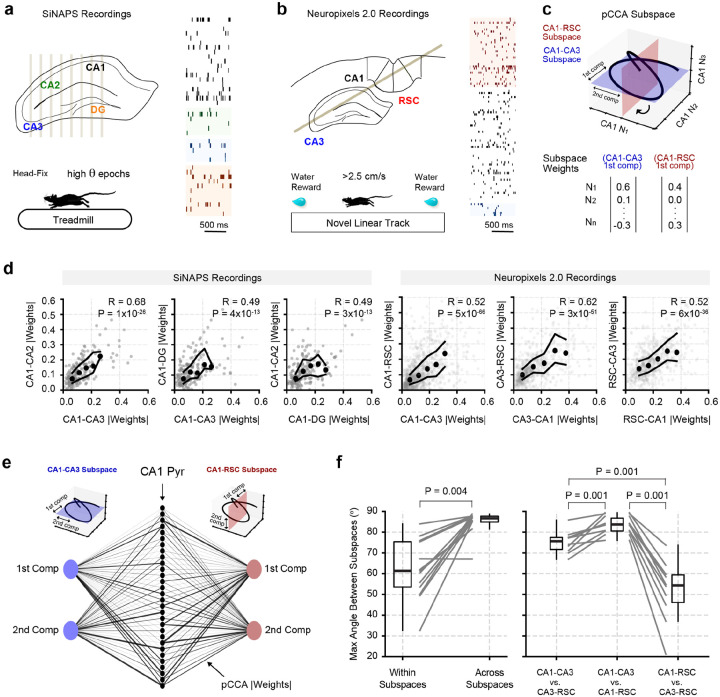
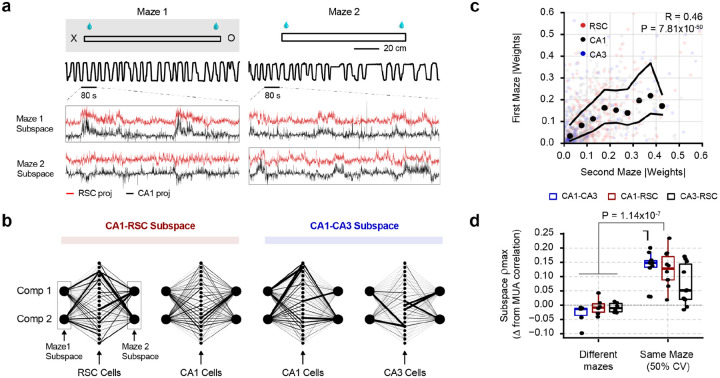
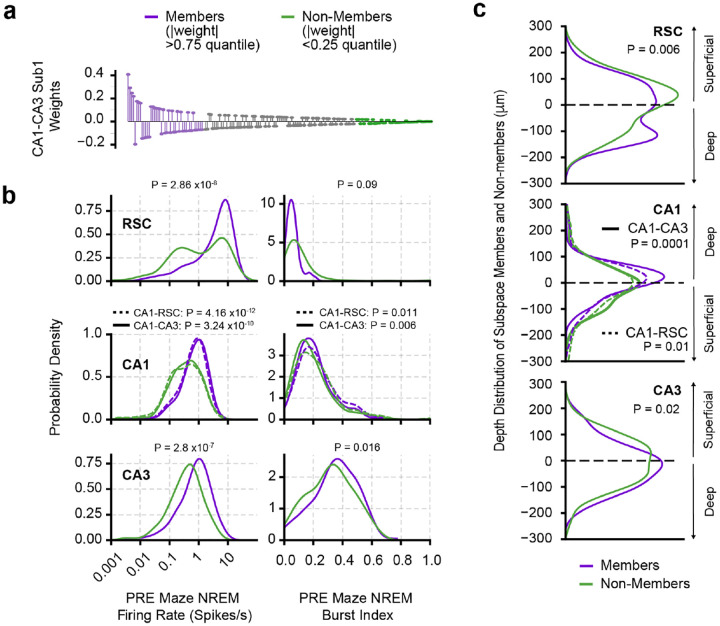
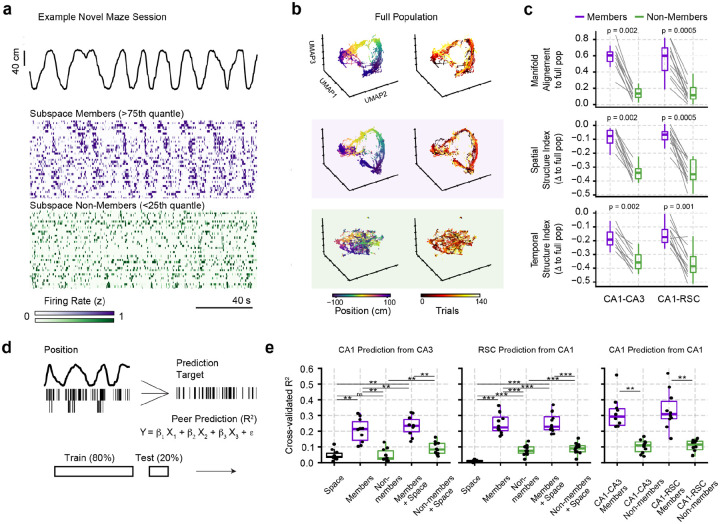
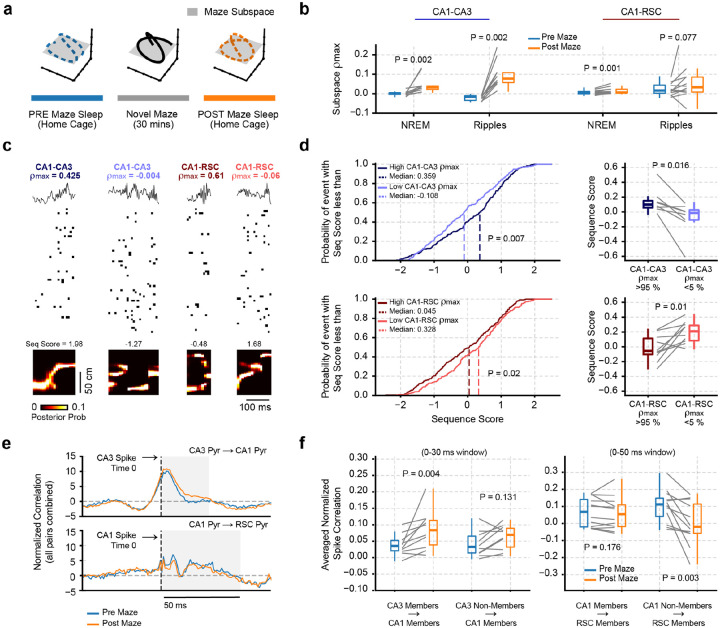
The capacity of hippocampal circuits to transform inputs into downstream outputs is fundamental to navigation and memory, yet the circuit-level mechanisms that enable this flexibility in adapting to experience remain unclear. Here we approach this problem by performing large-scale (up to 1,024 channel) recordings across the hippocampal–retrosplenial cortex (RSC) circuit in behaving mice, enabling simultaneous access to spiking activity in dentate gyrus (DG), CA3, CA2, CA1 and RSC. On the basis of a linear dimensionality-reduction technique known as partial canonical correlation analysis, we identify low-dimensional communication subspaces1 between two regions while accounting for influences from a third area. These subspaces captured distinct input–output transformations in the CA1 region, linking upstream hippocampal activity (DG, CA3 and CA2) to downstream cortical targets (RSC). Intrinsic firing properties and anatomical location constrained subspace memberships—members were mapped to deep sublayers of the CA3–CA1–RSC axis during both spatial and non-spatial tasks. These subspaces could recombine overlapping neuronal pools to support distinct interareal interactions across changing experiences and brain states. Reactivation patterns of CA1–CA3 subspaces, but not those of CA1–RSC, during post-experience sleep correlated with replay, reflecting a plasticity–stability balance in the input–output transformation along the hippocampal–retrosplenial axis. Our findings suggest a model in which hippocampal–neocortical communication reconfigures predetermined circuit motifs to flexibly encode experiences. Hippocampal–neocortical communication reconfigures predetermined circuit motifs to flexibly encode experiences.
Overview
The claims and statistics of this paper haven’t been checked yet.
Free: it reads the open-access text and checks the first 5 claims that cite a source we can check. Create a free account to check every claim.
Integrity signals
Registry
Cites
Statistics
Figures
Verification
Claims the paper makes
The claims and statistics of this paper haven’t been checked yet.
Free: it reads the open-access text and checks the first 5 claims that cite a source we can check. Create a free account to check every claim.
Self-check
Percentages, sums and reported differences re-computed from the paper’s own numbers.
The self-check needs the paper’s full text.
Citations
Cites
UMAP: Uniform Manifold Approximation and Projection for Dimension Reduction
McInnes, L., Healy, J., & Melville, J. (2018) · arXiv · doi:10.48550/arxiv.1802.03426 · Cited by 7,101
Emergence of simple-cell receptive field properties by learning a sparse code for natural images
Olshausen, B. A., & Field, D. J. (1996) · Nature · doi:10.1038/381607a0 · Cited by 5,694 · cited 1×
“Such a generalized sparse coding framework is computationally efficient, as coactivity patterns can be reshaped to store and retrieve memories with minimal overlap 31,32 .”
Memory and the hippocampus: A synthesis from findings with rats, monkeys, and humans.
Squire, L. R. (1992) · Psychological Review · doi:10.1037/0033-295x.99.2.195 · Cited by 5,376 · cited 2×
“Communication between the hippocampus and neocortex underlies the consolidation of experiences into long-term memories 2,3 , yet the circuit mechanisms governing this process remain poorly understood.”
McClelland, J. L., McNaughton, B. L., & O'Reilly, R. C. (1995) · Psychological Review · doi:10.1037/0033-295x.102.3.419 · Cited by 5,256 · cited 2×
“Finally, a fourth level governs these dynamics through time-division multiplexing: wake states prioritize encoding through fast hippocampal plasticity, whereas sleep states drive the gradual modification of cortical circuits 2,24,25 .”
DeepLabCut: markerless pose estimation of user-defined body parts with deep learning
Mathis, A., Mamidanna, P., Cury, K. M., Abe, T., Murthy, V. N., Mathis, M. W., & Bethge, M. (2018) · Nature Neuroscience · doi:10.1038/s41593-018-0209-y · Cited by 5,187 · cited 2×
“The animal’s location was detected within a region of interest around the maze, using a custom-trained DeepLabCut neural network 57 .”
InfluentialReactivation of hippocampal ensemble memories during sleep
Wilson, M. A., & McNaughton, B. L. (1994) · Science · doi:10.1126/science.8036517 · Cited by 3,118
Object vision and spatial vision: Two cortical pathways
Mishkin, M., Ungerleider, L. G., & Macko, K. A. (1983) · Trends in Neurosciences · doi:10.1016/0166-2236(83)90190-x · Cited by 2,947 · cited 1×
“…neuronal activity that flows into the hippocampus through the lateral (LEC) and medial (MEC) divisions of the entorhinal cortex is often conceptualized as two parallel streams, traditionally referred to as the ventral (‘what’) and dorsal (‘where’, ‘when’ and ‘how’) pathways 46 (Supplementary Fig.”
Fully integrated silicon probes for high-density recording of neural activity
Jun, J. J., Steinmetz, N. A., Siegle, J. H., Denman, D. J., Bauza, M., Barbarits, B., Lee, A. K., Anastassiou, C. A., Andrei, A., Aydın, Ç., et al. (2017) · Nature · doi:10.1038/nature24636 · Cited by 2,190 · cited 2×
“…component interconnect extension for instrumentation (a standardized modular electronic instrumentation platform) data acquisition card was connected to a computer through a PXI chassis (NI 1071, National Instruments), and OpenEphys or SpikeGLX software was used to write the data to disk 10,56 .”
Hippocampal sharp wave-ripple: A cognitive biomarker for episodic memory and planning
Buzsáki, G. (2015) · Hippocampus · doi:10.1002/hipo.22488 · Cited by 1,759 · cited 2×
“Finally, we show that CA1 input-and output-related subspaces are differentially reactivated during post-task non-rapid-eye-movement (NREM) sleep, especially during hippocampal sharp-wave ripples 11 .”
Self-citationTwo-stage model of memory trace formation: A role for “noisy” brain states
Buzsáki, G. (1989) · Neuroscience · doi:10.1016/0306-4522(89)90423-5 · Cited by 1,709 · cited 3×
“Finally, a fourth level governs these dynamics through time-division multiplexing: wake states prioritize encoding through fast hippocampal plasticity, whereas sleep states drive the gradual modification of cortical circuits 2,24,25 .”
Self-citation
Research works printed but not linked: 35
- Squire L. R., Genzel L., Wixted J. T. & Morris R. G. Memory consolidation. Cold Spring Harb. Perspect. Biol. 7, a021766 (2015). 26238360 PMC4526749
- Alvarez P. & Squire L. R. Memory consolidation and the medial temporal lobe: a simple network model. Proc Natl Acad Sci U S A 91, 7041– 7045 (1994). 8041742 PMC44334
- Marr D. Simple memory: a theory for archicortex. Philos Trans R Soc Lond B Biol Sci 262, 23– 81 (1971). 4399412
- Lavenex P. & Amaral D. G. Hippocampal-neocortical interaction: a hierarchy of associativity. Hippocampus 10, 420– 430 (2000). 10985281
- O’Keefe J. & Nadel L. The Hippocampus as a Cognitive Map. (Oxford University Press, USA, 1978).
- Remington E. D., Egger S. W., Narain D., Wang J. & Jazayeri M. A Dynamical Systems Perspective on Flexible Motor Timing. Trends Cogn Sci 22, 938– 952 (2018). 30266152 PMC6166486
- Sadtler P. T. Neural constraints on learning. Nature 512, 423– 426 (2014). 25164754 PMC4393644
- Kohn A. Principles of Corticocortical Communication: Proposed Schemes and Design Considerations. Trends Neurosci 43, 725– 737 (2020). 32771224 PMC7484382
- Muller R. U. & Kubie J. L. The effects of changes in the environment on the spatial firing of hippocampal complex-spike cells. J Neurosci 7, 1951– 1968 (1987). 3612226 PMC6568940
- Leutgeb S. Independent codes for spatial and episodic memory in hippocampal neuronal ensembles. Science 309, 619– 623 (2005). 16040709
- Nitzan N. Propagation of hippocampal ripples to the neocortex by way of a subiculum-retrosplenial pathway. Nat Commun 11, 1947 (2020). 32327634 PMC7181800
- Mizuseki K., Royer S., Diba K. & Buzsáki G. Activity dynamics and behavioral correlates of CA3 and CA1 hippocampal pyramidal neurons. Hippocampus 22, 1659– 1680 (2012). 22367959 PMC3718552
- Langston R. F., Stevenson C. H., Wilson C. L., Saunders I. & Wood E. R. The role of hippocampal subregions in memory for stimulus associations. Behav Brain Res 215, 275– 291 (2010). 20633579
- Wixted J. T. Sparse and distributed coding of episodic memory in neurons of the human hippocampus. Proc. Natl. Acad. Sci. U. S. A. 111, 9621– 9626 (2014). 24979802 PMC4084456
- Gava G. P. Organizing the coactivity structure of the hippocampus from robust to flexible memory. Science 385, 1120– 1127 (2024). 39236189 PMC7616439
- Libby A. & Buschman T. J. Rotational dynamics reduce interference between sensory and memory representations. Nat Neurosci 24, 715– 726 (2021). 33821001 PMC8102338
- Slomianka L., Amrein I., Knuesel I., Sørensen J. C. & Wolfer D. P. Hippocampal pyramidal cells: the reemergence of cortical lamination. Brain Struct Funct 216, 301– 317 (2011). 21597968 PMC3197924
- Bilkey D. K. & Schwartzkroin P. A. Variation in electrophysiology and morphology of hippocampal CA3 pyramidal cells. Brain Res 514, 77– 83 (1990). 2357533
- Fitch J. M., Juraska J. M. & Washington L. W. The dendritic morphology of pyramidal neurons in the rat hippocampal CA3 area. I. Cell types. Brain Res 479, 105– 114 (1989). 2466533
- Hemond P. Distinct classes of pyramidal cells exhibit mutually exclusive firing patterns in hippocampal area CA3b. Hippocampus 18, 411– 424 (2008). 18189311 PMC4339291
- Magó Á., Kis N., Lükő B. & Makara J. K. Distinct dendritic Ca spike forms produce opposing input-output transformations in rat CA3 pyramidal cells. Elife 10, (2021). PMC8612760 34817378
- Masukawa L. M., Benardo L. S. & Prince D. A. Variations in electrophysiological properties of hippocampal neurons in different subfields. Brain Res 242, 341– 344 (1982). 7116139
- Raus Balind S. Diverse synaptic and dendritic mechanisms of complex spike burst generation in hippocampal CA3 pyramidal cells. Nat Commun 10, 1859 (2019). 31015414 PMC6478939
- Witter M. P. Intrinsic and extrinsic wiring of CA3: indications for connectional heterogeneity. Learn Mem 14, 705– 713 (2007). 18007015
- Douglas R. J. & Martin K. A. C. Neuronal circuits of the neocortex. Annu Rev Neurosci 27, 419– 451 (2004). 15217339
- Goodale M. A. & Milner A. D. Separate visual pathways for perception and action. Trends Neurosci 15, 20– 25 (1992). 1374953
- Saur D. Ventral and dorsal pathways for language. Proc Natl Acad Sci U S A 105, 18035– 18040 (2008). 19004769 PMC2584675
- Weiller C., Reisert M., Glauche V., Musso M. & Rijntjes M. The dual-loop model for combining external and internal worlds in our brain. Neuroimage 263, 119583 (2022). 36007823
- Berndt M., Trusel M., Roberts T. F., Pfeiffer B. E. & Volk L. J. Bidirectional synaptic changes in deep and superficial hippocampal neurons following in vivo activity. Neuron 111, 2984– 2994.e4 (2023). 37689058 PMC10958998
- Norimoto H. Hippocampal ripples down-regulate synapses. Science 359, 1524– 1527 (2018). 29439023
- Rolls E. T. The mechanisms for pattern completion and pattern separation in the hippocampus. Front Syst Neurosci 7, 74 (2013). 24198767 PMC3812781
- Gava G. P. Integrating new memories into the hippocampal network activity space. Nat Neurosci 24, 326– 330 (2021). 33603228 PMC7116855
- Buzsáki G. & Llinás R. Space and time in the brain. Science 358, 482– 485 (2017). 29074768 PMC5998813
- Steinmetz N. A. Neuropixels 2.0: A miniaturized high-density probe for stable, long-term brain recordings. Science 372, (2021). PMC8244810 33859006
- Steinmetz N. A., Zatka-Haas P., Carandini M. & Harris K. D. Distributed coding of choice, action and engagement across the mouse brain. Nature 576, 266– 273 (2019). 31776518 PMC6913580
Cited by
Large-scale electrophysiology at single-spike resolution
Siegle, J. H., & Steinmetz, N. A. (2026) · Nature reviews. Neuroscience · doi:10.1038/s41583-026-01042-4 · Cited by 14
Zheng, Z., Park, C., Hammerschmith, E. W., Lu, R., Yu, S.-C., Sorek, M., Silverman, B., Jordan, C. S., Sterling, A. R., Silversmith, W., et al. (2026) · Nature Neuroscience · doi:10.1038/s41593-026-02388-9 · Cited by 10
“In the CA1 region, superficial versus deep pyramidal cells have been studied for differences in physiology 54–56 , long-range entorhinal inputs 57 , transcriptional profiles 58 , birthdating 59 , spatial coding 60,61 and inhibitory input 62 .”
Hippocampal CA3 forms a two-layer network of molecularly distinct cell types in mice and humansPreprint
Morse-Mora, R. J., Ben‐Simon, Y., Jayaram, S. A., Rössler, K., Jónás, P., & Watson, J. F. (2026) · bioRxiv (Cold Spring Harbor Laboratory) · doi:10.64898/2026.07.04.736487 · Cited by 4
Sharp wave-ripple clusters enhance hippocampal-neocortical engagement for memory consolidationPreprint
Vöröslakos, M., Lafferty, C. K., Zheng, Z., Paleologos, N., Chinigò, E., McClain, K., Aykan, D., Yoon, E., & Buzsáki, G. (2026) · bioRxiv (Cold Spring Harbor Laboratory) · doi:10.64898/2026.03.27.714843 · Cited by 1
Self-citationRodent Hippocampal-Cortical Population Decoding and Interactions in Episodic Memory Tasks
Hassett, A. K. S., Chen, S., & Chen, Z. S. (2025) · International IEEE/EMBS Conference on Neural Engineering · doi:10.1109/ner61569.2025.11589043
“…subspace method to analyze large-scale rodent hippocampal CA1, CA3 and retrosplenial cortex (RSC) recordings and their correspondence between maze running and sleep; we found distinct subspace patterns between CA1-CA3 and CA1-RSC subspaces during learning and sleep-dependent plasticity [22].”
Self-citation
Metadata
- Authors
- Gonzalez, J., Vöröslakos, M., Aykan, D., Soto, N., Nitzan, N., Swanson, R., Karadas, M., Chen, Z. S., & Buzsáki, G.
- Affiliations
- New York University (US)
- NYU Langone Health (US)
- Corresponding author
- Chen, Zhe Sage
- Buzsáki, György
- ORCID
- Venue
- Nature
- Published
- 2026-05-13
- Volume
- 655
- Issue
- 8121
- Pages
- 192-201
- ISSN
- 0028-0836 (ISSN-L)
- 1476-4687
- PMC
- PMC12776290
- OpenAlex
- W7161001422
- Cited by
- 7
- References
- 73
- Citations by year
- 2026: 6
- FWCI
- 24.78
- Type
- journal article
- Language
- en
- Open access
- hybrid
- doi.org
- Licence
- cc-by
- www.springernature.com/gp/researchers/text-and-data-mining (tdm)
- www.springernature.com/gp/researchers/text-and-data-mining (vor)
- Locations
- Nature (publishedVersion, cc-by)
- bioRxiv (Cold Spring Harbor Laboratory) (acceptedVersion, cc-by-nc-nd)
- PubMed (publishedVersion)
- PubMed Central (publishedVersion, cc-by-nc-nd)
- PubMed Central (submittedVersion)
- Funders
- National Institutes of Health (1rf1da056394-01)
- National Institute of Mental Health (R01MH122391, P50MH132642, R01MH139216, R01MH139352)
- National Institute of Neurological Disorders and Stroke (U19NS107616)
- Topics
- Life Sciences › Neuroscience › Cognitive Neuroscience › Memory and Neural Mechanisms
- Life Sciences › Neuroscience › Cognitive Neuroscience › Neural dynamics and brain function
- Life Sciences › Neuroscience › Cellular and Molecular Neuroscience › Neuroscience and Neuropharmacology Research
- Keywords
- input-output transformation, CA1, CA3, dentate gyrus, CA2, retrosplenial cortex, memory reactivation, spatial navigation, memory encoding, large-scale neural recording
About these checks
Registry, retraction, Cites and statistics results are computed, not judged, with one exception: a printed reference that no index lists is read once by a model before it counts as a citation error. Claims are extracted by a model and kept only when their quote appears verbatim in the text; each cited source is then checked, with a model’s help, for whether it says what the claim relies on. Those verdicts can be wrong — read the claim’s quote and the cited source before relying on one.
Statistics and arithmetic are recomputed, not judged.
Confidence bands are shown only for fields calibrated on our annotated test set. None is calibrated yet, so no band is shown.
What counts as a claim ›How we measure confidence ›How we check this ›
Are you an author, or do you see a problem with this page? Request a review
Data sources
Bibliographic data: Semantic Scholar, OpenAlex, Crossref.
Contains information from the Semantic Scholar Academic Graph Datasets, made available under the ODC Attribution License (ODC-BY 1.0).
Semantic Scholar’s data is described in: Kinney, R., et al. (2023). The Semantic Scholar Open Data Platform. arXiv:2301.10140.
