

Darkness and body size shaped end-Cretaceous marine extinction patterns
Open accessThe DOI matches its Crossref record; 69 of the 69 references it cites were found in a registry or an index; none of the 96 sources its claims cite is checked for support yet.
Abstract
The Chicxulub asteroid impact at the Cretaceous–Paleogene (K–Pg) boundary (66 Ma) is thought to have caused the extinction of around 75% of species in the fossil record by triggering catastrophic environmental changes 1 . However, despite decades of research, the mechanisms linking the environmental changes to the selective extinction patterns observed in the marine fossil record remain unresolved. Here we use a global trait-based ecosystem model 2,3 to establish this causality for the marine plankton community beyond the fossilized groups. Our model simulates diversity dynamics during the initial 100 years after the K–Pg boundary and represents explicitly extinction based on biomass thresholds that scales with body size. Under K–Pg climatic forcings, the model reproduces successfully key observed extinction patterns, including the high vulnerability of planktic foraminifera and other zooplankton, the survival of small mixotrophs 4 and phytoplankton 5,6 , and potential for reduced diversity loss in high-latitude settings 7 . Our analysis suggests that impact-driven darkness and body-size-dependent extinction thresholds drove most of the observed extinction patterns. These results suggest that plankton ecologies enhance survival through differences in energy demand and acquisition. Our study bridges the gap between fossil evidence of extinction patterns and the K–Pg impact winter hypothesis, highlighting the value of trait-based models for understanding past biodiversity crises.
Overview
CoChat Summary
TL;DR
Using a trait-based ecosystem model (EcoGENIE) coupled to cGENIE, the authors simulate 100 years after the Chicxulub impact and find that impact darkness and body-size-dependent extinction thresholds reproduce key K–Pg marine plankton extinction selectivity. The model attributes most extinction to light loss rather than CO₂, temperature, or acidification, with small mixotrophs and phytoplankton preferentially surviving.
Key findings
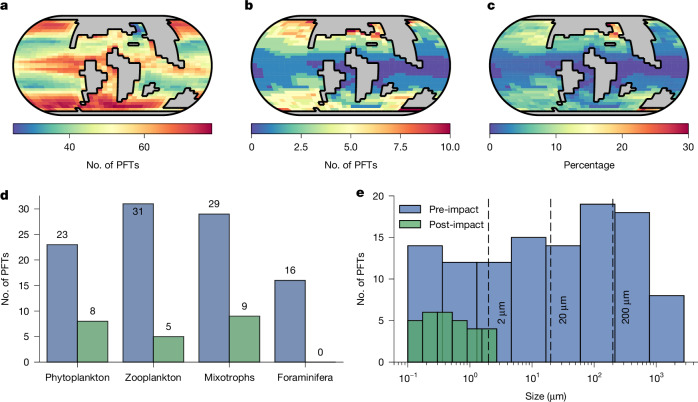
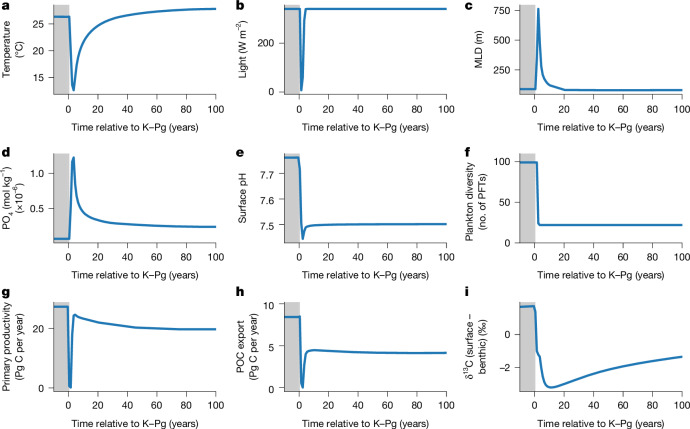
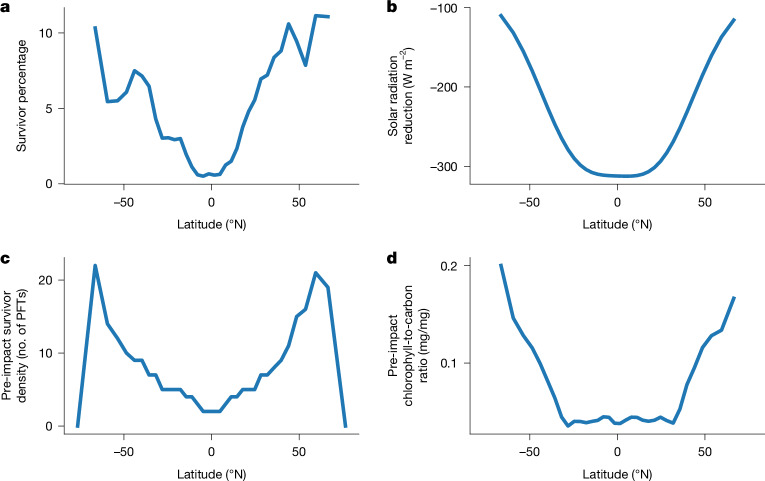
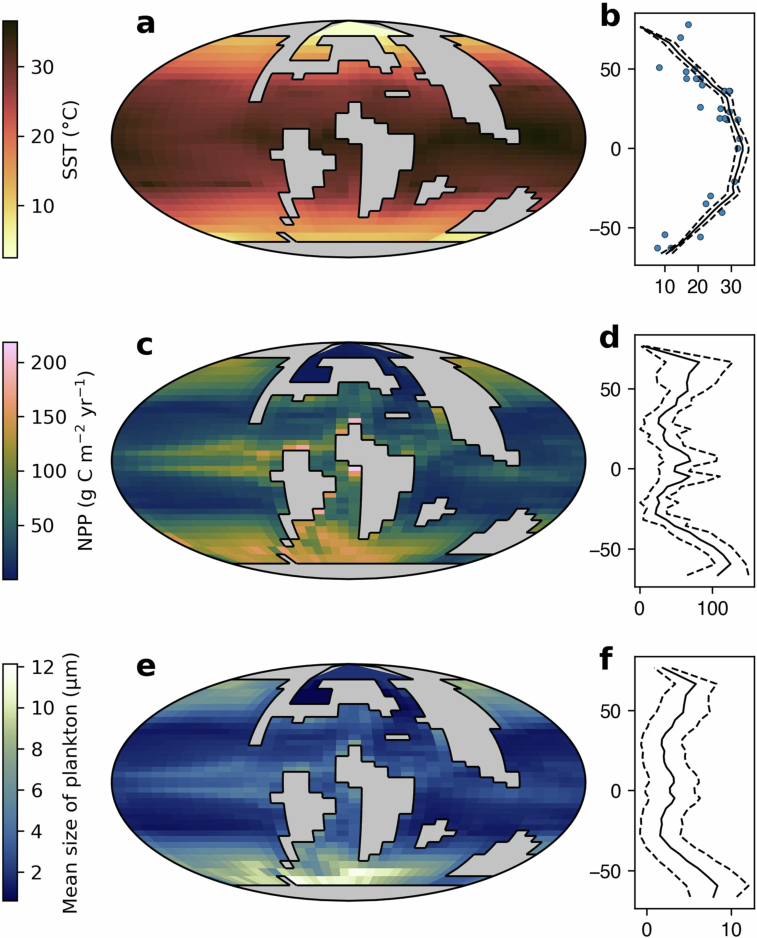
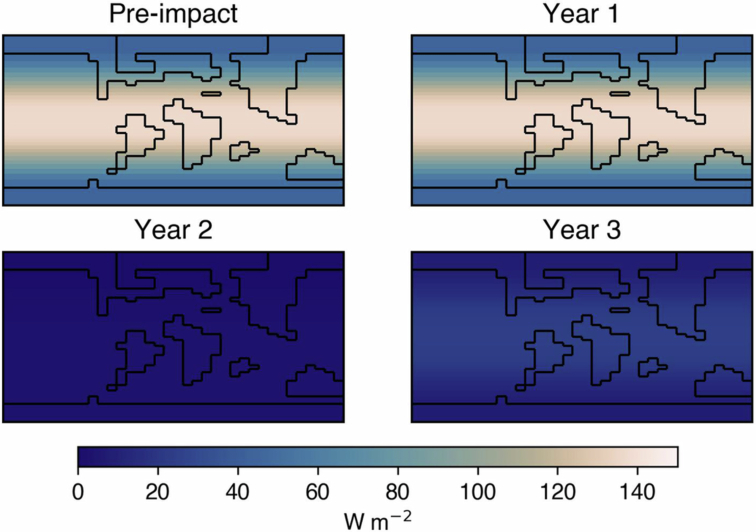
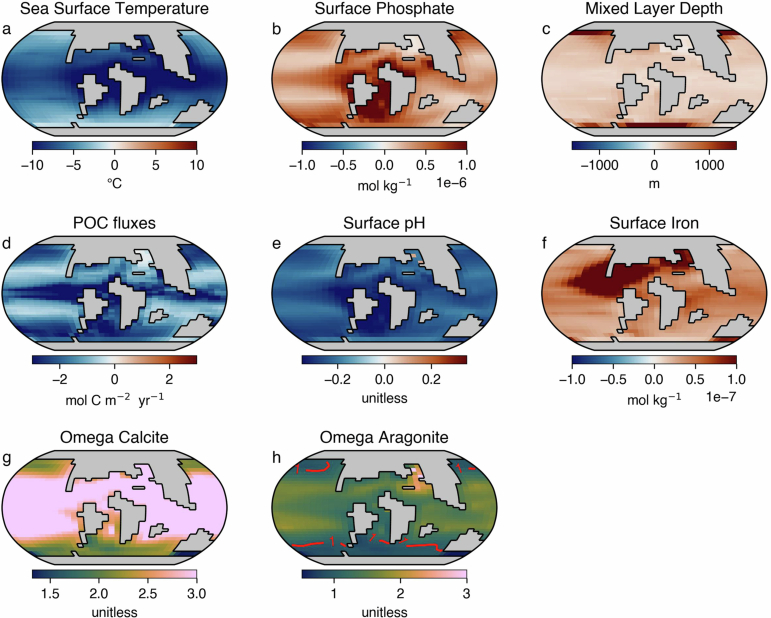
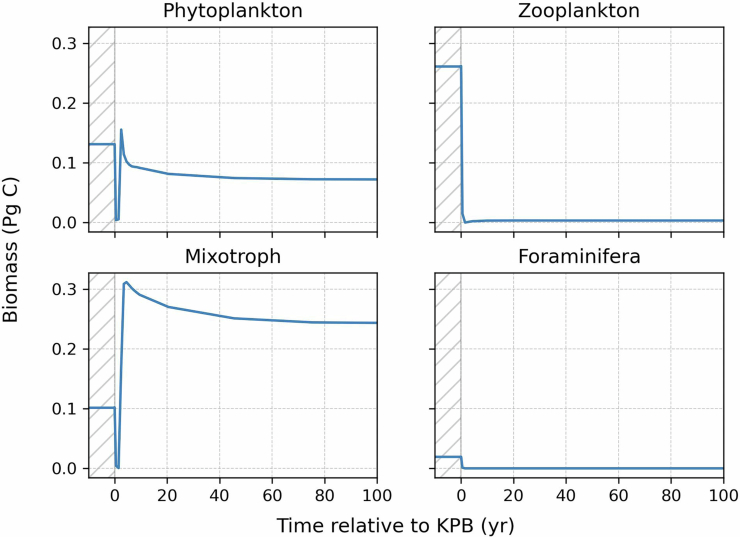
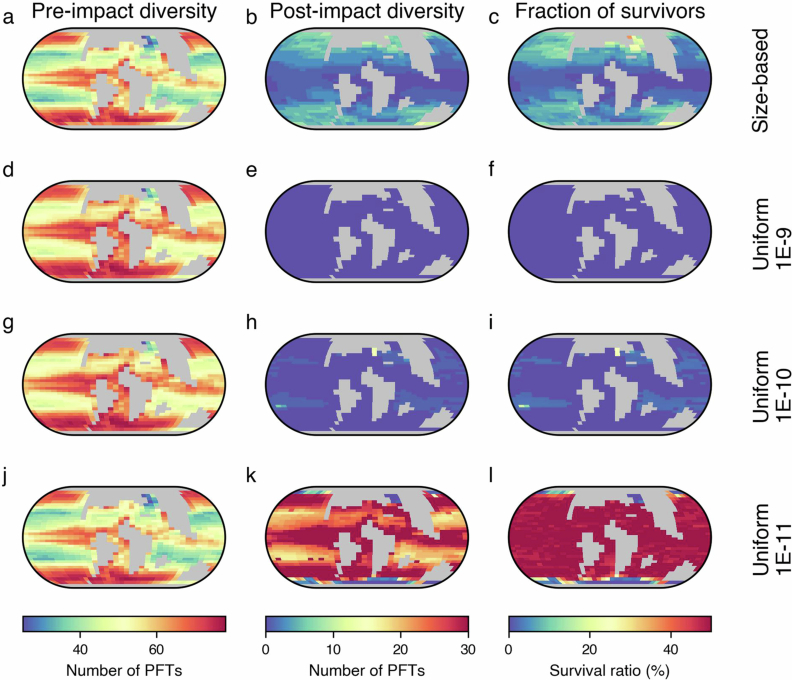
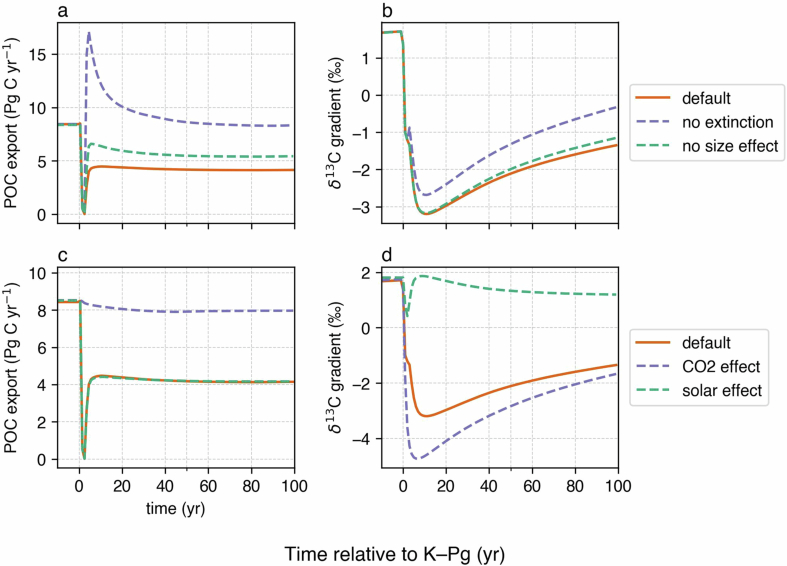
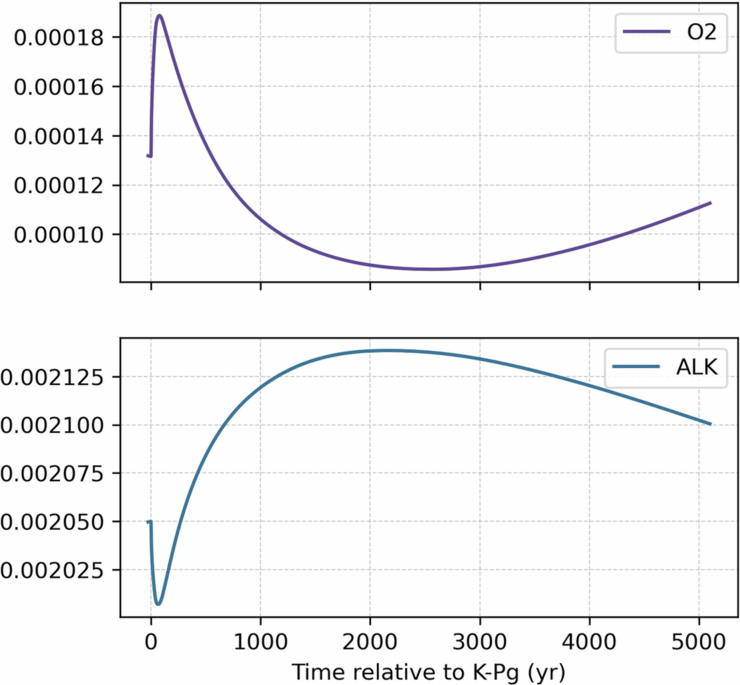
The model simulated a 78% loss of plankton functional types and a 99.5% reduction in global primary production and carbon export; only small-sized plankton (≤2.5 μm) survived, particularly at high latitudes. Extinction varied by group: foraminifera 100%, other zooplankton 84%, mixotrophs 69%, and phytoplankton 65%. Sensitivity experiments showed solar radiation forcing alone reproduced most extinction patterns, whereas CO₂ forcing had a negligible impact and temperature had limited impact; light limitation was the primary driver. Environmental changes included global mean SST dropping from 26.4 °C to 12.3 °C within the first 3 years post-impact, recovery taking around 30 years, mixed layer depth deepening to 750 m after 2 years, and PO₄ increasing 17 times (from 0.07 to 1.2 μmol P kg⁻¹) within the first 2 years; biological pump efficiency fell by 30%, and post-extinction carbon export was 61% of pre-impact levels versus a proxy-constrained 50%.
Methods
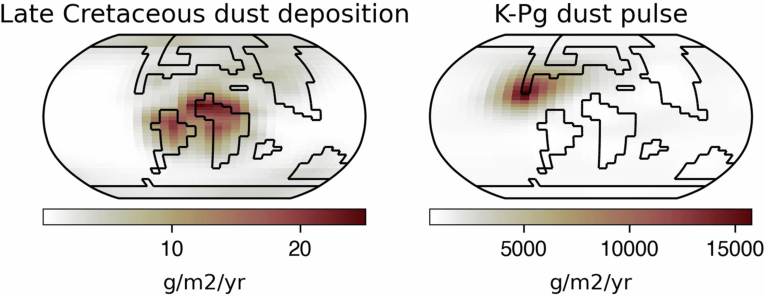
The study used the cGENIE Earth System Model of Intermediate Complexity with GOLDSTEIN ocean physics, BIOGEM biogeochemistry, EMBM atmosphere, EcoGENIE trait-based plankton ecosystem, and SEDGEM sediment components, applied to a Late Cretaceous climate state at 834 ppm CO₂. The spin-up produced a global mean SST of around 26.4 °C, deep-water temperature of 9.3 °C, and surface pH of 7.7; the initial community comprised 32 phytoplankton, 32 generic zooplankton, 32 mixotrophs, and 16 foraminifera functional types, with 99 plankton functional types surviving spin-up (around 88% of the initial community). The model was perturbed for 100 years after impact with a 7.30-h timestep under three forcings: a 700 ppm CO₂ pulse, reduced solar radiation, and ejecta-derived iron and phosphorus flux; extinction was implemented via a size-dependent biomass threshold equivalent to the minimum carbon biomass per individual, disabling photosynthesis and grazing when biomass fell below it. Sensitivity experiments isolated solar versus CO₂ forcing and light versus temperature effects, and model output was compared with fossil records, carbon isotope proxies, pH/export constraints, and other K–Pg observations.
Limitations
The paper states that the model does not directly incorporate pH effects on plankton physiology or biomineralization, lacks explicit mechanistic calcification and sulfuric/nitric acid effects, and may therefore underestimate volatile gas impacts; it also does not explicitly simulate shell mineralogy or carbon chemistry sensitivity, making calcareous plankton extinction-risk interpretations probably conservative, and calcite production is parameterized with a constant CaCO₃:POC rain ratio. The paper further states that EcoGENIE does not resolve direct effects of water-structure change (for example, destratification) on plankton vertical habitats, potentially missing a contributor to extinction selectivity, especially for deep-dwelling zooplankton; it does not include re-diversification, adaptive evolution, or ocean transport effects, assigns no differential temperature or light sensitivities or pre-defined niches across functional types, does not represent the Arctic Ocean due to limited grid resolution, and resolves functional rather than taxonomic diversity. The paper also notes that fossil data are spatially incomplete and biased toward groups with tests or shells, that the simulated extinction ratio of planktic foraminifera and nannoplankton is slightly overestimated probably due to the lack of a coastal/neritic trait, and that a potential synergistic effect of ocean acidification cannot be ruled out.
Model-written summary. Check it against the paper before relying on it.
Integrity signals
Registry
Cites
Statistics
Figures
Verification
Claims the paper makes
0 Valid · 0 Not valid · 55 Not checked · 61 Own results and interpretations
In the paper
“However, we do not observe the primary and export production overshoot reported by Brugger and colleagues29.”
§ Darkness and body size shaped end-Cretaceous marine extinction patterns > Modelling the K–Pg extinction
What the sources say
- Not checked yetcites [29] Brugger, J., Feulner, G., Hofmann, M. & Petri, S. A pronounced spike in ocean productivity triggered by the Chicxulub impact. Geophys. Res. Lett. 48, e2020GL092260 (2021). source
plain- Asserted: passes — The authors put it forward as true.
- Checkable: passes — It can be checked against evidence.
- Load-bearing: unclear — It is unclear whether the paper’s conclusions depend on it.
- Based: passes — The paper gives a reason why it holds.
None of the sources cited for this claim have been checked yet.
In the paper
“In contrast to other models29,38, cGENIE succeeds in simulating a reduced equator-to-pole temperature gradient, in agreement with proxy data.”
§ Darkness and body size shaped end-Cretaceous marine extinction patterns > Late Cretaceous climate and diversity
What the sources say
- Not checked yetcites [29] Brugger, J., Feulner, G., Hofmann, M. & Petri, S. A pronounced spike in ocean productivity triggered by the Chicxulub impact. Geophys. Res. Lett. 48, e2020GL092260 (2021). source
- Not checked yetcites [38] Niezgodzki, I., Knorr, G., Lohmann, G., Tyszka, J. & Markwick, P. J. Late Cretaceous climate simulations with different CO 2 levels and subarctic gateway configurations: a model–data comparison. Paleoceanography 32, 980–998 (2017). source
plain- Asserted: passes — The authors put it forward as true.
- Checkable: passes — It can be checked against evidence.
- Load-bearing: passes — The paper’s conclusions depend on it.
- Based: passes — The paper gives a reason why it holds.
A result the paper reports from its own data — it cites no other source for it, so there is none to check. The quote shows it is in the paper.
In the paper
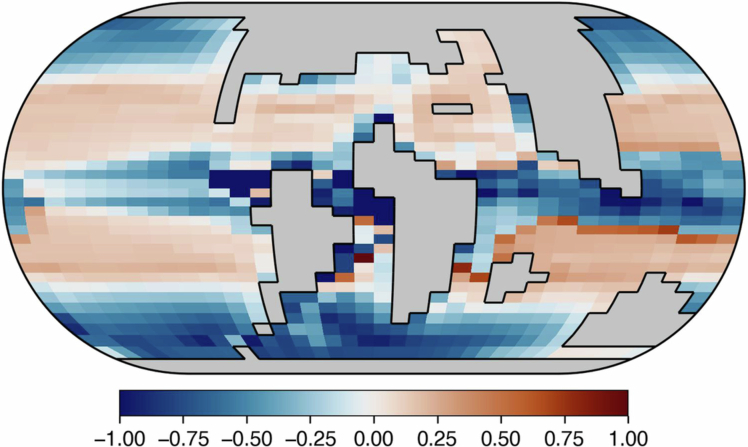
“Only small-sized plankton (less than or equal to 2.5 μm) survived, particularly in the high latitudes (Fig. 1b,c).”
§ Darkness and body size shaped end-Cretaceous marine extinction patterns > Modelling the K–Pg extinction
plainstates an association- Asserted: passes — The authors put it forward as true.
- Checkable: passes — It can be checked against evidence.
- Load-bearing: passes — The paper’s conclusions depend on it.
- Based: passes — The paper gives a reason why it holds.
None of the sources cited for this claim have been checked yet.
In the paper
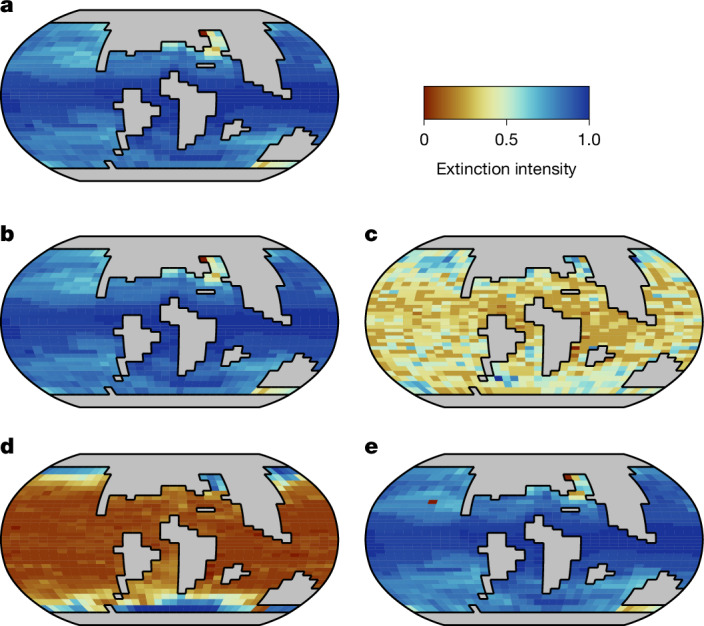
“Against expectations, temperature had a limited impact on extinction patterns (Fig. 3e), despite temperature’s exponential effect on growth rates47 and the well-documented correlation between temperature change and extinction risk31.”
§ Darkness and body size shaped end-Cretaceous marine extinction patterns > Drivers of selective extinction
What the sources say
- Not checked yetcites [47] Brown, J. H., Gillooly, J. F., Allen, A. P., Savage, V. M. & West, G. B. Toward a metabolic theory of ecology. Ecology 85, 1771–1789 (2004). source
- Not checked yetcites [31] Malanoski, C. M., Farnsworth, A., Lunt, D. J., Valdes, P. J. & Saupe, E. E. Climate change is an important predictor of extinction risk on macroevolutionary timescales. Science 383, 1130–1134 (2024). 38452067 source
plain- Asserted: passes — The authors put it forward as true.
- Checkable: passes — It can be checked against evidence.
- Load-bearing: passes — The paper’s conclusions depend on it.
- Based: passes — The paper gives a reason why it holds.
A result the paper reports from its own data — it cites no other source for it, so there is none to check. The quote shows it is in the paper.
In the paper
“The transient experiment shows that global annual mean sea surface temperature dropped from 26.4 °C to a minimum of 12.3 °C within the first 3 years post-impact (Fig. 2 and Extended Data Fig. 4).”
§ Darkness and body size shaped end-Cretaceous marine extinction patterns > Modelling the K–Pg extinction
plainstates a cause- Asserted: passes — The authors put it forward as true.
- Checkable: passes — It can be checked against evidence.
- Load-bearing: passes — The paper’s conclusions depend on it.
- Based: passes — The paper gives a reason why it holds.
50 more claims
Create a free account to see all 116 claims and to verify the 94 references still open.
- It may state two separate claims as one. 45
- Probably not a substantial claim. 22
- The quote only partly states this claim. 1
Self-check
Percentages, sums and reported differences re-computed from the paper’s own numbers.
Each contradiction between two passages listed here was confirmed by an independent check.
Rated minor: it would not touch a result — a value no result rests on, a p-value that stays on the same side of the significance level, or a conflict that is clerical, resolved elsewhere in the paper, or outside its own findings.
In the paper
§ Darkness and body size shaped end-Cretaceous marine extinction patterns > Drivers of selective extinction
“pre-impact photosynthetic activity radiation (PAR), pre-K–Pg plankton diversity was sustained except in high latitudes such as the Southern Ocean and North Pacific, where temperature change also contributed to extinction. This result indicates the primary role of light limitation in causing productivity loss and subsequent mass extinction through trophic cascades (Fig. 3d).”
§ Darkness and body size shaped end-Cretaceous marine extinction patterns > Drivers of selective extinction
“d,e, Subplots further disentangle the light (d) and temperature (e) effects from solar radiation change by forcing the plankton ecosystem with unchanged sea surface temperature (light effect only) and PAR (temperature effect only).”
Citations
Cites
TOWARD A METABOLIC THEORY OF ECOLOGY
Brown, J. H., Gillooly, J. F., Allen, A. P., Savage, V. M., & West, G. B. (2004) · Ecology · doi:10.1890/03-9000 · Cited by 7,779
Extraterrestrial Cause for the Cretaceous-Tertiary Extinction
Alvarez, L. W., Alvarez, W., Asaro, F., & Michel, H. V. (1980) · Science · doi:10.1126/science.208.4448.1095 · Cited by 3,198
The Chicxulub Asteroid Impact and Mass Extinction at the Cretaceous-Paleogene Boundary
Schulte, P., Alegret, L., Arenillas, I., Arz, J. A., Barton, P. J., Bown, P. R., Bralower, T. J., Christeson, G. L., Claeys, P., Cockell, C. S., et al. (2010) · Science · doi:10.1126/science.1177265 · Cited by 1,810
A dynamic regulatory model of phytoplanktonic acclimation to light, nutrients, and temperature
Geider, R. J., Maclntyre, H. L., & Kana, T. M. (1998) · Limnology and Oceanography · doi:10.4319/lo.1998.43.4.0679 · Cited by 966
Emergent Biogeography of Microbial Communities in a Model Ocean
Follows, M. J., Dutkiewicz, S., Grant, S., & Chisholm, S. W. (2007) · Science · doi:10.1126/science.1138544 · Cited by 873
Extinction and Ecosystem Function in the Marine Benthos
Solan, M., Cardinale, B. J., Downing, A. L., Engelhardt, K. A. M., Ruesink, J. L., & Srivastava, D. S. (2004) · Science · doi:10.1126/science.1103960 · Cited by 822
Insights into global diatom distribution and diversity in the world’s ocean
Malviya, S., Scalco, E., Audic, S., Vincent, F., Veluchamy, A., Poulain, J., Wincker, P., Iudicone, D., de Vargas, C., Bittner, L., et al. (2016) · Proceedings of the National Academy of Sciences · doi:10.1073/pnas.1509523113 · Cited by 773
U-Pb constraints on pulsed eruption of the Deccan Traps across the end-Cretaceous mass extinction
Schoene, B., Eddy, M. P., Samperton, K. M., Keller, C. B., Keller, G., Adatte, T., & Khadri, S. F. R. (2019) · Science · doi:10.1126/science.aau2422 · Cited by 542
PHANEROZOIC BIODIVERSITY MASS EXTINCTIONS
Bambach, R. K. (2006) · Annual Review of Earth and Planetary Sciences · doi:10.1146/annurev.earth.33.092203.122654 · Cited by 529
Evolution of the diatoms: insights from fossil, biological and molecular data
Sims, P. A., Mann, D. G., & Medlin, L. K. (2006) · Phycologia · doi:10.2216/05-22.1 · Cited by 449
Research works printed but not linked: 1
- Thomas, E. in Large Ecosystem Perturbations: Causes and Consequences Vol. 424 (eds Monechi, S., Coccioni, R. & Rampino, M.) 1–24 (Geological Society of America, 2007).
Cited by
Brown, A. J., Davies, S., Petersen, S., Witts, J. D., Myers, C., Piestch, C., Hoffman-Vinje, J., Naujokaitytė, J., Garb, M., Landman, N., et al. (2026) · Research Square · doi:10.21203/rs.3.rs-11613019/v1
Self-citation
Metadata
- Authors
- Ying, R., Monteiro, F. M., Witts, J. D., & Schmidt, D. N.
- Affiliations
- University of East Anglia (GB)
- University of Bristol (GB)
- Natural History Museum (GB)
- Corresponding author
- Ying, Rui
- Venue
- Nature
- Published
- 2026-05-27
- Volume
- 655
- Issue
- 8124
- Pages
- 957-962
- ISSN
- 0028-0836 (ISSN-L)
- 1476-4687
- PMC
- PMC13391373
- OpenAlex
- W7162485401
- Cited by
- 1
- References
- 69
- Citations by year
- 2026: 1
- FWCI
- 2.11
- Type
- journal article
- Language
- en
- Open access
- hybrid
- doi.org
- Licence
- cc-by
- creativecommons.org/licenses/by/4.0 (tdm)
- creativecommons.org/licenses/by/4.0 (vor)
- Locations
- Nature (publishedVersion, cc-by)
- PubMed Central (publishedVersion, cc-by)
- PubMed (publishedVersion)
- Explore Bristol Research (publishedVersion, cc-by)
- Bristol Research (University of Bristol) (publishedVersion, cc-by)
- UEA Digital Repository (University of East Anglia) (acceptedVersion)
- Funders
- University of East Anglia
- University of Bristol
- China Scholarship Council (202006380070)
- Natural Environment Research Council (NE/P019439/1, NE/X001261/1, NE/V01823X/1)
- Topics
- Physical Sciences › Earth and Planetary Sciences › Paleontology › Evolution and Paleontology Studies
- Physical Sciences › Earth and Planetary Sciences › Paleontology › Paleontology and Stratigraphy of Fossils
- Physical Sciences › Earth and Planetary Sciences › Paleontology › Paleontology and Evolutionary Biology
- Keywords
- end-Cretaceous mass extinction, Chicxulub impact, Cretaceous-Paleogene boundary, impact winter, darkness, body size, plankton communities, planktonic foraminifera, zooplankton, phytoplankton, diversity dynamics, extinction patterns
- MeSH terms
- Animals, Darkness, Fossils, Models, Biological, Phytoplankton, Plankton, Ecosystem, Biomass, Minor Planets, Biodiversity, Body Size, Extinction, Biological, Foraminifera, Climate Change, Aquatic Organisms
About these checks
Registry, retraction, Cites and statistics results are computed, not judged, with one exception: a printed reference that no index lists is read once by a model before it counts as a citation error. Claims are extracted by a model and kept only when their quote appears verbatim in the text; each cited source is then checked, with a model’s help, for whether it says what the claim relies on. Those verdicts can be wrong — read the claim’s quote and the cited source before relying on one.
A language model drew the claims from the paper on 2026-11-24, under version 3 of the claim definition (model deepseek-v4.1-flash, prompt extract-v3).
A second model labelled each claim on 2026-11-24 (model jev-1.13-20260917, definition revision gold-guideline-v0.2).
Statistics and arithmetic are recomputed, not judged.
Confidence bands are shown only for fields calibrated on our annotated test set. None is calibrated yet, so no band is shown.
What counts as a claim ›How we measure confidence ›How we check this ›
Are you an author, or do you see a problem with this page? Request a review
How to cite
Cite CoChat for the checks on this page, and the paper for its own findings.
- This page
- CoChat. (2026). Citation check: Darkness and body size shaped end-Cretaceous marine extinction patterns. https://app.cochat.ai/papers/10.1038/s41586-026-10541-4
- The paper
- Ying, R., Monteiro, F. M., Witts, J. D., & Schmidt, D. N. (2026). Darkness and body size shaped end-Cretaceous marine extinction patterns. Nature. https://doi.org/10.1038/s41586-026-10541-4
Data sources
Bibliographic data: Semantic Scholar, OpenAlex, Crossref.
Contains information from the Semantic Scholar Academic Graph Datasets, made available under the ODC Attribution License (ODC-BY 1.0).
Semantic Scholar’s data is described in: Kinney, R., et al. (2023). The Semantic Scholar Open Data Platform. arXiv:2301.10140.
