

Comprehensive genome analysis and variant detection at scale using DRAGEN
Open accessThe DOI matches its Crossref record; 83 of the 85 references it cites were found in a registry or an index; 36 of the 49 sources its claims cite were checked for support.
Abstract
Research and medical genomics require comprehensive, scalable methods for the discovery of novel disease targets, evolutionary drivers and genetic markers with clinical significance. This necessitates a framework to identify all types of variants independent of their size or location. Here we present DRAGEN, which uses multigenome mapping with pangenome references, hardware acceleration and machine learning-based variant detection to provide insights into individual genomes, with ~30 min of computation time from raw reads to variant detection. DRAGEN outperforms current state-of-the-art methods in speed and accuracy across all variant types (single-nucleotide variations, insertions or deletions, short tandem repeats, structural variations and copy number variations) and incorporates specialized methods for analysis of medically relevant genes. We demonstrate the performance of DRAGEN across 3,202 whole-genome sequencing datasets by generating fully genotyped multisample variant call format files and demonstrate its scalability, accuracy and innovation to further advance the integration of comprehensive genomics. Overall, DRAGEN marks a major milestone in sequencing data analysis and will provide insights across various diseases, including Mendelian and rare diseases, with a highly comprehensive and scalable platform.
Overview
CoChat Summary
TL;DR
DRAGEN is a hardware-accelerated, pangenome-based germline variant-calling platform that detects SNVs, indels, STRs, SVs, CNVs and specialized medically relevant gene variants from 35× WGS in about 30 min. Applied to 3,202 1kGP samples, it produced fully genotyped population VCFs and reported improved speed and accuracy over state-of-the-art methods across variant classes.
Key findings
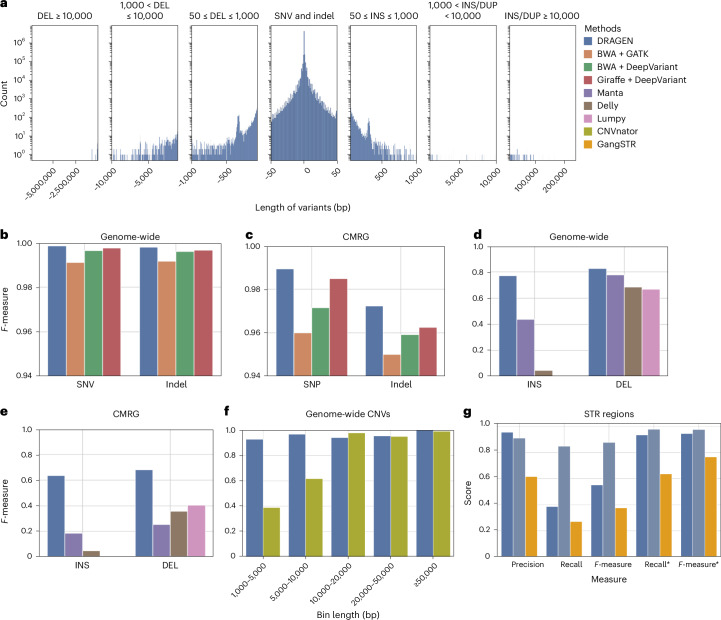
- For HG002, DRAGEN produced ~4.92 million small variant calls, including 3,956,307 SNVs and 960,908 indels, plus 13,886 SVs, 1,156 CNVs and STR variation at 31,370 polymorphic loci. It achieved an overall small-variant F-measure of 99.86% with 11,163 errors, SV insertion F-measure of 76.90% and deletion F-measure of 82.60%, and CNV F-measures of 92.60% for 1–5 kbp and 96.60% for 5–10 kbp.
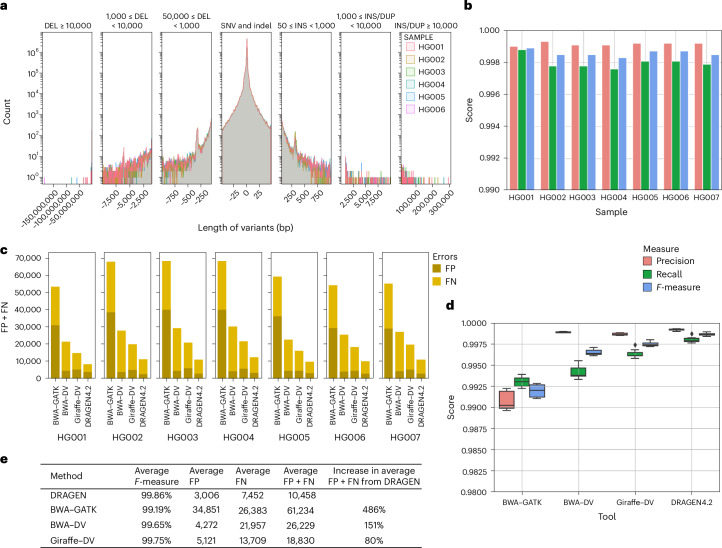
- Across HG001–HG007, DRAGEN detected an average of 4,894,415 small variants per sample, with mean F-measures of 99.80% for SNVs and 99.87% for indels. Compared with GATK + BWA, DeepVariant + BWA and Giraffe + DeepVariant, DRAGEN reduced combined SNV/indel errors by 82.88%, 60.07% and 44.33%, respectively; the pangenome reference reduced error by 54.20% on average.
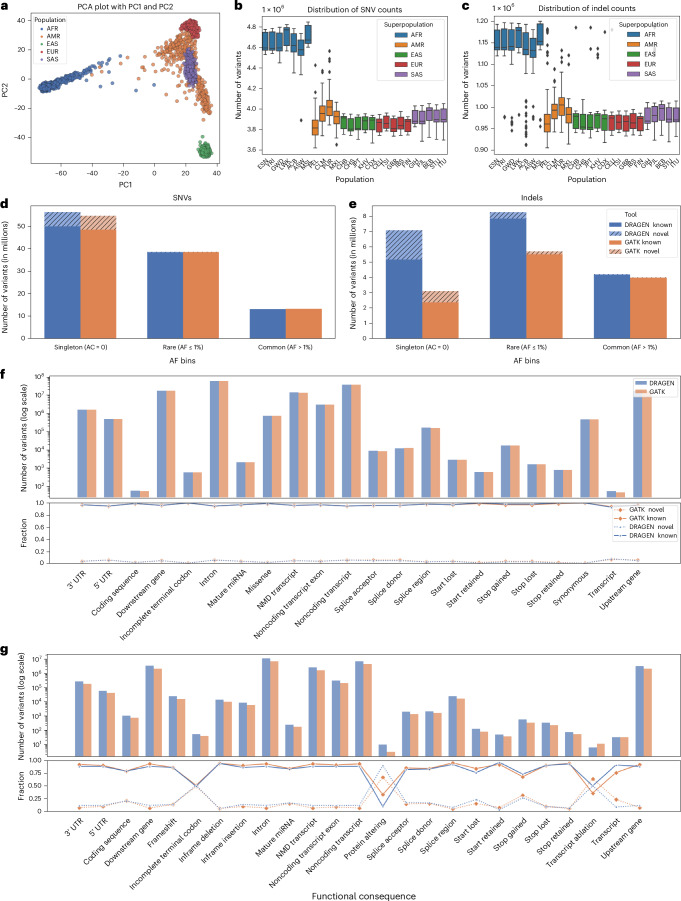
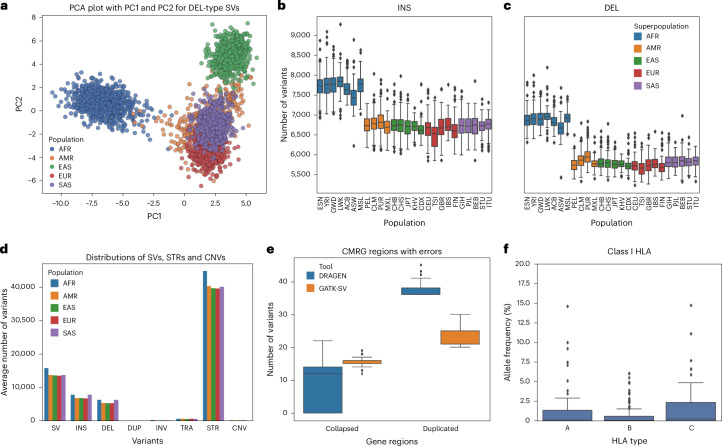
- In 3,202 high-coverage 1kGP samples, DRAGEN identified 116,346,215 SNVs and 24,979,420 indels, plus 409,033 STRs, 1,013,541 SVs and 9,216 CNVs. The joint callset had per-sample SNV recall 99.92%, precision 99.78% and F1 99.85%; indel recall 99.84%, precision 99.71% and F1 99.77%; aggregation of >3,202 samples took approximately 2 h.
- Targeted callers showed high concordance: CYP2D6 and CYP2B6 star allele calls were 99.3% and 92.1% concordant with orthogonal calls; SMN1 and SMN2 copy-number calls agreed with orthogonal methods for 99.8% and 99.7%; GBA calls were 100% concordant across 42 samples; LPA KIV-2 total and allele-specific copy numbers correlated at 98.2% and 99.7% across 154 samples.
Methods
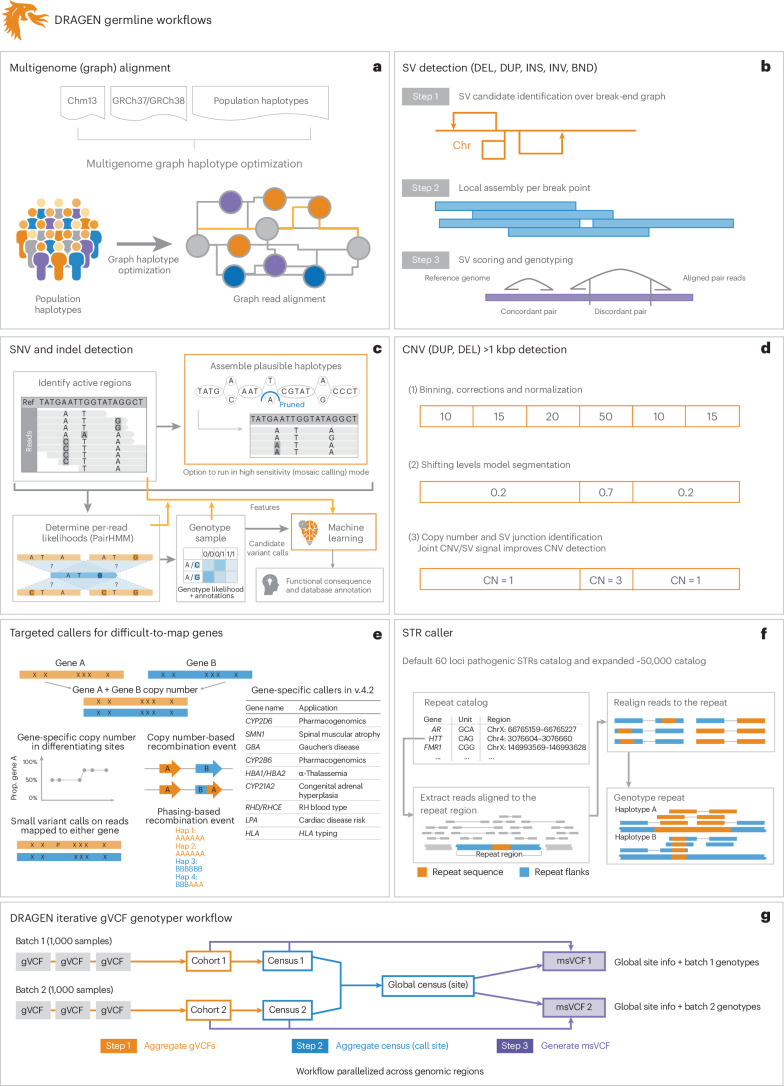
- DRAGEN v.4.2 was run on Illumina NovaSeq 6000 PCR-free 35× WGS data using a pangenome reference consisting of GRCh38 plus 64 haplotypes, with FPGA acceleration. The pipeline performs SNV/indel calling via de Bruijn graph assembly and HMM, followed by machine-learning recalibration; SV calling extends Manta; CNV calling uses a modified shifting-levels/Viterbi model; STR calling is based primarily on ExpansionHunter; nine targeted callers cover CYP2B6, CYP2D6, CYP21A2, GBA, HBA, LPA, RH, SMN and HLA.
- Benchmarking used GIAB v.4.2.1 for SNVs/indels, GIAB SV v.0.6, GIABTR v.1.0 and CMRG regions, with comparisons to GATK, DeepVariant + BWA, DeepVariant + Giraffe, Manta, Delly, Lumpy, CNVnator and GangSTR. Evaluations used RTGTools vcfeval, Witty.er and Truvari.
- Population analysis applied DRAGEN to 3,202 high-coverage 35× 1kGP samples from 26 populations and five superpopulations. Small variants were merged with the DRAGEN Iterative gVCF Genotyper; STR, SV and CNV calls were merged with Truvari; annotation used Illumina Connected Annotations against dbSNP, gnomAD, 1kGP and TOPMed.
Limitations
- The paper states remaining challenges in complex SV detection and accurate sizing of long STR expansions using short-read data, and notes that certain genes/regions require special attention, including HLA, CYP2D6, CYP2B6 and LPA; HLA-DRB1 allele calling was noted as pending improvement.
- The STR benchmark showed low F-measure with the 50,069-region catalog (19.68%) because the catalog is much smaller than the 1.7 million GIABTR regions, impacting recall, although precision was 95.47%; the larger 174,300-region catalog improved F-measure to 55.13%.
- CNV benchmarking was performed only on deletion types because no duplications were reported in the HG002 GIAB benchmark callsets.
Model-written summary. Check it against the paper before relying on it.
Integrity signals
Registry
Cites
Statistics
Figures
Verification
Claims the paper makes
24 Valid · 9 Not valid · 7 Not checked · 180 Own results and interpretations
At least one cited source doesn’t support this claim or points to a different paper, and none confirmed it — see the verdicts below.
In the paper
“The SV callset that was published in recent studies reported only 27,166 SVs, with 8,093 insertions, 13,506 deletions and 5,567 other types of SV.”
§ Comprehensive genome analysis and variant detection at scale using DRAGEN > Results > Comprehensive variant detection at population scale using DRAGEN
What the sources say
- Disputedcites [60] Byrska-Bishop, M. et al. High-coverage whole-genome sequencing of the expanded 1000 Genomes Project cohort including 602 trios. Cell 185, 3426–3440 (2022). 36055201 PMC9439720 sourceExperimental — accuracy not yet measured
The Results section (“Structural variation across the 3,202 1kGP samples”; page not available) reports 173,366 SV loci, including 49,693 insertions and 90,259 deletions—not the claimed 27,166 total, 8,093 insertions and 13,506 deletions. Its comparison with the earlier phase 3 call set also gives a different total: 68,697 SV sites. (LLM, conf=0.88)
Checked by a reasoning model — may be wrong.
plain- Asserted: passes — The authors put it forward as true.
- Checkable: passes — It can be checked against evidence.
- Load-bearing: passes — The paper’s conclusions depend on it.
- Based: passes — The paper gives a reason why it holds.
- Disputed
At least one cited source doesn’t support this claim or points to a different paper, and none confirmed it — see the verdicts below.
In the paper
“These 12 genes comprise 9 that are incorrectly duplicated and 3 that are incorrectly collapsed (for example, two instead of three copies).”
§ Comprehensive genome analysis and variant detection at scale using DRAGEN > Results > Comprehensive variant detection at population scale using DRAGEN
What the sources say
- Disputedcites [23] Behera, S. et al. FixItFelix: improving genomic analysis by fixing reference errors. Genome Biol. 24, 31 (2023). 36810122 PMC9942314 sourceExperimental — accuracy not yet measured
The Discussion says false duplications affected 12 medically relevant genes, rather than nine. The Results (Identification of GRCh38 errors) separately identify three medically relevant genes selected from collapsed regions; they do not describe those three as part of a 12-gene group split nine and three. Page numbers were not available in our copy. (LLM, conf=0.86)
Checked by a reasoning model — may be wrong.
plain- Asserted: passes — The authors put it forward as true.
- Checkable: passes — It can be checked against evidence.
- Load-bearing: passes — The paper’s conclusions depend on it.
- Based: passes — The paper gives a reason why it holds.
- Disputed
Every source the paper cites for this claim was checked and supports it.
In the paper
“Moreover, several of these medically relevant genes (for example, KCNE1, CBS, CRYAA, KCNJ18, MAP2K3, KMT2C) are wrongly represented in the GRCh38 reference due to false duplication and collapsed sequence errors23.”
§ Comprehensive genome analysis and variant detection at scale using DRAGEN > Results > Resolving the complete variant spectrum at scale and accuracy
What the sources say
- Supportedcites [23] Behera, S. et al. FixItFelix: improving genomic analysis by fixing reference errors. Genome Biol. 24, 31 (2023). 36810122 PMC9942314 source
The Results sections identify CBS, KCNE1, and CRYAA as affected by false duplications, and KCNJ18, MAP2K3, and KMT2C as affected by collapsed duplications in GRCh38. They describe these as medically relevant genes. Page numbers are not available in our copy. (LLM, conf=0.94)
plainstates a cause- Asserted: passes — The authors put it forward as true.
- Checkable: passes — It can be checked against evidence.
- Load-bearing: passes — The paper’s conclusions depend on it.
- Based: passes — The paper gives a reason why it holds.
- Supported
The cited sources support only part of this claim — read each source’s verdict below.
In the paper
“This GIAB benchmark spans 273 medically relevant genes that are highly repetitive and diverse and were therefore excluded from the genome-wide benchmark12.”
§ Comprehensive genome analysis and variant detection at scale using DRAGEN > Results > Resolving the complete variant spectrum at scale and accuracy
What the sources say
- Partly supportedcites [12] Wagner, J. et al. Curated variation benchmarks for challenging medically relevant autosomal genes. Nat Biotechnol 40, 672–680 (2022). 35132260 PMC9117392 sourceExperimental — accuracy not yet measured
The Introduction says the CMRG benchmark covers 273 medically relevant genes that were incompletely covered by previous GIAB benchmarks, and the Results describe these genes as substantially more challenging. But the Introduction specifies that up to 90% of each gene’s bases were already included, so saying the genes were excluded from the genome-wide benchmark overstates the finding. The paper describes several kinds of challenges, not every gene as both highly repetitive and diverse. (LLM, conf=0.86)
plainstates a cause- Asserted: passes — The authors put it forward as true.
- Checkable: passes — It can be checked against evidence.
- Load-bearing: passes — The paper’s conclusions depend on it.
- Based: passes — The paper gives a reason why it holds.
- Partly supported
The cited sources that could be checked couldn’t confirm or dispute this claim.
In the paper
“By contrast, the previous study only reported 36 SVs in collapsed and 18 SVs in duplicated regions across the entire 1kGP sample.”
§ Comprehensive genome analysis and variant detection at scale using DRAGEN > Results > Comprehensive variant detection at population scale using DRAGEN
What the sources say
- Could not verifycites [60] Byrska-Bishop, M. et al. High-coverage whole-genome sequencing of the expanded 1000 Genomes Project cohort including 602 trios. Cell 185, 3426–3440 (2022). 36055201 PMC9439720 sourceExperimental — accuracy not yet measured
The Results section, “Structural variation across the 3,202 1kGP samples” (page unavailable), reports an overall SV call set but gives no counts for collapsed or duplicated regions. Searches for “collapsed regions,” “duplicated regions,” and “36 SVs 18 SVs” found no passage establishing the claimed regional counts. (LLM, conf=0.76)
plain- Asserted: passes — The authors put it forward as true.
- Checkable: passes — It can be checked against evidence.
- Load-bearing: passes — The paper’s conclusions depend on it.
- Based: passes — The paper gives a reason why it holds.
- Could not verify
89 more claims · 8 with their cited sources checked
Create a free account to see all 220 claims and to verify the 2 references still open.
- It may state two separate claims as one. 106
- Borderline: one of the tests for a substantial claim is unclear. 2
- Probably not a substantial claim. 23
- The quote only partly states this claim. 3
Self-check
Percentages, sums and reported differences re-computed from the paper’s own numbers.
Rated minor: it would not touch a result — a value no result rests on, a p-value that stays on the same side of the significance level, or a conflict that is clerical, resolved elsewhere in the paper, or outside its own findings.
In the paper
“EUR (n = 633, 21.64%)”
§ Comprehensive genome analysis and variant detection at scale using DRAGEN > Results > Comprehensive variant detection at population scale using DRAGEN
Reported 21.64 · recomputed 19.768894
Rated minor: it would not touch a result — a value no result rests on, a p-value that stays on the same side of the significance level, or a conflict that is clerical, resolved elsewhere in the paper, or outside its own findings.
In the paper
“among samples with PASS filter, 1,189 were normal metabolizers, 381 were poor metabolizers, 154 were rapid metabolizers, 7 were ultrarapid metabolizers, 224 were intermediate metabolizers, 57 had indeterminate status, and 1,190 had none status.”
§ Comprehensive genome analysis and variant detection at scale using DRAGEN > Results > Comprehensive variant detection at population scale using DRAGEN
Reported 2017 · recomputed 3202
Citations
Cites
Fast and accurate short read alignment with Burrows-Wheeler transform
Li, H., & Durbin, R. (2009) · Bioinformatics · doi:10.1093/bioinformatics/btp324 · Cited by 58,607
A global reference for human genetic variation
The 1000 Genomes Project Consortium, authors, C., Auton, A., Abecasis, G. R., Steering committee, Altshuler, D. M., Durbin, R. M., Abecasis, G. R., Bentley, D. R., Chakravarti, A., et al. (2015) · Nature · doi:10.1038/nature15393 · Cited by 18,247
Self-citationGraph-based genome alignment and genotyping with HISAT2 and HISAT-genotype
Kim, D., Paggi, J. M., Park, C., Bennett, C., & Salzberg, S. L. (2019) · Nature Biotechnology · doi:10.1038/s41587-019-0201-4 · Cited by 15,022 · cited 1×
“DRAGEN were perfectly concordant with other callers, such as HLA-LA 54 , HISAT-genotype 55 , T1K 56 and HLA*ASM 57 .”
Aligning sequence reads, clone sequences and assembly contigs with BWA-MEM
Li, H. (2013) · DROPS (Schloss Dagstuhl – Leibniz Center for Informatics) · doi:10.48550/arxiv.1303.3997 · Cited by 5,159
Coming of age: ten years of next-generation sequencing technologies
Goodwin, S., McPherson, J. D., & McCombie, W. R. (2016) · Nature Reviews Genetics · doi:10.1038/nrg.2016.49 · Cited by 4,352 · cited 1×
“Over the last decade, the advent of genomic sequencing as a common methodology in genomics, genetics and medical applications has enabled multiple discoveries and insights for diseases, population diversity, evolutionary mechanisms and personalized medicine strategies 1–4 .”
ClinVar: public archive of relationships among sequence variation and human phenotype
Landrum, M. J., Lee, J. M., Riley, G. R., Jang, W., Rubinstein, W. S., Church, D. M., & Maglott, D. R. (2014) · Nucleic Acids Research · doi:10.1093/nar/gkt1113 · Cited by 3,516 · cited 1×
“Canonical transcripts are identified using information from MANE 82 or, when not available, via existing heuristic methods 83,84 .”
Verkerk, A. J. M. H., Pieretti, M., Sutcliffe, J. S., Fu, Y.-H., Kuhl, D. P. A., Pizzuti, A., Reiner, O., Richards, S., Victoria, M. F., Zhang, F., et al. (1991) · Cell · doi:10.1016/0092-8674(91)90397-h · Cited by 3,481
Performance of neural network basecalling tools for Oxford Nanopore sequencing
Wick, R. R., Judd, L. M., & Holt, K. E. (2019) · Genome Biology · doi:10.1186/s13059-019-1727-y · Cited by 3,221
DELLY: structural variant discovery by integrated paired-end and split-read analysis
Rausch, T., Zichner, T., Schlattl, A., Stütz, A. M., Benes, V., & Korbel, J. O. (2012) · Bioinformatics · doi:10.1093/bioinformatics/bts378 · Cited by 2,459
(2015) · doi:10.1093/bioinformatics/btv710 · Cited by 2,234
Research works printed but not linked: 1
- Wagner, J. et al. Curated variation benchmarks for challenging medically relevant autosomal genes. Nat. Biotechnol. 40, 672–680 (2022). 35132260 PMC9117392 · DOI · Paper page
Cited by
Neoadjuvant triplet immune checkpoint blockade in newly diagnosed glioblastoma
Long, G. V., Shklovskaya, E., Satgunaseelan, L., Mao, Y., da Silva, I. P., Perry, K. A., Diefenbach, R. J., Gide, T. N., Shivalingam, B., Buckland, M. E., et al. (2025) · Nature Medicine · doi:10.1038/s41591-025-03512-1 · Cited by 83
“39,40), copy number variation using PURPLE v.2.51 (ref.”
InfluentialA Hitchhiker's Guide to long-read genomic analysis
Mahmoud, M., Agustinho, D. P., & Sedlazeck, F. J. (2025) · Genome Research · doi:10.1101/gr.279975.124 · Cited by 27
Self-citationFeasibility and clinical utility of expanded genomic newborn screening in the Early Check program
Cope, H., Jalazo, E., Berg, J. S., Sullivan, J. A., Kucera, K. S., Shone, S. M., Frawley, H. E., Gwaltney, A. Y., Forsythe, A., Migliore, B. A., et al. (2025) · Nature Medicine · doi:10.1038/s41591-025-03945-8 · Cited by 35
GREGoR: accelerating genomics for rare diseases
Dawood, M., Heavner, B., Wheeler, M. M., Ungar, R. A., LoTempio, J. E., Wiel, L., Berger, S., Bernstein, J. A., Chong, J. X., Délot, E. C., et al. (2025) · Nature · doi:10.1038/s41586-025-09613-8 · Cited by 45
Self-citationBuffering and non-monotonic behavior of gene dosage response curves for human complex traitsPreprint
Milind, N., Smith, C. J., Zhu, H., Gjorgjieva, T., Spence, J. P., & Pritchard, J. K. (2024) · medRxiv · doi:10.1101/2024.11.11.24317065 · Cited by 15
Orji, O. C., Stones, J., Rajani, S., Markus, R., Öz, M. D., & Knight, H. M. (2024) · Molecular Neurobiology · doi:10.1007/s12035-024-04555-0 · Cited by 23
Lee, H., Kim, W., Kwon, N., Kim, C., Kim, S., & An, J. (2025) · Genomics & Informatics · doi:10.1186/s44342-025-00040-9 · Cited by 21
McDaniel, J., Patel, V., Olson, N. D., He, H., He, Z., Cole, K. D., Gooden, A. A., Schmitt, A. D., Sikkink, K. L., Sedlazeck, F. J., et al. (2025) · Scientific Data · doi:10.1038/s41597-025-05438-2 · Cited by 33
Self-citationShariaty, F., Pavlov, V. A., & Baranov, M. (2025) · Signal Image and Video Processing · doi:10.1007/s11760-025-04244-y · Cited by 16
Torres-Narvaez, E. S., González, D., Artunduaga-Alvarado, J. A., & Ortega‐Recalde, O. (2025) · Frontiers in Oncology · doi:10.3389/fonc.2025.1584178 · Cited by 18
Convergence of machine learning and genomics for precision oncology
Reardon, B. M., Culhane, A. C., & Allen, E. M. V. (2026) · Nature reviews. Cancer · doi:10.1038/s41568-025-00897-6 · Cited by 17
StarPhase: Comprehensive Phase-Aware Pharmacogenomic Diplotyper for Long-Read Sequencing DataPreprint
Holt, J., Harting, J., Chen, X., Baker, D. N., Saunders, C. T., Kronenberg, Z. N., Gonzaludo, N., Yoo, B., Hudjashov, G., Jõeloo, M., et al. (2024) · bioRxiv (Cold Spring Harbor Laboratory) · doi:10.1101/2024.12.10.627527 · Cited by 14
Sealock, J., Ivankovic, F., Liao, C., Chen, S., Churchhouse, C. L., Karczewski, K. J., Howrigan, D. P., & Neale, B. M. (2025) · Nature Protocols · doi:10.1038/s41596-025-01169-1 · Cited by 10
Ghorbani, M., Moosa, S., Siddig, Z., Farhad, R., Naeem, H., Harvey, W. T., Mastrorosa, F. K., Munson, K. M., Razali, R., ALIYEV, E. E., et al. (2025) · Nature Genetics · doi:10.1038/s41588-025-02173-7 · Cited by 18
Pangenome-aware DeepVariantPreprint
Asri, M., Chang, P.-C., Mier, J. C., Sirén, J., Eskandar, P., Kolesnikov, A., Cook, D. E., Brambrink, L., Hickey, G., Novak, A. M., et al. (2025) · bioRxiv (Cold Spring Harbor Laboratory) · doi:10.1101/2025.06.05.657102 · Cited by 12
Whole-exome sequencing identifies distinct genomic aberrations in eccrine porocarcinomas and poromas
Puttonen, M., Almusa, H., Böhling, T., Koljonen, V., & Sihto, H. J. (2025) · Orphanet Journal of Rare Diseases · doi:10.1186/s13023-025-03586-7 · Cited by 9
Unravelling mutational signatures with plasma circulating tumour DNA
Hollizeck, S., Wang, N., Wong, S. Q., Litchfield, C., Guinto, J., Ftouni, S., Rebello, R. J., Kanwal, S., Dong, R., Grimmond, S. M., et al. (2024) · Nature Communications · doi:10.1038/s41467-024-54193-2 · Cited by 8
Evaluation of false positive and false negative errors in targeted next generation sequencing
Moon, Y., Kim, Y.-H., Kim, J.-K., Hong, C. H., Kang, E., Choi, H., Lee, D. E., Kim, T., Heo, S. G., Han, N., et al. (2025) · Genome biology · doi:10.1186/s13059-025-03882-2 · Cited by 12
Vega, F. M. D. L., Irvine, S. A., Anur, P., Potts, K. A., Kraft, L. J., Torres, R., Kang, H. P., Truong, S., Lee, Y., Han, S., et al. (2024) · Bioinformatics Advances · doi:10.1093/bioadv/vbaf071 · Cited by 18
Self-citationCull, A., & Joly, D. L. (2025) · BMC Genomics · doi:10.1186/s12864-025-11263-z · Cited by 7
Gupta, V. R., Ben‐Mahmoud, A., Idris, A. B., Hottenga, J., Habbab, W., Alsayegh, A., Kim, H., Al‐Mamari, W., & Stanton, L. W. (2024) · International Journal of Molecular Sciences · doi:10.3390/ijms252413700 · Cited by 11
Trivett, H., Darby, A. C., & Oyebode, O. O. (2025) · BMC Infectious Diseases · doi:10.1186/s12879-025-10820-x · Cited by 7
Cianflone, A., Coppola, L., Primo, P., Maisto, G., Mastrodonato, F., Palma, M. A. D., Parasole, R., Omodei, D., & Mirabelli, P. (2025) · Pharmaceuticals · doi:10.3390/ph18111721 · Cited by 6
Litchfield, C., Nienhold, R., WICKI, A. N., Schmid, M., Aguilera‐Garcia, D., Koelzer, V. H., Aebersold, R. H., Ak, M., Alquaddoomi, F., Albert, S. I., et al. (2025) · Journal of Molecular Diagnostics · doi:10.1016/j.jmoldx.2025.04.011 · Cited by 5
The Emirati T2T-Level Pangenome: A Graph of 58 Complete GenomesPreprint
Olbrich, M. R., Mousa, M., Wohlers, I., Al-Aamri, A., Alnaqbi, H., Alsuwaidi, A. H., Manoharan, H. V., Marzouka, N., Ramachandran, S., Thomas, A. A., et al. (2024) · bioRxiv (Cold Spring Harbor Laboratory) · doi:10.1101/2024.12.16.628631 · Cited by 5
From sample to clinical insight: a review of exome sequencing in disease diagnostics
Manjunath, G. K., Verma, R. K., Berua, A., Mahalingam, S., Dakal, T. C., & Kumar, A. (2025) · Methods · doi:10.1016/j.ymeth.2025.11.007 · Cited by 5
Clinical translational research on stem cell products: prospects and challenges
Chen, S., ZHANG, L., Ren, Y., Bai, X., Wei, X., Chai, M., 崔苏甦, Zhao, X., & Deng, H. (2026) · Signal Transduction and Targeted Therapy · doi:10.1038/s41392-026-02582-y · Cited by 18
Eveleigh, R. J. M., Reiling, S. J., Gálvez, J. H., Bourgey, M., Ragoussis, J., & Bourque, G. (2026) · Genome biology · doi:10.1186/s13059-026-04048-4 · Cited by 6
Weimar, H. V., Farre, A. A., Rumford, J. E., & Mitchell, D. M. (2026) · Scientific Reports · doi:10.1038/s41598-026-40141-1 · Cited by 5
Buffering of gene dosage response curves for human complex traits
Milind, N., Smith, C. J., Zhu, H., Gjorgjieva, T., Spence, J. P., & Pritchard, J. K. (2026) · Cell Genomics · doi:10.1016/j.xgen.2026.101221 · Cited by 22
A closed-loop method for precise genome size estimation using HiFi reads
Xing, J., Hao, J., Tang, C., Xie, S., & Liu, K. (2025) · BMC Genomics · doi:10.1186/s12864-025-12031-9 · Cited by 6
Population health management genomic new-born screens and multi-omics intercepts
Henry, J. A. (2025) · Frontiers in Artificial Intelligence · doi:10.3389/frai.2024.1496942 · Cited by 4
Assessing the readiness of Oxford Nanopore sequencing for clinical genomics applications
Arres, J., Elavalli, S., Behl, S., Matías-Sánchez, D., Ali, A. A., Saad, A. A. Y. A., Attia, A., Minas, C., Pariyachery, S., Ahmed, S., et al. (2026) · Genome Research · doi:10.1101/gr.280134.124 · Cited by 6
Self-citationLYCEUM: Learning to call copy number variants on low coverage ancient genomesPreprint
Yılmaz, M. A., Ceylan, A. A., Kaynar, G., et al. (2024) · bioRxiv (Cold Spring Harbor Laboratory) · doi:10.1101/2024.10.28.620589 · Cited by 2
Constellation illuminates rare disease geneticsPreprint
Cheng, S., Zhang, Q., Zheng, X., Jhangiani, S. N., Weir, J., Farek, J., Mehta, H. H., Khan, Z., Han, Y., Dinh, H., et al. (2025) · medRxiv · doi:10.1101/2025.10.15.25337675 · Cited by 3
Self-citationVissers, J. H. A., Mitchell, C., Prall, O. W. J., Lo, W., Kanwal, S., Luen, S. J., Watts, S. C., Angel, C. M., Khoo, C., Pang, J., et al. (2025) · Genome Medicine · doi:10.1186/s13073-025-01534-5 · Cited by 3
Zhang, S., He, J., Duan, X., Liu, Z., Lan, Z., Wang, Q., Wang, J., Liu, W., Zhai, Q., Cruz‐Morales, P., et al. (2026) · Journal of Agricultural and Food Chemistry · doi:10.1021/acs.jafc.5c06841 · Cited by 2
Sjursen, W., Svaasand, E. K., Gilde, B., Ravi, A., Korseth, K. M., Singh, A., Johansen, J. A., Rødningen, O. K., Sevatdal, S. G., Hegre, S. A., et al. (2025) · Hereditary Cancer in Clinical Practice · doi:10.1186/s13053-025-00324-9 · Cited by 2
Comprehensive genomic atlas of plasma proteome in the Japanese population: the Nagahama studyPreprint
Yang, T., Kawaguchi, T., Kawaguchi, S., Higasa, K., Yoshiji, S., Iwasaki, T., Zhao, T., Takahashi, M., Setoh, K., Horii, K., et al. (2025) · medRxiv · doi:10.1101/2025.11.20.25340712 · Cited by 3
Calabrò, L., Caruso, F. P., Covre, A., Noviello, T., Lofiego, M. F., Tufano, R., Ferraro, L., Grisolia, P., Falco, A. D., Lagano, V., et al. (2026) · Nature Genetics · doi:10.1038/s41588-026-02580-4 · Cited by 3
Bolognini, D., Guarracino, A., Paleni, C., Dudley, T. S., Iacoviello, L., Raveane, A., Sudmant, P. H., Garrison, E. P., & Soranzo, N. (2026) · Genome biology · doi:10.1186/s13059-026-04242-4 · Cited by 2
Deep Learning Technology in Genomics, Radiotherapy, and Ophthalmology for Precision Medicine
Pratap, A., Huang, Y.-J., Chiang, C.-K., Liu, W., Lin, W.-Y., Hsu, H.-C., & Hsiung, P. (2026) · Journal of physiological investigation. · doi:10.4103/ejpi.ejpi-d-25-00069 · Cited by 3
Aardvark: sifting through differences in a mound of variants
Holt, J., Kronenberg, Z. N., Saunders, C. T., Dolzhenko, E., Krusche, P., Olson, N. D., Zook, J. M., & Eberle, M. A. (2026) · Genome biology · doi:10.1186/s13059-026-04165-0 · Cited by 6
LYCEUM: learning to call copy number variants on low-coverage ancient genomes
Yılmaz, M. A., Ceylan, A. A., Kaynar, G., & Çiçek, A. E. (2025) · Bioinformatics · doi:10.1093/bioinformatics/btaf244 · Cited by 4
Population-scalable genotyping from low-coverage sequencing data using pangenome graphsPreprint
Bolognini, D., Guarracino, A., Paleni, C., et al. (2026) · bioRxiv (Cold Spring Harbor Laboratory) · doi:10.64898/2026.02.05.704023 · Cited by 1
Rabea, F., AlJasmi, I., Jain, R., Ramaswamy, S., Taylor, A., Shenbagam, S., Chekroun, I., Sinha, S., Naofal, M. E., Yaslam, S., et al. (2026) · Nature Medicine · doi:10.1038/s41591-026-04598-x · Cited by 3
Ozaki, K., Irioka, T., Noma, S., Machida, A., Fukunaga, M., Murano, T., Takahashi, C., Tagami, M., Kawashima, T., Hirata, T., et al. (2025) · Scientific Reports · doi:10.1038/s41598-025-14566-z · Cited by 3
Gros-La-Faige, M. B., Génin, E., & Herzig, A. F. (2026) · Clinical Pharmacology & Therapeutics · doi:10.1002/cpt.70365 · Cited by 1
CHALLENGER: Detecting Copy Number Variants in Challenging Regions Using Whole Genome Sequencing DataPreprint
Yılmaz, M. A., Ceylan, A. A., & Çiçek, A. E. (2025) · bioRxiv (Cold Spring Harbor Laboratory) · doi:10.1101/2025.11.23.690083 · Cited by 1
Mapping the causal chain from genetic risk variants to lipid dysmetabolism in Parkinson’s diseasePreprint
De-Paula, R. B., Kim, J., Rhinn, H., Saade, H., Chavez, F. I., Segura, T., Lozano, M. V., Etoundi, M., Silos, K., Korchina, V., et al. (2025) · medRxiv · doi:10.1101/2025.07.14.25331535 · Cited by 1
Scalable and comprehensive mosaic variant calling using DRAGENPreprint
Behera, S., Rossi, M., Wang, Y., Izydorczyk, M., Tran, D., Dalgard, C. L., Kalef-Ezra, E., Kottapalli, K., Mehta, H. H., Parnaby, G., et al. (2026) · medRxiv · doi:10.64898/2026.02.03.26345450 · Cited by 2
Self-citationCitywide premarital genomic screening in a Middle Eastern population
Alblooshi, K., Sharaf, R., Shenbagam, S., Sinha, S., Jain, R., Yaslam, S., Alfalasi, R., Abdulbaki, A., Alyassi, A., Alyafei, H., et al. (2026) · Nature Medicine · doi:10.1038/s41591-026-04251-7 · Cited by 3
Yigit, A., Pekerbaş, M., Salman, B., Bulut, K., Ozzeybek, E., Topaloğlu, M., Akman, B., Yildirim, R. N., Aktug, S., Batur, T., et al. (2026) · European Journal of Human Genetics · doi:10.1038/s41431-026-02177-9 · Cited by 2
Chundru, V. K., Wright, H. I. W., Frayling, T. M., Wood, A. R., Weedon, M. N., Wright, C. F., Beaumont, R. N., & Hawkes, G. (2025) · bioRxiv (Cold Spring Harbor Laboratory) · doi:10.1101/2025.11.06.686913 · Cited by 3
Osundiji, M. A., Bello, A. O., & Hand, J. L. (2025) · Chromosome Research · doi:10.1007/s10577-025-09785-z · Cited by 1
Geysens, M., Souche, E. L., Chiara, B. M., Benoît, V., Tessi, B., Bossuyt, W., Bours, V., Crabbe, M., Didier, C., Matthias, D. S., et al. (2025) · medRxiv · doi:10.1101/2025.10.18.25328208 · Cited by 1
CliPME: the clinical pathogenic bacteria mutation and expression database
Xu, H., Huang, Y., Zhang, M., Liu, S., Hu, J., Huang, Z., Liao, Y., Zhang, T., Zhang, Q., Chen, H., et al. (2026) · Journal of genetics and genomics/Journal of Genetics and Genomics · doi:10.1016/j.jgg.2026.02.020 · Cited by 2
Self-citationUnraveling the potential of short and long read sequencing for human genome profilingPreprint
Leduc, A., Bachr, A., Sandron, F., Délepine, M., Delafoy, D., Fund, C., Daviaud, C., Meslage, S., Turon, V., Bacq‐Daian, D., et al. (2026) · bioRxiv (Cold Spring Harbor Laboratory) · doi:10.64898/2026.04.20.719568
Building and applying pangenome references to capture genetic diversity
Ashraf, H., Doerr, D., Ebler, J., & Marschall, T. (2026) · Nature Reviews Genetics · doi:10.1038/s41576-026-00987-7 · Cited by 4
Soybean science and production in China: A decade of progress and future prospects
Xu, C., Wu, T., Qin, C., Guo, Y., Cao, D., Ye, W., Yan, Z., Shen, Y., Zhao, X., Li, Y., et al. (2026) · Journal of Integrative Agriculture · doi:10.1016/j.jia.2026.09.014 · Cited by 1
PP-GWAS: Privacy Preserving Multi-Site Genome-wide Association Studies
Swaminathan, A. D., Hannemann, A., Ünal, A. B., Pfeifer, N., & Akgün, M. (2025) · Nature Communications · doi:10.48550/arxiv.2410.08122 · Cited by 5
Neoantigen-based T cell vaccines design strategies, therapeutic barriers, and clinical advances
Shi, J., Wang, J., 罗红梅, Zhao, Q., Yao, Z., Wu, G., Li, Z., Wang, H., Chen, G. D., & Wu, D. (2026) · Vaccine · doi:10.1016/j.vaccine.2026.128659 · Cited by 2
Mir, R., Alsayed, B. A., & Ullah, M. F. (2025) · Personalized Medicine · doi:10.1080/17410541.2025.2538424
Geysens, M., Souche, E., Baroni, M. C., Benoit, V., Beyltjens, T., Bossuyt, W., Bours, V., Crabbé, M., Croes, D., De Smet, M., et al. (2026) · Genome Medicine · doi:10.1186/s13073-026-01771-2
Genomics of Acute Myeloid Leukemia at Diagnosis and RemissionPreprint
Yu, K. F., Dillon, L. W., Tettero, J. M., Gui, G., Al-Ali, R. W., Grunwald, M. R., Krakow, E. F., Griffiths, E. A., Gomez-Arteaga, A., Vedula, R. S., et al. (2025) · medRxiv · doi:10.64898/2025.12.04.25340141 · Cited by 5
Self-citationChoose your human genome reference wisely
Marx, V. (2025) · Nature Methods · doi:10.1038/s41592-025-02850-9
Loss of Function of AFG3L2 Leading to Developmental and Epileptic Encephalopathy
Pan, Z., Yang, L., Tang, H., Chen, C., Yang, Q., 巫腾辉, He, F. P., Zhang, Z., Liu, F., & Peng, J. (2026) · CNS Neuroscience & Therapeutics · doi:10.1002/cns.71013
Parker, A., Eastman, A. J., Lin, P., Wang, J., Jaworski, J., Sale, R. L., Greene, C. A., Gamazon, E. R., Jasper, E. A., Hellwege, J. N., et al. (2026) · Placenta · doi:10.1016/j.placenta.2026.05.019
Winters, A. H., Kelly, M., Syed, M. G., Bergquist, T., Berry, A. S. F., Mohammed, N., Cawley, D., Jones, L. K., Pejaver, V. R., Gidding, S. S., et al. (2026) · Circulation · doi:10.1161/circulationaha.126.080694
TypeAssembly: Copy number estimation and allele typing for haplotype assembliesPreprint
Lai, H.-S., Liu, Y., Chiu, H.-C., Chang, T.-Y., Lin, H.-F., Tseng, Y.-H., Hung, T.-K., Lai, S.-K., Hsu, J. S., Hsu, C., et al. (2025) · bioRxiv (Cold Spring Harbor Laboratory) · doi:10.1101/2025.09.13.675996
gAIRR-wgs: An Algorithm to Genotype T Cell Receptor Alleles Using Whole Genome Sequencing DataPreprint
Huang, K.-T., Yang, Y.-H., Lin, M.-J., Lai, S.-K., Chou, T.-H., Lee, C.-Y., Hung, T.-K., Hsu, C., Yang, Y., Chen, C., et al. (2025) · bioRxiv (Cold Spring Harbor Laboratory) · doi:10.1101/2025.10.11.681280
Identification and Characterization of a Novel CACNA1A Variant in Epileptic Encephalopathy
Ivanova, A. S., Даниленко, Н. Г., Куликова, С. Л., Sivitskaya, L. N., & Siniauskaya, M. G. (2025) · Molecular Genetics Microbiology and Virology · doi:10.3103/s0891416825700065
The Emirati pangenome featuring a diploid chromosome-level reference
Olbrich, M., Mousa, M., Wohlers, I., Al-Aamri, A., Alnaqbi, H., Alsuwaidi, A. H., Manoharan, H. V., Marzouka, N., Bartels, L., Ramachandran, S. E., et al. (2026) · Nature Communications · doi:10.21203/rs.3.rs-7649659/v1 · Cited by 1
ExactCN: Predicting Exact Copy Numbers on Whole Exome Sequencing DataPreprint
FarhangKia, E., Ceylan, A. A., Gencturk, M. M., Yılmaz, M. A., Karademir, F., & Çiçek, A. E. (2025) · bioRxiv (Cold Spring Harbor Laboratory) · doi:10.1101/2025.11.24.690086 · Cited by 2
Multiple nucleotide variants in genetic diagnosis: implications from 11,467 cases of hearing loss
Ai, F., Zeng, J., Zhang, Q. Y., Zhong, M., Chen, M., Liu, C., Cheng, J., Chen, L., Bu, F., & Yuan, H. (2025) · Journal of genetics and genomics/Journal of Genetics and Genomics · doi:10.1016/j.jgg.2025.03.012 · Cited by 1
The sequence alignment problem: boundary conditions as the unifying principle
Gagniuc, P. A., & Gagniuc, E. (2026) · Briefings in Bioinformatics · doi:10.1093/bib/bbag333 · Cited by 1
Metapipeline-DNA: A comprehensive germline and somatic genomics Nextflow pipeline
Patel, Y., Zhu, C., Yamaguchi, T. N., Wang, N. K., Wiltsie, N., Zeltser, N., Gonzalez, A. E., Winata, H. K., Pan, Y., Mootor, M. F. E., et al. (2026) · Cell Reports Methods · doi:10.1016/j.crmeth.2026.101340 · Cited by 5
Moon, Y., Hong, C. H., Kim, J.-K., Kang, E.-K., Choi, H. W., Hwang, D.-W., Ko, J.-H., Kim, H.-S., Lee, D.-E., Park, S.-Y., et al. (2026) · bioRxiv (Cold Spring Harbor Laboratory) · doi:10.64898/2026.01.25.701479 · Cited by 1
Marín, R., Alay, A., Ajenjo-Bauza, M., Hijazo‐Pechero, S., Montironi, C., Hernández‐Illán, E., Jares, P., Azuara, D., Varela, M., Vidal, A., et al. (2026) · JCO Clinical Cancer Informatics · doi:10.1200/cci-25-00221
Genetic diversity and evolution of SARS-CoV-2 in the republic of Niger over 3 years
Lagaré, A., Adakal, I. A., Yacouba, A., Gnimadi, T. A. C., Sankhe, S., Mamadou, S., Kane, M., Issa, M., Otto, Y. A., Moumpatla, R. S., et al. (2026) · Infection Genetics and Evolution · doi:10.1016/j.meegid.2026.106000
Gupta, A., Cao, Y., Liang, J., & Turakhia, Y. (2026) · IEEE International Symposium on High-Performance Computer Architecture (HPCA) · doi:10.1109/hpca68181.2026.11408544
(2026) · doi:10.64898/2026.02.05.702695
Self-citationChurch, M., Burghel, G. J., Betts, G. N. J., et al. (2025) · JCO Precision Oncology · doi:10.1200/po-25-00490
Thaldar, D. W., & Pillay, S. (2026) · Elsevier eBooks · doi:10.1016/b978-0-443-15715-8.00058-3
Hu, Z., Wan, J.-J., Yan, Q., Fan, Y., & Liu, J. S. (2026) · Frontiers in Aging Neuroscience · doi:10.3389/fnagi.2026.1792887
Penner, I., Krämer, N., Hirsch, J., Büscher, N., Schmidt, H., & Plachter, B. (2025) · Viruses · doi:10.3390/v17030426
Marvin, C. T., Devaney, J. M., Buckingham, K. J., Noya, J., Shively, K. M., Jacques, C. N., Galey, M., Storz, S. H. R., Goffena, J., Berlyoung, A. S., et al. (2026) · medRxiv · doi:10.64898/2026.07.07.26357482
TargetQC: A targeted quality control framework for clinical genomic testing
Lan, F., Wang, Y., Lu, Y., Wu, B. B., Wang, X., Li, C., Liu, B., & Dong, X. (2026) · iScience · doi:10.1016/j.isci.2026.117393
Advances in Prenatal Genomic Sequencing
Thomas‐Wilson, A., & Jobanputra, V. (2025) · Advances in Molecular Pathology · doi:10.1016/j.yamp.2025.07.001
Asan, A. S., Kozhemiako, N., Goble, N., Yau, T., Zhu, T., Simmons, S., Haywood, N., Wang, Y., Kim, S., Guo, Z., et al. (2026) · bioRxiv (Cold Spring Harbor Laboratory) · doi:10.64898/2026.02.04.703851 · Cited by 1
Metadata
- Authors
- Behera, S., Catreux, S., Rossi, M., Truong, S., Huang, Z., Ruehle, M., Visvanath, A., Parnaby, G., Roddey, C., Onuchic, V., Finocchio, A., Cameron, D. L., English, A., Mehtalia, S., Han, J., Mehio, R., & Sedlazeck, F. J.
- Affiliations
- Baylor College of Medicine (US)
- Illumina (United States) (US)
- Corresponding author
- Catreux, Severine
- Han, James
- Mehio, Rami
- Sedlazeck, Fritz J.
- ORCID
- Venue
- Nature Biotechnology
- Published
- 2024-10-25
- Volume
- 43
- Issue
- 7
- Pages
- 1177-1191
- ISSN
- 0733-222X (ISSN-L)
- 1087-0156
- 1546-1696
- PMC
- PMC12022141
- OpenAlex
- W4403770348
- Semantic Scholar
- 016898d8ef83e2c964f81f8004213f65781ce40f
- Cited by
- 137
- References
- 83
- Citations by year
- 2026: 74 · 2025: 54 · 2024: 9
- FWCI
- 18.58
- Type
- journal article
- Language
- en
- Open access
- hybrid
- doi.org
- Licence
- cc-by-nc-nd
- creativecommons.org/licenses/by-nc-nd/4.0 (tdm)
- creativecommons.org/licenses/by-nc-nd/4.0 (vor)
- Locations
- Nature Biotechnology (publishedVersion, cc-by-nc-nd)
- PubMed Central (publishedVersion, cc-by-nc-nd)
- PubMed (publishedVersion)
- Digital Commons-TMC (Texas Medical Center) (submittedVersion)
- Funders
- National Institutes of Health (1ug3ns132105-01)
- National Institute on Aging (U01AG058589)
- National Human Genome Research Institute (U01HG011758)
- National Institute of Neurological Disorders and Stroke (UG3 NS132105)
- Topics
- Life Sciences › Biochemistry, Genetics and Molecular Biology › Molecular Biology › Genomics and Phylogenetic Studies
- Life Sciences › Biochemistry, Genetics and Molecular Biology › Genetics › Genomics and Rare Diseases
- Life Sciences › Biochemistry, Genetics and Molecular Biology › Genetics › Genomic variations and chromosomal abnormalities
- Keywords
- DRAGEN, variant calling, hardware acceleration, machine learning, whole genome sequencing, structural variants, copy number variation, indels, microsatellite markers, single nucleotide variants, scalability, monogenic disorders, rare diseases
- MeSH terms
- Machine Learning, Whole Genome Sequencing, Humans, Software, Genetic Variation, Genome, Human, Polymorphism, Single Nucleotide, Genomics, DNA Copy Number Variations
About these checks
Registry, retraction, Cites and statistics results are computed, not judged, with one exception: a printed reference that no index lists is read once by a model before it counts as a citation error. Claims are extracted by a model and kept only when their quote appears verbatim in the text; each cited source is then checked, with a model’s help, for whether it says what the claim relies on. Those verdicts can be wrong — read the claim’s quote and the cited source before relying on one.
The claim verdicts this report counts are experimental: their accuracy is not yet measured.
A language model drew the claims from the paper on 2026-10-10, under version 3 of the claim definition (model deepseek-v4.1-flash, prompt extract-v3).
A second model labelled each claim on 2026-10-10 (model jev-1.13-20260917, definition revision gold-guideline-v0.2).
Cited sources are checked with a language model’s help (gpt-6-sol).
Statistics and arithmetic are recomputed, not judged.
Confidence bands are shown only for fields calibrated on our annotated test set. None is calibrated yet, so no band is shown.
What counts as a claim ›How we measure confidence ›How we check this ›
Are you an author, or do you see a problem with this page? Request a review
Data sources
Bibliographic data: Semantic Scholar, OpenAlex, Crossref.
Contains information from the Semantic Scholar Academic Graph Datasets, made available under the ODC Attribution License (ODC-BY 1.0).
Semantic Scholar’s data is described in: Kinney, R., et al. (2023). The Semantic Scholar Open Data Platform. arXiv:2301.10140.
