

Comprehensive genome analysis and variant detection at scale using DRAGEN
Open accessThe DOI matches its Crossref record; 83 of the 85 references it cites were found in a registry or an index; 36 of the 49 sources its claims cite were checked for support.
Abstract
Research and medical genomics require comprehensive, scalable methods for the discovery of novel disease targets, evolutionary drivers and genetic markers with clinical significance. This necessitates a framework to identify all types of variants independent of their size or location. Here we present DRAGEN, which uses multigenome mapping with pangenome references, hardware acceleration and machine learning-based variant detection to provide insights into individual genomes, with ~30 min of computation time from raw reads to variant detection. DRAGEN outperforms current state-of-the-art methods in speed and accuracy across all variant types (single-nucleotide variations, insertions or deletions, short tandem repeats, structural variations and copy number variations) and incorporates specialized methods for analysis of medically relevant genes. We demonstrate the performance of DRAGEN across 3,202 whole-genome sequencing datasets by generating fully genotyped multisample variant call format files and demonstrate its scalability, accuracy and innovation to further advance the integration of comprehensive genomics. Overall, DRAGEN marks a major milestone in sequencing data analysis and will provide insights across various diseases, including Mendelian and rare diseases, with a highly comprehensive and scalable platform.
Overview
CoChat Summary
TL;DR
DRAGEN is a hardware-accelerated, pangenome-based germline variant-calling platform that detects SNVs, indels, STRs, SVs, CNVs and specialized medically relevant gene variants from 35× WGS in about 30 min. Applied to 3,202 1kGP samples, it produced fully genotyped population VCFs and reported improved speed and accuracy over state-of-the-art methods across variant classes.
Key findings
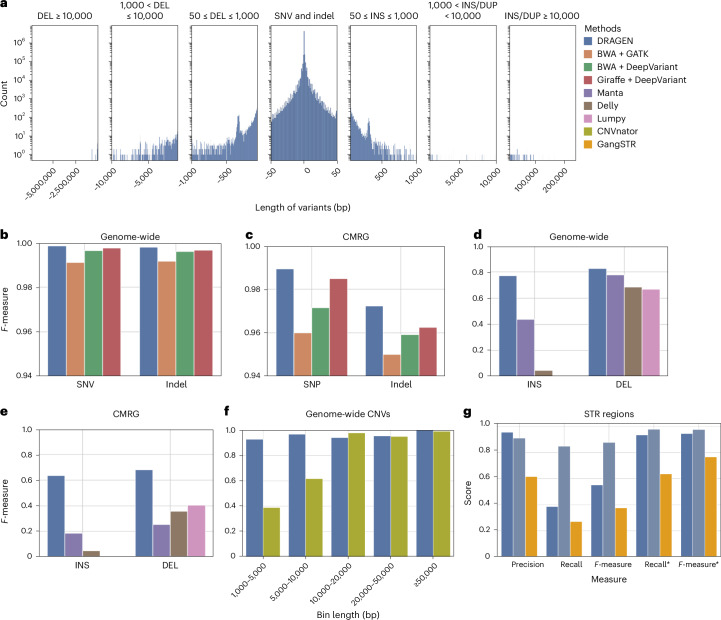
- For HG002, DRAGEN produced ~4.92 million small variant calls, including 3,956,307 SNVs and 960,908 indels, plus 13,886 SVs, 1,156 CNVs and STR variation at 31,370 polymorphic loci. It achieved an overall small-variant F-measure of 99.86% with 11,163 errors, SV insertion F-measure of 76.90% and deletion F-measure of 82.60%, and CNV F-measures of 92.60% for 1–5 kbp and 96.60% for 5–10 kbp.
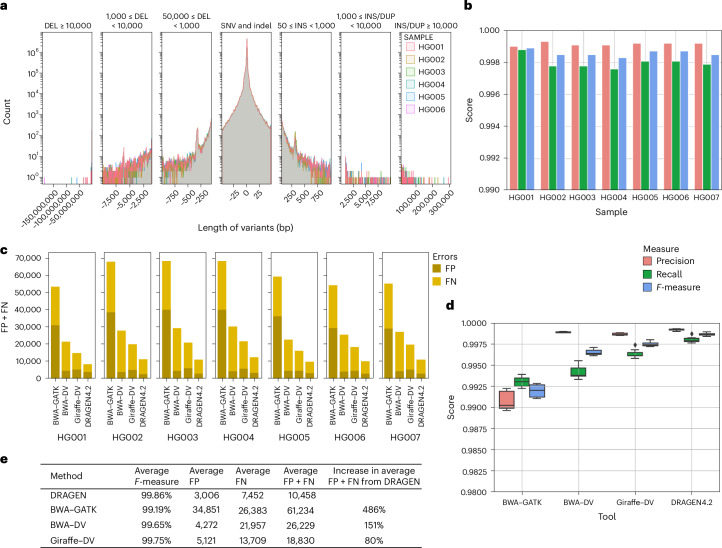
- Across HG001–HG007, DRAGEN detected an average of 4,894,415 small variants per sample, with mean F-measures of 99.80% for SNVs and 99.87% for indels. Compared with GATK + BWA, DeepVariant + BWA and Giraffe + DeepVariant, DRAGEN reduced combined SNV/indel errors by 82.88%, 60.07% and 44.33%, respectively; the pangenome reference reduced error by 54.20% on average.
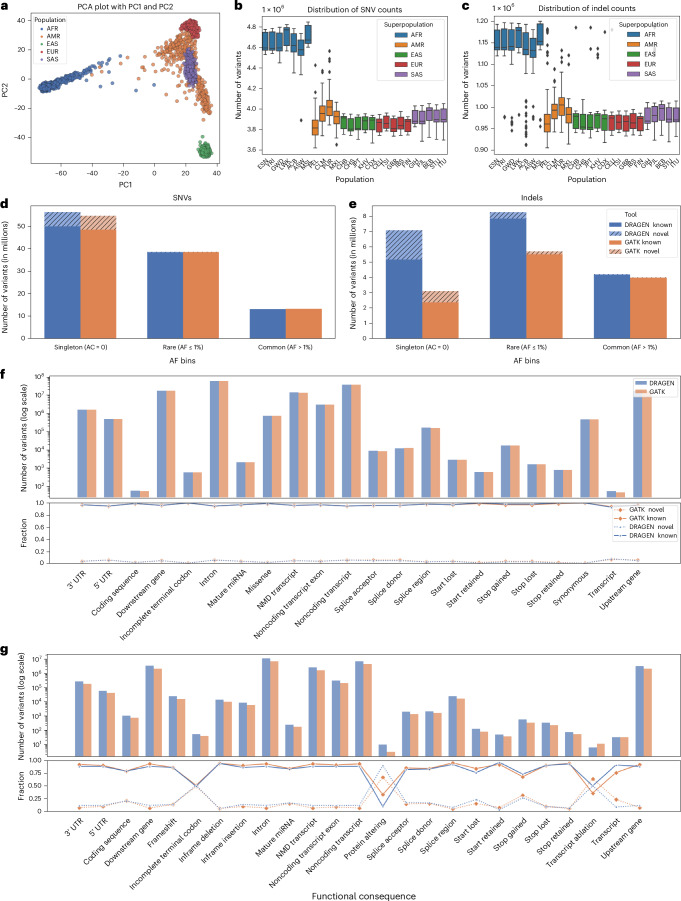
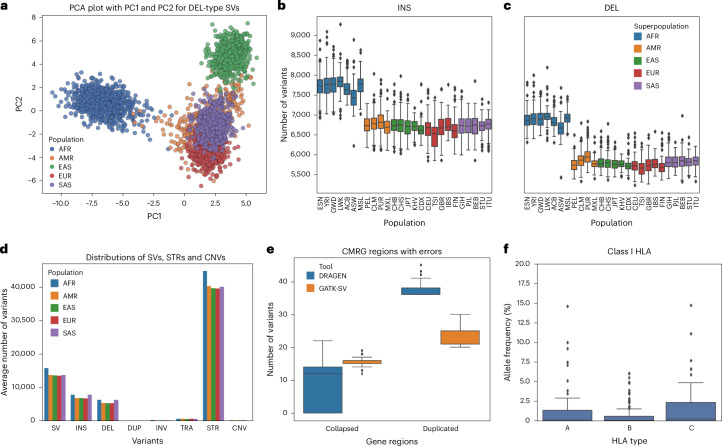
- In 3,202 high-coverage 1kGP samples, DRAGEN identified 116,346,215 SNVs and 24,979,420 indels, plus 409,033 STRs, 1,013,541 SVs and 9,216 CNVs. The joint callset had per-sample SNV recall 99.92%, precision 99.78% and F1 99.85%; indel recall 99.84%, precision 99.71% and F1 99.77%; aggregation of >3,202 samples took approximately 2 h.
- Targeted callers showed high concordance: CYP2D6 and CYP2B6 star allele calls were 99.3% and 92.1% concordant with orthogonal calls; SMN1 and SMN2 copy-number calls agreed with orthogonal methods for 99.8% and 99.7%; GBA calls were 100% concordant across 42 samples; LPA KIV-2 total and allele-specific copy numbers correlated at 98.2% and 99.7% across 154 samples.
Methods
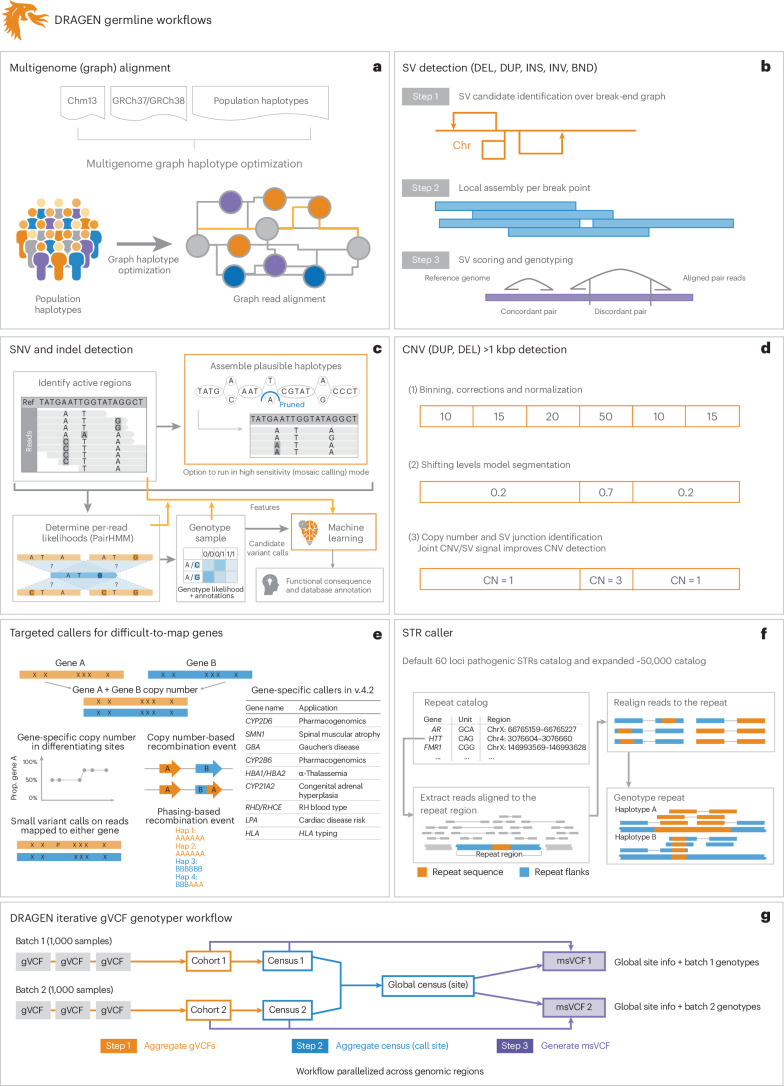
- DRAGEN v.4.2 was run on Illumina NovaSeq 6000 PCR-free 35× WGS data using a pangenome reference consisting of GRCh38 plus 64 haplotypes, with FPGA acceleration. The pipeline performs SNV/indel calling via de Bruijn graph assembly and HMM, followed by machine-learning recalibration; SV calling extends Manta; CNV calling uses a modified shifting-levels/Viterbi model; STR calling is based primarily on ExpansionHunter; nine targeted callers cover CYP2B6, CYP2D6, CYP21A2, GBA, HBA, LPA, RH, SMN and HLA.
- Benchmarking used GIAB v.4.2.1 for SNVs/indels, GIAB SV v.0.6, GIABTR v.1.0 and CMRG regions, with comparisons to GATK, DeepVariant + BWA, DeepVariant + Giraffe, Manta, Delly, Lumpy, CNVnator and GangSTR. Evaluations used RTGTools vcfeval, Witty.er and Truvari.
- Population analysis applied DRAGEN to 3,202 high-coverage 35× 1kGP samples from 26 populations and five superpopulations. Small variants were merged with the DRAGEN Iterative gVCF Genotyper; STR, SV and CNV calls were merged with Truvari; annotation used Illumina Connected Annotations against dbSNP, gnomAD, 1kGP and TOPMed.
Limitations
- The paper states remaining challenges in complex SV detection and accurate sizing of long STR expansions using short-read data, and notes that certain genes/regions require special attention, including HLA, CYP2D6, CYP2B6 and LPA; HLA-DRB1 allele calling was noted as pending improvement.
- The STR benchmark showed low F-measure with the 50,069-region catalog (19.68%) because the catalog is much smaller than the 1.7 million GIABTR regions, impacting recall, although precision was 95.47%; the larger 174,300-region catalog improved F-measure to 55.13%.
- CNV benchmarking was performed only on deletion types because no duplications were reported in the HG002 GIAB benchmark callsets.
Model-written summary. Check it against the paper before relying on it.
Integrity signals
Registry
Cites
Statistics
Figures
Verification
Claims the paper makes
24 Valid · 9 Not valid · 7 Not checked · 180 Own results and interpretations
At least one cited source doesn’t support this claim or points to a different paper, and none confirmed it — see the verdicts below.
In the paper
“The SV callset that was published in recent studies reported only 27,166 SVs, with 8,093 insertions, 13,506 deletions and 5,567 other types of SV.”
§ Comprehensive genome analysis and variant detection at scale using DRAGEN > Results > Comprehensive variant detection at population scale using DRAGEN
What the sources say
- Disputedcites [60] Byrska-Bishop, M. et al. High-coverage whole-genome sequencing of the expanded 1000 Genomes Project cohort including 602 trios. Cell 185, 3426–3440 (2022). 36055201 PMC9439720 sourceExperimental — accuracy not yet measured
The Results section (“Structural variation across the 3,202 1kGP samples”; page not available) reports 173,366 SV loci, including 49,693 insertions and 90,259 deletions—not the claimed 27,166 total, 8,093 insertions and 13,506 deletions. Its comparison with the earlier phase 3 call set also gives a different total: 68,697 SV sites. (LLM, conf=0.88)
Checked by a reasoning model — may be wrong.
plain- Asserted: passes — The authors put it forward as true.
- Checkable: passes — It can be checked against evidence.
- Load-bearing: passes — The paper’s conclusions depend on it.
- Based: passes — The paper gives a reason why it holds.
- Disputed
At least one cited source doesn’t support this claim or points to a different paper, and none confirmed it — see the verdicts below.
In the paper
“These 12 genes comprise 9 that are incorrectly duplicated and 3 that are incorrectly collapsed (for example, two instead of three copies).”
§ Comprehensive genome analysis and variant detection at scale using DRAGEN > Results > Comprehensive variant detection at population scale using DRAGEN
What the sources say
- Disputedcites [23] Behera, S. et al. FixItFelix: improving genomic analysis by fixing reference errors. Genome Biol. 24, 31 (2023). 36810122 PMC9942314 sourceExperimental — accuracy not yet measured
The Discussion says false duplications affected 12 medically relevant genes, rather than nine. The Results (Identification of GRCh38 errors) separately identify three medically relevant genes selected from collapsed regions; they do not describe those three as part of a 12-gene group split nine and three. Page numbers were not available in our copy. (LLM, conf=0.86)
Checked by a reasoning model — may be wrong.
plain- Asserted: passes — The authors put it forward as true.
- Checkable: passes — It can be checked against evidence.
- Load-bearing: passes — The paper’s conclusions depend on it.
- Based: passes — The paper gives a reason why it holds.
- Disputed
Every source the paper cites for this claim was checked and supports it.
In the paper
“Moreover, several of these medically relevant genes (for example, KCNE1, CBS, CRYAA, KCNJ18, MAP2K3, KMT2C) are wrongly represented in the GRCh38 reference due to false duplication and collapsed sequence errors23.”
§ Comprehensive genome analysis and variant detection at scale using DRAGEN > Results > Resolving the complete variant spectrum at scale and accuracy
What the sources say
- Supportedcites [23] Behera, S. et al. FixItFelix: improving genomic analysis by fixing reference errors. Genome Biol. 24, 31 (2023). 36810122 PMC9942314 source
The Results sections identify CBS, KCNE1, and CRYAA as affected by false duplications, and KCNJ18, MAP2K3, and KMT2C as affected by collapsed duplications in GRCh38. They describe these as medically relevant genes. Page numbers are not available in our copy. (LLM, conf=0.94)
plainstates a cause- Asserted: passes — The authors put it forward as true.
- Checkable: passes — It can be checked against evidence.
- Load-bearing: passes — The paper’s conclusions depend on it.
- Based: passes — The paper gives a reason why it holds.
- Supported
The cited sources support only part of this claim — read each source’s verdict below.
In the paper
“This GIAB benchmark spans 273 medically relevant genes that are highly repetitive and diverse and were therefore excluded from the genome-wide benchmark12.”
§ Comprehensive genome analysis and variant detection at scale using DRAGEN > Results > Resolving the complete variant spectrum at scale and accuracy
What the sources say
- Partly supportedcites [12] Wagner, J. et al. Curated variation benchmarks for challenging medically relevant autosomal genes. Nat Biotechnol 40, 672–680 (2022). 35132260 PMC9117392 sourceExperimental — accuracy not yet measured
The Introduction says the CMRG benchmark covers 273 medically relevant genes that were incompletely covered by previous GIAB benchmarks, and the Results describe these genes as substantially more challenging. But the Introduction specifies that up to 90% of each gene’s bases were already included, so saying the genes were excluded from the genome-wide benchmark overstates the finding. The paper describes several kinds of challenges, not every gene as both highly repetitive and diverse. (LLM, conf=0.86)
plainstates a cause- Asserted: passes — The authors put it forward as true.
- Checkable: passes — It can be checked against evidence.
- Load-bearing: passes — The paper’s conclusions depend on it.
- Based: passes — The paper gives a reason why it holds.
- Partly supported
The cited sources that could be checked couldn’t confirm or dispute this claim.
In the paper
“By contrast, the previous study only reported 36 SVs in collapsed and 18 SVs in duplicated regions across the entire 1kGP sample.”
§ Comprehensive genome analysis and variant detection at scale using DRAGEN > Results > Comprehensive variant detection at population scale using DRAGEN
What the sources say
- Could not verifycites [60] Byrska-Bishop, M. et al. High-coverage whole-genome sequencing of the expanded 1000 Genomes Project cohort including 602 trios. Cell 185, 3426–3440 (2022). 36055201 PMC9439720 sourceExperimental — accuracy not yet measured
The Results section, “Structural variation across the 3,202 1kGP samples” (page unavailable), reports an overall SV call set but gives no counts for collapsed or duplicated regions. Searches for “collapsed regions,” “duplicated regions,” and “36 SVs 18 SVs” found no passage establishing the claimed regional counts. (LLM, conf=0.76)
plain- Asserted: passes — The authors put it forward as true.
- Checkable: passes — It can be checked against evidence.
- Load-bearing: passes — The paper’s conclusions depend on it.
- Based: passes — The paper gives a reason why it holds.
- Could not verify
89 more claims · 8 with their cited sources checked
Create a free account to see all 220 claims and to verify the 2 references still open.
- It may state two separate claims as one. 106
- Borderline: one of the tests for a substantial claim is unclear. 2
- Probably not a substantial claim. 23
- The quote only partly states this claim. 3
Self-check
Percentages, sums and reported differences re-computed from the paper’s own numbers.
Rated minor: it would not touch a result — a value no result rests on, a p-value that stays on the same side of the significance level, or a conflict that is clerical, resolved elsewhere in the paper, or outside its own findings.
In the paper
“EUR (n = 633, 21.64%)”
§ Comprehensive genome analysis and variant detection at scale using DRAGEN > Results > Comprehensive variant detection at population scale using DRAGEN
Reported 21.64 · recomputed 19.768894
Rated minor: it would not touch a result — a value no result rests on, a p-value that stays on the same side of the significance level, or a conflict that is clerical, resolved elsewhere in the paper, or outside its own findings.
In the paper
“among samples with PASS filter, 1,189 were normal metabolizers, 381 were poor metabolizers, 154 were rapid metabolizers, 7 were ultrarapid metabolizers, 224 were intermediate metabolizers, 57 had indeterminate status, and 1,190 had none status.”
§ Comprehensive genome analysis and variant detection at scale using DRAGEN > Results > Comprehensive variant detection at population scale using DRAGEN
Reported 2017 · recomputed 3202
Citations
Cites
Fast and accurate short read alignment with Burrows-Wheeler transform
Li, H., & Durbin, R. (2009) · Bioinformatics · doi:10.1093/bioinformatics/btp324 · Cited by 58,607
A global reference for human genetic variation
The 1000 Genomes Project Consortium, authors, C., Auton, A., Abecasis, G. R., Steering committee, Altshuler, D. M., Durbin, R. M., Abecasis, G. R., Bentley, D. R., Chakravarti, A., et al. (2015) · Nature · doi:10.1038/nature15393 · Cited by 18,247
Self-citationGraph-based genome alignment and genotyping with HISAT2 and HISAT-genotype
Kim, D., Paggi, J. M., Park, C., Bennett, C., & Salzberg, S. L. (2019) · Nature Biotechnology · doi:10.1038/s41587-019-0201-4 · Cited by 15,022 · cited 1×
“DRAGEN were perfectly concordant with other callers, such as HLA-LA 54 , HISAT-genotype 55 , T1K 56 and HLA*ASM 57 .”
Aligning sequence reads, clone sequences and assembly contigs with BWA-MEM
Li, H. (2013) · DROPS (Schloss Dagstuhl – Leibniz Center for Informatics) · doi:10.48550/arxiv.1303.3997 · Cited by 5,159
Coming of age: ten years of next-generation sequencing technologies
Goodwin, S., McPherson, J. D., & McCombie, W. R. (2016) · Nature Reviews Genetics · doi:10.1038/nrg.2016.49 · Cited by 4,352 · cited 1×
“Over the last decade, the advent of genomic sequencing as a common methodology in genomics, genetics and medical applications has enabled multiple discoveries and insights for diseases, population diversity, evolutionary mechanisms and personalized medicine strategies 1–4 .”
ClinVar: public archive of relationships among sequence variation and human phenotype
Landrum, M. J., Lee, J. M., Riley, G. R., Jang, W., Rubinstein, W. S., Church, D. M., & Maglott, D. R. (2014) · Nucleic Acids Research · doi:10.1093/nar/gkt1113 · Cited by 3,516 · cited 1×
“Canonical transcripts are identified using information from MANE 82 or, when not available, via existing heuristic methods 83,84 .”
Verkerk, A. J. M. H., Pieretti, M., Sutcliffe, J. S., Fu, Y.-H., Kuhl, D. P. A., Pizzuti, A., Reiner, O., Richards, S., Victoria, M. F., Zhang, F., et al. (1991) · Cell · doi:10.1016/0092-8674(91)90397-h · Cited by 3,481
Performance of neural network basecalling tools for Oxford Nanopore sequencing
Wick, R. R., Judd, L. M., & Holt, K. E. (2019) · Genome Biology · doi:10.1186/s13059-019-1727-y · Cited by 3,221
DELLY: structural variant discovery by integrated paired-end and split-read analysis
Rausch, T., Zichner, T., Schlattl, A., Stütz, A. M., Benes, V., & Korbel, J. O. (2012) · Bioinformatics · doi:10.1093/bioinformatics/bts378 · Cited by 2,459
(2015) · doi:10.1093/bioinformatics/btv710 · Cited by 2,234
Scaling accurate genetic variant discovery to tens of thousands of samples
Poplin, R., Ruano-Rubio, V., DePristo, M. A., Fennell, T. J., Carneiro, M. O., Van der Auwera, G. A., Kling, D. E., Gauthier, L. D., Levy-Moonshine, A., Roazen, D., et al. (2017) · bioRxiv (Cold Spring Harbor Laboratory) · doi:10.1101/201178 · Cited by 1,915
A universal SNP and small-indel variant caller using deep neural networks
Poplin, R., Chang, P.-C., Alexander, D., Schwartz, S., Colthurst, T., Ku, A., Newburger, D., Dijamco, J., Nguyen, N., Afshar, P. T., et al. (2018) · Nature Biotechnology · doi:10.1038/nbt.4235 · Cited by 1,840
Abyzov, A., Urban, A. E., Snyder, M., & Gerstein, M. (2011) · Genome Research · doi:10.1101/gr.114876.110 · Cited by 1,658
LUMPY: a probabilistic framework for structural variant discovery
Layer, R. M., Chiang, C., Quinlan, A. R., & Hall, I. M. (2014) · Genome Biology · doi:10.1186/gb-2014-15-6-r84 · Cited by 1,554
Next-Generation Sequencing Technology: Current Trends and Advancements
Satam, H., Joshi, K., Mangrolia, U., Waghoo, S., Zaidi, G., Rawool, S., Thakare, R. P., Banday, S., Mishra, A. K., Das, G., et al. (2023) · Biology · doi:10.3390/biology12070997 · Cited by 1,299 · cited 1×
“Over the last decade, the advent of genomic sequencing as a common methodology in genomics, genetics and medical applications has enabled multiple discoveries and insights for diseases, population diversity, evolutionary mechanisms and personalized medicine strategies 1–4 .”
A draft human pangenome reference.
Liao, W.-W., Asri, M., Ebler, J., Doerr, D., Haukness, M., Hickey, G., Lu, S., Lucas, J. K., Monlong, J., Abel, H. J., et al. (2023) · Nature · doi:10.1038/s41586-023-05896-x · Cited by 1,129 · cited 1×
“This shows the improvement of variant calling by DRAGEN that incorporates the corrected regions during variant calls (Fig.”
Byrska-Bishop, M., Evani, U. S., Zhao, X., Basile, A. O., Abel, H. J., Regier, A. A., Corvelo, A., Clarke, W. E., Musunuri, R., Nagulapalli, K., et al. (2022) · Cell · doi:10.1016/j.cell.2022.08.004 · Cited by 1,094
(2017) · doi:10.1038/ncomms14061 · Cited by 815
Self-citationThe Sequence Ontology: a tool for the unification of genome annotations
Eilbeck, K., Lewis, S. E., Mungall, C. J., Yandell, M., Stein, L., Durbin, R., & Ashburner, M. (2005) · Genome Biology · doi:10.1186/gb-2005-6-5-r44 · Cited by 806
Mechanisms underlying structural variant formation in genomic disorders
Carvalho, C. M. B., & Lupski, J. R. (2016) · Nature Reviews Genetics · doi:10.1038/nrg.2015.25 · Cited by 774
OptiType: precision HLA typing from next-generation sequencing data
Szolek, A., Schubert, B., Mohr, C., Sturm, M., Feldhahn, M., & Kohlbacher, O. (2014) · Bioinformatics · doi:10.1093/bioinformatics/btu548 · Cited by 769
Structural variant calling: the long and the short of it
Mahmoud, M., Gobet, N., Cruz-Dávalos, D. I., Mounier, N., Dessimoz, C., & Sedlazeck, F. J. (2019) · Genome Biology · doi:10.1186/s13059-019-1828-7 · Cited by 725
Self-citationNon-coding genetic variants in human disease: Figure 1.
Zhang, F., & Lupski, J. R. (2015) · Human Molecular Genetics · doi:10.1093/hmg/ddv259 · Cited by 609
The impact of next-generation sequencing on genomics
Zhang, J., Chiodini, R., Badr, A., & Zhang, G. (2011) · Journal of Genetics and Genomics · doi:10.1016/j.jgg.2011.02.003 · Cited by 577
The H19 locus: Role of an imprinted non‐coding RNA in growth and development
Gabory, A., Jammes, H., & Dandolo, L. (2010) · BioEssays · doi:10.1002/bies.200900170 · Cited by 568
Piercing the dark matter: bioinformatics of long-range sequencing and mapping
Sedlazeck, F. J., Lee, H., Darby, C. A., & Schatz, M. C. (2018) · Nature Reviews Genetics · doi:10.1038/s41576-018-0003-4 · Cited by 530 · cited 4×
“It also requires a scalable and unified software framework to comprehensively identify all variant types (SNVs, indels, SVs, CNVs and repeat expansions), which has not been realized 6 .”
InfluentialSelf-citation30 years of repeat expansion disorders: What have we learned and what are the remaining challenges?
Depienne, C., & Mandel, J.-L. (2021) · The American Journal of Human Genetics · doi:10.1016/j.ajhg.2021.03.011 · Cited by 429
A robust benchmark for detection of germline large deletions and insertions
Zook, J. M., Hansen, N. F., Olson, N. D., Chapman, L., Mullikin, J. C., Xiao, C., Sherry, S., Koren, S., Phillippy, A. M., Boutros, P. C., et al. (2020) · Nature Biotechnology · doi:10.1038/s41587-020-0538-8 · Cited by 418
Self-citationHTSlib: C library for reading/writing high-throughput sequencing data
(2021) · doi:10.1093/gigascience/giab007 · Cited by 413
Pangenomics enables genotyping of known structural variants in 5202 diverse genomes
Sirén, J., Monlong, J., Chang, X., Novak, A. M., Eizenga, J. M., Markello, C., Sibbesen, J. A., Hickey, G., Chang, P.-C., Carroll, A., et al. (2021) · Science · doi:10.1126/science.abg8871 · Cited by 400 · cited 10×
“DRAGEN SNV call performance was then compared to that of GATK and DeepVariant calls with BWA and Giraffe 15 mapper using the GIAB benchmark for all samples (Fig.”
InfluentialExpansionHunter: a sequence-graph-based tool to analyze variation in short tandem repeat regions
Dolzhenko, E., Deshpande, V., Schlesinger, F., Krusche, P., Petrovski, R., Chen, S., Emig-Agius, D., Gross, A., Narzisi, G., Bowman, B., et al. (2019) · Bioinformatics · doi:10.1093/bioinformatics/btz431 · Cited by 394
Guidelines for the diagnosis and management of cystathionine beta‐synthase deficiency
Morris, A. A. M., Kožich, V., Santra, S., Andria, G., Ben‐Omran, T. I. M., Chakrapani, A. B., Crushell, E., Henderson, M. J., Hochuli, M., Huemer, M., et al. (2017) · Journal of Inherited Metabolic Disease · doi:10.1007/s10545-016-9979-0 · Cited by 340
Towards population-scale long-read sequencing
De Coster, W., Weissensteiner, M. H., & Sedlazeck, F. J. (2021) · Nature Reviews Genetics · doi:10.1038/s41576-021-00367-3 · Cited by 323
Self-citationRyan, D. P., Dias da Silva, M. R., Soong, T. W., Fontaine, B., Donaldson, M. R., Kung, A. W. C., Jongjaroenprasert, W., Liang, M. C., Khoo, D. H. C., Cheah, J. S., et al. (2010) · Cell · doi:10.1016/j.cell.2009.12.024 · Cited by 311
Mapping and characterization of structural variation in 17,795 human genomes
Genomics, N. C. F. C. D., Abel, H. J., Larson, D. E., Regier, A. A., Chiang, C., Das, I., Kanchi, K. L., Layer, R. M., Neale, B. M., Salerno, W. J., et al. (2020) · Nature · doi:10.1038/s41586-020-2371-0 · Cited by 310
Ebler, J., Ebert, P., Clarke, W. E., Rausch, T., Audano, P. A., Houwaart, T., Mao, Y., Korbel, J. O., Eichler, E. E., Zody, M. C., et al. (2022) · Nature Genetics · doi:10.1038/s41588-022-01043-w · Cited by 277 · cited 11×
“In addition, the DRAGEN multigenome mapper is already incorporated for SV and CNV calling, something that is not currently possible with any other graph genome implementations because they focus primarily on genotyping variants 14,73 .”
InfluentialGBA, Gaucher Disease, and Parkinson’s Disease: From Genetic to Clinic to New Therapeutic Approaches
Riboldi, G. M., & Di Fonzo, A. B. (2019) · Cells · doi:10.3390/cells8040364 · Cited by 274
Profiling the genome-wide landscape of tandem repeat expansions
(2019) · doi:10.1093/nar/gkz501 · Cited by 270
Carrier screening for spinal muscular atrophy
Prior, T. W. (2008) · Genetics in Medicine · doi:10.1097/gim.0b013e318188d069 · Cited by 270
Curated variation benchmarks for challenging medically relevant autosomal genes
Wagner, J., Olson, N. D., Harris, L., McDaniel, J., Cheng, H., Fungtammasan, A., Hwang, Y.-C., Gupta, R., Wenger, A. M., Rowell, W. J., et al. (2022) · Nature Biotechnology · doi:10.1038/s41587-021-01158-1 · Cited by 241 · cited 1×
“Later, the benchmark was expanded across the challenging medically relevant gene (CMRG) catalog 41 (see Methods for details).”
Self-citationTruvari: refined structural variant comparison preserves allelic diversity
English, A. C., Menon, V. K., Gibbs, R. A., Metcalf, G. A., & Sedlazeck, F. J. (2022) · Genome Biology · doi:10.1186/s13059-022-02840-6 · Cited by 236 · cited 5×
“Therefore, we developed a procedure to combine DRAGEN STR, SV and CNV calls together to form a comprehensive deduplicated large variant VCF file using Truvari 51 .”
InfluentialSelf-citationCleary, J. G., Braithwaite, R., Gaastra, K., Hilbush, B. S., Inglis, S., Irvine, S. A., Jackson, A., Littin, R., Rathod, M., Ware, D., et al. (2015) · doi:10.1101/023754 · Cited by 230
Clinical Role of Human Leukocyte Antigen in Health and Disease
Mosaad, Y. M. (2015) · Scandinavian Journal of Immunology · doi:10.1111/sji.12329 · Cited by 208
Olson, N. D., Wagner, J., McDaniel, J., Stephens, S. H., Westreich, S. T., Prasanna, A. G., Johanson, E., Boja, E., Maier, E. J., Serang, O., et al. (2022) · Cell Genomics · doi:10.1016/j.xgen.2022.100129 · Cited by 202
Self-citationBenchmarking challenging small variants with linked and long reads
Wagner, J., Olson, N. D., Harris, L., Khan, Z., Farek, J., Mahmoud, M., Stankovic, A., Kovacevic, V., Yoo, B., Miller, N., et al. (2022) · Cell Genomics · doi:10.1016/j.xgen.2022.100128 · Cited by 202
Self-citationParagraph: a graph-based structural variant genotyper for short-read sequence data
Chen, S., Krusche, P., Dolzhenko, E., Sherman, R. M., Petrovski, R., Schlesinger, F., Kirsche, M., Bentley, D. R., Schatz, M. C., Sedlazeck, F. J., et al. (2019) · Genome Biology · doi:10.1186/s13059-019-1909-7 · Cited by 196 · cited 2×
“This has been most successfully shown in SV genotyping using graph genomes 13,14 .”
Self-citationGalanello, R., & Cao, A. (2011) · Genetics in Medicine · doi:10.1097/gim.0b013e3181fcb468 · Cited by 187
Ibañez, K., Polke, J., Hagelstrom, R. T., Dolzhenko, E., Pasko, D., Thomas, E. R. A., Daugherty, L. C., Kasperaviciute, D., Smith, K. R., McDonagh, E. M., et al. (2022) · The Lancet Neurology · doi:10.1016/s1474-4422(21)00462-2 · Cited by 187
Variant calling and benchmarking in an era of complete human genome sequences
Olson, N. D., Wagner, J., Dwarshuis, N. J., Miga, K. H., Sedlazeck, F. J., Salit, M., & Zook, J. M. (2023) · Nature Reviews Genetics · doi:10.1038/s41576-023-00590-0 · Cited by 181
Self-citationCharacterization of 137 Genomic DNA Reference Materials for 28 Pharmacogenetic Genes
Pratt, V. M., Everts, R. E., Aggarwal, P., Beyer, B. N., Broeckel, U., Epstein-Baak, R., Hujsak, P. G., Kornreich, R., Liao, J., Lorier, R., et al. (2015) · Journal of Molecular Diagnostics · doi:10.1016/j.jmoldx.2015.08.005 · Cited by 162
HLA*LA—HLA typing from linearly projected graph alignments
Dilthey, A. T., Mentzer, A. J., Carapito, R., Cutland, C., Cereb, N., Madhi, S. A., Rhie, A., Koren, S., Bahram, S., McVean, G., et al. (2019) · Bioinformatics · doi:10.1093/bioinformatics/btz235 · Cited by 155
Spinal muscular atrophy diagnosis and carrier screening from genome sequencing data
Chen, X., Sanchis-Juan, A., French, C. E., Connell, A. J., Delon, I., Kingsbury, Z., Chawla, A., Halpern, A. L., Taft, R. J., Bentley, D. R., et al. (2020) · Genetics in Medicine · doi:10.1038/s41436-020-0754-0 · Cited by 137
Cancer Genomes Evolve by Pulverizing Single Chromosomes
Meyerson, M., & Pellman, D. (2011) · Cell · doi:10.1016/j.cell.2010.12.025 · Cited by 115
Current research status of HLA in immune‐related diseases
Liu, B., Shao, Y., & Fu, R. (2021) · Immunity Inflammation and Disease · doi:10.1002/iid3.416 · Cited by 110
GLnexus: joint variant calling for large cohort sequencing
Lin, M. F., Rodeh, O., Penn, J., Bai, X., Reid, J. G., Krasheninina, O., & Salerno, W. J. (2018) · bioRxiv (Cold Spring Harbor Laboratory) · doi:10.1101/343970 · Cited by 106
Cyrius: accurate CYP2D6 genotyping using whole-genome sequencing data
Chen, X., Shen, F., Gonzaludo, N., Malhotra, A., Rogert, C., Taft, R. J., Bentley, D. R., & Eberle, M. A. (2021) · The Pharmacogenomics Journal · doi:10.1038/s41397-020-00205-5 · Cited by 95
Coassin, S., Erhart, G., Weissensteiner, H., Eca Guimarães de Araújo, M., Lamina, C., Schönherr, S., Forer, L., Haun, M., Losso, J. L., Köttgen, A., et al. (2017) · European Heart Journal · doi:10.1093/eurheartj/ehx174 · Cited by 93
High-Accuracy HLA Type Inference from Whole-Genome Sequencing Data Using Population Reference Graphs
Dilthey, A. T., Gourraud, P.-A., Mentzer, A. J., Cereb, N., Iqbal, Z., & McVean, G. (2016) · PLOS Computational Biology · doi:10.1371/journal.pcbi.1005151 · Cited by 92
The EN-TEx resource of multi-tissue personal epigenomes & variant-impact models
Rozowsky, J., Gao, J., Borsari, B., Yang, Y. T., Galeev, T., Gürsoy, G., Epstein, C. B., Xiong, K., Xu, J., Li, T., et al. (2023) · Cell · doi:10.1016/j.cell.2023.02.018 · Cited by 78
Self-citationsvtools: population-scale analysis of structural variation
Larson, D. E., Abel, H. J., Chiang, C., Badve, A., Das, I., Eldred, J. M., Layer, R. M., & Hall, I. M. (2019) · Bioinformatics · doi:10.1093/bioinformatics/btz492 · Cited by 71
Analysis and benchmarking of small and large genomic variants across tandem repeats
English, A. C., Dolzhenko, E., Ziaei Jam, H., McKenzie, S. K., Olson, N. D., De Coster, W., Park, J., Gu, B., Wagner, J., Eberle, M. A., et al. (2025) · Nature Biotechnology · doi:10.1038/s41587-024-02225-z · Cited by 68
Self-citationUncovering Missing Heritability in Rare Diseases
Maroilley, T., & Tarailo‐Graovac, M. (2019) · Genes · doi:10.3390/genes10040275 · Cited by 64
Efficient and accurate KIR and HLA genotyping with massively parallel sequencing data
Song, L., Bai, G., Liu, X. S., Li, B., & Li, H. (2023) · Genome Research · doi:10.1101/gr.277585.122 · Cited by 61
Toffoli, M., Chen, X., Sedlazeck, F. J., Lee, C.-Y., Mullin, S., Higgins, A., Koletsi, S., Garcia-Segura, M. E., Sammler, E., Scholz, S. W., et al. (2022) · Communications Biology · doi:10.1038/s42003-022-03610-7 · Cited by 59
Self-citationCutaneous innate immune tolerance is mediated by epigenetic control of MAP2K3 by HDAC8/9
Sawada, Y., Nakatsuji, T., Dokoshi, T., Kulkarni, N. N., Liggins, M. C., Sen, G., & Gallo, R. L. (2021) · Science Immunology · doi:10.1126/sciimmunol.abe1935 · Cited by 58
Structural Variants May Be a Source of Missing Heritability in sALS
Theunissen, F., Flynn, L. L., Anderton, R. S., Mastaglia, F., Pytte, J., Jiang, L., Hodgetts, S., Burns, D. K., Saunders, A., Fletcher, S., et al. (2020) · Frontiers in Neuroscience · doi:10.3389/fnins.2020.00047 · Cited by 53
AKT: ancestry and kinship toolkit
Arthur, R., Schulz-Trieglaff, O. B., Cox, A. J., & O’Connell, J. (2016) · Bioinformatics · doi:10.1093/bioinformatics/btw576 · Cited by 51
Wheeler, M. M., Lannert, K. W., Huston, H., Fletcher, S. N., Harris, S., Teramura, G., Maki, H. J., Frazar, C. D., Underwood, J. G., Shaffer, T. S., et al. (2018) · Genetics in Medicine · doi:10.1038/s41436-018-0074-9 · Cited by 43
Genomic variant benchmark: if you cannot measure it, you cannot improve it
Majidian, S., Agustinho, D. P., Chin, C.-S., Sedlazeck, F. J., & Mahmoud, M. (2023) · Genome biology · doi:10.1186/s13059-023-03061-1 · Cited by 38
Self-citationNicholas, T. J., Cormier, M. J., & Quinlan, A. R. (2022) · BMC Bioinformatics · doi:10.1186/s12859-022-05008-y · Cited by 32
Fragile sites, chromosomal lesions, tandem repeats, and disease
Mirceta, M., Shum, N., Schmidt, M. H. M., & Pearson, C. E. (2022) · Frontiers in Genetics · doi:10.3389/fgene.2022.985975 · Cited by 30
FixItFelix: improving genomic analysis by fixing reference errors
Behera, S., LeFaive, J., Orchard, P., Mahmoud, M., Paulin, L. F., Farek, J., Soto, D. C., Parker, S. C. J., Smith, A. V., Dennis, M. Y., et al. (2023) · Genome Biology · doi:10.1186/s13059-023-02863-7 · Cited by 28
Self-citationExploring the link between GBA1 mutations and Dementia with Lewy bodies, A mini-review
Gaubert, S., Hourregue, C., Mouton-Liger, F., Millot, P., Franco, M., Amar-Bouaziz, E., Aarsland, D., Hugon, J., & Paquet, C. (2022) · Neuroscience & Biobehavioral Reviews · doi:10.1016/j.neubiorev.2022.104856 · Cited by 26
Strömberg, M. P., Roy, R., Lajugie, J., Jiang, Y., Li, H., & Margulies, E. H. (2017) · ACM International Conference on Bioinformatics, Computational Biology, and Health Informatics (ACM-BCB) · doi:10.1145/3107411.3108204 · Cited by 26
Davies, B. J., Coller, J. K., Somogyi, A. A., Milne, R. W., & Sallustio, B. C. (2007) · Drug Metabolism and Disposition · doi:10.1124/dmd.106.012252 · Cited by 25 · cited 1×
“The CYP2D6 and CYP2B6 genes are important for pharmacogenomics and encode an enzyme that is responsible for metabolizing most commonly used drugs 30 .”
Structural variation across 138,134 samples in the TOPMed consortium
Jun, G., English, A., Metcalf, G., Yang, J., Chaisson, M., Pankratz, N., Menon, V., Salerno, W., Krasheninina, O., Smith, A., et al. (2023) · doi:10.21203/rs.3.rs-2515453/v1 · Cited by 24
Self-citationTarailo-Graovac, M., Wasserman, W. W., & Van Karnebeek, C. D. M. (2017) · Expert Review of Molecular Diagnostics · doi:10.1080/14737159.2017.1293527 · Cited by 23
Behera, S., Belyeu, J. R., Chen, X., Paulin, L. F., Nguyen, N. Q. H., Newman, E., Mahmoud, M., Menon, V. K., Qi, Q., Joshi, P., et al. (2023) · doi:10.1101/2023.04.24.538128 · Cited by 21
Self-citationBehera, S., Belyeu, J. R., Chen, X., Paulin, L. F., Nguyen, N. Q., Newman, E., Mahmoud, M., Menon, V. K., Qi, Q., Joshi, P. H., et al. (2024) · BMC Medical Genomics · doi:10.1186/s12920-024-02024-0 · Cited by 21
Self-citationAuthor Correction: A structural variation reference for medical and population genetics
Genome Aggregation Database Production Team, Collins, R. L., Brand, H., Karczewski, K. J., Zhao, X., Alföldi, J., Francioli, L. C., Khera, A. V., Lowther, C., Gauthier, L. D., et al. (2021) · Nature · doi:10.1038/s41586-020-03176-6 · Cited by 16
Variant predictions in congenital adrenal hyperplasia caused by mutations in CYP21A2
Prado, M. J., Ligabue‐Braun, R., Zaha, A., Rossetti, M. L. R., & Pandey, A. V. (2022) · Frontiers in Pharmacology · doi:10.3389/fphar.2022.931089 · Cited by 11
(2022) · doi:10.1007/978-1-0716-2293-3 · Cited by 10
Sedlazeck, F. J., Yu, B., Mansfield, A. J., Chen, H., Krasheninina, O. A., Tin, A., Qi, Q., Zarate, S., Traynelis, J. L., Menon, V. K., et al. (2020) · bioRxiv (Cold Spring Harbor Laboratory) · doi:10.1101/2020.05.02.074096 · Cited by 5
Self-citationHGSVC2 project code contributions
Ebert, P. (2021) · Figshare · doi:10.5281/zenodo.4482026 · Cited by 4
github.com/vgteam/vg_wdl/GiraffeDeepVariantLite
Specified, A. N. (2022) · Zenodo (CERN European Organization for Nuclear Research) · doi:10.5281/zenodo.6647019 · Cited by 2
Research works printed but not linked: 1
- Wagner, J. et al. Curated variation benchmarks for challenging medically relevant autosomal genes. Nat. Biotechnol. 40, 672–680 (2022). 35132260 PMC9117392 · DOI · Paper page
Cited by
Neoadjuvant triplet immune checkpoint blockade in newly diagnosed glioblastoma
Long, G. V., Shklovskaya, E., Satgunaseelan, L., Mao, Y., da Silva, I. P., Perry, K. A., Diefenbach, R. J., Gide, T. N., Shivalingam, B., Buckland, M. E., et al. (2025) · Nature Medicine · doi:10.1038/s41591-025-03512-1 · Cited by 83
“39,40), copy number variation using PURPLE v.2.51 (ref.”
InfluentialA Hitchhiker's Guide to long-read genomic analysis
Mahmoud, M., Agustinho, D. P., & Sedlazeck, F. J. (2025) · Genome Research · doi:10.1101/gr.279975.124 · Cited by 27
Self-citationFeasibility and clinical utility of expanded genomic newborn screening in the Early Check program
Cope, H., Jalazo, E., Berg, J. S., Sullivan, J. A., Kucera, K. S., Shone, S. M., Frawley, H. E., Gwaltney, A. Y., Forsythe, A., Migliore, B. A., et al. (2025) · Nature Medicine · doi:10.1038/s41591-025-03945-8 · Cited by 35
GREGoR: accelerating genomics for rare diseases
Dawood, M., Heavner, B., Wheeler, M. M., Ungar, R. A., LoTempio, J. E., Wiel, L., Berger, S., Bernstein, J. A., Chong, J. X., Délot, E. C., et al. (2025) · Nature · doi:10.1038/s41586-025-09613-8 · Cited by 45
Self-citationBuffering and non-monotonic behavior of gene dosage response curves for human complex traitsPreprint
Milind, N., Smith, C. J., Zhu, H., Gjorgjieva, T., Spence, J. P., & Pritchard, J. K. (2024) · medRxiv · doi:10.1101/2024.11.11.24317065 · Cited by 15
Metadata
- Authors
- Behera, S., Catreux, S., Rossi, M., Truong, S., Huang, Z., Ruehle, M., Visvanath, A., Parnaby, G., Roddey, C., Onuchic, V., Finocchio, A., Cameron, D. L., English, A., Mehtalia, S., Han, J., Mehio, R., & Sedlazeck, F. J.
- Affiliations
- Baylor College of Medicine (US)
- Illumina (United States) (US)
- Corresponding author
- Catreux, Severine
- Han, James
- Mehio, Rami
- Sedlazeck, Fritz J.
- ORCID
- Venue
- Nature Biotechnology
- Published
- 2024-10-25
- Volume
- 43
- Issue
- 7
- Pages
- 1177-1191
- ISSN
- 0733-222X (ISSN-L)
- 1087-0156
- 1546-1696
- PMC
- PMC12022141
- OpenAlex
- W4403770348
- Semantic Scholar
- 016898d8ef83e2c964f81f8004213f65781ce40f
- Cited by
- 137
- References
- 83
- Citations by year
- 2026: 74 · 2025: 54 · 2024: 9
- FWCI
- 18.58
- Type
- journal article
- Language
- en
- Open access
- hybrid
- doi.org
- Licence
- cc-by-nc-nd
- creativecommons.org/licenses/by-nc-nd/4.0 (tdm)
- creativecommons.org/licenses/by-nc-nd/4.0 (vor)
- Locations
- Nature Biotechnology (publishedVersion, cc-by-nc-nd)
- PubMed Central (publishedVersion, cc-by-nc-nd)
- PubMed (publishedVersion)
- Digital Commons-TMC (Texas Medical Center) (submittedVersion)
- Funders
- National Institutes of Health (1ug3ns132105-01)
- National Institute on Aging (U01AG058589)
- National Human Genome Research Institute (U01HG011758)
- National Institute of Neurological Disorders and Stroke (UG3 NS132105)
- Topics
- Life Sciences › Biochemistry, Genetics and Molecular Biology › Molecular Biology › Genomics and Phylogenetic Studies
- Life Sciences › Biochemistry, Genetics and Molecular Biology › Genetics › Genomics and Rare Diseases
- Life Sciences › Biochemistry, Genetics and Molecular Biology › Genetics › Genomic variations and chromosomal abnormalities
- Keywords
- DRAGEN, variant calling, hardware acceleration, machine learning, whole genome sequencing, structural variants, copy number variation, indels, microsatellite markers, single nucleotide variants, scalability, monogenic disorders, rare diseases
- MeSH terms
- Machine Learning, Whole Genome Sequencing, Humans, Software, Genetic Variation, Genome, Human, Polymorphism, Single Nucleotide, Genomics, DNA Copy Number Variations
About these checks
Registry, retraction, Cites and statistics results are computed, not judged, with one exception: a printed reference that no index lists is read once by a model before it counts as a citation error. Claims are extracted by a model and kept only when their quote appears verbatim in the text; each cited source is then checked, with a model’s help, for whether it says what the claim relies on. Those verdicts can be wrong — read the claim’s quote and the cited source before relying on one.
The claim verdicts this report counts are experimental: their accuracy is not yet measured.
A language model drew the claims from the paper on 2026-10-10, under version 3 of the claim definition (model deepseek-v4.1-flash, prompt extract-v3).
A second model labelled each claim on 2026-10-10 (model jev-1.13-20260917, definition revision gold-guideline-v0.2).
Cited sources are checked with a language model’s help (gpt-6-sol).
Statistics and arithmetic are recomputed, not judged.
Confidence bands are shown only for fields calibrated on our annotated test set. None is calibrated yet, so no band is shown.
What counts as a claim ›How we measure confidence ›How we check this ›
Are you an author, or do you see a problem with this page? Request a review
Data sources
Bibliographic data: Semantic Scholar, OpenAlex, Crossref.
Contains information from the Semantic Scholar Academic Graph Datasets, made available under the ODC Attribution License (ODC-BY 1.0).
Semantic Scholar’s data is described in: Kinney, R., et al. (2023). The Semantic Scholar Open Data Platform. arXiv:2301.10140.
