

Systema: a framework for evaluating genetic perturbation response prediction beyond systematic variation
Open accessThe DOI matches its Crossref record; 38 of the 38 references it cites were found in a registry or an index.
Abstract
Predicting transcriptional responses to genetic perturbations is challenging in functional genomics. While recent methods aim to infer effects of untested perturbations, their true predictive power remains unclear. Here, we show that current methods struggle to generalize beyond systematic variation, the consistent transcriptional differences between perturbed and control cells arising from selection biases or confounders. We quantify this variation in ten datasets, spanning three technologies and five cell lines, and show that common metrics are susceptible to these biases, leading to overestimated performance. To address this, we introduce Systema, an evaluation framework that emphasizes perturbation-specific effects and identifies predictions that correctly reconstruct the perturbation landscape. Using this framework, we uncover insights into the predictive capabilities of existing methods and show that predicting responses to unseen perturbations is substantially harder than standard metrics suggest. Our work highlights the importance of heterogeneous gene panels and disentangles predictive performance from systematic effects, enabling biologically meaningful developments in perturbation response modeling.
Overview
The claims and statistics of this paper haven’t been checked yet.
Free: it reads the open-access text and checks the first 5 claims that cite a source we can check. Create a free account to check every claim.
Integrity signals
Registry
Cites
Statistics
Figures
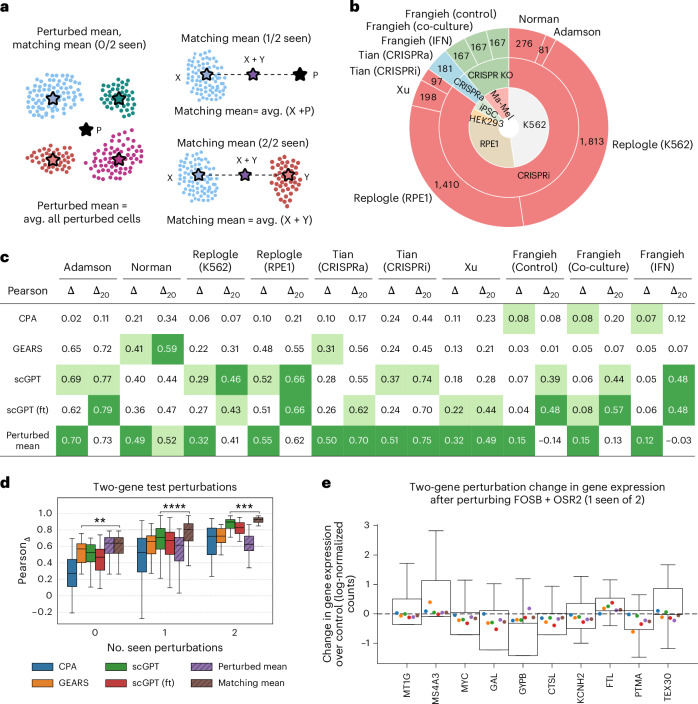
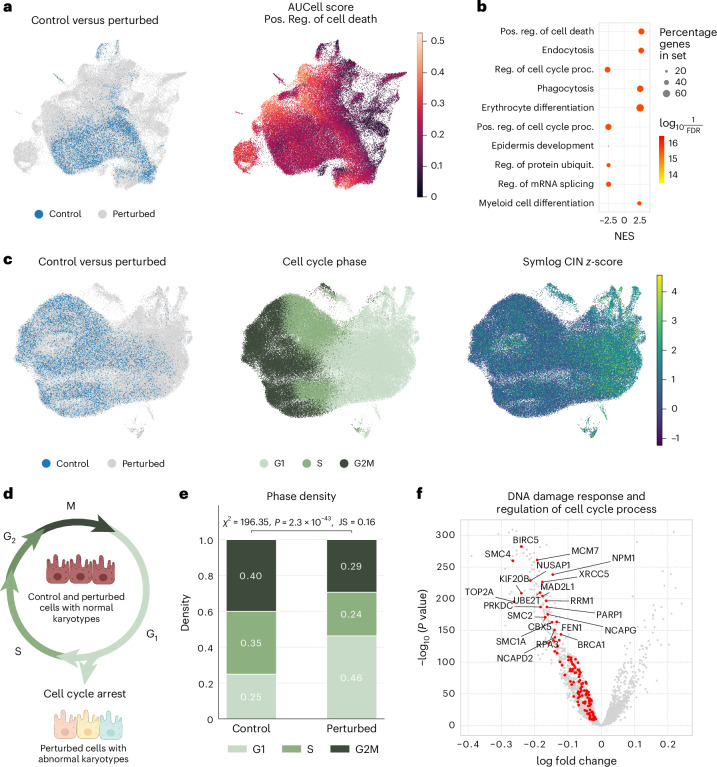
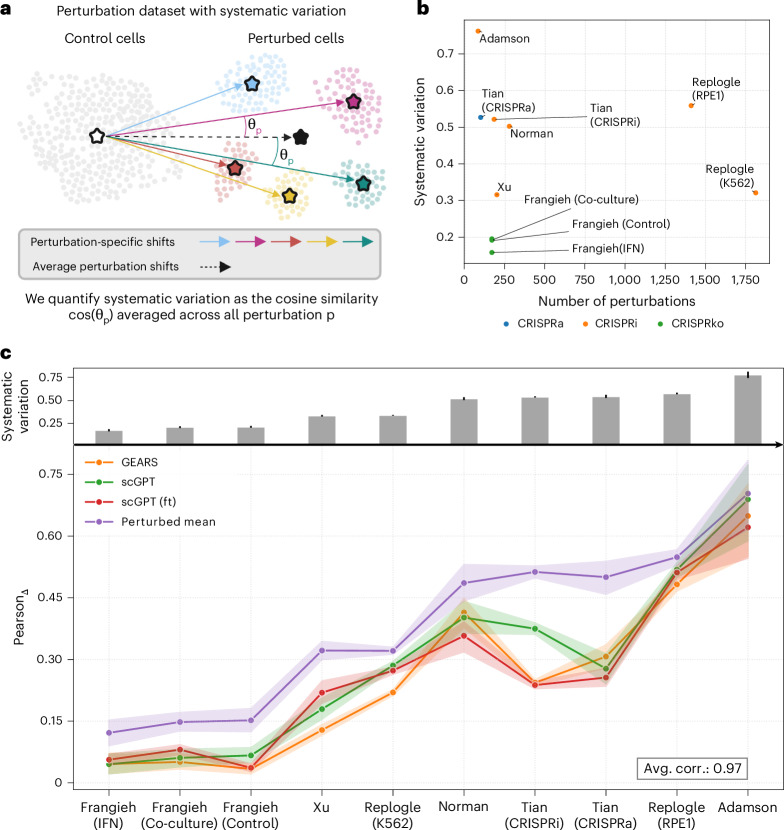
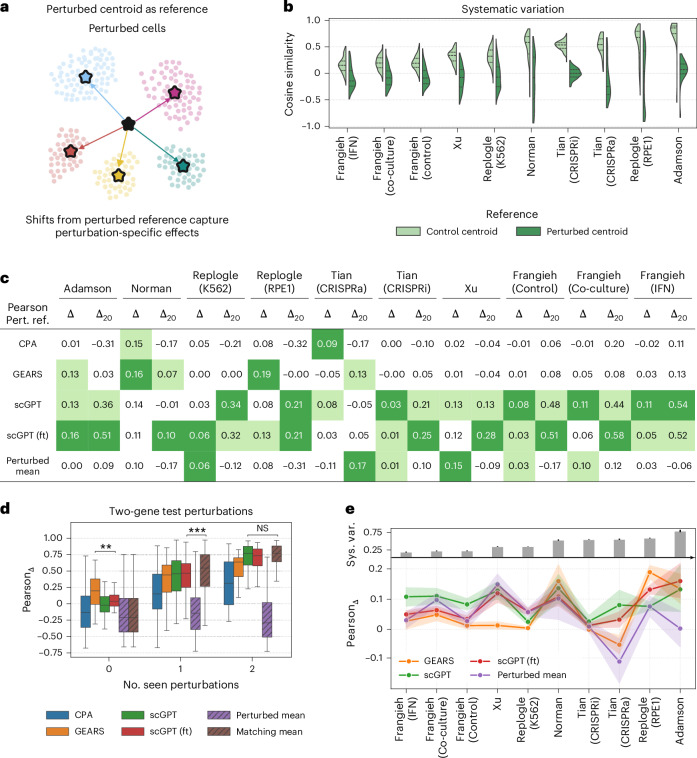
Verification
Claims the paper makes
The claims and statistics of this paper haven’t been checked yet.
Free: it reads the open-access text and checks the first 5 claims that cite a source we can check. Create a free account to check every claim.
Claims other papers make about this one
Each is checked against this paper’s own text: does it say what the citing paper says it does?
The source backs part of the claim, not all of it — or backs it for a different population, condition or comparison.
In the citing paper
“While this work provides valuable insights, its evaluation was limited in dataset diversity and task coverage, leaving the question of whether such conclusions generalize across broader biological contexts.”
From A systematic comparison of single-cell perturbation response prediction models (2026) · cites this paper as [26]
Experimental — accuracy not yet measuredThe cited source says what the claim attributes to it.
In the citing paper
“These observations are consistent with recent work showing that standard perturbation metrics can overestimate biological prediction accuracy and that metric design remains a critical challenge for virtual-cell benchmarking (26, 30, 31).”
From A systematic comparison of single-cell perturbation response prediction models (2026) · cites this paper as [26]
The cited source says what the claim attributes to it.
In the citing paper
“Recent studies have provided initial benchmarks comparing foundation models, other deep learning architectures, and simple baselines for perturbation effect prediction and reported that complex models do not consistently outperform the simpler alternatives (22–26).”
From A systematic comparison of single-cell perturbation response prediction models (2026) · cites this paper as [26]
Self-check
Percentages, sums and reported differences re-computed from the paper’s own numbers.
The self-check needs the paper’s full text.
Citations
Cites
Subramanian, A., Tamayo, P., Mootha, V. K., Mukherjee, S., Ebert, B. L., Gillette, M. A., Paulovich, A., Pomeroy, S. L., Golub, T. R., Lander, E. S., et al. (2005) · Proceedings of the National Academy of Sciences · doi:10.1073/pnas.0506580102 · Cited by 53,625 · cited 5×
“To identify enriched pathways (between perturbed and control cells), we performed GSEA on the processed data using GSEApy 30 and Biological Process 2023 gene sets from GO.”
InfluentialGene Ontology: tool for the unification of biology
Ashburner, M., Ball, C. A., Blake, J. A., Botstein, D., Butler, H., Cherry, J. M., Davis, A. P., Dolinski, K., Dwight, S. S., Eppig, J. T., et al. (2000) · Nature Genetics · doi:10.1038/75556 · Cited by 43,206
SCANPY: large-scale single-cell gene expression data analysis
Wolf, F. A., Angerer, P., & Theis, F. J. (2018) · Genome Biology · doi:10.1186/s13059-017-1382-0 · Cited by 8,881 · cited 1×
“27–32 and Supplementary Tables 3–6).”
Scenic: single-cell regulatory network inference and clustering.
Aibar, S., González-Blas, C. B., Moerman, T., Huynh-Thu, V. A., Imrichova, H., Hulselmans, G., Rambow, F., Marine, J.-C., Geurts, P., Aerts, J., et al. (2017) · Nature Methods · doi:10.1038/nmeth.4463 · Cited by 6,520
Dissecting the multicellular ecosystem of metastatic melanoma by single-cell RNA-seq
Tirosh, I., Izar, B., Prakadan, S. M., Wadsworth, M. H., Treacy, D., Trombetta, J. J., Rotem, A., Rodman, C., Lian, C., Murphy, G., et al. (2016) · Science · doi:10.1126/science.aad0501 · Cited by 4,944 · cited 2×
“33) and results were robust to the panel of genetic perturbations (Supplementary Fig.”
The Gene Ontology knowledgebase in 2023
The Gene Ontology Consortium, Aleksander, S. A., Balhoff, J., Carbon, S., Cherry, J. M., Drabkin, H. J., Ebert, D., Feuermann, M., Gaudet, P., Harris, N. L., et al. (2023) · GENETICS · doi:10.1093/genetics/iyad031 · Cited by 2,664
scGPT: Towards Building a Foundation Model for Single-Cell Multi-omics Using Generative AI
Cui, H., Wang, C., Maan, H., Pang, K., Luo, F., & Wang, B. (2023) · doi:10.1101/2023.04.30.538439 · Cited by 1,694
RNA virus interference via CRISPR/Cas13a system in plants
Aman, R., Ali, Z., Butt, H., Mahas, A., Aljedaani, F., Khan, M. Z., Ding, S., & Mahfouz, M. (2018) · Genome Biology · doi:10.1186/s13059-017-1381-1 · Cited by 1,497
Adamson, B., Norman, T. M., Jost, M., Cho, M. Y., Nuñez, J. K., Chen, Y., Villalta, J. E., Gilbert, L. A., Horlbeck, M. A., Hein, M. Y., et al. (2016) · Cell · doi:10.1016/j.cell.2016.11.048 · Cited by 1,193 · cited 12×
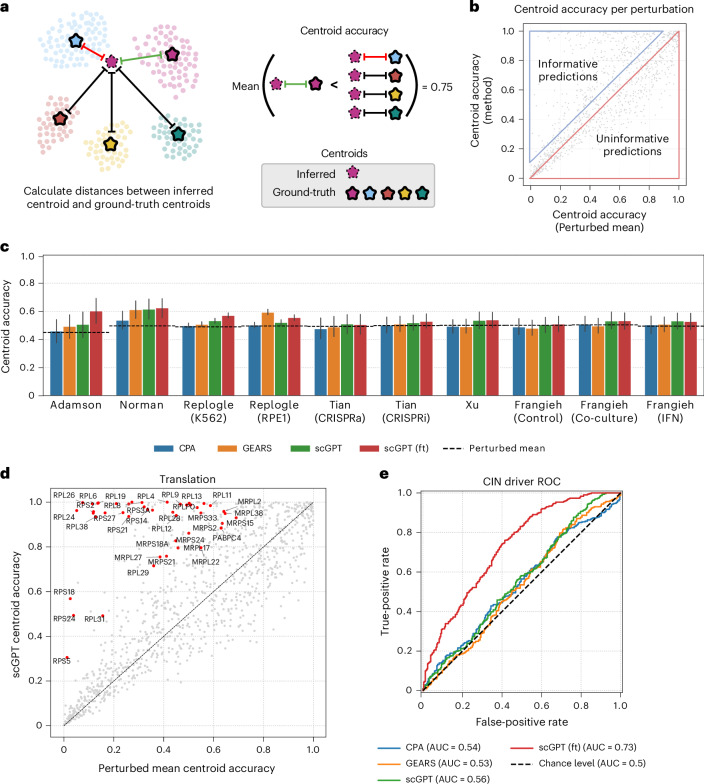
“Nonetheless, the fine-tuned version of scGPT achieved the highest accuracies overall, outperforming other methods in Adamson 13 , Norman 14 , and Replogle 15 (K562) datasets.”
InfluentialGSEApy: a comprehensive package for performing gene set enrichment analysis in Python
Fang, Z., Liu, X., & Peltz, G. (2023) · Bioinformatics · doi:10.1093/bioinformatics/btac757 · Cited by 1,170
Research works printed but not linked: 2
- Hetzel, L. et al. Predicting cellular responses to novel drug perturbations at a single-cell resolution. Adv. Neural Info. Process. Syst. 35, 26711–26722 (2022).
- Lopez, R., Hütter, J. C., Pritchard, J. & Regev, A. Large-scale differentiable causal discovery of factor graphs. Adv. Neural Info. Process. Syst. 35, 19290–303 (2022).
Cited by
Zhu, R., Dann, E., Yan, J., Retana, J. R., Goto, R., Guitche, R. C., Brixi, L., Ota, M., Hartman, A., Roth, T. L., et al. (2026) · Cell · doi:10.1016/j.cell.2026.08.002 · Cited by 58
Interpretation, extrapolation and perturbation of single cells
Dimitrov, D., Schrod, S., Rohbeck, M., & Stegle, O. (2026) · Nature Reviews Genetics · doi:10.1038/s41576-025-00920-4 · Cited by 39
AI Scientists for Building Virtual-Cell ModelsPreprint
Tang, X., Chen, J., Shao, D., Yu, Z., Cui, Y., Wang, W., Wu, F., Zhuang, Y., Shi, W., Huang, Z., et al. (2025) · arXiv (Cornell University) · doi:10.48550/arxiv.2508.02276 · Cited by 35
Wang, C., Karimzadeh, M., Ravindra, N. G., Bounds, L. R., Alerasool, N., Huang, A., Ma, S., Gulbranson, D. R., Cui, H., Lee, Y., et al. (2026) · bioRxiv (Cold Spring Harbor Laboratory) · doi:10.64898/2026.03.18.712807 · Cited by 28
Virtual Cells Need Context, Not Just ScalePreprint
Dibaeinia, P., Babu, S., Knudson, M. K., ElSheikh, A., Wen, Y., Liu, H., Perera, J. F., & Khan, A. A. (2026) · bioRxiv (Cold Spring Harbor Laboratory) · doi:10.64898/2026.02.04.703804 · Cited by 28
A Systematic Comparison of Single-Cell Perturbation Response Prediction Models
Li, L., You, Y., Fu, Y., Liao, W., Fan, X., Lu, S., Cao, Y., Li, B., Ren, W., Kong, J., et al. (2024) · bioRxiv (Cold Spring Harbor Laboratory) · doi:10.1101/2024.12.23.630036 · Cited by 25
scDFM: Distributional Flow Matching Model for Robust Single-Cell Perturbation Prediction
Yu, C., Wang, C., Liao, B., & Wu, T. (2026) · International Conference on Learning Representations · doi:10.48550/arxiv.2602.07103 · Cited by 22
Deep learning perturbation models can outperform baselines on calibrated metrics
Miller, H. E., Mejia, G. M., Leblanc, F. J. A., Swain, B., Wang, B., & de Lima Camillo, L. P. (2026) · Nature Biotechnology · doi:10.1038/s41587-026-03307-w · Cited by 18
Shang, E., Wei, Y., & Roeder, K. (2025) · Proceedings of the National Academy of Sciences · doi:10.1073/pnas.2525268122 · Cited by 18
Conditional Monge Gap enables generalizable single-cell perturbation modelling
Driessen, A., Rajwade, D. A., Harsanyi, B., Rapsomaniki, M., & Born, J. (2026) · Nature Machine Intelligence · doi:10.1038/s42256-026-01242-8 · Cited by 17
Toward generalizable and interpretable AI in regulatory genomics
NAGAI, M., Murphy, A. E., Rizzo, K., & Koo, P. K. (2026) · Nature Genetics · doi:10.1038/s41588-026-02670-3 · Cited by 18
Alsulami, R., Lehmann, R., Khan, S. A., Lagani, V., Maillo, A., Gómez-Cabrero, D., Kiani, N. A., & Tegner, J. N. (2026) · Nature Machine Intelligence · doi:10.1038/s42256-026-01202-2 · Cited by 16
He, C.-J., Zhang, J.-Q., Dahleh, M., & Uhler, C. (2025) · bioRxiv · doi:10.1101/2025.06.27.661992 · Cited by 15
scArchon: a scalable benchmarking framework for assessing single-cell perturbation models
Radig, J., Droit, R., Doncevic, D., Li, A., Bui, D., Herfurth, L., Kühn, T., & Herrmann, C. (2026) · Genome biology · doi:10.1186/s13059-026-04104-z · Cited by 13
Effects of Distance Metrics and Scaling on the Perturbation Discrimination ScorePreprint
Liu, Q., Zhang, Q., Du, J., Zhao, S., & Wang, J. (2025) · arXiv (Cornell University) · doi:10.48550/arxiv.2511.16954 · Cited by 13
Spurious correlation inflates performance in single-cell perturbation predictionPreprint
Nicol, P. B., Shivakumar, S., & Irizarry, R. A. (2026) · bioRxiv (Cold Spring Harbor Laboratory) · doi:10.64898/2026.05.07.723486 · Cited by 11
Trans -eQTLs reveal the architecture of human gene regulatory networksPreprint
Warmerdam, R., Westra, H.-J., van der Graaf, A., Bonder, M. J., Deelen, P., van Lieshout, T., Landman, A. J., Jesse, M., Strober, B. J., Boltz, T. A., et al. (2026) · medRxiv · doi:10.64898/2026.02.04.26343575 · Cited by 11
Signal, Bounds, and Baselines: Principles for Evaluating Virtual Cell Perturbation ModelsPreprint
Vollenweider, M., & Bühlmann, P. (2026) · bioRxiv (Cold Spring Harbor Laboratory) · doi:10.64898/2026.04.20.719650 · Cited by 11
Artificial intelligence in clinical oncology: Multimodal integration and translational development
Lin, R., Zhao, Z., Liu, Z., Kang, J., Zhang, K., Huang, X., & Yu, Y. (2026) · Cancer Letters · doi:10.1016/j.canlet.2026.218493 · Cited by 8
Cell-JEPA: Latent Representation Learning for Single-Cell TranscriptomicsPreprint
ElSheikh, A., Wang, R.-X., Wu, W., Wen, Y., Dibaeinia, P., Zhang, J., Hu, J. Y.-C., Knudson, M. K., Babu, S., Sun, S.-H., et al. (2026) · arXiv (Cornell University) · doi:10.48550/arxiv.2602.02093 · Cited by 8
Benchmarking biomedical foundation models
Sáez-Rodríguez, J., Schäfer, P. S. L., Kalavros, N., & Stolovitzky, G. A. (2026) · Nature Methods · doi:10.1038/s41592-026-03182-y · Cited by 7
Evaluating Single-Cell Perturbation Response Models Is Far from StraightforwardPreprint
Heidari, M., Karimpour, M., Srivatsa, S., & Montazeri, H. (2026) · bioRxiv (Cold Spring Harbor Laboratory) · doi:10.64898/2026.02.14.705879 · Cited by 7
Molina, A., & Zhang, X. (2026) · bioRxiv (Cold Spring Harbor Laboratory) · doi:10.64898/2026.07.24.740459 · Cited by 7
PRESCRIBE: Predicting Single-Cell Responses with Bayesian Estimation
Cheng, J., Chi, C., Zhou, J., Xin, H., & Xia, J. (2025) · neural information processing systems · doi:10.52202/085713-4868 · Cited by 7
Latent causal diffusions for single-cell perturbation modeling
Lorch, L., Zhang, J., Bunne, C., Krause, A., Schölkopf, B., & Uhler, C. (2026) · Proceedings of the National Academy of Sciences · doi:10.1073/pnas.2602630123 · Cited by 7
Noori, A., Fishman, N., Fang, A., Fesser, L., & Žitnik, M. (2026) · Cell · doi:10.1016/j.cell.2026.08.032 · Cited by 6
Li, C., Wei, L., & Zhang, X. (2025) · bioRxiv (Cold Spring Harbor Laboratory) · doi:10.1101/2025.11.13.688367 · Cited by 6
Towards Principled Evaluation of Single-Cell Perturbation Prediction ModelsPreprint
Schäfer, P. S. L., Reid, K. A., Boldyga, Z., Aksu, E. D., Hakem, H., & Sáez-Rodríguez, J. (2026) · bioRxiv (Cold Spring Harbor Laboratory) · doi:10.64898/2026.07.23.740433 · Cited by 6
Benchmarking zero-shot single-cell foundation model embeddings for cellular dynamics reconstructionPreprint
Zhou, X., Wang, Z., Ling, Y., Tian, Q., Zhang, Z., Li, Y., Chen, L., & Zhou, P. (2026) · bioRxiv (Cold Spring Harbor Laboratory) · doi:10.64898/2026.03.10.710748 · Cited by 6
Reliable single-cell perturbations explain and improve model performancePreprint
Wang, X., Kuipers, J., Hugi, F., Platt, R. J., & Beerenwinkel, N. (2026) · bioRxiv (Cold Spring Harbor Laboratory) · doi:10.64898/2026.08.11.744177 · Cited by 5
VCBench: A Multi-Dimensional Benchmark for Single-Cell Foundation ModelsPreprint
Weidener, L., Brkić, M., Jovanović, M., Ulgac, E., & Meduri, A. (2026) · bioRxiv (Cold Spring Harbor Laboratory) · doi:10.64898/2026.06.18.733146 · Cited by 5
STRAND: Sequence-Conditioned Transport for Single-Cell PerturbationsPreprint
Fu, B., Gabbita, S., Dasoulas, G., Lin, X., Gao, S., Su, X., Ghosh, S., & Žitnik, M. (2026) · arXiv (Cornell University) · doi:10.48550/arxiv.2602.10156 · Cited by 4
‘Virtual cells’ aim to turn raw data into predictive models of biology
Eisenstein, M. S. (2026) · Nature · doi:10.1038/d41586-026-01731-1 · Cited by 4
MVCBench: A Multimodal Benchmark for Drug-induced Virtual Cell PhenotypesPreprint
Li, B., Wang, Q., Wang, S., Zhang, B., Peng, Y., Zeng, P., Liu, C., Li, M., Tang, Z., Yao, X., et al. (2026) · bioRxiv (Cold Spring Harbor Laboratory) · doi:10.64898/2026.04.22.720110 · Cited by 4
Co-fluctuations of genes in single cells predict transcriptome-wide outcomes to perturbationsPreprint
Kuznets-Speck, B., Kumari, N., Senthilkumar, I., Jung, J., Rios, H. M. L., Schwartz, L., Sun, H., Anisetti, V. R., Wang, C., Wang, Q., et al. (2025) · bioRxiv (Cold Spring Harbor Laboratory) · doi:10.1101/2025.06.27.661814 · Cited by 4
Kudo, T., Lopez, R., Meireles, A. M., Rios, A., Coelho, P. P., Chandrasekar, V., Lam, D. C., Huetter, J.-C., Ota, M., Rozenblatt–Rosen, O., et al. (2026) · bioRxiv (Cold Spring Harbor Laboratory) · doi:10.64898/2026.05.27.728345 · Cited by 4
Pang, J., Qiu, P. S., He, Y., Deng, Y., Tang, W., Huang, Z., Yan, J., Li, B., Lin, A., Cao, L., et al. (2025) · bioRxiv (Cold Spring Harbor Laboratory) · doi:10.64898/2025.12.29.696804 · Cited by 3
pertTF: context-aware AI modeling for genome-scale and cross-system perturbation predictionPreprint
Su, Y., Liu, D., Menon, V. K., Song, B., Boccara, S., Zhang, N., Zhao, H., Zhao, J. H., Wang, L., Hu, N., et al. (2026) · bioRxiv (Cold Spring Harbor Laboratory) · doi:10.64898/2026.03.12.711379 · Cited by 3
Artificial-intelligence-driven rational design of nanoparticle-mediated targeted protein degradation
Liu, R., Liu, Y., Xia, X., Deng, W., Gallego‐Ortega, D., & Shi, B. (2026) · Cell Biomaterials · doi:10.1016/j.celbio.2026.100443 · Cited by 3
Extrapolation Guarantees for Perturbation Modeling Under the Additive Latent Shift AssumptionPreprint
von Kügelgen, J., Ketterer, J., Vollenweider, M., Scholkemper, M., Shen, X., Meinshausen, N., & Peters, J. (2025) · arXiv (Cornell University) · doi:10.48550/arxiv.2504.18522 · Cited by 3
Kaufmann, L., Breton, L. L., Carraz-Billat, E., Fournier, Q., & Lemieux, S. (2026) · bioRxiv (Cold Spring Harbor Laboratory) · doi:10.64898/2026.09.28.755146 · Cited by 3
SCALE: Scalable Conditional Atlas-Level Endpoint Transport for virtual cell perturbation predictionPreprint
Chen, S., Yu, L., Jin, K., Mao, X., Zhang, S., Gu, X., Xu, S., Xu, S., Jin, K., Bai, L., et al. (2026) · bioRxiv (Cold Spring Harbor Laboratory) · doi:10.64898/2026.03.17.712536 · Cited by 3
Representation learning of single-cell RNA-seq data
Ahlmann-Eltze, C., Barkmann, F., Lause, J., Boeva, V., & Kobak, D. (2026) · RNA · doi:10.1261/rna.080889.125 · Cited by 3
Mechanisms Matter: Transportability of Cellular Perturbation EffectsPreprint
Qi, S.-A., & Chapfuwa, P. (2026) · bioRxiv (Cold Spring Harbor Laboratory) · doi:10.64898/2026.05.08.723625 · Cited by 3
Many Needles in a Haystack: Active Hit Discovery for Perturbation ExperimentsPreprint
Rubbi, A., Merchant, A., Ogden, S., Akbarnejad, A., Lió, P., Vakili, S., & Lotfollahi, M. (2026) · arXiv (Cornell University) · doi:10.48550/arxiv.2605.10196 · Cited by 3
Are Current AI Virtual Cell Models Useful for Scientific Discovery?Preprint
Bereket, M. D., & Leskovec, J. (2026) · bioRxiv (Cold Spring Harbor Laboratory) · doi:10.64898/2026.04.23.719015 · Cited by 2
Multimodal artificial intelligence for predictive and programmable virtual cells
Ramadurai, K. W., & Banerjee, A. (2026) · Trends Open · doi:10.1016/j.treopn.2026.07.007 · Cited by 2
COMPASS: Component-Wise Inference of Shared and Gene-Specific Perturbation ResponsePreprint
Liang, H., & Singh, R. (2026) · bioRxiv (Cold Spring Harbor Laboratory) · doi:10.64898/2026.08.03.742643 · Cited by 2
Demir, A., Anderson, E. W., Jenkins, J. L., & Mukherjee, S. (2026) · arXiv (Cornell University) · doi:10.48550/arxiv.2605.00930 · Cited by 2
On the use of variational autoencoders for biomedical data integration
Avelli, M. P., Medina, R. H., Webel, H. E., & Rasmussen, S. (2026) · BMC Artificial Intelligence · doi:10.1186/s44398-026-00034-9 · Cited by 2
Chen, S., Zahedi, R., Chhuo, L., Nguyen, R., BaghGolshani, M., Beheshti, A., Grosser, M., Yang, M., Farbehi, N., Lovell, N. H., et al. (2026) · arXiv (Cornell University) · doi:10.48550/arxiv.2607.17227 · Cited by 2
OmicsFM brings proteomics into the foundation model eraPreprint
Heyndrickx, S., Gabriels, R., Ramadasan, H., Martens, L., & Claeys, T. (2026) · bioRxiv (Cold Spring Harbor Laboratory) · doi:10.64898/2026.08.25.747021 · Cited by 2
AI-driven framework modeling perturbation in brain organoids reveals candidate genes for autismPreprint
Koh, I. G., Chang, E., Choi, Y. S., Kim, S.-W., Kim, Y., Lee, H., Byeon, G., Ryu, Y., Kim, S., Lee, J., et al. (2026) · bioRxiv (Cold Spring Harbor Laboratory) · doi:10.64898/2026.08.22.746387 · Cited by 2
Bird, J. (2026) · arXiv (Cornell University) · doi:10.48550/arxiv.2608.05359 · Cited by 2
A systematic comparison of single-cell perturbation response prediction models
Li, L., You, Y., Fu, Y., Liao, W., Fan, X., Lu, S., Cao, Y., Li, B., Ren, W., Kong, J., et al. (2026) · Science Advances · doi:10.1126/sciadv.aed3414 · Cited by 1
Evaluating the learnability of single-cell large language models on multiple tasks
Yan, Y., Wang, X., & Song, D. (2026) · doi:10.21203/rs.3.rs-8919408/v1 · Cited by 1
Evaluating the learnability of single-cell large language models on multiple tasks
Yan, Y., Wang, X., & Song, D. (2026) · BMC Genomics · doi:10.1186/s12864-026-12975-6 · Cited by 1
Drug Response Prediction Provides a Biologically Relevant Benchmark for Perturbation Response ModelsPreprint
Brouwer, N., Damyanov, M., Argelo, J., Vis, D. J., Reinders, M. J. T., & Wessels, L. F. A. (2025) · bioRxiv (Cold Spring Harbor Laboratory) · doi:10.64898/2025.12.09.693213 · Cited by 1
Wang, X., Liu, M., Jia, M., Wang, Q., Li, X., Zou, Q., Huang, X., Zhang, L., Lv, X., Wang, J., et al. (2026) · The Innovation Oncology · doi:10.59717/j.xinn-oncol.2026.100027 · Cited by 1
A Multi-modal LLM-Knowledge Fusion Framework for Predicting Single-cell Genetic Perturbation EffectsPreprint
Lu, M., You, N., Zhang, H., Zheng, L., Li, B., Jiang, W., Zhang, Y., Sun, H., & Zhou, Y. (2026) · bioRxiv (Cold Spring Harbor Laboratory) · doi:10.64898/2026.04.24.720560 · Cited by 1
Zhang, J., Schwartz, M. A., Mutaher, M., Olajide, O., Pritykin, Y., Ashenberg, O., Hacohen, N., & Uhler, C. (2026) · bioRxiv (Cold Spring Harbor Laboratory) · doi:10.64898/2026.05.21.726863 · Cited by 1
Charting the computational landscape of single-cell genetic perturbation
Zhang, Y., Huang, J., Li, Y., Liu, T., Ren, L., Huang, J. H., Lin, H., Feng, J., & Zhang, Y. (2026) · Journal of Advanced Research · doi:10.1016/j.jare.2026.06.012 · Cited by 1
Unbalanced Perturbation Dynamics For Cell Fate DesignPreprint
Peng, Q., Wang, Y., Li, J., Wang, X., Xiao, Y., & Zhou, P. (2026) · bioRxiv (Cold Spring Harbor Laboratory) · doi:10.64898/2026.06.30.735555 · Cited by 1
Identifying fate-determining transcription factors with single-cell omics
Xi, X., Li, C., Wei, L., & Zhang, X. (2026) · Trends in Genetics · doi:10.1016/j.tig.2026.05.005 · Cited by 1
Mu, C., Ding, Y., Weiss, A., Rosenfeld, S., Li, F., & Geng, X. (2026) · Biomolecules · doi:10.3390/biom16071054 · Cited by 1
A systematic delineation of 3′UTR regulatory elements and their contextual associations
Liang, N., Li, J., Ding, Y., Wang, Y., Champer, J., Ren, L., & Gao, G. (2026) · Cell Systems · doi:10.1101/2025.06.09.658412 · Cited by 1
Emerging frontiers for AI in single-cell genomics
Mitra, S., Li, J., & Leslie, C. S. (2026) · Molecular Cell · doi:10.1016/j.molcel.2026.09.014 · Cited by 1
scLDM: a conditional diffusion framework for single-cell perturbation prediction
Wu, B., Liu, Y., Cheng, Y., Liu, X., Zou, Q., Wei, L., & Xu, L. (2026) · Bioinformatics · doi:10.1093/bioinformatics/btag727 · Cited by 1
Zeng, Q., Cai, W., Tian, R., Wang, Q., Zhou, D., Pan, M., Yang, H. Y., Liu, Z., Lin, G. N., & Wang, Z. (2026) · bioRxiv (Cold Spring Harbor Laboratory) · doi:10.64898/2026.07.15.738608 · Cited by 1
A split-control criterion for few-shot adaptation in single-cell perturbation predictionPreprint
Liang, W., Yang, Y., Zhang, Q.-Y., Feng, J.-C., Wang, Q., Zou, D., Tang, J., Liu, Y., Wang, S., Duan, J., et al. (2026) · bioRxiv (Cold Spring Harbor Laboratory) · doi:10.64898/2026.10.05.756906 · Cited by 1
AetherCell: A generative engine for virtual cell perturbation and in vivo drug discoveryPreprint
Li, W., Chen, Y., Peng, Z., Xiang, L., Wang, D., & Xie, Z. (2026) · bioRxiv (Cold Spring Harbor Laboratory) · doi:10.64898/2026.03.13.710968 · Cited by 1
RegimeFormer: A Large Protein Model of Global Perturbation RegimesPreprint
Ma, S., Chai, Y., Wu, Y., Zhang, Q., Yuan, Y., Zhao, K., Chen, Z., Wang, H., Cao, S., Yu, X., et al. (2026) · bioRxiv (Cold Spring Harbor Laboratory) · doi:10.64898/2026.08.26.747182 · Cited by 1
Wu, D., Li, M., Zhang, Y., Kumar, A., Lundberg, E. K., Yeung, S. Y., & Fox, E. B. (2026) · arXiv (Cornell University) · doi:10.48550/arxiv.2606.27752 · Cited by 1
Querying Counterfactuals on Tissue Graphs with Supervised DisentanglementPreprint
Moeed, A., Schrod, S., Rohbeck, M., Bonder, M. J., Lutsik, P., Stegle, O., & Dimitrov, D. (2026) · arXiv (Cornell University) · doi:10.48550/arxiv.2606.08493 · Cited by 1
Li, M., Li, B., Zhang, C., Yan, Y., Xu, J., & Tang, Z. (2026) · arXiv (Cornell University) · doi:10.48550/arxiv.2609.27234 · Cited by 1
AmbiModBench: Benchmarking Gene Perturbation Prediction Beyond Shared ResponsesPreprint
Huang, S., Yang, Z., Yu, K., Chen, J., & Li, S. Z. (2026) · arXiv (Cornell University) · doi:10.48550/arxiv.2609.32527 · Cited by 1
Huang, Y. B., Wang, H., & Wilson, P. C. (2026) · bioRxiv (Cold Spring Harbor Laboratory) · doi:10.64898/2026.08.21.746243 · Cited by 1
Li, Q., Chi, Y., Song, L., Zhang, H., Li, J., Xi, X., Wei, C., Sun, Y., Chen, Y., Liu, X., et al. (2026) · arXiv (Cornell University) · doi:10.48550/arxiv.2608.06824 · Cited by 1
Single-cell perturbation prediction near experimental reproducibility with GENESISPreprint
Conci, R., D’Ascenzo, D., di Montesano, S. C., Raghavan, S., Winter, P. S., Allen, E. M. V., Crawford, L. A., & Lotter, W. E. (2026) · bioRxiv (Cold Spring Harbor Laboratory) · doi:10.64898/2026.10.30.763081 · Cited by 1
The recoverable resolution of cellular perturbation-response predictionPreprint
Huang, Y., Wang, H., Li, C., & Wilson, P. C. (2026) · bioRxiv (Cold Spring Harbor Laboratory) · doi:10.64898/2026.09.30.755756 · Cited by 1
Tiwari, K., Mahajan, G., Bellad, R., Dhruw, N. K., & Jha, A. (2026) · doi:10.64898/2026.10.16.759604
“Compounding this, most published benchmarks use generous training fractions of 50–80%, simulating data-rich conditions that bear little resemblance to the few-shot regime practitioners actually operate in [5, 7–9].”
Lin¹, D., Chen², Y., Liu², Y., & Zhang¹, Y. (2026) · Research Square · doi:10.21203/rs.3.rs-10446347/v1
Magnitov, M. D., van der Weide, R. H., Witvliet, A. F., Hernández-Quiles, M., Martinovic, M., Teunissen, H., Braccioli, L., Vermeulen, M., & de Wit, E. (2026) · Nature Communications · doi:10.1038/s41467-026-72392-x
CellTarNet: Robust Single-Cell Perturbation Prediction using Transformer Generative Model
Shankar, S. S. (2026) · ACM International Conference on Bioinformatics, Computational Biology, and Health Informatics (ACM-BCB) · doi:10.1145/3807503.3819992
Romero-Tapiador, S., Rodríguez-Mier, P., Garrido‐Rodríguez, M., Tolosana, R., Morales, A., & Sáez-Rodríguez, J. (2025) · bioRxiv (Cold Spring Harbor Laboratory) · doi:10.1101/2025.09.08.674873
Multiscale transcriptomic organization of the human brain with DigitalBrainPreprint
An, J., Hu, X., Jiang, Y., Jiang, M., Qiu, S., Liu, G., Wei, X., Wang, Y., Lin, J. Q., Wang, C., et al. (2026) · bioRxiv (Cold Spring Harbor Laboratory) · doi:10.64898/2026.04.14.718492
Okano, Y., Ishikawa, T., Sato, Y., Okano, H., & Sakurada, K. (2025) · bioRxiv (Cold Spring Harbor Laboratory) · doi:10.64898/2025.12.28.696309
Zhang, M., Takahashi, D., Benali, Y., & Liu, X. (2025) · Pharmacophore · doi:10.51847/efvx6kqqna
Score Distributions, Not Cells: Evaluating Single-Cell Perturbations Under Class OverlapPreprint
Marrakchi, Y., D’Ascenzo, D., & di Montesano, S. C. (2026) · arXiv (Cornell University) · doi:10.48550/arxiv.2607.04595
Harnessing LLMs to decode genetic perturbations
Gao, Z., & Jiang, R. (2025) · Nature Computational Science · doi:10.1038/s43588-025-00910-w
Clone-level multi-modal prediction of tumour drug responsePreprint
Duchemin, Q., Banos, D. T., Bertolini, A., Ferreira, P., Schill, R., Lienhard, M., Wegmann, R., Snijder, B., Stekhoven, D. J., Beerenwinkel, N., et al. (2026) · bioRxiv (Cold Spring Harbor Laboratory) · doi:10.64898/2026.05.06.723206
Decoding Single-Cell Omics of Perturbation Responses Using DeSCOPEPreprint
Wu, P., Wei, H., Li, Y., Zheng, X., Zhou, C., Hu, X. S., & Wang, C. (2026) · bioRxiv (Cold Spring Harbor Laboratory) · doi:10.64898/2026.04.13.718147
Sun, J., He, Y., Zhu, O., & Chen, Y. T. (2026) · bioRxiv (Cold Spring Harbor Laboratory) · doi:10.64898/2026.07.20.739620
What Makes a Virtual Cell a World Model? Three Gaps, Three Experiments, and a RoadmapPreprint
YU, C., Zhou, J., Tan, C., Li, S. Z., Liu, X., Zhang, X., Zhang, Z., Lei, Z., & Wang, Z. (2026) · Research Square · doi:10.21203/rs.3.rs-10404367/v1
Zha, Y., Lin, D., Chen, Y., Liu, Y., & Zhang, Y. (2026) · Journal of Biomedical Informatics · doi:10.2139/ssrn.7160896
Chem2Gen-Bench: Benchmarking Chemical-to-Genetic Translation in Perturbation Response SpacePreprint
Lin, Y., & Chen, Y. (2026) · arXiv (Cornell University) · doi:10.48550/arxiv.2606.21109
The projection basis determines the information ceiling for perturbation predictionPreprint
Bianco, S. (2026) · bioRxiv (Cold Spring Harbor Laboratory) · doi:10.64898/2026.07.07.737004
Wei, D., Fang, Z., Gao, Q., Yuan, Y., Wang, H., Tan, H., Li, J., Peng, Z., Yang, L., Jin, M., et al. (2026) · Research Square · doi:10.21203/rs.3.rs-10231666/v1
PertDiffBench: Benchmarking Diffusion Models for Single-Cell Perturbation Response PredictionPreprint
Song, Z., Xiang, Y., Song, Z., Jin, W. T., Li, J., Sun, C., & Xie, L. (2026) · bioRxiv (Cold Spring Harbor Laboratory) · doi:10.64898/2026.06.13.732013
A benchmarking framework for perturbational signature recontextualization across biological contextsPreprint
Chen, A., Rappaport, N., Schork, N. J., Girke, T., & Monti, S. (2026) · bioRxiv (Cold Spring Harbor Laboratory) · doi:10.64898/2026.08.14.744937
Metadata
- Authors
- Viñas Torné, R., Wiatrak, M., Piran, Z., Fan, S., Jiang, L., Teichmann, S. A., Nitzan, M., & Brbić, M.
- Affiliations
- Wellcome/MRC Cambridge Stem Cell Institute (GB)
- Hebrew University of Jerusalem (IL)
- École Polytechnique Fédérale de Lausanne (CH)
- Canadian Institute for Advanced Research (CA)
- SIB Swiss Institute of Bioinformatics (CH)
- Corresponding author
- Nitzan, Mor
- Brbić, Maria
- Venue
- Nature Biotechnology
- Published
- 2025-08-25
- Volume
- 44
- Issue
- 6
- Pages
- 1050-1059
- ISSN
- 0733-222X (ISSN-L)
- 1087-0156
- 1546-1696
- PMC
- PMC13271886
- OpenAlex
- W4413495491
- Cited by
- 58
- References
- 33
- Citations by year
- 2026: 49 · 2025: 9
- FWCI
- 17.19
- Type
- journal article
- Language
- en
- Open access
- hybrid
- doi.org
- Licence
- cc-by
- creativecommons.org/licenses/by/4.0 (tdm)
- creativecommons.org/licenses/by/4.0 (vor)
- Locations
- Nature Biotechnology (publishedVersion, cc-by)
- PubMed (publishedVersion)
- PubMed Central (publishedVersion, cc-by)
- Apollo (University of Cambridge) (submittedVersion, cc-by)
- Infoscience (Ecole Polytechnique Fédérale de Lausanne) (submittedVersion)
- Funders
- Schweizerischer Nationalfonds zur Förderung der Wissenschaftlichen Forschung (TMSGI2_226252, IC00I0-231922)
- Peter und Traudl Engelhorn Foundation
- European Union
- Topics
- Life Sciences › Biochemistry, Genetics and Molecular Biology › Molecular Biology › Gene Regulatory Network Analysis
- Life Sciences › Biochemistry, Genetics and Molecular Biology › Molecular Biology › Bioinformatics and Genomic Networks
- Life Sciences › Biochemistry, Genetics and Molecular Biology › Molecular Biology › Genomics and Chromatin Dynamics
- Keywords
- transcriptional response, systematic variation, selection bias, confounding, evaluation framework, performance indicators, CRISPR/Cas9, cell lines
- MeSH terms
- Humans, Gene Expression Profiling, Genomics
About these checks
Registry, retraction, Cites and statistics results are computed, not judged, with one exception: a printed reference that no index lists is read once by a model before it counts as a citation error. Claims are extracted by a model and kept only when their quote appears verbatim in the text; each cited source is then checked, with a model’s help, for whether it says what the claim relies on. Those verdicts can be wrong — read the claim’s quote and the cited source before relying on one.
Statistics and arithmetic are recomputed, not judged.
Confidence bands are shown only for fields calibrated on our annotated test set. None is calibrated yet, so no band is shown.
What counts as a claim ›How we measure confidence ›How we check this ›
Are you an author, or do you see a problem with this page? Request a review
Data sources
Bibliographic data: Semantic Scholar, OpenAlex, Crossref.
Contains information from the Semantic Scholar Academic Graph Datasets, made available under the ODC Attribution License (ODC-BY 1.0).
Semantic Scholar’s data is described in: Kinney, R., et al. (2023). The Semantic Scholar Open Data Platform. arXiv:2301.10140.
