

Swarm learning for decentralized artificial intelligence in cancer histopathology
Open accessPublished version of a preprint
The DOI matches its Crossref record; 58 of the 58 references it cites were found in a registry or an index; 13 of the 25 sources its claims cite were checked for support.
Abstract
Artificial intelligence (AI) can predict the presence of molecular alterations directly from routine histopathology slides. However, training robust AI systems requires large datasets for which data collection faces practical, ethical and legal obstacles. These obstacles could be overcome with swarm learning (SL), in which partners jointly train AI models while avoiding data transfer and monopolistic data governance. Here, we demonstrate the successful use of SL in large, multicentric datasets of gigapixel histopathology images from over 5,000 patients. We show that AI models trained using SL can predict BRAF mutational status and microsatellite instability directly from hematoxylin and eosin (H&E)-stained pathology slides of colorectal cancer. We trained AI models on three patient cohorts from Northern Ireland, Germany and the United States, and validated the prediction performance in two independent datasets from the United Kingdom. Our data show that SL-trained AI models outperform most locally trained models, and perform on par with models that are trained on the merged datasets. In addition, we show that SL-based AI models are data efficient. In the future, SL can be used to train distributed AI models for any histopathology image analysis task, eliminating the need for data transfer.
Overview
CoChat Summary
TL;DR
This retrospective multicentric study shows that swarm learning (SL) can train AI models on decentralized gigapixel histopathology images to predict BRAF mutational status and microsatellite instability in colorectal cancer without transferring patient data. SL models generally outperformed local models and performed on par with centrally merged models, while being data efficient.
Key findings
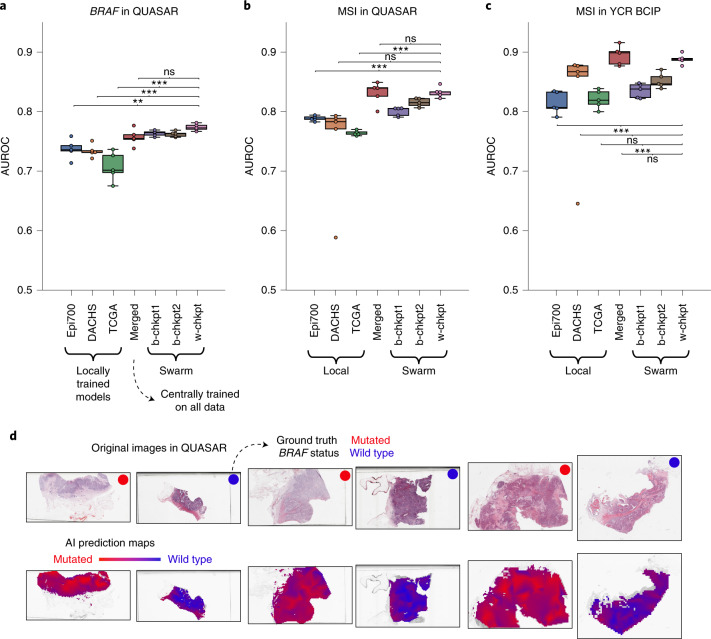
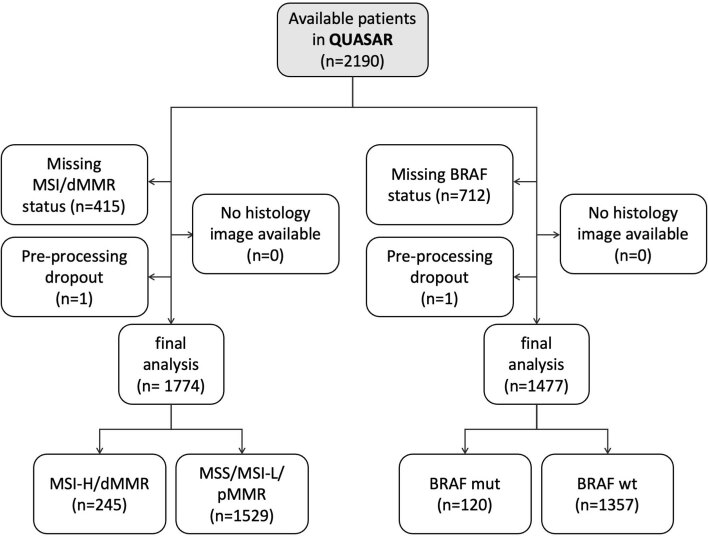
- For BRAF prediction in QUASAR, local models achieved AUROCs of 0.7358 ± 0.0162 (Epi700), 0.7339 ± 0.0107 (DACHS) and 0.7071 ± 0.0243 (TCGA); the merged model reached 0.7567 ± 0.0139. SL models b-chkpt1, b-chkpt2 and weighted w-chkpt achieved 0.7634 ± 0.0047, 0.7621 ± 0.0045 and 0.7736 ± 0.0057, respectively, with w-chkpt significantly better than the merged model (P = 0.0374).
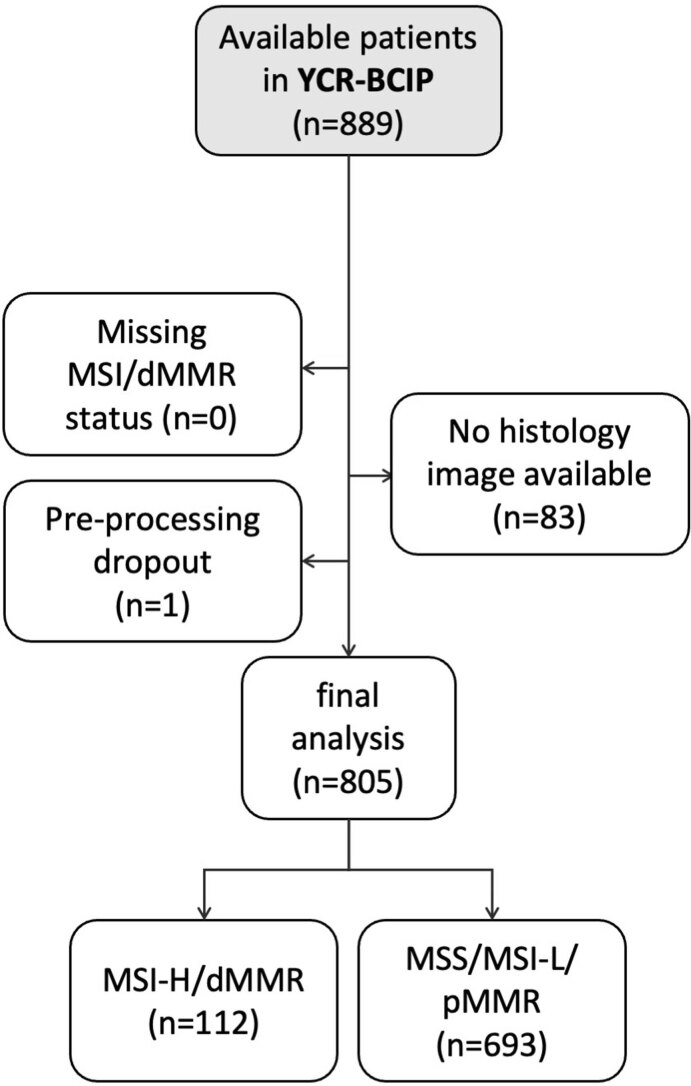
- For MSI prediction in QUASAR, b-chkpt1 and b-chkpt2 achieved AUROCs of 0.8001 ± 0.0073 and 0.8151 ± 0.0071, outperforming local Epi700 (0.7884 ± 0.0043) and TCGA (0.7639 ± 0.0162); w-chkpt was on par with the merged model (0.8326 ± 0.0089 vs 0.8308 ± 0.0190, P = 0.8650). In YCR BCIP, merged and w-chkpt were also on par (0.8943 ± 0.0161 vs 0.8882 ± 0.0084, P = 0.4647).
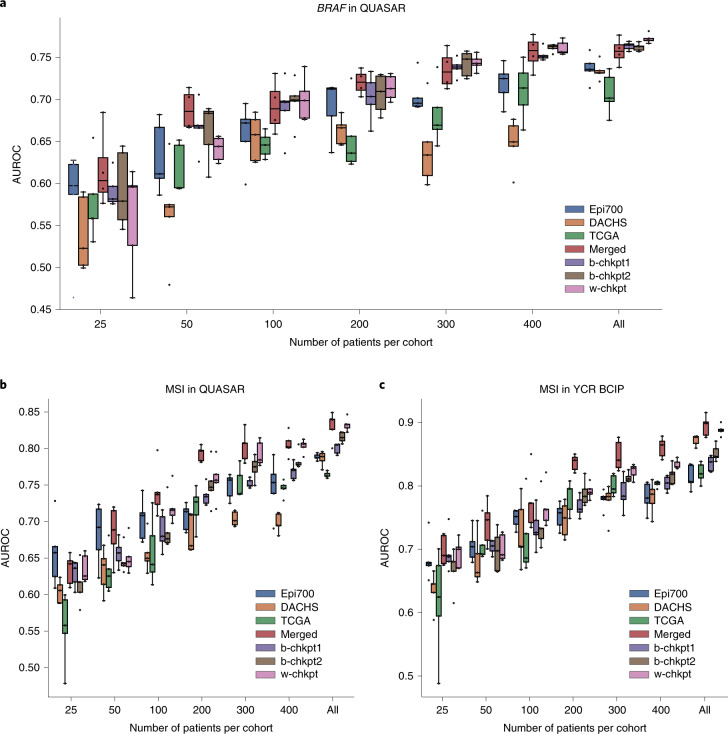
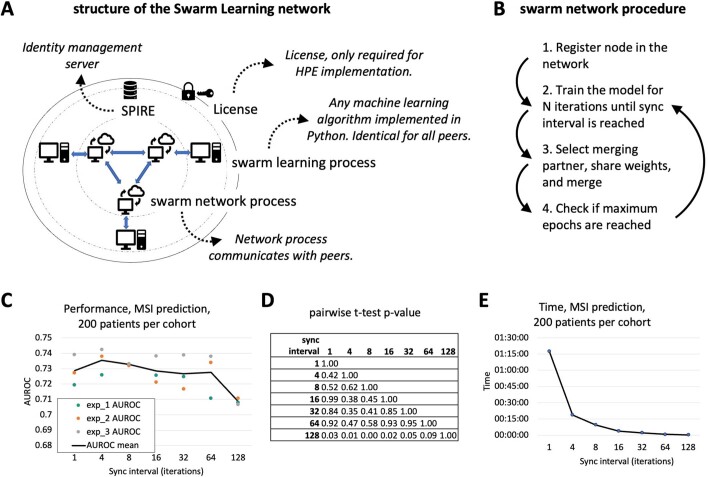
- SL was data efficient: for BRAF, w-chkpt maintained AUROCs of 0.7000 ± 0.0260 at 100 patients, 0.7139 ± 0.0149 at 200 and 0.7438 ± 0.0093 at 300 patients per cohort, not significantly different from the merged model; for MSI, w-chkpt was comparable to merged down to 300 patients per cohort, but merged outperformed swarm models at ≤200 patients.
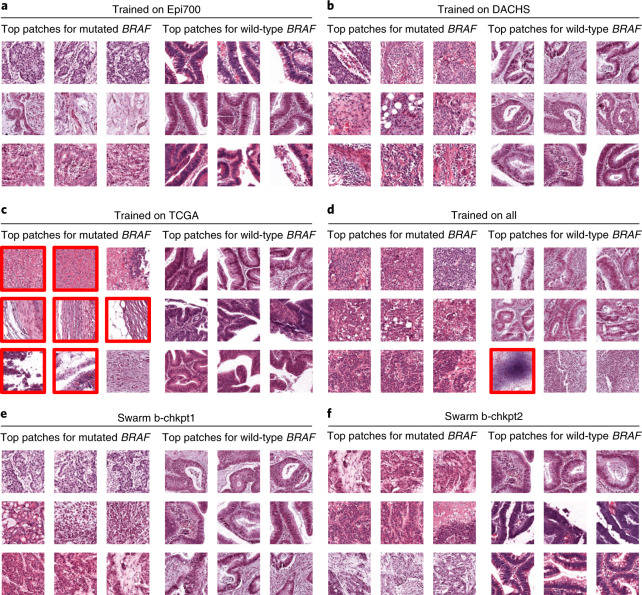
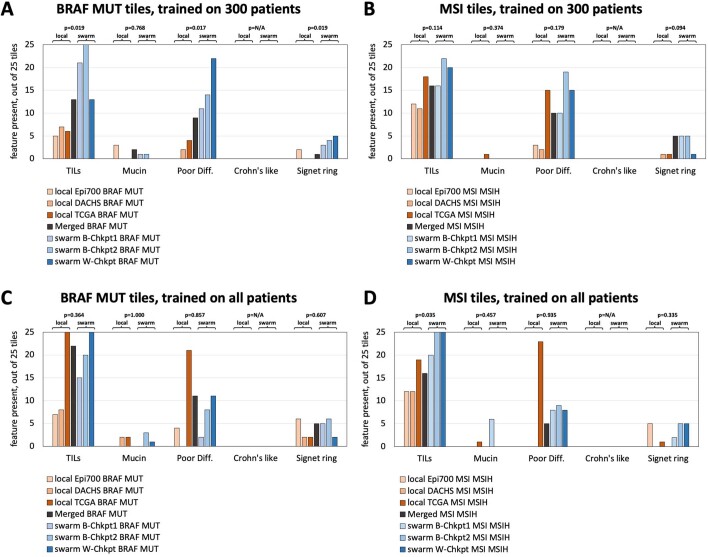
- In a blinded reader study, for BRAF models trained on 300 patients per cohort, TILs (P = 0.019), poor differentiation (P = 0.017) and signet ring cells (P = 0.019) were significantly more frequent in tiles selected by swarm-trained models than by locally trained models.
Methods
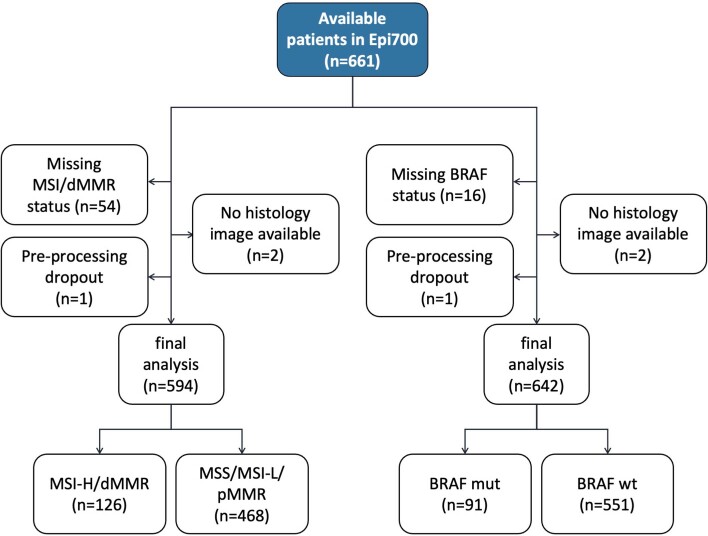
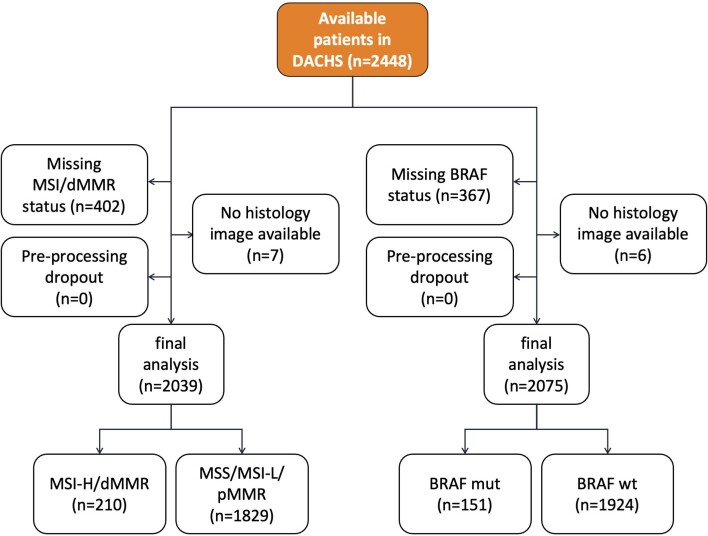
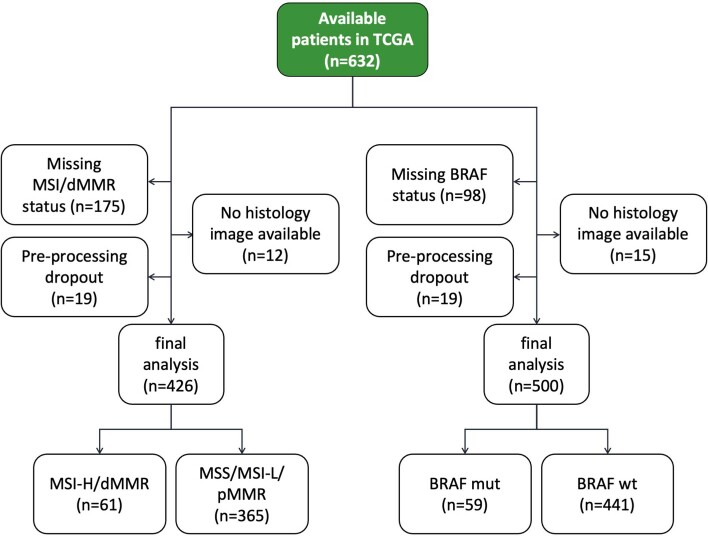
- Retrospective multicentric study using five colorectal cancer cohorts: training cohorts Epi700 (n = 661, Northern Ireland), DACHS (n = 2,448, Germany) and TCGA (n = 632, largely United States); test cohorts QUASAR (clinical trial cohort) and YCR BCIP (n = 889, United Kingdom). Ground-truth BRAF and MSI/dMMR status was determined by cohort-specific methods including PCR, immunohistochemistry and sequencing.
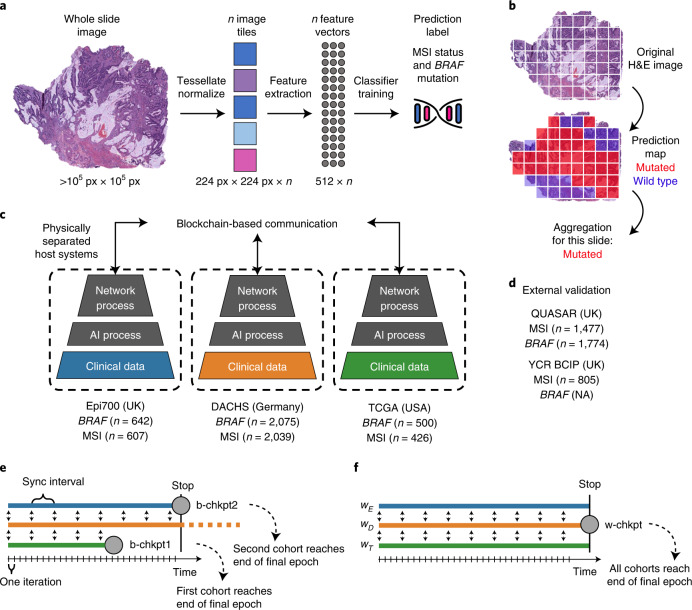
- Whole-slide images were tessellated into 512 × 512 × 3 patches, color-normalized, and filtered for blur/no tissue; ResNet-18 extracted a 512 × 1 feature vector from 150 randomly selected patches per patient, followed by a fully connected classifier. SL used the HPE implementation on three physically separate servers with blockchain-based coordination; basic and weighted SL checkpoints were compared. AUROC was the primary metric, experiments were repeated five times, and two-sided unpaired t-tests with P ≤ 0.05 were used.
Limitations
- Stated: differential privacy was not explicitly investigated; model performance needs further improvement before clinical implementation; previous work suggests approximately 10,000 patients may be needed for further gains; embedding SL servers in existing healthcare infrastructure across countries would require substantial practical efforts; large-scale international validation is needed.
- Evident: all statistical comparisons used two-sided t-tests without correction for multiple testing; only one model and one hyperparameter set were evaluated; synchronization interval optimization was tested only on the QUASAR MSI/dMMR task; BRAF status was not assessed in YCR BCIP because BRAF testing there was performed only in MSI/dMMR cases.
Model-written summary. Check it against the paper before relying on it.
Integrity signals
Registry
Cites
Statistics
Figures
Verification
Claims the paper makes
7 Valid · 1 Not valid · 8 Not checked · 56 Own results and interpretations
The cited sources support only part of this claim — read each source’s verdict below.
In the paper
“However, training robust AI systems requires large datasets for which data collection faces practical, ethical and legal obstacles.”
- Also stated in: § A · plain
“AI models are data hungry.In histopathology, the performance of AI models increases with the size and diversity of the training set 16,19,20 .”
What the sources say
- Partly supportedcites [16] Muti, H. S. et al. Development and validation of deep learning classifiers to detect Epstein-Barr virus and microsatellite instability status in gastric cancer: a retrospective multicentre cohort study. Lancet Digit. Health 3, E654-E664 (2021). sourceExperimental — accuracy not yet measured
The Discussion (page not available) finds that classifiers trained on a large, diverse dataset performed better and concludes that diverse cohorts are necessary for consistently high validation performance in gastric cancer. This supports the large-dataset point in that setting, but the paper does not establish it for AI systems generally or identify practical, ethical, and legal obstacles to collecting such data. The Data availability section (page not available) describes sharing restrictions, without characterising them as those three kinds of obstacle. (LLM, conf=0.84)
- Supportedcites [19] Campanella, G. et al. Clinical-grade computational pathology using weakly supervised deep learning on whole slide images. Nat. Med. 25, 1301-1309 (2019). source
The Results section, under “Dataset size dependence of classification accuracy,” reports that larger training datasets could further improve performance and that, in general, at least 10,000 slides were needed for good performance. The paper establishes this point for clinical computational pathology; it does not establish a dataset-size threshold for every kind of AI system. (LLM, conf=0.88)
- Supportedcites [20] Echle, A. et al. Clinical-grade detection of microsatellite instability in colorectal tumors by deep learning. Gastroenterology 159, 1406-1416.E11 (2020). source
In “Increasing Patient Number Compensates for Batch Effects and Improves Performance,” the paper says that larger training datasets yield more robust classifiers and reports improved performance as patient numbers increased. The “Context: Multicenter Validation of Deep Learning Biomarkers” section also identifies a need for very large patient series. (LLM, conf=0.92)
plainstates a cause- Asserted: passes — The authors put it forward as true.
- Checkable: passes — It can be checked against evidence.
- Load-bearing: passes — The paper’s conclusions depend on it.
- Based: passes — The paper gives a reason why it holds.
- Also stated in: § A · plain
The cited sources support only part of this claim — read each source’s verdict below.
In the paper
“Qualitatively, we found that in many cases there was a histological phenotype known to be associated with either BRAF mutational status or MSI/ dMMR, such as mucinous histology and/or poor differentiation 30,31 .”
What the sources say
- Supportedcites [30] Shia, J. et al. Morphological characterization of colorectal cancers in The Cancer Genome Atlas reveals distinct morphology-molecular associations: clinical and biological implications. Mod. Pathol. 30, 599-609 (2017). source
Shia et al. (2017) establishes exactly these morphology–molecular links: in the Results ('Mucinous histology was associated with frequent alterations in BRAF, PIK3CA, and the TGF-β pathway genes among MSI-H and non-MSI-H cancers') mucinous histology was significantly associated with BRAF mutations (P < 0.001 overall; P < 0.02 in non-MSI-H), and 86% of mucinous tumors carried alterations in BRAF/PIK3CA/SMAD2/SMAD4 vs 26% of non-mucinous (Results, p. 599-609 passage). For MSI/dMMR, 'The Spectrum of Tumor Morphological Patterns' defines the characteristic 'MSI-H histology' as mucinous features (39% vs 10%), medullary/medullary-like morphology (21% vs 0%) and increased TILs (57% vs 5%, P < 0.001), and Table 1 lists poorly differentiated tumors at 14% of MSI-H vs 2% of non-MSI-H within the significant histology-type difference (P < 0.001), with poorly differentiated/solid-growth tumors showing the highest mononucleotide frameshift mutation counts in MSI-H (Table 2). The claim's disjunction ('either BRAF mutational status or MSI/dMMR') is therefore covered by the source for both mucinous histology and poor differentiation. (LLM, conf=0.82)
- Partly supportedcites [31] Greenson, J. K. et al. Pathologic predictors of microsatellite instability in colorectal cancer. Am. J. Surg. Pathol. 33, 126-133 (2009). sourceExperimental — accuracy not yet measured
Greenson et al. (2009) squarely supports the MSI/dMMR half of the attributed association: the Introduction lists mucinous and poorly differentiated tumors as 'more likely to be MSI-H', and the Abstract/Results (Tables 1 and 3) report any mucinous differentiation and well-or-poor differentiation as independent predictors of MSI-H (OR 1.728 and 3.408 multivariate). However, no passage of our copy links these phenotypes to BRAF mutational status — the paper's molecular framing is sporadic hMLH1 promoter methylation versus germline mismatch-repair mutations (Introduction), and BRAF is not mentioned anywhere in the text or reference list I retrieved (searched: BRAF/V600E, hMLH1 methylation, CpG). The 'BRAF mutational status' limb of the claim is therefore unsupported by this source (it may come from the co-cited reference). The citing authors' own observation about their highly scoring patches is their conclusion, not judged here. (LLM, conf=0.75)
plainstates an association- Asserted: passes — The authors put it forward as true.
- Checkable: passes — It can be checked against evidence.
- Load-bearing: passes — The paper’s conclusions depend on it.
- Based: passes — The paper gives a reason why it holds.
- Supported
Every source the paper cites for this claim was checked and supports it.
In the paper
“These ground truth diagnostic methods are the clinical state of the art in determining MSI/dMMR status 50 .”
What the sources say
- Supportedcites [50] West, N. P. et al. Lynch syndrome screening in colorectal cancer: results of a prospective 2-year regional programme validating the NICE diagnostics guidance pathway throughout a 5.2-million population. Histopathology 79, 690-699 (2021). source
The Testing Pathway (p. 3) describes four-protein MMR immunohistochemistry, followed where indicated by BRAF mutation and MLH1 promoter methylation testing. The Discussion (pp. 4, 6) identifies this as the NICE DG27 clinical screening pathway and explains why IHC was chosen over MSI testing. This supports describing the methods as clinically established for determining dMMR status. (LLM, conf=0.86)
plain- Asserted: passes — The authors put it forward as true.
- Checkable: passes — It can be checked against evidence.
- Load-bearing: passes — The paper’s conclusions depend on it.
- Based: passes — The paper gives a reason why it holds.
- Supported
Every source the paper cites for this claim was checked and supports it.
In the paper
“For prediction of molecular features from image data, we adapted our weakly supervised end-to-end prediction pipeline, which outperformed similar approaches for mutation prediction in a recent benchmark study 52 .”
What the sources say
- Supportedcites [52] Laleh, N. G. et al. Benchmarking artificial intelligence methods for end-to-end computational pathology. Preprint at https://www.biorxiv.org/cont ent/10.1101/2021.08.09.455633v1 (2021). source
The Discussion passage (section heading fragment ', 5, 6 and 7).') states that 'classical weakly supervised workflows (in which all tiles inherit the slide label) markedly outperformed MIL-based workflows' and advises choosing classical weakly supervised rather than MIL-based workflows for mutation prediction tasks. The 'Overall assessment of classifier performance for mutation prediction' section corroborates this: ResNet and ViT — the weakly supervised end-to-end models per Figure 2 — were never significantly outperformed across the 20 mutation-prediction comparisons, while classical MIL and CLAM were outperformed in 13/20 and 7/20 tasks respectively. Minor caveat: in the within-cohort gastric MSI and bladder FGFR3 experiments CLAM reached the highest AUROC ('Prediction of molecular alterations in gastric and bladder cancer'), but the paper's overall conclusion for mutation prediction matches the claim. (LLM, conf=0.85)
plainstates a cause- Asserted: passes — The authors put it forward as true.
- Checkable: passes — It can be checked against evidence.
- Load-bearing: unclear — It is unclear whether the paper’s conclusions depend on it.
- Based: passes — The paper gives a reason why it holds.
- Supported
A result the paper reports from its own data — it cites no other source for it, so there is none to check. The quote shows it is in the paper.
In the paper
“Strikingly, SL was also able to rescue the performance: down to 100 patients per cohort, weighted SL (w-chkpt) maintained a high performance with AUROCs of 0.7000 ± 0.0260 for 100 patients, 0.7139 ± 0.0149 for 200 patients and 0.7438 ± 0.0093 for 300 patients.”
boostedstates an associationn = 100- Asserted: passes — The authors put it forward as true.
- Checkable: passes — It can be checked against evidence.
- Load-bearing: passes — The paper’s conclusions depend on it.
- Based: passes — The paper gives a reason why it holds.
27 more claims
Create a free account to see all 72 claims and to verify the 12 references still open.
- Probably not a substantial claim. 21
- It may state two separate claims as one. 23
- The quote only partly states this claim. 1
Claims other papers make about this one
Each is checked against this paper’s own text: does it say what the citing paper says it does?
The cited source says what the claim attributes to it.
In the citing paper
“One of the possible solutions to overcome this barrier to data accessibility in research is to utilise federated or swarm learning.114”
From Use of artificial intelligence for liver diseases: A survey from the EASL congress 2024 (2024) · cites this paper as [114]
In the citing paper
“These approaches allow models to be trained across multiple centres without the need to share sensitive patient data, thereby respecting privacy and regulatory constraints.”
From Use of artificial intelligence for liver diseases: A survey from the EASL congress 2024 (2024) · cites this paper as [114]
In the citing paper
“The third option is federated learning (FL), where data remain private at each institution, but machine learning models are jointly updated and shared in a distributed fashion (166, 167).”
From Artificial Intelligence in Oncology: Current Landscape, Challenges, and Future Directions (2024) · cites this paper as [167]
Self-check
Percentages, sums and reported differences re-computed from the paper’s own numbers.
Each contradiction between two passages listed here was confirmed by an independent check.
Rated major: it would touch a result — a value a result rests on, reported and recomputed p-values on opposite sides of the significance level, two passages that conflict with no sign which is right, or a cited work retracted before this paper was published.
In the paper
§ SL models can predict microsatellite instability.
“DACHS AUROC = 0.8326 ± 0.0090 vs w-chkpt AUROC = 0.7403 ± 0.0878, P = 0.05705”
§ SL models can predict microsatellite instability.
“merged AUROC = 0.8308 ± 0.0190 vs w-chkpt AUROC = 0.8326 ± 0.0089, P = 0.8650”
Rated minor: it would not touch a result — a value no result rests on, a p-value that stays on the same side of the significance level, or a conflict that is clerical, resolved elsewhere in the paper, or outside its own findings.
In the paper
§ SL models can predict BRAF mutational status.
“We evaluated the patient-level performance for prediction of BRAF mutational status on the QUASAR cohort (n = 1,774 patients from the United Kingdom; Extended Data Fig. 5).”
§ Extended Data
“Total cohort size (number of patients, for BRAF mutational status) in the test set is 1,477 for QUASAR.”
Rated minor: it would not touch a result — a value no result rests on, a p-value that stays on the same side of the significance level, or a conflict that is clerical, resolved elsewhere in the paper, or outside its own findings.
In the paper
“Wild-type BRAF 471 (74.5%) 1,930 (78.8%) 553 (83.7%) 32 (3.6% a ) 1,358 (62%) Mutated BRAF 63 (10%) 151 (6.2%) 92 (13.9%) 75 (8.4% a ) 129 (5.9%) Unknown BRAF status 98 (15.5%) 367 (15%) 16 (2.4%)782 (88%) 916 (41.8%)”
Reported 2190 · recomputed 2403
Citations
Cites
Federated Learning: Strategies for Improving Communication Efficiency
Konečný, J., McMahan, H. B., Yu, F. X., Richtárik, P., Suresh, A. T., & Bacon, D. (2016) · arXiv · doi:10.48550/arxiv.1610.05492 · Cited by 3,766
Coudray, N., Ocampo, P. S., Sakellaropoulos, T., Narula, N., Snuderl, M., Fenyö, D., Moreira, A. L., Razavian, N., & Tsirigos, A. (2018) · Nature Medicine · doi:10.1038/s41591-018-0177-5 · Cited by 2,930
Clinical-grade computational pathology using weakly supervised deep learning on whole slide images
Campanella, G., Hanna, M. G., Geneslaw, L., Miraflor, A., Werneck Krauss Silva, V., Busam, K. J., Brogi, E., Reuter, V. E., Klimstra, D. S., & Fuchs, T. J. (2019) · Nature Medicine · doi:10.1038/s41591-019-0508-1 · Cited by 2,799 · cited 2×
“Brinker (13), Jenny Chang-Claude (14,15), Firas Khader (16), Andreas Schuppert (17), Tom Luedde (18), Sebastian Foersch (19), Hannah Sophie Muti (1), Christian Trautwein (1), Michael Hoffmeister (9), Daniel Truhn (16), Jakob Nikolas Kather (1,2,12,20)”
BackgroundSecure, privacy-preserving and federated machine learning in medical imaging
Kaissis, G. A., Makowski, M. R., Rückert, D., & Braren, R. F. (2020) · Nature Machine Intelligence · doi:10.1038/s42256-020-0186-1 · Cited by 1,676 · cited 1×
“46 Another limitation of this work is that the model performance needs to be further improved before clinical implementation.”
BackgroundA method for normalizing histology slides for quantitative analysis
Macenko, M., Niethammer, M., Marron, J. S., Borland, D., Woosley, J. T., Guan, X., Schmitt, C., & Thomas, N. E. (2009) · 2009 IEEE International Symposium on Biomedical Imaging: From Nano to Macro · doi:10.1109/isbi.2009.5193250 · Cited by 1,482 · cited 1×
“38 During this process, blurry patches and patches with no tissue are removed from the data set using canny edge detection in OpenCV.”
MethodKather, J. N., Pearson, A. T., Halama, N., Jäger, D., Krause, J., Loosen, S. H., Marx, A., Boor, P., Tacke, F., Neumann, U. P., et al. (2019) · Nature Medicine · doi:10.1038/s41591-019-0462-y · Cited by 1,458
Self-citationAdjuvant chemotherapy versus observation in patients with colorectal cancer: a randomised study
QUASAR Collaborative Group (2007) · The Lancet · doi:10.1016/s0140-6736(07)61866-2 · Cited by 1,437
Moher, D., Schulz, K. F., Altman, D. G., & for the CONSORT Group* (2001) · Annals of Internal Medicine · doi:10.7326/0003-4819-134-8-200104170-00011 · Cited by 1,426
Benjamens, S., Dhunnoo, P., & Meskó, B. (2020) · npj Digital Medicine · doi:10.1038/s41746-020-00324-0 · Cited by 1,215
Swarm Learning for decentralized and confidential clinical machine learning
Warnat-Herresthal, S., Schultze, H., Shastry, K. L., Manamohan, S., Mukherjee, S., Garg, V., Sarveswara, R., Händler, K., Pickkers, P., Aziz, N. A., et al. (2021) · Nature · doi:10.1038/s41586-021-03583-3 · Cited by 884 · cited 2×
“26 In SL, AI models are trained locally and models are combined centrally without requiring central coordination.”
BackgroundMethod
Research works printed but not linked: 1
- McMahan, B., Moore, E., Ramage, D., Hampson, S. & Arcas, B. A. Y. Communication-efficient learning of deep networks from decentralized data. In Proc. 20th Int. Conf. Artif. Intell. Stat. Vol. 54 (Eds. Singh, A. & Zhu, J.) 1273-1282 (PMLR, 2017).
Cited by
Items 101–200 of 256
Swarm Learning-based Secure and Fair Model Sharing for Metaverse Healthcare
Zhang, G., Dai, Y., Wu, J., Zhu, X., & Lu, Y. (2023) · Mobile Networks and Applications · doi:10.1007/s11036-023-02236-1 · Cited by 14
Fed-BioMed: Open, Transparent and Trusted Federated Learning for Real-world Healthcare Applications
Cremonesi, F., Vesin, M., Cansiz, S., Bouillard, Y., Balelli, I., Innocenti, L., Taiello, R., Silva, S., Ayed, S.-S., Önen, M., et al. (2025) · Studies in Computational Intelligence · doi:10.1007/978-3-031-78841-3_2 · Cited by 13
Computational pathology: an evolving concept
Prassas, I., Clarke, B. A., Youssef, T., Phlamon, J., Dimitrakopoulos, L., Rofaeil, A., & Yousef, G. M. (2024) · Clinical Chemistry and Laboratory Medicine (CCLM) · doi:10.1515/cclm-2023-1124 · Cited by 13
Backpack Client Selection Keeping Swarm Learning in Industrial Digital Twins for Wireless Mapping
Wei, X., Su, N., Guo, Y., & Zhao, P. (2025) · Electronics · doi:10.3390/electronics14122323 · Cited by 13
Chatterji, S., Niehues, J. M., van Treeck, M., Loeffler, C. M. L., Saldanha, O. L., Veldhuizen, G. P., Çifçi, D., Carrero, Z. I., Eid, R. A., Speirs, V., et al. (2023) · npj Breast Cancer · doi:10.1038/s41523-023-00599-y · Cited by 13
Self-citationSwarm learning for decentralized healthcare
Becker, M. (2022) · Der Hautarzt · doi:10.1007/s00105-021-04940-z · Cited by 13
Baker, S., & Xiang, W. (2023) · arXiv · doi:10.48550/arxiv.2312.01555 · Cited by 12
“Another key approach for preserving privacy was distributed learning, both in federated [115] and swarm learning structures [124], where local models are trained on private data, shared securely, and then aggregated into a final model for the end-user.”
BackgroundMethodInfluentialXie, Y., Chen, X., Yang, H., Wang, H., Zhou, H., Lu, L., Zhang, J., Liu, P., & Ye, Z. (2025) · European Journal of Trauma and Emergency Surgery · doi:10.1007/s00068-025-02793-y · Cited by 12
Diniz, J. M., Vasconcelos, H., Rb-Silva, R., Ameijeiras-Rodriguez, C., Rodrigues, D., Ramos, P., Tomás, A., Gao, Y., Souza, J., & Freitas, A. (2026) · npj Digital Medicine · doi:10.1038/s41746-025-02329-z · Cited by 11
Wang, Z., & Guo, Z. (2023) · Chinese Journal of Integrative Medicine · doi:10.1007/s11655-023-3639-7 · Cited by 11
He, T., Han, P., Duan, S., Wang, Z., Wu, W., Liu, C., & Han, J. (2024) · Future Generation Computer Systems · doi:10.1016/j.future.2024.05.048 · Cited by 11
Artificial intelligence in current undergraduate medical education
y Humanismo., M. N. S. I. D. L. S. V. D. H. D. L. M. I. D. C. D. L. A. D. M. Y. M. D. S. C. D. C. B. Y. D. C., & Reverón, R. R. (2024) · Gaceta Médica de Caracas · doi:10.47307/gmc.2024.132.2.24 · Cited by 11
Generative Data Augmentation for Non-IID Problem in Decentralized Clinical Machine Learning
Wang, Z., Duan, S., Wu, C., Lin, W., Zha, X., Han, P., & Liu, C. (2022) · International Conference on Data Intelligence and Security (ICDIS) · doi:10.1109/icdis55630.2022.00058 · Cited by 11
Prospects and challenges of deep learning in gynecologic malignancies
Zhang, Y., & Zeng, L. (2025) · Frontiers in Oncology · doi:10.3389/fonc.2025.1592078 · Cited by 10
AI-based neoadjuvant immunotherapy response prediction across pan-cancer: a comprehensive review
Deng, Y., Li, T., Wang, Y., Chen, S., Tang, F., Zhu, T., Ran, J., Yang, B., Zhang, X., Xu, R., et al. (2025) · Cancer Cell International · doi:10.1186/s12935-025-04063-8 · Cited by 12
Building Trust in Medical Use of Artificial Intelligence – The Swarm Learning Principle
Schultze, J. L. (2023) · Journal of CME · doi:10.1080/28338073.2022.2162202 · Cited by 10
Swarm Learning Empowered Federated Deep Learning for Seamless Smartphone-Based Activity Recognition
Jamil, H., Jian, Y., Jamil, F., & Ahmad, S. (2024) · IEEE Transactions on Consumer Electronics · doi:10.1109/tce.2024.3479078 · Cited by 10
Medical imaging-based artificial intelligence in pneumonia: A narrative review
Yang, Y., Xing, W., Liu, Y., Li, Y., Ta, D., Song, Y., & Hou, D. (2025) · Neurocomputing · doi:10.1016/j.neucom.2025.129731 · Cited by 10
Computational pathology for breast cancer: Where do we stand for prognostic applications?
Gessain, G., & Lacroix‐Triki, M. (2025) · The Breast · doi:10.1016/j.breast.2025.104464 · Cited by 10
A General-Purpose AI Assistant Embedded in an Open-Source Radiology Information System
Purkayastha, S., Isaac, R., Anthony, S., Shukla, S., Krupinski, E. A., Danish, J. A., & Gichoya, J. W. (2023) · Lecture notes in computer science · doi:10.1007/978-3-031-34344-5_46 · Cited by 9
Review of Mathematical Optimization in Federated Learning
Yang, S., Zhao, F., Zhou, Z., Shi, L., Ren, X., & Xu, A. Z. (2025) · CSIAM Transactions on Applied Mathematics · doi:10.4208//csiam-am.so-2024-0023 · Cited by 9
Wu, J., Yan, D., Du, X., Wu, C., Lin, X., Xu, B., Xu, Y. C., Ye, J., & Shen, Y. (2025) · Acta Pharmaceutica Sinica B · doi:10.1016/j.apsb.2025.06.010 · Cited by 9
RetractedMakhlouf, Y., Singh, V. K., Craig, S. G., McArdle, A., French, D., Loughrey, M. B., Oliver, N., Acevedo, J. B., O’Reilly, P. G., James, J. A., et al. (2023) · Computational and Structural Biotechnology Journal · doi:10.1016/j.csbj.2023.11.048 · Cited by 9
Self-citationVirtual Histological Staining as a Tool for Extending Renal Segmentation Across Stains
Denholm, J., Hamidinekoo, A., Burlutskiy, N., Setyo, L. C., Zhang, I., Yousefi, F., Mortimer, J., Huix, J. P., Bagnall, C. J., Lewis, A. R., et al. (2025) · Modern Pathology · doi:10.1016/j.modpat.2025.100842 · Cited by 8
Recent advances and future prospects for blockchain in biomedicine
Ni, E., Tang, X., Zhou, X., Lee, D. H., Elhussein, A., Knight, E., Gürsoy, G., & Gerstein, M. (2025) · Cell Reports Methods · doi:10.1016/j.crmeth.2025.101114 · Cited by 8
Sweileh, M. W. (2025) · Digital Health · doi:10.1177/20552076251393286 · Cited by 8
Aligning computational pathology with clinical practice for colorectal cancer
Baumann, E., Carreño-Martínez, J. F., Frei, A. L., García-Baroja, J., Gwerder, M., Khan, A., Mehmeti, R., Hanimann, J., Zens, P., Dawson, H., et al. (2025) · npj Precision Oncology · doi:10.1038/s41698-025-01119-w · Cited by 8
Bahaa, S., Ramadan, O., Darwish, Z. E., El-Fiky, E. A., & Saleh, M. S. E. (2025) · BMC Oral Health · doi:10.1186/s12903-025-07482-1 · Cited by 8
Thompson, N., Morley-Bunker, A. E., Mclauchlan, J., Glyn, T., & Eglinton, T. (2024) · BJS Open · doi:10.1093/bjsopen/zrae033 · Cited by 9
Engel, B., Assis, D. N., Bhat, M., Clusmann, J., Drenth, J. P. H., Gerussi, A., Londoño, M., Oo, Y. H., Schregel, I., Sebode, M., et al. (2024) · JHEP Reports · doi:10.1016/j.jhepr.2024.101265 · Cited by 8
Wu, Y., Ji, Y., Lee, S., Akram, J., Braytee, A., & Anaissi, A. (2025) · Lecture notes in computer science · doi:10.1007/978-3-031-97635-3_27 · Cited by 8
Shao, Z., Dai, L., Jonnagaddala, J., Chen, Y., Wang, Y., Fang, Z., & Zhang, Y. (2023) · JCO Clinical Cancer Informatics · doi:10.1200/cci.22.00178 · Cited by 8
Lecuelle, J., Truntzer, C., Basile, D., Laghi, L., Greco, L., Ilie, A., Rageot, D., Emile, J., Bibeau, F., Taïeb, J., et al. (2024) · EBioMedicine · doi:10.1016/j.ebiom.2024.105207 · Cited by 8
Recent advances in artificial intelligence-assisted endocrinology and diabetes
Oikonomakos, I. T., Anjana, R. M., Mohan, V., Steenblock, C., & Bornstein, S. R. (2024) · doi:10.37349/eemd.2023.00004 · Cited by 10
Xu, L., Chen, Y., Chen, Y., Nie, L., Wei, X., Xue, L., & Zhang, D. (2024) · Applied Energy · doi:10.1016/j.apenergy.2024.125053 · Cited by 7
Brickman, A., Baykara, Y., Carabaño, M., & Hacking, S. M. (2023) · Journal of Pathology Informatics · doi:10.1016/j.jpi.2023.100350 · Cited by 7
Hallucinating Machines: Exploring the ethical implications of generative language models
Hill, M. (2023) · Open Access Victoria University of Wellington | Te Herenga Waka (Figshare) · doi:10.26686/wgtn.24180456 · Cited by 7
ODFormer: a Virtual Organoid for Predicting Personalized Therapeutic Responses in Pancreatic CancerPreprint
Xu, J., Yang, X., Li, Y., Wang, H., Li, Y., Tang, S., Guo, S., Zou, J., Shi, X., Chen, Z., et al. (2025) · bioRxiv (Cold Spring Harbor Laboratory) · doi:10.1101/2025.07.08.663664 · Cited by 7
Blatter, T. U., Witte, H., Fasquelle-Lopez, J., Nakas, C. T., Raisaro, J. L., & Leichtle, A. B. (2023) · Journal of Medical Internet Research · doi:10.2196/47254 · Cited by 7
Unlocking the potential of AI-assisted pathology for molecular alteration screening
Aldea, M. D., Ghigna, M., Lacroix‐Triki, M., & André, F. (2023) · European Journal of Cancer · doi:10.1016/j.ejca.2023.113467 · Cited by 6
A Key Performance Indicator to Analyze Swarm Learning Performances with EHR
Mantovani, M., Scheda, R., Combi, C., & Diciotti, S. (2024) · IEEE International Conference on Healthcare Informatics (ICHI) · doi:10.1109/ichi61247.2024.00099 · Cited by 5
Peleva, E., Chen, Y., Finke, B., Rizvi, H., Healy, E., Lai, C., Craig, P. J., Rickaby, W., Schoenherr, C., Nourse, C., et al. (2025) · npj Precision Oncology · doi:10.1038/s41698-025-01065-7 · Cited by 5
Saldanha, O. L., Pfeiffer, K., Bodenstedt, S., Kirchner, M., Jenke, A. C., Barata, C., Barbosa, S., Barthel, J., Carstens, M., Castro, L. T., et al. (2026) · NEJM AI · doi:10.1056/aioa2501116 · Cited by 5
Self-citationKang, H., & Wang, J. (2024) · Complex & Intelligent Systems · doi:10.1007/s40747-024-01573-2 · Cited by 3
Kusztos, V. E., & Simonetto, D. A. (2025) · Journal of Clinical and Experimental Hepatology · doi:10.1016/j.jceh.2025.102579 · Cited by 5
Multimedia Datasets: Challenges and Future Possibilities
Nguyen, T., Storås, A. M., Thambawita, V. L., Hicks, S. A., Halvorsen, P., & Riegler, M. (2023) · Lecture notes in computer science · doi:10.1007/978-3-031-27818-1_58 · Cited by 5
Brunel, B., Prada, P., Slimano, F., Boulagnon‐Rombi, C., Bouché, O., & Piot, O. (2023) · The Analyst · doi:10.1039/d3an00627a · Cited by 5
Xiaojian, Y., Zhanbo, Q., Chu, J., Wang, Z., Liu, J., Liu, J., Pan, Y., & Han, S. (2024) · Journal of Cancer Research and Clinical Oncology · doi:10.1007/s00432-024-05992-z · Cited by 5
Song, F., Li, Y., Jiang, M., Li, K., Zhang, J., Zhang, Y., & Pang, Z. (2025) · IEEE Journal of Biomedical and Health Informatics · doi:10.1109/jbhi.2025.3531419 · Cited by 5
Boman, S. E., Mulliqi, N., Blilie, A., Ji, X., Szolnoky, K., Gudlaugsson, E. G., Janssen, E. A. M., Kjosavik, S. R., Asenjo, J., Gambacorta, M., et al. (2026) · Scientific Reports · doi:10.1038/s41598-026-52148-9 · Cited by 4
Advancing cancer detection and treatment using longitudinal routine clinical data
Liu, F., Wang, K., Xu, H., Tang, C., Shen, X., Wang, M., Yang, L., Yang, L., Liu, L., Hu, C., et al. (2026) · Cell · doi:10.1016/j.cell.2026.07.009 · Cited by 4
Swarm Learning for Oncology Research
Shashank, H. S., Sathyanarayana, A., Acharya, A., Akhil, M., & Upadhyaya, S. R. (2023) · Lecture notes in computer science · doi:10.1007/978-3-031-36402-0_14 · Cited by 4
Hierarchical Active Learning With Label Proportions on Data Regions
Luo, Z., Gao, Q., He, Y., Wang, H., Hauskrecht, M., & Li, T. (2024) · IEEE Transactions on Knowledge and Data Engineering · doi:10.1109/tkde.2024.3419588 · Cited by 4
Hierarchical Active Learning With Qualitative Feedback on Regions
Luo, Z., He, Y., Xue, Y., Wang, H., Hauskrecht, M., & Li, T. (2023) · IEEE Transactions on Human-Machine Systems · doi:10.1109/thms.2023.3252815 · Cited by 4
Maussion, C., Coindre, J., Blay, J., Schutte, K., Camara, A., Loarer, F. L., Perret, R. E., Jean‐Denis, M., Meurgey, A., Ducimetière, F., et al. (2025) · Scientific Reports · doi:10.1038/s41598-025-20495-8 · Cited by 3
Han, C., Zhao, B., Deng, T., Huang, J., Liu, F., Lin, J., Lyu, S., Wang, L., Lu, C. Y., Liang, C., et al. (2026) · Cancer Research · doi:10.1158/0008-5472.can-25-3255 · Cited by 3
Graph Agent Network: Empowering Nodes with Inference Capabilities for Adversarial Resilience
Liu, A., Li, W., Li, T., Li, B., Xu, G., Zhou, P., Ma, W., & Huang, H. (2025) · Proceedings of the AAAI Conference on Artificial Intelligence · doi:10.1609/aaai.v39i18.34063 · Cited by 3
Brain Storm Optimization based Swarm Learning for Diabetic Retinopathy Image Classification
Qu, L., Wang, C., & Shi, Y. (2024) · IEEE Congress on Evolutionary Computation (CEC) · doi:10.1109/cec60901.2024.10612118 · Cited by 3
Is Histopathology Deep Learning Artificial Intelligence the Future of Precision Oncology?
Wagner, V. M. (2024) · Journal of Clinical Oncology · doi:10.1200/jco-24-01271 · Cited by 3
Donatello, D. (2025) · Journal of Ultrasound · doi:10.1007/s40477-025-00983-3 · Cited by 2
Silvestri, C. J., Hoagland, D. L., Woodward, J. M., Naaseh, A., McDermott, C. E., Carter, B. M., Lund, S. B., Prokop, L. J., Bernard, A., & Navarro, S. M. (2025) · Journal of surgical education · doi:10.1016/j.jsurg.2025.103758 · Cited by 2
Artificial Intelligence in Clinical Trials: From Protocol Design to Pharmacovigilance
Schulman, A., Fernández‐Torras, A., Gadiya, Y., Saeed, K., Mestres, J., & Tanoli, Z. (2026) · Springer eBooks · doi:10.1007/978-3-031-98022-0_24 · Cited by 2
Zhao, Z., Alzubaidi, L., Alwzwazy, H. A., Zhang, J., Alammar, Z., & Gu, Y. (2026) · Artificial Intelligence Review · doi:10.1007/s10462-026-11540-7 · Cited by 2
Ferdowsi, M., Moustafa, N., Keshk, M., & Turnbull, B. (2026) · Electronics · doi:10.3390/electronics15071519 · Cited by 4
Valous, N. A., Charoentong, P., Lenoir, B., Zörnig, I., & Jäger, D. (2022) · ImmunoInformatics · doi:10.1016/j.immuno.2022.100016 · Cited by 2
Künstliche Intelligenz in der Pathologie: Status quo und Zukunftsperspektiven
Foersch, S., & Schulz, S. (2024) · Die Onkologie · doi:10.1007/s00761-024-01482-6 · Cited by 2
Self-citationDigital Giants Duel: How Go-Jek and Grab Are Transforming Indonesia's Economic Landscape
Rahmat, A., Wahdaniah, W., Bahasoan, A. N., Hayadin, M. R., & Fausiah, F. (2024) · ProBisnis Jurnal Manajemen · Cited by 2
Şengöz, N. (2022) · El-Cezeri Fen ve Mühendislik Dergisi · doi:10.31202/ecjse.1159621 · Cited by 2
Song, J., Song, Z., Zhang, J., & Gong, Y. (2024) · Journal of Computational Biology · doi:10.1089/cmb.2023.0115 · Cited by 2
A Conceptual Swarm Intelligence Framework for Deriving a Global Healthcare Machine Learning Model
Davalos, S. V. (2024) · International Journal of Business and Applied Social Science · doi:10.33642/ijbass.v10n5p2 · Cited by 2
Histopathological evaluation of abdominal aortic aneurysms with deep learning
Kolbinger, F. R., Nahhas, O. S. M. E., Nackenhorst, M. C., Brostjan, C., Eilenberg, W. H., Busch, A., & Kather, J. N. (2025) · Diagnostic Pathology · doi:10.1186/s13000-025-01684-5 · Cited by 2
Self-citationHiwase, K., Verma, P., Zade, N. R., Kumar, P., Weerarathna, I. N., & Gundewar, S. K. (2026) · International Journal of Computational Intelligence Systems · doi:10.1007/s44196-026-01164-8 · Cited by 2
SwarmMAP: swarm learning for decentralized cell type annotation in single cell sequencing data
Saldanha, O. L., Goepp, V., Pfeiffer, K., Kim, H., Zhu, J. F., Kramann, R., Hayat, S., & Kather, J. N. (2026) · npj Systems Biology and Applications · doi:10.1038/s41540-026-00667-6 · Cited by 2
Self-citationFederated learning for multi-institutional AI in healthcare via digital pathology
Soleimani, R., Azimi, M., & Talebi, N. (2026) · Biomedizinische Technik/Biomedical Engineering · doi:10.1515/bmt-2025-0489 · Cited by 2
When blockchain meets artificial intelligence: An application to cancer histopathology
Hong, R., & Fenyö, D. (2022) · Cell Reports Medicine · doi:10.1016/j.xcrm.2022.100666 · Cited by 2
Artificial Intelligence in Cancer: A SWOT Analysis
Torkay, G., Fadlallah, N., Karagöz, A., Canlı, M., Saydam, E., Mete, A., Kızılışık, F., Darıcı, H., & YEŞİL, Y. (2024) · Journal of AI · doi:10.61969/jai.1469589 · Cited by 2
Innocenti, L., Antonelli, M., Ourselin, S., & Lorenzi, M. (2025) · Elsevier eBooks · doi:10.1016/b978-0-44-323761-4.00034-1 · Cited by 2
Artificial intelligence in Barrett's oesophagus and the need for shared and combined data
Schmitz, R., & Kather, J. N. (2022) · United European Gastroenterology Journal · doi:10.1002/ueg2.12260 · Cited by 2
Self-citationZhao, Z., Alzubaidi, L., Alwzwazy, H. A., Zhang, J., & Gu, Y. (2025) · arXiv (Cornell University) · doi:10.48550/arxiv.2507.18657 · Cited by 2
Park, K., & Youm, H.-Y. (2025) · Big Data and Cognitive Computing · doi:10.3390/bdcc9080212 · Cited by 1
Controlled Self-Recovery of the Aggregator in Federated Learning Using RAFT Protocol
Dautov, R., & Husom, E. J. (2026) · ACM Transactions on Autonomous and Adaptive Systems · doi:10.1145/3785470 · Cited by 1
Anaissi, A., Huang, W., Hua, J., Akram, J., Hussein, A., & Braytee, A. (2025) · International Conference on Information Technology: IoT and Smart City (ICIT) · doi:10.1145/3787330.3787354 · Cited by 1
KI-SL: An Efficient and Secure Knowledge Index-Based Swarm Learning Method of Data Collaboration
Kang, H., & Zhang, C. (2026) · IEEE Internet of Things Journal · doi:10.1109/jiot.2026.3676793 · Cited by 1
Artificial Intelligence and Radiomics in Molecular Oncology Imaging
Truhn, D., & Nebelung, S. (2026) · Recent results in cancer research/Recent Results in Cancer Research · doi:10.1007/978-3-032-15314-2_12 · Cited by 1
Self-citationAlwzwazy, H. A., Alzubaidi, L., Zhao, Z., Crawford, R., Alnaseri, O., Jurdak, R., & Gu, Y. (2026) · Neural Networks · doi:10.1016/j.neunet.2026.109190 · Cited by 1
Closing the Loop in Precision Oncology: A Digital Twin‐Driven Paradigm for Dynamic Decision‐Making
Zhu, J., Yang, M., Ouyang, C., & Zhang, L. (2026) · iMetaMed · doi:10.1002/imm3.70044 · Cited by 1
Son, N. D. H., Ngan, V. D. T., Nha, L. M., Luong, T. D., Pham, V.-H., & Duy, P. T. (2026) · Computers & Electrical Engineering · doi:10.1016/j.compeleceng.2026.111349 · Cited by 1
Scalability and Saturation in Swarm Learning: A KPI-Driven Analysis on Real-World Clinical Data
Mantovani, M., Scaglia, S., & Combi, C. (2026) · ACM International Conference on Bioinformatics, Computational Biology, and Health Informatics (ACM-BCB) · doi:10.1145/3807503.3817123 · Cited by 1
Class visualizations and activation atlases for computational pathology
Gustav, M., Wolf, F., Glasner, C., Reitsam, N. G., Schulz, S., Aschenbroich, K., Märkl, B., Foersch, S., & Kather, J. N. (2026) · Cell Reports Medicine · doi:10.1016/j.xcrm.2026.103054 · Cited by 1
Self-citationSwarm Learning And Clinical Data: Evaluating The Benefit of a New Node For The Whole Network
Mantovani, M., Scaglia, S., Scheda, R., Combi, C., & Diciotti, S. (2026) · Journal of Healthcare Informatics Research · doi:10.1007/s41666-026-00255-7 · Cited by 1
Apprentissage automatique fédéré pour l’IA collaborative dans le secteur de la santé
Önen, M., Cremonesi, F., & Lorenzi, M. (2023) · Revue internationale de droit économique · doi:10.3917/ride.363.0095 · Cited by 1
Digital pathology and artificial intelligence in cancer research
Han, C., Lu, C. Y., & Liu, Z. (2024) · Elsevier eBooks · doi:10.1016/b978-0-323-95223-1.00016-3 · Cited by 1
Anatomical Embedding-Based Training Method for Medical Image Segmentation Foundation Models
Zhuang, M., Xu, R., Zhang, Q., Liu, A., Fan, X., & Wang, H. (2024) · Lecture notes in computer science · doi:10.1007/978-3-031-73471-7_15 · Cited by 1
Theranostics and artificial intelligence as tools to detect various cancers
Ghode, P., Sharma, M., Maheshwari, R., & Jain, S. K. (2025) · Elsevier eBooks · doi:10.1016/b978-0-443-34199-1.00015-6 · Cited by 1
Haggenmüller, S. (2025) · heiDOK (Heidelberg University) · doi:10.11588/heidok.00036626 · Cited by 1
Bandyopadhyay, A., Hennocq, Q., Lienhard, O., Hsieh, T., Zaiter, A., Breton, L., Warnat‐Herresthal, S., Schultze, H., Aschenbrenner, A. C., Cormier‐Daire, V., et al. (2026) · medRxiv · doi:10.64898/2026.01.02.26343337 · Cited by 1
Raju, D. N. (2026) · arXiv (Cornell University) · doi:10.48550/arxiv.2605.02660 · Cited by 1
Artificial Intelligence in Cancer Medicine: The Future of Cancer Care?
Vetter, M. H. F. (2023) · healthbook TIMES Oncology Hematology · doi:10.36000/hbt.oh.2023.16.105
WoC-Bots: swarms of biologically inspired prediction agents
Grimes, S., & Breen, D. E. (2023) · iDEA - Drexel University Institutional Repository · doi:10.17918/00001634
Retracted: Assessing the Efficiency of AI for Multivariate Data Analysis
Kumar, J. R. R., Chaturvedi, M., Anandhasilambarasan, D., Ashok, V., Nawadkar, A. R., & Va, M. (2023) · International Conference on Smart Generation Computing, Communication and Networking (SMART GENCON) · doi:10.1109/smartgencon60755.2023.10442527
Retracted
Metadata
- Authors
- Saldanha, O. L., Quirke, P., West, N. P., James, J. A., Loughrey, M. B., Grabsch, H. I., Salto-Tellez, M., Alwers, E., Cifci, D., Ghaffari Laleh, N., Seibel, T., Gray, R., Hutchins, G. G. A., Brenner, H., van Treeck, M., Yuan, T., Brinker, T. J., Chang-Claude, J., Khader, F., Schuppert, A., Luedde, T., Trautwein, C., Muti, H. S., Foersch, S., Hoffmeister, M., Truhn, D., & Kather, J. N.
- Affiliations
- Universitätsklinikum Aachen (DE)
- University of Leeds (GB)
- Queen's University Belfast (GB)
- German Cancer Research Center (DE)
- University of Oxford (GB)
- Universität Hamburg (DE)
- Düsseldorf University Hospital (DE)
- University Medical Center of the Johannes Gutenberg University Mainz (DE)
- Corresponding author
- Kather, Jakob Nikolas
- ORCID
- Saldanha, Oliver Lester
- Quirke, Philip
- West, Nicholas P.
- James, Jacqueline A.
- Loughrey, Maurice B.
- Grabsch, Heike I.
- Alwers, Elizabeth
- Cifci, Didem
- Seibel, Tobias
- Gray, Richard
- Hutchins, Gordon G. A.
- Brenner, Hermann
- Brinker, Titus J.
- Chang-Claude, Jenny
- Khader, Firas
- Schuppert, Andreas
- Luedde, Tom
- Trautwein, Christian
- Muti, Hannah Sophie
- Foersch, Sebastian
- Hoffmeister, Michael
- Truhn, Daniel
- Kather, Jakob Nikolas
- Venue
- Nature Medicine
- Published
- 2022-04-25
- Volume
- 28
- Issue
- 6
- Pages
- 1232-1239
- ISSN
- 1078-8956 (ISSN-L)
- 1546-170X
- PMC
- PMC9205774
- OpenAlex
- W4225746601
- Cited by
- 227
- References
- 54
- Citations by year
- 2026: 41 · 2025: 52 · 2024: 58 · 2023: 56 · 2022: 20
- FWCI
- 15.31
- Type
- journal article
- Language
- en
- Open access
- hybrid
- doi.org
- Licence
- cc-by
- creativecommons.org/licenses/by/4.0 (tdm)
- creativecommons.org/licenses/by/4.0 (vor)
- Locations
- Nature Medicine (publishedVersion, cc-by)
- bioRxiv (Cold Spring Harbor Laboratory) (acceptedVersion, cc-by)
- PubMed Central (publishedVersion, cc-by)
- PubMed (publishedVersion)
- Research Publications (Maastricht University) (publishedVersion, cc-by)
- White Rose Research Online (University of Leeds, The University of Sheffield, University of York) (acceptedVersion)
- RWTH Publications (RWTH Aachen) (submittedVersion, other-oa)
- Research Portal (Queen's University Belfast) (submittedVersion, cc-by)
- Research Publications (Maastricht University) (submittedVersion, other-oa)
- RWTH Publications (RWTH Aachen)
- Funders
- Deutsches Krebsforschungszentrum
- Friends of the Cancer Centre
- Cancer Research UK (A15333, C37703/A15333, C50104/A17592)
- National Institute for Health and Care Research (NIHR200162)
- Public Health Agency (SPI/5151/15, EAT/4905/13)
- Bundesministerium für Bildung und Forschung (BR 1704/6-3, 01KH0404, 01ER0814, 01ER0815, 01ER1505A and 01ER1505B, BR 1704/6-4, BR 1704/6-1, 01ER1505B, 01ER1505A, 01ER0814, ZMVI1-2520DAT111, 01ER0815, CH 117/1-1, 01KH0404)
- Bundesministerium für Gesundheit (ZMVI1-2520DAT111, 2520DAT111, DEEP LIVER ZMVI1-2520DAT111)
- Deutsche Krebshilfe (#70113864, 2520DAT111)
- Topics
- Physical Sciences › Computer Science › Artificial Intelligence › AI in cancer detection
- Health Sciences › Medicine › Health Informatics › Artificial Intelligence in Healthcare and Education
- Physical Sciences › Computer Science › Artificial Intelligence › Privacy-Preserving Technologies in Data
- Keywords
- swarm learning, decentralized artificial intelligence, tumor histology, BRAF mutation status, microsatellite instability, colorectal cancer, H&E-stained slides, data privacy, data governance, data efficiency
- MeSH terms
- Artificial Intelligence, United Kingdom, Humans, Image Processing, Computer-Assisted, Neoplasms, Staining and Labeling
About these checks
Registry, retraction, Cites and statistics results are computed, not judged, with one exception: a printed reference that no index lists is read once by a model before it counts as a citation error. Claims are extracted by a model and kept only when their quote appears verbatim in the text; each cited source is then checked, with a model’s help, for whether it says what the claim relies on. Those verdicts can be wrong — read the claim’s quote and the cited source before relying on one.
The claim verdicts this report counts are experimental: their accuracy is not yet measured.
A language model drew the claims from the paper on 2026-10-05, under version 3 of the claim definition (model deepseek-v4.1-flash, prompt extract-v3).
A second model labelled each claim on 2026-10-05 (model jev-1.13-20260917, definition revision gold-guideline-v0.2).
Cited sources are checked with a language model’s help (gpt-6-sol and qwen3.8-omni-flash).
Statistics and arithmetic are recomputed, not judged.
Confidence bands are shown only for fields calibrated on our annotated test set. None is calibrated yet, so no band is shown.
What counts as a claim ›How we measure confidence ›How we check this ›
Are you an author, or do you see a problem with this page? Request a review
Data sources
Bibliographic data: Semantic Scholar, OpenAlex, Crossref.
Contains information from the Semantic Scholar Academic Graph Datasets, made available under the ODC Attribution License (ODC-BY 1.0).
Semantic Scholar’s data is described in: Kinney, R., et al. (2023). The Semantic Scholar Open Data Platform. arXiv:2301.10140.
