

Artificial intelligence-enabled detection and assessment of Parkinson’s disease using nocturnal breathing signals
Open accessThe DOI matches its Crossref record; 55 of the 57 references it cites were found in a registry or an index.
Abstract
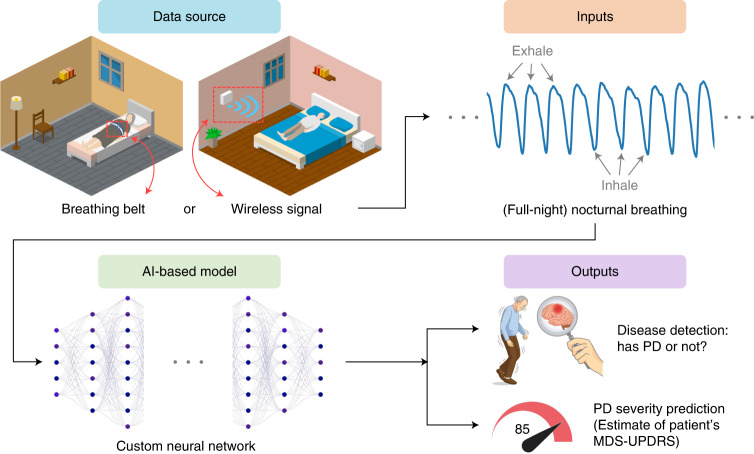
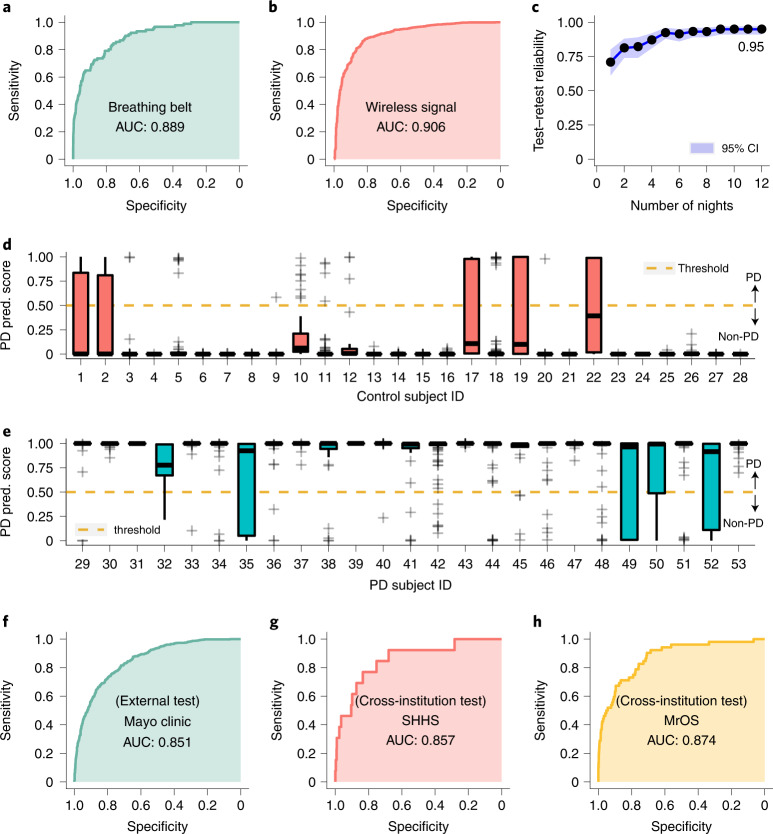
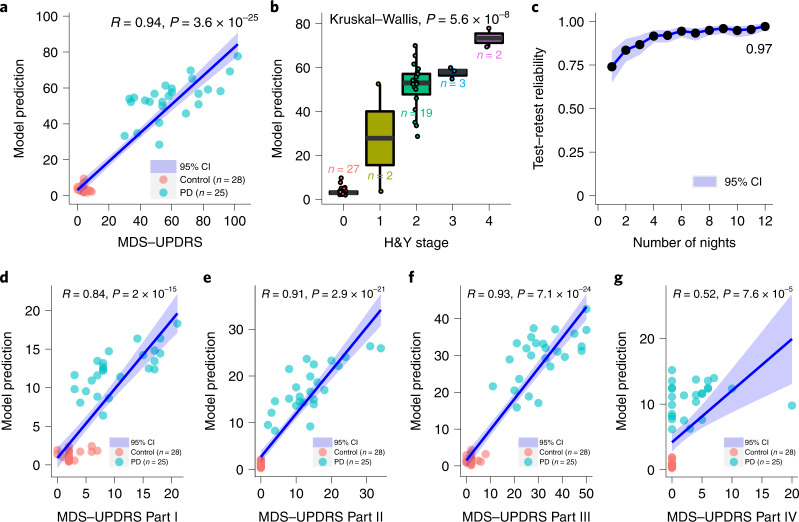
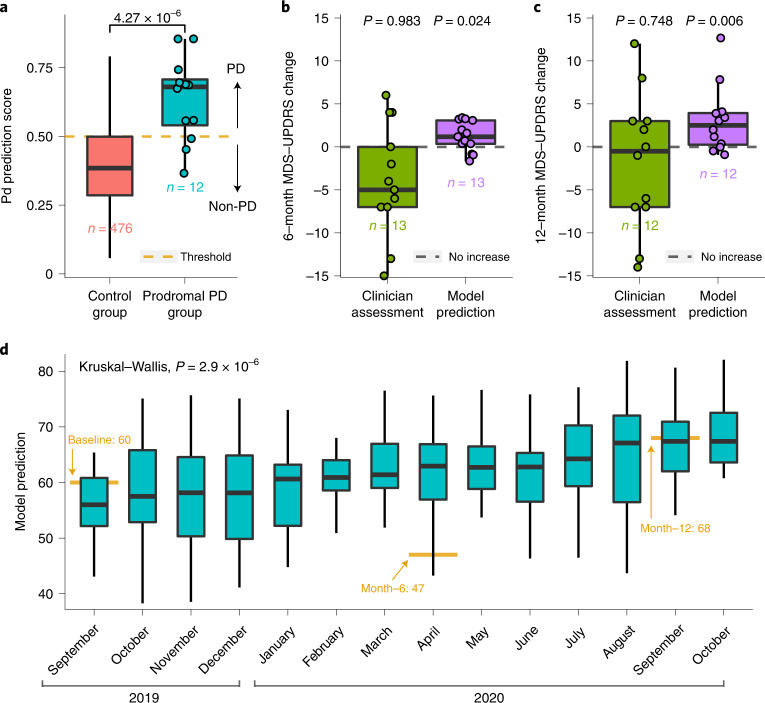
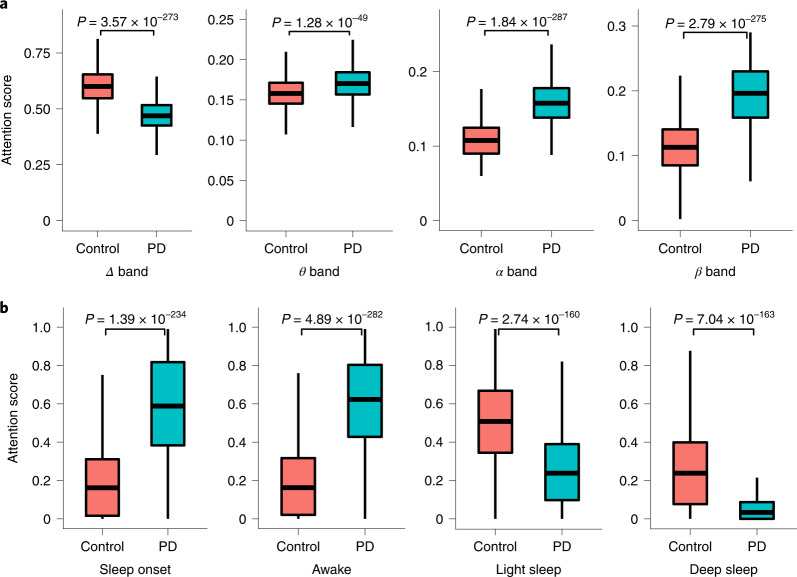
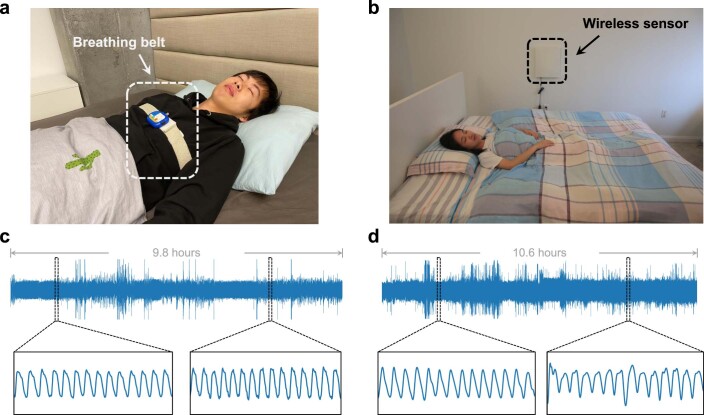
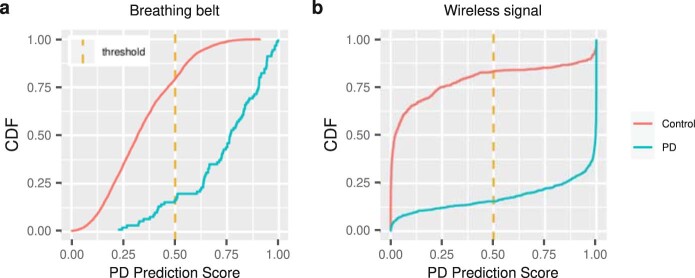
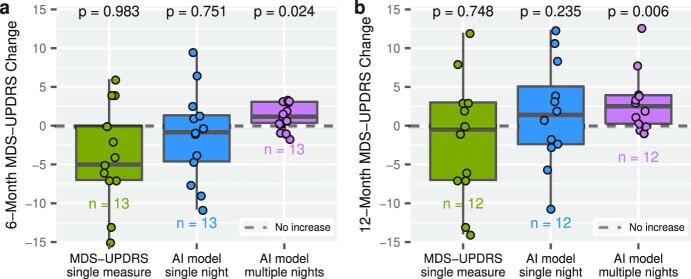
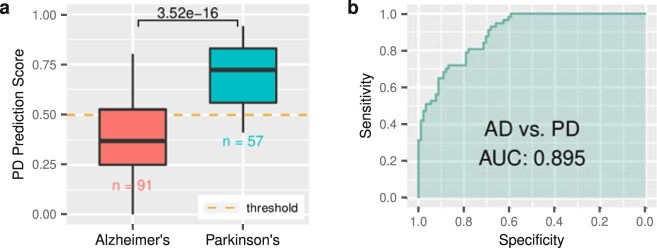
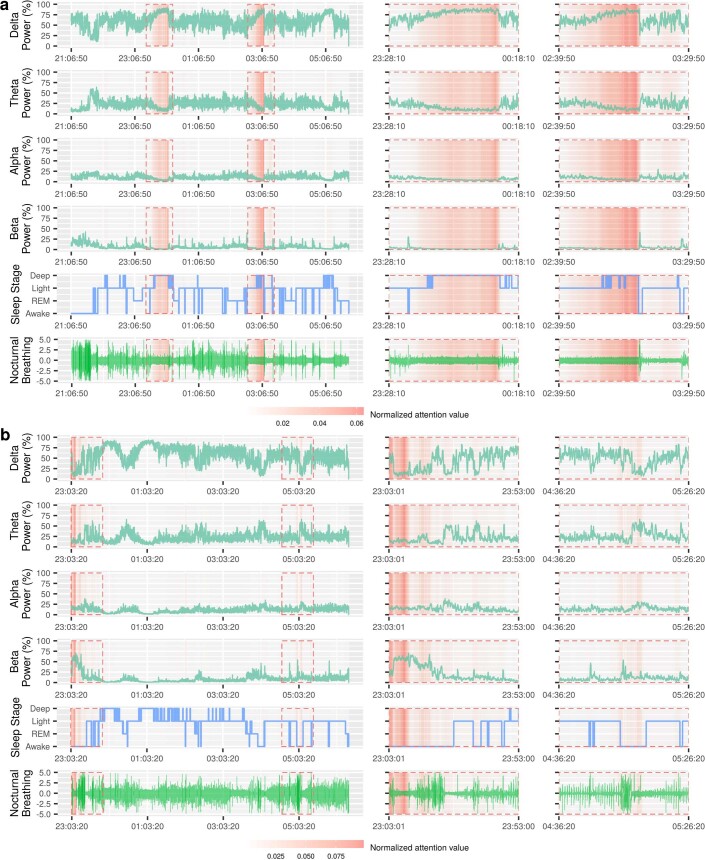
There are currently no effective biomarkers for diagnosing Parkinson’s disease (PD) or tracking its progression. Here, we developed an artificial intelligence (AI) model to detect PD and track its progression from nocturnal breathing signals. The model was evaluated on a large dataset comprising 7,671 individuals, using data from several hospitals in the United States, as well as multiple public datasets. The AI model can detect PD with an area-under-the-curve of 0.90 and 0.85 on held-out and external test sets, respectively. The AI model can also estimate PD severity and progression in accordance with the Movement Disorder Society Unified Parkinson’s Disease Rating Scale ( R = 0.94, P = 3.6 × 10 –25 ). The AI model uses an attention layer that allows for interpreting its predictions with respect to sleep and electroencephalogram. Moreover, the model can assess PD in the home setting in a touchless manner, by extracting breathing from radio waves that bounce off a person’s body during sleep. Our study demonstrates the feasibility of objective, noninvasive, at-home assessment of PD, and also provides initial evidence that this AI model may be useful for risk assessment before clinical diagnosis.
Overview
The claims and statistics of this paper haven’t been checked yet.
Free: it reads the open-access text and checks the first 5 claims that cite a source we can check. Create a free account to check every claim.
Integrity signals
Registry
Cites
Statistics
Figures
Verification
Claims the paper makes
The claims and statistics of this paper haven’t been checked yet.
Free: it reads the open-access text and checks the first 5 claims that cite a source we can check. Create a free account to check every claim.
Self-check
Percentages, sums and reported differences re-computed from the paper’s own numbers.
The self-check needs the paper’s full text.
Citations
Cites
Deep Residual Learning for Image Recognition
He, K., Zhang, X., Ren, S., & Sun, J. (2016) · 2016 IEEE Conference on Computer Vision and Pattern Recognition (CVPR) · doi:10.1109/cvpr.2016.90 · Cited by 235,474
U-Net: Convolutional Networks for Biomedical Image Segmentation
Ronneberger, O., Fischer, P., & Brox, T. (2015) · Lecture notes in computer science · doi:10.1007/978-3-319-24574-4_28 · Cited by 99,404
LeCun, Y., Bengio, Y., & Hinton, G. (2015) · Nature · doi:10.1038/nature14539 · Cited by 84,126
Welch, P. (1967) · IEEE Transactions on Audio and Electroacoustics · doi:10.1109/tau.1967.1161901 · Cited by 12,277
Parkinsonism: onset, progression, and mortality
Hoehn, M. M., & Yahr, M. D. (1967) · Neurology · doi:10.1212/wnl.17.5.427 · Cited by 12,107
A training algorithm for optimal margin classifiers
Boser, B. E., Guyon, I. M., & Vapnik, V. N. (1992) · Proceedings of the fifth annual workshop on Computational learning theory · doi:10.1145/130385.130401 · Cited by 11,992
Staging of brain pathology related to sporadic Parkinson’s disease
Braak, H., Tredici, K. D., Rüb, U., de Vos, R. A. I., Jansen Steur, E. N. H., & Braak, E. (2003) · Neurobiology of Aging · doi:10.1016/s0197-4580(02)00065-9 · Cited by 10,777
Goetz, C. G., Tilley, B. C., Shaftman, S. R., Stebbins, G. T., Fahn, S., Martinez‐Martin, P., Poewe, W., Sampaio, C., Stern, M. B., Dodel, R., et al. (2008) · Movement Disorders · doi:10.1002/mds.22340 · Cited by 7,536
Parkinson's disease: clinical features and diagnosis
Jankovic, J. (2008) · Journal of Neurology, Neurosurgery & Psychiatry · doi:10.1136/jnnp.2007.131045 · Cited by 5,720 · cited 1×
“Currently, diagnosis of PD is based on the presence of clinical motor symptoms 6 , which are estimated to develop after 50–80% of dopaminergic neurons have already degenerated 43 .”
Two-sided confidence intervals for the single proportion: comparison of seven methods
Newcombe, R. G. (1998) · Statistics in Medicine · doi:10.1002/(sici)1097-0258(19980430)17:8<857::aid-sim777>3.0.co;2-e · Cited by 5,107
Research works printed but not linked: 2
- Yang, Y., Zha, K., Chen, Y-C., Wang, H. & Katabi, D. Delving into deep imbalanced regression. In Proc. 38th International Conference on Machine Learning, Vol. 139 (Eds. Meila, M. & Zhang, T.) 11842–11851 (PMLR, 2021).
- Zhao M Learning sleep stages from radio signals: a conditional adversarial architecture Proc. 34th Int. Conf. Mach. Learn. (ICML) 2017 70 4100 4109
Cited by
Items 301–370 of 370
Next‐Generation Brain Health Monitoring Enabled by Integrated Wearable AI Infrastructure
Masrur, M. A., Khan, B., Khalid, R. T., Sumaira, & Abdullah, S. (2026) · Smart Medicine · doi:10.1002/smmd.70053
Wave2Graph: Integrating spectral features and correlations for graph-based learning in sound waves
Hoang, T., Tran, T. K., Vu, X.-S., Nguyen, D.-K., Bhuyan, M. H., & Nguyen, H. D. (2024) · AI Open · doi:10.1016/j.aiopen.2024.08.004
Applications and wearables for disease monitoring
Pilotto, A., Zatti, C., Rizzardi, A., & Padovani, A. (2024) · Elsevier eBooks · doi:10.1016/b978-0-323-99494-1.00006-x
Blumenthal, Y., Imamura, K., & Inoue, H. (2025) · Current human cell research and applications · doi:10.1007/978-981-95-0587-6_10
Guo, X., Wang, T., Wang, D., Zhou, J., & Lai, X. (2025) · Frontiers in Aging Neuroscience · doi:10.3389/fnagi.2025.1535861
Classification Of Parkinson's Disease Using Machine Learning Technique
Hadi, W. A. (2025) · Journal of Al-Qadisiyah for Computer Science and Mathematics · doi:10.29304/jqcsm.2025.17.22189
Early detection of Parkinson’s disease using multimodal information
Ghosh, S., & Roy, S. D. (2026) · Elsevier eBooks · doi:10.1016/b978-0-443-33455-9.00033-x
Jayasudha, V., Deepa, N., & Thiyagarajan, D. (2025) · Discover Applied Sciences · doi:10.1007/s42452-025-07195-8
Multimodal Electrophysiological Signals for Machine Learning-Aided Parkinson’s Disease Diagnosis
Jiang, B., Liu, H., Ran, Y., Zhou, Y., Chen, K., Yang, X., Zhao, J., Hu, M., Fang, B., & Pei, G. (2026) · Biosensors · doi:10.3390/bios16070381
Influence of Artificial Intelligence in the Control of Movement Disorders
Carl, B., Redden, B., Litvak, C., Pathak, S., Parise, R., Nadar, R. M., Jeyabalan, J. B., Rajaram, P., Alexander, C. S. W., Alharbi, H. F., et al. (2024) · Nutritional neurosciences · doi:10.1007/978-981-97-2577-9_6
Classification of Craniomaxillofacial Free Flap: Mechanism and Model
Men, Y., Han, J., Yao, S., Zhai, G., Hu, M., & Liu, J. (2025) · IEEE Transactions on Biomedical Engineering · doi:10.1109/tbme.2025.3600400
Guest Editorial Introduction to the Special Section on Invisible Sensing: Radar-Based Biomonitoring
Eskofier, B. M., & Vossiek, M. (2024) · IEEE Open Journal of Engineering in Medicine and Biology · doi:10.1109/ojemb.2024.3409086
Singh, J., & Garg, A. (2023) · IEEE International Conference for Convergence in Technology (I2CT) · doi:10.1109/i2ct57861.2023.10126411
Parveen, N., Vidyabharathi, D., Shaik, N., & Ram Nivas, D. (2024) · Advances in medical technologies and clinical practice book series · doi:10.4018/979-8-3693-3605-2.ch021
Wu, Y., Rundek, T., Nguyen, P., Yesha, Y., Feldman, M., Atit, P., Miller, J., Najafi, T., & Haq, I. U. (2025) · medRxiv · doi:10.64898/2025.12.29.25343190
Kaur, J., Jain, A. K., & Singh, U. (2026) · Lecture notes in networks and systems · doi:10.1007/978-3-032-31119-1_44
Deep-learning-based object detection of pelvic autonomic nerves during total mesorectal excision
Zhang, Q., Li, J., Meng, T., Chen, Z.-F., Zhou, X., & Lu, X. (2026) · World Journal of Gastroenterology · doi:10.3748/wjg.121592
PDFormer: A Multimodal Transformer for Quantifying Motor Symptom Severity in Parkinson’s Disease
Li, Y., Ahmed, M. R., Ba, F., Gong, M., & Cheng, L. (2026) · Medical Image Analysis · doi:10.1016/j.media.2026.104323
SasiRekha, S. (2024) · International Journal of Advanced Research in Computer Science · doi:10.26483/ijarcs.v15i1.7044
Mellot, A. (2024) · theses.fr (ABES) · doi:10.70675/e84e94abz65d5z42a9za845ze797fd29ff28
ARTIFICIAL INTELLIGENCE IN RADIOLOGY: CURRENT APPLICATIONS AND FUTURE DIRECTIONS
Waleed, S., Shah, S. Z. A., Tariq, R. A., Jabeen, E., Akhtar, M. K., & Batool, S. (2026) · Veredas do Direito Direito Ambiental e Desenvolvimento Sustentável · doi:10.18623/rvd.v23.8175
Digital Remote Patient Monitoring in Neurodegenerative Diseases
(2026) · Frontiers research topics · doi:10.3389/978-2-8325-7200-9
Τεχνητή νοημοσύνη και βιωσιμότητα
Κατωμέρη, Σ. (2025) · Dione (University of Piraeus)
An AI Co-Data-Scientist for Prioritizing Candidate Biomarkers from Wearable Sensor DataPreprint
Kim, Y., Rahman, S., Schmidgall, S., Park, C., Heydari, A., Metwally, A. A., Yu, H., Liu, X., Xu, X., Yang, Y., et al. (2026) · Research Square · doi:10.21203/rs.3.rs-10063234/v1
Self-citationA Review of Machine Learning Used in the Diagnosis of Parkinson’s Disease
Kee, W. J., Lee, I. E., Sheraz, M., Chuah, T. C., & Dhawale, C. A. (2025) · International Journal of Integrated Engineering · doi:10.30880/ijie.2025.17.06.002
OctoSense: Building a Unified Ecosystem for Open-Source Wireless SensingPreprint
Hou, W., Zhang, X., & Wu, C. (2026) · arXiv (Cornell University) · doi:10.48550/arxiv.2610.12405
An Oriented Interpenetrating Network Structure Multi-Stimuli Responsive HydrogelPreprint
Fu, X., Tong, H., Pan, Z., Zhou, Y., ZHANG, X., Zhang, K., Kang, S., Luo, J., Lu, W., & Douadji, L. (2024) · SSRN Electronic Journal · doi:10.2139/ssrn.4791993
Oriented Interpenetrating Network Structure Multi-Stimuli Responsive HydrogelPreprint
Fu, X., Zhou, Y., Tong, H., Pan, Z., Luo, J., Lu, W., Douadji, L., Zhang, K., Kang, S., & ZHANG, X. (2024) · SSRN Electronic Journal · doi:10.2139/ssrn.4899004
You, J., Li, J., Yao, R., Gao, J., Wu, J., & Ye, J. (2024) · Annual International Conference of the IEEE Engineering in Medicine and Biology Society (EMBC) · doi:10.1109/embc53108.2024.10782287
Animated Virtual Therapist in Virtual Reality Environment for People with Parkinson's Disease
Li, W., Agada, R., & Yan, J. (2025) · IEEE International Conference on Artificial Intelligence and eXtended and Virtual Reality (AIxVR) · doi:10.1109/aixvr63409.2025.00055
Hippocampal Volume Changes Post-STN DBS in Parkinson’s Patients
Mangra, S. (2025) · TSpace (University of Toronto)
AI home monitoring for behavioral markers of cerebrovascular disease
Baek, J., Cho, K.-H., Lim, L., & Chong, J. W. (2026) · npj Digital Medicine · doi:10.1038/s41746-026-02836-7
AI in Pharmacovigilance: Addressing Regulatory Challenges and Global Harmonization
Karade, R. J., Balakshe, P. V., Velhal, A. B., Jadhav, P. D., & Botare, A. B. (2026) · International Journal of Drug Delivery Technology · doi:10.25258/ijddt.16.66s.151
Chen, D., Gao, J., Ma, Z., Jiang, W., Ren, X., Shi, Y., Liu, H., Zhang, M., & Fan, W. (2026) · Biosensors and Bioelectronics · doi:10.1016/j.bios.2026.119328
Yuan, X., Zhang, B., Hu, Y., & Chen, Y. (2025) · International Conference on Data Science and Information Technology (DSIT) · doi:10.1109/dsit67006.2025.11390044
Self-citationDhatrak, P. N., LELE, A. M., & Kshirsagar, M. (2025) · Research on Biomedical Engineering · doi:10.1007/s42600-025-00438-y
The Heart Wants What It Wants: How Can ECG Foundation Models Help Us Understand Emotions?
Culer, Ł. (2025) · International Conference on Affective Computing and Intelligent Interaction Workshops and Demos (ACIIW) · doi:10.1109/aciiw68946.2025.11761293
Tillämpade intelligenta system inom välfärdsteknologi och digital hälsa. Nulägesanalys
Öling-Wärnå, V., & Westö, J. (2023) · Theseus (Ammattikorkeakoulujen)
Task-evoked multimodal wearable sensing for community-based cognitive impairment assessmentPreprint
Liu, C., Zhao, M., Zhao, L., Yin, H., Song, Y., Qi, X., Xiang, W., Yang, C., Zhu, Y., Liu, Y., et al. (2026) · Research Square · doi:10.21203/rs.3.rs-8946251/v1
Self-citationFrom Packets to Patterns: Interpreting Encrypted Network Traffic as Longitudinal Behavioral SignalsPreprint
Mahmood, R., Shahawy, O. E., Barua, S., Beattie, Z., Kaye, J. A., Xu, X., Wu, C.-Y., & Huang, D. Y. (2026) · arXiv (Cornell University) · doi:10.48550/arxiv.2605.01616
ANAIS - XVIII ENCA - II Congresso Internacional de Ciências Integradas - UNIFSM
Maria, U. C. U. S. (2026) · Revista interdisciplinar em saúde · doi:10.35621/23587490.v13.n1.p53-1225
Rubin, C. J., Lee, L. W., Assa’ad, A., Lara‐Corrales, I., Katabi, D., Rahul, H. S., Ruan, S., Krishna, P., Hristov, R., Chandross, K. J., et al. (2026) · Dermatology and Therapy · doi:10.1007/s13555-026-01864-1
Self-citationConvention vs. Innovation I: Digital technology will replace clinic-based care in Parkinson disease
Schneider, R. B., Phillips, O. W., & Kalia, L. V. (2024) · Parkinsonism & Related Disorders · doi:10.1016/j.parkreldis.2024.106067
Arogya Sahayak: AI-Powered Health Navigator App
Sarkar, A., Nath, T., Bhattacharjee, D., Das, P., Ray, C., Bhowmik, S., & Nandi, S. (2025) · International Journal of Enhanced Research In Science Technology & Engineering · doi:10.55948/ijerste.2025.0634
Williams, A., Stroupe, A., del Rosario, C., Umanzor, C., Symonds, T. L., & Durlach, C. (2024) · Research Square · doi:10.21203/rs.3.rs-4731346/v1
Dipa, S. A., Islam, H., Akter, M., Sharmin, F., Shahnawaj, M., & Hellol, H. I. (2025) · Frontiers in Computer Science and Artificial Intelligence · doi:10.32996/fcsai.2025.4.5.8x
Padilla, P. E. A., Paredes-Tobar, O. S., & Coque, E. J. P. (2025) · Revista de Ciencias Médicas de Pinar del Río
Zalewska, Z., Reczka, K., Szymkowiak, J., & Woźniak, M. (2026) · International Journal of Innovative Technologies in Social Science · doi:10.31435/ijitss.2(50).2026.5356
AI Based Parkinson Disorder Diagnosis System – A Comprehensive Review
D, A. C., & Arulanand, N. (2022) · Journal of Trends in Computer Science and Smart Technology · doi:10.36548/jtcsst.2022.4.004
Capturing autism’s sleep problems with devices nearable and wearable
Askham, A. V., & Hess, P. (2023) · The Transmitter · doi:10.53053/gank9910
UTILISING TUNABLE Q WAVELET TRANSFORM METHOD WITH EEG SIGNALS FOR PARKINSONS DETECTION
(2023) · International Research Journal of Modernization in Engineering Technology and Science · doi:10.56726/irjmets46314
Artificial Intelligence for Humanity: Perspectives From Outside of Medicine
Bristol, S. J., Fishman, E. K., Chu, L. C. H., Weisberg, E. M., Rowe, S. P., & Lugo-Fagundo, E. (2023) · Journal of the American College of Radiology · doi:10.1016/j.jacr.2023.03.028
Brooks, C. (2024) · Wiley eBooks · doi:10.1002/9781394310562.notes
An intelligent system for monitoring and predicting Parkinson’s disease: A review
Ayyal, A. H., Gharghan, S. K., & Mutlag, A. H. (2024) · AIP conference proceedings · doi:10.1063/5.0236240
Contactless Sleep Staging with Radar: A Transfer Learning ApproachPreprint
Krauss, D., Richer, R., Albrecht, N. C., Jukic, J., Krebber, C. H., Zwiessele, P., German, A., Koelpin, A., Regensburger, M., Winkler, J., et al. (2025) · doi:10.36227/techrxiv.174535565.58795771/v1
Parkinson's Diagnosis Through the Use of AI Throught Speech and Gait
Asha, V., Garg, S., Gupta, M., Sharma, S. K., Reddy, K., & Mohammed, M. W. (2025) · International Conference on Cognitive Computing in Engineering, Communications, Sciences and Biomedical Health Informatics (IC3ECSBHI) · doi:10.1109/ic3ecsbhi63591.2025.10991021
Vats, S. (2025) · International journal of research and scientific innovation · doi:10.51244/ijrsi.2025.120800149
Spearman and Jaccard‐Based Convolutional Deep Neural Learning for Early Parkinson’s Diagnosis
Murali, V., Natarajan, R., Flammini, F., Alfurhood, B. S., Kumar, C. M. N., & Sowmya, V. L. (2025) · International Journal of Intelligent Systems · doi:10.1155/int/6662826
Satyanarayana, T. V. V., Bhargavi, M. M., Kavarakuntla, V. R. P., Gayaz, S., & Reddy, S. C. K. (2025) · International Conference on Information, Implementation, and Innovation in Technology (I2ITCON) · doi:10.1109/i2itcon65200.2025.11210716
Applied Instrumentation : student works
Cara, T. P., García, J. E. G., & Piedrafita, Ó. C. (2016) · UPCommons institutional repository (Universitat Politècnica de Catalunya)
X-INCEPD: Enhancing Inception-based Model for Parkinson’s Disease Prediction with Explainable AI
Tsolakis, N., Maga‐Nteve, C., Vrochidis, S., Bassiliades, N., & Μεδίτσκος, Γ. (2025) · International Conference on Information, Intelligence, Systems & Applications (IISA) · doi:10.1109/iisa66859.2025.11771066
An ML-Driven Framework for Parkinson's Disease Identification from Voice Data
Arora, M., Emmanuel, M., Khandelwal, C., & Bhanot, A. (2026) · Lecture notes in networks and systems · doi:10.1007/978-981-95-3486-9_9
A Novel Machine Learning Approach for Tuberculosis Detection using Volatile Organic Compounds
Vishal, B. G., George, J., & Chanti, S. (2025) · International Conference on Intelligent Computing, Information and Control Systems (ICOIICS) · doi:10.1109/icoiics67115.2025.11390373
Early detection of Parkinson’s disease using deep learning approaches.
Khelladi, A. (2025) · Dépôt Institutionnel de lUniversité de Tlemcen
A Framework for Designing Digital English Classroom Activities Based on Multimodal Teaching Concepts
Xie, D. (2026) · Ingegneria Sismica · doi:10.65102/is2026584
de Almeida, W. S., de Almeida, W. S., & Vieira, D. (2026) · Revista Master Ensino Pesquisa e Extensão · doi:10.47224/revistamaster.v10i20.763
Video-based Parkinson's disease detection in low data regimes
Sriram, P. (2023) · Illinois Digital Environment for Access to Learning and Scholarship (University of Illinois at Urbana-Champaign)
Chopra, S., Barber, C., Malhotra, S. R., Schrier, R. C., Campbell, K., Chang, J., Heckman, E. J., Ahn, A. P., & THOMAS, R. J. (2026) · Current Sleep Medicine Reports · doi:10.1007/s40675-026-00402-x
Metadata
- Authors
- Yang, Y., Yuan, Y., Zhang, G., Wang, H., Chen, Y.-C., Liu, Y., Tarolli, C. G., Crepeau, D., Bukartyk, J., Junna, M. R., Videnovic, A., Ellis, T. D., Lipford, M. C., Dorsey, R., & Katabi, D.
- Affiliations
- Massachusetts Institute of Technology (US)
- Rutgers, The State University of New Jersey (US)
- University of Rochester Medicine (US)
- Mayo Clinic (US)
- Boston University (US)
- Corresponding author
- Yang, Yuzhe
- Yuan, Yuan
- ORCID
- Venue
- Nature Medicine
- Published
- 2022-08-22
- Volume
- 28
- Issue
- 10
- Pages
- 2207-2215
- ISSN
- 1078-8956 (ISSN-L)
- 1546-170X
- PMC
- PMC9556299
- OpenAlex
- W4299293190
- Cited by
- 296
- References
- 57
- Citations by year
- 2026: 51 · 2025: 89 · 2024: 87 · 2023: 58 · 2022: 11
- FWCI
- 17.79
- Type
- journal article
- Language
- en
- Open access
- hybrid
- doi.org
- Licence
- cc-by
- creativecommons.org/licenses/by/4.0 (tdm)
- creativecommons.org/licenses/by/4.0 (vor)
- Locations
- Nature Medicine (publishedVersion, cc-by)
- PubMed Central (publishedVersion, cc-by)
- PubMed (publishedVersion)
- Funders
- National Science Foundation (2014391)
- Michael J. Fox Foundation for Parkinson's Research
- National Institutes of Health
- National Institute of Neurological Disorders and Stroke (P50NS108676)
- Topics
- Physical Sciences › Engineering › Biomedical Engineering › Non-Invasive Vital Sign Monitoring
- Health Sciences › Medicine › Clinical Neurology › Parkinson's Disease Mechanisms and Treatments
- Health Sciences › Health Professions › Health Information Management › Artificial Intelligence in Healthcare
- Keywords
- Parkinson's disease, disease progression, Unified Parkinson's Disease Rating Scale, attention mechanism, interpretability, home-based assessment, biomarkers, non-invasive diagnosis, risk assessment
- MeSH terms
- Artificial Intelligence, Humans, Parkinson Disease, Severity of Illness Index, Sleep
About these checks
Registry, retraction, Cites and statistics results are computed, not judged, with one exception: a printed reference that no index lists is read once by a model before it counts as a citation error. Claims are extracted by a model and kept only when their quote appears verbatim in the text; each cited source is then checked, with a model’s help, for whether it says what the claim relies on. Those verdicts can be wrong — read the claim’s quote and the cited source before relying on one.
Statistics and arithmetic are recomputed, not judged.
Confidence bands are shown only for fields calibrated on our annotated test set. None is calibrated yet, so no band is shown.
What counts as a claim ›How we measure confidence ›How we check this ›
Are you an author, or do you see a problem with this page? Request a review
Data sources
Bibliographic data: Semantic Scholar, OpenAlex, Crossref.
Contains information from the Semantic Scholar Academic Graph Datasets, made available under the ODC Attribution License (ODC-BY 1.0).
Semantic Scholar’s data is described in: Kinney, R., et al. (2023). The Semantic Scholar Open Data Platform. arXiv:2301.10140.
