

A multimodal whole-slide foundation model for pathology
Open accessThe DOI matches its Crossref record; 141 of the 141 references it cites were found in a registry or an index; 63 of the 104 sources its claims cite were checked for support.
Abstract
The field of computational pathology has been transformed with recent advances in foundation models that encode histopathology region-of-interests (ROIs) into versatile and transferable feature representations via self-supervised learning. However, translating these advancements to address complex clinical challenges at the patient and slide level remains constrained by limited clinical data in disease-specific cohorts, especially for rare clinical conditions. We propose Transformer-based pathology Image and Text Alignment Network (TITAN), a multimodal whole-slide foundation model pretrained using 335,645 whole-slide images via visual self-supervised learning and vision-language alignment with corresponding pathology reports and 423,122 synthetic captions generated from a multimodal generative AI copilot for pathology. Without any fine-tuning or requiring clinical labels, TITAN can extract general-purpose slide representations and generate pathology reports that generalize to resource-limited clinical scenarios such as rare disease retrieval and cancer prognosis. We evaluate TITAN on diverse clinical tasks and find that it outperforms both ROI and slide foundation models across machine learning settings, including linear probing, few-shot and zero-shot classification, rare cancer retrieval, cross-modal retrieval and pathology report generation. Pretrained using 335,645 whole-slide images, a foundation model is developed to provide representations for slide- and patient-level tasks. It is capable of performing clinical tasks and generating reports even in data-scarce scenarios, such as rare cancer diagnosis and survival prediction, without requiring further fine-tuning.
Overview
CoChat Summary
## TL;DR
TITAN is a multimodal whole-slide foundation model for pathology pretrained on 335,645 WSIs and 182,862 reports, plus 423,122 synthetic ROI captions, to produce transferable slide embeddings and report-generation capability. Across diverse pathology tasks, it outperforms prior slide foundation models in classification, few-shot learning, rare cancer retrieval, cross-modal retrieval, and report generation.
## Key findings
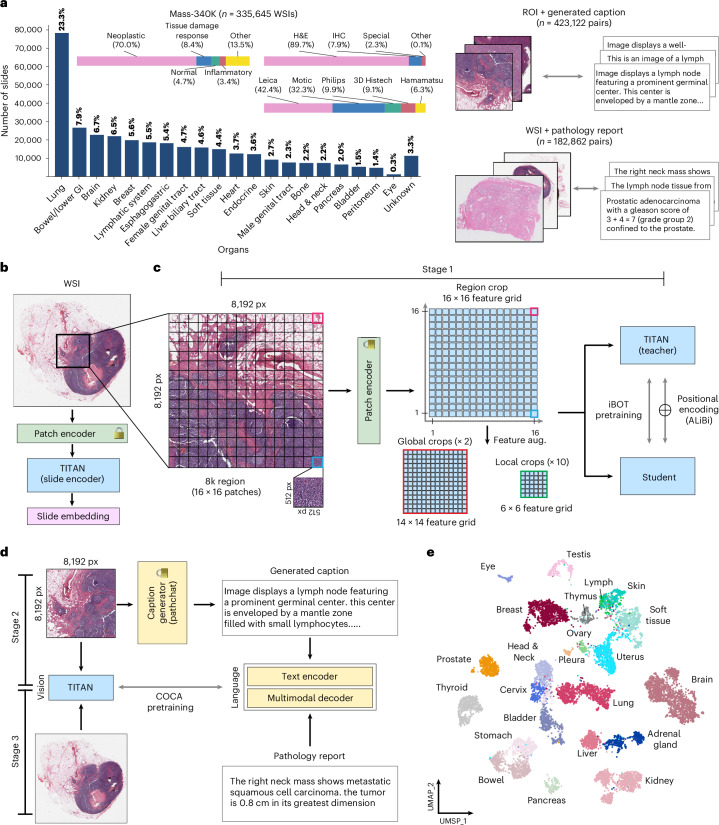
- TITAN was pretrained on 335,645 whole-slide images from 20 organs, with multimodal alignment using 423,122 synthetic ROI captions and 182,862 slide-report pairs; the abstract also states 423,122 synthetic captions and 335,645 WSIs.
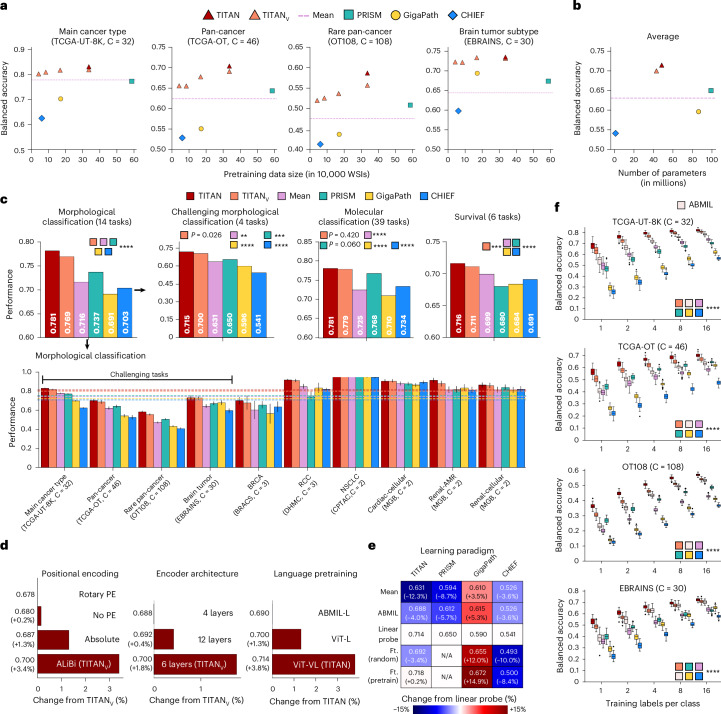
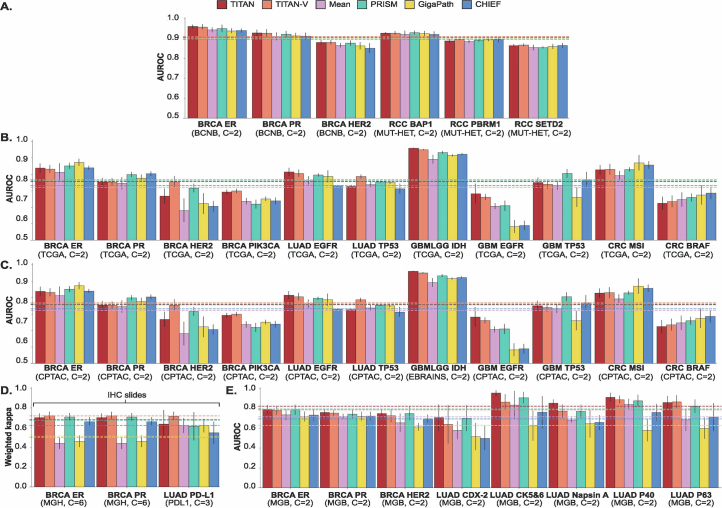
- On downstream tasks, the paper reports TITAN/TITANV outperforming prior slide encoders across morphological subtyping (14 tasks), grading (3 tasks), molecular classification (39 tasks), and survival prediction (6 tasks).
- In low-data few-shot learning, TITAN significantly outperformed all other encoders (P < 0.0001); for 16-shot learning it beat CHIEF by 22.4% on TCGA-UT-8K and 18.7% on TCGA-OT, and on 1-shot OT108 it beat ABMIL by 56.7%.
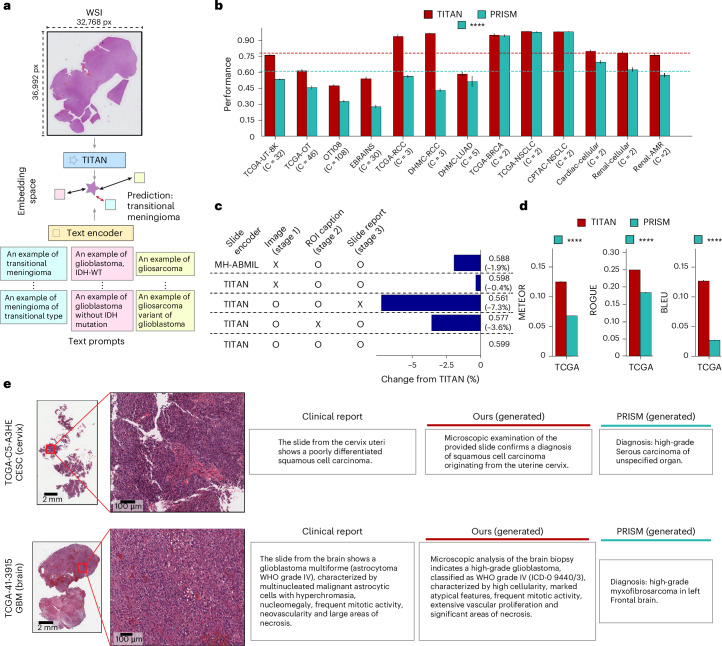
- For zero-shot classification on 13 subtyping tasks, TITAN outperformed PRISM by +56.52% balanced accuracy on multiclass tasks and +13.8% AUROC on binary tasks; on EBRAINS, balanced accuracy was more than double PRISM’s (+121.9%).
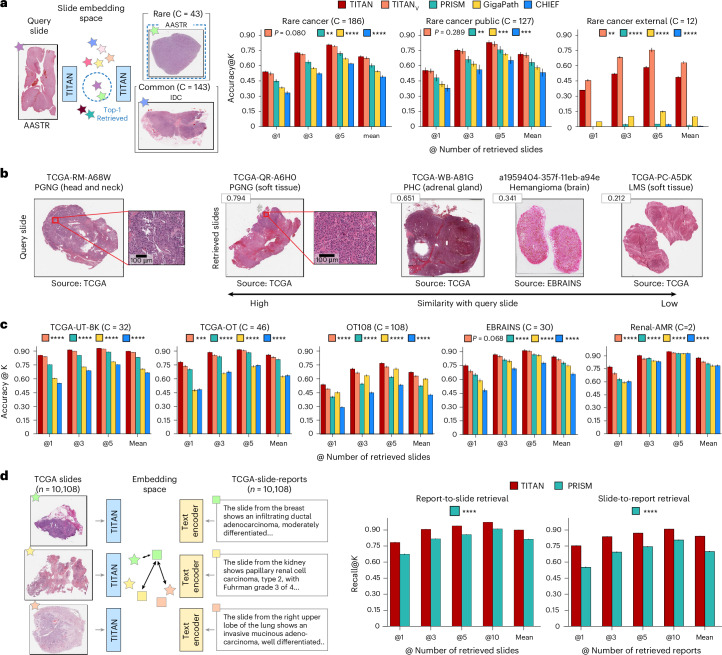
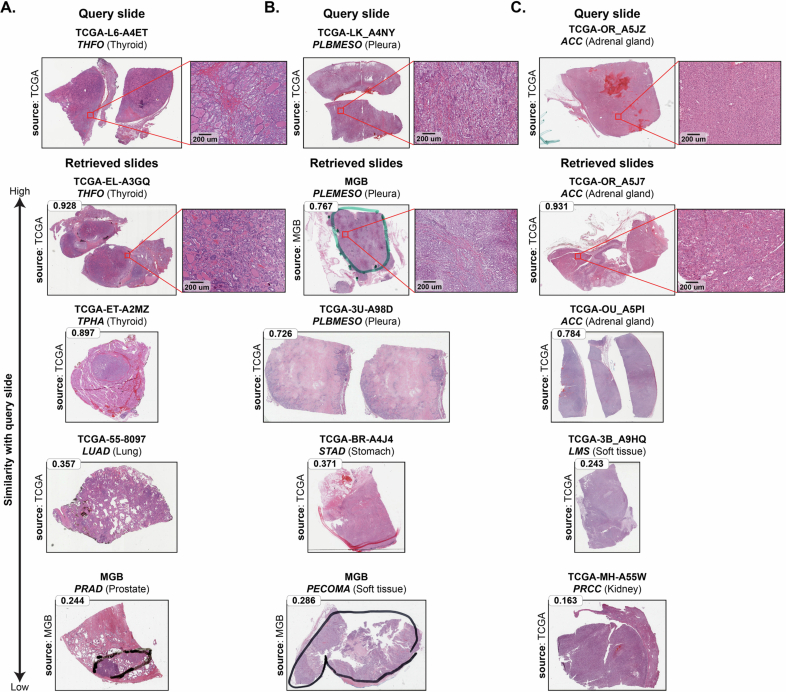
- For rare-cancer retrieval, TITAN improved over the next best model PRISM by +14.8% in Accuracy@K and +18.1% in MVAcc@K on average; on Rare-Cancer-External, TITAN and TITANV improved over GigaPath by +30.8% / +41.5% in Accuracy@K and +31.2% / +26.7% in MVAcc@K.
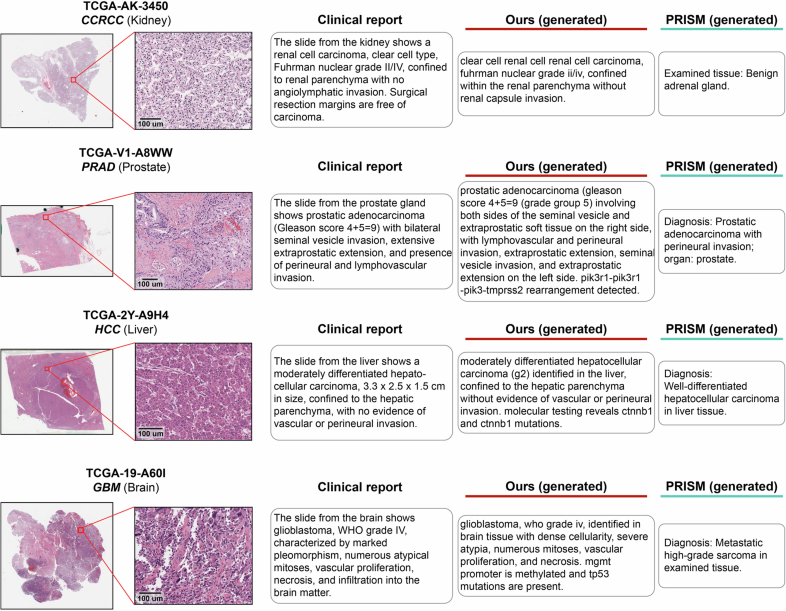
- For report generation on 10,108 slide-report pairs from TCGA-Slide-Reports, TITAN outperformed PRISM by 161% on average across METEOR, ROUGE, and BLEU; for cross-modal retrieval, it improved by +10.5% on report-to-slide and +20.5% on slide-to-report Recall@K.
## Methods
- Design: Two-stage multimodal continual pretraining on top of a vision-only whole-slide model: stage 1 SSL on ROI feature grids with iBOT, stage 2 ROI-caption alignment using synthetic PathChat captions, and stage 3 WSI-report alignment using clinical pathology reports; the multimodal stages use a CoCa-style image encoder, text encoder, and text decoder.
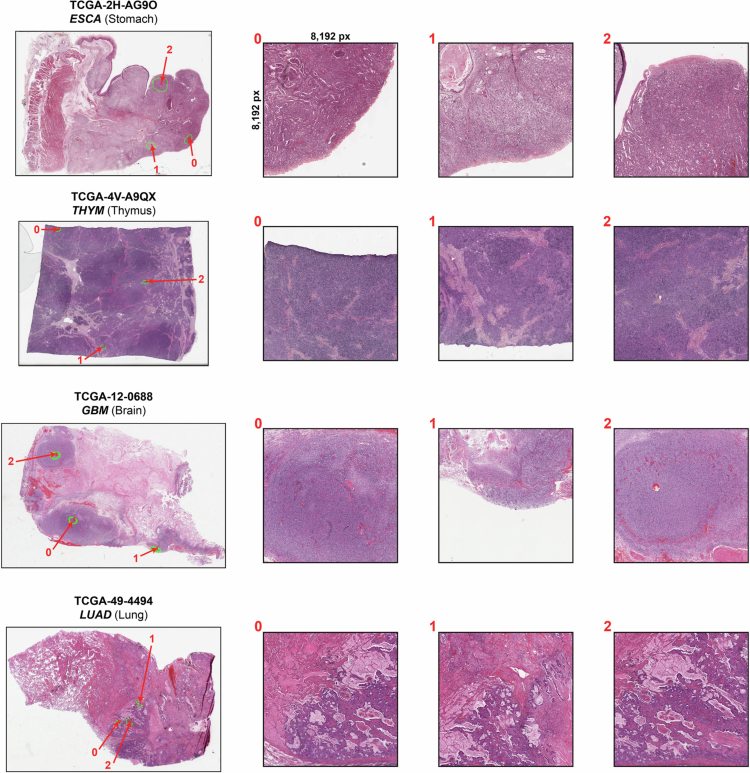
- Data/sample: Pretraining used Mass-340K with 335,645 WSIs and 182,862 medical reports; stage 2 used 423,122 ROIs of 8,192 × 8,192 pixels, and stage 3 used 182,862 slide-report pairs. Downstream evaluation spans multiple public and in-house datasets, including TCGA-UT-8K (25,495 ROIs), TCGA-OT (11,186 WSIs), TCGA-Slide-Reports (10,108 WSIs with paired reports), and rare-cancer retrieval sets.
- Main analysis: The paper evaluates TITAN/TITANV with linear probing, k-NN probing, few-shot classification, slide retrieval, cross-modal retrieval, zero-shot classification, report generation, and survival analysis, comparing against baselines including PRISM, GigaPath, CHIEF, ABMIL, and mean pooling.
## Limitations
- The authors state that pretraining on 8k × 8k region crops and extrapolating with ALiBi to the entire WSI may still not capture the full contextual information.
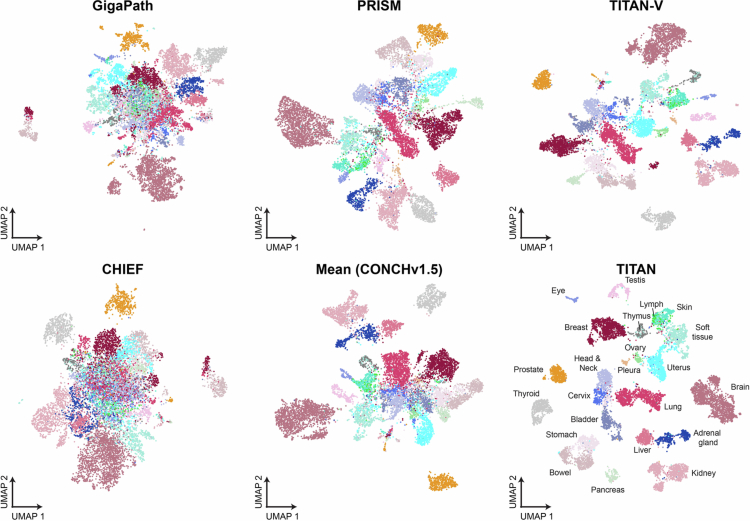
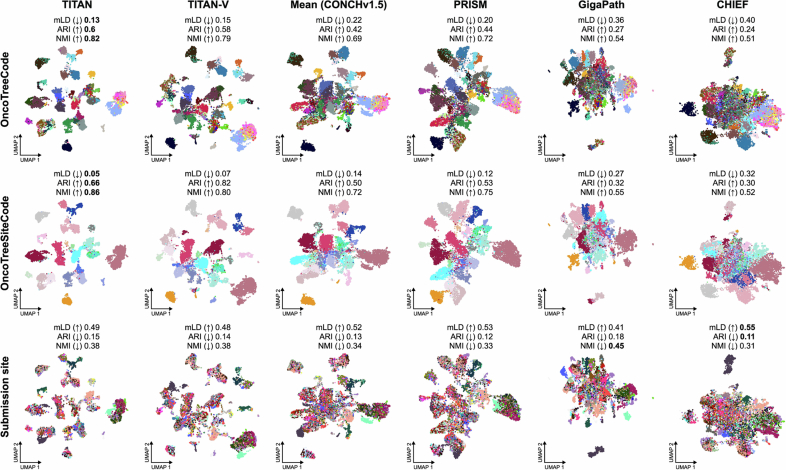
- They note that slide models may encode nonbiological features such as tissue processing sites and scanners, which can affect translational impact.
- They state that clinical report processing remains challenging for vision-language alignment and that Mass-340K contains fewer slides than some other pretraining datasets.
- Evident from the text: several reported gains are based on internal retrospective data and curated benchmark datasets, so generalization beyond the evaluated cohorts is only partially tested.
Model-written summary. Check it against the paper before relying on it.
Integrity signals
Registry
Cites
Statistics
Figures
Verification
Claims the paper makes
28 Valid · 0 Not valid · 8 Not checked · 92 Own results and interpretations
The cited sources support only part of this claim — read each source’s verdict below.
In the paper
“Similarly, given a diagnostically challenging WSI, retrieving a similar WSI via slide search5,46–53 or pathology reports through cross-modal report search10,54–56 typically requires specialized algorithms to bridge the gap between fine-grained patch embeddings and slide-level information, introducing hurdles to clinical adoption.”
§ A multimodal whole-slide foundation model for pathology > Main
What the sources say
- Not checked — no full text of the sourcecites [5] Wang, X. et al. RetCCL: clustering-guided contrastive learning for whole-slide image retrieval. Med. Image Anal. 83, 102645 (2023). 36270093 source
- Not checked — no full text of the sourcecites [46] Lew, M. S., Sebe, N., Djeraba, C. & Jain, R. Content-based multimedia information retrieval: State of the art and challenges. ACM Trans. Multimed. Comput. Commun. Appl. 2, 1–19 (2006). source
- Not checked — no full text of the sourcecites [47] Cruz-Roa, A., Caicedo, J. C. & González, F. A. Visual pattern mining in histology image collections using bag of features. Artif. Intell. Med. 52, 91–106 (2011). 21664806 source
- Not checked — no full text of the sourcecites [48] Caicedo, J. C., Cruz, A. & Gonzalez, F. A. Histopathology image classification using bag of features and kernel functions. In Proc. 12th Conference on Artificial Intelligence in Medicine (eds Combi, C., et al.) 126–135 (Springer, 2009). source
- Partly supportedcites [49] Sridhar, A., Doyle, S. & Madabhushi, A. Content-based image retrieval of digitized histopathology in boosted spectrally embedded spaces. J. Pathol. Inform. 6, 41 (2015). 26167385 PMC4498317 sourceExperimental — accuracy not yet measured
Split into 2 atoms — 0 confirmed, 1 partially supported, 0 disputed, 0 misattributed, 1 unverifiable. Expand the claim to see per-atom verdicts.
- Supportedcites [50] Kalra, S. et al. Yottixel—an image search engine for large archives of histopathology whole slide images. Med. Image Anal. 65, 101757 (2020). 32623275 sourceExperimental — accuracy not yet measured
Split into 2 atoms — 2 confirmed, 0 partially supported, 0 disputed, 0 misattributed, 0 unverifiable. Expand the claim to see per-atom verdicts.
- Partly supportedcites [51] Chen, C. et al. Fast and scalable search of whole-slide images via self-supervised deep learning. Nat. Biomed. Eng. 6, 1420–1434 (2022). 36217022 PMC9792371 sourceExperimental — accuracy not yet measured
Split into 2 atoms — 1 confirmed, 1 partially supported, 0 disputed, 0 misattributed, 0 unverifiable. Expand the claim to see per-atom verdicts.
- Not checked — no full text of the sourcecites [52] Zheng, Y. et al. Histopathological whole slide image analysis using context-based CBIR. IEEE Trans. Med. Imaging 37, 1641–1652 (2018). 29969415 source
- Not checked — no full text of the sourcecites [53] Shang, H. H. et al. Histopathology slide indexing and search—are we there yet? NEJM AI 1, AIcs2300019 (2024). source
- Partly supportedcites [10] Lu, M. Y. et al. A visual-language foundation model for computational pathology. Nat. Med. 30, 863–874 (2024). 38504017 PMC11384335 sourceExperimental — accuracy not yet measured
Split into 2 atoms — 0 confirmed, 2 partially supported, 0 disputed, 0 misattributed, 0 unverifiable. Expand the claim to see per-atom verdicts.
plainstates a cause- Asserted: passes — The authors put it forward as true.
- Checkable: passes — It can be checked against evidence.
- Load-bearing: passes — The paper’s conclusions depend on it.
- Based: passes — The paper gives a reason why it holds.
The cited sources support only part of this claim — read each source’s verdict below.
In the paper
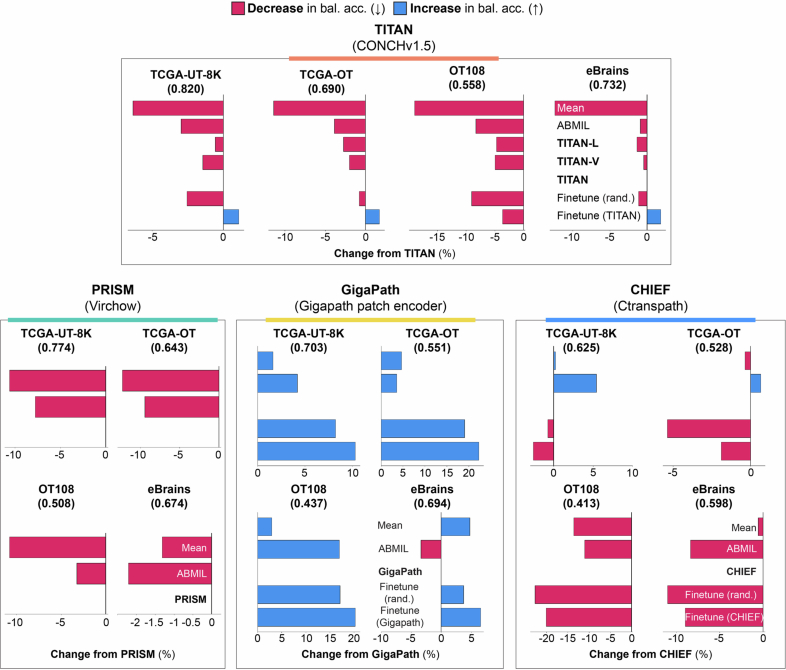
“This suggests that the pretrained weights of TITANV can serve as a good initialization for task-specific training, in line with previous works62,64.”
§ A multimodal whole-slide foundation model for pathology > Results > Comparison with different learning paradigms for slide encoding
What the sources say
- Partly supportedcites [62] Shaikovski, G. et al. PRISM: a multi-modal generative foundation model for slide-level histopathology. Preprint at https://arxiv.org/abs/2405.10254 (2024). sourceExperimental — accuracy not yet measured
Section 5.2 reports that fine-tuning PRISM’s pretrained slide encoder outperformed training it from scratch in six of nine biomarker tasks. This supports the general point that pretrained weights can be a useful starting point for task-specific training, but the paper does not establish that result for TITANV. (LLM, conf=0.85)
- Partly supportedcites [64] Jaume, G. et al. Transcriptomics-guided slide representation learning in computational pathology. In Proc. IEEE/CVF Conference on Computer Vision and Pattern Recognition (CVPR) 9632–9644 (IEEE, 2024). sourceExperimental — accuracy not yet measured
The Slide retrieval section (p. 7) says TANGLE pre-training produces task-agnostic features usable for downstream tasks, and the linear-probing results (p. 5) show strong few-shot performance. But the source studies TANGLE, not TITANV, and evaluates pretrained representations rather than showing that TITANV weights provide a good initialization for task-specific training. (LLM, conf=0.84)
hedgedstates an association- Asserted: passes — The authors put it forward as true.
- Checkable: passes — It can be checked against evidence.
- Load-bearing: passes — The paper’s conclusions depend on it.
- Based: passes — The paper gives a reason why it holds.
- Partly supported
None of the sources cited for this claim have been checked yet.
In the paper
“Building on the success of knowledge distillation and masked image modeling86,87 for patch encoder pretraining21,22, TITAN introduces a large-scale pretraining paradigm that leverages millions of high-resolution region-of-interests (ROIs; at 8,192 × 8,192 pixels at 20× magnification) for scalable WSI encoding.”
§ A multimodal whole-slide foundation model for pathology > Main
What the sources say
- Not checked yetcites [86] Zhou, J. et al. iBOT: image BERT pre-training with online tokenizer. In Proc. International Conference on Learning Representations https://openreview.net/forum?id=ydopy-e6Dg (OpenReview, 2022). source
- Not checked yetcites [87] Oquab, M. et al. Dinov2: learning robust visual features without supervision. Trans. Mach. Learn. Res. https://openreview.net/forum?id=a68SUt6zFt (2024). source
- Could not verifycites [21] Campanella, G. et al. A clinical benchmark of public self-supervised pathology foundation models. Nat. Commun. 16, 3640 (2025). 40240324 PMC12003829 sourceExperimental — accuracy not yet measured
The Introduction describes large-scale pretraining of other pathology models, and the Discussion considers limitations of tile-level encoders. Searches for TITAN and its claimed 8,192 × 8,192-pixel ROIs found no passage in our copy addressing TITAN's pretraining or WSI encoding. (LLM, conf=0.74)
- Could not verifycites [22] Neidlinger, P. et al. Benchmarking foundation models as feature extractors for weakly-supervised computational pathology. Preprint at https://arxiv.org/abs/2408.15823 (2024). PMC13279263 41034516 sourceExperimental — accuracy not yet measured
The Main section discusses large-scale pathology foundation models generally, while Methods > Image processing and deep learning techniques describes processing WSIs into 224 × 224-pixel tiles. Searches for TITAN and the claimed 8,192 × 8,192-pixel ROIs found no passage in our copy describing TITAN’s pretraining or WSI-encoding approach; no page numbers were provided. (LLM, conf=0.76)
plainstates a cause- Asserted: passes — The authors put it forward as true.
- Checkable: passes — It can be checked against evidence.
- Load-bearing: passes — The paper’s conclusions depend on it.
- Based: passes — The paper gives a reason why it holds.
The sources with a verdict support this claim; the rest weren’t checked yet, have no full text we could read, or their verdicts aren’t rated yet.
In the paper
“Even with other nonparametric evaluations with prototyping105,106 and 20 nearest-neighbor evaluation, which predicts each WSI’s label based on the proximity to other WSI embeddings in the embedding space, we observe that TITAN and TITANV maintain superior performance Supplementary Tables 22–33.”
§ A multimodal whole-slide foundation model for pathology > Results > TITAN improves region and slide-level diagnostic capabilities
What the sources say
- Supportedcites [105] Wang, Y., Chao, W.-L., Weinberger, K. Q. & Van Der Maaten, L. Simpleshot: revisiting nearest-neighbor classification for few-shot learning. Preprint at arXiv https://arxiv.org/abs/1911.04623 (2019). source
Section 2 (p. 2) describes classifying an image by proximity in feature space and, for multi-shot classification, averaging each class’s feature vectors into a centroid. This supports the cited prototyping method. The TITAN/TITANV performance result is explicitly the citing authors’ own observation, not a finding attributed to SimpleShot. (LLM, conf=0.90)
- Not checked yetcites [106] Snell, J., Swersky, K. & Zemel, R. Prototypical networks for few-shot learning. In Proc. 31st International Conference on Neural Information Processing Systems (eds Guyon, I. et al.) 4080–4090 (Curran Associates, 2017). source
plainstates an association- Asserted: passes — The authors put it forward as true.
- Checkable: passes — It can be checked against evidence.
- Load-bearing: unclear — It is unclear whether the paper’s conclusions depend on it.
- Based: passes — The paper gives a reason why it holds.
- Supported
Every source the paper cites for this claim was checked and supports it.
In the paper
“From cancer subtyping to molecular classification, TITAN consistently outperforms other state-of-the-art slide encoders, such as PRISM62, GigaPath58 and CHIEF83.”
§ A multimodal whole-slide foundation model for pathology > Results > Discussion
What the sources say
- Supportedcites [62] Shaikovski, G. et al. PRISM: a multi-modal generative foundation model for slide-level histopathology. Preprint at https://arxiv.org/abs/2405.10254 (2024). source
The citation attached to “PRISM” identifies an example of a slide encoder. Table 1 and §5.1 describe PRISM as a pre-trained slide encoder; the citation does not attribute the TITAN comparison to the PRISM paper. (LLM, conf=0.92)
- Supportedcites [58] Xu H. et al. A whole-slide foundation model for digital pathology from real-world data Nature 630 181–188 (2024). 38778098 PMC11153137 source
The citation is attached to GigaPath as an example of a slide encoder, not as the source of the TITAN comparison. The Methods section (‘Competing methods and benchmarks’) identifies Prov-GigaPath as a model with a LongNet slide encoder, supporting that identification. (LLM, conf=0.91)
- Supportedcites [83] Wang X. et al. A pathology foundation model for cancer diagnosis and prognosis prediction Nature 634 970–978 (2024). 39232164 PMC12186853 source
The citation is attached to CHIEF as an example of a slide encoder, not to the claim about TITAN’s comparative performance. The Discussion describes CHIEF as a general-purpose pathology foundation framework and a pathology feature extractor, supporting that identification. (LLM, conf=0.90)
plainstates an association- Asserted: passes — The authors put it forward as true.
- Checkable: passes — It can be checked against evidence.
- Load-bearing: passes — The paper’s conclusions depend on it.
- Based: passes — The paper gives a reason why it holds.
- Supported
39 more claims · 5 with their cited sources checked
Create a free account to see all 128 claims and to verify the 17 references still open.
- It may state two separate claims as one. 53
- Probably not a substantial claim. 39
Citations
Cites
Swin Transformer: Hierarchical Vision Transformer using Shifted Windows
Liu, Z., Lin, Y., Cao, Y., Hu, H., Wei, Y., Zhang, Z., Lin, S., & Guo, B. (2021) · 2021 IEEE/CVF International Conference on Computer Vision (ICCV) · doi:10.1109/iccv48922.2021.00986 · Cited by 35,534
BLEU: a method for automatic evaluation of machine translation
Papineni, K., Roukos, S., Ward, T., & Zhu, W.-J. (2001) · Proceedings of the 40th Annual Meeting on Association for Computational Linguistics - ACL '02 · doi:10.3115/1073083.1073135 · Cited by 21,344
The cancer genome atlas pan-cancer analysis project
The Cancer Genome Atlas Research Network, Weinstein, J. N., Collisson, E. A., Mills, G. B., Shaw, K. R. M., Ozenberger, B. A., Ellrott, K., Shmulevich, I., Sander, C., & Stuart, J. M. (2013) · Nature Genetics · doi:10.1038/ng.2764 · Cited by 9,092
Masked Autoencoders Are Scalable Vision Learners
He, K., Chen, X., Xie, S., Li, Y., Dollar, P., & Girshick, R. (2022) · 2022 IEEE/CVF Conference on Computer Vision and Pattern Recognition (CVPR) · doi:10.1109/cvpr52688.2022.01553 · Cited by 8,489 · cited 1×
“It was trained on 171,189 in-house WSIs from Providence via masked autoencoder 135 .”
Emerging Properties in Self-Supervised Vision Transformers
Caron, M., Touvron, H., Misra, I., Jégou, H., Mairal, J., Bojanowski, P., & Joulin, A. (2021) · arXiv · Cited by 5,932 · cited 1×
“…it in the following two settings: first, we follow SimpleShot to create a prototypical class representation by averaging all slide embeddings per diagnostic class 105 ; second, we use the scikit-learn implementation of k -NN with k = 20 following stability observations from SSL literature 87,138 .”
Emerging Properties in Self-Supervised Vision Transformers
Caron, M., Touvron, H., Misra, I., Jegou, H., Mairal, J., Bojanowski, P., & Joulin, A. (2021) · 2021 IEEE/CVF International Conference on Computer Vision (ICCV) · doi:10.1109/iccv48922.2021.00951 · Cited by 5,638 · cited 1×
“…it in the following two settings: first, we follow SimpleShot to create a prototypical class representation by averaging all slide embeddings per diagnostic class 105 ; second, we use the scikit-learn implementation of k -NN with k = 20 following stability observations from SSL literature 87,138 .”
The Genotype-Tissue Expression (GTEx) pilot analysis: Multitissue gene regulation in humans
The GTEx Consortium, Ardlie, K. G., Deluca, D. S., Segrè, A. V., Sullivan, T. J., Young, T. R., Gelfand, E. T., Trowbridge, C. A., Maller, J. B., Tukiainen, T., et al. (2015) · Science · doi:10.1126/science.1262110 · Cited by 5,062 · cited 1×
“For the second stage of vision-language alignment (stage 3 of TITAN), we curated a dataset of 182,862 slide-report pairs from a combination of in-house clinical reports and pathology notes from the GTEx consortium 129 .”
Liu, J., Lichtenberg, T., Hoadley, K. A., Poisson, L. M., Lazar, A. J., Cherniack, A. D., Kovatich, A. J., Benz, C. C., Levine, D. A., Lee, A. V., et al. (2018) · Cell · doi:10.1016/j.cell.2018.02.052 · Cited by 3,725 · cited 23×
“We next evaluate TITAN on a range of clinically relevant tasks that span morphological classification (14 tasks), grading (3 tasks), molecular classification (39 tasks) and survival prediction (6 tasks; Supplementary Tables 17–21).”
InfluentialSelf-citationEhteshami Bejnordi, B., Veta, M., Johannes van Diest, P., van Ginneken, B., Karssemeijer, N., Litjens, G., van der Laak, J. A. W. M., and the CAMELYON16 Consortium, Hermsen, M., Manson, Q. F., et al. (2017) · JAMA · doi:10.1001/jama.2017.14585 · Cited by 3,293 · cited 2×
“2c and Supplementary Tables 22–33).”
Self-citationCoudray, N., Ocampo, P. S., Sakellaropoulos, T., Narula, N., Snuderl, M., Fenyö, D., Moreira, A. L., Razavian, N., & Tsirigos, A. (2018) · Nature Medicine · doi:10.1038/s41591-018-0177-5 · Cited by 2,930
Research works printed but not linked: 15
- Juyal, D. et al. Pluto: pathology-universal transformer. In ICML 2024 Workshop on Foundation Models in the Wild. https://openreview.net/forum?id=7yn50e6tVX (OpenReview, 2024).
- Shao, D. et al. Do multiple instance learning models transfer? In Proc. 42nd International Conference on Machine Learning, (eds Singh, A. et al.) 54219–54238 (PMLR, 2025).
- Ilse, M., Tomczak, J. M. & Welling, M. Attention-based deep multiple instance learning. In Proc. 35th International Conference on Machine Learning (eds Dy, J. & Krause, A.) 2127–2136 (PMLR, 2018).
- Xiang, J. & Zhang, J. Exploring low-rank property in multiple instance learning for whole slide image classification. Proceedings of the 11th International Conference on Learning Representations https://openreview.net/forum?id=01KmhBsEPFO (OpenReview, 2023).
- Ahmed, F. et al. PathAlign: a vision-language model for whole slide images in histopathology. In Proc. MICCAI Workshop on Computational Pathology (eds Ciompi, F. et al.) 72–108 (PMLR, 2024).
- Oquab, M. et al. Dinov2: learning robust visual features without supervision. Trans. Mach. Learn. Res. https://openreview.net/forum?id=a68SUt6zFt (2024).
- Dosovitskiy, A. et al. An image is worth 16 × 16 words: transformers for image recognition at scale. In Proc. International Conference on Learning Representations https://openreview.net/forum?id=YicbFdNTTy (OpenReview, 2021).
- Press, O., Smith, N. & Lewis, M. Train short, test long: attention with linear biases enables input length extrapolation. In Proc.International Conference on Learning Representations https://openreview.net/forum?id=R8sQPpGCv0 (OpenReview, 2022).
- Yu J. et al. CoCa: contrastive captioners are image-text foundation models Trans. Mach. Learn. Res. https://openreview.net/forum?id=Ee277P3AYC (2022).
- Song, A. H. et al. Multimodal prototyping for cancer survival prediction. In Proc.41st International Conference on Machine Learning (eds Salakhutdinov, R. et al.) 46050–46073 (PMLR, 2024).
- Snell, J., Swersky, K. & Zemel, R. Prototypical networks for few-shot learning. In Proc. 31st International Conference on Neural Information Processing Systems (eds Guyon, I. et al.) 4080–4090 (Curran Associates, 2017).
- Radford, A. et al. Learning transferable visual models from natural language supervision. In Proc. 38thInternational Conference on Machine Learning (eds Meila, M. & Zhang, T.) 8748–8763 (PMLR, 2021).
- Banerjee, S. & Lavie, A. METEOR: an automatic metric for MT evaluation with improved correlation with human judgments. In Proc. ACL Workshop on Intrinsic and Extrinsic Evaluation Measures for Machine Translation and/or Summarization (ed Goldstein, J. et al) 65–72 (Association for Computational Linguistics, 2005).
- Lin, C.-Y. Rouge: a package for automatic evaluation of summaries. In Text Summarization Branches Out: Proceedings of the ACL-04 Workshop 74–81 (Association for Computational Linguistics, 2004).
- Jaegle, A. et al. Perceiver: general perception with iterative attention. In Proc. 38th International Conference on Machine Learning (eds Meila, M. & Zhang, T.) 4651–4664 (PMLR, 2021).
Cited by
Items 101–152 of 152
Heilijgers, F., Le, H., Coudray, N., Karimkhan, A., Chen, D., Peeters, K. C. M. J., Hacking, S. M., Mesker, W. E., & Tsirigos, A. (2026) · bioRxiv (Cold Spring Harbor Laboratory) · doi:10.64898/2026.07.15.738753
Gao, Y., Ma, T., Li, L., Ding, Y., Qi, R., Cui, X., & Gao, X. (2026) · Chinese Medical Journal · doi:10.1097/cm9.0000000000004154 · Cited by 1
Towards a unified foundation model for medical imaging
Jin, K., & Grzybowski, A. E. (2026) · The Lancet Digital Health · doi:10.1016/j.landig.2026.101013
Deep Learning for Localization Microscopy in 2D and 3D
Goldenberg, O., Xiao, D., & Shechtman, Y. (2026) · Accounts of Chemical Research · doi:10.1021/acs.accounts.6c00345
Jumaah, N. S., Jabbar, M. S., Abbood, S. H., Ayesha, N., Mohamed, M. B. A., & Khan, M. I. (2026) · Computational and Systems Oncology · doi:10.1002/cso2.70022
Spatially resolved tissue architecture and computational pathology in pancreatic cancer
Bae, S.-W., Tsirigos, A., Min, J., & Maitra, A. (2026) · Experimental & Molecular Medicine · doi:10.1038/s12276-026-01782-4
“More recently, multimodal vision-language models have aligned histology image embeddings with pathology text, including report-derived supervision, to support retrieval, report generation, and other cross-modal applications 23,76 .”
FusionSurv: A multi-modal fusion representation network for pan-cancer survival analysis
Gao, R., Yang, Z., & Liu, Z. (2026) · Biomedical Signal Processing and Control · doi:10.1016/j.bspc.2026.111197
Wang, G., Li, Q., Sang, J., Xiao, Y., Zhang, P., Chen, W., Tran, T., Li, Z., Li, S., & Zhang, T. (2026) · Research Square · doi:10.21203/rs.3.rs-9949149/v1 · Cited by 1
Jansson‐Knodell, C. L., Savage, E. C., Poissant, K., Kerosky, M., Yu, I., Fong, R., Dalton, J. E., Robertson, S., & Rubio‐Tapia, A. (2026) · Clinical Gastroenterology and Hepatology · doi:10.1016/j.cgh.2026.07.021 · Cited by 1
Zhang, D., Liu, J., Ma, Y., Ge, J., Zeng, Z., Sun, W., Liu, Q., He, K., Zheng, Y., Yu, W., et al. (2026) · Bioinformatics · doi:10.1093/bioinformatics/btag597
Bilal, M. (2026) · Lecture notes in computer science · doi:10.1007/978-3-032-35387-0_20
Azam, M. T., Mohamed, W., Ali, K., Aboudessouki, A., Balaha, H. M., El-Melegy, M. T., Ali, A., Ghazal, M., Khalil, A., Gondim, D. D., et al. (2026) · Proceedings - International Conference on Image Processing · doi:10.1109/icip61757.2026.11630321
Evaluating Demographic Fairness In Histopathology Foundation Models
García-de-la-Puente, N. P., López-Pérez, M., & Naranjo, V. (2026) · Proceedings - International Conference on Image Processing · doi:10.1109/icip61757.2026.11630439
Sun, M., Kong, W., Qiu, S., & Ge, X. (2026) · Journal of Translational Medicine · doi:10.1186/s12967-026-08794-8 · Cited by 1
Sustainable Community-Wide Model to Enhance Cancer Data Usage and Utility
Boja, E. S., Ghosh, M., Huang, Y., Lih, T. M., Shraim, R., Wheeler, G. L., Thomas, D., Khanna, R., Sandor, S. R., Zhang, J., et al. (2026) · JCO Clinical Cancer Informatics · doi:10.1200/cci-26-00123 · Cited by 1
Guo, Y. (2026) · International Conference on Computer Vision, Image and Deep Learning (CVIDL) · doi:10.1109/cvidl70130.2026.11637802
“TITAN is a representative multimodal whole-slide foundation model in this direction [25].”
Yan, S., Gao, T.-T., & Zhao, X. (2026) · Frontiers in Immunology · doi:10.3389/fimmu.2026.1846143
“These models could learn to recognize complex spatial patterns, integrate different data types, and generate clinically actionable predictions (86).”
Liu, Y., Dong, Y., Zhang, G., Wu, Y., Zhang, S., Chen, Y., Cao, R., Wang, R., Yin, C., & Li, Y. (2026) · Frontiers in Cell and Developmental Biology · doi:10.3389/fcell.2026.1863777
Artificial intelligence in oncology: linking biological discovery to clinical utility
Kuchana, S. K., Alahari, N. V., Kode, R., Jalapu, K. R., & Alahari, S. K. (2026) · Molecular Cancer · doi:10.1186/s12943-026-02771-x
Multi‐omics–driven precision medicine
Li, H., Zhao, Z., Zhang, Y., Ma, Y., Hu, G., Zeng, M., Yang, Z., Zhao, Z., Zhou, X., Hu, W., et al. (2026) · iMeta · doi:10.1002/imt2.70165 · Cited by 2
IA et pathologie computationnelle
Cheng, Y., & Caldéraro, J. (2026) · Annales de Pathologie · doi:10.1016/j.annpat.2026.07.001
Foundation Models in Medical Image Analysis: A Systematic Review and Quantitative Analysis
Rajendran, P., Safari, M., He, W.-F., Hu, M.-Z., Shah, K., Wang, S.-S., Zhou, J., & Yang, X.-F. (2025) · Medical Image Analysis · doi:10.1016/j.media.2026.104293 · Cited by 8
Dalani, T., Jerry, W. K. H., Wu, J., Fang, X., Feng, T., Xie, F., Huang, M., Liang, Y., To, K. F., Kang, W., et al. (2026) · Cancers · doi:10.3390/cancers18172802
Self-citationMohammed, O. (2026) · Zenodo (CERN European Organization for Nuclear Research) · doi:10.5281/zenodo.22167477
Chen, Y., Ma, C., Li, Q., Yan, F., Chen, Y., Li, T., Ye, J., Hu, M., Lin, Y., Li, Y., et al. (2026) · Nature Cancer · doi:10.1038/s43018-026-01220-4 · Cited by 2
Neighbor-constrained attention for multiple instance learning in whole-slide histopathology
Li, M., & Li, W. (2026) · Medical & Biological Engineering & Computing · doi:10.1007/s11517-026-03627-8
Yang, J. (2026) · International Conference on Innovation Management and Information Systems (ICIMIS) · doi:10.1145/3821966.3822081
Mohammed, O. (2026) · Zenodo (CERN European Organization for Nuclear Research) · doi:10.5281/zenodo.22257735
Song, J., Gu, Z., Han, J., et al. (2026) · British Journal of Haematology · doi:10.1111/bjh.70829
Bartusik‐Aebisher, D., Czech, S., Szpara, J., Paul, A., Xavierselvan, M., & Aebisher, D. (2026) · Applied Sciences · doi:10.3390/app16178771
The role of pathology foundation models in cancer diagnosis, biomarker discovery, and prognosis
Embaye, K. S., Tubelleza, R., Pavilion, G. L., Kilgallon, A., & Kulasinghe, A. (2026) · Trends Open · doi:10.1016/j.treopn.2026.08.006
Pixelomics: The pixelome as a foundation of precision pathology
Ullah, E., Hu, J., Rashidi, H., Pantanowitz, L., Li, Z., & Parwani, A. V. (2026) · Elsevier eBooks · doi:10.1016/b978-0-443-40383-5.00016-9
AI-assisted multimodal data integration for precision oncology
Chera, A., Chirilaș, A.-M., El-Sabeh, A., Cretu-Stancu, M., & Bucur, O. (2026) · Frontiers in Artificial Intelligence · doi:10.3389/frai.2026.1917442
“In oncology, these include whole-slide pathology foundation models, such as TITAN (Ding et al., 2025), as well as foundation model-driven embedding frameworks like HONeYBEE (Tripathi et al., 2025), which integrates clinical, imaging, and genomic data at scale.”
Lee, H., Ha, S. Y., Kim, S., & Min, Y. W. (2026) · Frontiers in Oncology · doi:10.3389/fonc.2026.1953562
Teamwork makes the dream work? Ensemble learning in computational pathology
Schulz, S., & Foersch, S. (2026) · Cancer Cell · doi:10.1016/j.ccell.2026.08.013
Deep Learning-Assisted Prioritization of Candidate Drug Targets in Tumors Using Spatial Multi-Omics
Liu, Y.-X., Zhou, X., Zhang, J., Liu, G., & Cao, Y. (2026) · Biology · doi:10.3390/biology15181601
“Vision-omics foundation models and multimodal pathology foundation models now seek transferable representations from much larger datasets, opening a path toward cross-cancer and cross-task spatial phenotype prediction [20,84].”
Artificial Intelligence for Thyroid Histopathology Image Analysis: A Systematic Review
Tao, G., Yaakob, R., & Abdipoor, S. (2026) · Journal of Artificial Intelligence · doi:10.3923/jai.2026.78.93
Nguyen, N. H., Lý, K. N., & Le, N. Q. K. (2026) · Computers · doi:10.3390/computers15090626
Kilim, O., Pipek, O., Sztupinszki, Z., Dióssy, M., Prósz, A. G., Naceur‐Lombardelli, C., Veeriah, S., Moore, D., Jamal‐Hanjani, M., Hackshaw, A. K., et al. (2026) · Immuno-Oncology Technology · doi:10.1016/j.iotech.2026.101614 · Cited by 2
Role of foundation models in data-driven tissue diagnostics
Bilal, M., Aadam, Raza, M., Alsuhaibani, A., Altherwy, Y. N., Alabduljabbar, A., Almarshad, F. A., Golding, P., & Rajpoot, N. (2026) · Molecular Aspects of Medicine · doi:10.1016/j.mam.2026.101504
Liu, D., Liang, S., Chen, N., Chen, H., Liang, S., Feng, Y., & Qin, C. (2026) · International Conference on Electronic Information, Computer and Aerospace Remote Sensing (EICARS) · doi:10.1109/eicars71536.2026.11694639
“More recently, pathology foundation models have further improved the representation capability of WSI features [7],[10],[17] .”
Clinical applications of artificial intelligence in genitourinary pathology
Li, A., & Parwani, A. V. (2026) · Molecular Aspects of Medicine · doi:10.1016/j.mam.2026.101518
Artificial intelligence in biomarker discovery for diseases: diagnostic and therapeutic prospects
Dinç, R., & Ardıç, N. (2026) · Signal Transduction and Targeted Therapy · doi:10.1038/s41392-026-02946-4 · Cited by 1
Schouten, D., van der Laak, J. A. W. M., Somford, D., Küsters‐Vandevelde, H. V. N., Khalili, N., Bosma, J. S., Saha, A., Twilt, J. J., Coelho, T., de Rooij, M., et al. (2026) · Lecture notes in computer science · doi:10.1007/978-3-032-38224-5_23
Autoencoders for unsupervised analysis of rat myeloarchitecture
Estela, M., Salo, R. A., Molina, I. S. M., Narvaez, O., Kolehmainen, V., Tohka, J., & Sierra, A. (2026) · Brain Structure and Function · doi:10.1007/s00429-026-03166-w
“At three clusters, the features from both methods (AE and PCA) identified major tissue divisions (white matter, grey matter, borders & ventricles), while at nine and 21 clusters progressively detailed structures emerged (white matter variations, hippocampal subfields, and cortical layers).”
Xu, N., Chen, A. C. H., Ruan, H., Yang, D., Liao, R., Qi, X., Fong, S. W., Cao, D., Yu, L., Huang, Y., et al. (2026) · PLOS Digital Health · doi:10.1371/journal.pdig.0001744
“Whole-slide pretrained models, such as TITAN and Prov-GigaPath, further broaden the available strategies by incorporating broader slide-level context [50].”
Cao, C., Ji, Z., He, C., Wang, J., Luo, X., Liu, J., Jing, X., Yan, F., Chen, Y., Dong, Z., et al. (2026) · Advanced Science · doi:10.1002/advs.78019 · Cited by 1
“5 [ 8 ], UNI v1, UNI2-h [ 39 ], and Virchow2 [ 68 ], DAIMS outperformed pathology-only models in most evaluated settings, including ABMIL [ 76 ], ILRA [ 77 ], TransMIL [ 78 ], and WIKG [ 79 ], as well as previously reported multimodal methods, including CMTA [ 80 ], MOTCAT [ 31 ], and SurvPath [ 81…”
Bridging the Spatial Blind Spot in Pathology Foundation Models for Tumor Localization
Xu, G., & Zhang, K. (2026) · INTERNATIONAL CONFERENCE ON MULTIMODAL INTERACTION · doi:10.1145/3776574.3831210
“Slide-level FMs such as TITAN [6], CHIEF [25], and PRISM [21] aggregate patch features into holistic WSI representations.”
Hou, J., Yi, X., Li, C., Li, J., Cao, H., Lu, Q., & Yu, X. (2026) · PLOS Digital Health · doi:10.1371/journal.pdig.0001378
Wang, Y., & Odabachian, L. (2026) · Journal of Pathology Informatics · doi:10.1016/j.jpi.2026.100749
Gassen, S., Flinner, N., Mathisen, I. F., Bein, J., Beldermann, O., Haug, L., Köllermann, J. W., Chun, F. K. ‐., Bachmann, A., Lehr, K., et al. (2026) · Basic and Clinical Andrology · doi:10.1186/s12610-026-00329-x
“This includes slide-level and patch-level applications as well as fine-tuning with task-specific heads, class weighting and dedicated validation [38, 39].”
AI‐Assisted Micronucleus Detection: A Critical Systematic Review With Quantitative Synthesis
Paul, S. (2026) · Cell Biology International · doi:10.1002/cbin.70225
Metadata
- Authors
- Ding, T., Wagner, S. J., Song, A. H., Chen, R. J., Lu, M. Y., Zhang, A., Vaidya, A. J., Jaume, G., Shaban, M., Kim, A., Williamson, D. F. K., Robertson, H., Chen, B., Almagro-Pérez, C., Doucet, P., Sahai, S., Chen, C., Chen, C. S., Komura, D., Kawabe, A., Ochi, M., Sato, S., Yokose, T., Miyagi, Y., Ishikawa, S., Gerber, G., Peng, T., Le, L. P., & Mahmood, F.
- Affiliations
- Broad Institute (US)
- Harvard University (US)
- The University of Tokyo (JP)
- Kanagawa Cancer Center (JP)
- Helmholtz Munich (DE)
- Corresponding author
- Le, Long Phi
- Mahmood, Faisal
- ORCID
- Wagner, Sophia J.
- Song, Andrew H.
- Lu, Ming Y.
- Zhang, Andrew
- Vaidya, Anurag J.
- Jaume, Guillaume
- Shaban, Muhammad
- Kim, Ahrong
- Williamson, Drew F. K.
- Robertson, Harry
- Chen, Bowen
- Almagro-Pérez, Cristina
- Sahai, Sharifa
- Komura, Daisuke
- Ochi, Mieko
- Sato, Shinya
- Yokose, Tomoyuki
- Miyagi, Yohei
- Ishikawa, Shumpei
- Gerber, Georg
- Peng, Tingying
- Le, Long Phi
- Mahmood, Faisal
- Venue
- Nature Medicine
- Published
- 2025-11
- Volume
- 31
- Issue
- 11
- Pages
- 3749-3761
- ISSN
- 1078-8956 (ISSN-L)
- 1546-170X
- PMC
- PMC12618242
- OpenAlex
- W4415913530
- Semantic Scholar
- 27ef41325e809dc35657540d14bcbb79cadad20f
- Cited by
- 171
- References
- 112
- Citations by year
- 2026: 154 · 2025: 16
- FWCI
- 67.65
- Type
- journal article
- Language
- en
- Open access
- hybrid
- doi.org
- Licence
- cc-by-nc-nd
- creativecommons.org/licenses/by-nc-nd/4.0 (tdm)
- creativecommons.org/licenses/by-nc-nd/4.0 (vor, 4 d)
- Locations
- Nature Medicine (publishedVersion, cc-by-nc-nd)
- Europe PMC (PubMed Central) (publishedVersion, cc-by-nc-nd)
- PubMed (publishedVersion)
- Funders
- National Institute of General Medical Sciences (R35GM149270, R35GM138216)
- Topics
- Physical Sciences › Computer Science › Artificial Intelligence › AI in cancer detection
- Physical Sciences › Computer Science › Computer Vision and Pattern Recognition › Multimodal Machine Learning Applications
- Health Sciences › Medicine › Radiology, Nuclear Medicine and Imaging › Radiomics and Machine Learning in Medical Imaging
- Keywords
- whole slide images, foundation models, computational pathology, vision-language models, self-supervised learning, multimodal generative AI, cancer prognosis, cross-modal retrieval, zero-shot classification, few-shot classification, linear probing, histopathology
- MeSH terms
- Machine Learning, Humans, Image Processing, Computer-Assisted, Neoplasms, Pathology
About these checks
Registry, retraction, Cites and statistics results are computed, not judged, with one exception: a printed reference that no index lists is read once by a model before it counts as a citation error. Claims are extracted by a model and kept only when their quote appears verbatim in the text; each cited source is then checked, with a model’s help, for whether it says what the claim relies on. Those verdicts can be wrong — read the claim’s quote and the cited source before relying on one.
The claim verdicts this report counts are experimental: their accuracy is not yet measured.
A language model drew the claims from the paper on 2026-09-30, under version 3 of the claim definition (model deepseek-v4.1-flash, prompt extract-v3).
A second model labelled each claim on 2026-09-30 (model jev-1.13-20260917, definition revision gold-guideline-v0.2).
Cited sources are checked with a language model’s help (gpt-6-sol).
Statistics and arithmetic are recomputed, not judged.
Confidence bands are shown only for fields calibrated on our annotated test set. None is calibrated yet, so no band is shown.
What counts as a claim ›How we measure confidence ›How we check this ›
Are you an author, or do you see a problem with this page? Request a review
Data sources
Bibliographic data: Semantic Scholar, OpenAlex, Crossref.
Contains information from the Semantic Scholar Academic Graph Datasets, made available under the ODC Attribution License (ODC-BY 1.0).
Semantic Scholar’s data is described in: Kinney, R., et al. (2023). The Semantic Scholar Open Data Platform. arXiv:2301.10140.
