

Integrated care pathway in individuals with Long COVID: STIMULATE-ICP, a cluster-randomized, phase 3 trial
Open accessThe DOI matches its Crossref record; 50 of the 50 references it cites were found in a registry or an index; none of the 56 sources its claims cite is checked for support yet.
Abstract
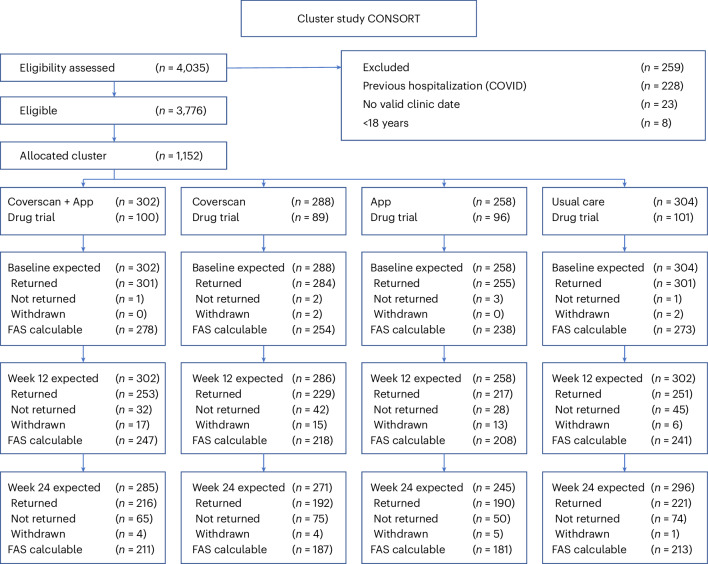
Combining multidisciplinary care plans into integrated care pathways (ICPs) is scalable, generalizable and effective for several long-term conditions, but not evaluated in Long COVID (LC). Our phase 3, cluster-randomized, multicenter clinical trial investigated the effectiveness of ICP interventions for LC. Recruitment of adults ≥18 years with LC was conducted in 6 National Health Service LC clinics in England with specialist ICPs. The intervention arms were (i) multi-organ magnetic resonance imaging (MRI; Coverscan), (ii) digital rehabilitation (Living with COVID Recovery), (iii) both multi-organ MRI and digital rehabilitation, and (iv) neither multi-organ MRI nor digital rehabilitation (usual care); cluster randomizing at primary care network (PCN) level to deliver interventions as ‘standard of care’ in that area. The primary endpoint was mean Fatigue Assessment Scale (FAS) at 12 weeks. Secondary endpoints included FAS at 24 weeks and EQ-5D-5L visual assessment scale at 12 and 24 weeks. A total of 1,152 participants from allocated PCNs consented to data collection, and 122 PCN clusters were allocated to the multi-organ MRI (33 PCNs), digital rehabilitation (32 PCNs), ‘both’ (27 PCNs) and ‘neither’ (30 PCNs) arms. Baseline FAS was equivalent across groups (mean 35.8, s.d. 8.21, 66.4% female). Overall, the primary outcome was achieved in all arms, with scores improving by 4.5 points to 31.3 (s.d. 9.31) at 12 weeks. Compared with usual care, effects on 12-week FAS were −0.18 (95% confidence interval −0.72, 1.09; P = 0.69) with multi-organ MRI; −0.53 (−1.42, 0.36; P = 0.25) with digital rehabilitation; and −0.17 (−1.06, 0.72; P = 0.71) with their interaction. Absolute differences for other interventions from usual care were modest. There were no serious adverse events related to ICP interventions. Multidisciplinary holistic clinical care is associated with fatigue reduction in LC, irrespective of multi-organ MRI. Digital rehabilitation could be useful in longer-term LC management. Large, multi-site trials of optimal ICP interventions are feasible, but further trials are required. ISRCTN identifier: ISRCTN10665760 .
Overview
CoChat Summary
TL;DR
In a phase 3 cluster-randomized trial in 1,152 adults with Long COVID across six NHS clinics, specialist integrated care was associated with reduced fatigue, but adding multi-organ MRI and/or digital rehabilitation did not significantly improve 12-week fatigue versus usual care. Digital rehabilitation showed small 24-week improvements in fatigue and quality of life of uncertain clinical significance.
Key findings
- Baseline mean FAS was 35.8 (s.d. 8.21); 66.4% were female. Overall FAS improved by 4.5 points to 31.3 (s.d. 9.31) at 12 weeks; 59% of 870 participants with baseline and 12-week FAS experienced a clinically important drop of at least 3 points.
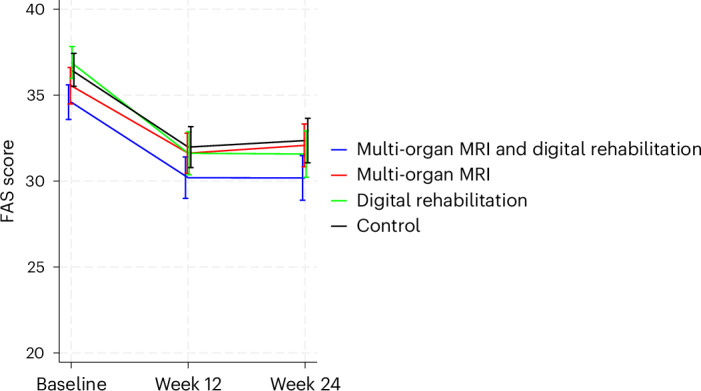
- Compared with usual care, 12-week FAS differences were −0.18 (95% CI −0.72, 1.09; P = 0.69) for multi-organ MRI, −0.53 (−1.42, 0.36; P = 0.25) for digital rehabilitation, and −0.17 (−1.06, 0.72; P = 0.71) for their interaction; none were significant.
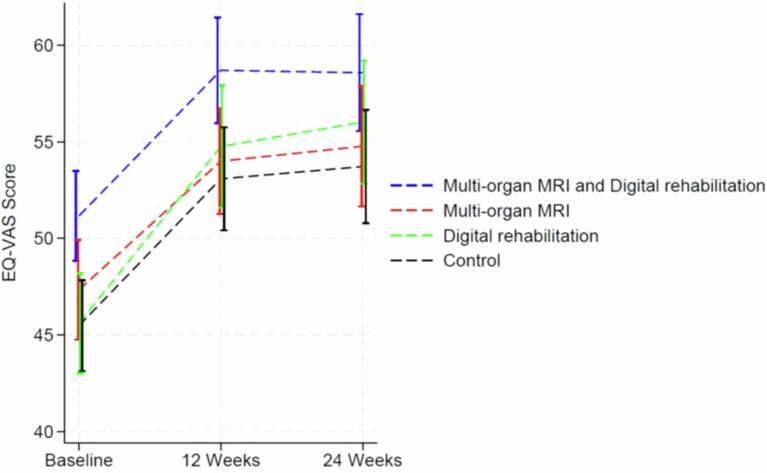
- At 24 weeks, digital rehabilitation was associated with FAS difference −1.14 (95% CI −2.12, −0.16; P = 0.023) and EQ-VAS difference 2.74 (0.07, 5.41; P = 0.045); multi-organ MRI and the interaction were not significant. No serious adverse events were related to ICP interventions (4 SAEs in 4 ICP participants, none related).
Methods
- Phase 3, cluster-randomized, multicenter, 2 × 2 factorial trial in adults ≥18 years with Long COVID at six NHS Long COVID clinics in England; 1,152 participants consented from 122 PCNs allocated to multi-organ MRI (33 PCNs), digital rehabilitation (32), both (27), or neither/usual care (30).
- Interventions were multi-organ MRI (Coverscan) and/or digital rehabilitation (Living with COVID Recovery) added to NHS guideline-based specialist LC care; primary endpoint was mean FAS at 12 weeks, with secondary outcomes including FAS at 24 weeks and EQ-5D-5L VAS at 12 and 24 weeks.
- Primary analysis used multilevel/linear regression with PCN/site effects, adjusted for baseline FAS, gender, PCN size, deprivation, and drug-trial participation; 870 participants with baseline and 12-week FAS were included in the linear regression.
Limitations
- Stated: the trial could not control for interactions between drug allocation and ICP components for the minority co-enrolled in the nested drug trial due to lower-than-expected recruitment; it was designed in 2021 without fully anticipating viral variants, repeat infections, vaccine updates, policy, service landscape, and resource constraints, causing variability in intervention delivery across sites.
- Stated: full evaluation of all ICP components requires clinical and health economic data still to be completed; investigators and participants were unblinded, analyst blinding was impractical; adverse events were not routinely recorded for those not in the drug trial; the 24-week digital rehabilitation effect is a secondary, hypothesis-generating outcome of uncertain clinical significance; a minimal clinically important difference for FAS is not confirmed in LC; power was very low for abnormal versus normal Coverscan comparison.
- Text-evident: cluster randomization at PCN level with individual consent for data collection may introduce selection/recruitment differences; no non-ICP control arm was considered impractical and unethical, so the trial cannot isolate the NHS ICP’s own efficacy.
Model-written summary. Check it against the paper before relying on it.
Integrity signals
Registry
Cites
Statistics
Figures
Verification
Claims the paper makes
0 Valid · 0 Not valid · 28 Not checked · 64 Own results and interpretations
A result the paper reports from its own data — it cites no other source for it, so there is none to check. The quote shows it is in the paper.
In the paper
“Regression analyses restricted to those with a Coverscan showed almost no difference in FAS at 12 and 24 weeks between those with site-reported abnormal and normal scans, although power was very low for this comparison.”
§ Integrated care pathway in individuals with Long COVID: STIMULATE-ICP, a cluster-randomized, phase 3 trial > Results > Post hoc analyses
plain- Asserted: passes — The authors put it forward as true.
- Checkable: passes — It can be checked against evidence.
- Load-bearing: unclear — It is unclear whether the paper’s conclusions depend on it.
- Based: passes — The paper gives a reason why it holds.
A result the paper reports from its own data — it cites no other source for it, so there is none to check. The quote shows it is in the paper.
In the paper
“Overall, we observed a 12.6% FAS reduction from a high baseline.”
§ Integrated care pathway in individuals with Long COVID: STIMULATE-ICP, a cluster-randomized, phase 3 trial > Discussion
plainstates a cause- Asserted: passes — The authors put it forward as true.
- Checkable: passes — It can be checked against evidence.
- Load-bearing: passes — The paper’s conclusions depend on it.
- Based: passes — The paper gives a reason why it holds.
A result the paper reports from its own data — it cites no other source for it, so there is none to check. The quote shows it is in the paper.
In the paper
“FAS scores at 24 weeks compared with usual care for multi-organ MRI, digital rehabilitation and their interaction were 0.43 (−0.57, 1.43; P = 0.398), −1.14 (−2.12, −0.16; P = 0.023) and −0.23 (−1.21, 0.76; P = 0.651; Table 4).”
§ Integrated care pathway in individuals with Long COVID: STIMULATE-ICP, a cluster-randomized, phase 3 trial > Results > Patient disposition
plain- Asserted: passes — The authors put it forward as true.
- Checkable: passes — It can be checked against evidence.
- Load-bearing: unclear — It is unclear whether the paper’s conclusions depend on it.
- Based: passes — The paper gives a reason why it holds.
A result the paper reports from its own data — it cites no other source for it, so there is none to check. The quote shows it is in the paper.
In the paper
“This observed difference between treatment groups of 1.14 points on FAS was statistically significant but may not be clinically meaningful.”
§ Integrated care pathway in individuals with Long COVID: STIMULATE-ICP, a cluster-randomized, phase 3 trial > Discussion
plain- Asserted: passes — The authors put it forward as true.
- Checkable: passes — It can be checked against evidence.
- Load-bearing: unclear — It is unclear whether the paper’s conclusions depend on it.
- Based: passes — The paper gives a reason why it holds.
A result the paper reports from its own data — it cites no other source for it, so there is none to check. The quote shows it is in the paper.
In the paper
“FAS scores at 24 weeks compared with usual care for multi-organ MRI, digital rehabilitation and their interaction were 0.43 (−0.57, 1.43; P = 0.398), −1.14 (−2.12, −0.16; P = 0.023) and −0.23 (−1.21, 0.76; P = 0.651; Table 4).”
§ Integrated care pathway in individuals with Long COVID: STIMULATE-ICP, a cluster-randomized, phase 3 trial > Results > Patient disposition
plain- Asserted: passes — The authors put it forward as true.
- Checkable: passes — It can be checked against evidence.
- Load-bearing: passes — The paper’s conclusions depend on it.
- Based: passes — The paper gives a reason why it holds.
40 more claims
Create a free account to see all 92 claims and to verify the 56 references still open.
- It may state two separate claims as one. 26
- Probably not a substantial claim. 35
Self-check
Percentages, sums and reported differences re-computed from the paper’s own numbers.
Each contradiction between two passages listed here was confirmed by an independent check.
Rated minor: it would not touch a result — a value no result rests on, a p-value that stays on the same side of the significance level, or a conflict that is clerical, resolved elsewhere in the paper, or outside its own findings.
In the paper
§ Integrated care pathway in individuals with Long COVID: STIMULATE-ICP, a cluster-randomized, phase 3 trial > Abstract
“Compared with usual care, effects on 12-week FAS were −0.18 (95% confidence interval −0.72, 1.09; P = 0.69) with multi-organ MRI”
§ Integrated care pathway in individuals with Long COVID: STIMULATE-ICP, a cluster-randomized, phase 3 trial > Results > Patient disposition
“compared with usual care, estimated FAS at 12 weeks for multi-organ MRI, digital rehabilitation and their interaction differed by 0.18 (95% CI −0.72, 1.09; P = 0.691)”
Rated minor: it would not touch a result — a value no result rests on, a p-value that stays on the same side of the significance level, or a conflict that is clerical, resolved elsewhere in the paper, or outside its own findings.
In the paper
§ Integrated care pathway in individuals with Long COVID: STIMULATE-ICP, a cluster-randomized, phase 3 trial > Methods > Statistical analysis
“The interaction term being significant would suggest that any improvement in FAS from the offer of digital rehabilitation is similar, whether or not MRI is offered.”
§ Integrated care pathway in individuals with Long COVID: STIMULATE-ICP, a cluster-randomized, phase 3 trial > Results > Patient disposition
“The last of these shows whether the effect of the offer of digital rehabilitation on FAS differed according to whether MRI had been offered.”
Citations
Cites
Vos, T., Lim, S. S., Abbafati, C., Abbas, K. M., Abbasi, M., Abbasifard, M., Abbasi-Kangevari, M., Abbastabar, H., Abd-Allah, F., Abdelalim, A., et al. (2020) · The Lancet · doi:10.1016/s0140-6736(20)30925-9 · Cited by 19,358
Dexamethasone in Hospitalized Patients with Covid-19
The RECOVERY Collaborative Group (2021) · New England Journal of Medicine · doi:10.1056/nejmoa2021436 · Cited by 11,477
Long COVID: major findings, mechanisms and recommendations
Davis, H. E., McCorkell, L., Vogel, J. M., & Topol, E. J. (2023) · Nature Reviews Microbiology · doi:10.1038/s41579-022-00846-2 · Cited by 4,153
Consort 2010 statement: extension to cluster randomised trials
Campbell, M. K., Piaggio, G., Elbourne, D. R., Altman, D. G., & for the CONSORT Group (2012) · BMJ · doi:10.1136/bmj.e5661 · Cited by 3,510
Characterizing long COVID in an international cohort: 7 months of symptoms and their impact
Davis, H. E., Assaf, G. S., McCorkell, L., Wei, H., Low, R. J., Re'em, Y., Redfield, S., Austin, J. P., & Akrami, A. (2021) · eClinicalMedicine · doi:10.1016/j.eclinm.2021.101019 · Cited by 2,881
CONSORT 2025 statement: updated guideline for reporting randomised trials
Hopewell, S., Chan, A.-W., Collins, G. S., Hróbjartsson, A., Moher, D., Schulz, K. F., Tunn, R., Aggarwal, R., Berkwits, M., Berlin, J. A., et al. (2025) · BMJ · doi:10.1136/bmj-2024-081123 · Cited by 1,195 · cited 1×
“CONSORT 2025 guidelines were followed, as well as the CONSORT cluster-randomized trial extension 51,52 (Supplementary Information, pp. 249–255).”
Post-covid syndrome in individuals admitted to hospital with covid-19: retrospective cohort study
Ayoubkhani, D., Khunti, K., Nafilyan, V., Maddox, T., Humberstone, B., Diamond, I., & Banerjee, A. (2021) · BMJ · doi:10.1136/bmj.n693 · Cited by 832
Self-citationThe effects of integrated care: a systematic review of UK and international evidence
Baxter, S., Johnson, M., Chambers, D., Sutton, A., Goyder, E., & Booth, A. (2018) · BMC Health Services Research · doi:10.1186/s12913-018-3161-3 · Cited by 678
Heterogeneous aging across multiple organ systems and prediction of chronic disease and mortality
Tian, Y. E., Cropley, V., Maier, A. B., Lautenschlager, N. T., Breakspear, M., & Zalesky, A. (2023) · Nature Medicine · doi:10.1038/s41591-023-02296-6 · Cited by 618 · cited 5×
“Participants reported long symptom duration and severe fatigue at baseline with consistent Multi-organ imaging could identify aging and chronic diseases early in trajectories of several LTCs 30 .”
InfluentialDennis, A., Wamil, M., Alberts, J., Oben, J., Cuthbertson, D. J., Wootton, D., Crooks, M., Gabbay, M., Brady, M., Hishmeh, L., et al. (2021) · BMJ Open · doi:10.1136/bmjopen-2020-048391 · Cited by 560
Self-citation
Metadata
- Authors
- STIMULATE-ICP Consortium, Writing Group, Banerjee, A., Prescott, G., Wall, E., Watkins, C. L., Heightman, M., Consortium, Gibbon, A., Butt, A.-T., Sarna, A., Manzelat, A., Viswanathan, A., Dennis, A., Clegg, A., Williams, A., Green, A., Parabita, A., Loveless, A., Chandra, A., Dashtban, A., Latchford, C., Adams-Heath, C., Robson, C., van der Feltz-Cornelis, C. M., Brown, C., Hooper, C., Cuthbertson, D., Wootton, D., Strain, W. D., Sunkersing, D., Ravindran, D., Forshaw, D., Clutterbuck, D., Foley, E., Bax, E., Murray, E., Attree, E., Fraser, E., Mi, E., Begum, F., Mutesva, F., Gambino, F., Allsopp, G., Lip, G. Y. H., Dehbi, H.-M., Wang, H.-I., Grice, H., Goodfellow, H., Montgomery, H., Selejan, I. L., Sahota, J., Prashar, J., Scott, J., Hayer, J., Sweetman, J., Peel, J., Wright, J., Waywell, J., Newton, J., Khunti, K., Hildick, K., Horstmanshof, K., Khan, K., Balasundaram, K., Pasea, L., O’Mahoney, L., Fisher, L., Hishmeh, L., Leahy, M., Gomes, M., Pantelic, M., Gabbay, M., Burns, M. R., Leach, M., Ramasawmy, M., Crooks, M., Zandi, M., Mohamed, M., Kryvutenko, N., Smith, N., Williams, N., Alwan, N. A., Sherwood, O., Medina, P. F., Lorgelly, P., Cumberlidge, P., Evans, R. A., Botell, R., Hext, R., Nyam, R., Williams, R., Banerjee, R., Livingston, R., Mallinson, R., Bell, R., Suriano, R., Eccles, S., Clegg, S., Burchell-Kirk, S., Equi, S., Cone, S., Elliott-Cooper, T., Hillman, T., Kailayanathan, T., Benedetto, V., & Mu, Y.
- Affiliations
- University College London (GB)
- University of Lancashire (GB)
- The Francis Crick Institute (GB)
- University College London Hospitals NHS Foundation Trust (GB)
- Tameside Hospital (GB)
- Royal Free London NHS Foundation Trust (GB)
- Northern General Hospital (GB)
- Perspectum Ltd. (United Kingdom) (GB)
- Hull Royal Infirmary (GB)
- Derbyshire Community Health Services NHS Foundation Trust (GB)
- University of York (GB)
- University of Liverpool (GB)
- University of Exeter (GB)
- University of Southampton (GB)
- Worthing Hospital (GB)
- John Radcliffe Hospital (GB)
- NHS England (GB)
- Department for Work and Pensions (GB)
- Barts Health NHS Trust (GB)
- University of Leicester (GB)
- Princess Alexandra Hospital NHS Trust (GB)
- Leicester Royal Infirmary (GB)
- University of Sussex (GB)
- University of Hull (GB)
- University of Auckland (NZ)
- Royal Devon & Exeter NHS Foundation Trust (GB)
- Corresponding author
- Banerjee, Amitava
- ORCID
- Banerjee, Amitava
- Wall, Emma
- Watkins, Caroline Leigh
- Heightman, Melissa
- Butt, Al-Tahoor
- Clegg, Andrew
- Williams, Andrew
- Green, Angela
- Chandra, Anu
- Latchford, Charles
- Robson, Chris
- Wootton, Dan
- Strain, William David
- Sunkersing, David
- Forshaw, Denise
- Clutterbuck, Donna
- Bax, Elena
- Murray, Elizabeth
- Fraser, Emily
- Mi, Emma
- Lip, Gregory Y. H.
- Dehbi, Hakim-Moulay
- Goodfellow, Henry
- Montgomery, Hugh
- Selejan, Ileana L.
- Sahota, Jagdeep
- Prashar, Jai
- Sweetman, Jennifer
- Peel, Joanna
- Waywell, Jonathan
- Khunti, Kamlesh
- Balasundaram, Kumaran
- Pasea, Laura
- Hishmeh, Lyth
- Gomes, Manuel
- Pantelic, Marija
- Gabbay, Mark
- Ramasawmy, Mel
- Zandi, Michael
- Mohamed, Mohamed
- Williams, Nefyn
- Alwan, Nisreen A.
- Sherwood, Ondine
- Lorgelly, Paula
- Evans, Rachael A.
- Banerjee, Rajarshi
- Eccles, Samantha
- Hillman, Toby
- Benedetto, Valerio
- Mu, Yi
- Venue
- Nature Medicine
- Published
- 2026-07-28
- Volume
- 32
- Issue
- 8
- Pages
- 3040-3047
- ISSN
- 1078-8956 (ISSN-L)
- 1546-170X
- PMC
- PMC13472957
- OpenAlex
- W7171516878
- Cited by
- 0
- References
- 50
- FWCI
- 0.00
- Type
- journal article
- Language
- en
- Open access
- hybrid
- doi.org
- Licence
- cc-by
- creativecommons.org/licenses/by/4.0 (tdm)
- creativecommons.org/licenses/by/4.0 (vor)
- Locations
- Nature Medicine (publishedVersion, cc-by)
- PubMed Central (publishedVersion, cc-by)
- PubMed (publishedVersion)
- CLOK (University of Central Lancashire) (acceptedVersion, cc-by)
- White Rose Research Online (University of Leeds, The University of Sheffield, University of York) (acceptedVersion, cc-by)
- ePrints Soton (University of Southampton) (acceptedVersion)
- ResearchSpace (University of Auckland) (submittedVersion, cc-by)
- Funders
- DH | National Institute for Health Research (COV-LT2-0043)
- Topics
- Health Sciences › Medicine › Clinical Neurology › Long-Term Effects of COVID-19
- Health Sciences › Health Professions › Physical Therapy, Sports Therapy and Rehabilitation › Medical Practices and Rehabilitation
- Health Sciences › Medicine › Infectious Diseases › COVID-19 Clinical Research Studies
- Keywords
- long COVID, integrated care pathways, fatigue, digital rehabilitation, multidisciplinary care, holistic care, post-COVID-19 recovery, quality of life, primary care
- MeSH terms
- SARS-CoV-2, Post-Acute COVID-19 Syndrome, Adult, Aged, England, Fatigue, Female, Humans, Magnetic Resonance Imaging, Male, Middle Aged, Primary Health Care, Delivery of Health Care, Integrated, Pandemics
About these checks
Registry, retraction, Cites and statistics results are computed, not judged, with one exception: a printed reference that no index lists is read once by a model before it counts as a citation error. Claims are extracted by a model and kept only when their quote appears verbatim in the text; each cited source is then checked, with a model’s help, for whether it says what the claim relies on. Those verdicts can be wrong — read the claim’s quote and the cited source before relying on one.
A language model drew the claims from the paper on 2026-11-28, under version 3 of the claim definition (model deepseek-v4.1-flash, prompt extract-v3).
A second model labelled each claim on 2026-11-28 (model jev-1.13-20260917, definition revision gold-guideline-v0.2).
Statistics and arithmetic are recomputed, not judged.
Confidence bands are shown only for fields calibrated on our annotated test set. None is calibrated yet, so no band is shown.
What counts as a claim ›How we measure confidence ›How we check this ›
Are you an author, or do you see a problem with this page? Request a review
Data sources
Bibliographic data: Semantic Scholar, OpenAlex, Crossref.
Contains information from the Semantic Scholar Academic Graph Datasets, made available under the ODC Attribution License (ODC-BY 1.0).
Semantic Scholar’s data is described in: Kinney, R., et al. (2023). The Semantic Scholar Open Data Platform. arXiv:2301.10140.
