

The DOI matches its Crossref record; 124 of the 124 references it cites were found in a registry or an index.
Organizing memories for generalization in complementary learning systems
Open accessPublished version of a preprint
Abstract
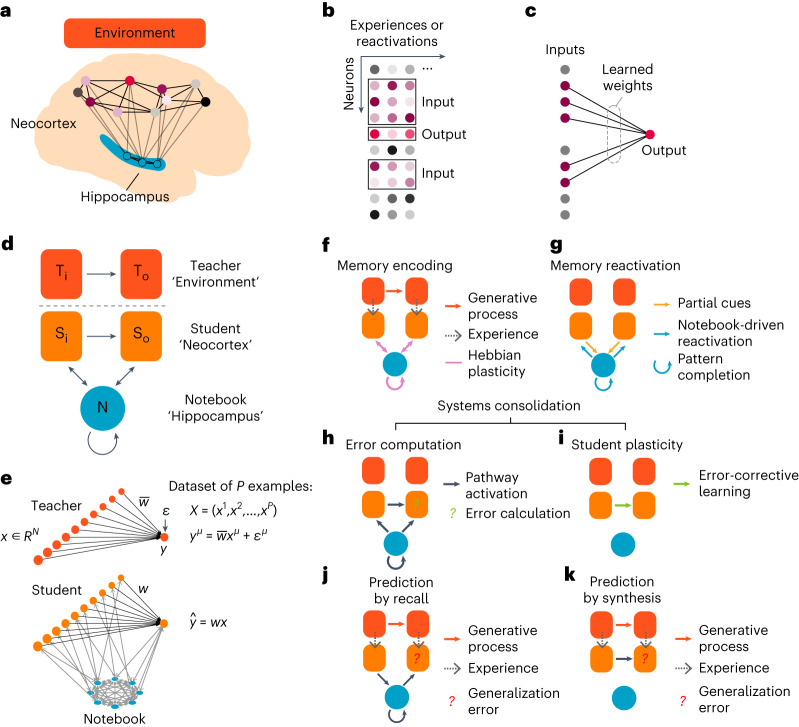
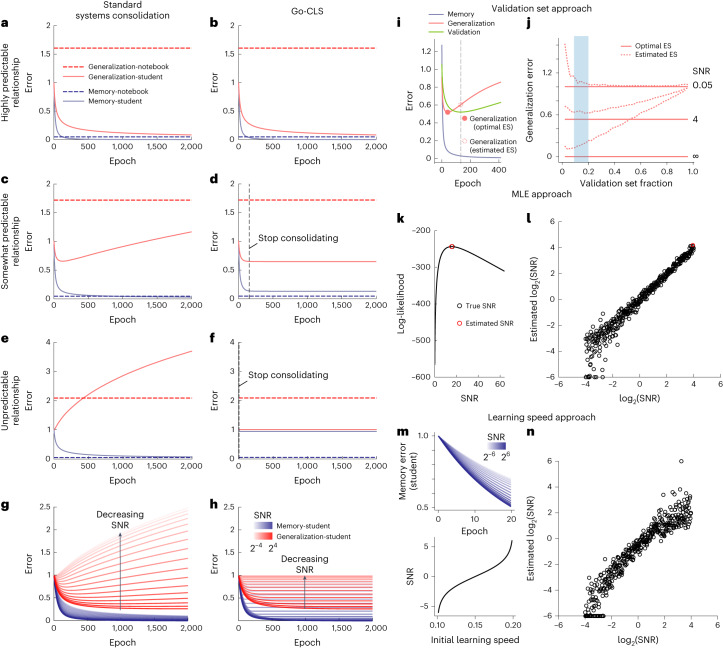
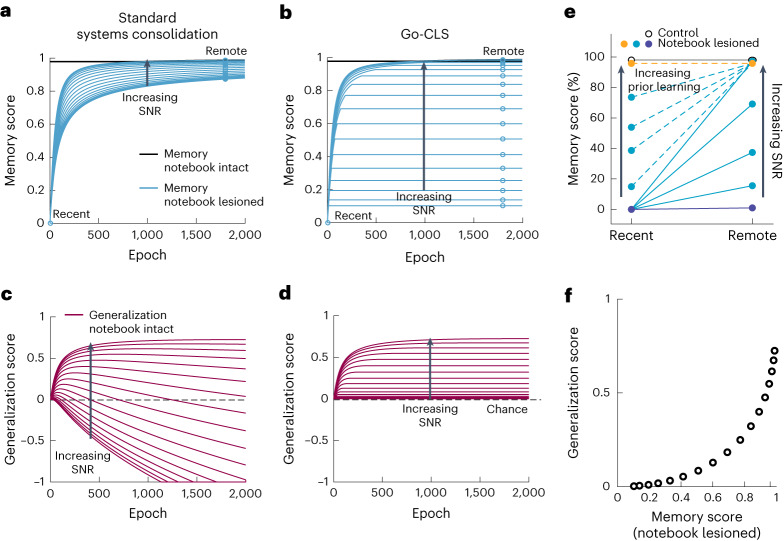
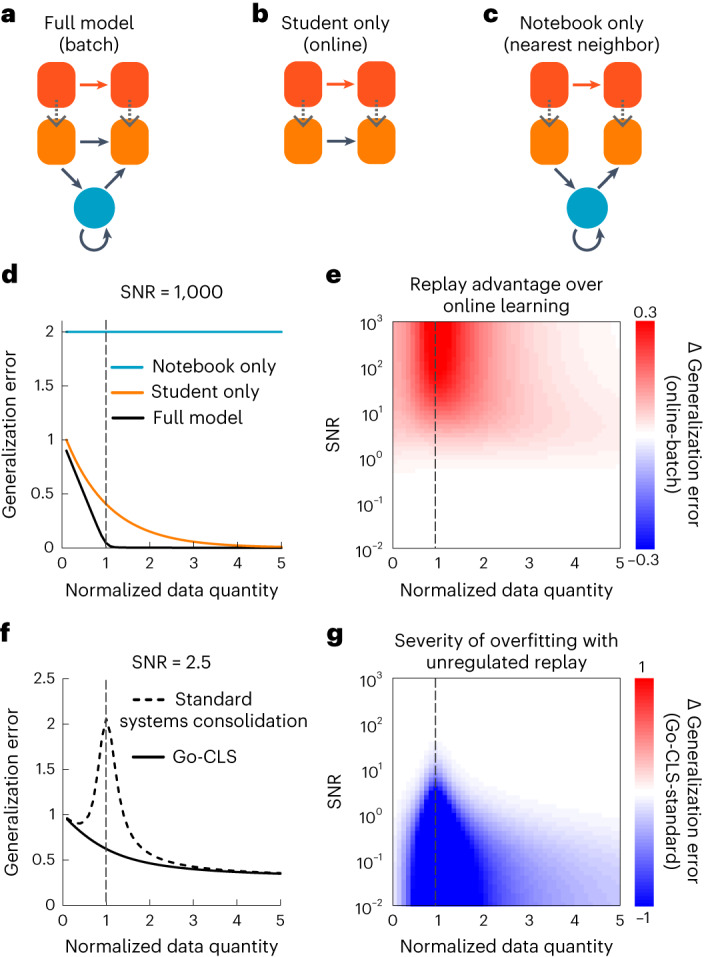
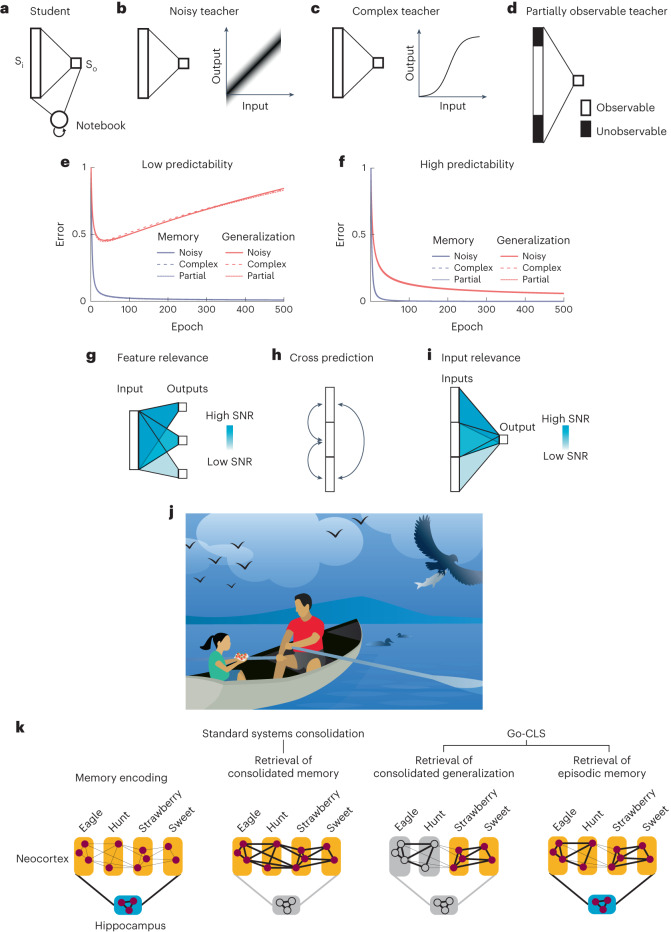
Memorization and generalization are complementary cognitive processes that jointly promote adaptive behavior. For example, animals should memorize safe routes to specific water sources and generalize from these memories to discover environmental features that predict new ones. These functions depend on systems consolidation mechanisms that construct neocortical memory traces from hippocampal precursors, but why systems consolidation only applies to a subset of hippocampal memories is unclear. Here we introduce a new neural network formalization of systems consolidation that reveals an overlooked tension—unregulated neocortical memory transfer can cause overfitting and harm generalization in an unpredictable world. We resolve this tension by postulating that memories only consolidate when it aids generalization. This framework accounts for partial hippocampal–cortical memory transfer and provides a normative principle for reconceptualizing numerous observations in the field. Generalization-optimized systems consolidation thus provides new insight into how adaptive behavior benefits from complementary learning systems specialized for memorization and generalization.
Overview
The claims and statistics of this paper haven’t been checked yet.
Run the check — free, no account needed. It reads the open-access text and checks the sources it cites.
Integrity signals
Registry
Cites
Statistics
Figures
Verification
Claims the paper makes
The claims and statistics of this paper haven’t been checked yet.
Run the check — free, no account needed. It reads the open-access text and checks the sources it cites.
Claims other papers make about this one
Each is checked against this paper’s own text: does it say what the citing paper says it does?
The source backs part of the claim, not all of it — or backs it for a different population, condition or comparison.
In the citing paper
“Schema formation is beneficial when new evidence fits existing structure (Tse et al., 2007), but harmful when it is non-selective or poorly controlled: nonselective consolidation causes interference and loss of specificity (McClelland et al., 1995; Sun et al., 2023).”
From Useful Memories Become Faulty When Continuously Updated by LLMs (2026) · cites this paper as Sun et al., 2023
Experimental — accuracy not yet measuredThe source backs part of the claim, not all of it — or backs it for a different population, condition or comparison.
In the citing paper
“Together, these failure modes weaken the boundary between what should be generalized, what should remain task-specific, and what should be preserved as raw episodic evidence (Sun et al., 2023; Bartlett, 1932; Brainerd and Reyna, 2002).”
From Useful Memories Become Faulty When Continuously Updated by LLMs (2026) · cites this paper as Sun et al., 2023
Experimental — accuracy not yet measured
Self-check
Percentages, sums and reported differences re-computed from the paper’s own numbers.
The self-check needs the paper’s full text.
Citations
Cites
Deep Residual Learning for Image Recognition
He, K., Zhang, X., Ren, S., & Sun, J. (2016) · 2016 IEEE Conference on Computer Vision and Pattern Recognition (CVPR) · doi:10.1109/cvpr.2016.90 · Cited by 235,474
ImageNet: A large-scale hierarchical image database
Deng, J., Dong, W., Socher, R., Li, L.-J., Li, K., & Fei-Fei, L. (2009) · 2009 IEEE Conference on Computer Vision and Pattern Recognition · doi:10.1109/cvpr.2009.5206848 · Cited by 65,333
Gradient-based learning applied to document recognition
Lecun, Y., Bottou, L., Bengio, Y., & Haffner, P. (1998) · Proceedings of the IEEE · doi:10.1109/5.726791 · Cited by 58,805
Learning representations by back-propagating errors
Rumelhart, D. E., Hinton, G. E., & Williams, R. J. (1986) · Nature · doi:10.1038/323533a0 · Cited by 31,892
Human-level control through deep reinforcement learning
Mnih, V., Kavukcuoglu, K., Silver, D., Rusu, A. A., Veness, J., Bellemare, M. G., Graves, A., Riedmiller, M., Fidjeland, A. K., Ostrovski, G., et al. (2015) · Nature · doi:10.1038/nature14236 · Cited by 30,357
Tversky, A., & Kahneman, D. (1974) · Science · doi:10.1126/science.185.4157.1124 · Cited by 28,810
The Elements of Statistical Learning
Hastie, T., Tibshirani, R., & Friedman, J. (2009) · Springer Series in Statistics · doi:10.1007/978-0-387-84858-7 · Cited by 25,970
Learning Multiple Layers of Features from Tiny Images
Krizhevsky, A. (2024) · doi:10.57702/zp44cu3g · Cited by 23,889
Judgment under Uncertainty: Heuristics and Biases
Tversky, A., & Kahneman, D. (1975) · Utility, Probability, and Human Decision Making · doi:10.1007/978-94-010-1834-0_8 · Cited by 22,650
Neural networks and physical systems with emergent collective computational abilities.
Hopfield, J. J. (1982) · Proceedings of the National Academy of Sciences · doi:10.1073/pnas.79.8.2554 · Cited by 19,270
Research works printed but not linked: 3
- MacKay, D. J. C. Information Theory, Inference and Learning Algorithms (Cambridge University Press, 2003).
- Srivastava, N., Hinton, G., Krizhevsky, A., Sutskever, I. & Salakhutdinov, R. Dropout: a simple way to prevent neural networks from overfitting. J. Mach. Learn. Res. 15, 1929–1958 (2014).
- Pezeshki, M., Mitra, A., Bengio, Y. & Lajoie, G. Multi-scale feature learning dynamics: insights for double descent. In Proceedings of the 39th International Conference on Machine Learning (Eds. Chaudhuri, K. et al.) 17669–17690 (PMLR, 2022).
Cited by
Sorted by citations
Replay and compositional computation
Kurth-Nelson, Z. L., Behrens, T. E. J., Wayne, G., Miller, K. J., Luettgau, L., Dolan, R. J., Liu, Y., & Schwartenbeck, P. (2023) · Neuron · doi:10.1016/j.neuron.2022.12.028 · Cited by 100
A generative model of memory construction and consolidation
Spens, E., & Burgess, N. (2024) · Nature Human Behaviour · doi:10.1038/s41562-023-01799-z · Cited by 122
Singh, D., Norman, K. A., & Schapiro, A. C. (2022) · Proceedings of the National Academy of Sciences · doi:10.1073/pnas.2123432119 · Cited by 81
Boosting generalization of fine-tuning BERT for fake news detection
Qin, S., & Zhang, M. (2024) · Information Processing & Management · doi:10.1016/j.ipm.2024.103745 · Cited by 54
Beyond hippocampus: Thalamic and prefrontal contributions to an evolving memory
Yadav, N., Toader, A. C., & Rajasethupathy, P. (2024) · Neuron · doi:10.1016/j.neuron.2023.12.021 · Cited by 31
Associative memory of structured knowledge
Steinberg, J., & Sompolinsky, H. (2022) · Scientific Reports · doi:10.1038/s41598-022-25708-y · Cited by 30
Shin, J. D., & Jadhav, S. P. (2024) · Current Biology · doi:10.1016/j.cub.2024.05.018 · Cited by 29
Learning produces a hippocampal cognitive map in the form of an orthogonalized state machinePreprint
Sun, W., Winnubst, J., Natrajan, M., Lai, C., Kajikawa, K., Michaelos, M., Gattoni, R., Stringer, C., Flickinger, D., Fitzgerald, J. E., et al. (2023) · bioRxiv (Cold Spring Harbor Laboratory) · doi:10.1101/2023.08.03.551900 · Cited by 24
Self-citationSummerfield, C. (2022) · doi:10.1093/oso/9780192843883.001.0001 · Cited by 24
Bhasin, B. J., Raymond, J. L., & Goldman, M. S. (2024) · Proceedings of the National Academy of Sciences · doi:10.1073/pnas.2406010121 · Cited by 21
The relational bottleneck as an inductive bias for efficient abstraction
Webb, T. W., Frankland, S., Altabaa, A., Segert, S., Krishnamurthy, K., Campbell, D. I., Russin, J., Giallanza, T., O’Reilly, R. C., Lafferty, J., et al. (2024) · Trends in Cognitive Sciences · doi:10.1016/j.tics.2024.04.001 · Cited by 37
Interactive Continual Learning: Fast and Slow Thinking
Qi, B., Chen, X., Gao, J., Dong, L., Liu, J., Wu, L., & Zhou, B. (2024) · IEEE Computer Society Conference on Computer Vision and Pattern Recognition/Proceedings - IEEE Computer Society Conference on Computer Vision and Pattern Recognition/Proceedings · doi:10.1109/cvpr52733.2024.01224 · Cited by 21
Replay shapes abstract cognitive maps for efficient social navigation
Son, J.-Y., Vives, M., Bhandari, A., & FeldmanHall, O. (2024) · Nature Human Behaviour · doi:10.1038/s41562-024-01990-w · Cited by 26
Mill, R. D., & Cole, M. W. (2025) · Nature Communications · doi:10.1038/s41467-025-65041-2 · Cited by 26
Learning, Fast and Slow: Single- and Many-Shot Learning in the Hippocampus
Liao, Z., & Losonczy, A. (2024) · Annual Review of Neuroscience · doi:10.1146/annurev-neuro-102423-100258 · Cited by 26
Ruffini, G., Castaldo, F., Lopez-Sola, E., Sanchez-Todo, R., & Vohryzek, J. (2024) · Entropy · doi:10.3390/e26110953 · Cited by 20
Inhibitory plasticity supports replay generalization in the hippocampus
Liao, Z., Terada, S., Raikov, I., Hadjiabadi, D. H., Szoboszlay, M., Soltész, I., & Losonczy, A. (2024) · Nature Neuroscience · doi:10.1038/s41593-024-01745-w · Cited by 14
General pre-trained inertial signal feature extraction based on temporal memory fusion
Wang, Y., & Zhao, Y. (2025) · Information Fusion · doi:10.1016/j.inffus.2025.103274 · Cited by 14
Hippocampal and orbitofrontal neurons contribute to complementary aspects of associative structure
Lin, H., & Zhou, J. (2024) · Nature Communications · doi:10.1038/s41467-024-49652-9 · Cited by 17
Han, P., Huang, X., Fang, Y., & Han, G. (2025) · IEEE Transactions on Network Science and Engineering · doi:10.1109/tnse.2025.3572362 · Cited by 11
The Neural Representation of Events Is Dominated by Elements that Are Most Reliably Present
Bromis, K., Raykov, P., Wickens, L., Roseboom, W., & Bird, C. M. (2021) · Journal of Cognitive Neuroscience · doi:10.1162/jocn_a_01802 · Cited by 11
Structural and Functional Properties of Hippocampal Neurons
Spruston, N., Piskorowski, R. A., Chevaleyre, V., Eyre, M. D., McBain, C. J., & Bartos, M. (2025) · Oxford University Press eBooks · doi:10.1093/med/9780190065324.003.0005 · Cited by 11
Self-citationAI As Artificial Memory: A Global Reconfiguration of Our Collective Memory Practices?
Schuh, J. (2024) · Memory Studies Review · doi:10.1163/29498902-202400012 · Cited by 10
A non-Hebbian code for episodic memory
Pang, R., & Recanatesi, S. (2025) · Science Advances · doi:10.1126/sciadv.ado4112 · Cited by 11
Adaptive compression as a unifying framework for episodic and semantic memory
Nagy, D., Orbán, G., & Wu, C. M. (2025) · Nature Reviews Psychology · doi:10.1038/s44159-025-00458-6 · Cited by 12
A comparison of hippocampal and retrosplenial cortical spatial and contextual firing patterns
Subramanian, D. L., Miller, A. M. P., & Smith, D. M. (2024) · Hippocampus · doi:10.1002/hipo.23610 · Cited by 9
A hippocampal population code for rapid generalizationPreprint
Tang, W., Chang, H., Liu, C., Perez-Hernandez, S., Zheng, W. Y., Park, J., Oliva, A., & Fernández‐Ruiz, A. (2025) · bioRxiv (Cold Spring Harbor Laboratory) · doi:10.1101/2025.03.15.643456 · Cited by 10
Neurogenesis-dependent transformation of hippocampal memory traces during systems consolidation
Golbabaei, A., Coelho, C. A. O., de Snoo, M. L., Cristofaro, A. D., Josselyn, S. A., & Frankland, P. W. (2025) · Current Biology · doi:10.1016/j.cub.2025.09.005 · Cited by 8
Li, Z., Wang, J., Tang, C., Wang, P., Ren, P., Li, S., Yi, L., Liu, Q., Sun, L., Li, K. X., et al. (2024) · Communications Biology · doi:10.1038/s42003-024-06941-9 · Cited by 8
Hippocampal-cortical interactions in the consolidation of social memory
Park, G., Kim, M. S., Lee, Y., Shin, S., Kim, S. J., Kim, S. J., Lee, Y., & Lee, Y. (2025) · Nature Communications · doi:10.1038/s41467-025-64264-7 · Cited by 7
What neuroscience can tell AI about learning in continuously changing environments
Durstewitz, D., Averbeck, B. B., & Koppe, G. (2025) · Nature Machine Intelligence · doi:10.1038/s42256-025-01146-z · Cited by 7
CrowdTransfer: Enabling Crowd Knowledge Transfer in AIoT Community
Liu, Y., Guo, B., Li, N., Ding, Y., Zhang, Z., & Yu, Z. (2024) · IEEE Communications Surveys & Tutorials · doi:10.1109/comst.2024.3423319 · Cited by 13
An abstract relational map emerges in the human medial prefrontal cortex with consolidation
Baram, A. B., Nili, H., Barreiros, I. V., Samborska, V., Behrens, T. E. J., & Garvert, M. M. (2026) · Current Biology · doi:10.1016/j.cub.2026.05.068 · Cited by 10
The Problem-Ladenness of Theory
Levenstein, D., Santo, A. D., Heijnen, S., Narayan, M., Maatman, F. O., Rawski, J., & Wright, C. (2024) · Computational Brain & Behavior · doi:10.1007/s42113-024-00219-3 · Cited by 6
Percept, Memory, and Imagine: World Feature Simulating for Open-Domain Unknown Object Detection
Wu, A., & Deng, C. D. (2025) · IEEE Computer Society Conference on Computer Vision and Pattern Recognition/Proceedings - IEEE Computer Society Conference on Computer Vision and Pattern Recognition/Proceedings · doi:10.1109/cvpr52734.2025.00441 · Cited by 5
Bio-inspired cognitive navigation for robots
Hao, Z., Guo, B., Ding, Y., Li, L., Liu, S., Gao, T., Liu, S., & Yu, Z. (2026) · Nature Reviews Electrical Engineering · doi:10.1038/s44287-026-00294-7 · Cited by 5
Selective consolidation of learning and memory via recall-gated plasticity
Lindsey, J. W., & Litwin-Kumar, A. (2023) · eLife · doi:10.7554/elife.90793 · Cited by 8
A unifying account of replay as context-driven memory reactivation
Zhou, Z., Kahana, M. J., & Schapiro, A. C. (2026) · eLife · doi:10.1101/2023.03.22.533833 · Cited by 7
A unifying account of replay as context-driven memory reactivationPreprint
Zhou, Z., Kahana, M. J., & Schapiro, A. C. (2024) · eLife · doi:10.7554/elife.99931.1 · Cited by 5
Curriculum effects in multitask learning through the lens of contextual inference
Shivkumar, S., Lengyel, M., & Wolpert, D. M. (2025) · Current Opinion in Neurobiology · doi:10.1016/j.conb.2025.103123 · Cited by 5
Working memory of cognitive systems: modes of existence, models, and evaluation criteria
Gribkov, A. A., & Zelenskii, A. A. (2025) · Психология и Психотехника · doi:10.7256/2454-0722.2025.4.77077 · Cited by 4
Segregation-to-integration transformation model of memory evolution
Bavassi, L., & Fuentemilla, L. (2024) · Network Neuroscience · doi:10.1162/netn_a_00415 · Cited by 4
Hippocampo-neocortical interaction as compressive retrieval-augmented generation
Spens, E., & Burgess, N. (2026) · Nature Communications · doi:10.1038/s41467-026-74357-6 · Cited by 5
Chang, O., Ramos, L., Morocho-Cayamcela, M. E., Armas, R., & Zhinín-Vera, L. (2024) · Multimedia Tools and Applications · doi:10.1007/s11042-024-18925-2 · Cited by 3
Predictive learning as the basis of the testing effect
Chen, H., Hauspie, C., Ergo, K., Calderon, C. B., & Verguts, T. (2025) · Communications Psychology · doi:10.1038/s44271-025-00200-1 · Cited by 4
Shin, J. D., & Jadhav, S. P. (2023) · bioRxiv (Cold Spring Harbor Laboratory) · doi:10.1101/2023.12.12.571373 · Cited by 3
A unifying account of replay as context-driven memory reactivationPreprint
Zhou, Z., Kahana, M. J., & Schapiro, A. C. (2024) · eLife · doi:10.7554/elife.99931 · Cited by 7
Memory traces bias new learning for hippocampal generalizationPreprint
Qian, F. K., Li, G., Lipshutz, D., Romani, S., & Magee, J. C. (2025) · bioRxiv (Cold Spring Harbor Laboratory) · doi:10.1101/2025.11.24.690297 · Cited by 7
Larimar: Large Language Models with Episodic Memory Control
Das, P., Chaudhury, S., Nelson, E., Melnyk, I., Swaminathan, S., Dai, S., Lozano, A., Kollias, G., Chenthamarakshan, V., Jiří, et al. (2024) · arXiv · doi:10.48550/arxiv.2403.11901 · Cited by 3
Stability through plasticity: Finding robust memories through representational drift
Natrajan, M., & Fitzgerald, J. E. (2025) · Proceedings of the National Academy of Sciences · doi:10.1073/pnas.2500077122 · Cited by 4
Self-citationIntermediate-term memory mechanism inspired lightweight single image super resolution
Cheng, D., Wang, Y., Zhang, H., Li, L., Kou, Q., & Jiang, H. (2024) · Multimedia Tools and Applications · doi:10.1007/s11042-024-18471-x · Cited by 3
Computational models of learning and synaptic plasticity
Tyulmankov, D. (2025) · Elsevier eBooks · doi:10.1016/b978-0-443-15754-7.00078-x · Cited by 3
Theory of systems memory consolidation via recall-gated plasticityPreprint
Lindsey, J. W., & Litwin-Kumar, A. (2023) · eLife · doi:10.7554/elife.90793.1 · Cited by 2
Distributed learning across fast and slow neural systems supports efficient motor adaptationPreprint
Agueci, L., & Cayco-Gajic, N. A. (2025) · bioRxiv (Cold Spring Harbor Laboratory) · doi:10.1101/2025.06.01.657238 · Cited by 2
Summerfield, C. (2022) · Oxford University Press eBooks · doi:10.1093/oso/9780192843883.003.0006 · Cited by 1
Structure transfer and consolidation in visual implicit learning
Garber, D., & Fiser, J. (2025) · eLife · doi:10.1101/2024.06.20.599904 · Cited by 1
Experience reorganizes content-specific memory traces in macaques
Abbaspoor, S., Aljishi, A., & Hoffman, K. L. (2026) · Nature Neuroscience · doi:10.1038/s41593-026-02357-2 · Cited by 1
Statistical learning prioritizes abstract over item-specific representations
Zhou, M., & Tong, S. X. (2025) · Psychonomic Bulletin & Review · doi:10.3758/s13423-025-02757-8 · Cited by 1
Maor, I., Atwell, J. E., Ascher, I., Zhao, Y., Takahashi, Y. K., Hart, E. E., Pereira, F., & Schoenbaum, G. M. (2026) · Nature Communications · doi:10.1038/s41467-026-69330-2 · Cited by 1
Nasiraee, H., Nazari, F., Khodadad, F. S., & Liu, X. (2026) · Scientific Reports · doi:10.1038/s41598-026-48527-x · Cited by 1
Cluster-Based Inference for Memory-Based CognitionPreprint
Penny, W. D., Menghi, N., & Renoult, L. (2022) · bioRxiv (Cold Spring Harbor Laboratory) · doi:10.1101/2022.04.22.489185 · Cited by 1
Brain and Quantum Mechanics: the Epistemological Challenge of NeurosciencePreprint
Rossi, A. (2024) · SSRN Electronic Journal · doi:10.2139/ssrn.4801540 · Cited by 3
Structure transfer and consolidation in visual implicit learningPreprint
Garber, D., & Fiser, J. (2025) · eLife · doi:10.7554/elife.100785.2 · Cited by 1
Homeostatic Binary Networks: A simple framework for learning with overlapping patternsPreprint
Albesa-González, A., & Clopath, C. (2025) · bioRxiv (Cold Spring Harbor Laboratory) · doi:10.1101/2025.10.03.680195 · Cited by 1
Useful Memories Become Faulty When Continuously Updated by LLMs
Zhang, D., Lin, Y., Wu, Z., Sun, Y., Li, B., Li, D., & Peng, H. (2026) · arXiv · doi:10.48550/arxiv.2605.12978
Selective consolidation of learning and memory via recall-gated plasticityPreprint
Lindsey, J. W., & Litwin-Kumar, A. (2022) · bioRxiv (Cold Spring Harbor Laboratory) · doi:10.1101/2022.12.08.519638
Summerfield, C. (2022) · Oxford University Press eBooks · doi:10.1093/oso/9780192843883.003.0008
Summerfield, C. (2022) · Oxford University Press eBooks · doi:10.1093/oso/9780192843883.003.0003
Summerfield, C. (2022) · Oxford University Press eBooks · doi:10.1093/oso/9780192843883.003.0007
Summerfield, C. (2022) · Oxford University Press eBooks · doi:10.1093/oso/9780192843883.003.0002
Summerfield, C. (2022) · Oxford University Press eBooks · doi:10.1093/oso/9780192843883.003.0004
Summerfield, C. (2022) · Oxford University Press eBooks · doi:10.1093/oso/9780192843883.002.0003
Summerfield, C. (2022) · Oxford University Press eBooks · doi:10.1093/oso/9780192843883.002.0004
Summerfield, C. (2022) · Oxford University Press eBooks · doi:10.1093/oso/9780192843883.002.0006
Summerfield, C. (2022) · Oxford University Press eBooks · doi:10.1093/oso/9780192843883.003.0005
Summerfield, C. (2022) · Oxford University Press eBooks · doi:10.1093/oso/9780192843883.003.0001
Selective consolidation of learning and memory via recall-gated plasticityPreprint
Lindsey, J. W., & Litwin-Kumar, A. (2024) · eLife · doi:10.7554/elife.90793.2
Structure transfer and consolidation in visual implicit learningPreprint
Garber, D., & Fiser, J. (2024) · eLife · doi:10.7554/elife.100785.1
Structure transfer and consolidation in visual implicit learningPreprint
Garber, D., & Fiser, J. (2024) · eLife · doi:10.7554/elife.100785
(2024) · Elsevier eBooks · doi:10.1016/b978-0-443-23565-8.09996-8
Anisman, H., Hayley, S. P., & Kusnecov, A. W. (2024) · Elsevier eBooks · doi:10.1016/b978-0-443-23565-8.00010-7
Savkina, E. M., Vartanov, A., Kaverina, M. Y., Kuleva, A. Y., Галкин, М. В., & Krotkova, O. A. (2024) · Современные технологии в медицине · doi:10.17691/stm2024.16.6.01
Computational Models of Hippocampal Cognitive Function
Bush, D., & Burgess, N. (2025) · Oxford University Press eBooks · doi:10.1093/med/9780190065324.003.0016
Structure transfer and consolidation in visual implicit learningPreprint
Garber, D., & Fiser, J. (2025) · eLife · doi:10.7554/elife.100785.3
A gradient of complementary learning systems emerges through meta-learningPreprint
Zhou, Z., & Schapiro, A. C. (2025) · bioRxiv (Cold Spring Harbor Laboratory) · doi:10.1101/2025.07.10.664201 · Cited by 2
Wang, T., Zhang, M., Lu, M., & Li, M. (2025) · SSRN Electronic Journal · doi:10.2139/ssrn.5462404
Albesa-González, A., & Clopath, C. (2025) · bioRxiv (Cold Spring Harbor Laboratory) · doi:10.1101/2025.10.03.680209
Cognitive Architecture for Learning in Autonomous Agents: A Study in Discrete Navigation
Hernandez, J., Cattaneo, M. F. P., Peluffo-Ordóñez, D. H., & Flórez, H. (2025) · Communications in computer and information science · doi:10.1007/978-3-032-07175-0_1 · Cited by 1
Sleep-modulated disinhibition enables replay for memory consolidation, accelerated by ripplesPreprint
Dutta, S. (2025) · bioRxiv (Cold Spring Harbor Laboratory) · doi:10.64898/2025.12.09.693276
A unifying account of replay as context-driven memory reactivationPreprint
Zhou, Z., Kahana, M. J., & Schapiro, A. C. (2025) · eLife · doi:10.7554/elife.99931.2
Connectionist Models of Reading
Borkenhagen, M. J. C., & Cox, C. R. (2026) · Elsevier eBooks · doi:10.1016/b978-0-323-95504-1.01285-0
Tan, Y., & Wang, D. (2026) · IEEE Transactions on Industrial Informatics · doi:10.1109/tii.2026.3668807
Han, Y., Li, Z., Long, Z., & Wu, X. (2026) · IEEE International Conference on Acoustics Speech and Signal Processing · doi:10.1109/icassp55912.2026.11464913
Memory reactivation induces generalized visual learning and top-down propagated cortical plasticityPreprint
Fang, F., Song, Y., Wang, Q., & Mo, C. (2026) · Research Square · doi:10.21203/rs.3.rs-9102041/v1
Liu, C., Hao, Q., Cui, Y., Wang, Q., Zhao, Y., Zhang, L., Li, J., Zhao, Q., Lu, F., Wu, J., et al. (2026) · Journal of Neuroscience · doi:10.1523/jneurosci.2340-25.2026
REM sleep as a dummy-model of the world: A theoretical framework
Censi, S. T., Granzotto, A., & Sensi, S. L. (2026) · Progress in Neurobiology · doi:10.1016/j.pneurobio.2026.102939
Saulskaya, N. B., & Susorova, M. A. (2026) · Journal of Evolutionary Biochemistry and Physiology · doi:10.1134/s002209302603018x
Hughes, J., Doty, T. J., & Balkin, T. J. (2026) · bioRxiv (Cold Spring Harbor Laboratory) · doi:10.64898/2026.07.03.736438
Szeto, K. C. (2026) · SSRN Electronic Journal · doi:10.2139/ssrn.7170898
Relational memory structure among prior neutral episodes guides Pavlovian threat responsesPreprint
Bączkowski, B. M., & Villringer, A. (2026) · Learning & Memory · doi:10.1101/lm.054210.126
Metadata
- Authors
- Sun, W., Advani, M., Spruston, N., Saxe, A., & Fitzgerald, J. E.
- Affiliations
- Howard Hughes Medical Institute (US)
- Harvard University (US)
- Canadian Institute for Advanced Research (CA)
- Corresponding author
- Saxe, Andrew
- Fitzgerald, James E.
- Venue
- Nature Neuroscience
- Published
- 2023-07-20
- Volume
- 26
- Issue
- 8
- Pages
- 1438-1448
- ISSN
- 1097-6256 (ISSN-L)
- 1546-1726
- PMC
- PMC10400413
- OpenAlex
- W4384922492
- Cited by
- 103
- References
- 124
- Citations by year
- 2026: 21 · 2025: 30 · 2024: 30 · 2023: 5
- FWCI
- 12.85
- Type
- journal article
- Language
- en
- Open access
- hybrid
- doi.org
- Locations
- Nature Neuroscience (publishedVersion, cc-by)
- bioRxiv (Cold Spring Harbor Laboratory) (acceptedVersion)
- PubMed Central (publishedVersion, cc-by)
- PubMed (publishedVersion)
- UCL Discovery (University College London) (submittedVersion, cc-by)
- Funders
- Howard Hughes Medical Institute
- Swartz Foundation
- Wellcome Trust (216386/Z/19/Z)
- Royal Society
- Gatsby Charitable Foundation
- Swartz Foundation CIFAR Azrieli Global Scholars program
- Topics
- Life Sciences › Neuroscience › Cognitive Neuroscience › Memory and Neural Mechanisms
- Life Sciences › Neuroscience › Cognitive Neuroscience › Memory Processes and Influences
- Life Sciences › Neuroscience › Cognitive Neuroscience › Neural dynamics and brain function
- Keywords
- complementary learning systems, systems consolidation, memory generalization, hippocampus, neocortex, memory transfer, overfitting, neural network model, memory consolidation, adaptive behavior
- MeSH terms
- Memory Consolidation, Animals, Generalization, Psychological, Hippocampus, Learning
About these checks
Registry, retraction, Cites and statistics results are computed, not judged, with one exception: a printed reference that no index lists is read once by a model before it counts as a citation error. Claims are extracted by a model and kept only when their quote appears verbatim in the text; each cited source is then checked, with a model’s help, for whether it says what the claim relies on. Those verdicts can be wrong — read the claim’s quote and the cited source before relying on one.
Statistics and arithmetic are recomputed, not judged.
Confidence bands are shown only for fields calibrated on our annotated test set. None is calibrated yet, so no band is shown.
What counts as a claim ›How we measure confidence ›How we check this ›
Are you an author, or do you see a problem with this page? Request a review
