

The DOI matches its Crossref record; 124 of the 124 references it cites were found in a registry or an index.
Organizing memories for generalization in complementary learning systems
Open accessPublished version of a preprint
Abstract
Memorization and generalization are complementary cognitive processes that jointly promote adaptive behavior. For example, animals should memorize safe routes to specific water sources and generalize from these memories to discover environmental features that predict new ones. These functions depend on systems consolidation mechanisms that construct neocortical memory traces from hippocampal precursors, but why systems consolidation only applies to a subset of hippocampal memories is unclear. Here we introduce a new neural network formalization of systems consolidation that reveals an overlooked tension—unregulated neocortical memory transfer can cause overfitting and harm generalization in an unpredictable world. We resolve this tension by postulating that memories only consolidate when it aids generalization. This framework accounts for partial hippocampal–cortical memory transfer and provides a normative principle for reconceptualizing numerous observations in the field. Generalization-optimized systems consolidation thus provides new insight into how adaptive behavior benefits from complementary learning systems specialized for memorization and generalization.
Overview
The claims and statistics of this paper haven’t been checked yet.
Run the check — free, no account needed. It reads the open-access text and checks the sources it cites.
Integrity signals
Registry
Cites
Statistics
Figures
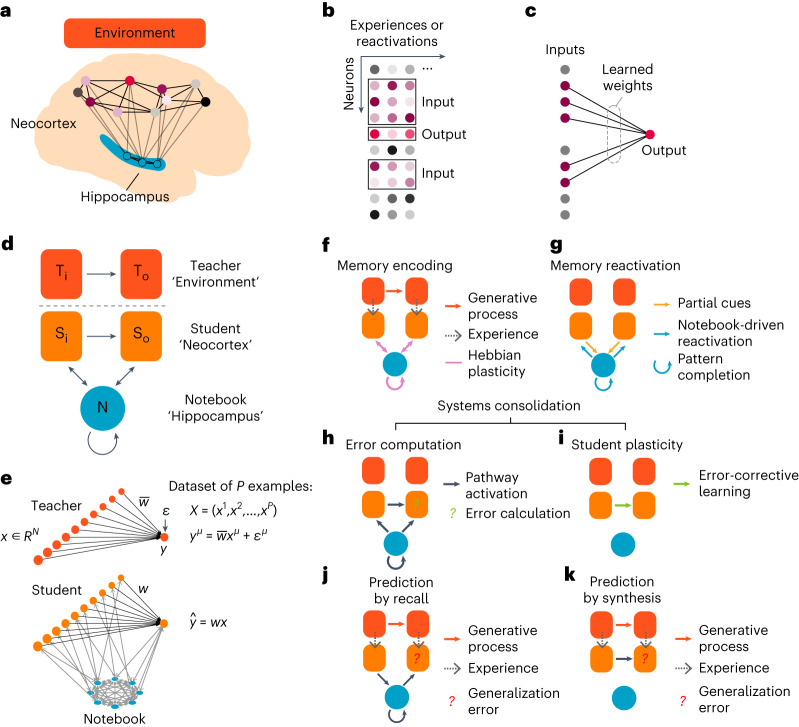
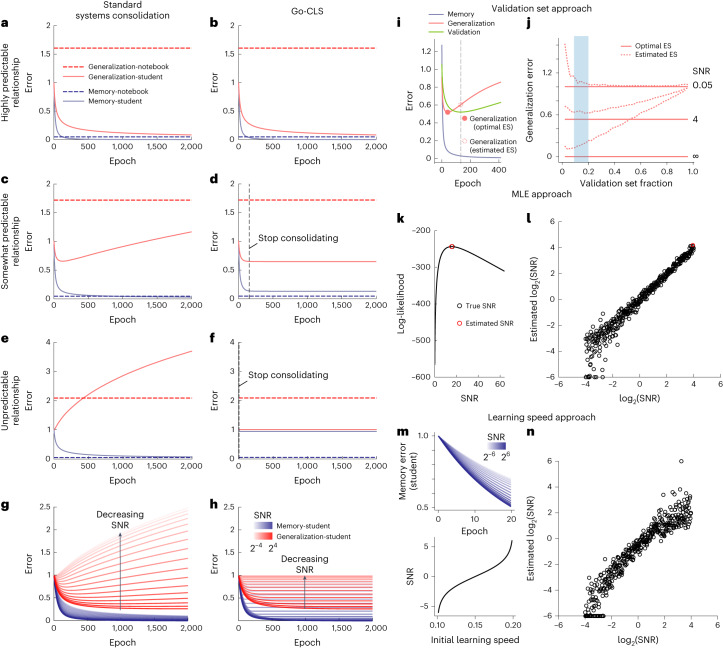
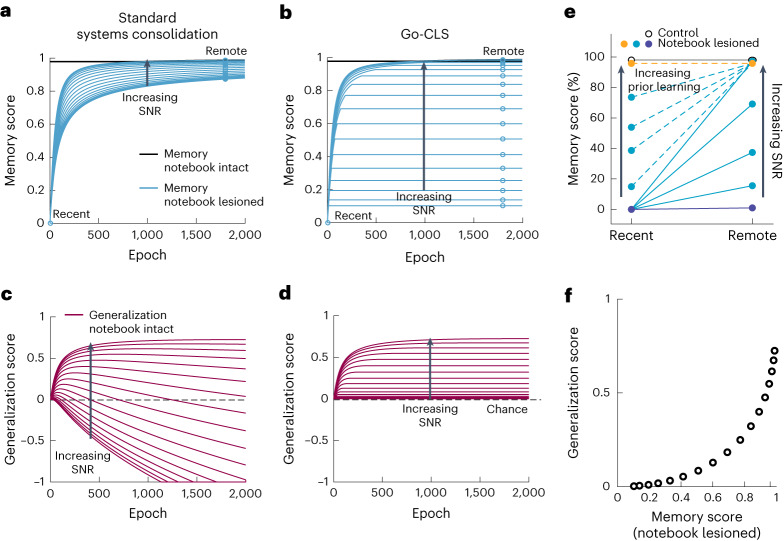
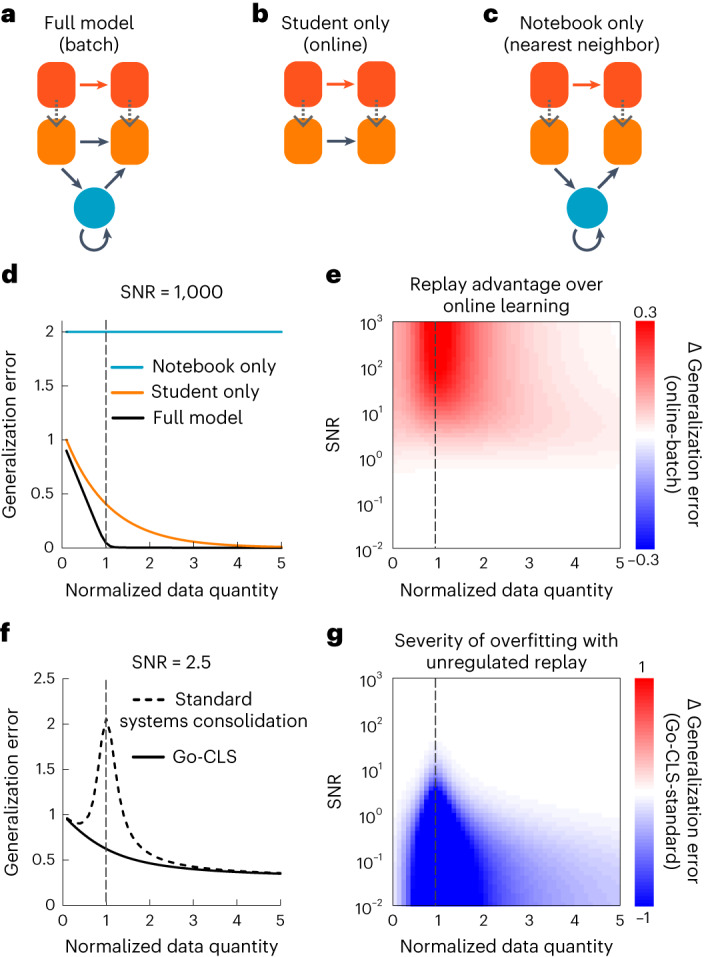
Verification
Claims the paper makes
The claims and statistics of this paper haven’t been checked yet.
Run the check — free, no account needed. It reads the open-access text and checks the sources it cites.
Claims other papers make about this one
Each is checked against this paper’s own text: does it say what the citing paper says it does?
The source backs part of the claim, not all of it — or backs it for a different population, condition or comparison.
In the citing paper
“Schema formation is beneficial when new evidence fits existing structure (Tse et al., 2007), but harmful when it is non-selective or poorly controlled: nonselective consolidation causes interference and loss of specificity (McClelland et al., 1995; Sun et al., 2023).”
From Useful Memories Become Faulty When Continuously Updated by LLMs (2026) · cites this paper as Sun et al., 2023
Experimental — accuracy not yet measuredThe source backs part of the claim, not all of it — or backs it for a different population, condition or comparison.
In the citing paper
“Together, these failure modes weaken the boundary between what should be generalized, what should remain task-specific, and what should be preserved as raw episodic evidence (Sun et al., 2023; Bartlett, 1932; Brainerd and Reyna, 2002).”
From Useful Memories Become Faulty When Continuously Updated by LLMs (2026) · cites this paper as Sun et al., 2023
Experimental — accuracy not yet measured
Self-check
Percentages, sums and reported differences re-computed from the paper’s own numbers.
The self-check needs the paper’s full text.
Citations
Cites
Deep Residual Learning for Image Recognition
He, K., Zhang, X., Ren, S., & Sun, J. (2016) · 2016 IEEE Conference on Computer Vision and Pattern Recognition (CVPR) · doi:10.1109/cvpr.2016.90 · Cited by 235,474
ImageNet: A large-scale hierarchical image database
Deng, J., Dong, W., Socher, R., Li, L.-J., Li, K., & Fei-Fei, L. (2009) · 2009 IEEE Conference on Computer Vision and Pattern Recognition · doi:10.1109/cvpr.2009.5206848 · Cited by 65,333
Gradient-based learning applied to document recognition
Lecun, Y., Bottou, L., Bengio, Y., & Haffner, P. (1998) · Proceedings of the IEEE · doi:10.1109/5.726791 · Cited by 58,805
Learning representations by back-propagating errors
Rumelhart, D. E., Hinton, G. E., & Williams, R. J. (1986) · Nature · doi:10.1038/323533a0 · Cited by 31,892
Human-level control through deep reinforcement learning
Mnih, V., Kavukcuoglu, K., Silver, D., Rusu, A. A., Veness, J., Bellemare, M. G., Graves, A., Riedmiller, M., Fidjeland, A. K., Ostrovski, G., et al. (2015) · Nature · doi:10.1038/nature14236 · Cited by 30,357
Tversky, A., & Kahneman, D. (1974) · Science · doi:10.1126/science.185.4157.1124 · Cited by 28,810
The Elements of Statistical Learning
Hastie, T., Tibshirani, R., & Friedman, J. (2009) · Springer Series in Statistics · doi:10.1007/978-0-387-84858-7 · Cited by 25,970
Learning Multiple Layers of Features from Tiny Images
Krizhevsky, A. (2024) · doi:10.57702/zp44cu3g · Cited by 23,889
Judgment under Uncertainty: Heuristics and Biases
Tversky, A., & Kahneman, D. (1975) · Utility, Probability, and Human Decision Making · doi:10.1007/978-94-010-1834-0_8 · Cited by 22,650
Neural networks and physical systems with emergent collective computational abilities.
Hopfield, J. J. (1982) · Proceedings of the National Academy of Sciences · doi:10.1073/pnas.79.8.2554 · Cited by 19,270
Research works printed but not linked: 3
- MacKay, D. J. C. Information Theory, Inference and Learning Algorithms (Cambridge University Press, 2003).
- Srivastava, N., Hinton, G., Krizhevsky, A., Sutskever, I. & Salakhutdinov, R. Dropout: a simple way to prevent neural networks from overfitting. J. Mach. Learn. Res. 15, 1929–1958 (2014).
- Pezeshki, M., Mitra, A., Bengio, Y. & Lajoie, G. Multi-scale feature learning dynamics: insights for double descent. In Proceedings of the 39th International Conference on Machine Learning (Eds. Chaudhuri, K. et al.) 17669–17690 (PMLR, 2022).
Cited by
Sorted by citations
Items 101–104 of 104
Self-Organized Context Dependent Processing in Neural Networks
GuangFu, H., Chen, Y., Qin, S., Alexandre, F., & Yu, S. (2026) · Cognitive Computation · doi:10.1007/s12559-026-10624-4
Representation of fear memory features in the ventral hippocampus
Milentijevic, A., Cerquetella, C., Nevian, T., Ciocchi, S., & Forro, T. (2026) · Current Biology · doi:10.1016/j.cub.2026.09.034 · Cited by 1
Luo, Y., Yang, L., Zhao, S., Nan, X., Yang, J., Zhang, T., & Li, H. (2026) · Neuroscience & Biobehavioral Reviews · doi:10.1016/j.neubiorev.2026.107059
Liu, H., Mattar, M., & Michelmann, S. (2026) · bioRxiv (Cold Spring Harbor Laboratory) · doi:10.64898/2026.10.18.759853
Metadata
- Authors
- Sun, W., Advani, M., Spruston, N., Saxe, A., & Fitzgerald, J. E.
- Affiliations
- Howard Hughes Medical Institute (US)
- Harvard University (US)
- Canadian Institute for Advanced Research (CA)
- Corresponding author
- Saxe, Andrew
- Fitzgerald, James E.
- Venue
- Nature Neuroscience
- Published
- 2023-07-20
- Volume
- 26
- Issue
- 8
- Pages
- 1438-1448
- ISSN
- 1097-6256 (ISSN-L)
- 1546-1726
- PMC
- PMC10400413
- OpenAlex
- W4384922492
- Cited by
- 103
- References
- 124
- Citations by year
- 2026: 21 · 2025: 30 · 2024: 30 · 2023: 5
- FWCI
- 12.85
- Type
- journal article
- Language
- en
- Open access
- hybrid
- doi.org
- Locations
- Nature Neuroscience (publishedVersion, cc-by)
- bioRxiv (Cold Spring Harbor Laboratory) (acceptedVersion)
- PubMed Central (publishedVersion, cc-by)
- PubMed (publishedVersion)
- UCL Discovery (University College London) (submittedVersion, cc-by)
- Funders
- Howard Hughes Medical Institute
- Swartz Foundation
- Wellcome Trust (216386/Z/19/Z)
- Royal Society
- Gatsby Charitable Foundation
- Swartz Foundation CIFAR Azrieli Global Scholars program
- Topics
- Life Sciences › Neuroscience › Cognitive Neuroscience › Memory and Neural Mechanisms
- Life Sciences › Neuroscience › Cognitive Neuroscience › Memory Processes and Influences
- Life Sciences › Neuroscience › Cognitive Neuroscience › Neural dynamics and brain function
- Keywords
- complementary learning systems, systems consolidation, memory generalization, hippocampus, neocortex, memory transfer, overfitting, neural network model, memory consolidation, adaptive behavior
- MeSH terms
- Memory Consolidation, Animals, Generalization, Psychological, Hippocampus, Learning
About these checks
Registry, retraction, Cites and statistics results are computed, not judged, with one exception: a printed reference that no index lists is read once by a model before it counts as a citation error. Claims are extracted by a model and kept only when their quote appears verbatim in the text; each cited source is then checked, with a model’s help, for whether it says what the claim relies on. Those verdicts can be wrong — read the claim’s quote and the cited source before relying on one.
Statistics and arithmetic are recomputed, not judged.
Confidence bands are shown only for fields calibrated on our annotated test set. None is calibrated yet, so no band is shown.
What counts as a claim ›How we measure confidence ›How we check this ›
Are you an author, or do you see a problem with this page? Request a review
