

The mesencephalic locomotor region recruits V2a reticulospinal neurons to drive forward locomotion in larval zebrafish
Open accessPublished version of a preprint
The DOI matches its Crossref record; 153 of the 153 references it cites were found in a registry or an index; 18 of the 58 sources its claims cite were checked for support.
Abstract
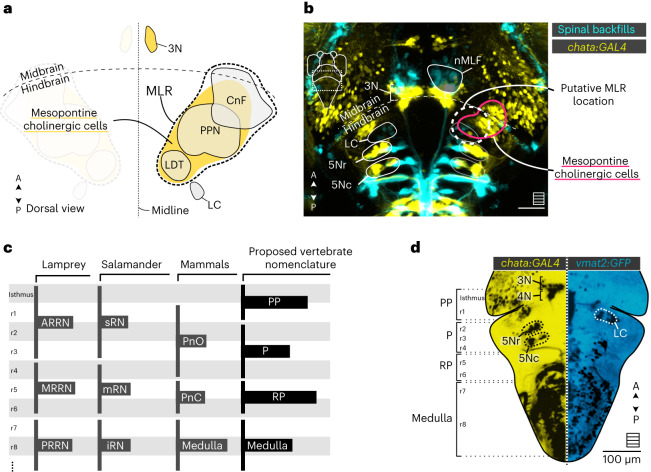
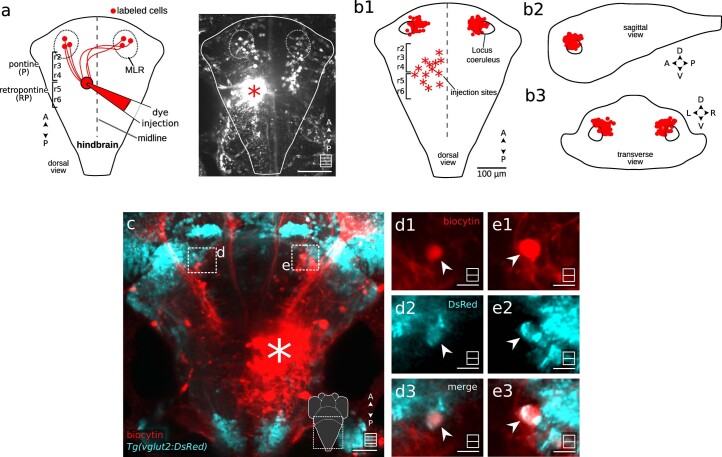
The mesencephalic locomotor region (MLR) is a brain stem area whose stimulation triggers graded forward locomotion. How MLR neurons recruit downstream vsx2 + (V2a) reticulospinal neurons (RSNs) is poorly understood. Here, to overcome this challenge, we uncovered the locus of MLR in transparent larval zebrafish and show that the MLR locus is distinct from the nucleus of the medial longitudinal fasciculus. MLR stimulations reliably elicit forward locomotion of controlled duration and frequency. MLR neurons recruit V2a RSNs via projections onto somata in pontine and retropontine areas, and onto dendrites in the medulla. High-speed volumetric imaging of neuronal activity reveals that strongly MLR-coupled RSNs are active for steering or forward swimming, whereas weakly MLR-coupled medullary RSNs encode the duration and frequency of the forward component. Our study demonstrates how MLR neurons recruit specific V2a RSNs to control the kinematics of forward locomotion and suggests conservation of the motor functions of V2a RSNs across vertebrates.
Overview
CoChat Summary
TL;DR
This study identifies the mesencephalic locomotor region (MLR) in larval zebrafish as a ~40-µm region dorsomedial to the locus coeruleus and shows it drives forward locomotion by recruiting V2a reticulospinal neurons (RSNs) while not recruiting nMLF neurons. MLR neurons project to P/RP V2a RSN somata and medullary V2a RSN dendrites, with medullary V2a RSNs encoding forward locomotor duration and frequency.
Key findings
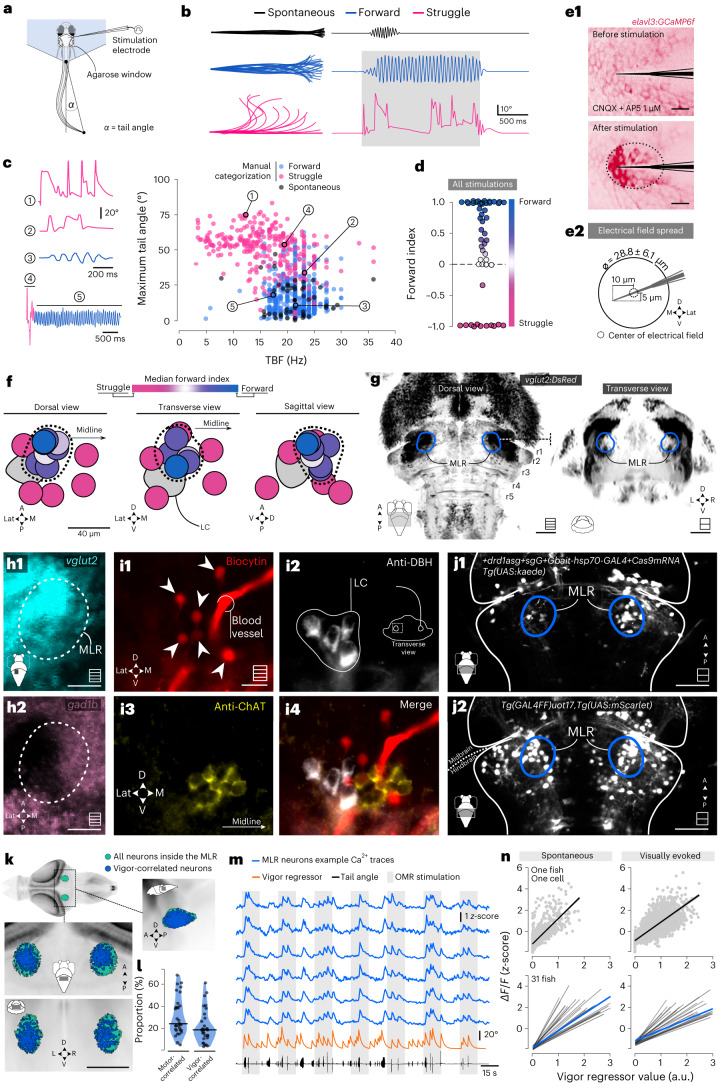
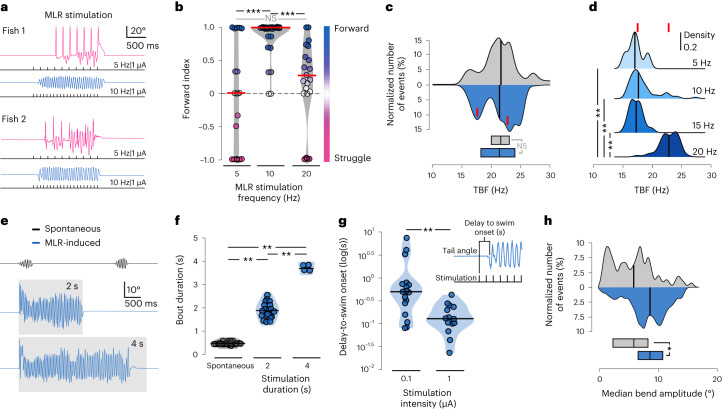
- The MLR locus was localized to a ~40-µm-diameter region at the isthmus/r1 boundary, medial and dorsal to the locus coeruleus, containing glutamatergic, GABAergic and cholinergic neurons and D1-receptor-expressing cells; it is distinct from the nMLF. MLR stimulation at 10 Hz was most effective for forward swimming, and 20-Hz stimulation elicited forward swims at 23.1 ± 1.618 Hz versus lower frequencies.
- MLR stimulation controlled forward-swim kinematics: 2-s and 4-s trains elicited sustained episodes lasting 1.91 ± 0.44 s and 3.65 ± 0.315 s, respectively, versus spontaneous bouts of 0.41 ± 0.15 s; MLR-evoked swims had larger tail bend amplitude (8.5 ± 3.8°) than spontaneous swims (5.9 ± 3.16°).
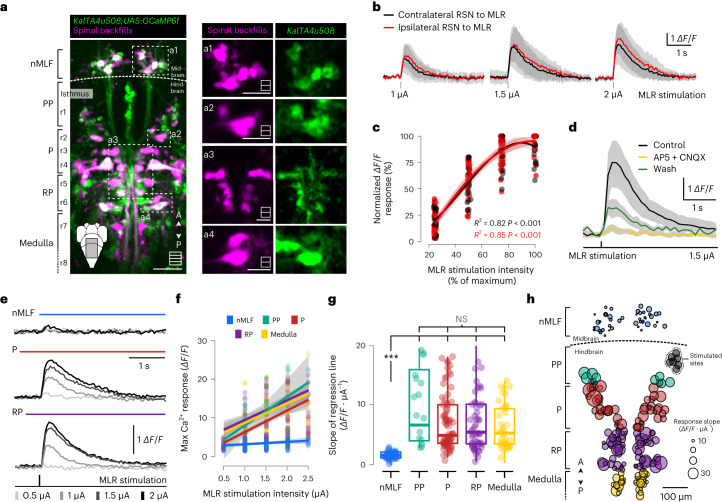
- Unilateral single-pulse MLR stimulation recruited ipsilateral and contralateral hindbrain RSNs but not nMLF neurons; glutamatergic antagonists AP5/CNQX blocked RSN calcium responses (7.6 ± 2.6% of pre-drug response after 40-min incubation, 23 ± 8% after 180-min washout). Response slopes were much lower for nMLF (0.74 ± 1.4 ΔF/F·µA−1) than for PP (7.8 ± 5.9), P (5.1 ± 4.7), RP (5.2 ± 5.7) and medulla (4.2 ± 3.8).
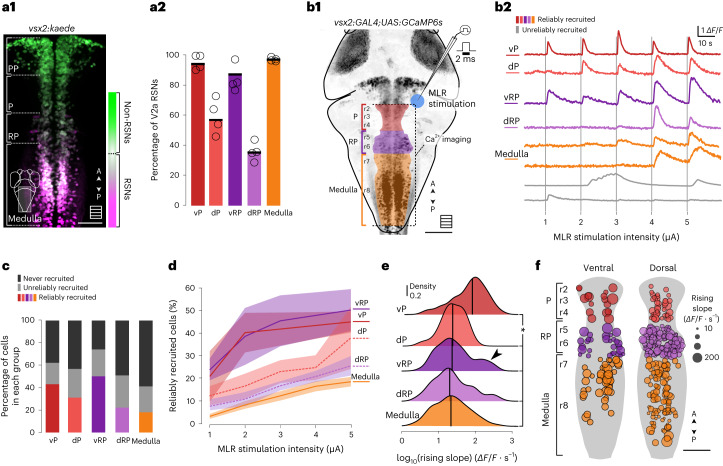
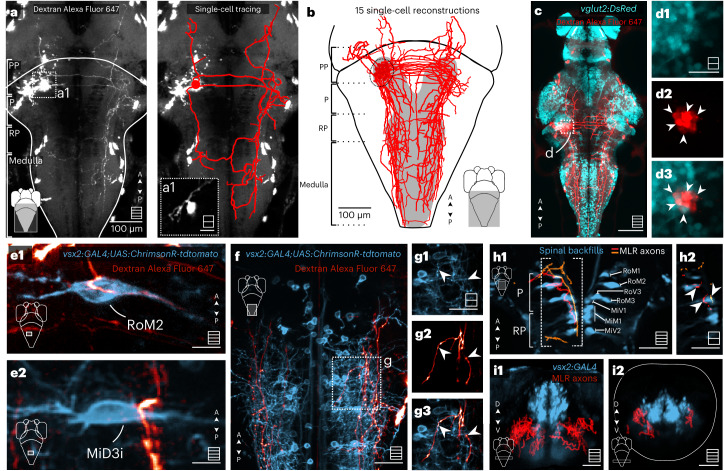
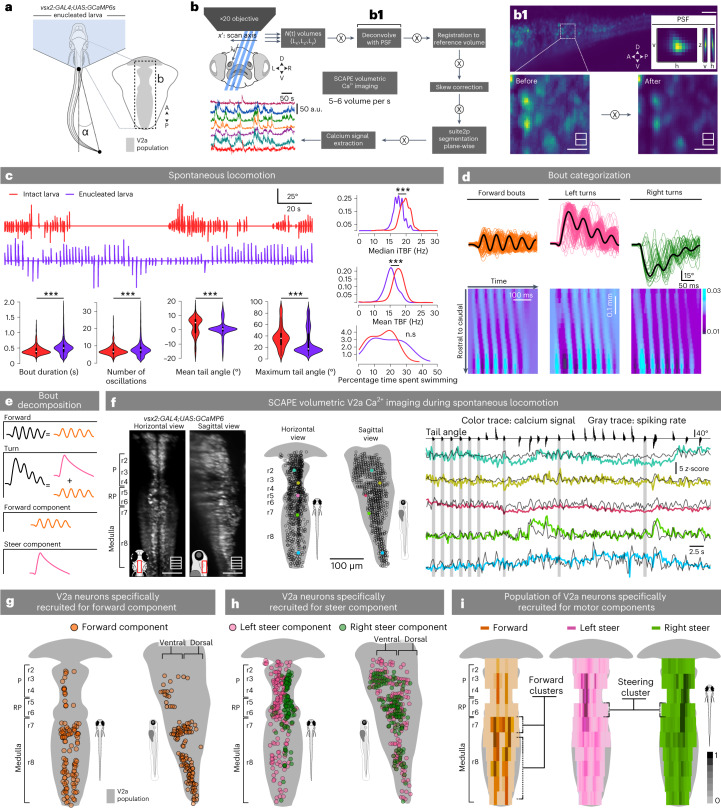
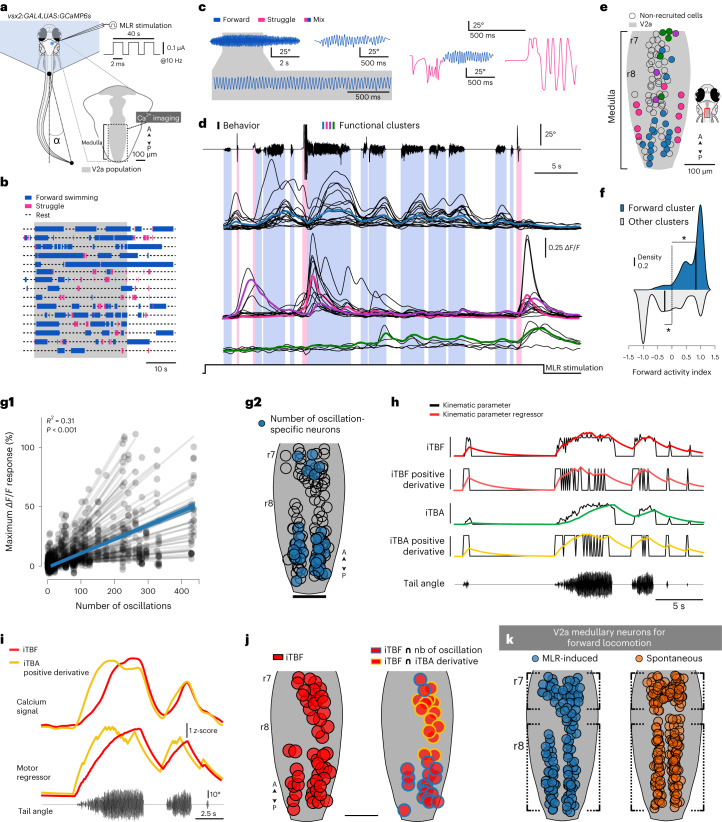
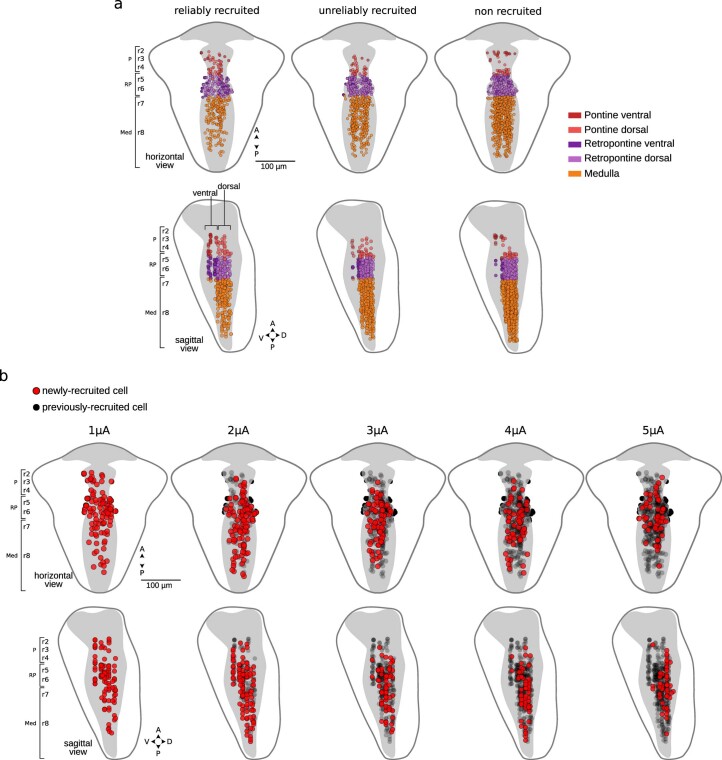
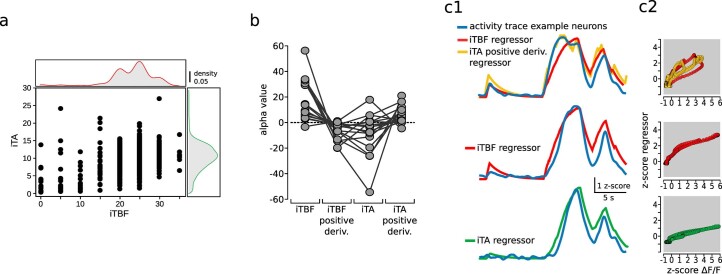
- MLR differentially recruited V2a RSNs: reliably recruited fractions were vP 42.8%, vRP 50.0%, dP 32.0%, dRP 22.7% and medulla 17%; MLR neurons formed axosomatic contacts onto P/RP V2a RSNs but only axodendritic contacts onto medullary V2a RSNs. Medullary forward-cluster V2a RSNs were 18.32 ± 7.32% of recorded medullary neurons, and 59 of 89 neurons encoded instantaneous tail beat frequency; high-speed volumetric imaging showed forward-component V2a neurons at 8.9 ± 3.2%, left-steering at 36.5 ± 1.5% and right-steering at 29.5 ± 4.5%.
Methods
- Larval zebrafish (4–7 dpf) were used with transgenic lines labeling V2a neurons, RSNs, glutamatergic/GABAergic/cholinergic populations and calcium indicators; experiments included electrical MLR stimulation with tungsten microelectrodes, behavioral tail tracking, spinning-disk calcium imaging, SCAPE high-speed volumetric imaging, focal electroporation, retrograde biocytin labeling, Kaede photoconversion, immunohistochemistry and CRISPR–Cas9 knock-in of drd1a reporters.
- Behavioral analysis used ZebraZoom for tail tracking and bout segmentation; calcium imaging analysis used suite2p for ROI extraction, deconvolution, motion correction, spike inference, clustering and regression against motor regressors.
- Sample sizes varied by experiment, including 31 fish for whole-brain OMR imaging, 5 fish for V2a recruitment and medullary forward-cluster analyses, and 3 enucleated larvae for volumetric forward/steering maps.
Limitations
- Stated: MLR stimulation never produced locomotor frequencies above approximately 25 Hz, and the authors cannot exclude that stimulation of adjacent areas, homolog of the cuneiform nucleus, could trigger fast swimming; the current MLR definition may correspond to the mammalian PPN homolog.
- Stated: Data collection and analysis were not performed blind to experimental conditions, except for manual segmentation and categorization of behavior in Figs. 2 and 3.
- Stated/evident: Enucleation altered swim kinematics (longer bouts, more oscillations, lower tail bend amplitude and slower tail beat frequency), and the SCAPE system’s depth of field was smaller by a factor of 2 than the reference system, which may affect generalization and imaging resolution.
Model-written summary. Check it against the paper before relying on it.
Integrity signals
Registry
Cites
Statistics
Figures
Verification
Claims the paper makes
9 Valid · 1 Not valid · 24 Not checked · 144 Own results and interpretations
The cited sources support only part of this claim — read each source’s verdict below.
In the paper
“In all vertebrate species investigated, the MLR induces locomotion via the activation of RSNs12–15.”
§ The mesencephalic locomotor region recruits V2a reticulospinal neurons to drive forward locomotion in larval zebrafish > Main
What the sources say
- Not checked yetcites [12] Capelli P Pivetta C Soledad Esposito M Arber S Locomotor speed control circuits in the caudal brainstem Nature 2017 551 373 377 10.1038/nature24064 29059682 source
- Partly supportedcites [13] Ryczko D Auclair F Cabelguen J-M Dubuc R The mesencephalic locomotor region sends a bilateral glutamatergic drive to hindbrain reticulospinal neurons in a tetrapod J. Comp. Neurol. 2016 524 1361 1383 10.1002/cne.23911 26470600 PMC5019149 sourceExperimental — accuracy not yet measured
The Introduction (section 'Introduction'/Abstract) does state the scheme the claim attributes: 'Anatomical studies provided evidence that the MLR projects down to reticulospinal (RS) neurons, which in turn activate the spinal central pattern generator (CPG) for locomotion', alongside 'stimulation of the MLR on one side elicits bilateral, symmetrical locomotor movements in all vertebrate species examined as of now', and the Discussion ('Central role of the RS system in locomotor control') documents the MLR→RS relay in lampreys, cats, birds and salamanders. However, the universality asserted in the claim ('in all vertebrate species investigated') is not carried by this source: the same paper states that 'How the RS system is controlled by the MLR in mammals remains unresolved' and that 'In tetrapods, the downward connectivity from the MLR is still unknown… the mechanisms by which the MLR controls RS neurons are not fully resolved in tetrapods'. Its own new data are from a single species, the salamander, and it frames the conservation across vertebrates as a suggestion ('suggesting that the structure and organization of brainstem locomotor circuits were conserved in vertebrates'), so the un-hedged all-species formulation overstates it. (LLM, conf=0.72)
- Not checked yetcites [14] Steeves JD Jordan LM Autoradiographic demonstration of the projections from the mesencephalic locomotor region Brain Res. 1984 307 263 276 10.1016/0006-8993(84)90480-3 6466996 source
- Not checked yetcites [15] Garcia-Rill E Skinner RD Gilmore SA Owings R Connections of the mesencephalic locomotor region (MLR) II. Afferents and efferents Brain Res. Bull. 1983 10 63 71 10.1016/0361-9230(83)90076-X 6186345 source
plainstates a cause- Asserted: passes — The authors put it forward as true.
- Checkable: passes — It can be checked against evidence.
- Load-bearing: unclear — It is unclear whether the paper’s conclusions depend on it.
- Based: passes — The paper gives a reason why it holds.
The cited sources support only part of this claim — read each source’s verdict below.
In the paper
“V2a RSNs are necessary for the initiation of locomotion18.”
§ The mesencephalic locomotor region recruits V2a reticulospinal neurons to drive forward locomotion in larval zebrafish > Main
What the sources say
- Partly supportedcites [18] Kimura Y Hindbrain V2a neurons in the excitation of spinal locomotor circuits during zebrafish swimming Curr. Biol. 2013 23 843 849 10.1016/j.cub.2013.03.066 23623549 sourceExperimental — accuracy not yet measured
Our copy supports the necessity element only for sustaining already-running swimming: the Results summary states that Arch/Halo3 photo-inhibition showed 'the activity of hindbrain V2a neurons was absolutely essential for sustaining spontaneously occurring swimming,' and the inactivation paradigm applied light only after swimming-related movements were detected (Results, Fig. 3; Movie S2). The initiation element is supported only as sufficiency, not necessity: ChR activation of hindbrain V2a neurons elicited forward swimming in 97.1% of trials (Results, Fig. 2). No passage tests whether V2a reticulospinal neurons are required for the onset/initiation of a locomotor episode, and the data come from 3 dpf zebrafish larvae swimming, so the unqualified generalization to 'initiation of locomotion' overstates the source. (LLM, conf=0.80)
plainstates a cause- Asserted: passes — The authors put it forward as true.
- Checkable: passes — It can be checked against evidence.
- Load-bearing: passes — The paper’s conclusions depend on it.
- Based: passes — The paper gives a reason why it holds.
- Partly supported
Every source the paper cites for this claim was checked and supports it.
In the paper
“Unilateral stimulation of the MLR recruits ipsilateral and contralateral RSNs13,39.”
§ The mesencephalic locomotor region recruits V2a reticulospinal neurons to drive forward locomotion in larval zebrafish > Results > MLR recruits ipsilateral and contralateral RSNs but not nMLF neurons
What the sources say
- Supportedcites [13] Ryczko D Auclair F Cabelguen J-M Dubuc R The mesencephalic locomotor region sends a bilateral glutamatergic drive to hindbrain reticulospinal neurons in a tetrapod J. Comp. Neurol. 2016 524 1361 1383 10.1002/cne.23911 26470600 PMC5019149 source
The Results section 'Effects of the MLR on RS cells' (p. ~4, passage 1) concludes that 'a unilateral stimulation of the MLR symmetrically activates RS cells of the mRN and iRN on both sides,' with comparable Ca2+ responses in ipsilateral and contralateral neurons for both train (n = 122 cells, eight preparations) and single-pulse stimulation (passages 2-3). The Discussion section headed 'Recruitment of RS cells by MLR stimulation' (passage 5) frames the finding in terms of recruitment of RS cells by MLR stimulation. The claim's wording ('recruits ipsilateral and contralateral RSNs') matches, though the source's demonstration is in the salamander preparation. (LLM, conf=0.92)
- Supportedcites [39] Brocard F The transformation of a unilateral locomotor command into a symmetrical bilateral activation in the brainstem J. Neurosci. 2010 30 523 533 10.1523/JNEUROSCI.3433-09.2010 20071515 PMC6632989 source
The Discussion (p. 1, 'Discussion') states the main finding as 'the striking similarity of synaptic responses elicited in RS cells on both sides by a unilateral stimulation of the MLR,' and credits symmetrical swimming to 'symmetrical MLR inputs to RS cells on both sides.' The 'Projections from the isthmic region to RS cells' section likewise refers to 'the bilateral recruitment of RS cells of the MRRN from unilateral stimulation of the MLR,' and the Abstract/Results ('Monosynaptic connectivity between the MLR and RS cells on both sides') report monosynaptic input to both the MRRN and PRRN. The work is in larval lamprey, which the citing sentence does not specify, but the attributed point — unilateral MLR stimulation recruiting ipsilateral and contralateral reticulospinal neurons — is directly stated. (LLM, conf=0.90)
plainstates a cause- Asserted: passes — The authors put it forward as true.
- Checkable: passes — It can be checked against evidence.
- Load-bearing: passes — The paper’s conclusions depend on it.
- Based: passes — The paper gives a reason why it holds.
- Supported
Every source the paper cites for this claim was checked and supports it.
In the paper
“Because not all hindbrain V2a neurons are RSNs17,18,41,42, we first quantified the proportions of V2a RSNs in each subdivision of the hindbrain”
§ The mesencephalic locomotor region recruits V2a reticulospinal neurons to drive forward locomotion in larval zebrafish > Results > The MLR differentially recruits distributed hindbrain V2a RSNs
What the sources say
- Supportedcites [17] Bretzner F Brownstone RM Lhx3-Chx10 reticulospinal neurons in locomotor circuits J. Neurosci. 2013 33 14681 14692 10.1523/JNEUROSCI.5231-12.2013 24027269 PMC6705172 source
In the section 'Lhx3 and Chx10 medRF neurons are reticulospinal neurons', our copy reports that only 8% of Chx10::eGFP (V2a-marker) medRF neurons were retrogradely labeled from the cervical spinal cord (16% for Lhx3-YFP), and states this 'likely indicates that Chx10 neurons are also involved in non-reticulospinal pathways' — i.e. that the hindbrain V2a population is not wholly reticulospinal. This is exactly the paraphrased point the citing sentence attributes to the source; the paper adds the caveat that TMRD does not fill all axons and so would underestimate the RSN fraction, but it still concludes Lhx3/Chx10 neurons form 'a significant component' rather than all of the reticulospinal pathway. (LLM, conf=0.85)
- Supportedcites [18] Kimura Y Hindbrain V2a neurons in the excitation of spinal locomotor circuits during zebrafish swimming Curr. Biol. 2013 23 843 849 10.1016/j.cub.2013.03.066 23623549 source
Our copy treats reticulospinal V2a neurons as a subset of the hindbrain V2a population: the Introduction states hindbrain V2a neurons are ipsilaterally projecting excitatory neurons 'many of which project down the spinal cord', and the Results (Kaede photo-conversion/backfilling) summarize that only 'some of the ipsilaterally projecting large reticulospinal neurons, including MiD2i, MiD3i, MiV1, and MiV2, were among the V2a neurons' while small reticulospinal V2a neurons are abundant caudally and 'gradually became smaller in more rostral regions'. The Discussion adds that in the rostral hindbrain 'few neurons in the region project to the spinal cord'. Together these establish that not all hindbrain V2a neurons are reticulospinal neurons, and the paper's region-by-region quantification matches the citing sentence's framing. (LLM, conf=0.85)
- Supportedcites [41] Pujala A Koyama M Chronology-based architecture of descending circuits that underlie the development of locomotor repertoire after birth eLife 2019 8 e42135 10.7554/eLife.42135 30801247 PMC6449084 source
The Introduction treats hindbrain V2a neurons as a cell type that 'include[s] excitatory reticulospinal neurons', i.e. RSNs are a subset of the V2a population rather than coextensive with it. The Results section on birth order reinforces this by restricting attention to 'Hindbrain V2a neurons with spinal projections' and noting that, beyond the large dye-fillable RS neurons, 'a majority of the V2a neurons in the caudal hindbrain have also been shown to project to the spinal cord' — implying a non-descending remainder. Figure 2C's schema likewise depicts the V2a subpopulation within the RS neuron set. Our copy therefore clearly supports the background premise that not all hindbrain V2a neurons are reticulospinal, though it states it by implication/subset framing rather than as an explicit negation. (LLM, conf=0.85)
- Supportedcites [42] Chopek JW Zhang Y Brownstone RM Intrinsic brainstem circuits comprised of Chx10-expressing neurons contribute to reticulospinal output in mice J. Neurophysiol. 2021 126 1978 1990 10.1152/jn.00322.2021 34669520 PMC8715053 source
The DISCUSSION section 'Subtypes of GRN Chx10 Neurons' states that the authors 'now definitively demonstrate that there are at least two major subtypes of Chx10 neurons in the GRN—reticulospinal neurons and local interneurons,' and the INTRODUCTION notes that of the two identified subsets 'only one of which (comprised of neurons with large somata) is reticulospinal.' The RESULTS section 'Large Chx10 Neurons Are Reticulospinal' quantifies this: spinal CTB labelling returned only 8–11% of Chx10ON neurons in the rostral GRN. Since Chx10/Vsx2 is the V2a marker (the paper equates the two for spinal neurons and uses a line previously used to study spinal V2a neurons) and the GRN is a hindbrain reticular formation nucleus, our copy establishes that a substantial fraction of hindbrain Chx10/V2a neurons are local interneurons rather than RSNs, supporting the paraphrase. (LLM, conf=0.85)
plain- Asserted: passes — The authors put it forward as true.
- Checkable: passes — It can be checked against evidence.
- Load-bearing: passes — The paper’s conclusions depend on it.
- Based: passes — The paper gives a reason why it holds.
- Supported
None of the sources cited for this claim have been checked yet.
In the paper
“At low intensity, the zebrafish MLR recruits ventral V2a RSNs in the P and RP regions in an all-or-nothing fashion, consistent with previous reports of large excitatory postsynaptic potentials previously recorded in these cells13,38,39.”
§ The mesencephalic locomotor region recruits V2a reticulospinal neurons to drive forward locomotion in larval zebrafish > Discussion > Anatomical and functional coupling of MLR neurons to V2a RSNs
What the sources say
- Could not verifycites [13] Ryczko D Auclair F Cabelguen J-M Dubuc R The mesencephalic locomotor region sends a bilateral glutamatergic drive to hindbrain reticulospinal neurons in a tetrapod J. Comp. Neurol. 2016 524 1361 1383 10.1002/cne.23911 26470600 PMC5019149 sourceExperimental — accuracy not yet measured
Our copy of Ryczko et al. (2016) is a salamander (Notophthalmus viridescens) Ca2+-imaging/tracing study; the only zebrafish recruitment statement it makes is in the Discussion ('Recruitment of RS cells by MLR stimulation'), where it credits Kinkhabwala et al. (2011) with showing that dorsal glutamatergic reticular cells are recruited first at low swimming frequencies — nothing about ventral V2a reticulospinal neurons in the P and RP nuclei being recruited in an all-or-nothing fashion. Searches for 'zebrafish V2a', 'all-or-none/threshold recruitment', 'P and RP nuclei' and 'excitatory postsynaptic potentials in reticulospinal neurons' returned no passage addressing the claim; the paper's own recruitment data (Results, 'Effects of the MLR on RS cells'; 'Comparison of Ca2+ responses in the mRN and the iRN') describe graded, cubic-polynomial growth of Ca2+ responses with stimulation intensity in salamander mRN/iRN cells, not zebrafish V2a cells. Because our copy does not treat the zebrafish point (and names no source for an all-or-none ventral V2a recruitment), it can neither support nor contradict the claim. (LLM, conf=0.70)
- Not checked yetcites [38] Brocard F Dubuc R Differential contribution of reticulospinal cells to the control of locomotion induced by the mesencephalic locomotor region J. Neurophysiol. 2003 90 1714 1727 10.1152/jn.00202.2003 12736238 source
- Not checked yetcites [39] Brocard F The transformation of a unilateral locomotor command into a symmetrical bilateral activation in the brainstem J. Neurosci. 2010 30 523 533 10.1523/JNEUROSCI.3433-09.2010 20071515 PMC6632989 source
plainstates a cause- Asserted: passes — The authors put it forward as true.
- Checkable: passes — It can be checked against evidence.
- Load-bearing: passes — The paper’s conclusions depend on it.
- Based: passes — The paper gives a reason why it holds.
- Could not verify
75 more claims
Create a free account to see all 178 claims and to verify the 40 references still open.
- Probably not a substantial claim. 41
- It may state two separate claims as one. 63
Claims other papers make about this one
Each is checked against this paper’s own text: does it say what the citing paper says it does?
The cited source says what the claim attributes to it.
In the citing paper
“This also aligns with modularity at the level of brainstem spinal projection neurons observed in vertebrates (zebrafish58, mice6,18,59), indicating that vertebrates could also have halting pathways that differentially inhibit forward locomotion and turning.”
From Neural circuit mechanisms underlying context-specific halting in Drosophila (2024) · cites this paper as [58]
Statistics recomputed
Every reported test result, recomputed from its test statistic and degrees of freedom. A result shows as not adding up only once an independent check has confirmed it.
- ConsistentF(112, 13.02) = 211.3reported p < .001 · recomputed p < .001
“F(112, 13.02) = 211.3, p < .001”
- ConsistentF(100, 13.45) = 151.1reported p < .001 · recomputed p < .001
“F(100, 13.45) = 151.1, p < .001”
Self-check
Percentages, sums and reported differences re-computed from the paper’s own numbers.
Each contradiction between two passages listed here was confirmed by an independent check.
Rated major: it would touch a result — a value a result rests on, reported and recomputed p-values on opposite sides of the significance level, two passages that conflict with no sign which is right, or a cited work retracted before this paper was published.
In the paper
§ The mesencephalic locomotor region recruits V2a reticulospinal neurons to drive forward locomotion in larval zebrafish > Results > Medullary V2a RSNs encode locomotor duration and frequency
“forward cluster: 1,438 cells”
§ The mesencephalic locomotor region recruits V2a reticulospinal neurons to drive forward locomotion in larval zebrafish > Results > Medullary V2a RSNs encode locomotor duration and frequency
“a total of 1,140 neurons out of 5 fish recorded”
Rated major: it would touch a result — a value a result rests on, reported and recomputed p-values on opposite sides of the significance level, two passages that conflict with no sign which is right, or a cited work retracted before this paper was published.
In the paper
“forward cluster: 18.32 ± 7.32%, 26.4 ± 12.6 of 228 ± 35.9 neurons per fish, a total of 1,140 neurons out of 5 fish recorded”
§ The mesencephalic locomotor region recruits V2a reticulospinal neurons to drive forward locomotion in larval zebrafish > Results > Medullary V2a RSNs encode locomotor duration and frequency
Reported 18.32 · recomputed 11.578947
Rated minor: it would not touch a result — a value no result rests on, a p-value that stays on the same side of the significance level, or a conflict that is clerical, resolved elsewhere in the paper, or outside its own findings.
In the paper
“5 Hz: n = 19 stimulations, −0.06 ± 0.8; 10 Hz: n = 26 stimulations, 0.919 ± 0.24; 20 Hz: n = 19 stimulations, 0.27 ± 0.55 s; Kruskal–Wallis test, χ2 = 105.85, d.f. = 3”
§ The mesencephalic locomotor region recruits V2a reticulospinal neurons to drive forward locomotion in larval zebrafish > Results > MLR sets the kinematics of locomotion
Reported 3 · recomputed 2
Rated minor: it would not touch a result — a value no result rests on, a p-value that stays on the same side of the significance level, or a conflict that is clerical, resolved elsewhere in the paper, or outside its own findings.
In the paper
§ The mesencephalic locomotor region recruits V2a reticulospinal neurons to drive forward locomotion in larval zebrafish > Results > The MLR differentially recruits distributed hindbrain V2a RSNs
“only a subset of V2a RSNs were reliably recruited in the medulla (Fig. 5c, 17%)”
§ The mesencephalic locomotor region recruits V2a reticulospinal neurons to drive forward locomotion in larval zebrafish > Results > Medullary V2a RSNs encode locomotor duration and frequency
“Fig. 5: reliably recruited V2a neurons: 22% of medullary V2a neurons”
Rated minor: it would not touch a result — a value no result rests on, a p-value that stays on the same side of the significance level, or a conflict that is clerical, resolved elsewhere in the paper, or outside its own findings.
In the paper
“5 Hz: ten episodes, 17.54 ± 1.31 Hz; 10 Hz: 60 episodes, 18.7 ± 2.34 Hz; 15 Hz: 18 episodes, 17.66 ± 1.07 Hz; 20 Hz: 154 episodes, 23.1 ± 1.618 Hz; Kruskal–Wallis test, χ2 = 6237, d.f. = 31”
§ The mesencephalic locomotor region recruits V2a reticulospinal neurons to drive forward locomotion in larval zebrafish > Results > MLR sets the kinematics of locomotion
Reported 31 · recomputed 3
1 more finding
Create a free account to see every finding of this check.
Citations
Cites
Fiji: an open-source platform for biological-image analysis
Schindelin, J., Arganda-Carreras, I., Frise, E., Kaynig, V., Longair, M., Pietzsch, T., Preibisch, S., Rueden, C., Saalfeld, S., Schmid, B., et al. (2012) · Nature Methods · doi:10.1038/nmeth.2019 · Cited by 66,890
Wickham, H., Averick, M., Bryan, J., Chang, W., McGowan, L., François, R., Grolemund, G., Hayes, A., Henry, L., Hester, J., et al. (2019) · Journal of Open Source Software · doi:10.21105/joss.01686 · Cited by 22,138
seaborn: statistical data visualization
Waskom, M. (2021) · Journal of Open Source Software · doi:10.21105/joss.03021 · Cited by 7,310
Cellpose: a generalist algorithm for cellular segmentation
Stringer, C., Wang, T., Michaelos, M., & Pachitariu, M. (2021) · Nature Methods · doi:10.1038/s41592-020-01018-x · Cited by 4,369
An iterative technique for the rectification of observed distributions
Lucy, L. B. (1974) · The Astronomical Journal · doi:10.1086/111605 · Cited by 3,866
Suite2p: beyond 10,000 neurons with standard two-photon microscopy
Pachitariu, M., Stringer, C., Dipoppa, M., Schröder, S., Rossi, L. F., Dalgleish, H., Carandini, M., & Harris, K. D. (2016) · bioRxiv (Cold Spring Harbor Laboratory) · doi:10.1101/061507 · Cited by 1,247
mScarlet: a bright monomeric red fluorescent protein for cellular imaging
Bindels, D. S., Haarbosch, L., van Weeren, L., Postma, M., Wiese, K. E., Mastop, M., Aumonier, S., Gotthard, G., Royant, A., Hink, M. A., et al. (2017) · Nature Methods · doi:10.1038/nmeth.4074 · Cited by 1,156
Droettboom, M., Caswell, T. A., Hunter, J., Firing, E., Nielsen, J. H., Varoquaux, N., Root, B., De Andrade, E. S., Elson, P., Dale, D., et al. (2014) · Zenodo (CERN European Organization for Nuclear Research) · doi:10.5281/zenodo.592536 · Cited by 857
[Control of walking and running by means of electric stimulation of the midbrain].
Shik, M. L., Fv, S., & Gn, O. (1966) · PubMed · Cited by 752
Decoding the organization of spinal circuits that control locomotion
Kiehn, O. (2016) · Nature Reviews Neuroscience · doi:10.1038/nrn.2016.9 · Cited by 742
Cited by
Brainstem circuits encoding start, speed, and duration of swimming in adult zebrafish
Berg, E. M., Mrowka, L., Bertuzzi, M., Madrid, D., Picton, L. D., & El Manira, A. (2023) · Neuron · doi:10.1016/j.neuron.2022.10.034 · Cited by 54
Neural circuit mechanisms underlying context-specific halting in Drosophila
Sapkal, N., Mancini, N., Kumar, D. S., Spiller, N., Murakami, K., Vitelli, G., Bargeron, B., Maier, K., Eichler, K., Jefferis, G. S. X. E., et al. (2023) · doi:10.1101/2023.09.25.559438 · Cited by 54
Neural circuit mechanisms underlying context-specific halting in Drosophila
Sapkal, N., Mancini, N., Kumar, D. S., Spiller, N., Murakami, K., Vitelli, G., Bargeron, B., Maier, K., Eichler, K., Jefferis, G. S. X. E., et al. (2024) · Nature · doi:10.1038/s41586-024-07854-7 · Cited by 54
“This also aligns with modularity at the level of brainstem spinal projection neurons observed in vertebrates (zebrafish 58 , mice 6,18,59 ), indicating that vertebrates could also have halting pathways that differentially inhibit forward locomotion and turning.”
Ryczko, D. (2024) · The Neuroscientist · doi:10.1177/10738584221139136 · Cited by 31
Granger causality analysis for calcium transients in neuronal networks, challenges and improvements
Chen, X., Ginoux, F., Tano, M. C., Mora, T., Walczak, A. M., & Wyart, C. (2023) · eLife · doi:10.7554/elife.81279 · Cited by 31
Self-citationActivity-driven myelin sheath growth is mediated by mGluR5
Braaker, P. N., Mi, X., Soong, D. Y. H., Bin, J. M., Marshall-Phelps, K. L., Bradley, S., Benito-Kwiecinski, S. K., Meng, J., Arafa, D., Richmond, C., et al. (2025) · Nature Neuroscience · doi:10.1038/s41593-025-01956-9 · Cited by 28
“These neurons have well-defined roles in regulating complex motor behaviors of larval zebrafish, and their opto-stimulation induces physiologically relevant activity 64,65 .”
Dopamine control of downstream motor centers
Ryczko, D., & Dubuc, R. (2023) · Current Opinion in Neurobiology · doi:10.1016/j.conb.2023.102785 · Cited by 25
Self-citationUncovering multiscale structure in the variability of larval zebrafish navigation
Sridhar, G., Vergassola, M., Marques, J. C., Orger, M. B., Costa, A. C., & Wyart, C. (2024) · Proceedings of the National Academy of Sciences · doi:10.1073/pnas.2410254121 · Cited by 20
“In particular, the modulation of the MLR by dopamine released from posterior tuberculum (Carbo-Tano et al. (2023)) could explain the long-lived persistence of cruising behaviors.”
InfluentialSelf-citationPiarulli, S., Riedel, J. A., Fossum, F. N., Kermen, F., Hansen, B. H., Kvæstad, B., Olsvik, P. A., & Farkas, J. (2023) · Chemosphere · doi:10.1016/j.chemosphere.2023.140950 · Cited by 15
Handa, T., Sugiyama, T., Islam, T., Johansen, J. P., Yanagawa, Y., McHugh, T. J., & Okamoto, H. (2025) · Molecular Psychiatry · doi:10.1038/s41380-025-02964-8 · Cited by 15
Harnessing spinal circuit reorganization for targeted functional recovery after spinal cord injury
Sun, X., Li, L., Huang, L., Li, Y., Wang, L., & Wei, Q. (2025) · Neurobiology of Disease · doi:10.1016/j.nbd.2025.106854 · Cited by 17
Brainstem neural mechanisms controlling locomotion with special reference to basal vertebrates
Lacroix-Ouellette, P., & Dubuc, R. (2023) · Frontiers in Neural Circuits · doi:10.3389/fncir.2023.910207 · Cited by 19
Self-citationA two-layer neural circuit controls fast forward locomotion in Drosophila
Zhao, Q., Li, X., Wen, J., He, Y., Zheng, N., Li, W., Cardona, A., & Gong, Z. (2024) · Current Biology · doi:10.1016/j.cub.2024.06.060 · Cited by 12
Evolutionarily conserved brainstem architecture enables gravity-guided vertical navigation
Zhu, Y., Gelnaw, H., Auer, F., Hamling, K. R., Ehrlich, D., & Schoppik, D. (2024) · PLoS Biology · doi:10.1371/journal.pbio.3002902 · Cited by 13
Pedunculopontine-stimulation obstructs hippocampal theta rhythm and halts movement
Kaur, J., Komi, S., Dmytriyeva, O., Houser, G., Bonfils, M. C. A., & Berg, R. W. (2025) · Scientific Reports · doi:10.1038/s41598-025-01695-8 · Cited by 13
“While the capacity of the MLR to activate spinal motor circuits is well established across species 12,13,17–23 , the PPN’s involvement in modulating behavioral states and controlling sympathetic cardiovascular functions is equally important 24–27 .”
Pazzaglia, A., Bičanski, A., Ferrario, A., Arreguit, J., Ryczko, D., & Ijspeert, A. J. (2025) · PLoS Computational Biology · doi:10.1371/journal.pcbi.1012101 · Cited by 11
Separate brainstem circuits for fast steering and slow exploratory turns
Xu, L., Zhu, B., Zhu, Z., Tao, X., Zhang, T., Manira, A. E., & Song, J. (2025) · Nature Communications · doi:10.1038/s41467-025-58621-9 · Cited by 8
“These neurons convey speci fi c commands to spinal circuits to generate movements with precise timing, force, and trajectory 14,24,30,42 – 47 .”
A brainstem circuit for gravity-guided vertical navigationPreprint
Zhu, Y., Gelnaw, H., Auer, F., Hamling, K. R., Ehrlich, D., & Schoppik, D. (2024) · bioRxiv (Cold Spring Harbor Laboratory) · doi:10.1101/2024.03.12.584680 · Cited by 7
“Anatomically, utricle-recipient vestibular nuclei relay information to the spinal cord directly 32–34 and indirectly 24,25,30,35,36 through a highly-conserved midbrain population called the interstitial nucleus of Cajal / nucleus of the medial longitudinal fasciculus (INC/nMLF) 37,38 .”
BackgroundCharacterization of Transgenic Lines Labeling Reticulospinal Neurons in Larval Zebrafish
Collins, E. M., Silva, P. T., Ostrovsky, A. D., Renninger, S. L., Tomás, A. R., del Corral, R. D., & Orger, M. B. (2025) · eNeuro · doi:10.1523/eneuro.0581-24.2025 · Cited by 11
Kilic, U., Smets, C., Deng, Z., Boogers, A., Laughlin, M. M., Vloo, P. D., George, D. D., & Nuttin, B. (2025) · Neuromodulation Technology at the Neural Interface · doi:10.1016/j.neurom.2025.06.004 · Cited by 6
Cerebellar Purkinje cells control posture in larval zebrafish (Danio rerio)Preprint
Auer, F., Nardone, K., Matsuda, K., Hibi, M., & Schoppik, D. (2025) · eLife · doi:10.7554/elife.97614 · Cited by 12
van der Zouwen, C. I., Tello, A. J., Suresh, J. S., Duque‐Yate, J., Hsu, T. M., Konanur, V., Boutin, J., Roitman, M. F., & Ryczko, D. (2025) · Scientific Reports · doi:10.1038/s41598-025-05572-2 · Cited by 7
Redefining the central pattern generator for vertebrate locomotion
Manira, A. E. (2026) · Nature reviews. Neuroscience · doi:10.1038/s41583-026-01029-1 · Cited by 12
Circuit Modules for Flexible Locomotion
Picton, L. D., Pallucchi, I., Fontanel, P., Bertuzzi, M., Song, J., & Manira, A. E. (2025) · Annual Review of Neuroscience · doi:10.1146/annurev-neuro-112723-061241 · Cited by 4
Li, R., Xing, H., Shen, Y., Chen, M., Lyu, B., Yang, X., Sun, L., Jiang, C., Lv, J., Ding, X., et al. (2025) · Advanced Science · doi:10.1002/advs.202503966 · Cited by 3
Linking brain and behavior states in Zebrafish Larvae locomotion using hidden Markov models
Dommanget-Kott, M., Fernández-de-Cossio-Díaz, J., Coraggioso, M., Bormuth, V., Monasson, R., Debrégeas, G., & Cocco, S. (2026) · PLoS Computational Biology · doi:10.1371/journal.pcbi.1013762 · Cited by 5
Larbi, M. C., Messa, G., Jalal, H., & Koutsikou, S. (2022) · Frontiers in Neural Circuits · doi:10.3389/fncir.2022.1027831 · Cited by 2
Cerebellar Purkinje cells control posture in larval zebrafish (Danio rerio)
Auer, F., Nardone, K., Matsuda, K., Hibi, M., & Schoppik, D. (2025) · eLife · doi:10.7554/elife.97614.3 · Cited by 3
Lunsford, E. T., Tano, M. C., & Wyart, C. (2026) · Proceedings of the National Academy of Sciences · doi:10.1073/pnas.2515782123 · Cited by 2
Self-citationBehavioral adaptation to changing energy constraints via altered frequency of movement selectionPreprint
Darveniza, T., Zhu, S., Pujic, Z., Sun, B., Levendosky, M., Wong, R., Agarwal, R., McCullough, M., & Goodhill, G. J. (2023) · bioRxiv (Cold Spring Harbor Laboratory) · doi:10.1101/2023.11.08.566262 · Cited by 4
Velez-Angel, N., Lu, S., Fabella, B. A., Reagor, C. C., Brown, H. R., Vázquez, Y., Jacobo, A., & Hudspeth, A. J. (2025) · bioRxiv (Cold Spring Harbor Laboratory) · doi:10.1101/2025.02.07.637118 · Cited by 2
A dedicated brain circuit controls forward walking in DrosophilaPreprint
Dallmann, C. J., Iqbal, F. M., Liebscher, S., Erginkaya, M., Liessem, S., Sauer, E., Soyka, H., Cascino-Milani, F., Goldammer, J., Ito, K., et al. (2026) · bioRxiv (Cold Spring Harbor Laboratory) · doi:10.64898/2026.01.04.697356 · Cited by 3
Whole-brain mapping of spinal-projecting neurons in larval zebrafish
Tano, M. C., Fidelin, K., Welch, T., Narayan, S., Ahrens, M. B., Dubuc, R., & Wyart, C. (2026) · eLife · doi:10.7554/elife.112062 · Cited by 2
Self-citationVelez-Angel, N., Lu, S., Fabella, B. A., Reagor, C. C., Brown, H. R., Vázquez, Y., Jacobo, A., & Hudspeth, A. J. (2025) · iScience · doi:10.1016/j.isci.2025.114192 · Cited by 3
“30 Responsive neurons were also found in the superior contralateral medulla, likely associated with the anterior rhombencephalic turning region 37 or the mesencephalic locomotor region 38 and other areas in the inferior hindbrain.”
Mammalian genome research resources available from the National BioResource Project in Japan
Mizuno‐Iijima, S., Kawamoto, S., Asano, M., Mashimo, T., Wakana, S., Nakamura, K., Nishijima, K.-I., Okamoto, H., Saito, K., Yoshina, S., et al. (2024) · Mammalian Genome · doi:10.1007/s00335-024-10063-2 · Cited by 2
Sy, S. K. H., Chan, D. C. W., Zhang, J. J., Lyu, J., Feng, C., Wang, K., Mok, V., Wong, K. K. Y., Mu, Y., Hu, Y., et al. (2024) · bioRxiv (Cold Spring Harbor Laboratory) · doi:10.1101/2024.10.27.620486 · Cited by 1
Slangewal, K., Aimon, S., Capelle, M. Q., Kämpf, F., Naumann, H., Baier, H., Slanchev, K., & Bahl, A. (2025) · bioRxiv (Cold Spring Harbor Laboratory) · doi:10.1101/2025.08.12.669772 · Cited by 1
“Recent efforts to build anatomical neuronal libraries lacking functional information 42 have facilitated circuit dissection, as, for example, in studies of locomotion 58 , evidence accumulation 17 , retinal processing outputs 59 , and motor vigor learning 60 .”
Divergent spatiotemporal integration of whole-field visual motion in medaka and zebrafish larvaePreprint
Isoe, Y., Mabene, Y. F., Bind, M., & Engert, F. (2025) · bioRxiv (Cold Spring Harbor Laboratory) · doi:10.1101/2025.08.22.671687 · Cited by 2
“The shorter persistence in zebrafish small turns enables rapid disengagement and course corrections, suitable for variable, unpredictable environments.”
Sy, S. K. H., Chan, D. C. W., Zhang, J. J., Lyu, J., Feng, C., Wang, K., Mok, V., Wong, K. K. Y., Mu, Y., Hu, Y., et al. (2026) · eLife · doi:10.7554/elife.109494.1 · Cited by 2
Distributed representations of chemosensory valence in a naïve vertebrate brainPreprint
Jenkins, B., & Frank, T. (2026) · bioRxiv (Cold Spring Harbor Laboratory) · doi:10.64898/2026.06.17.732810 · Cited by 4
Cerebellar Purkinje Cells Control Posture in Larval Zebrafish (Danio rerio)Preprint
Auer, F., Nardone, K., Matsuda, K., Hibi, M., & Schoppik, D. (2024) · eLife · doi:10.7554/elife.97614.1 · Cited by 1
Cerebellar Purkinje Cells Control Posture in Larval Zebrafish (Danio rerio)Preprint
Auer, F., Nardone, K., Matsuda, K., Hibi, M., & Schoppik, D. (2025) · eLife · doi:10.7554/elife.97614.2
Multimodal sensory overload in dopamine-deficient larval zebrafish leads to paradoxical kinesiaPreprint
Bose, K., Bhardwaj, K., & Guo, S. (2025) · Research Square · doi:10.1101/2025.06.30.662454
RNA-Seq Revealed the Effects of Cold Stress on Different Brain Regions of Leiocassis longirostris
Liu, S., Li, Q., Deng, Y., Wang, Z., Feng, Y., Zhao, Z., Zhao, H. Q., Zhang, L., Duan, Y., Huang, Z., et al. (2025) · Animals · doi:10.3390/ani15142107
“Previous studies have noted that cold-sensitive neurons may exist in the MB, thereby playing a role in temperature signal transmission and regulation [19].”
Head stabilization behavior and underlying circuit mechanisms in larval zebrafish
Sugioka, T., Thiele, T. R., Baier, H., Tanimoto, M., & Higashijima, S. (2026) · Communications Biology · doi:10.1038/s42003-026-09990-4
Self-citationSy, S. K. H., Chan, D. C. W., Zhang, J. J., Lyu, J., Feng, C., Wang, K., Mok, V., Wong, K. K. Y., Mu, Y., Hu, Y., et al. (2026) · eLife · doi:10.7554/elife.109494
Noradrenaline prolongs the state of motor arrest via cerebrospinal fluid signalingPreprint
Dhanasekar, M., Fidelin, K., Greco, M., Lunsford, E. T., Tano, M. C., Deleuze, C., Moisan, L., Mora, T., Walczak, A. M., & Wyart, C. (2026) · bioRxiv (Cold Spring Harbor Laboratory) · doi:10.64898/2026.02.06.704024
“Reticulospinal neurons, including the vsx2 ⁺ neurons in the brainstem ( Figure S3B) , provide descending excitatory drive to spinal CPGs for locomotion 35,56,57 .”
InfluentialSelf-citationUsseglio, G. (2022) · theses.fr (ABES) · doi:10.70675/888f2c6dzf5e4z4e02z9391z4ed6b152c69a
Organization and locomotor functions of V2a-derived reticulospinal neurons in zebrafish
Jia, X. (2025) · theses.fr (ABES) · doi:10.70675/c5ad2c47z099az419fz8333z67b01a7bbb08
Self-citationYeung, S. S.-H., Cheng, H.-M., Lee, C.-K., Chan, W.-H., Luo, Y.-Q., Wong, G. T. C., & Chang, R. C. (2026) · iScience · doi:10.1016/j.isci.2026.115798 · Cited by 2
“5,6 These parameters, while useful, fail to encompass the intricate dynamics of locomotor behavior, especially in disease contexts.”
ZHU, J., Luo, H., Chen, H., Zhang, Y., Cao, Z., & Liang, W. (2026) · Micron · doi:10.1016/j.micron.2026.104059
Divergent spatiotemporal integration of whole-field visual motion in medaka and zebrafish larvaePreprint
Isoe, Y., Mabene, Y. F., Bind, M.-A., & Engert, F. (2026) · eLife · doi:10.7554/elife.111462
Divergent spatiotemporal integration of whole-field visual motion in medaka and zebrafish larvaePreprint
Isoe, Y., Mabene, Y. F., Bind, M.-A., & Engert, F. (2026) · eLife · doi:10.7554/elife.111462.1
Comparative Anatomy of the Central Nervous System of Danio Rerio and Mammals
Partevian, S. A., Shadrina, M. I., Slominsky, P. A., & Alieva, A. K. (2026) · Cell and Tissue Biology · doi:10.1134/s1990519x26600365
Yang, Z., Zhu, M., Zhang, Y., Zhang, W., Gao, P., Peng, Y., 容旭巍, Tian, L., & Zhang, Y. (2026) · Journal of Fish Biology · doi:10.1111/jfb.70645
Aimon, S., Naumann, H., & Bahl, A. (2026) · bioRxiv (Cold Spring Harbor Laboratory) · doi:10.64898/2026.09.30.752102
Whole brain mapping of spinal-projecting neurons in larval zebrafishPreprint
Tano, M. C., Fidelin, K., Welch, T., Narayan, S., Ahrens, M. B., Dubuc, R., & Wyart, C. (2026) · eLife · doi:10.7554/elife.112062.2
Self-citationSy, S. K. H., Chan, D. C. W., Zhang, J. J., Lyu, J., Feng, C., Wang, K., Mok, V., Wong, K. K. Y., Mu, Y., Hu, Y., et al. (2026) · eLife · doi:10.7554/elife.109494.2
Metadata
- Authors
- Carbo-Tano, M., Lapoix, M., Jia, X., Thouvenin, O., Pascucci, M., Auclair, F., Quan, F. B., Albadri, S., Aguda, V., Farouj, Y., Hillman, E. M. C., Portugues, R., Del Bene, F., Thiele, T. R., Dubuc, R., & Wyart, C.
- Affiliations
- Centre National de la Recherche Scientifique (FR)
- Université de Montréal (CA)
- University of Toronto (CA)
- Technical University of Munich (DE)
- Mortimer B. Zuckerman Mind Brain Behavior Institute (US)
- Université du Québec à Montréal (CA)
- Corresponding author
- Dubuc, Réjean
- Wyart, Claire
- ORCID
- Venue
- Nature Neuroscience
- Published
- 2023-09-04
- Volume
- 26
- Issue
- 10
- Pages
- 1775-1790
- ISSN
- 1097-6256 (ISSN-L)
- 1546-1726
- PMC
- PMC10545542
- OpenAlex
- W4386439177
- Semantic Scholar
- ebc1862453fd920245506ebc3b31372c1431bf6a
- Cited by
- 58
- References
- 153
- Citations by year
- 2026: 19 · 2025: 20 · 2024: 9 · 2023: 5
- FWCI
- 7.67
- Type
- journal article
- Language
- en
- Open access
- hybrid
- doi.org
- Licence
- cc-by
- creativecommons.org/licenses/by/4.0 (tdm)
- creativecommons.org/licenses/by/4.0 (vor)
- Locations
- Nature Neuroscience (publishedVersion, cc-by)
- bioRxiv (Cold Spring Harbor Laboratory) (acceptedVersion, cc-by-nc-nd)
- PubMed Central (publishedVersion, cc-by)
- PubMed (publishedVersion)
- Zenodo (CERN European Organization for Nuclear Research) (submittedVersion, cc-by)
- Digital Commons-TMC (Texas Medical Center) (submittedVersion)
- HAL (submittedVersion, cc-by)
- Open access LMU (Ludwid Maxmilian's Universitat Munchen) (submittedVersion, cc-by)
- mediaTUM (Technical University of Munich) (submittedVersion)
- Funders
- New York Stem Cell Foundation (NYSCF-R-NI39, 1U19NS104653-01)
- Great Lakes Fishery Commission (54067, 217435, 15129, 54021, 54035)
- European Commission (2021-2026, HORIZON2020, 15129, 813457)
- Deutsche Forschungsgemeinschaft (EXC 2145, EXC 2145SyNergy, 390857198)
- Volkswagen Foundation
- Agence Nationale de la Recherche (ANR-17-EURE-0012)
- Fondation pour la Recherche Médicale (FRM-EQU202003010612, EQU202003010612)
- Campus France (1U19NS104653-01, 2017-2-0035)
- National Institutes of Health (2021-2026, 1uf1ns108213-01)
- Canadian Institutes of Health Research (54067, 15129, 54021, 54035, 217435)
- Natural Sciences and Engineering Research Council of Canada (217435, 15129, 54035, 54067, 54021, 217435-0)
- National Institute of Neurological Disorders and Stroke (UF1 NS108213, U01NS094296, U19NS104653)
- H2020 European Research Council (101002870)
- Topics
- Life Sciences › Biochemistry, Genetics and Molecular Biology › Cell Biology › Zebrafish Biomedical Research Applications
- Life Sciences › Neuroscience › Cellular and Molecular Neuroscience › Neuroscience and Neuropharmacology Research
- Life Sciences › Neuroscience › Cognitive Neuroscience › Motor Control and Adaptation
- Keywords
- mesencephalic locomotor region, forward locomotion, zebrafish larvae, swimming kinematics, medial longitudinal fasciculus, neuronal activity imaging, locomotion control
- MeSH terms
- Animals, Electric Stimulation, Larva, Locomotion, Mesencephalon, Neurons, Spinal Cord, Zebrafish
About these checks
Registry, retraction, Cites and statistics results are computed, not judged, with one exception: a printed reference that no index lists is read once by a model before it counts as a citation error. Claims are extracted by a model and kept only when their quote appears verbatim in the text; each cited source is then checked, with a model’s help, for whether it says what the claim relies on. Those verdicts can be wrong — read the claim’s quote and the cited source before relying on one.
The claim verdicts this report counts are experimental: their accuracy is not yet measured.
A language model drew the claims from the paper on 2026-10-07, under version 3 of the claim definition (model deepseek-v4.1-flash, prompt extract-v3).
A second model labelled each claim on 2026-10-07 (model jev-1.13-20260917, definition revision gold-guideline-v0.2).
Cited sources are checked with a language model’s help (qwen3.8-omni-flash).
Statistics and arithmetic are recomputed, not judged.
Confidence bands are shown only for fields calibrated on our annotated test set. None is calibrated yet, so no band is shown.
What counts as a claim ›How we measure confidence ›How we check this ›
Are you an author, or do you see a problem with this page? Request a review
Data sources
Bibliographic data: Semantic Scholar, OpenAlex, Crossref.
Contains information from the Semantic Scholar Academic Graph Datasets, made available under the ODC Attribution License (ODC-BY 1.0).
Semantic Scholar’s data is described in: Kinney, R., et al. (2023). The Semantic Scholar Open Data Platform. arXiv:2301.10140.
