

The mesencephalic locomotor region recruits V2a reticulospinal neurons to drive forward locomotion in larval zebrafish
Open accessPublished version of a preprint
The DOI matches its Crossref record; 153 of the 153 references it cites were found in a registry or an index; 18 of the 58 sources its claims cite were checked for support.
Abstract
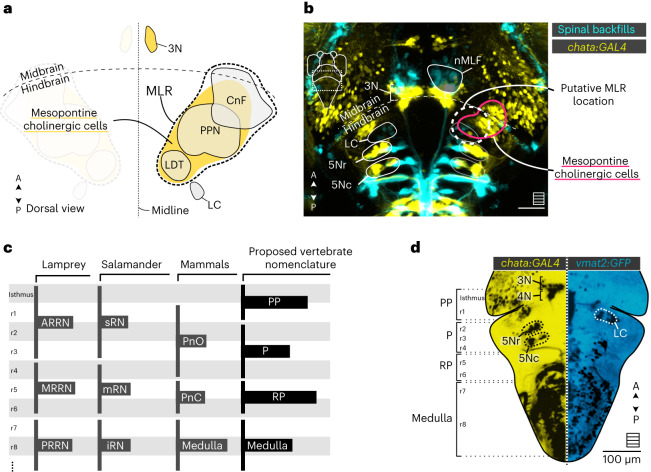
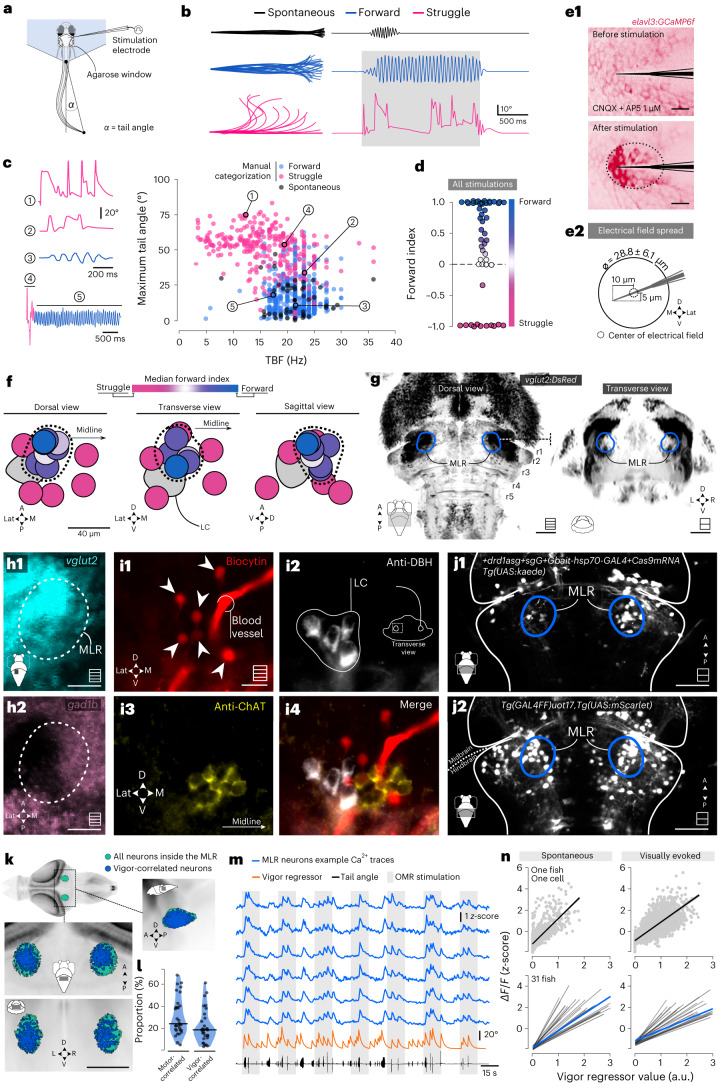
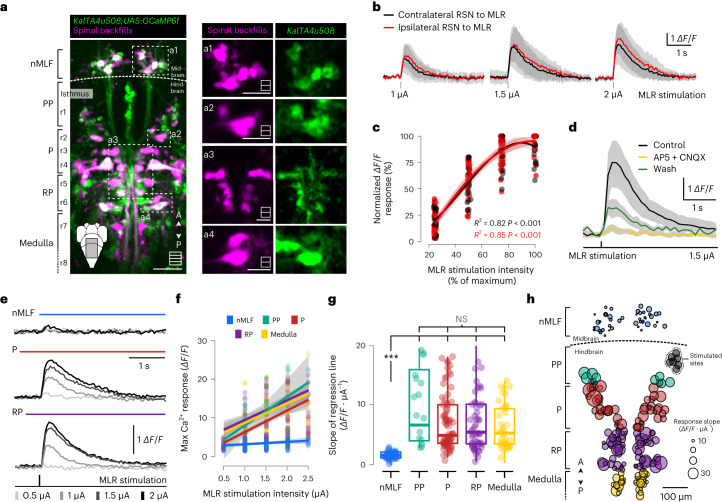
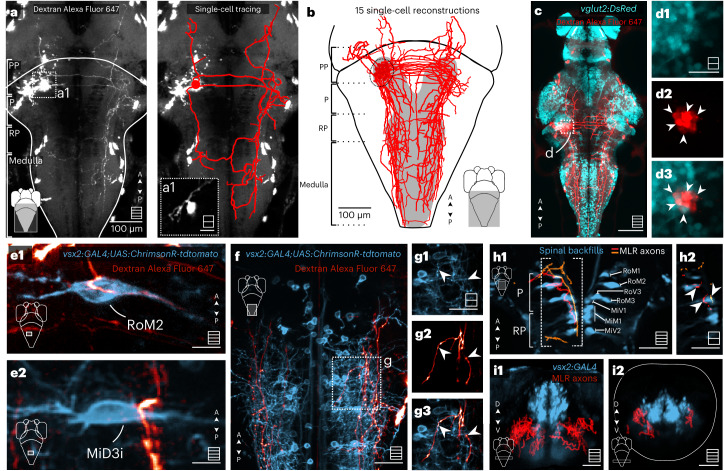
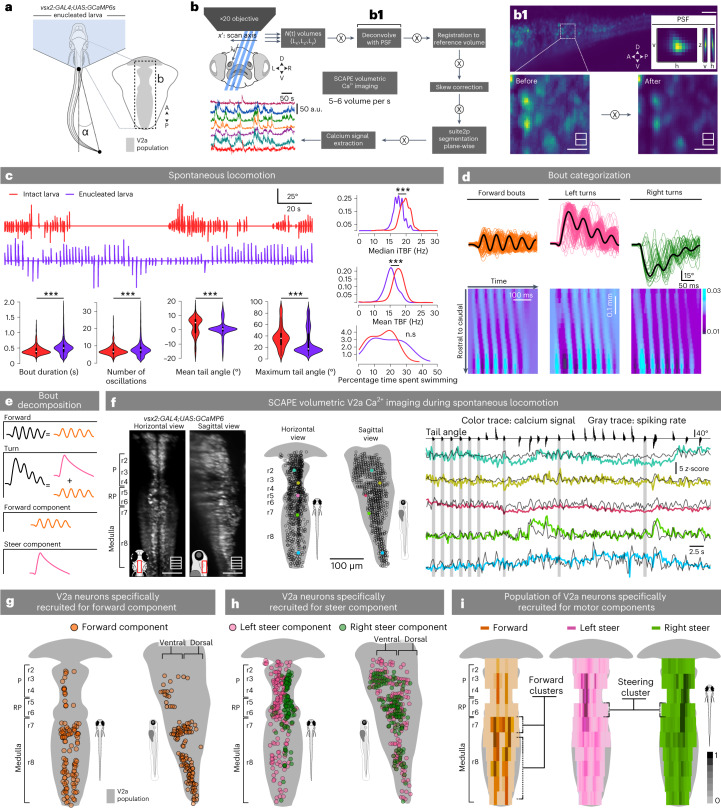
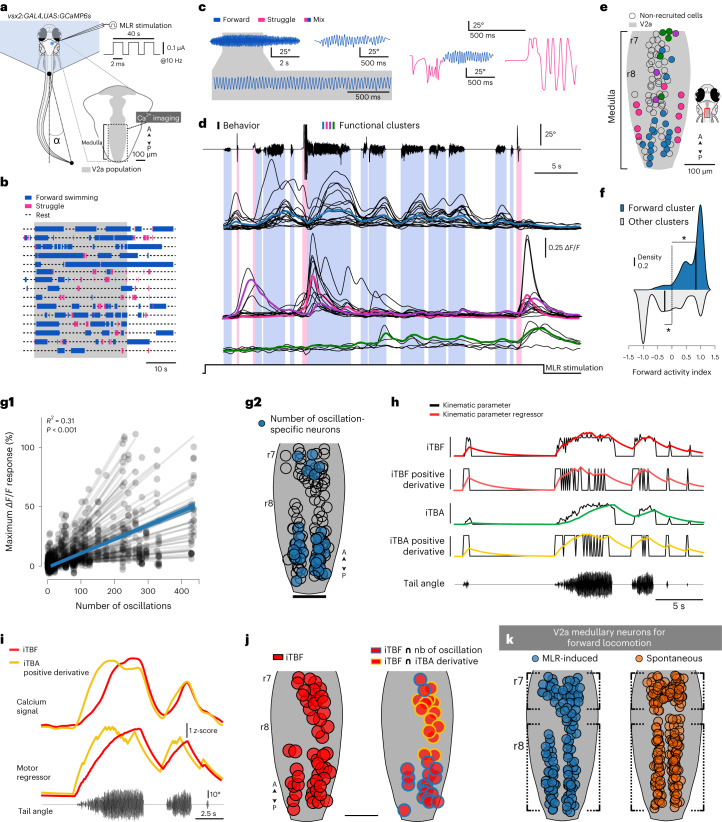
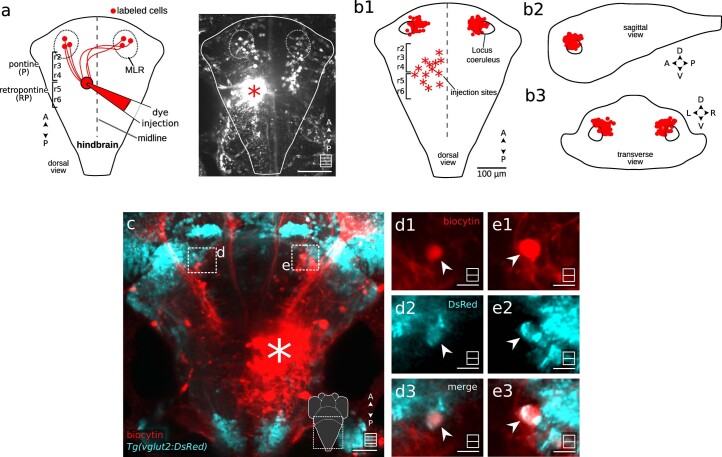
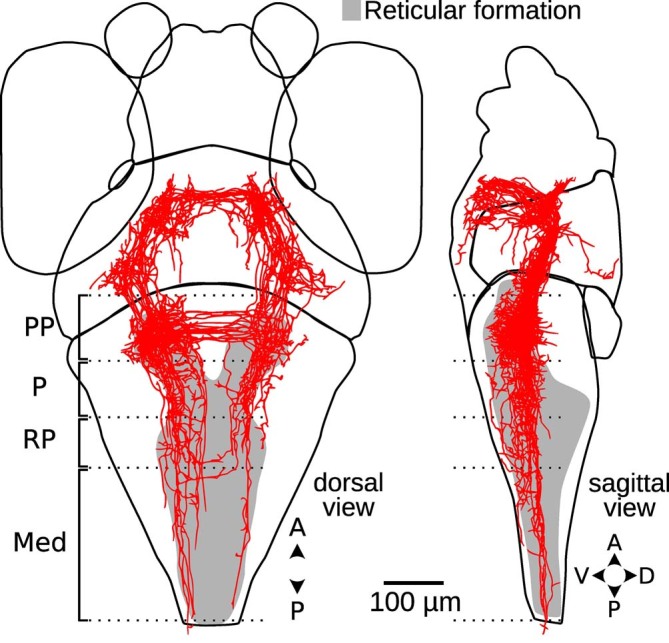
The mesencephalic locomotor region (MLR) is a brain stem area whose stimulation triggers graded forward locomotion. How MLR neurons recruit downstream vsx2 + (V2a) reticulospinal neurons (RSNs) is poorly understood. Here, to overcome this challenge, we uncovered the locus of MLR in transparent larval zebrafish and show that the MLR locus is distinct from the nucleus of the medial longitudinal fasciculus. MLR stimulations reliably elicit forward locomotion of controlled duration and frequency. MLR neurons recruit V2a RSNs via projections onto somata in pontine and retropontine areas, and onto dendrites in the medulla. High-speed volumetric imaging of neuronal activity reveals that strongly MLR-coupled RSNs are active for steering or forward swimming, whereas weakly MLR-coupled medullary RSNs encode the duration and frequency of the forward component. Our study demonstrates how MLR neurons recruit specific V2a RSNs to control the kinematics of forward locomotion and suggests conservation of the motor functions of V2a RSNs across vertebrates.
Overview
CoChat Summary
TL;DR
This study identifies the mesencephalic locomotor region (MLR) in larval zebrafish as a ~40-µm region dorsomedial to the locus coeruleus and shows it drives forward locomotion by recruiting V2a reticulospinal neurons (RSNs) while not recruiting nMLF neurons. MLR neurons project to P/RP V2a RSN somata and medullary V2a RSN dendrites, with medullary V2a RSNs encoding forward locomotor duration and frequency.
Key findings
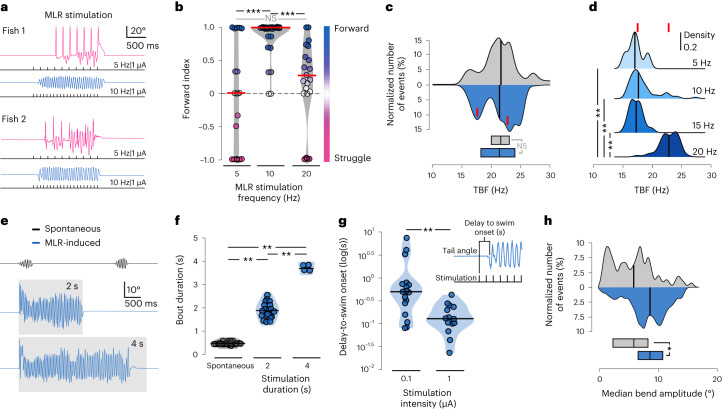
- The MLR locus was localized to a ~40-µm-diameter region at the isthmus/r1 boundary, medial and dorsal to the locus coeruleus, containing glutamatergic, GABAergic and cholinergic neurons and D1-receptor-expressing cells; it is distinct from the nMLF. MLR stimulation at 10 Hz was most effective for forward swimming, and 20-Hz stimulation elicited forward swims at 23.1 ± 1.618 Hz versus lower frequencies.
- MLR stimulation controlled forward-swim kinematics: 2-s and 4-s trains elicited sustained episodes lasting 1.91 ± 0.44 s and 3.65 ± 0.315 s, respectively, versus spontaneous bouts of 0.41 ± 0.15 s; MLR-evoked swims had larger tail bend amplitude (8.5 ± 3.8°) than spontaneous swims (5.9 ± 3.16°).
- Unilateral single-pulse MLR stimulation recruited ipsilateral and contralateral hindbrain RSNs but not nMLF neurons; glutamatergic antagonists AP5/CNQX blocked RSN calcium responses (7.6 ± 2.6% of pre-drug response after 40-min incubation, 23 ± 8% after 180-min washout). Response slopes were much lower for nMLF (0.74 ± 1.4 ΔF/F·µA−1) than for PP (7.8 ± 5.9), P (5.1 ± 4.7), RP (5.2 ± 5.7) and medulla (4.2 ± 3.8).
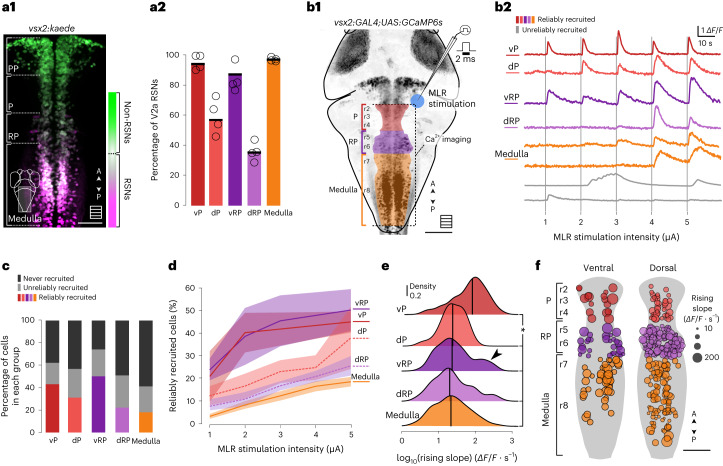
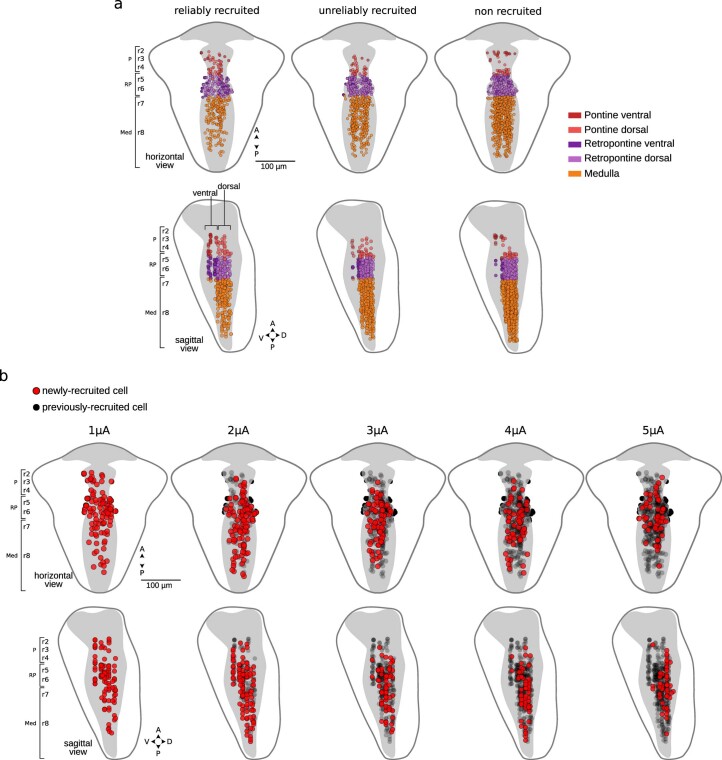
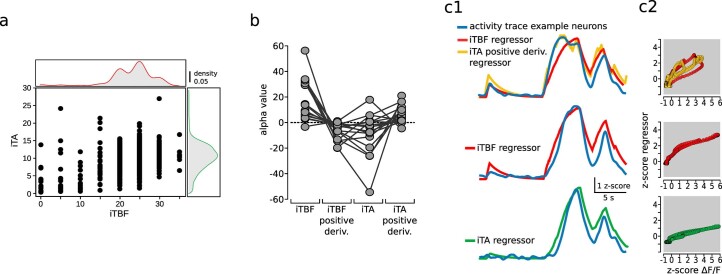
- MLR differentially recruited V2a RSNs: reliably recruited fractions were vP 42.8%, vRP 50.0%, dP 32.0%, dRP 22.7% and medulla 17%; MLR neurons formed axosomatic contacts onto P/RP V2a RSNs but only axodendritic contacts onto medullary V2a RSNs. Medullary forward-cluster V2a RSNs were 18.32 ± 7.32% of recorded medullary neurons, and 59 of 89 neurons encoded instantaneous tail beat frequency; high-speed volumetric imaging showed forward-component V2a neurons at 8.9 ± 3.2%, left-steering at 36.5 ± 1.5% and right-steering at 29.5 ± 4.5%.
Methods
- Larval zebrafish (4–7 dpf) were used with transgenic lines labeling V2a neurons, RSNs, glutamatergic/GABAergic/cholinergic populations and calcium indicators; experiments included electrical MLR stimulation with tungsten microelectrodes, behavioral tail tracking, spinning-disk calcium imaging, SCAPE high-speed volumetric imaging, focal electroporation, retrograde biocytin labeling, Kaede photoconversion, immunohistochemistry and CRISPR–Cas9 knock-in of drd1a reporters.
- Behavioral analysis used ZebraZoom for tail tracking and bout segmentation; calcium imaging analysis used suite2p for ROI extraction, deconvolution, motion correction, spike inference, clustering and regression against motor regressors.
- Sample sizes varied by experiment, including 31 fish for whole-brain OMR imaging, 5 fish for V2a recruitment and medullary forward-cluster analyses, and 3 enucleated larvae for volumetric forward/steering maps.
Limitations
- Stated: MLR stimulation never produced locomotor frequencies above approximately 25 Hz, and the authors cannot exclude that stimulation of adjacent areas, homolog of the cuneiform nucleus, could trigger fast swimming; the current MLR definition may correspond to the mammalian PPN homolog.
- Stated: Data collection and analysis were not performed blind to experimental conditions, except for manual segmentation and categorization of behavior in Figs. 2 and 3.
- Stated/evident: Enucleation altered swim kinematics (longer bouts, more oscillations, lower tail bend amplitude and slower tail beat frequency), and the SCAPE system’s depth of field was smaller by a factor of 2 than the reference system, which may affect generalization and imaging resolution.
Model-written summary. Check it against the paper before relying on it.
Integrity signals
Registry
Cites
Statistics
Figures
Verification
Claims the paper makes
9 Valid · 1 Not valid · 24 Not checked · 144 Own results and interpretations
The cited sources support only part of this claim — read each source’s verdict below.
In the paper
“In all vertebrate species investigated, the MLR induces locomotion via the activation of RSNs12–15.”
§ The mesencephalic locomotor region recruits V2a reticulospinal neurons to drive forward locomotion in larval zebrafish > Main
What the sources say
- Not checked yetcites [12] Capelli P Pivetta C Soledad Esposito M Arber S Locomotor speed control circuits in the caudal brainstem Nature 2017 551 373 377 10.1038/nature24064 29059682 source
- Partly supportedcites [13] Ryczko D Auclair F Cabelguen J-M Dubuc R The mesencephalic locomotor region sends a bilateral glutamatergic drive to hindbrain reticulospinal neurons in a tetrapod J. Comp. Neurol. 2016 524 1361 1383 10.1002/cne.23911 26470600 PMC5019149 sourceExperimental — accuracy not yet measured
The Introduction (section 'Introduction'/Abstract) does state the scheme the claim attributes: 'Anatomical studies provided evidence that the MLR projects down to reticulospinal (RS) neurons, which in turn activate the spinal central pattern generator (CPG) for locomotion', alongside 'stimulation of the MLR on one side elicits bilateral, symmetrical locomotor movements in all vertebrate species examined as of now', and the Discussion ('Central role of the RS system in locomotor control') documents the MLR→RS relay in lampreys, cats, birds and salamanders. However, the universality asserted in the claim ('in all vertebrate species investigated') is not carried by this source: the same paper states that 'How the RS system is controlled by the MLR in mammals remains unresolved' and that 'In tetrapods, the downward connectivity from the MLR is still unknown… the mechanisms by which the MLR controls RS neurons are not fully resolved in tetrapods'. Its own new data are from a single species, the salamander, and it frames the conservation across vertebrates as a suggestion ('suggesting that the structure and organization of brainstem locomotor circuits were conserved in vertebrates'), so the un-hedged all-species formulation overstates it. (LLM, conf=0.72)
- Not checked yetcites [14] Steeves JD Jordan LM Autoradiographic demonstration of the projections from the mesencephalic locomotor region Brain Res. 1984 307 263 276 10.1016/0006-8993(84)90480-3 6466996 source
- Not checked yetcites [15] Garcia-Rill E Skinner RD Gilmore SA Owings R Connections of the mesencephalic locomotor region (MLR) II. Afferents and efferents Brain Res. Bull. 1983 10 63 71 10.1016/0361-9230(83)90076-X 6186345 source
plainstates a cause- Asserted: passes — The authors put it forward as true.
- Checkable: passes — It can be checked against evidence.
- Load-bearing: unclear — It is unclear whether the paper’s conclusions depend on it.
- Based: passes — The paper gives a reason why it holds.
The cited sources support only part of this claim — read each source’s verdict below.
In the paper
“V2a RSNs are necessary for the initiation of locomotion18.”
§ The mesencephalic locomotor region recruits V2a reticulospinal neurons to drive forward locomotion in larval zebrafish > Main
What the sources say
- Partly supportedcites [18] Kimura Y Hindbrain V2a neurons in the excitation of spinal locomotor circuits during zebrafish swimming Curr. Biol. 2013 23 843 849 10.1016/j.cub.2013.03.066 23623549 sourceExperimental — accuracy not yet measured
Our copy supports the necessity element only for sustaining already-running swimming: the Results summary states that Arch/Halo3 photo-inhibition showed 'the activity of hindbrain V2a neurons was absolutely essential for sustaining spontaneously occurring swimming,' and the inactivation paradigm applied light only after swimming-related movements were detected (Results, Fig. 3; Movie S2). The initiation element is supported only as sufficiency, not necessity: ChR activation of hindbrain V2a neurons elicited forward swimming in 97.1% of trials (Results, Fig. 2). No passage tests whether V2a reticulospinal neurons are required for the onset/initiation of a locomotor episode, and the data come from 3 dpf zebrafish larvae swimming, so the unqualified generalization to 'initiation of locomotion' overstates the source. (LLM, conf=0.80)
plainstates a cause- Asserted: passes — The authors put it forward as true.
- Checkable: passes — It can be checked against evidence.
- Load-bearing: passes — The paper’s conclusions depend on it.
- Based: passes — The paper gives a reason why it holds.
- Partly supported
Every source the paper cites for this claim was checked and supports it.
In the paper
“Unilateral stimulation of the MLR recruits ipsilateral and contralateral RSNs13,39.”
§ The mesencephalic locomotor region recruits V2a reticulospinal neurons to drive forward locomotion in larval zebrafish > Results > MLR recruits ipsilateral and contralateral RSNs but not nMLF neurons
What the sources say
- Supportedcites [13] Ryczko D Auclair F Cabelguen J-M Dubuc R The mesencephalic locomotor region sends a bilateral glutamatergic drive to hindbrain reticulospinal neurons in a tetrapod J. Comp. Neurol. 2016 524 1361 1383 10.1002/cne.23911 26470600 PMC5019149 source
The Results section 'Effects of the MLR on RS cells' (p. ~4, passage 1) concludes that 'a unilateral stimulation of the MLR symmetrically activates RS cells of the mRN and iRN on both sides,' with comparable Ca2+ responses in ipsilateral and contralateral neurons for both train (n = 122 cells, eight preparations) and single-pulse stimulation (passages 2-3). The Discussion section headed 'Recruitment of RS cells by MLR stimulation' (passage 5) frames the finding in terms of recruitment of RS cells by MLR stimulation. The claim's wording ('recruits ipsilateral and contralateral RSNs') matches, though the source's demonstration is in the salamander preparation. (LLM, conf=0.92)
- Supportedcites [39] Brocard F The transformation of a unilateral locomotor command into a symmetrical bilateral activation in the brainstem J. Neurosci. 2010 30 523 533 10.1523/JNEUROSCI.3433-09.2010 20071515 PMC6632989 source
The Discussion (p. 1, 'Discussion') states the main finding as 'the striking similarity of synaptic responses elicited in RS cells on both sides by a unilateral stimulation of the MLR,' and credits symmetrical swimming to 'symmetrical MLR inputs to RS cells on both sides.' The 'Projections from the isthmic region to RS cells' section likewise refers to 'the bilateral recruitment of RS cells of the MRRN from unilateral stimulation of the MLR,' and the Abstract/Results ('Monosynaptic connectivity between the MLR and RS cells on both sides') report monosynaptic input to both the MRRN and PRRN. The work is in larval lamprey, which the citing sentence does not specify, but the attributed point — unilateral MLR stimulation recruiting ipsilateral and contralateral reticulospinal neurons — is directly stated. (LLM, conf=0.90)
plainstates a cause- Asserted: passes — The authors put it forward as true.
- Checkable: passes — It can be checked against evidence.
- Load-bearing: passes — The paper’s conclusions depend on it.
- Based: passes — The paper gives a reason why it holds.
- Supported
Every source the paper cites for this claim was checked and supports it.
In the paper
“Because not all hindbrain V2a neurons are RSNs17,18,41,42, we first quantified the proportions of V2a RSNs in each subdivision of the hindbrain”
§ The mesencephalic locomotor region recruits V2a reticulospinal neurons to drive forward locomotion in larval zebrafish > Results > The MLR differentially recruits distributed hindbrain V2a RSNs
What the sources say
- Supportedcites [17] Bretzner F Brownstone RM Lhx3-Chx10 reticulospinal neurons in locomotor circuits J. Neurosci. 2013 33 14681 14692 10.1523/JNEUROSCI.5231-12.2013 24027269 PMC6705172 source
In the section 'Lhx3 and Chx10 medRF neurons are reticulospinal neurons', our copy reports that only 8% of Chx10::eGFP (V2a-marker) medRF neurons were retrogradely labeled from the cervical spinal cord (16% for Lhx3-YFP), and states this 'likely indicates that Chx10 neurons are also involved in non-reticulospinal pathways' — i.e. that the hindbrain V2a population is not wholly reticulospinal. This is exactly the paraphrased point the citing sentence attributes to the source; the paper adds the caveat that TMRD does not fill all axons and so would underestimate the RSN fraction, but it still concludes Lhx3/Chx10 neurons form 'a significant component' rather than all of the reticulospinal pathway. (LLM, conf=0.85)
- Supportedcites [18] Kimura Y Hindbrain V2a neurons in the excitation of spinal locomotor circuits during zebrafish swimming Curr. Biol. 2013 23 843 849 10.1016/j.cub.2013.03.066 23623549 source
Our copy treats reticulospinal V2a neurons as a subset of the hindbrain V2a population: the Introduction states hindbrain V2a neurons are ipsilaterally projecting excitatory neurons 'many of which project down the spinal cord', and the Results (Kaede photo-conversion/backfilling) summarize that only 'some of the ipsilaterally projecting large reticulospinal neurons, including MiD2i, MiD3i, MiV1, and MiV2, were among the V2a neurons' while small reticulospinal V2a neurons are abundant caudally and 'gradually became smaller in more rostral regions'. The Discussion adds that in the rostral hindbrain 'few neurons in the region project to the spinal cord'. Together these establish that not all hindbrain V2a neurons are reticulospinal neurons, and the paper's region-by-region quantification matches the citing sentence's framing. (LLM, conf=0.85)
- Supportedcites [41] Pujala A Koyama M Chronology-based architecture of descending circuits that underlie the development of locomotor repertoire after birth eLife 2019 8 e42135 10.7554/eLife.42135 30801247 PMC6449084 source
The Introduction treats hindbrain V2a neurons as a cell type that 'include[s] excitatory reticulospinal neurons', i.e. RSNs are a subset of the V2a population rather than coextensive with it. The Results section on birth order reinforces this by restricting attention to 'Hindbrain V2a neurons with spinal projections' and noting that, beyond the large dye-fillable RS neurons, 'a majority of the V2a neurons in the caudal hindbrain have also been shown to project to the spinal cord' — implying a non-descending remainder. Figure 2C's schema likewise depicts the V2a subpopulation within the RS neuron set. Our copy therefore clearly supports the background premise that not all hindbrain V2a neurons are reticulospinal, though it states it by implication/subset framing rather than as an explicit negation. (LLM, conf=0.85)
- Supportedcites [42] Chopek JW Zhang Y Brownstone RM Intrinsic brainstem circuits comprised of Chx10-expressing neurons contribute to reticulospinal output in mice J. Neurophysiol. 2021 126 1978 1990 10.1152/jn.00322.2021 34669520 PMC8715053 source
The DISCUSSION section 'Subtypes of GRN Chx10 Neurons' states that the authors 'now definitively demonstrate that there are at least two major subtypes of Chx10 neurons in the GRN—reticulospinal neurons and local interneurons,' and the INTRODUCTION notes that of the two identified subsets 'only one of which (comprised of neurons with large somata) is reticulospinal.' The RESULTS section 'Large Chx10 Neurons Are Reticulospinal' quantifies this: spinal CTB labelling returned only 8–11% of Chx10ON neurons in the rostral GRN. Since Chx10/Vsx2 is the V2a marker (the paper equates the two for spinal neurons and uses a line previously used to study spinal V2a neurons) and the GRN is a hindbrain reticular formation nucleus, our copy establishes that a substantial fraction of hindbrain Chx10/V2a neurons are local interneurons rather than RSNs, supporting the paraphrase. (LLM, conf=0.85)
plain- Asserted: passes — The authors put it forward as true.
- Checkable: passes — It can be checked against evidence.
- Load-bearing: passes — The paper’s conclusions depend on it.
- Based: passes — The paper gives a reason why it holds.
- Supported
None of the sources cited for this claim have been checked yet.
In the paper
“At low intensity, the zebrafish MLR recruits ventral V2a RSNs in the P and RP regions in an all-or-nothing fashion, consistent with previous reports of large excitatory postsynaptic potentials previously recorded in these cells13,38,39.”
§ The mesencephalic locomotor region recruits V2a reticulospinal neurons to drive forward locomotion in larval zebrafish > Discussion > Anatomical and functional coupling of MLR neurons to V2a RSNs
What the sources say
- Could not verifycites [13] Ryczko D Auclair F Cabelguen J-M Dubuc R The mesencephalic locomotor region sends a bilateral glutamatergic drive to hindbrain reticulospinal neurons in a tetrapod J. Comp. Neurol. 2016 524 1361 1383 10.1002/cne.23911 26470600 PMC5019149 sourceExperimental — accuracy not yet measured
Our copy of Ryczko et al. (2016) is a salamander (Notophthalmus viridescens) Ca2+-imaging/tracing study; the only zebrafish recruitment statement it makes is in the Discussion ('Recruitment of RS cells by MLR stimulation'), where it credits Kinkhabwala et al. (2011) with showing that dorsal glutamatergic reticular cells are recruited first at low swimming frequencies — nothing about ventral V2a reticulospinal neurons in the P and RP nuclei being recruited in an all-or-nothing fashion. Searches for 'zebrafish V2a', 'all-or-none/threshold recruitment', 'P and RP nuclei' and 'excitatory postsynaptic potentials in reticulospinal neurons' returned no passage addressing the claim; the paper's own recruitment data (Results, 'Effects of the MLR on RS cells'; 'Comparison of Ca2+ responses in the mRN and the iRN') describe graded, cubic-polynomial growth of Ca2+ responses with stimulation intensity in salamander mRN/iRN cells, not zebrafish V2a cells. Because our copy does not treat the zebrafish point (and names no source for an all-or-none ventral V2a recruitment), it can neither support nor contradict the claim. (LLM, conf=0.70)
- Not checked yetcites [38] Brocard F Dubuc R Differential contribution of reticulospinal cells to the control of locomotion induced by the mesencephalic locomotor region J. Neurophysiol. 2003 90 1714 1727 10.1152/jn.00202.2003 12736238 source
- Not checked yetcites [39] Brocard F The transformation of a unilateral locomotor command into a symmetrical bilateral activation in the brainstem J. Neurosci. 2010 30 523 533 10.1523/JNEUROSCI.3433-09.2010 20071515 PMC6632989 source
plainstates a cause- Asserted: passes — The authors put it forward as true.
- Checkable: passes — It can be checked against evidence.
- Load-bearing: passes — The paper’s conclusions depend on it.
- Based: passes — The paper gives a reason why it holds.
- Could not verify
75 more claims
Create a free account to see all 178 claims and to verify the 40 references still open.
- Probably not a substantial claim. 41
- It may state two separate claims as one. 63
Claims other papers make about this one
Each is checked against this paper’s own text: does it say what the citing paper says it does?
The cited source says what the claim attributes to it.
In the citing paper
“This also aligns with modularity at the level of brainstem spinal projection neurons observed in vertebrates (zebrafish58, mice6,18,59), indicating that vertebrates could also have halting pathways that differentially inhibit forward locomotion and turning.”
From Neural circuit mechanisms underlying context-specific halting in Drosophila (2024) · cites this paper as [58]
Statistics recomputed
Every reported test result, recomputed from its test statistic and degrees of freedom. A result shows as not adding up only once an independent check has confirmed it.
- ConsistentF(112, 13.02) = 211.3reported p < .001 · recomputed p < .001
“F(112, 13.02) = 211.3, p < .001”
- ConsistentF(100, 13.45) = 151.1reported p < .001 · recomputed p < .001
“F(100, 13.45) = 151.1, p < .001”
Self-check
Percentages, sums and reported differences re-computed from the paper’s own numbers.
Each contradiction between two passages listed here was confirmed by an independent check.
Rated major: it would touch a result — a value a result rests on, reported and recomputed p-values on opposite sides of the significance level, two passages that conflict with no sign which is right, or a cited work retracted before this paper was published.
In the paper
§ The mesencephalic locomotor region recruits V2a reticulospinal neurons to drive forward locomotion in larval zebrafish > Results > Medullary V2a RSNs encode locomotor duration and frequency
“forward cluster: 1,438 cells”
§ The mesencephalic locomotor region recruits V2a reticulospinal neurons to drive forward locomotion in larval zebrafish > Results > Medullary V2a RSNs encode locomotor duration and frequency
“a total of 1,140 neurons out of 5 fish recorded”
Rated major: it would touch a result — a value a result rests on, reported and recomputed p-values on opposite sides of the significance level, two passages that conflict with no sign which is right, or a cited work retracted before this paper was published.
In the paper
“forward cluster: 18.32 ± 7.32%, 26.4 ± 12.6 of 228 ± 35.9 neurons per fish, a total of 1,140 neurons out of 5 fish recorded”
§ The mesencephalic locomotor region recruits V2a reticulospinal neurons to drive forward locomotion in larval zebrafish > Results > Medullary V2a RSNs encode locomotor duration and frequency
Reported 18.32 · recomputed 11.578947
Rated minor: it would not touch a result — a value no result rests on, a p-value that stays on the same side of the significance level, or a conflict that is clerical, resolved elsewhere in the paper, or outside its own findings.
In the paper
“5 Hz: n = 19 stimulations, −0.06 ± 0.8; 10 Hz: n = 26 stimulations, 0.919 ± 0.24; 20 Hz: n = 19 stimulations, 0.27 ± 0.55 s; Kruskal–Wallis test, χ2 = 105.85, d.f. = 3”
§ The mesencephalic locomotor region recruits V2a reticulospinal neurons to drive forward locomotion in larval zebrafish > Results > MLR sets the kinematics of locomotion
Reported 3 · recomputed 2
Rated minor: it would not touch a result — a value no result rests on, a p-value that stays on the same side of the significance level, or a conflict that is clerical, resolved elsewhere in the paper, or outside its own findings.
In the paper
§ The mesencephalic locomotor region recruits V2a reticulospinal neurons to drive forward locomotion in larval zebrafish > Results > The MLR differentially recruits distributed hindbrain V2a RSNs
“only a subset of V2a RSNs were reliably recruited in the medulla (Fig. 5c, 17%)”
§ The mesencephalic locomotor region recruits V2a reticulospinal neurons to drive forward locomotion in larval zebrafish > Results > Medullary V2a RSNs encode locomotor duration and frequency
“Fig. 5: reliably recruited V2a neurons: 22% of medullary V2a neurons”
Rated minor: it would not touch a result — a value no result rests on, a p-value that stays on the same side of the significance level, or a conflict that is clerical, resolved elsewhere in the paper, or outside its own findings.
In the paper
“5 Hz: ten episodes, 17.54 ± 1.31 Hz; 10 Hz: 60 episodes, 18.7 ± 2.34 Hz; 15 Hz: 18 episodes, 17.66 ± 1.07 Hz; 20 Hz: 154 episodes, 23.1 ± 1.618 Hz; Kruskal–Wallis test, χ2 = 6237, d.f. = 31”
§ The mesencephalic locomotor region recruits V2a reticulospinal neurons to drive forward locomotion in larval zebrafish > Results > MLR sets the kinematics of locomotion
Reported 31 · recomputed 3
1 more finding
Create a free account to see every finding of this check.
Citations
Cites
Fiji: an open-source platform for biological-image analysis
Schindelin, J., Arganda-Carreras, I., Frise, E., Kaynig, V., Longair, M., Pietzsch, T., Preibisch, S., Rueden, C., Saalfeld, S., Schmid, B., et al. (2012) · Nature Methods · doi:10.1038/nmeth.2019 · Cited by 66,890
Wickham, H., Averick, M., Bryan, J., Chang, W., McGowan, L., François, R., Grolemund, G., Hayes, A., Henry, L., Hester, J., et al. (2019) · Journal of Open Source Software · doi:10.21105/joss.01686 · Cited by 22,138
seaborn: statistical data visualization
Waskom, M. (2021) · Journal of Open Source Software · doi:10.21105/joss.03021 · Cited by 7,310
Cellpose: a generalist algorithm for cellular segmentation
Stringer, C., Wang, T., Michaelos, M., & Pachitariu, M. (2021) · Nature Methods · doi:10.1038/s41592-020-01018-x · Cited by 4,369
An iterative technique for the rectification of observed distributions
Lucy, L. B. (1974) · The Astronomical Journal · doi:10.1086/111605 · Cited by 3,866
Suite2p: beyond 10,000 neurons with standard two-photon microscopy
Pachitariu, M., Stringer, C., Dipoppa, M., Schröder, S., Rossi, L. F., Dalgleish, H., Carandini, M., & Harris, K. D. (2016) · bioRxiv (Cold Spring Harbor Laboratory) · doi:10.1101/061507 · Cited by 1,247
mScarlet: a bright monomeric red fluorescent protein for cellular imaging
Bindels, D. S., Haarbosch, L., van Weeren, L., Postma, M., Wiese, K. E., Mastop, M., Aumonier, S., Gotthard, G., Royant, A., Hink, M. A., et al. (2017) · Nature Methods · doi:10.1038/nmeth.4074 · Cited by 1,156
Droettboom, M., Caswell, T. A., Hunter, J., Firing, E., Nielsen, J. H., Varoquaux, N., Root, B., De Andrade, E. S., Elson, P., Dale, D., et al. (2014) · Zenodo (CERN European Organization for Nuclear Research) · doi:10.5281/zenodo.592536 · Cited by 857
[Control of walking and running by means of electric stimulation of the midbrain].
Shik, M. L., Fv, S., & Gn, O. (1966) · PubMed · Cited by 752
Decoding the organization of spinal circuits that control locomotion
Kiehn, O. (2016) · Nature Reviews Neuroscience · doi:10.1038/nrn.2016.9 · Cited by 742
Optimization and gaits in the locomotion of vertebrates
Alexander, R. M. (1989) · Physiological Reviews · doi:10.1152/physrev.1989.69.4.1199 · Cited by 613
DeconvolutionLab2: An open-source software for deconvolution microscopy
Sage, D., Donati, L., Soulez, F., Fortun, D., Schmit, G., Seitz, A., Guiet, R., Vonesch, C., & Unser, M. (2017) · Methods · doi:10.1016/j.ymeth.2016.12.015 · Cited by 600
Bouchard, M. B., Voleti, V., Mendes, C. S., Lacefield, C., Grueber, W. B., Mann, R. S., Bruno, R. M., & Hillman, E. M. C. (2015) · Nature Photonics · doi:10.1038/nphoton.2014.323 · Cited by 566
Self-citationAsakawa, K., Suster, M. L., Mizusawa, K., Nagayoshi, S., Kotani, T., Urasaki, A., Kishimoto, Y., Hibi, M., & Kawakami, K. (2008) · Proceedings of the National Academy of Sciences · doi:10.1073/pnas.0704963105 · Cited by 560
Fast online deconvolution of calcium imaging data
Friedrich, J., Zhou, P., & Paninski, L. (2017) · PLOS Computational Biology · doi:10.1371/journal.pcbi.1005423 · Cited by 559
Midbrain circuits that set locomotor speed and gait selection
Caggiano, V., Leiras, R., Goñi-Erro, H., Masini, D., Bellardita, C., Bouvier, J., Caldeira, V., Fisone, G., & Kiehn, O. (2018) · Nature · doi:10.1038/nature25448 · Cited by 444
Laser-induced gene expression in specific cells of transgenic zebrafish
Halloran, M. C., Sato-Maeda, M., Warren, J. T., Su, F., Lele, Z., Krone, P. H., Kuwada, J. Y., & Shoji, W. (2000) · Development · doi:10.1242/dev.127.9.1953 · Cited by 440
Cholinergic mesencephalic neurons are involved in gait and postural disorders in Parkinson disease
Karachi, C., Grabli, D., Bernard, F. A., Tandé, D., Wattiez, N., Belaid, H., Bardinet, E., Prigent, A., Nothacker, H.-P., Hunot, S., et al. (2010) · Journal of Clinical Investigation · doi:10.1172/jci42642 · Cited by 434
Edwards, S. B. (1975) · Journal of Comparative Neurology · doi:10.1002/cne.901610306 · Cited by 431
Optogenetic dissection of a behavioural module in the vertebrate spinal cord
Wyart, C., Bene, F. D., Warp, E., Scott, E. K., Trauner, D., Baier, H., & Isacoff, E. Y. (2009) · Nature · doi:10.1038/nature08323 · Cited by 409
Self-citationCell-Type-Specific Control of Brainstem Locomotor Circuits by Basal Ganglia
Roseberry, T. K., Lee, A. M., Lalive, A. L., Wilbrecht, L., Bonci, A., & Kreitzer, A. C. (2016) · Cell · doi:10.1016/j.cell.2015.12.037 · Cited by 395
Targeting neural circuitry in zebrafish using GAL4 enhancer trapping
Scott, E. K., Mason, L., Arrenberg, A. B., Ziv, L., Gosse, N. J., Xiao, T., Chi, N. C., Asakawa, K., Kawakami, K., & Baier, H. (2007) · Nature Methods · doi:10.1038/nmeth1033 · Cited by 392
Gahtan, E., Tanger, P., & Baier, H. (2005) · The Journal of Neuroscience · doi:10.1523/jneurosci.2678-05.2005 · Cited by 350
Neural bases of goal-directed locomotion in vertebrates—An overview
Grillner, S., Wallén, P., Saitoh, K., Kozlov, A., & Robertson, B. (2008) · Brain Research Reviews · doi:10.1016/j.brainresrev.2007.06.027 · Cited by 341
Li, X., Yu, B., Sun, Q., Zhang, Y., Ren, M., Zhang, X., Li, A., Yuan, J., Madisen, L., Luo, Q., et al. (2018) · Proceedings of the National Academy of Sciences · doi:10.1073/pnas.1703601115 · Cited by 333
Kimura, Y., Hisano, Y., Kawahara, A., & Higashijima, S.-I. (2014) · Scientific Reports · doi:10.1038/srep06545 · Cited by 326
The interstitial nucleus of Cajal and its role in the control of movements of head and eyes
FUKUSHIMA, K. (1987) · Progress in Neurobiology · doi:10.1016/0301-0082(87)90016-5 · Cited by 325
Real-time volumetric microscopy of in vivo dynamics and large-scale samples with SCAPE 2.0
Voleti, V., Patel, K. B., Li, W., Perez Campos, C., Bharadwaj, S., Yu, H., Ford, C., Casper, M. J., Yan, R. W., Liang, W., et al. (2019) · Nature Methods · doi:10.1038/s41592-019-0579-4 · Cited by 320
Self-citationBrain-wide mapping of neural activity controlling zebrafish exploratory locomotion
Dunn, T. W., Mu, Y., Narayan, S., Randlett, O., Naumann, E. A., Yang, C.-T., Schier, A. F., Freeman, J., Engert, F., & Ahrens, M. B. (2016) · eLife · doi:10.7554/elife.12741 · Cited by 312
Kimura, Y., Okamura, Y., & Higashijima, S.-I. (2006) · The Journal of Neuroscience · doi:10.1523/jneurosci.4993-05.2006 · Cited by 302
Mapping brain activity at scale with cluster computing
Freeman, J., Vladimirov, N., Kawashima, T., Mu, Y., Sofroniew, N. J., Bennett, D. V., Rosen, J., Yang, C.-T., Looger, L. L., & Ahrens, M. B. (2014) · Nature Methods · doi:10.1038/nmeth.3041 · Cited by 299
Initiation of locomotion in mammals
JORDAN, L. M. (1998) · Annals of the New York Academy of Sciences · doi:10.1111/j.1749-6632.1998.tb09040.x · Cited by 289
Locomotor speed control circuits in the caudal brainstem
Capelli, P., Pivetta, C., Soledad Esposito, M., & Arber, S. (2017) · Nature · doi:10.1038/nature24064 · Cited by 288
Identification of a brainstem circuit regulating visual cortical state in parallel with locomotion
Lee, A. M., Hoy, J. L., Bonci, A., Wilbrecht, L., Stryker, M. P., & Niell, C. M. (2014) · Neuron · doi:10.1016/j.neuron.2014.06.031 · Cited by 282
The mesencephalic locomotor region (MLR) in the rat
Skinner, R. D., & Garcia-Rill, E. (1984) · Brain Research · doi:10.1016/0006-8993(84)90319-6 · Cited by 281
Control of visually guided behavior by distinct populations of spinal projection neurons
Orger, M. B., Kampff, A. R., Severi, K. E., Bollmann, J. H., & Engert, F. (2008) · Nature Neuroscience · doi:10.1038/nn2048 · Cited by 274
A Cellular-Resolution Atlas of the Larval Zebrafish Brain
Kunst, M., Laurell, E., Mokayes, N., Kramer, A., Kubo, F., Fernandes, A. M., Förster, D., Dal Maschio, M., & Baier, H. (2019) · Neuron · doi:10.1016/j.neuron.2019.04.034 · Cited by 274
Descending command neurons in the brainstem that halt locomotion
Bouvier, J., Caggiano, V., Leiras, R., Caldeira, V., Bellardita, C., Balueva, K., Fuchs, A., & Kiehn, O. (2015) · Cell · doi:10.1016/j.cell.2015.10.074 · Cited by 259
A novel diuretic hormone receptor in Drosophila: evidence for conservation of CGRP signaling
Johnson, E. C., Shafer, O. T., Trigg, J. S., Park, J., Schooley, D. A., Dow, J. A., & Taghert, P. H. (2005) · Journal of Experimental Biology · doi:10.1242/jeb.01529 · Cited by 254
Hägglund, M., Borgius, L., Dougherty, K. J., & Kiehn, O. (2010) · Nature Neuroscience · doi:10.1038/nn.2482 · Cited by 253
Brain neurons which project to the spinal cord in young larvae of the zebrafish
Kimmel, C. B., Powell, S. L., & Metcalfe, W. K. (1982) · Journal of Comparative Neurology · doi:10.1002/cne.902050203 · Cited by 253
Structure of the Zebrafish Locomotor Repertoire Revealed with Unsupervised Behavioral Clustering
Marques, J. C., Lackner, S., Félix, R., & Orger, M. B. (2018) · Current Biology · doi:10.1016/j.cub.2017.12.002 · Cited by 245
Optical control of zebrafish behavior with halorhodopsin
Arrenberg, A. B., Del Bene, F., & Baier, H. (2009) · Proceedings of the National Academy of Sciences · doi:10.1073/pnas.0906252106 · Cited by 243
Neural control and modulation of swimming speed in the larval zebrafish
Severi, K. E., Portugues, R., Marques, J. C., O’Malley, D. M., Orger, M. B., & Engert, F. (2014) · Neuron · doi:10.1016/j.neuron.2014.06.032 · Cited by 239
Self-citationLocomotion-inducing sites in the vicinity of the pedunculopontine nucleus
Garcia-Rill, E., Houser, C. R., Skinner, R. D., Smith, W., & Woodward, D. J. (1987) · Brain Research Bulletin · doi:10.1016/0361-9230(87)90208-5 · Cited by 227
Ancestral Circuits for the Coordinated Modulation of Brain State
Lovett-Barron, M., Andalman, A. S., Allen, W. E., Vesuna, S., Kauvar, I., Burns, V. M., & Deisseroth, K. (2017) · Cell · doi:10.1016/j.cell.2017.10.021 · Cited by 212
Aberdam, E., Bertolotto, C., Sviderskaya, E. V., de Thillot, V., Hemesath, T. J., Fisher, D. E., Bennett, D. C., Ortonne, J.-P., & Ballotti, R. (1998) · Journal of Biological Chemistry · doi:10.1074/jbc.273.31.19560 · Cited by 206
A structural and functional ground plan for neurons in the hindbrain of zebrafish
Kinkhabwala, A., Riley, M., Koyama, M., Monen, J., Satou, C., Kimura, Y., Higashijima, S.-I., & Fetcho, J. (2011) · Proceedings of the National Academy of Sciences · doi:10.1073/pnas.1012185108 · Cited by 203
A dedicated visual pathway for prey detection in larval zebrafish
Semmelhack, J. L., Donovan, J. C., Thiele, T. R., Kuehn, E., Laurell, E., & Baier, H. (2014) · eLife · doi:10.7554/elife.04878 · Cited by 202
Self-citationInitiation of locomotion in lampreys
Dubuc, R., Brocard, F., Antri, M., Fénelon, K., Gariépy, J.-F., Smetana, R., Ménard, A., Le Ray, D., Viana Di Prisco, G., Pearlstein, É., et al. (2008) · Brain Research Reviews · doi:10.1016/j.brainresrev.2007.07.016 · Cited by 201
Self-citationDescending Control of Swim Posture by a Midbrain Nucleus in Zebrafish
Thiele, T. R., Donovan, J. C., & Baier, H. (2014) · Neuron · doi:10.1016/j.neuron.2014.04.018 · Cited by 198
Self-citationMapping a sensory-motor network onto a structural and functional ground plan in the hindbrain
Koyama, M., Kinkhabwala, A., Satou, C., Higashijima, S.-I., & Fetcho, J. (2011) · Proceedings of the National Academy of Sciences · doi:10.1073/pnas.1012189108 · Cited by 190
Visualization of monoaminergic neurons and neurotoxicity of MPTP in live transgenic zebrafish
Wen, L., Wei, W., Gu, W., Huang, P., Ren, X., Zhang, Z., Zhu, Z., Lin, S., & Zhang, B. (2008) · Developmental Biology · doi:10.1016/j.ydbio.2007.11.012 · Cited by 189
Hindbrain V2a neurons in the excitation of spinal locomotor circuits during zebrafish swimming
Kimura, Y., Satou, C., Fujioka, S., Shoji, W., Umeda, K., Ishizuka, T., Yawo, H., & Higashijima, S.-I. (2013) · Current Biology · doi:10.1016/j.cub.2013.03.066 · Cited by 186
Lister, J. A., Close, J., & Raible, D. W. (2001) · Developmental Biology · doi:10.1006/dbio.2001.0379 · Cited by 185
Emergence of patterned activity in the developing zebrafish spinal cord
Warp, E., Agarwal, G., Wyart, C., Friedmann, D., Oldfield, C. S., Conner, A., Del Bene, F., Arrenberg, A. B., Baier, H., & Isacoff, E. Y. (2012) · Current Biology · doi:10.1016/j.cub.2011.12.002 · Cited by 184
Self-citationThe Multifunctional Mesencephalic Locomotor Region
Ryczko, D., & Dubuc, R. (2013) · Current Pharmaceutical Design · doi:10.2174/1381612811319240011 · Cited by 179
Self-citationEvidence for a Widespread Brain Stem Escape Network in Larval Zebrafish
Gahtan, E., Sankrithi, N., Campos, J. B., & O'Malley, D. M. (2002) · Journal of Neurophysiology · doi:10.1152/jn.00596.2001 · Cited by 169
Chemical activation of the mesecephalic locomotor region
Garcia-Rill, E., Skinner, R. D., & Fitzgerald, J. A. (1985) · Brain Research · doi:10.1016/0006-8993(85)90006-x · Cited by 163
Sirota, M. G., Di Prisco, G. V., & Dubuc, R. (2000) · European Journal of Neuroscience · doi:10.1046/j.1460-9568.2000.00301.x · Cited by 158
Self-citationBrainstem neurons that command mammalian locomotor asymmetries
Cregg, J. M., Leiras, R., Montalant, A., Wanken, P., Wickersham, I. R., & Kiehn, O. (2020) · Nature Neuroscience · doi:10.1038/s41593-020-0633-7 · Cited by 154
Control of walking and running by means of electrical stimulation of the mesencephalon.
Shik, M. L., Fv, S., & Orlovsky, G. N. (1969) · PubMed · Cited by 152
Connections of the mesencephalic locomotor region (MLR) II. Afferents and efferents
Garcia-Rill, E., Skinner, R. D., Gilmore, S. A., & Owings, R. (1983) · Brain Research Bulletin · doi:10.1016/0361-9230(83)90076-x · Cited by 149
ZebraZoom: an automated program for high-throughput behavioral analysis and categorization
Mirat, O., Sternberg, J. R., Severi, K. E., & Wyart, C. (2013) · Frontiers in Neural Circuits · doi:10.3389/fncir.2013.00107 · Cited by 149
Self-citationAutoradiographic demonstration of the projections from the mesencephalic locomotor region
Steeves, J. D., & Jordan, L. M. (1984) · Brain Research · doi:10.1016/0006-8993(84)90480-3 · Cited by 141
Sensorimotor computation underlying phototaxis in zebrafish
Wolf, S., Dubreuil, A. M., Bertoni, T., Böhm, U. L., Bormuth, V., Candelier, R., Karpenko, S., Hildebrand, D. G. C., Bianco, I. H., Monasson, R., et al. (2017) · Nature Communications · doi:10.1038/s41467-017-00310-3 · Cited by 138
Initiation of Locomotion in Adult Zebrafish
Kyriakatos, A., Mahmood, R., Ausborn, J., Porres, C. P., Buschges, A., & El Manira, A. (2011) · Journal of Neuroscience · doi:10.1523/jneurosci.1012-11.2011 · Cited by 135
Cabelguen, J.-M., Bourcier-Lucas, C., & Dubuc, R. (2003) · The Journal of Neuroscience · doi:10.1523/jneurosci.23-06-02434.2003 · Cited by 134
Self-citationThe tangential nucleus controls a gravito-inertial vestibulo-ocular reflex
Bianco, I. H., Ma, L.-H., Schoppik, D., Robson, D. N., Orger, M. B., Beck, J. C., Li, J. M., Schier, A. F., Engert, F., & Baker, R. (2012) · Current Biology · doi:10.1016/j.cub.2012.05.026 · Cited by 134
Spinal projection neurons control turning behaviors in zebrafish
Huang, K.-H., Ahrens, M. B., Dunn, T. W., & Engert, F. (2013) · Current Biology · doi:10.1016/j.cub.2013.06.044 · Cited by 133
Activity of Reticulospinal Neurons During Locomotion in the Freely Behaving Lamprey
Deliagina, T. G., Zelenin, P. V., Fagerstedt, P., Grillner, S., & Orlovsky, G. N. (2000) · Journal of Neurophysiology · doi:10.1152/jn.2000.83.2.853 · Cited by 131
Noga, B. R., Kriellaars, D. J., Brownstone, R. M., & Jordan, L. M. (2003) · Journal of Neurophysiology · doi:10.1152/jn.00034.2003 · Cited by 126
Menelaou, E., & McLean, D. L. (2012) · The Journal of Neuroscience · doi:10.1523/jneurosci.1809-12.2012 · Cited by 116
Anatomy and physiology of the primate interstitial nucleus of Cajal I. efferent projections
Kokkoroyannis, T., Scudder, C. A., Balaban, C. D., Highstein, S. M., & Moschovakis, A. K. (1996) · Journal of Neurophysiology · doi:10.1152/jn.1996.75.2.725 · Cited by 114
Brocard, F., & Dubuc, R. (2003) · Journal of Neurophysiology · doi:10.1152/jn.00202.2003 · Cited by 107
Self-citationMidbrain Control of Three-Dimensional Head Orientation
Klier, E. M., Wang, H., Constantin, A. G., & Crawford, J. D. (2002) · Science · doi:10.1126/science.1067300 · Cited by 101
A descending dopamine pathway conserved from basal vertebrates to mammals
Ryczko, D., Cone, J. J., Alpert, M. H., Goetz, L., Auclair, F., Dubé, C., Parent, M., Roitman, M. F., Alford, S., & Dubuc, R. (2016) · Proceedings of the National Academy of Sciences · doi:10.1073/pnas.1600684113 · Cited by 101
Self-citationLhx3-Chx10 Reticulospinal Neurons in Locomotor Circuits
Bretzner, F., & Brownstone, R. M. (2013) · The Journal of Neuroscience · doi:10.1523/jneurosci.5231-12.2013 · Cited by 99
mixtools: An R Package for Analyzing Finite Mixture Models
Benaglia, T., Chauveau, D., Hunter, D. R., & Young, D. S. (2009) · Cited by 99
Hubbard, J. M., Böhm, U. L., Prendergast, A., Tseng, P.-E. B., Newman, M., Stokes, C., & Wyart, C. (2016) · Current Biology · doi:10.1016/j.cub.2016.08.026 · Cited by 94
Self-citationPedunculopontine stimulation induces prolonged activation of pontine reticular neurons
García‐Rill, E., Skinner, R. D., Miyazato, H., & Homma, Y. (2001) · Neuroscience · doi:10.1016/s0306-4522(01)00094-x · Cited by 89
The interstitial nucleus of Cajal in the midbrain reticular formation and vertical eye movement
Fukushima, K. (1991) · Neuroscience Research · doi:10.1016/0168-0102(91)90055-4 · Cited by 89
Control of orienting movements and locomotion by projection-defined subsets of brainstem V2a neurons
Usseglio, G., Gatier, E., Heuzé, A., Hérent, C., & Bouvier, J. (2020) · Current Biology · doi:10.1016/j.cub.2020.09.014 · Cited by 87
Cholinergic left-right asymmetry in the habenulo-interpeduncular pathway
Hong, E., Santhakumar, K., Akitake, C. A., Ahn, S. J., Thisse, C., Thisse, B., Wyart, C., Mangin, J.-M., & Halpern, M. E. (2013) · Proceedings of the National Academy of Sciences · doi:10.1073/pnas.1319566110 · Cited by 87
Self-citationPretectal neurons control hunting behaviour
Antinucci, P., Folgueira, M., & Bianco, I. H. (2019) · eLife · doi:10.7554/elife.48114 · Cited by 86
Wang, Z., Maunze, B., Wang, Y., Tsoulfas, P., & Blackmore, M. G. (2018) · The Journal of Neuroscience · doi:10.1523/jneurosci.1196-18.2018 · Cited by 85
Song, J., Pallucchi, I., Ausborn, J., Ampatzis, K., Bertuzzi, M., Fontanel, P., Picton, L. D., & El Manira, A. (2020) · Neuron · doi:10.1016/j.neuron.2019.12.030 · Cited by 84
Postural performance in decerebrated rabbit
Евгеньевич, М. П., Zelenin, P. V., Lyalka, V. F., Orlovsky, G. N., & Deliagina, T. G. (2008) · Behavioural Brain Research · doi:10.1016/j.bbr.2008.02.011 · Cited by 83
Vestibular control of swimming in lamprey: I. Responses of reticulospinal neurons to roll and pitch
Orlovsky, G. N., Deliagina, T. G., & Wall�n, P. (1992) · Experimental Brain Research · doi:10.1007/bf00230930 · Cited by 82
Medioventral medulla-induced locomotion
Kinjo, N., Atsuta, Y., Webber, M., Kyle, R., Skinner, R. D., & García‐Rill, E. (1990) · Brain Research Bulletin · doi:10.1016/0361-9230(90)90104-8 · Cited by 82
Locomotion of fish evoked by electrical stimulation of the brain
Kashin, S. M., Feldman, A. G., & Orlovsky, G. N. (1974) · Brain Research · doi:10.1016/0006-8993(74)90891-9 · Cited by 81
Nucleus Isthmi Is Required to Sustain Target Pursuit during Visually Guided Prey-Catching
Henriques, P. M., Rahman, N., Jackson, S. E., & Bianco, I. H. (2019) · Current Biology · doi:10.1016/j.cub.2019.04.064 · Cited by 81
Pujala, A., & Koyama, M. (2019) · eLife · doi:10.7554/elife.42135 · Cited by 80
Peeling back the layers of locomotor control in the spinal cord
McLean, D. L., & Dougherty, K. J. (2015) · Current Opinion in Neurobiology · doi:10.1016/j.conb.2015.03.001 · Cited by 80
Gahtan, E., & O'Malley, D. M. (2003) · Journal of Comparative Neurology · doi:10.1002/cne.10621 · Cited by 77
GABA distribution in lamprey is phylogenetically conserved
Robertson, B., Auclair, F., Ménard, A., Grillner, S., & Dubuc, R. (2007) · Journal of Comparative Neurology · doi:10.1002/cne.21348 · Cited by 77
Self-citationWatson, C., Bartholomaeus, C., & Puelles, L. (2019) · Frontiers in Neuroanatomy · doi:10.3389/fnana.2019.00010 · Cited by 76
A cerebellar internal model calibrates a feedback controller involved in sensorimotor control
Markov, D. A., Petrucco, L., Kist, A. M., & Portugues, R. (2021) · Nature Communications · doi:10.1038/s41467-021-26988-0 · Cited by 76
Self-citationKobayashi, N., Yoshida, M., Matsumoto, N., & Uematsu, K. (2009) · Neuroscience Letters · doi:10.1016/j.neulet.2009.01.035 · Cited by 73
Selective Responses to Tonic Descending Commands by Temporal Summation in a Spinal Motor Pool
Wang, W.-C., & McLean, D. L. (2014) · Neuron · doi:10.1016/j.neuron.2014.06.021 · Cited by 73
A Specific Population of Reticulospinal Neurons Controls the Termination of Locomotion
Juvin, L., Grätsch, S., Trillaud-Doppia, E., Gariépy, J.-F., Büschges, A., & Dubuc, R. (2016) · Cell Reports · doi:10.1016/j.celrep.2016.05.029 · Cited by 73
Self-citationA calibrated optogenetic toolbox of stable zebrafish opsin lines
Antinucci, P., Dumitrescu, A. S., Deleuze, C., Morley, H. J., Leung, K. H. C., Hagley, T., Kubo, F., Baier, H., Bianco, I. H., & Wyart, C. (2020) · eLife · doi:10.7554/elife.54937 · Cited by 71
Self-citationThe lamprey blueprint of the mammalian nervous system
Robertson, B., Kardamakis, A. A., Capantini, L., Pérez‐Fernández, J., Suryanarayana, S. M., Wallén, P., Stephenson‐Jones, M., & Grillner, S. E. (2014) · Progress in brain research · doi:10.1016/b978-0-444-63488-7.00016-1 · Cited by 71
Nicotinic activation of reticulospinal cells involved in the control of swimming in lampreys
Le Ray, D., Brocard, F., Bourcier‐Lucas, C., Auclair, F., Lafaille, P., & Dubuc, R. (2003) · European Journal of Neuroscience · doi:10.1046/j.1460-9568.2003.02417.x · Cited by 70
Self-citationBrainstem Circuits Controlling Action Diversification
Ruder, L., & Arber, S. (2019) · Annual Review of Neuroscience · doi:10.1146/annurev-neuro-070918-050201 · Cited by 69
[Relations between reticulo-spinal neurons and locomotor regions of the brain stem].
Gn, O. (1970) · PubMed · Cited by 69
Deliagina, T. G., Orlovsky, G. N., Grillner, S. E., & Wallén, P. (1992) · Experimental Brain Research · doi:10.1007/bf00230932 · Cited by 68
Rahmati, V., Kirmse, K., Marković, D., Holthoff, K., & Kiebel, S. J. (2016) · PLoS Computational Biology · doi:10.1371/journal.pcbi.1004736 · Cited by 65
Brocard, F., Ryczko, D., Fénelon, K., Hatem, R., Gonzales, D., Auclair, F., & Dubuc, R. (2010) · The Journal of Neuroscience · doi:10.1523/jneurosci.3433-09.2010 · Cited by 64
Self-citationUematsu, K., & Todo, T. (1997) · Brain Research · doi:10.1016/s0006-8993(97)00619-7 · Cited by 62
Specific neural substrate linking respiration to locomotion
Gariépy, J.-F., Missaghi, K., Chevallier, S., Chartré, S., Robert, M., Auclair, F., Lund, J. P., & Dubuc, R. (2012) · Proceedings of the National Academy of Sciences · doi:10.1073/pnas.1113002109 · Cited by 61
Self-citationA Brainstem Locomotor Circuit Drives the Activity of Speed Cells in the Medial Entorhinal Cortex
Carvalho, M. M., Tanke, N., Kropff, E., Witter, M. P., Moser, M.-B., & Moser, E. I. (2020) · Cell Reports · doi:10.1016/j.celrep.2020.108123 · Cited by 61
Bernau, N. A., Puzdrowki, R. L., & Leonard, R. (1991) · Brain Research · doi:10.1016/0006-8993(91)90119-g · Cited by 60
Fictive swimming elicited by electrical stimulation of the midbrain in goldfish
Fetcho, J. R., & Svoboda, K. R. (1993) · Journal of Neurophysiology · doi:10.1152/jn.1993.70.2.765 · Cited by 56
Spinal sensory neurons project onto the hindbrain to stabilize posture and enhance locomotor speed
Wu, M., Tano, M. C., Mirat, O., Lejeune, F., Roussel, J., Quan, F. B., Fidelin, K., & Wyart, C. (2021) · Current Biology · doi:10.1016/j.cub.2021.05.042 · Cited by 56
Self-citationWalking with Salamanders: From Molecules to Biorobotics
Ryczko, D., Simon, A., & Ijspeert, A. J. (2020) · Trends in Neurosciences · doi:10.1016/j.tins.2020.08.006 · Cited by 54
Evolutionary divergence of locomotion in two related vertebrate species
Rajan, G., Lafaye, J., Faini, G., Carbo-Tano, M., Duroure, K., Tanese, D., Panier, T., Candelier, R., Henninger, J., Britz, R., et al. (2022) · Cell Reports · doi:10.1016/j.celrep.2022.110585 · Cited by 54
Self-citationBrainstem circuits encoding start, speed, and duration of swimming in adult zebrafish
Berg, E. M., Mrowka, L., Bertuzzi, M., Madrid, D., Picton, L. D., & El Manira, A. (2023) · Neuron · doi:10.1016/j.neuron.2022.10.034 · Cited by 54
Sankrithi, N. S., & O'Malley, D. M. (2010) · Neuroscience · doi:10.1016/j.neuroscience.2010.01.003 · Cited by 52
Development of the Mauthner Neurons in Embryos and Larvae of the Zebrafish, Brachydanio rerio
Eaton, R. C., & Farley, R. D. (1973) · Copeia · doi:10.2307/1443067 · Cited by 51
Homeodomain transcription factors in the development of subsets of hindbrain reticulospinal neurons
Cepeda-Nieto, A. C., Pfaff, S. L., & Varela-Echavarría, A. (2005) · Molecular and Cellular Neuroscience · doi:10.1016/j.mcn.2004.06.016 · Cited by 50
Activation of Brainstem Neurons During Mesencephalic Locomotor Region-Evoked Locomotion in the Cat
Opris, I., Dai, X., Johnson, D. M. G., Sanchez, F. J., Villamil, L. M., Xie, S., Lee-Hauser, C. R., Chang, S., Jordan, L. M., & Noga, B. R. (2019) · Frontiers in Systems Neuroscience · doi:10.3389/fnsys.2019.00069 · Cited by 47
Biomechanics and neural circuits for vestibular-induced fine postural control in larval zebrafish
Sugioka, T., Tanimoto, M., & Higashijima, S. (2023) · Nature Communications · doi:10.1038/s41467-023-36682-y · Cited by 47
Ryczko, D., Auclair, F., Cabelguen, J., & Dubuc, R. (2016) · Journal of Comparative Neurology · doi:10.1002/cne.23911 · Cited by 46
Self-citationMilan, L., Courtand, G., Cardoit, L., Masmejean, F., Barrière, G., Cazalets, J., Garret, M., & Bertrand, S. S. (2015) · PLoS ONE · doi:10.1371/journal.pone.0135525 · Cited by 44
A Brainstem Neural Substrate for Stopping Locomotion
Grätsch, S., Auclair, F., Demers, O., Auguste, E., Hanna, A., Büschges, A., & Dubuc, R. (2019) · The Journal of Neuroscience · doi:10.1523/jneurosci.1992-18.2018 · Cited by 43
Self-citationDeep brain stimulation of midbrain locomotor circuits in the freely moving pig
Chang, S. J., Santamaria, A. J., Sanchez, F. J., Villamil, L. M., Saraiva, P. P., Benavides, F., Nunez-Gomez, Y., Solano, J. P., Opris, I., Guest, J. D., et al. (2021) · Brain Stimulation · doi:10.1016/j.brs.2021.02.017 · Cited by 42
Dalezios, Y., Scudder, C. A., Highstein, S. M., & Moschovakis, A. K. (1998) · Journal of Neurophysiology · doi:10.1152/jn.1998.80.6.3100 · Cited by 35
Reticulospinal neurons controlling forward and backward swimming in the lamprey
Zelenin, P. V. (2011) · Journal of Neurophysiology · doi:10.1152/jn.00887.2010 · Cited by 34
Ryczko, D. (2024) · The Neuroscientist · doi:10.1177/10738584221139136 · Cited by 31
Granger causality analysis for calcium transients in neuronal networks, challenges and improvements
Chen, X., Ginoux, F., Tano, M. C., Mora, T., Walczak, A. M., & Wyart, C. (2023) · eLife · doi:10.7554/elife.81279 · Cited by 31
Self-citationBrainstem circuits controlling lid–eye coordination in monkey
Horn, A. K. E., & Büttner‐Ennever, J. A. (2008) · Progress in brain research · doi:10.1016/s0079-6123(08)00612-2 · Cited by 31
Green, M. H., & Hale, M. E. (2012) · Journal of Neurophysiology · doi:10.1152/jn.00623.2012 · Cited by 28
Brainstem Steering of Locomotor Activity in the Newborn Rat
Oueghlani, Z., Simonnet, C., Cardoit, L., Courtand, G., Cazalets, J.-R., Morin, D., Juvin, L., & Barrière, G. (2018) · The Journal of Neuroscience · doi:10.1523/jneurosci.1074-18.2018 · Cited by 27
Deep imaging in the brainstem reveals functional heterogeneity in V2a neurons controlling locomotion
Schwenkgrub, J., Harrell, E. R., Bathellier, B., & Bouvier, J. (2020) · Science Advances · doi:10.1126/sciadv.abc6309 · Cited by 27
Marlinsky, V. V., & Voitenko, L. P. (1991) · Neuroscience · doi:10.1016/0306-4522(91)90287-x · Cited by 26
Locomotion evoked by stimulation of the brain stem in the Atlantic stingray, Dasyatis sabina
Livingston, C., & Leonard, R. (1990) · Journal of Neuroscience · doi:10.1523/jneurosci.10-01-00194.1990 · Cited by 25
Somatostatin 1.1 contributes to the innate exploration of zebrafish larva
Quan, F. B., Desban, L., Mirat, O., Kermarquer, M., Roussel, J., Koëth, F., Marnas, H., Djenoune, L., Lejeune, F., Tostivint, H., et al. (2020) · Scientific Reports · doi:10.1038/s41598-020-72039-x · Cited by 23
Self-citationPerelmuter, J. T., & Forlano, P. M. (2017) · Journal of Comparative Neurology · doi:10.1002/cne.24177 · Cited by 21
Neck Muscle Synergies During Stimulation and Inactivation of the Interstitial Nucleus of Cajal (INC)
Farshadmanesh, F., Chang, P., Wang, H., Yan, X., Corneil, B. D., & Crawford, J. D. (2008) · Journal of Neurophysiology · doi:10.1152/jn.90363.2008 · Cited by 20
Swimming rhythm generation in the caudal hindbrain of the lamprey
Buchanan, J. T. (2018) · Journal of Neurophysiology · doi:10.1152/jn.00851.2017 · Cited by 18
Descending dopaminergic control of brainstem locomotor circuits
Fougère, M., Flaive, A., Frigon, A., & Ryczko, D. (2019) · Current Opinion in Physiology · doi:10.1016/j.cophys.2018.12.004 · Cited by 18
Li, W., & Soffe, S. R. (2019) · Frontiers in Cellular Neuroscience · doi:10.3389/fncel.2019.00047 · Cited by 17
Chopek, J. W., Zhang, Y., & Brownstone, R. M. (2021) · Journal of Neurophysiology · doi:10.1152/jn.00322.2021 · Cited by 17
Horn, A. K. E., & Adamczyk, C. (2012) · Elsevier eBooks · doi:10.1016/b978-0-12-374236-0.10009-4 · Cited by 17
Responses of Reticulospinal Neurons in the Lamprey to Lateral Turns
Karayannidou, A., Zelenin, P. V., Orlovsky, G. N., & Deliagina, T. G. (2007) · Journal of Neurophysiology · doi:10.1152/jn.00912.2006 · Cited by 16
Interstitial nucleus of Cajal (INC) projections to the region of Probst's tract
Skinner, R. D., García‐Rill, E., Griffin, S. T., Nelson, R. J., & Fitzgerald, J. A. (1984) · Brain Research Bulletin · doi:10.1016/0361-9230(84)90192-8 · Cited by 13
Activities of mesencephalic nucleus neurons during fictive swimming of the carp Cyprinus carpio
Yoshihiko, B. A. B. A., Kake, Y., YOSHIDA, M., & Uematsu, K. (2003) · Fisheries Science · doi:10.1046/j.1444-2906.2003.00660.x · Cited by 8
Evolutionary divergence of locomotion in two related vertebrate speciesPreprint
Rajan, G., Lafaye, J., Tano, M. C., et al. (2021) · bioRxiv (Cold Spring Harbor Laboratory) · doi:10.1101/2021.02.11.430752 · Cited by 7
The Restoration of Conduction by Central Remyelination
(1981) · Brain · doi:10.1093/brain/104.4.647 · Cited by 6
[The participation of the interstitial nucleus of Cajal in initiating locomotion in cats and rats].
Vk, B. (1991) · PubMed · Cited by 4
Targeted Electroporation in Embryonic, Larval, and Adult Zebrafish
Zou, M., Friedrich, R. W., & Bianco, I. H. (2016) · Methods in molecular biology · doi:10.1007/978-1-4939-3771-4_17 · Cited by 4
Localization, pharmacology, and organization of brain locomotor areas in larval lamprey
Jackson, A. W., & McClellan, A. D. (2010) · Neuroscience · doi:10.1016/j.neuroscience.2010.11.014 · Cited by 4
Cited by
Brainstem circuits encoding start, speed, and duration of swimming in adult zebrafish
Berg, E. M., Mrowka, L., Bertuzzi, M., Madrid, D., Picton, L. D., & El Manira, A. (2023) · Neuron · doi:10.1016/j.neuron.2022.10.034 · Cited by 54
Neural circuit mechanisms underlying context-specific halting in Drosophila
Sapkal, N., Mancini, N., Kumar, D. S., Spiller, N., Murakami, K., Vitelli, G., Bargeron, B., Maier, K., Eichler, K., Jefferis, G. S. X. E., et al. (2023) · doi:10.1101/2023.09.25.559438 · Cited by 54
Neural circuit mechanisms underlying context-specific halting in Drosophila
Sapkal, N., Mancini, N., Kumar, D. S., Spiller, N., Murakami, K., Vitelli, G., Bargeron, B., Maier, K., Eichler, K., Jefferis, G. S. X. E., et al. (2024) · Nature · doi:10.1038/s41586-024-07854-7 · Cited by 54
“This also aligns with modularity at the level of brainstem spinal projection neurons observed in vertebrates (zebrafish 58 , mice 6,18,59 ), indicating that vertebrates could also have halting pathways that differentially inhibit forward locomotion and turning.”
Ryczko, D. (2024) · The Neuroscientist · doi:10.1177/10738584221139136 · Cited by 31
Granger causality analysis for calcium transients in neuronal networks, challenges and improvements
Chen, X., Ginoux, F., Tano, M. C., Mora, T., Walczak, A. M., & Wyart, C. (2023) · eLife · doi:10.7554/elife.81279 · Cited by 31
Self-citation
Metadata
- Authors
- Carbo-Tano, M., Lapoix, M., Jia, X., Thouvenin, O., Pascucci, M., Auclair, F., Quan, F. B., Albadri, S., Aguda, V., Farouj, Y., Hillman, E. M. C., Portugues, R., Del Bene, F., Thiele, T. R., Dubuc, R., & Wyart, C.
- Affiliations
- Centre National de la Recherche Scientifique (FR)
- Université de Montréal (CA)
- University of Toronto (CA)
- Technical University of Munich (DE)
- Mortimer B. Zuckerman Mind Brain Behavior Institute (US)
- Université du Québec à Montréal (CA)
- Corresponding author
- Dubuc, Réjean
- Wyart, Claire
- ORCID
- Venue
- Nature Neuroscience
- Published
- 2023-09-04
- Volume
- 26
- Issue
- 10
- Pages
- 1775-1790
- ISSN
- 1097-6256 (ISSN-L)
- 1546-1726
- PMC
- PMC10545542
- OpenAlex
- W4386439177
- Semantic Scholar
- ebc1862453fd920245506ebc3b31372c1431bf6a
- Cited by
- 58
- References
- 153
- Citations by year
- 2026: 19 · 2025: 20 · 2024: 9 · 2023: 5
- FWCI
- 7.67
- Type
- journal article
- Language
- en
- Open access
- hybrid
- doi.org
- Licence
- cc-by
- creativecommons.org/licenses/by/4.0 (tdm)
- creativecommons.org/licenses/by/4.0 (vor)
- Locations
- Nature Neuroscience (publishedVersion, cc-by)
- bioRxiv (Cold Spring Harbor Laboratory) (acceptedVersion, cc-by-nc-nd)
- PubMed Central (publishedVersion, cc-by)
- PubMed (publishedVersion)
- Zenodo (CERN European Organization for Nuclear Research) (submittedVersion, cc-by)
- Digital Commons-TMC (Texas Medical Center) (submittedVersion)
- HAL (submittedVersion, cc-by)
- Open access LMU (Ludwid Maxmilian's Universitat Munchen) (submittedVersion, cc-by)
- mediaTUM (Technical University of Munich) (submittedVersion)
- Funders
- New York Stem Cell Foundation (NYSCF-R-NI39, 1U19NS104653-01)
- Great Lakes Fishery Commission (54067, 217435, 15129, 54021, 54035)
- European Commission (2021-2026, HORIZON2020, 15129, 813457)
- Deutsche Forschungsgemeinschaft (EXC 2145, EXC 2145SyNergy, 390857198)
- Volkswagen Foundation
- Agence Nationale de la Recherche (ANR-17-EURE-0012)
- Fondation pour la Recherche Médicale (FRM-EQU202003010612, EQU202003010612)
- Campus France (1U19NS104653-01, 2017-2-0035)
- National Institutes of Health (2021-2026, 1uf1ns108213-01)
- Canadian Institutes of Health Research (54067, 15129, 54021, 54035, 217435)
- Natural Sciences and Engineering Research Council of Canada (217435, 15129, 54035, 54067, 54021, 217435-0)
- National Institute of Neurological Disorders and Stroke (UF1 NS108213, U01NS094296, U19NS104653)
- H2020 European Research Council (101002870)
- Topics
- Life Sciences › Biochemistry, Genetics and Molecular Biology › Cell Biology › Zebrafish Biomedical Research Applications
- Life Sciences › Neuroscience › Cellular and Molecular Neuroscience › Neuroscience and Neuropharmacology Research
- Life Sciences › Neuroscience › Cognitive Neuroscience › Motor Control and Adaptation
- Keywords
- mesencephalic locomotor region, forward locomotion, zebrafish larvae, swimming kinematics, medial longitudinal fasciculus, neuronal activity imaging, locomotion control
- MeSH terms
- Animals, Electric Stimulation, Larva, Locomotion, Mesencephalon, Neurons, Spinal Cord, Zebrafish
About these checks
Registry, retraction, Cites and statistics results are computed, not judged, with one exception: a printed reference that no index lists is read once by a model before it counts as a citation error. Claims are extracted by a model and kept only when their quote appears verbatim in the text; each cited source is then checked, with a model’s help, for whether it says what the claim relies on. Those verdicts can be wrong — read the claim’s quote and the cited source before relying on one.
The claim verdicts this report counts are experimental: their accuracy is not yet measured.
A language model drew the claims from the paper on 2026-10-07, under version 3 of the claim definition (model deepseek-v4.1-flash, prompt extract-v3).
A second model labelled each claim on 2026-10-07 (model jev-1.13-20260917, definition revision gold-guideline-v0.2).
Cited sources are checked with a language model’s help (qwen3.8-omni-flash).
Statistics and arithmetic are recomputed, not judged.
Confidence bands are shown only for fields calibrated on our annotated test set. None is calibrated yet, so no band is shown.
What counts as a claim ›How we measure confidence ›How we check this ›
Are you an author, or do you see a problem with this page? Request a review
Data sources
Bibliographic data: Semantic Scholar, OpenAlex, Crossref.
Contains information from the Semantic Scholar Academic Graph Datasets, made available under the ODC Attribution License (ODC-BY 1.0).
Semantic Scholar’s data is described in: Kinney, R., et al. (2023). The Semantic Scholar Open Data Platform. arXiv:2301.10140.
