

The Upworthy Research Archive, a time series of 32,487 experiments in U.S. media
Open accessThe DOI matches its Crossref record; 17 of the 18 references it cites were found in a registry or an index.
Abstract
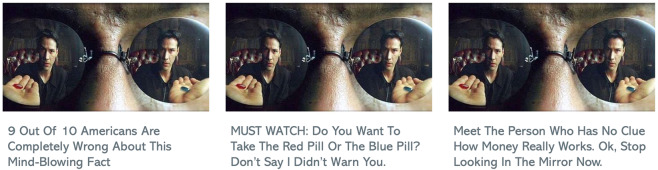
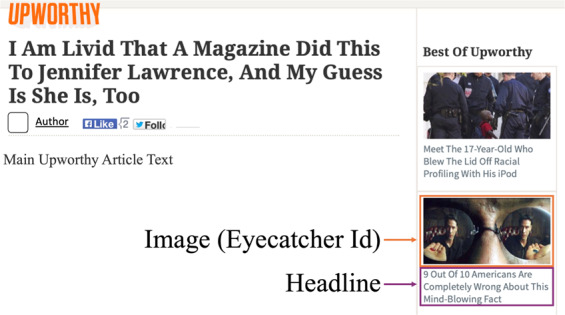
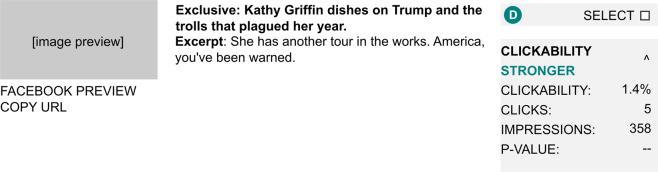
The pursuit of audience attention online has led organizations to conduct thousands of behavioral experiments each year in media, politics, activism, and digital technology. One pioneer of A/B tests was Upworthy.com, a U.S. media publisher that conducted a randomized trial for every article they published. Each experiment tested variations in a headline and image “package,” recording how many randomly-assigned viewers selected each variation. While none of these tests were designed to answer scientific questions, scientists can advance knowledge by meta-analyzing and data-mining the tens of thousands of experiments Upworthy conducted. This archive records the stimuli and outcome for every A/B test fielded by Upworthy between January 24, 2013 and April 30, 2015. In total, the archive includes 32,487 experiments, 150,817 experiment arms, and 538,272,878 participant assignments. The open access dataset is organized to support exploratory and confirmatory research, as well as meta-scientific research on ways that scientists make use of the archive.
Overview
The claims and statistics of this paper haven’t been checked yet.
Free: it reads the open-access text and checks the first 5 claims that cite a source we can check. Create a free account to check every claim.
Integrity signals
Registry
Cites
Statistics
Figures
Verification
Claims the paper makes
The claims and statistics of this paper haven’t been checked yet.
Free: it reads the open-access text and checks the first 5 claims that cite a source we can check. Create a free account to check every claim.
Claims other papers make about this one
Each is checked against this paper’s own text: does it say what the citing paper says it does?
The source backs part of the claim, not all of it — or backs it for a different population, condition or comparison.
In the citing paper
“The experiments were conducted separately (that is, only a single experiment was conducted at the same time for the entire website) so each test can be analysed as independent of all other tests53.”
From Negativity drives online news consumption (2023) · cites this paper as [53]
Experimental — accuracy not yet measuredThe check wasn’t confident either way, so it gives no verdict — never disputed.
In the citing paper
“Notably, we uncovered a negativity bias in the data even though Upworthy branded itself as a ‘positive news outlet’53.”
From Negativity drives online news consumption (2023) · cites this paper as [53]
Experimental — accuracy not yet measuredThe check wasn’t confident either way, so it gives no verdict — never disputed.
In the citing paper
“even though Upworthy branded itself as a ‘positive news outlet’53.”
From Negativity drives online news consumption (2023) · cites this paper as [53]
Experimental — accuracy not yet measuredIn the citing paper
“Upworthy has been regarded as one of the fastest-growing media companies worldwide53 and, at its peak, reached more users than established publishers such as the New York Times55.”
From Negativity drives online news consumption (2023) · cites this paper as [53]
In the citing paper
“Here we analyse data from the Upworthy Research Archive53, a repository of news consumption data that are both applied and causal.”
From Negativity drives online news consumption (2023) · cites this paper as [53]
2 more claims about this paper
Create a free account to see every claim other papers make about this one.
Self-check
Percentages, sums and reported differences re-computed from the paper’s own numbers.
The self-check needs the paper’s full text.
Citations
Cites
The Algorithmic Foundations of Differential Privacy
Dwork, C., & Roth, A. (2014) · Foundations and Trends® in Theoretical Computer Science · doi:10.1561/0400000042 · Cited by 5,557
The Algorithmic Foundations of Differential Privacy
Dwork, C., & Roth, A. (2013) · doi:10.1561/9781601988195 · Cited by 3,856
The State of Applied Econometrics: Causality and Policy Evaluation
Athey, S., & Imbens, G. W. (2017) · Journal of Economic Perspectives · doi:10.1257/jep.31.2.3 · Cited by 1,397
Field Experiments: Design, Analysis, and Interpretation
Green, D. (2024) · doi:10.61700/sgeirzx0v0mjh1252 · Cited by 1,320
Social Media and Democracy: The State of the Field, Prospects for Reform
(2020) · Cambridge University Press eBooks · doi:10.1017/9781108890960 · Cited by 295
Analytic Activism: Digital Listening and the New Political Strategy
Karpf, D. (2016) · Cited by 213
Interdependence and the cost of uncoordinated responses to COVID-19
Holtz, D., Zhao, M., Benzell, S. G., Cao, C. Y., Rahimian, M. A., Yang, J., Allen, J., Collis, A., Moehring, A., Sowrirajan, T., et al. (2020) · Proceedings of the National Academy of Sciences · doi:10.1073/pnas.2009522117 · Cited by 203
All the news That’s fit to click: the economics of clickbait media
Munger, K. (2020) · Political Communication · doi:10.1080/10584609.2019.1687626 · Cited by 175
Self-citationNo silver bullet: De-identification still doesn't work
Narayanan, A., & Felten, E. W. (2014) · Cited by 101
Analytic Activism: Digital Listening and the New Political Strategy
Karpf, D. (2017) · Oxford University Press eBooks · doi:10.1093/acprof:oso/9780190266127.001.0001 · Cited by 71
Cited by
Negativity drives online news consumption
Robertson, C. E., Pröllochs, N., Schwarzenegger, K., Pärnamets, P., Van Bavel, J. J., & Feuerriegel, S. (2023) · Nature Human Behaviour · doi:10.1038/s41562-023-01538-4 · Cited by 333
Statistical Challenges in Online Controlled Experiments: A Review of A/B Testing Methodology
Larsen, N., Stallrich, J. W., Sengupta, S., Deng, A., Kohavi, R., & Stevens, N. T. (2023) · The American Statistician · doi:10.1080/00031305.2023.2257237 · Cited by 139
“While some open access repositories exists (see, e.g., Liu et al. (2021a) and Matias et al. (2021)), the proprietary nature of these experiments makes open-access data-sharing uncommon.”
BackgroundValidated names for experimental studies on race and ethnicity
Crabtree, C. D., Kim, J. Y., Gaddis, S. M., Holbein, J. B., Guage, C., & Marx, W. W. (2023) · Scientific Data · doi:10.1038/s41597-023-01947-0 · Cited by 81
Reading dies in complexity: Online news consumers prefer simple writing
Shulman, H. C., Markowitz, D. M., & Rogers, T. (2024) · Science Advances · doi:10.1126/sciadv.adn2555 · Cited by 66
“The Upworthy Research Archive, and the methods therein, are discussed at length with the dataset ( 38 ) that introduced this resource.”
Did clickbait crack the code on virality?
Mukherjee, P., Dutta, S., & Bruyn, A. D. (2022) · Journal of the Academy of Marketing Science · doi:10.1007/s11747-021-00830-x · Cited by 60
Metadata
- Authors
- Matias, J. N., Munger, K., Le Quere, M. A., & Ebersole, C.
- Affiliations
- Cornell University (US)
- Pennsylvania State University (US)
- University of Virginia (US)
- Corresponding author
- Matias, J. Nathan
- Venue
- Scientific Data
- Published
- 2021-08-02
- Volume
- 8
- Issue
- 1
- Pages
- 195-195
- ISSN
- 2052-4463 (ISSN-L)
- PMC
- PMC8329003
- OpenAlex
- W3189225531
- Cited by
- 29
- References
- 18
- Citations by year
- 2026: 6 · 2025: 6 · 2024: 5 · 2023: 6 · 2022: 4 · 2021: 2
- Type
- data paper
- Language
- en
- Update notices
- correction (2024-07-11)
- Open access
- gold
- doi.org
- Licence
- cc-by
- creativecommons.org/licenses/by/4.0 (tdm)
- creativecommons.org/licenses/by/4.0 (vor)
- Locations
- Scientific Data (publishedVersion, cc-by)
- PubMed Central (publishedVersion, cc-by)
- PubMed (publishedVersion)
- DOAJ (DOAJ: Directory of Open Access Journals) (submittedVersion, cc-by-sa)
- Topics
- Social Sciences › Library and Information Sciences › Academic Publishing and Open Access
- Social Sciences › General Social Sciences › Computational and Text Analysis Methods
- Social Sciences › Sociology and Political Science › Media Influence and Politics
- Keywords
- A/B testing, online media, audience attention, image variation, user engagement, randomized experiments, meta-analysis, data mining
About these checks
Registry, retraction, Cites and statistics results are computed, not judged, with one exception: a printed reference that no index lists is read once by a model before it counts as a citation error. Claims are extracted by a model and kept only when their quote appears verbatim in the text; each cited source is then checked, with a model’s help, for whether it says what the claim relies on. Those verdicts can be wrong — read the claim’s quote and the cited source before relying on one.
Statistics and arithmetic are recomputed, not judged.
Confidence bands are shown only for fields calibrated on our annotated test set. None is calibrated yet, so no band is shown.
What counts as a claim ›How we measure confidence ›How we check this ›
Are you an author, or do you see a problem with this page? Request a review
How to cite
Cite CoChat for the checks on this page, and the paper for its own findings.
- This page
- CoChat. (2026). Citation check: The Upworthy Research Archive, a time series of 32,487 experiments in U.S. media. https://app.cochat.ai/papers/10.1038/s41597-021-00934-7
- The paper
- Matias, J. N., Munger, K., Le Quere, M. A., & Ebersole, C. (2021). The Upworthy Research Archive, a time series of 32,487 experiments in U.S. media. Scientific Data. https://doi.org/10.1038/s41597-021-00934-7
Data sources
Bibliographic data: Semantic Scholar, OpenAlex, Crossref.
Contains information from the Semantic Scholar Academic Graph Datasets, made available under the ODC Attribution License (ODC-BY 1.0).
Semantic Scholar’s data is described in: Kinney, R., et al. (2023). The Semantic Scholar Open Data Platform. arXiv:2301.10140.
