

The DOI matches its Crossref record; 4 of the 4 references it cites were found in a registry or an index.
The Criminal Justice Administrative Records System: A next-generation research data platform
Abstract
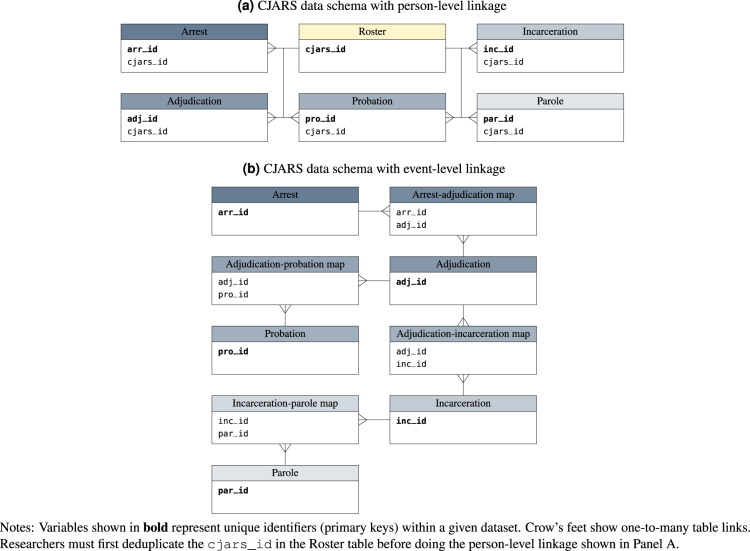
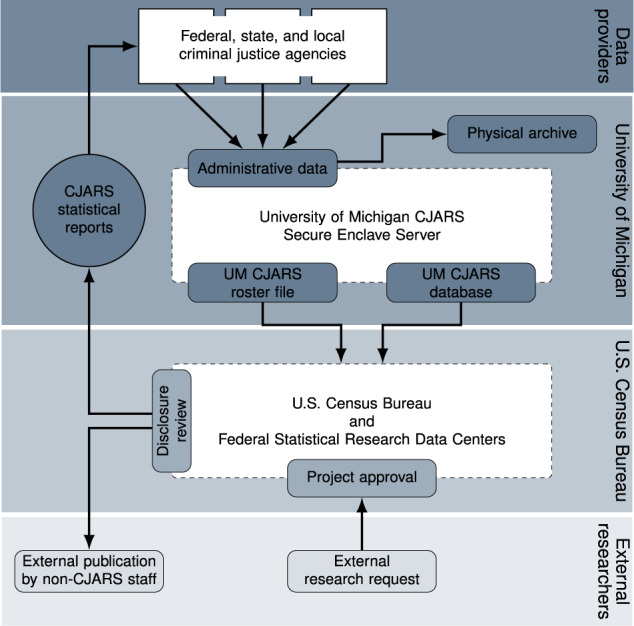
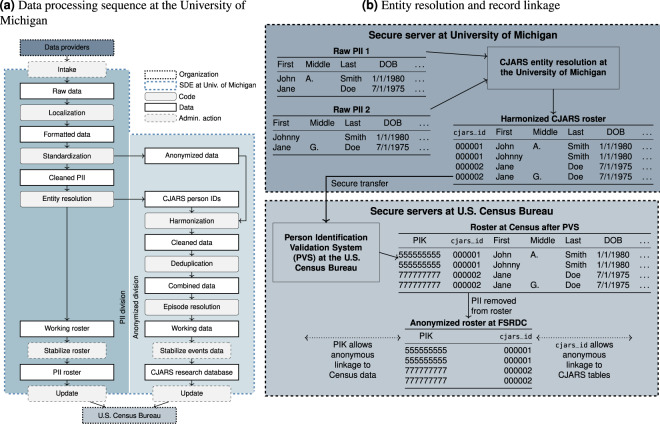
The Criminal Justice Administrative Records System (CJARS), a joint project of the U.S. Census Bureau and the University of Michigan, is a nationally integrated data infrastructure project designed to transform research and policymaking on the United States criminal justice system. At the University of Michigan, CJARS collects longitudinal electronic records from criminal justice agencies and harmonizes these records to track a criminal episode across all stages of the system. At the U.S. Census Bureau, harmonized criminal justice records can be linked anonymously at the person-level with extensive social, demographic, and economic information from national survey and administrative records.
Overview
The claims and statistics of this paper haven’t been checked yet.
Run the check — free, no account needed. It reads the open-access text and checks the sources it cites.
Integrity signals
Registry
Cites
Statistics
Figures
Verification
Claims the paper makes
The claims and statistics of this paper haven’t been checked yet.
Run the check — free, no account needed. It reads the open-access text and checks the sources it cites.
Claims other papers make about this one
Each is checked against this paper’s own text: does it say what the citing paper says it does?
The cited source says what the claim attributes to it.
In the citing paper
“CJARS is a longitudinal, harmonized data system of criminal justice events and a partnership between the University of Michigan and the Census Bureau(Finlay and Mueller-Smith 2022).”
From Race and Ethnicity (Mis)measurement in the U.S. Criminal Justice System (2024) · cites this paper as Finlay and Mueller-Smith 2022
Self-check
Percentages, sums and reported differences re-computed from the paper’s own numbers.
The self-check needs the paper’s full text.
Citations
Cites
State Court Processing Statistics, 1990-2006: Felony Defendants in Large Urban Counties
United States Department of Justice. Office of Justice Programs. Bureau of Justice Statistics (1998) · ICPSR Data Holdings · doi:10.3886/icpsr02038 · Cited by 32
Evidence‐based solution to information sharing between law enforcement agencies
Plecas, D. B., McCormick, A. V., Levine, J., Neal, P., & Cohen, I. M. (2011) · Policing An International Journal · doi:10.1108/13639511111106641 · Cited by 19
National Corrections Reporting Program, 1991-2018: Selected Variables
Statistics, U. S. B. O. J. (2021) · ICPSR Data Holdings · doi:10.3886/icpsr37973 · Cited by 1
National Prisoner Statistics, [United States], 1978-2018
Statistics, U. S. B. O. J. (2020) · ICPSR Data Holdings · doi:10.3886/icpsr37639 · Cited by 1
Research works printed but not linked: 1
- Jacobs, J. & Crepet, T. The Expanding Scope, Use, and Availability of Criminal Records. NYU J. Legislation Public Policy 11, 177 (2007).
Cited by
Race and Ethnicity (Mis)measurement in the U.S. Criminal Justice System
Finlay, K., Luh, E., & Mueller-Smith, M. (2024) · doi:10.3386/w32657 · Cited by 8
Self-citation
Metadata
- Authors
- Finlay, K., Mueller-Smith, M., & Papp, J.
- Venue
- Scientific Data
- Published
- 2022-09-12
- Volume
- 9
- Issue
- 1
- ISSN
- 2052-4463
- PMC
- PMC9468342
- Cited by
- 13
- References
- 4
- Language
- en
- Licence
- creativecommons.org/licenses/by/4.0 (tdm)
- creativecommons.org/licenses/by/4.0 (vor)
- Funders
- US Census Bureau
- Bill and Melinda Gates Foundation
- Laura and John Arnold Foundation
About these checks
Registry, retraction, Cites and statistics results are computed, not judged, with one exception: a printed reference that no index lists is read once by a model before it counts as a citation error. Claims are extracted by a model and kept only when their quote appears verbatim in the text; each cited source is then checked, with a model’s help, for whether it says what the claim relies on. Those verdicts can be wrong — read the claim’s quote and the cited source before relying on one.
Statistics and arithmetic are recomputed, not judged.
Confidence bands are shown only for fields calibrated on our annotated test set. None is calibrated yet, so no band is shown.
What counts as a claim ›How we measure confidence ›How we check this ›
Are you an author, or do you see a problem with this page? Request a review
How to cite
Cite CoChat for the checks on this page, and the paper for its own findings.
- This page
- CoChat. (2026). Citation check: The Criminal Justice Administrative Records System: A next-generation research data platform. https://app.cochat.ai/papers/10.1038/s41597-022-01620-y
- The paper
- Finlay, K., Mueller-Smith, M., & Papp, J. (2022). The Criminal Justice Administrative Records System: A next-generation research data platform. Scientific Data. https://doi.org/10.1038/s41597-022-01620-y
Data sources
Bibliographic data: Semantic Scholar, OpenAlex, Crossref.
Contains information from the Semantic Scholar Academic Graph Datasets, made available under the ODC Attribution License (ODC-BY 1.0).
Semantic Scholar’s data is described in: Kinney, R., et al. (2023). The Semantic Scholar Open Data Platform. arXiv:2301.10140.
