

A Question Answering Dataset for Temporal-Sensitive Retrieval-Augmented Generation
Open accessThe DOI matches its Crossref record; 30 of the 30 references it cites were found in a registry or an index; 4 of the 16 sources its claims cite were checked for support.
Abstract
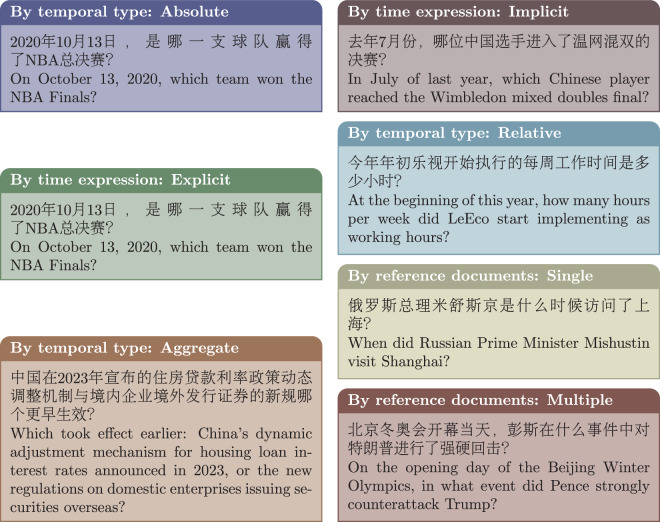
We introduce ChronoQA, a benchmark dataset for Chinese question answering focused on evaluating temporal reasoning in Retrieval-Augmented Generation (RAG) systems. Built from over 300,000 news articles published between 2019 and 2024, ChronoQA contains 5,176 questions covering absolute, aggregate, and relative temporal types, with both explicit and implicit time expressions. The dataset features both single- and multi-document scenarios, reflecting real-world requirements for temporal alignment and logical consistency. By providing structured evaluation across a wide range of temporal tasks, ChronoQA offers a dynamic, reliable, and scalable resource for benchmarking RAG systems in evolving knowledge environments.
Overview
CoChat Summary
TL;DR
ChronoQA is a Chinese benchmark of 5,176 temporal-sensitive QA pairs built from over 300,000 news articles published between 2019 and 2024, designed to evaluate temporal reasoning in retrieval-augmented generation. It covers absolute, aggregate, and relative temporal types, explicit and implicit time expressions, and single- and multi-document scenarios.
Key findings
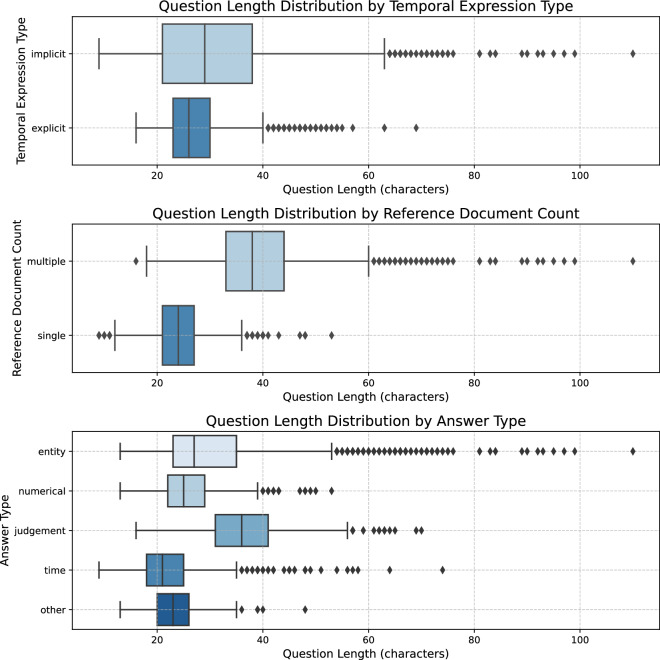
- ChronoQA contains 5,176 QA pairs: absolute 2,529, aggregate 1,911, relative 736; explicit time expressions 2,000, implicit 3,176; single-document 3,261, multi-document 1,915 (37%); answer types entity 2,556, time 864, numerical 507, judgement 1,045, other 204.
- Quality validation manually reviewed ~6,000 examples, finding over 95% met quality standards with Cohen’s Kappa = 0.85; all identified error pairs were removed.
- Retrieval baselines at K = 10 showed Query Decomposition best overall: Recall 68.2, MAP 57.6, NDCG 78.9; on multiple-document questions: Recall 53.9, MAP 53.1, NDCG 83.2. Native RAG at K = 10 scored overall Recall 61.8, MAP 53.5, NDCG 71.8.
- Error analysis of 100 cases found relative/implicit time expressions caused 69% of failures versus 31% for absolute/explicit; day-level granularity caused 62% of errors, month 27%, year 11%; retrieval failure accounted for 72% of incorrect answers, while 7% failed even with perfect retrieval.
Methods
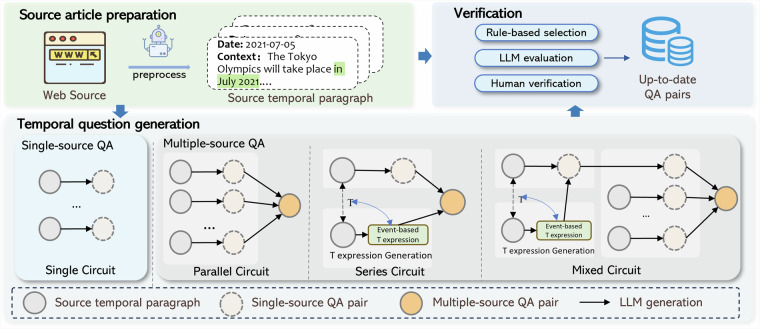
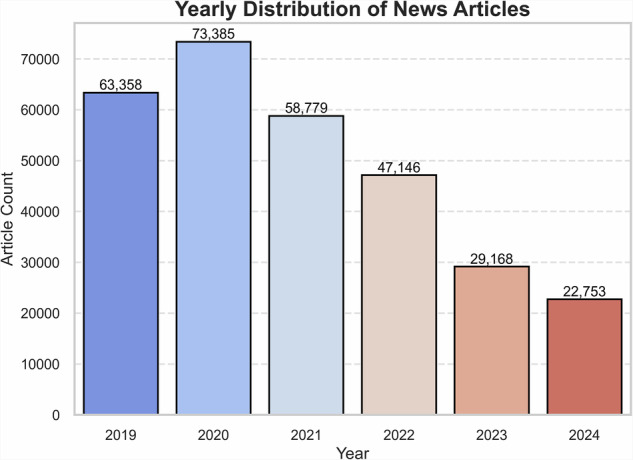
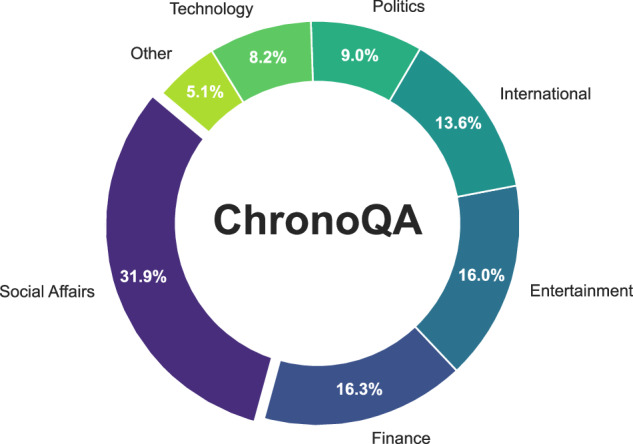
- Source articles came from public news sources (e.g., Sina News) covering January 1, 2019, to August 30, 2024, averaging approximately 171.8 articles per day and roughly 350k textual units; after cleaning and deduplication, gpt-4o-mini extracted 294,696 “intensive temporal paragraphs.”
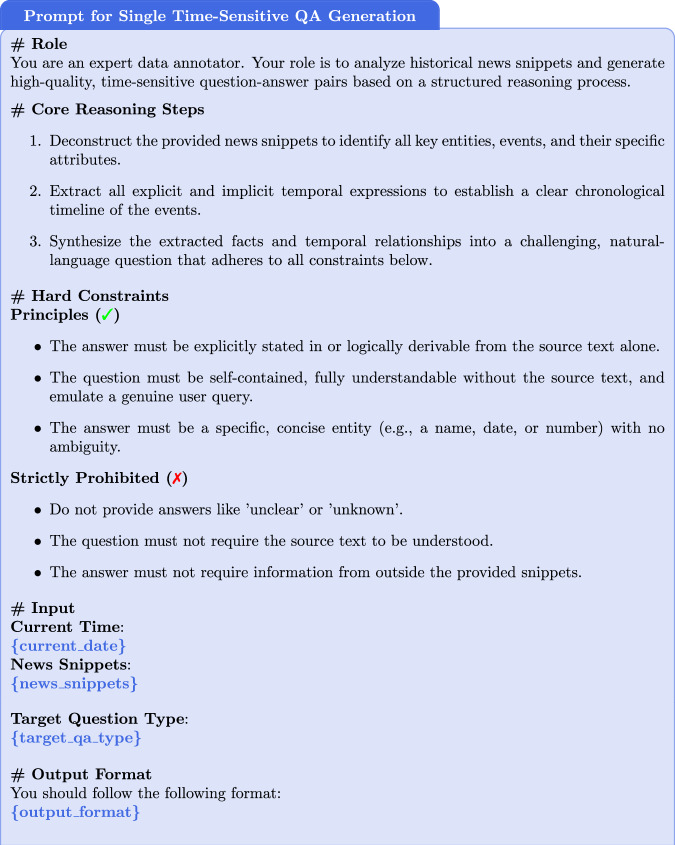
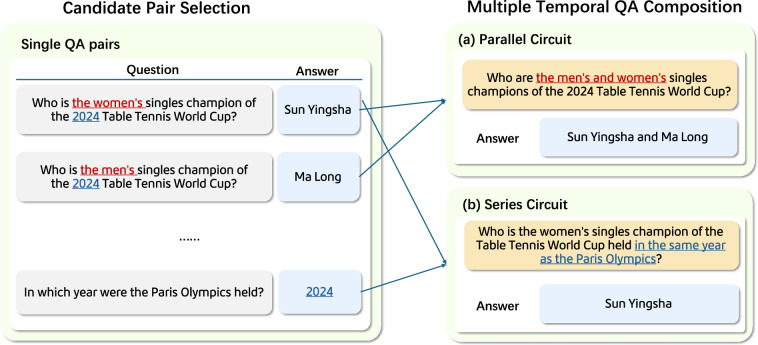
- Single temporal QA pairs were generated with gpt-4o from those paragraphs using structured prompts, yielding over 10,000 standalone pairs after automated filtering; multi-document questions were composed via semantic similarity (bge-large-zh-1.5 embeddings, cosine similarity) and temporal proximity, using parallel and series reasoning circuits with o1-mini.
- Verification combined rule-based filtering, gpt-4o evaluation of fluency/factual accuracy/temporal relevance, and manual review; retrieval experiments compared Native RAG, Temporal Filter, Query Rewrite, and Query Decomposition at K = 5 and K = 10 using Recall, MAP, and NDCG.
Limitations
- The paper does not state a dedicated limitations section.
- Evident from the text: the dataset is Chinese-language and news-based, with source coverage bounded to January 1, 2019–August 30, 2024, so temporal and topical coverage is tied to that corpus despite the claimed scalable/updatable framework.
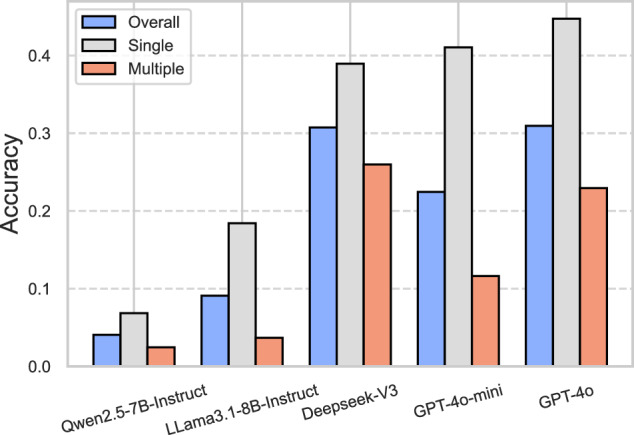
- Evident from the text: manual validation covered ~6,000 examples rather than the full final set, error analysis examined only 100 cases, direct LLM performance is reported only in Fig. 8 without numeric values in the text, and retrieval baselines are limited to four methods at K = 5 and K = 10.
Model-written summary. Check it against the paper before relying on it.
Integrity signals
Registry
Cites
Statistics
Figures
Verification
Claims the paper makes
3 Valid · 1 Not valid · 5 Not checked · 53 Own results and interpretations
The cited sources support only part of this claim — read each source’s verdict below.
In the paper
“LLMs remain inherently static, with their knowledge fixed at the time of training4.”
§ A Question Answering Dataset for Temporal-Sensitive Retrieval-Augmented Generation > Background & Summary
What the sources say
- Partly supportedcites [4] Sun, K., Xu, Y. E., Zha, H., Liu, Y. & Dong, X. L. Head-to-Tail: How knowledgeable are large language models (LLMs)? A.K.A. Will LLMs replace knowledge graphs? In Proc. 2024 Conf. of the North American Chapter of the Association for Computational Linguistics: Human Language Technologies (Vol. 1: Long Papers), 311-325 (2024). sourceExperimental — accuracy not yet measured
Our copy supports only part of the attribution: Section 4.1 states that 'LLMs have incorporated factual knowledge within their parameters, the amount of this encoded knowledge remains limited', and the same section's 'Torso-to-tail and recent knowledge' paragraph says emerging knowledge is where 'training data are typically sparse or absent', so serving it needs external knowledge retrieval (citing Asai et al., 2023; Nakano et al., 2022; Shi et al., 2023; Borgeaud et al., 2022); Section 4.1's 'Head knowledge' paragraph likewise says new knowledge must be infused 'through model training or fine-tuning'. Together these ground the idea that an LLM's factual knowledge comes from its training and cannot be extended without retraining/fine-tuning or retrieval. However, no passage in our copy characterises LLMs as 'inherently static' or states that their knowledge is fixed at the time of training as such — that sweeping framing is the citing authors' own and is not asserted by this paper, whose focus is measuring QA accuracy over head/torso/tail entities (Sections 1, 3.4, 4.2). (LLM, conf=0.65)
plain- Asserted: passes — The authors put it forward as true.
- Checkable: passes — It can be checked against evidence.
- Load-bearing: passes — The paper’s conclusions depend on it.
- Based: passes — The paper gives a reason why it holds.
- Partly supported
The sources with a verdict support this claim; the rest weren’t checked yet, have no full text we could read, or their verdicts aren’t rated yet.
In the paper
“existing RAG systems face significant challenges when dealing with time-sensitive queries11,12. Their reliance on semantic matching often leads to retrieving outdated or irrelevant documents”
§ A Question Answering Dataset for Temporal-Sensitive Retrieval-Augmented Generation > Background & Summary
What the sources say
- Not checked yetcites [11] Wu, F. et al. Time-sensitive retrieval-augmented generation for question answering. In Proc. 33rd ACM Int. Conf. on Information and Knowledge Management (CIKM), 2544-2553 (2024). source
- Supportedcites [12] Zhang, S. et al. MRAG: A modular retrieval framework for time-sensitive question answering. Preprint at https://arxiv.org/abs/2412.15540 (2024). source
The Introduction (p. 1) states that RAG 'performance heavily relies on off-the-shelf retrieval systems, which are often limited to keywords or semantic matching' while time-sensitive questions 'require intensive temporal reasoning to identify relevant documents'. Section 3.3 (Preliminary Evaluation on TEMPRAGEVAL) reports 'a significant degradation in retrieval performance caused by temporal perturbations' (GEMMA top-1 evidence recall 45.0% -> 20.3%) because retrievers shortcut on exact date matching, and Appendix A (Controlled Experiments) concludes 'existing retrieval methods demonstrate limited temporal reasoning capabilities', with temporally relevant documents 'potentially leading to their exclusion from the retrieval process' — i.e. irrelevant/temporally wrong passages ranked instead, as in the Appendix O.1 case study where the GEMMA top-1 passage matches the query date but discusses a record set in 2007. (LLM, conf=0.85)
plainstates a cause- Asserted: passes — The authors put it forward as true.
- Checkable: passes — It can be checked against evidence.
- Load-bearing: passes — The paper’s conclusions depend on it.
- Based: passes — The paper gives a reason why it holds.
None of the sources cited for this claim have been checked yet.
In the paper
“most existing benchmarks focus on static knowledge retrieval, lacking a systematic approach to temporal reasoning.”
§ A Question Answering Dataset for Temporal-Sensitive Retrieval-Augmented Generation > Background & Summary
What the sources say
- Not checked yetcites [14] Kwiatkowski, T. et al. Natural Questions: a benchmark for question answering research. Trans. Assoc. Comput. Linguist. 7, 452–466, 10.1162/tacl_a_00276 (2019). source
Checked before — its earlier verdict is held back until a new check runs.
- Could not verifycites [15] Joshi, M., Choi, E., Weld, D. S. & Zettlemoyer, L. TriviaQA: A large scale distantly supervised challenge dataset for reading comprehension. In Proc. 55th Annu. Meet. Assoc. Comput. Linguist. (Vol. 1: Long Papers), 1601–1611 (2017) sourceExperimental — accuracy not yet measured
Our copy's Related Work (§7, §7.1 Reading comprehension, §7.2 Open domain question answering) does survey existing QA/reading-comprehension benchmarks and their limitations, but those limitations are scale, construction bias, cloze-style vs natural-language questions, questions crowdsourced from preselected passages, and KB-QA datasets that 'can only retrieve facts covered by the KB' — nothing frames them as 'static knowledge retrieval' or as missing temporal reasoning. Searched for temporal reasoning, time-sensitive/date-based evaluation, and static vs dynamic knowledge; the only temporal mention in the paper is the §4 Dataset Analysis annotator instruction to ignore temporal references like 'this year', which concerns TriviaQA's own verified subset, not a claim about other benchmarks. So the decisive point of the claim is not addressed by this source. (LLM, conf=0.62)
- Not matchedcites [16] Nguyen, T. et al. MS MARCO: A human generated machine reading comprehension dataset. In Proc. Workshop on Cognitive Computation: Integrating Neural and Symbolic Approaches, co-located with NIPS 2016, vol. 1773 (2016).
Its entry has no title and year that we can search by.
plain- Asserted: passes — The authors put it forward as true.
- Checkable: passes — It can be checked against evidence.
- Load-bearing: passes — The paper’s conclusions depend on it.
- Based: passes — The paper gives a reason why it holds.
- Not checked yet
The cited sources support only part of this claim — read each source’s verdict below.
In the paper
“FreshQA18 evaluates whether models retrieve the most temporally relevant evidence”
§ A Question Answering Dataset for Temporal-Sensitive Retrieval-Augmented Generation > Background & Summary
What the sources say
- Partly supportedcites [18] Vu, T. et al. FreshLLMs: Refreshing large language models with search engine augmentation. In Findings of the Assoc. Comput. Linguist., ACL 2024, 13697-13720 (2024). sourceExperimental — accuracy not yet measured
Our copy supports the temporal-currency half of the claim: FreshQA is described (Introduction, p.1; §2 FreshQA) as a dynamic benchmark whose questions 'require a model to "understand" up-to-date world knowledge', scored under RELAXED/STRICT so that answers must be 'accurate and up-to-date' (Figure 4 evaluation criteria). But what FreshQA evaluates is the factuality/currency of a model's generated answer, not whether the model 'retrieves the most temporally relevant evidence' — retrieval and temporal ordering of evidences belong to the FreshPrompt method (§4.1: evidences arranged oldest-to-newest, reasoning 'to determine the most relevant and current answer'; §4.3 TIME ORDER vs RANDOM ORDER ablation). The citing sentence therefore transfers a property of the augmentation method onto the benchmark. (LLM, conf=0.70)
plain- Asserted: passes — The authors put it forward as true.
- Checkable: passes — It can be checked against evidence.
- Load-bearing: passes — The paper’s conclusions depend on it.
- Based: passes — The paper gives a reason why it holds.
- Partly supported
A result the paper reports from its own data — it cites no other source for it, so there is none to check. The quote shows it is in the paper.
In the paper
“covering absolute, aggregate, and relative temporal types”
§ A Question Answering Dataset for Temporal-Sensitive Retrieval-Augmented Generation > Abstract
plain- Asserted: passes — The authors put it forward as true.
- Checkable: passes — It can be checked against evidence.
- Load-bearing: passes — The paper’s conclusions depend on it.
- Based: passes — The paper gives a reason why it holds.
27 more claims
Create a free account to see all 62 claims and to verify the 11 references still open.
- It may state two separate claims as one. 23
- Probably not a substantial claim. 14
- The quote only partly states this claim. 2
Citations
Cites
LLaMA: Open and Efficient Foundation Language Models
Touvron, H., Lavril, T., Izacard, G., Martinet, X., Lachaux, M.-A., Lacroix, T., Rozière, B., Goyal, N., Hambro, E., Azhar, F., et al. (2023) · arXiv · doi:10.48550/arxiv.2302.13971 · Cited by 4,602
Natural Questions: A benchmark for question answering research
Kwiatkowski, T., Palomaki, J., Redfield, O., Collins, M., Parikh, A., Alberti, C., Epstein, D., Polosukhin, I., Devlin, J., Lee, K., et al. (2019) · Transactions of the Association for Computational Linguistics · doi:10.1162/tacl_a_00276 · Cited by 2,069 · cited 1×
“Early QA datasets, such as Natural Questions (NQ)[17], TriviaQA [14], and MS MARCO [15], primarily assess open-domain retrieval, relying on web documents and knowledge graphs.”
HotpotQA: A Dataset for Diverse, Explainable Multi-hop Question Answering
Yang, Z., Qi, P., Zhang, S., Bengio, Y., Cohen, W., Salakhutdinov, R., & Manning, C. D. (2018) · Proceedings of the 2018 Conference on Empirical Methods in Natural Language Processing · doi:10.18653/v1/d18-1259 · Cited by 1,804 · cited 1×
“More advanced RAG benchmarks like HotpotQA [16] introduce multi-hop retrieval, requiring models to synthesize information across multiple sources.”
TriviaQA: A Large Scale Distantly Supervised Challenge Dataset for Reading Comprehension
Joshi, M., Choi, E., Weld, D., & Zettlemoyer, L. (2017) · Proceedings of the 55th Annual Meeting of the Association for Computational Linguistics (Volume 1: Long Papers) · doi:10.18653/v1/p17-1147 · Cited by 1,690 · cited 1×
“Early QA datasets, such as Natural Questions (NQ)[17], TriviaQA [14], and MS MARCO [15], primarily assess open-domain retrieval, relying on web documents and knowledge graphs.”
Large language models generate functional protein sequences across diverse families
Madani, A., Krause, B., Greene, E. R., Subramanian, S., Mohr, B. P., Holton, J. M., Olmos, J. L., Xiong, C., Sun, Z. Z., Socher, R., et al. (2023) · Nature Biotechnology · doi:10.1038/s41587-022-01618-2 · Cited by 1,078
GLM: General Language Model Pretraining with Autoregressive Blank Infilling
Du, Z., Qian, Y., Liu, X., Ding, M., Qiu, J., Yang, Z., & Tang, J. (2022) · Proceedings of the 60th Annual Meeting of the Association for Computational Linguistics (Volume 1: Long Papers) · doi:10.18653/v1/2022.acl-long.26 · Cited by 955
Retrieval-Augmented Generation for Large Language Models: A Survey
Gao, Y., Xiong, Y., Gao, X., Jia, K., Pan, J., Bi, Y., Dai, Y., Sun, J., Wang, M., & Wang, H. (2023) · arXiv · doi:10.48550/arxiv.2312.10997 · Cited by 876
C-Pack: Packed Resources For General Chinese Embeddings
Xiao, S., Liu, Z., Zhang, P., Muennighoff, N., Lian, D., & Nie, J.-Y. (2024) · Proceedings of the 47th International ACM SIGIR Conference on Research and Development in Information Retrieval · doi:10.1145/3626772.3657878 · Cited by 523
C-Pack: Packed Resources For General Chinese Embeddings
Xiao, S., Liu, Z., Zhang, P., Muennighoff, N., Lian, D., & Nie, J.-Y. (2023) · arXiv · doi:10.48550/arxiv.2309.07597 · Cited by 514
Benchmarking Retrieval-Augmented Generation for Medicine
Xiong, G., Jin, Q., Lu, Z., & Zhang, A. (2024) · arXiv · doi:10.48550/arxiv.2402.13178 · Cited by 312
Benchmarking Retrieval-Augmented Generation for Medicine
Xiong, G., Jin, Q., Lu, Z., & Zhang, A. (2024) · Findings of the Association for Computational Linguistics ACL 2024 · doi:10.18653/v1/2024.findings-acl.372 · Cited by 310
Evolving knowledge for development: the role of knowledge management in a changing world
Laszlo, K. C., & Laszlo, A. (2002) · Journal of Knowledge Management · doi:10.1108/13673270210440893 · Cited by 209
Discovering Event Evolution Graphs From News Corpora
Yang, C. C., Shi, X., & Wei, C.-P. (2009) · IEEE transactions on systems, man and cybernetics. Part A. Systems and humans · doi:10.1109/tsmca.2009.2015885 · Cited by 120
FreshLLMs: Refreshing Large Language Models with Search Engine Augmentation
Vu, T., Iyyer, M., Wang, X., Constant, N., Wei, J., Wei, J., Tar, C., Sung, Y.-H., Zhou, D., Le, Q., et al. (2024) · Findings of the Association for Computational Linguistics ACL 2024 · doi:10.18653/v1/2024.findings-acl.813 · Cited by 73
Time-aware link prediction to explore network effects on temporal knowledge evolution
Choudhury, N., & Uddin, S. (2016) · Scientometrics · doi:10.1007/s11192-016-2003-5 · Cited by 69
Sun, K., Xu, Y., Zha, H., Liu, Y., & Dong, X. L. (2024) · Proceedings of the 2024 Conference of the North American Chapter of the Association for Computational Linguistics: Human Language Technologies (Volume 1: Long Papers) · doi:10.18653/v1/2024.naacl-long.18 · Cited by 46
CRAG - Comprehensive RAG Benchmark
Yang, X., Sun, K., Xin, H., Sun, Y., Bhalla, N., Chen, X., Choudhary, S., Gui, R., Jiang, Z., Jiang, Z., et al. (2024) · Advances in Neural Information Processing Systems 37 · doi:10.52202/079017-0335 · Cited by 37
TempRetriever: Fusion-based Temporal Dense Passage Retrieval for Time-Sensitive Questions
Abdallah, A., Piryani, B., Wallat, J., Anand, A., & Jatowt, A. (2026) · ACM International Conference on Web Search and Data Mining (WSDM) · doi:10.1145/3773966.3777938 · Cited by 31
MultiHop-RAG: Benchmarking Retrieval-Augmented Generation for Multi-Hop Queries
Tang, Y., & Yang, Y. (2024) · arXiv · doi:10.48550/arxiv.2401.15391 · Cited by 23
Let LLMs Take on the Latest Challenges! A Chinese Dynamic Question Answering BenchmarkPreprint
Xu, Z., Li, Y., Ding, R., Wang, X., Chen, B., Jiang, Y., Zheng, H., Lu, W., Xie, P., & Huang, F. (2024) · arXiv (Cornell University) · doi:10.48550/arxiv.2402.19248 · Cited by 18
Self-citationTemporal Knowledge Question Answering via Abstract Reasoning Induction
Chen, Z., Li, D., Zhao, X., Hu, B., & Zhang, M. (2024) · Proceedings of the 62nd Annual Meeting of the Association for Computational Linguistics (Volume 1: Long Papers) · doi:10.18653/v1/2024.acl-long.267 · Cited by 16
Self-citationTime-Sensitve Retrieval-Augmented Generation for Question Answering
Wu, F., Liu, L., He, W., Liu, Z., Zhang, Z., Wang, H., & Wang, M. (2024) · Proceedings of the 33rd ACM International Conference on Information and Knowledge Management · doi:10.1145/3627673.3679800 · Cited by 10
MRAG: a modular retrieval framework for time-sensitive question answering
Zhang, S., Xue, Y., Zhang, Y., Wu, X., Luu, A. T., & Zhao, C. (2025) · Findings of the Association for Computational Linguistics: EMNLP 2025 · doi:10.18653/v1/2025.findings-emnlp.167 · Cited by 3
ChronoQA: A Question Answering Dataset for Temporal-Sensitive Retrieval-Augmented Generation
Chen, Z., Min, E., Zhao, X., Li, Y., Jia, X., Liao, J., Li, J., Wang, S., Hu, B., & Yin, D. (2025) · Zenodo (CERN European Organization for Nuclear Research) · doi:10.5281/zenodo.15282441 · Cited by 1
Self-citationMRAG: A Modular Retrieval Framework for Time-Sensitive Question Answering
Siyue, Z., Yuxiang, X., Yiming, Z., Xiaobao, W., Tuan, L. A., & Chen, Z. (2024) · arXiv · doi:10.48550/arxiv.2412.15540
Self-citationOpenAI, Achiam, J., Adler, S., Agarwal, S., Ahmad, L., Akkaya, I., Aleman, F. L., Almeida, D., Altenschmidt, J., Altman, S., et al. (2023) · arXiv · doi:10.48550/arxiv.2303.08774
DomainRAG: A Chinese Benchmark for Evaluating Domain-specific Retrieval-Augmented Generation
Wang, S., Liu, J., Song, S., Cheng, J., Fu, Y., Guo, P., Fang, K., Zhu, Y., & Dou, Z. (2024) · arXiv · doi:10.48550/arxiv.2406.05654
Self-citationAn Adaptive Framework for Generating Systematic Explanatory Answer in Online Q&A Platforms
Chen, Z., Wang, X., Jiang, Y., Liao, J., Xie, P., Huang, F., & Zhao, X. (2024) · arXiv · doi:10.48550/arxiv.2410.17694
Self-citationTempRetriever: Fusion-based Temporal Dense Passage Retrieval for Time-Sensitive Questions
Abdallah, A., Piryani, B., Wallat, J., Anand, A., & Jatowt, A. (2025) · arXiv · doi:10.48550/arxiv.2502.21024
ChronoQA: A Question Answering Dataset for Temporal-Sensitive Retrieval-Augmented Generation
Chen, Z., Min, E., Zhao, X., Li, Y., Jia, X., Liao, J., Li, J., Wang, S., Hu, B., & Yin, D. (2025) · Zenodo · doi:10.5281/zenodo.17163857
Self-citation
Research works printed but not linked: 1
- Nguyen, T. et al. MS MARCO: A human generated machine reading comprehension dataset. In Proc. Workshop on Cognitive Computation: Integrating Neural and Symbolic Approaches, co-located with NIPS 2016, vol. 1773 (2016).
Cited by
TEMPO: Realistic Multi-Domain Benchmark for Temporal Reasoning-Intensive Retrieval
Abdallah, A., Ali, M., Abdul-Mageed, M., & Jatowt, A. (2026) · Conference on Empirical Methods in Natural Language Processing (EMNLP) · doi:10.18653/2026.emnlp-main.291 · Cited by 11
Nam, Y., Kim, J. H., Song, H., Yoon, S., Lee, J.-G., & Lee, B. S. (2026) · Findings of the Association for Computational Linguistics: EMNLP (Findings of EMNLP) · doi:10.18653/2026.findings-emnlp.398 · Cited by 4
Rank4Gen: RAG-Preference-Aligned Document Set Selection and Ranking
Fan, Y., Chu, Y., Xia, Z., Chen, X., Liu, J., Liang, H., Ma, J., He, B., Sun, Y., Zhai, J., et al. (2026) · Findings of the Association for Computational Linguistics: EMNLP (Findings of EMNLP) · doi:10.18653/2026.findings-emnlp.942 · Cited by 4
Kim, S., Wang, J., Xie, X., & Whang, S. E. (2026) · International Conference on Learning Representations · doi:10.48550/arxiv.2508.02045 · Cited by 3
Advancing Temporal Sensitive Question Answering through Progressive Multi-Step Reflection
Chen, Z., Min, E., Zhao, X. H., Li, Y., Jia, X., Liao, J., Wang, S., Hu, B., & Yin, D. (2025) · ACM International Conference on Information and Knowledge Management (CIKM) · doi:10.1145/3746252.3761292 · Cited by 1
Self-citation
Metadata
- Authors
- Chen, Z., Min, E., Zhao, X., Li, Y., Jia, X., Liao, J., Li, J., Wang, S., Hu, B., & Yin, D.
- Affiliations
- National University of Defense Technology (CN)
- Baidu (China) (CN)
- Harbin Institute of Technology (CN)
- Corresponding author
- Zhao, Xiang
- ORCID
- Venue
- Scientific Data
- Published
- 2025-11-21
- Volume
- 12
- Issue
- 1
- Pages
- 1855-1855
- ISSN
- 2052-4463 (ISSN-L)
- PMC
- PMC12638886
- OpenAlex
- W4416466501
- Cited by
- 20
- References
- 25
- Citations by year
- 2026: 18 · 2025: 2
- Type
- data paper
- Language
- en
- Open access
- gold
- doi.org
- Licence
- cc-by-nc-nd
- creativecommons.org/licenses/by-nc-nd/4.0 (tdm)
- creativecommons.org/licenses/by-nc-nd/4.0 (vor)
- Locations
- Scientific Data (publishedVersion, cc-by-nc-nd)
- Europe PMC (PubMed Central) (publishedVersion, cc-by-nc-nd)
- PubMed (publishedVersion)
- PubMed Central (publishedVersion, cc-by-nc-nd)
- arXiv (Cornell University) (submittedVersion, cc-by)
- DOAJ (DOAJ: Directory of Open Access Journals) (submittedVersion, cc-by-sa)
- arXiv (Cornell University)
- Funders
- National Natural Science Foundation of China (72301284, U23A20296, 62272469)
- Topics
- Physical Sciences › Computer Science › Artificial Intelligence › Topic Modeling
- Physical Sciences › Computer Science › Information Systems › Information Retrieval and Search Behavior
- Physical Sciences › Computer Science › Artificial Intelligence › Natural Language Processing Techniques
- Keywords
- temporal reasoning, retrieval-augmented generation, question answering dataset, Chinese question answering, news articles, temporal expressions, temporal alignment, logical consistency
About these checks
Registry, retraction, Cites and statistics results are computed, not judged, with one exception: a printed reference that no index lists is read once by a model before it counts as a citation error. Claims are extracted by a model and kept only when their quote appears verbatim in the text; each cited source is then checked, with a model’s help, for whether it says what the claim relies on. Those verdicts can be wrong — read the claim’s quote and the cited source before relying on one.
The claim verdicts this report counts are experimental: their accuracy is not yet measured.
A language model drew the claims from the paper on 2026-11-18, under version 3 of the claim definition (model deepseek-v4.1-flash, prompt extract-v3).
A second model labelled each claim on 2026-11-18 (model jev-1.13-20260917, definition revision gold-guideline-v0.2).
Cited sources are checked with a language model’s help (qwen3.8-omni-flash).
Statistics and arithmetic are recomputed, not judged.
Confidence bands are shown only for fields calibrated on our annotated test set. None is calibrated yet, so no band is shown.
What counts as a claim ›How we measure confidence ›How we check this ›
Are you an author, or do you see a problem with this page? Request a review
Data sources
Bibliographic data: Semantic Scholar, OpenAlex, Crossref.
Contains information from the Semantic Scholar Academic Graph Datasets, made available under the ODC Attribution License (ODC-BY 1.0).
Semantic Scholar’s data is described in: Kinney, R., et al. (2023). The Semantic Scholar Open Data Platform. arXiv:2301.10140.
