

The DOI matches its Crossref record; 71 of the 71 references it cites were found in a registry or an index.
The influence of emotional interference on cognitive control: A meta-analysis of neuroimaging studies using the emotional Stroop task
Open accessAbstract
The neural correlates underlying the influence of emotional interference on cognitive control remain a topic of discussion. Here, we assessed 16 neuroimaging studies that used an emotional Stroop task and that reported a significant interaction effect between emotion (stimulus type) and cognitive conflict. There were a total of 330 participants, equaling 132 foci for an activation likelihood estimation (ALE) analysis. Results revealed consistent brain activation patterns related to emotionally-salient stimuli (as compared to emotionally-neutral trials) during cognitive conflict trials [incongruent trials (with task-irrelevant information interfering), versus congruent/baseline trials (less disturbance from task-irrelevant information)], that span the lateral prefrontal cortex (dorsolateral prefrontal cortex and inferior frontal gyrus), the medial prefrontal cortex, and the dorsal anterior cingulate cortex. Comparing mild emotional interference trials (without semantic conflict) versus intense emotional interference trials (with semantic conflict), revealed that while concurrent activation in similar brain regions as mentioned above was found for intense emotional interference trials, activation for mild emotional interference trials was only found in the precentral/postcentral gyrus. These data provide evidence for the potential neural mechanisms underlying emotional interference on cognitive control, and further elucidate an important distinction in brain activation patterns for different levels of emotional conflict across emotional Stroop tasks.
Overview
The claims and statistics of this paper haven’t been checked yet.
Run the check — free, no account needed. It reads the open-access text and checks the sources it cites.
Integrity signals
Registry
Cites
Statistics
Figures
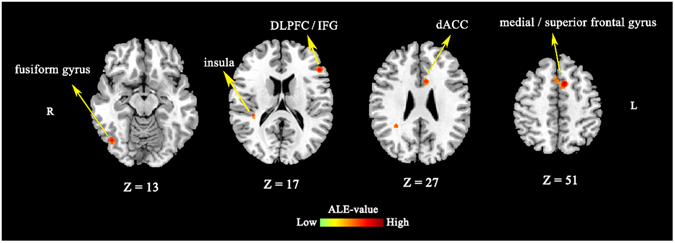
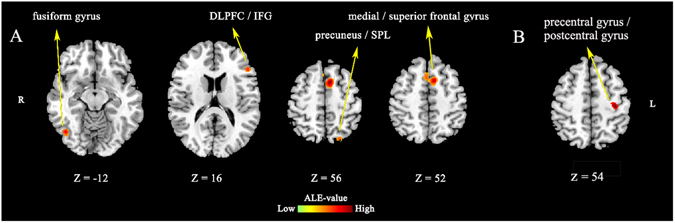
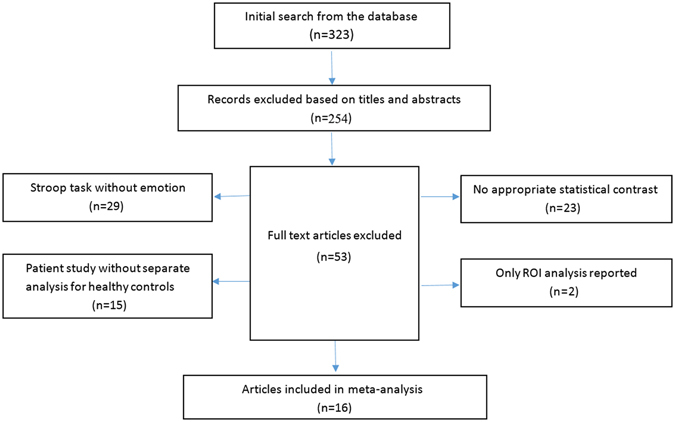
Verification
Claims the paper makes
The claims and statistics of this paper haven’t been checked yet.
Run the check — free, no account needed. It reads the open-access text and checks the sources it cites.
Claims other papers make about this one
Each is checked against this paper’s own text: does it say what the citing paper says it does?
The source backs part of the claim, not all of it — or backs it for a different population, condition or comparison.
In the citing paper
“Many PFC areas are particularly associated with control over emotionally relevant information (hot CC) [60–64, 66], which, as discussed earlier, show some dissociations from cool CC.”
From The role of prefrontal cortex in cognitive control and executive function (2022) · cites this paper as [63]
Experimental — accuracy not yet measuredThe cited source says what the claim attributes to it.
In the citing paper
“Many PFC areas are particularly associated with control over emotionally relevant information (hot CC) [60–64, 66], which, as discussed earlier, show some dissociations from cool CC.”
From The role of prefrontal cortex in cognitive control and executive function (2022) · cites this paper as [63]
Self-check
Percentages, sums and reported differences re-computed from the paper’s own numbers.
The self-check needs the paper’s full text.
Citations
Cites
Miyake, A., Friedman, N. P., Emerson, M. J., Witzki, A. H., Howerter, A., & Wager, T. D. (2000) · Cognitive Psychology · doi:10.1006/cogp.1999.0734 · Cited by 15,798
LeDoux, J. E. (2000) · Annual Review of Neuroscience · doi:10.1146/annurev.neuro.23.1.155 · Cited by 8,444
Conflict monitoring and cognitive control
Botvinick, M. M., Braver, T. S., Barch, D. M., Carter, C. S., & Cohen, J. D. (2001) · Psychological Review · doi:10.1037/0033-295x.108.3.624 · Cited by 7,351
Effects of noise letters upon the identification of a target letter in a nonsearch task
Eriksen, B. A., & Eriksen, C. W. (1974) · Perception & Psychophysics · doi:10.3758/bf03203267 · Cited by 7,230
Saliency, switching, attention and control: a network model of insula function
Menon, V., & Uddin, L. Q. (2010) · Brain Structure and Function · doi:10.1007/s00429-010-0262-0 · Cited by 5,592
The precuneus: a review of its functional anatomy and behavioural correlates
Cavanna, A. E., & Trimble, M. R. (2006) · Brain · doi:10.1093/brain/awl004 · Cited by 5,128
Meeting of minds: the medial frontal cortex and social cognition
Amodio, D. M., & Frith, C. D. (2006) · Nature Reviews Neuroscience · doi:10.1038/nrn1884 · Cited by 3,782
MacDonald, A. W., Cohen, J. D., Stenger, V. A., & Carter, C. S. (2000) · Science · doi:10.1126/science.288.5472.1835 · Cited by 3,666
Conflict monitoring and anterior cingulate cortex: an update
Botvinick, M. M., Cohen, J. D., & Carter, C. S. (2004) · Trends in Cognitive Sciences · doi:10.1016/j.tics.2004.10.003 · Cited by 3,623
Sridharan, D., Levitin, D. J., & Menon, V. (2008) · Proceedings of the National Academy of Sciences · doi:10.1073/pnas.0800005105 · Cited by 2,892
Cited by
Sorted by citations
The role of prefrontal cortex in cognitive control and executive function
Friedman, N. P., & Robbins, T. W. (2022) · Neuropsychopharmacology · doi:10.1038/s41386-021-01132-0 · Cited by 1,737
Belcher, B. R., Zink, J., Azad, A., Campbell, C. E., Chakravartti, S. P., & Herting, M. M. (2020) · Biological Psychiatry Cognitive Neuroscience and Neuroimaging · doi:10.1016/j.bpsc.2020.08.005 · Cited by 345
Hur, J., Stockbridge, M. D., Fox, A. S., & Shackman, A. J. (2019) · Progress in brain research · doi:10.1016/bs.pbr.2019.03.012 · Cited by 95
Chen, T., Becker, B., Camilleri, J. A., Wang, L., Yu, S., Eickhoff, S. B., & Feng, C. (2018) · Brain Structure and Function · doi:10.1007/s00429-018-1727-9 · Cited by 86
Habitual exercise is associated with cognitive control and cognitive reappraisal success
Giles, G. E., Cantelon, J. A., Eddy, M. D., Brunyé, T. T., Urry, H. L., Mahoney, C. R., & Kanarek, R. B. (2017) · Experimental Brain Research · doi:10.1007/s00221-017-5098-x · Cited by 86
Metadata
- Authors
- Song, S., Zilverstand, A., Song, H., d’Oleire Uquillas, F., Wang, Y., Xie, C., Cheng, L., & Zou, Z.
- Affiliations
- Southwest University (CN)
- Icahn School of Medicine at Mount Sinai (US)
- University of Science and Technology of China (CN)
- Chinese Academy of Sciences (CN)
- Corresponding author
- Zou, Zhiling
- Venue
- Scientific Reports
- Published
- 2017-05-18
- Volume
- 7
- Issue
- 1
- Pages
- 2088-2088
- ISSN
- 2045-2322 (ISSN-L)
- PMC
- PMC5437037
- OpenAlex
- W2612856300
- Cited by
- 160
- References
- 71
- Citations by year
- 2026: 14 · 2025: 26 · 2024: 17 · 2023: 22 · 2022: 19 · 2021: 24 · 2020: 18 · 2019: 11 · 2018: 5 · 2017: 3
- FWCI
- 1.13
- Type
- journal article
- Language
- en
- Open access
- gold
- doi.org
- Locations
- Scientific Reports (publishedVersion, cc-by)
- Europe PMC (PubMed Central) (publishedVersion, cc-by)
- PubMed Central (publishedVersion, cc-by)
- PubMed (publishedVersion)
- Digital Access to Scholarship at Harvard (DASH) (Harvard University) (submittedVersion, cc-by)
- DOAJ (DOAJ: Directory of Open Access Journals) (submittedVersion, cc-by-sa)
- Topics
- Life Sciences › Neuroscience › Cognitive Neuroscience › Neural and Behavioral Psychology Studies
- Life Sciences › Neuroscience › Cognitive Neuroscience › Neurobiology of Language and Bilingualism
- Life Sciences › Neuroscience › Cellular and Molecular Neuroscience › Neurotransmitter Receptor Influence on Behavior
- Keywords
- emotional interference, cognitive control, emotional Stroop task, emotional conflict, cognitive conflict, emotional salience, dorsolateral prefrontal cortex, medial prefrontal cortex, dorsal anterior cingulate cortex, inferior frontal gyrus, neural correlates
- MeSH terms
- Brain, Cognition, Conflict, Psychological, Emotions, Humans, Magnetic Resonance Imaging, Semantics, Stroop Test
About these checks
Registry, retraction, Cites and statistics results are computed, not judged, with one exception: a printed reference that no index lists is read once by a model before it counts as a citation error. Claims are extracted by a model and kept only when their quote appears verbatim in the text; each cited source is then checked, with a model’s help, for whether it says what the claim relies on. Those verdicts can be wrong — read the claim’s quote and the cited source before relying on one.
Statistics and arithmetic are recomputed, not judged.
Confidence bands are shown only for fields calibrated on our annotated test set. None is calibrated yet, so no band is shown.
What counts as a claim ›How we measure confidence ›How we check this ›
Are you an author, or do you see a problem with this page? Request a review
