

The DOI matches its Crossref record; 3 of the 3 references it cites were found in a registry or an index.
C-terminal fragments of the amyloid precursor protein in cerebrospinal fluid as potential biomarkers for Alzheimer disease.
Abstract
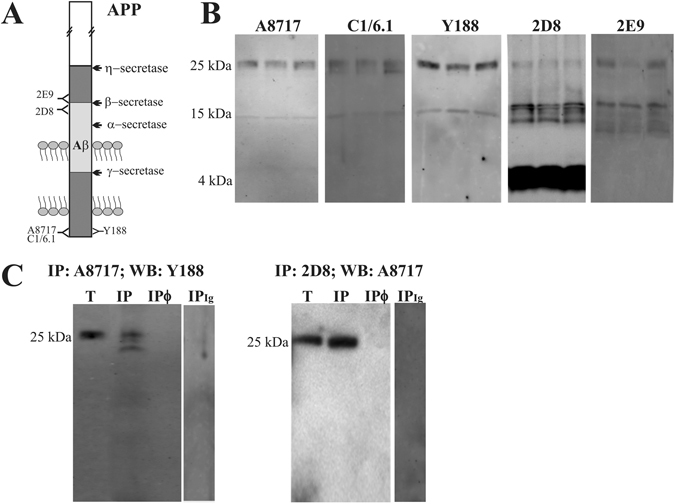
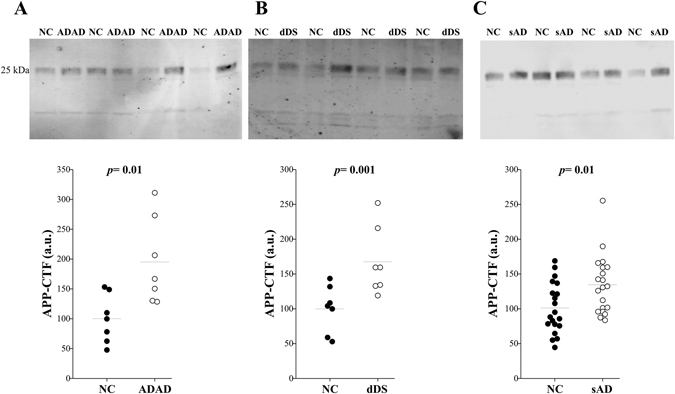
This study assesses whether C-terminal fragments (CTF) of the amyloid precursor protein (APP) are present in cerebrospinal fluid (CSF) and their potential as biomarkers for Alzheimer’s disease (AD). Immunoprecipitation and simultaneous assay by Western blotting using multiplex fluorescence imaging with specific antibodies against particular domains served to characterize CTFs of APP in human CSF. We demonstrate that APP-CTFs are detectable in human CSF, being the most abundant a 25-kDa fragment, probably resulting from proteolytic processing by η-secretase. The level of the 25-kDa APP-CTF was evaluated in three independent CSF sample sets of patients and controls. The CSF level of this 25-kDa CTF is higher in subjects with autosomal dominant AD linked to PSEN1 mutations, in demented Down syndrome individuals and in sporadic AD subjects compared to age-matched controls. Our data suggest that APP-CTF could be a potential diagnostic biomarker for AD.
Overview
The claims and statistics of this paper haven’t been checked yet.
Run the check — free, no account needed. It reads the open-access text and checks the sources it cites.
Integrity signals
Registry
Cites
Statistics
Figures
Verification
Claims the paper makes
The claims and statistics of this paper haven’t been checked yet.
Run the check — free, no account needed. It reads the open-access text and checks the sources it cites.
Claims other papers make about this one
Each is checked against this paper’s own text: does it say what the citing paper says it does?
In the citing paper
“Another study identified a ∼25 kDa η-CTF in CSF, but in this case the peptide content was higher in AD patients with a PSEN1 familial mutation, in patients with sporadic AD and in Down Syndrome individuals with Alzheimer’s type dementia, compared to age-matched non-demented controls, raising the possibility that η-CTF could be a new disease biomarker (Garcia-Ayllon et al., 2017).”
From Emerging Alternative Proteinases in APP Metabolism and Alzheimer’s Disease Pathogenesis: A Focus on MT1-MMP and MT5-MMP (2019) · cites this paper as Garcia-Ayllon et al., 2017
Self-check
Percentages, sums and reported differences re-computed from the paper’s own numbers.
The self-check needs the paper’s full text.
Citations
Cites
Amyloid β-peptide is produced by cultured cells during normal metabolism
Haass, C., Schlossmacher, M. G., Hung, A. Y., Vigo-Pelfrey, C., Mellon, A., Ostaszewski, B. L., Lieberburg, I., Koo, E. H., Schenk, D., Teplow, D. B., et al. (1992) · Nature · doi:10.1038/359322a0 · Cited by 1,921
η-Secretase processing of APP inhibits neuronal activity in the hippocampus
Willem, M., Tahirovic, S., Busche, M. A., Ovsepian, S. V., Chafai, M., Kootar, S., Hornburg, D., Evans, L. D. B., Moore, S., Daria, A., et al. (2015) · Nature · doi:10.1038/nature14864 · Cited by 398
Lauritzen, I., Pardossi-Piquard, R., Bourgeois, A., Pagnotta, S., Biferi, M.-G., Barkats, M., Lacor, P., Klein, W., Bauer, C., & Checler, F. (2016) · Acta Neuropathologica · doi:10.1007/s00401-016-1577-6 · Cited by 219
Research works printed but not linked: 29
- Scheltens, P. et al. Alzheimer’s disease. Lancet 388, 505–517 (2016). · DOI · Paper page
- Blennow, K., Mattsson, N., Schöll, M., Hansson, O. & Zetterberg, H. Amyloid biomarkers in Alzheimer’s disease. Trends Pharmacol Sci 36, 297–309 (2015). · DOI · Paper page
- Olsson, B. et al. CSF and blood biomarkers for Alzheimer’s disease: a systematic review and meta-analysis. Lancet Neurol 15, 673–684 (2016). · DOI · Paper page
- Haass, C., Kaether, C., Thinakaran, G. & Sisodia, S. Trafficking and proteolytic processing of APP. Cold Spring Harb Perspect Med 2, a006270 (2012). · DOI · Paper page
- Andrew, R. J., Kellett, K. A., Thinakaran, G. & Hooper, N. M. A Greek Tragedy: the Growing Complexity of Alzheimer Amyloid Precursor Protein Proteolysis. J Biol Chem. 291, 19235–19244 (2016). · DOI
- Portelius, E. et al. A novel pathway for amyloid precursor protein processing. Neurobiol Aging 32, 1090–1098 (2011). · DOI
- Portelius, E. et al. Identification of novel N-terminal fragments of amyloid precursor protein in cerebrospinal fluid. Exp Neurol 223, 351–358 (2010). · DOI
- Zhang, Z. et al. Delta-secretase cleaves amyloid precursor protein and regulates the pathogenesis in Alzheimer’s disease. Nat Commun 6, 8762 (2015). · DOI · Paper page
- Palmert, M. R. et al. The beta-amyloid protein precursor of Alzheimer disease has soluble derivatives found in human brain and cerebrospinal fluid. Proc Natl Acad Sci USA 86, 6338–6342 (1989). · DOI
- Ghiso, J., Tagliavini, F., Timmers, W. F. & Frangione, B. Alzheimer’s disease amyloid precursor protein is present in senile plaques and cerebrospinal fluid: immunohistochemical and biochemical characterization. Biochem Biophys Res Commun 163, 430–437 (1989). · DOI
- Moser, J. J., Chan, E. K. & Fritzler, M. J. Optimization of immunoprecipitation-western blot analysis in detecting GW182-associated components of GW/P bodies. Nat Protoc 4, 674–685 (2009). · DOI
- Dubois, B. et al. Advancing research diagnostic criteria for Alzheimer’s disease: the IWG-2 criteria. Lancet Neurol 13, 614–629 (2014). · DOI · Paper page
- Wang, H. et al. Cathepsin L Mediates the Degradation of Novel APP C-Terminal Fragments. Biochemistry. 54, 2806–2816 (2015). · DOI
- Vella, L. J. & Cappai, R. Identification of a novel amyloid precursor protein processing pathway that generates secreted N-terminal fragments. FASEB J 26, 2930–2940 (2012). · DOI
- Cuchillo-Ibañez, I. et al. Heteromers of amyloid precursor protein in cerebrospinal fluid. Mol Neurodegener 10, 2 (2015). · DOI
- García-Ayllón, M. S. et al. CSF Presenilin-1 complexes are increased in Alzheimer’s disease. Acta Neuropathol Commun 1, 46 (2013). · DOI
- Baskin, F., Rosenberg, R. N. & Greenberg, B. D. Increased release of an amyloidogenic C-terminal Alzheimer amyloid precursor protein fragment from stressed PC-12 cells. J Neurosci Res 29, 127–132 (1991). · DOI
- Sharples, R. A. et al. Inhibition of gamma-secretase causes increased secretion of amyloid precursor protein C-terminal fragments in association with exosomes. FASEB J 22, 1469–1478 (2008). · DOI
- Vingtdeux, V. et al. Alkalizing drugs induce accumulation of amyloid precursor protein by-products in luminal vesicles of multivesicular bodies. J Biol Chem 282, 18197–18205 (2007). · DOI
- Chen, J. M., Dando, P. M., Stevens, R. A., Fortunato, M. & Barrett, A. J. Cloning and expression of mouse legumain, a lysosomal endopeptidase. Biochem J 335, 111–117 (1998). · DOI
- Haass, C., Koo, E. H., Mellon, A., Hung, A. Y. & Selkoe, D. J. Targeting of cell-surface beta-amyloid precursor protein to lysosomes: alternative processing into amyloid-bearing fragments. Nature 357, 500–503 (1992). · DOI
- Gandhi, S., Refolo, L. M. & Sambamurti, K. Amyloid precursor protein compartmentalization restricts beta-amyloid production: therapeutic targets based on BACE compartmentalization. J Mol Neurosci 24, 137–143 (2004). · DOI
- Pera, M. et al. Distinct patterns of APP processing in the CNS in autosomal-dominant and sporadic Alzheimer disease. Acta Neuropathol 125, 201–213 (2013). · DOI · Paper page
- del Campo, M. et al. Recommendations to standardize preanalytical confounding factors in Alzheimer’s and Parkinson’s disease cerebrospinal fluid biomarkers: an update. Biomark Med 6, 419–430 (2012). · DOI · Paper page
- Isbert, S. et al. APP dimer formation is initiated in the endoplasmic reticulum and differs between APP isoforms. Cell Mol Life Sci 69, 1353–1375 (2012). · DOI
- Woltjer, R. L. et al. Role of glutathione in intracellular amyloid-alpha precursor protein/carboxy-terminal fragment aggregation and associated cytotoxicity. J Neurochem 93, 1047–1056 (2005). · DOI
- Cheng, F. et al. Suppression of amyloid beta A11 antibody immunoreactivity by vitamin C: possible role of heparan sulfate oligosaccharides derived from glypican-1 by ascorbate-induced, nitric oxide (NO)-catalyzed degradation. J Biol Chem 286, 27559–27572 (2011). · DOI
- Janssen, L., Sobott, F., De Deyn, P. P. & Van Dam, D. Signal loss due to oligomerization in ELISA analysis of amyloid-beta can be recovered by a novel sample pre-treatment method. MethodsX 2, 112–123 (2015). · DOI
- McKhann, G. M. et al. The diagnosis of dementia due to Alzheimer’s disease: recommendations from the National Institute on Aging-Alzheimer’s Association workgroups on diagnostic guidelines for Alzheimer’s disease. Alzheimers Dement 7, 263–269 (2011). · DOI · Paper page
Cited by
Sorted by citations
García-González, L., Pilat, D., Baranger, K., & Rivera, S. (2019) · Frontiers in Aging Neuroscience · doi:10.3389/fnagi.2019.00244 · Cited by 88
Accumulation of APP-CTF induces mitophagy dysfunction in the iNSCs model of Alzheimer’s disease
Lee, S.-E., Kwon, D., Shin, N., Kong, D., Kim, N. G., Kim, H.-Y., Kim, M.-J., Choi, S. W., & Kang, K.-S. (2022) · Cell Death Discovery · doi:10.1038/s41420-021-00796-3 · Cited by 53
Metadata
- Authors
- García-Ayllón, M.-S., Lopez-Font, I., Boix, C. P., Fortea, J., Sánchez-Valle, R., Lleó, A., Molinuevo, J.-L., Zetterberg, H., Blennow, K., & Sáez-Valero, J.
- Venue
- Scientific Reports
- Published
- 2017-05-30
- Volume
- 7
- Issue
- 1
- ISSN
- 2045-2322
- PMC
- PMC5449401
- Cited by
- 51
- References
- 3
- Language
- en
About these checks
Registry, retraction, Cites and statistics results are computed, not judged, with one exception: a printed reference that no index lists is read once by a model before it counts as a citation error. Claims are extracted by a model and kept only when their quote appears verbatim in the text; each cited source is then checked, with a model’s help, for whether it says what the claim relies on. Those verdicts can be wrong — read the claim’s quote and the cited source before relying on one.
Statistics and arithmetic are recomputed, not judged.
Confidence bands are shown only for fields calibrated on our annotated test set. None is calibrated yet, so no band is shown.
What counts as a claim ›How we measure confidence ›How we check this ›
Are you an author, or do you see a problem with this page? Request a review
