

The role of touch in regulating inter-partner physiological coupling during empathy for pain
Open accessThe DOI matches its Crossref record; 96 of the 97 references it cites were found in a registry or an index; 10 of the 32 sources its claims cite were checked for support.
Abstract
The human ability to synchronize with other individuals is critical for the development of social behavior. Recent research has shown that physiological inter-personal synchronization may underlie behavioral synchrony. Nevertheless, the factors that modulate physiological coupling are still largely unknown. Here we suggest that social touch and empathy for pain may enhance interpersonal physiological coupling. Twenty-two romantic couples were assigned the roles of target (pain receiver) and observer (pain observer) under pain/no-pain and touch/no-touch conditions, and their ECG and respiration rates were recorded. The results indicate that the partner touch increased interpersonal respiration coupling under both pain and no-pain conditions and increased heart rate coupling under pain conditions. In addition, physiological coupling was diminished by pain in the absence of the partner’s touch. Critically, we found that high partner’s empathy and high levels of analgesia enhanced coupling during the partner’s touch. Collectively, the evidence indicates that social touch increases interpersonal physiological coupling during pain. Furthermore, the effects of touch on cardio-respiratory inter-partner coupling may contribute to the analgesic effects of touch via the autonomic nervous system.
Overview
CoChat Summary
TL;DR
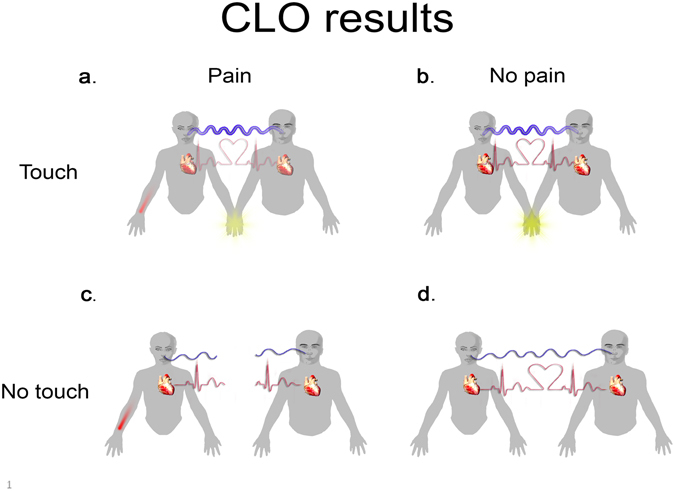
Partner touch increased inter-partner respiration coupling under both pain and no-pain conditions and increased heart-rate coupling during pain; pain without touch diminished coupling. High partner empathy/empathic accuracy and greater touch-related analgesia enhanced coupling during touch.
Key findings
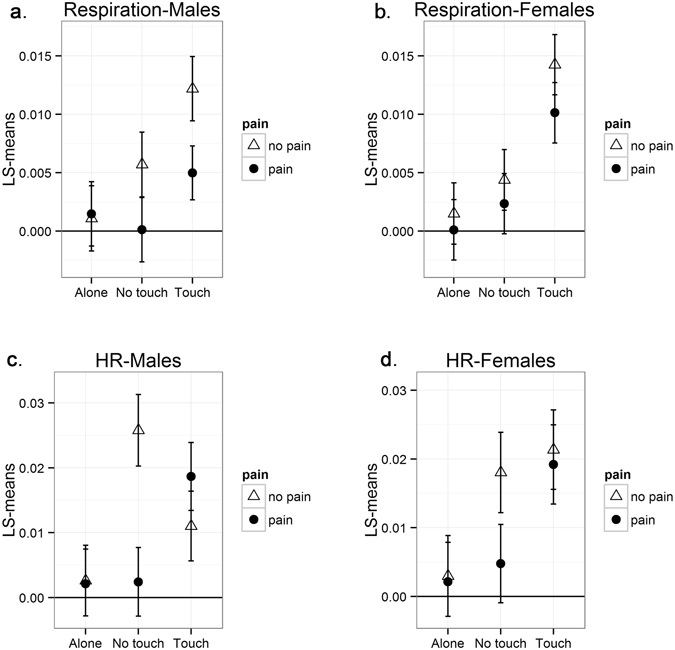
- Touch increased respiration coupling versus no touch in both no-pain and pain conditions: men Δζt/nt(np) = 0.006, p < 0.001 and Δζt/nt(p) = 0.012, p < 0.001; women Δζt/nt(np) = 0.010, p < 0.001 and Δζt/nt(p) = 0.008, p < 0.001.
- Heart-rate coupling was higher during touch-pain than no-touch-pain: men Δζt/nt(p) = 0.017, p < 0.001; women Δζt/nt(p) = 0.014, p < 0.001. Touch-pain also exceeded touch-no pain for heart rate (Δζt(p/np) = 0.007, p < 0.001 for both men and women).
- Pain without partner touch disrupted coupling: no-touch-pain cross-partner effects were not significant for respiration (men ζnt(p) < 0.001, p = 0.96; women ζnt(p) = 0.002, p = 0.54) or heart rate (men ζnt(p) = 0.002, p = 0.57; women ζnt(p) = 0.004, p = 0.183).
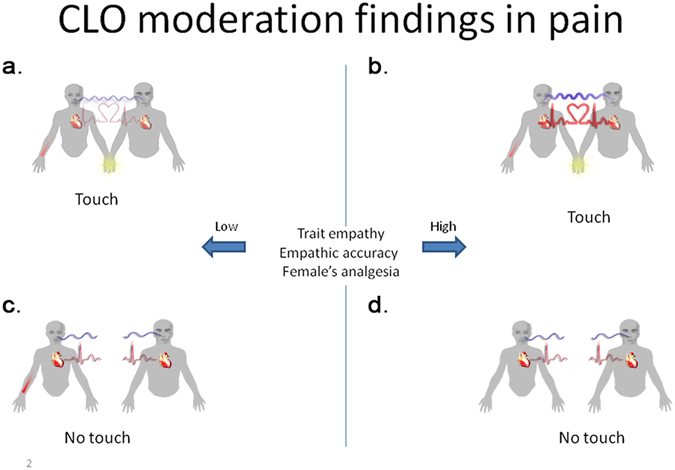
- High empathic accuracy and high women’s analgesia moderated touch-related coupling. For respiration, empathic accuracy moderation: F(4,28000) = 27.87, p < 0.0001, ΔR2 = 0.23; analgesia moderation: F(4,28000) = 26.59, p < 0.0001, ΔR2 = 0.19. For heart rate, empathic accuracy: F(4,13000) = 20.73, p < 0.0001, ΔR2 = 0.24; analgesia: F(4,13000) = 5.03, p < 0.0001, ΔR2 = 0.25. Touch also reduced pain ratings versus no-touch (Mdiff = −0.36, p = 0.029) and pain-alone (Mdiff = −0.66, p < 0.001).
Methods
- Twenty-two romantic couples completed the study; women were pain targets and men were observers. Two couples were dropped from analysis because of unsuccessful physiological recording.
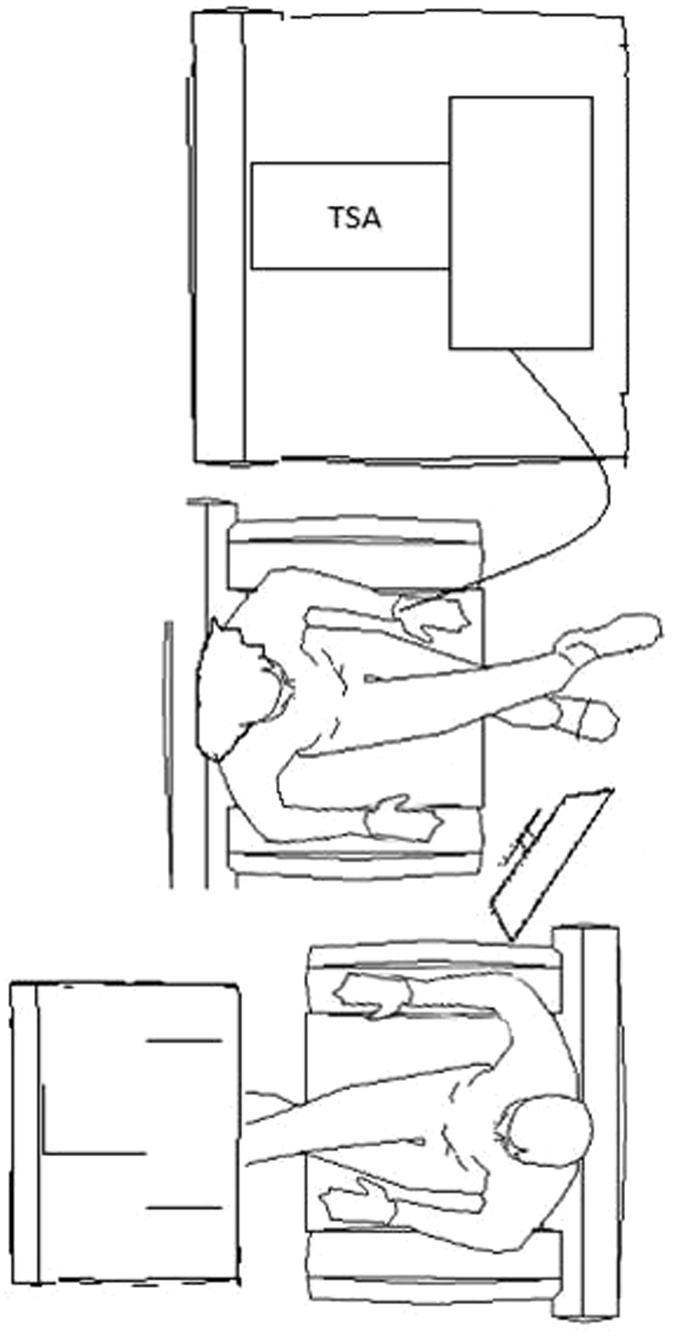
- Six conditions crossed pain/no-pain with alone/no-touch/touch; ECG and respiration were recorded simultaneously from both partners. Pain was individually calibrated to a numerical pain score of 60/100.
- Data were analyzed with a coupled linear oscillator (CLO) model using linear mixed models in SAS, with BIC for model selection and simulation-based multiple-test correction. Moderation analyses tested trait empathy (IRI), empathic accuracy, and women’s analgesia.
Limitations
- The paper states that only female participants received pain while male participants observed, restricting generalizability to the male-to-female direction; future work should test both sexes, homosexual and heterosexual participants, and other relationship types.
- The paper also notes use of a single subjectively adjusted heat-pain intensity, static handholding without squeezing/stroking/rubbing, possible visual information in all interacting conditions, and no separate emotional versus intensity pain ratings.
- Evident from the text: the analyzed sample was small and consisted only of long-term romantic couples without children, limiting broader generalization.
Model-written summary. Check it against the paper before relying on it.
Integrity signals
Registry
Cites
Statistics
Figures
Verification
Claims the paper makes
9 Valid · 1 Not valid · 9 Not checked · 75 Own results and interpretations
The sources with a verdict support this claim; the rest weren’t checked yet, have no full text we could read, or their verdicts aren’t rated yet.
In the paper
“tactile-induced analgesia66 correlates with activations in brain areas related to multimodal neural activity67 and emotional processes68–72.”
§ The role of touch in regulating inter-partner physiological coupling during empathy for pain > Discussion
What the sources say
- Supportedcites [66] Mancini F Beaumont A-L Hu L Haggard P Iannetti GD Touch inhibits subcortical and cortical nociceptive responses Pain 2015 156 1936 44 10.1097/j.pain.0000000000000253 26058037 PMC4579551 source
Citation 66 is attached to “tactile-induced analgesia,” not to the later claims about multimodal neural activity or emotional processes. The Results (§3.1, Psychophysics) report significantly lower subjective pain intensity with touch than without it, supporting the cited phenomenon. (LLM, conf=0.94)
- Not checked — no full text of the sourcecites [67] Mouraux A Iannetti GD Nociceptive laser-evoked brain potentials do not reflect nociceptive-specific neural activity J. Neurophysiol. 2009 101 3258 3269 10.1152/jn.91181.2008 19339457 source
- Not checked — no full text of the sourcecites [68] Kanske P Kotz SA Concreteness in emotional words: ERP evidence from a hemifield study Brain Res. 2007 1148 138 148 10.1016/j.brainres.2007.02.044 17391654 source
plainstates an association- Asserted: passes — The authors put it forward as true.
- Checkable: passes — It can be checked against evidence.
- Load-bearing: unclear — It is unclear whether the paper’s conclusions depend on it.
- Based: passes — The paper gives a reason why it holds.
- Supported
Every source the paper cites for this claim was checked and supports it.
In the paper
“The decrease in coupling when the women experienced pain and their partners observed their pain partially contradicts the findings of Konvalinka et al.17.”
§ The role of touch in regulating inter-partner physiological coupling during empathy for pain > Discussion
What the sources say
- Supportedcites [17] Konvalinka I Synchronized arousal between performers and related spectators in a fire-walking ritual Proc. Natl. Acad. Sci. 2011 108 8514 8519 10.1073/pnas.1016955108 21536887 PMC3100954 source
The Discussion (pp. 4–5) reports increased shared heart-rate dynamics between fire-walkers and related spectators during the ritual compared with baseline. A decrease in coupling between women experiencing pain and partners observing them is therefore a partial contrast, as the cited study examined a different setting and population. (LLM, conf=0.90)
hedged- Asserted: passes — The authors put it forward as true.
- Checkable: passes — It can be checked against evidence.
- Load-bearing: unclear — It is unclear whether the paper’s conclusions depend on it.
- Based: passes — The paper gives a reason why it holds.
- Supported
A result the paper reports from its own data — it cites no other source for it, so there is none to check. The quote shows it is in the paper.
In the paper
“In contrast to our original hypothesis, pain did not increase physiological coupling in the absence of the partner’s touch.”
- Also stated in: § Abstract · plain
“physiological coupling was diminished by pain in the absence of the partner’s touch.”
§ The role of touch in regulating inter-partner physiological coupling during empathy for pain > Discussion
plain- Asserted: passes — The authors put it forward as true.
- Checkable: passes — It can be checked against evidence.
- Load-bearing: passes — The paper’s conclusions depend on it.
- Based: passes — The paper gives a reason why it holds.
- Also stated in: § Abstract · plain
A result the paper reports from its own data — it cites no other source for it, so there is none to check. The quote shows it is in the paper.
In the paper
“Moreover, in the couples where the female partners reported greater touch-related analgesia, we observed enhanced physiological coupling.”
§ The role of touch in regulating inter-partner physiological coupling during empathy for pain > Discussion
plainstates an association- Asserted: passes — The authors put it forward as true.
- Checkable: passes — It can be checked against evidence.
- Load-bearing: passes — The paper’s conclusions depend on it.
- Based: passes — The paper gives a reason why it holds.
A result the paper reports from its own data — it cites no other source for it, so there is none to check. The quote shows it is in the paper.
In the paper
“To conclude, we show here that touch regulates physiological coupling during pain”
§ The role of touch in regulating inter-partner physiological coupling during empathy for pain > Discussion
plainstates a cause- Asserted: passes — The authors put it forward as true.
- Checkable: passes — It can be checked against evidence.
- Load-bearing: passes — The paper’s conclusions depend on it.
- Based: passes — The paper gives a reason why it holds.
46 more claims
Create a free account to see all 94 claims and every source verdict.
- Probably not a substantial claim. 17
- It may state two separate claims as one. 31
Claims other papers make about this one
Each is checked against this paper’s own text: does it say what the citing paper says it does?
The source backs part of the claim, not all of it — or backs it for a different population, condition or comparison.
In the citing paper
“Traits such as empathic concern and perspective-taking appear to promote synchrony in autonomic and endocrine systems, enabling individuals to emotionally and physiologically “tune in” to others in meaningful ways (30, 42, 49).”
From Physiological attunement and flourishing: understanding the influence of relationships on health (2025) · cites this paper as [49]
Experimental — accuracy not yet measuredThe source backs part of the claim, not all of it — or backs it for a different population, condition or comparison.
In the citing paper
“Across multiple studies, physiological attunement in romantic couples, friends, and social groups was associated with emotional closeness, mutual regulation, empathy, and stress buffering—core elements of meaningful and flourishing relationships (29, 42, 49).”
From Physiological attunement and flourishing: understanding the influence of relationships on health (2025) · cites this paper as [49]
Experimental — accuracy not yet measuredThe cited source says what the claim attributes to it.
In the citing paper
“For instance, interpersonal touch reliably enhanced autonomic coupling (47, 49)”
From Physiological attunement and flourishing: understanding the influence of relationships on health (2025) · cites this paper as [49]
The cited source says what the claim attributes to it.
In the citing paper
“In a study examining couples under pain conditions, dyads with higher trait empathy showed stronger HR and respiratory synchrony, especially when touch was involved (49).”
From Physiological attunement and flourishing: understanding the influence of relationships on health (2025) · cites this paper as [49]
The cited source says what the claim attributes to it.
In the citing paper
“During pain empathy tasks, touch enhanced synchrony in HR and respiration, particularly among couples high in trait empathy (49).”
From Physiological attunement and flourishing: understanding the influence of relationships on health (2025) · cites this paper as [49]
1 more claim about this paper
Create a free account to see every claim other papers make about this one.
Statistics that don’t add up
Each reported p-value recomputed from its test statistic and degrees of freedom, each partial η² from its F, and each ratio, mean difference or B printed with a p checked against its own confidence interval.
Rated minor: it would not touch a result — a value no result rests on, a p-value that stays on the same side of the significance level, or a conflict that is clerical, resolved elsewhere in the paper, or outside its own findings.
In the paper
“F(4,13000) = 5.03, p < 0.0001”
§ The role of touch in regulating inter-partner physiological coupling during empathy for pain > Results > Moderation analysis
Reported p < .0001 · recomputed p < .001
Statistics recomputed
Every reported test result, recomputed from its test statistic and degrees of freedom. A result shows as not adding up only once an independent check has confirmed it.
- Doesn’t add upF(4, 13000) = 5.03reported p < .0001 · recomputed p < .001
“F(4,13000) = 5.03, p < .0001”
- ConsistentF(4, 55000) = 14.44reported p < .0001 · recomputed p < .001
“F(4,55000) = 14.44, p < .0001”
- ConsistentF(4, 25000) = 19.4reported p < .0001 · recomputed p < .001
“F(4,25000) = 19.40, p < .0001”
- ConsistentF(4, 28000) = 27.87reported p < .0001 · recomputed p < .001
“F(4,28000) = 27.87, p < .0001”
- ConsistentF(4, 28000) = 26.59reported p < .0001 · recomputed p < .001
“F(4,28000) = 26.59, p < .0001”
3 more recomputed tests
Create a free account to see every test the Stats check recomputed.
Self-check
Percentages, sums and reported differences re-computed from the paper’s own numbers.
Each contradiction between two passages listed here was confirmed by an independent check.
Rated major: it would touch a result — a value a result rests on, reported and recomputed p-values on opposite sides of the significance level, two passages that conflict with no sign which is right, or a cited work retracted before this paper was published.
In the paper
§ The role of touch in regulating inter-partner physiological coupling during empathy for pain > Results > Moderation analysis
“a high level of empathic accuracy (one standard deviation above the mean) compared to a low level (one standard deviation below the mean) was associated with increased coupling”
§ The role of touch in regulating inter-partner physiological coupling during empathy for pain > Methods > Statistical analysis
“The measure of empathic accuracy was defined as the absolute difference between the partners’ pain ratings (each male partner’s pain ratings minus his female partner’s pain ratings) divided by the female partner’s pain ratings.”
Rated minor: it would not touch a result — a value no result rests on, a p-value that stays on the same side of the significance level, or a conflict that is clerical, resolved elsewhere in the paper, or outside its own findings.
In the paper
§ The role of touch in regulating inter-partner physiological coupling during empathy for pain > Results > Model for female participants: How changes in respiration in males predict shifts in changes of females
“(ζnt(p) = −0.005, p = 0.32)”
§ The role of touch in regulating inter-partner physiological coupling during empathy for pain > Results > Model for female participants: How changes in respiration in males predict shifts in changes of females
“no touch-pain (ζnt(p) = 0.004, p = 0.183)”
Rated minor: it would not touch a result — a value no result rests on, a p-value that stays on the same side of the significance level, or a conflict that is clerical, resolved elsewhere in the paper, or outside its own findings.
In the paper
§ The role of touch in regulating inter-partner physiological coupling during empathy for pain > Results > Model for male participants: How changes in respiration in females predict shifts in changes of males
“Δζt(p/np) = −0.007, p < 0.001, 95% CI [−0.004, 0.010]”
§ The role of touch in regulating inter-partner physiological coupling during empathy for pain > Results > Model for male participants: How changes in respiration in females predict shifts in changes of males
“95% CI [−0.004, 0.010]”
Rated minor: it would not touch a result — a value no result rests on, a p-value that stays on the same side of the significance level, or a conflict that is clerical, resolved elsewhere in the paper, or outside its own findings.
In the paper
§ The role of touch in regulating inter-partner physiological coupling during empathy for pain > Results > Model for male participants: How changes in respiration in females predict shifts in changes of males
“touch-no pain (ηt(np) = −0.012, p < 0.001, 95% CI [−0.06, −0.18])”
§ The role of touch in regulating inter-partner physiological coupling during empathy for pain > Results > Model for male participants: How changes in respiration in females predict shifts in changes of males
“ηt(np) = −0.012, p < 0.001, 95% CI [−0.06, −0.18]”
Rated minor: it would not touch a result — a value no result rests on, a p-value that stays on the same side of the significance level, or a conflict that is clerical, resolved elsewhere in the paper, or outside its own findings.
In the paper
§ The role of touch in regulating inter-partner physiological coupling during empathy for pain > Results > Model for male participants: How changes in respiration in females predict shifts in changes of males
“Δζnt(p/np) = −0.006, p < 0.001, 95% CI [−0.004, 0.008]”
§ The role of touch in regulating inter-partner physiological coupling during empathy for pain > Results > Model for male participants: How changes in respiration in females predict shifts in changes of males
“95% CI [−0.004, 0.008]”
Cited works that were retracted
Works this paper cites that were later retracted, from the retraction notices publishers deposit. Major when the notice came out before this paper was published.
Rated major: it would touch a result — a value a result rests on, reported and recomputed p-values on opposite sides of the significance level, two passages that conflict with no sign which is right, or a cited work retracted before this paper was published.
Cited work 10.1002/14651858.cd006535.pub2 · retracted 2013-11-22 · notice 10.1002/14651858.cd006535.pub3 · this paper published 2017-06-12
A note, not an issue: for example, a cited work that was retracted only after this paper was published, which its authors could not have known.
In the paper
“So, P. S., Jiang, J. Y. & Qin, Y. Touch therapies for pain relief in adults. Cochrane Libr. doi:10.1002/14651858.CD006535.pub3 (2008).”
Cited work 10.1002/14651858.cd006535.pub3 · retraction date not known · this paper published 2017-06-12
Citations
Cites
2 retracted
Touch therapies for pain relief in adults
So, P. S., Jiang, J. Y., & Qin, Y. (2008) · Cochrane Database of Systematic Reviews · doi:10.1002/14651858.cd006535.pub2 · Cited by 111
RetractedTouch therapies for pain relief in adults
So, P. S., Jiang, J. Y., & Qin, Y. (2013) · Cochrane Database of Systematic Reviews · doi:10.1002/14651858.cd006535.pub3 · Cited by 4
RetractedHierarchical Linear Models: Applications and Data Analysis Methods.
Longford, N. T., Bryk, A. S., & Raudenbush, S. W. (1993) · Contemporary Sociology · doi:10.2307/2075823 · Cited by 18,724
(1980) · Medical Entomology and Zoology · Cited by 4,712
Empathy: its ultimate and proximate bases
Preston, S. D., & de Waal, F. B. M. (2002) · Behavioral and Brain Sciences · doi:10.1017/s0140525x02000018 · Cited by 4,126
Empathy for Pain Involves the Affective but not Sensory Components of Pain
Singer, T., Seymour, B., O'Doherty, J., Kaube, H., Dolan, R. J., & Frith, C. D. (2004) · Science · doi:10.1126/science.1093535 · Cited by 3,929
Contributions of anterior cingulate cortex to behaviour
Devinsky, O., Morrell, M. J., & Vogt, B. A. (1995) · Brain · doi:10.1093/brain/118.1.279 · Cited by 3,377
Synchronization of Pulse-Coupled Biological Oscillators
Mirollo, R. E., & Strogatz, S. H. (1990) · SIAM Journal on Applied Mathematics · doi:10.1137/0150098 · Cited by 2,074
Lamm, C., Decety, J., & Singer, T. (2011) · NeuroImage · doi:10.1016/j.neuroimage.2010.10.014 · Cited by 2,016
Joint action: bodies and minds moving together
SEBANZ, N., BEKKERING, H., & KNOBLICH, G. (2006) · Trends in Cognitive Sciences · doi:10.1016/j.tics.2005.12.009 · Cited by 1,950
Research works printed but not linked: 1
- Ruef, A. M. Empathy in long-term marriage: Behavioral and physiological correlates (Doctoral dissertation, University of California, Berkeley, 2001). Diss. Abstr. Int. 62 (2001).
Cited by
Items 101–119 of 119
Zhou, Z., Tian, H., Luo, S.-W., Wang, Y., & Shi, D. (2022) · Journal of Psychology in Africa · doi:10.1080/14330237.2022.2121040
Mostafa, R., McNair, N. A., Tan, W., Saunders, C., Colagiuri, B., & Barnes, K. (2023) · doi:10.31234/osf.io/ev2y5
Knauss, A., Jensen, J. F., Fish, M., Bolin, L. P., & Brimhall, A. S. (2024) · Research Square · doi:10.21203/rs.3.rs-4959313/v1 · Cited by 1
Healing synchrony? potential benefits of interpersonal synchrony for chronic pain management
Świdrak, J. (2025) · Frontiers in Pain Research · doi:10.3389/fpain.2025.1463321 · Cited by 1
Untersuchung und Therapie von Schmerzen
Bassimtabar, A. (2025) · Springer eBooks · doi:10.1007/978-3-662-70334-2_5
Empathy for pain persists across live two-way video interactions and viewing of prerecorded videos
Heimann, J., Petereit, P., Perry, A., & Krämer, U. M. (2026) · Cognitive Affective & Behavioral Neuroscience · doi:10.1101/2025.07.07.663421 · Cited by 2
Examination and Treatment of Pain
Bassimtabar, A. (2025) · Springer eBooks · doi:10.1007/978-3-662-71562-8_5
Exploring cardiac physiological synchrony and its implications for stress and anxiety
Escobar, L. S., Robbins, M., Hwang, J., Jung, S.-M., & Park, D. J. (2025) · Ageing and Neurodegenerative Diseases · doi:10.20517/and.2025.14 · Cited by 1
Golbabaei, S., Hosseinnezhad, M., Karami, Z., & Borhani, K. (2025) · bioRxiv (Cold Spring Harbor Laboratory) · doi:10.64898/2025.12.25.696484
Introduction to the Role of Adaptivity in Social Interaction Science
Hendrikse, S. C. F., Treur, J., & Koole, S. L. (2025) · Studies in systems, decision and control · doi:10.1007/978-3-031-99968-0_1
Wearable Microblower System for Affective Touch: Airflow-Based Tactile Stroking Stimulation
Yim, Y., & Tanaka, F. (2026) · IEEE/SICE International Symposium on System Integration (SII) · doi:10.1109/sii64115.2026.11404700 · Cited by 1
Neurophysiological mechanisms of embodied empathy in martial arts
Shpak, G. (2026) · Frontiers in Psychology · doi:10.3389/fpsyg.2026.1782703
Drimalla, H. (2026) · Springer eBooks · doi:10.1007/978-981-96-5290-7_20
Breathing Life Into Robots: Pseudo-Respiration Enhances Human-Robot Interaction—a Behavioural Study
Lavault, S., Desmons, C., Hajage, D., Mazel, A., Plumet, F., Gauthier, P., Peiffer, C., Chétouani, M., Nierat, M., Pélachaud, C., et al. (2026) · International Journal of Social Robotics · doi:10.1007/s12369-026-01388-w
Jaltare, K. P., Sanfrinnon, L., & Torta, D. M. E. (2026) · PAIN Reports · doi:10.1097/pr9.0000000000001464 · Cited by 1
Erdélyi, V., Gergely, B., Köteles, F. G., & Szemerszky, R. (2026) · International Journal of Psychophysiology · doi:10.1016/j.ijpsycho.2026.113441
Interpersonal heart rate synchrony and prosocial behaviors in musical contexts
Carmona, J. M. P., Pereira, A., Toffolo, R. B. G., & Matos, F. D. O. (2026) · Frontiers in Psychology · doi:10.3389/fpsyg.2026.1836447
Li, S., Liu, T., & Zhang, M. (2026) · Brain Research · doi:10.1016/j.brainres.2026.150517
Metadata
- Authors
- Goldstein, P., Weissman-Fogel, I., & Shamay-Tsoory, S. G.
- Affiliations
- University of Haifa (IL)
- Corresponding author
- Goldstein, Pavel
- ORCID
- Goldstein, Pavel
- Venue
- Scientific Reports
- Published
- 2017-06-12
- Volume
- 7
- Issue
- 1
- Pages
- 3252-3252
- ISSN
- 2045-2322 (ISSN-L)
- PMC
- PMC5468314
- OpenAlex
- W2622601941
- Cited by
- 118
- References
- 97
- Citations by year
- 2026: 11 · 2025: 10 · 2024: 13 · 2023: 8 · 2022: 19 · 2021: 18 · 2020: 19 · 2019: 9 · 2018: 10 · 2017: 1
- FWCI
- 15.27
- Type
- journal article
- Language
- en
- Open access
- gold
- doi.org
- Licence
- cc-by
- creativecommons.org/licenses/by/4.0 (tdm)
- creativecommons.org/licenses/by/4.0 (vor)
- Locations
- Scientific Reports (publishedVersion, cc-by)
- Europe PMC (PubMed Central) (publishedVersion, other-oa)
- PubMed Central (publishedVersion, cc-by)
- PubMed (publishedVersion)
- DOAJ (DOAJ: Directory of Open Access Journals) (submittedVersion, cc-by-sa)
- Topics
- Social Sciences › Psychology › Social Psychology › Action Observation and Synchronization
- Health Sciences › Medicine › Cardiology and Cardiovascular Medicine › Heart Rate Variability and Autonomic Control
- Life Sciences › Neuroscience › Cognitive Neuroscience › Tactile and Sensory Interactions
- Keywords
- social touch, empathy for pain, heart rate synchronization, romantic partners, pain perception, analgesia, autonomic nervous system, interpersonal synchrony
- MeSH terms
- Adult, Electrocardiography, Empathy, Female, Heart Rate, Humans, Interpersonal Relations, Male, Pain, Social Behavior, Touch, Respiratory Rate
About these checks
Registry, retraction, Cites and statistics results are computed, not judged, with one exception: a printed reference that no index lists is read once by a model before it counts as a citation error. Claims are extracted by a model and kept only when their quote appears verbatim in the text; each cited source is then checked, with a model’s help, for whether it says what the claim relies on. Those verdicts can be wrong — read the claim’s quote and the cited source before relying on one.
The claim verdicts this report counts are experimental: their accuracy is not yet measured.
A language model drew the claims from the paper on 2026-10-10, under version 3 of the claim definition (model deepseek-v4.1-flash, prompt extract-v3).
A second model labelled each claim on 2026-10-10 (model jev-1.13-20260917, definition revision gold-guideline-v0.2).
Cited sources are checked with a language model’s help (gpt-6-sol).
Statistics and arithmetic are recomputed, not judged.
Confidence bands are shown only for fields calibrated on our annotated test set. None is calibrated yet, so no band is shown.
What counts as a claim ›How we measure confidence ›How we check this ›
Are you an author, or do you see a problem with this page? Request a review
Data sources
Bibliographic data: Semantic Scholar, OpenAlex, Crossref.
Contains information from the Semantic Scholar Academic Graph Datasets, made available under the ODC Attribution License (ODC-BY 1.0).
Semantic Scholar’s data is described in: Kinney, R., et al. (2023). The Semantic Scholar Open Data Platform. arXiv:2301.10140.
