

The role of touch in regulating inter-partner physiological coupling during empathy for pain
Open accessThe DOI matches its Crossref record; 96 of the 97 references it cites were found in a registry or an index; 10 of the 32 sources its claims cite were checked for support.
Abstract
The human ability to synchronize with other individuals is critical for the development of social behavior. Recent research has shown that physiological inter-personal synchronization may underlie behavioral synchrony. Nevertheless, the factors that modulate physiological coupling are still largely unknown. Here we suggest that social touch and empathy for pain may enhance interpersonal physiological coupling. Twenty-two romantic couples were assigned the roles of target (pain receiver) and observer (pain observer) under pain/no-pain and touch/no-touch conditions, and their ECG and respiration rates were recorded. The results indicate that the partner touch increased interpersonal respiration coupling under both pain and no-pain conditions and increased heart rate coupling under pain conditions. In addition, physiological coupling was diminished by pain in the absence of the partner’s touch. Critically, we found that high partner’s empathy and high levels of analgesia enhanced coupling during the partner’s touch. Collectively, the evidence indicates that social touch increases interpersonal physiological coupling during pain. Furthermore, the effects of touch on cardio-respiratory inter-partner coupling may contribute to the analgesic effects of touch via the autonomic nervous system.
Overview
CoChat Summary
TL;DR
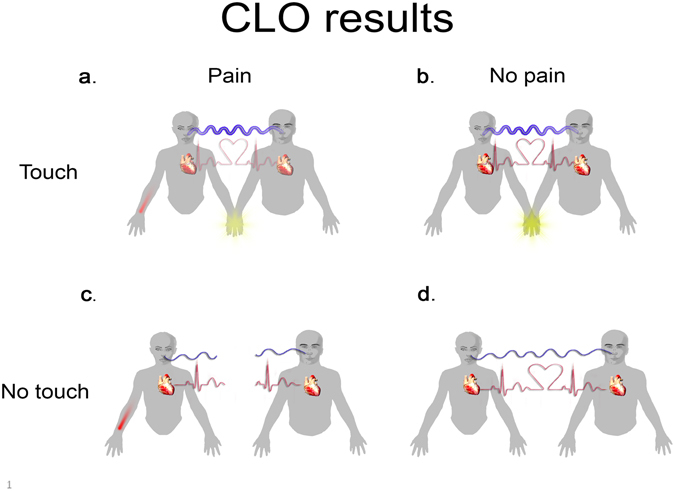
Partner touch increased inter-partner respiration coupling under both pain and no-pain conditions and increased heart-rate coupling during pain; pain without touch diminished coupling. High partner empathy/empathic accuracy and greater touch-related analgesia enhanced coupling during touch.
Key findings
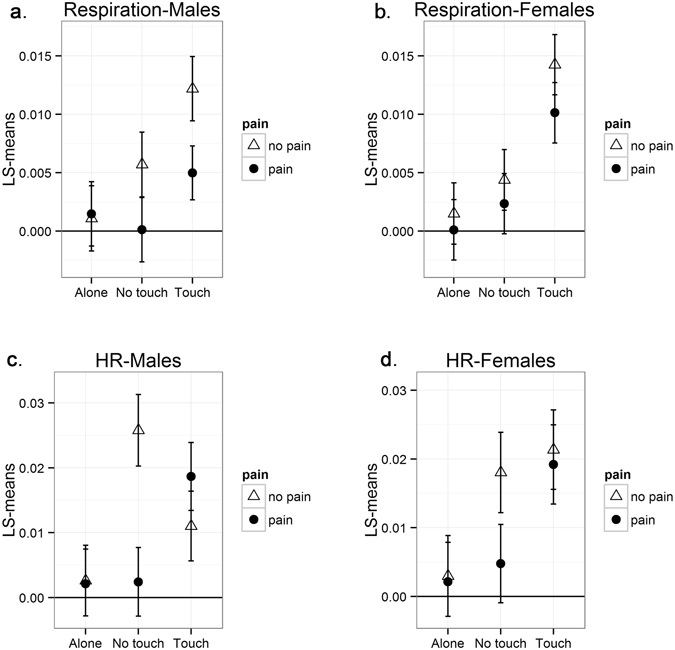
- Touch increased respiration coupling versus no touch in both no-pain and pain conditions: men Δζt/nt(np) = 0.006, p < 0.001 and Δζt/nt(p) = 0.012, p < 0.001; women Δζt/nt(np) = 0.010, p < 0.001 and Δζt/nt(p) = 0.008, p < 0.001.
- Heart-rate coupling was higher during touch-pain than no-touch-pain: men Δζt/nt(p) = 0.017, p < 0.001; women Δζt/nt(p) = 0.014, p < 0.001. Touch-pain also exceeded touch-no pain for heart rate (Δζt(p/np) = 0.007, p < 0.001 for both men and women).
- Pain without partner touch disrupted coupling: no-touch-pain cross-partner effects were not significant for respiration (men ζnt(p) < 0.001, p = 0.96; women ζnt(p) = 0.002, p = 0.54) or heart rate (men ζnt(p) = 0.002, p = 0.57; women ζnt(p) = 0.004, p = 0.183).
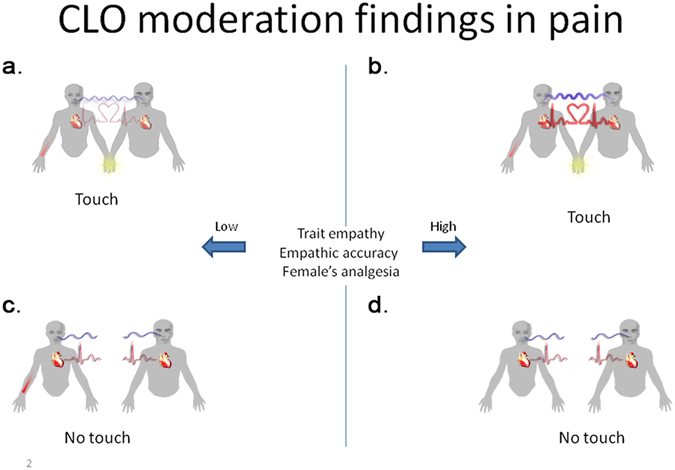
- High empathic accuracy and high women’s analgesia moderated touch-related coupling. For respiration, empathic accuracy moderation: F(4,28000) = 27.87, p < 0.0001, ΔR2 = 0.23; analgesia moderation: F(4,28000) = 26.59, p < 0.0001, ΔR2 = 0.19. For heart rate, empathic accuracy: F(4,13000) = 20.73, p < 0.0001, ΔR2 = 0.24; analgesia: F(4,13000) = 5.03, p < 0.0001, ΔR2 = 0.25. Touch also reduced pain ratings versus no-touch (Mdiff = −0.36, p = 0.029) and pain-alone (Mdiff = −0.66, p < 0.001).
Methods
- Twenty-two romantic couples completed the study; women were pain targets and men were observers. Two couples were dropped from analysis because of unsuccessful physiological recording.
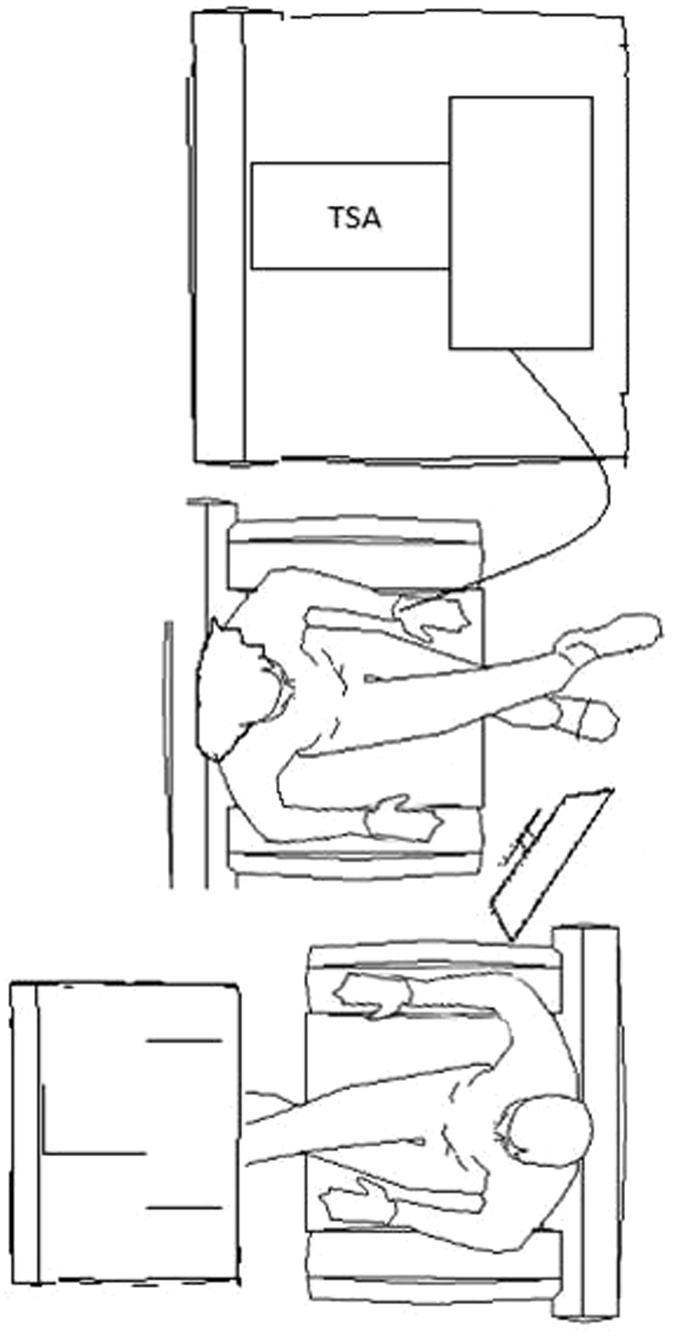
- Six conditions crossed pain/no-pain with alone/no-touch/touch; ECG and respiration were recorded simultaneously from both partners. Pain was individually calibrated to a numerical pain score of 60/100.
- Data were analyzed with a coupled linear oscillator (CLO) model using linear mixed models in SAS, with BIC for model selection and simulation-based multiple-test correction. Moderation analyses tested trait empathy (IRI), empathic accuracy, and women’s analgesia.
Limitations
- The paper states that only female participants received pain while male participants observed, restricting generalizability to the male-to-female direction; future work should test both sexes, homosexual and heterosexual participants, and other relationship types.
- The paper also notes use of a single subjectively adjusted heat-pain intensity, static handholding without squeezing/stroking/rubbing, possible visual information in all interacting conditions, and no separate emotional versus intensity pain ratings.
- Evident from the text: the analyzed sample was small and consisted only of long-term romantic couples without children, limiting broader generalization.
Model-written summary. Check it against the paper before relying on it.
Integrity signals
Registry
Cites
Statistics
Figures
Verification
Claims the paper makes
9 Valid · 1 Not valid · 9 Not checked · 75 Own results and interpretations
The sources with a verdict support this claim; the rest weren’t checked yet, have no full text we could read, or their verdicts aren’t rated yet.
In the paper
“tactile-induced analgesia66 correlates with activations in brain areas related to multimodal neural activity67 and emotional processes68–72.”
§ The role of touch in regulating inter-partner physiological coupling during empathy for pain > Discussion
What the sources say
- Supportedcites [66] Mancini F Beaumont A-L Hu L Haggard P Iannetti GD Touch inhibits subcortical and cortical nociceptive responses Pain 2015 156 1936 44 10.1097/j.pain.0000000000000253 26058037 PMC4579551 source
Citation 66 is attached to “tactile-induced analgesia,” not to the later claims about multimodal neural activity or emotional processes. The Results (§3.1, Psychophysics) report significantly lower subjective pain intensity with touch than without it, supporting the cited phenomenon. (LLM, conf=0.94)
- Not checked — no full text of the sourcecites [67] Mouraux A Iannetti GD Nociceptive laser-evoked brain potentials do not reflect nociceptive-specific neural activity J. Neurophysiol. 2009 101 3258 3269 10.1152/jn.91181.2008 19339457 source
- Not checked — no full text of the sourcecites [68] Kanske P Kotz SA Concreteness in emotional words: ERP evidence from a hemifield study Brain Res. 2007 1148 138 148 10.1016/j.brainres.2007.02.044 17391654 source
plainstates an association- Asserted: passes — The authors put it forward as true.
- Checkable: passes — It can be checked against evidence.
- Load-bearing: unclear — It is unclear whether the paper’s conclusions depend on it.
- Based: passes — The paper gives a reason why it holds.
- Supported
Every source the paper cites for this claim was checked and supports it.
In the paper
“The decrease in coupling when the women experienced pain and their partners observed their pain partially contradicts the findings of Konvalinka et al.17.”
§ The role of touch in regulating inter-partner physiological coupling during empathy for pain > Discussion
What the sources say
- Supportedcites [17] Konvalinka I Synchronized arousal between performers and related spectators in a fire-walking ritual Proc. Natl. Acad. Sci. 2011 108 8514 8519 10.1073/pnas.1016955108 21536887 PMC3100954 source
The Discussion (pp. 4–5) reports increased shared heart-rate dynamics between fire-walkers and related spectators during the ritual compared with baseline. A decrease in coupling between women experiencing pain and partners observing them is therefore a partial contrast, as the cited study examined a different setting and population. (LLM, conf=0.90)
hedged- Asserted: passes — The authors put it forward as true.
- Checkable: passes — It can be checked against evidence.
- Load-bearing: unclear — It is unclear whether the paper’s conclusions depend on it.
- Based: passes — The paper gives a reason why it holds.
- Supported
A result the paper reports from its own data — it cites no other source for it, so there is none to check. The quote shows it is in the paper.
In the paper
“In contrast to our original hypothesis, pain did not increase physiological coupling in the absence of the partner’s touch.”
- Also stated in: § Abstract · plain
“physiological coupling was diminished by pain in the absence of the partner’s touch.”
§ The role of touch in regulating inter-partner physiological coupling during empathy for pain > Discussion
plain- Asserted: passes — The authors put it forward as true.
- Checkable: passes — It can be checked against evidence.
- Load-bearing: passes — The paper’s conclusions depend on it.
- Based: passes — The paper gives a reason why it holds.
- Also stated in: § Abstract · plain
A result the paper reports from its own data — it cites no other source for it, so there is none to check. The quote shows it is in the paper.
In the paper
“Moreover, in the couples where the female partners reported greater touch-related analgesia, we observed enhanced physiological coupling.”
§ The role of touch in regulating inter-partner physiological coupling during empathy for pain > Discussion
plainstates an association- Asserted: passes — The authors put it forward as true.
- Checkable: passes — It can be checked against evidence.
- Load-bearing: passes — The paper’s conclusions depend on it.
- Based: passes — The paper gives a reason why it holds.
A result the paper reports from its own data — it cites no other source for it, so there is none to check. The quote shows it is in the paper.
In the paper
“To conclude, we show here that touch regulates physiological coupling during pain”
§ The role of touch in regulating inter-partner physiological coupling during empathy for pain > Discussion
plainstates a cause- Asserted: passes — The authors put it forward as true.
- Checkable: passes — It can be checked against evidence.
- Load-bearing: passes — The paper’s conclusions depend on it.
- Based: passes — The paper gives a reason why it holds.
46 more claims
Create a free account to see all 94 claims and every source verdict.
- Probably not a substantial claim. 17
- It may state two separate claims as one. 31
Claims other papers make about this one
Each is checked against this paper’s own text: does it say what the citing paper says it does?
The source backs part of the claim, not all of it — or backs it for a different population, condition or comparison.
In the citing paper
“Traits such as empathic concern and perspective-taking appear to promote synchrony in autonomic and endocrine systems, enabling individuals to emotionally and physiologically “tune in” to others in meaningful ways (30, 42, 49).”
From Physiological attunement and flourishing: understanding the influence of relationships on health (2025) · cites this paper as [49]
Experimental — accuracy not yet measuredThe source backs part of the claim, not all of it — or backs it for a different population, condition or comparison.
In the citing paper
“Across multiple studies, physiological attunement in romantic couples, friends, and social groups was associated with emotional closeness, mutual regulation, empathy, and stress buffering—core elements of meaningful and flourishing relationships (29, 42, 49).”
From Physiological attunement and flourishing: understanding the influence of relationships on health (2025) · cites this paper as [49]
Experimental — accuracy not yet measuredThe cited source says what the claim attributes to it.
In the citing paper
“For instance, interpersonal touch reliably enhanced autonomic coupling (47, 49)”
From Physiological attunement and flourishing: understanding the influence of relationships on health (2025) · cites this paper as [49]
The cited source says what the claim attributes to it.
In the citing paper
“In a study examining couples under pain conditions, dyads with higher trait empathy showed stronger HR and respiratory synchrony, especially when touch was involved (49).”
From Physiological attunement and flourishing: understanding the influence of relationships on health (2025) · cites this paper as [49]
The cited source says what the claim attributes to it.
In the citing paper
“During pain empathy tasks, touch enhanced synchrony in HR and respiration, particularly among couples high in trait empathy (49).”
From Physiological attunement and flourishing: understanding the influence of relationships on health (2025) · cites this paper as [49]
1 more claim about this paper
Create a free account to see every claim other papers make about this one.
Statistics that don’t add up
Each reported p-value recomputed from its test statistic and degrees of freedom, each partial η² from its F, and each ratio, mean difference or B printed with a p checked against its own confidence interval.
Rated minor: it would not touch a result — a value no result rests on, a p-value that stays on the same side of the significance level, or a conflict that is clerical, resolved elsewhere in the paper, or outside its own findings.
In the paper
“F(4,13000) = 5.03, p < 0.0001”
§ The role of touch in regulating inter-partner physiological coupling during empathy for pain > Results > Moderation analysis
Reported p < .0001 · recomputed p < .001
Statistics recomputed
Every reported test result, recomputed from its test statistic and degrees of freedom. A result shows as not adding up only once an independent check has confirmed it.
- Doesn’t add upF(4, 13000) = 5.03reported p < .0001 · recomputed p < .001
“F(4,13000) = 5.03, p < .0001”
- ConsistentF(4, 55000) = 14.44reported p < .0001 · recomputed p < .001
“F(4,55000) = 14.44, p < .0001”
- ConsistentF(4, 25000) = 19.4reported p < .0001 · recomputed p < .001
“F(4,25000) = 19.40, p < .0001”
- ConsistentF(4, 28000) = 27.87reported p < .0001 · recomputed p < .001
“F(4,28000) = 27.87, p < .0001”
- ConsistentF(4, 28000) = 26.59reported p < .0001 · recomputed p < .001
“F(4,28000) = 26.59, p < .0001”
3 more recomputed tests
Create a free account to see every test the Stats check recomputed.
Self-check
Percentages, sums and reported differences re-computed from the paper’s own numbers.
Each contradiction between two passages listed here was confirmed by an independent check.
Rated major: it would touch a result — a value a result rests on, reported and recomputed p-values on opposite sides of the significance level, two passages that conflict with no sign which is right, or a cited work retracted before this paper was published.
In the paper
§ The role of touch in regulating inter-partner physiological coupling during empathy for pain > Results > Moderation analysis
“a high level of empathic accuracy (one standard deviation above the mean) compared to a low level (one standard deviation below the mean) was associated with increased coupling”
§ The role of touch in regulating inter-partner physiological coupling during empathy for pain > Methods > Statistical analysis
“The measure of empathic accuracy was defined as the absolute difference between the partners’ pain ratings (each male partner’s pain ratings minus his female partner’s pain ratings) divided by the female partner’s pain ratings.”
Rated minor: it would not touch a result — a value no result rests on, a p-value that stays on the same side of the significance level, or a conflict that is clerical, resolved elsewhere in the paper, or outside its own findings.
In the paper
§ The role of touch in regulating inter-partner physiological coupling during empathy for pain > Results > Model for female participants: How changes in respiration in males predict shifts in changes of females
“(ζnt(p) = −0.005, p = 0.32)”
§ The role of touch in regulating inter-partner physiological coupling during empathy for pain > Results > Model for female participants: How changes in respiration in males predict shifts in changes of females
“no touch-pain (ζnt(p) = 0.004, p = 0.183)”
Rated minor: it would not touch a result — a value no result rests on, a p-value that stays on the same side of the significance level, or a conflict that is clerical, resolved elsewhere in the paper, or outside its own findings.
In the paper
§ The role of touch in regulating inter-partner physiological coupling during empathy for pain > Results > Model for male participants: How changes in respiration in females predict shifts in changes of males
“Δζt(p/np) = −0.007, p < 0.001, 95% CI [−0.004, 0.010]”
§ The role of touch in regulating inter-partner physiological coupling during empathy for pain > Results > Model for male participants: How changes in respiration in females predict shifts in changes of males
“95% CI [−0.004, 0.010]”
Rated minor: it would not touch a result — a value no result rests on, a p-value that stays on the same side of the significance level, or a conflict that is clerical, resolved elsewhere in the paper, or outside its own findings.
In the paper
§ The role of touch in regulating inter-partner physiological coupling during empathy for pain > Results > Model for male participants: How changes in respiration in females predict shifts in changes of males
“touch-no pain (ηt(np) = −0.012, p < 0.001, 95% CI [−0.06, −0.18])”
§ The role of touch in regulating inter-partner physiological coupling during empathy for pain > Results > Model for male participants: How changes in respiration in females predict shifts in changes of males
“ηt(np) = −0.012, p < 0.001, 95% CI [−0.06, −0.18]”
Rated minor: it would not touch a result — a value no result rests on, a p-value that stays on the same side of the significance level, or a conflict that is clerical, resolved elsewhere in the paper, or outside its own findings.
In the paper
§ The role of touch in regulating inter-partner physiological coupling during empathy for pain > Results > Model for male participants: How changes in respiration in females predict shifts in changes of males
“Δζnt(p/np) = −0.006, p < 0.001, 95% CI [−0.004, 0.008]”
§ The role of touch in regulating inter-partner physiological coupling during empathy for pain > Results > Model for male participants: How changes in respiration in females predict shifts in changes of males
“95% CI [−0.004, 0.008]”
Cited works that were retracted
Works this paper cites that were later retracted, from the retraction notices publishers deposit. Major when the notice came out before this paper was published.
Rated major: it would touch a result — a value a result rests on, reported and recomputed p-values on opposite sides of the significance level, two passages that conflict with no sign which is right, or a cited work retracted before this paper was published.
Cited work 10.1002/14651858.cd006535.pub2 · retracted 2013-11-22 · notice 10.1002/14651858.cd006535.pub3 · this paper published 2017-06-12
A note, not an issue: for example, a cited work that was retracted only after this paper was published, which its authors could not have known.
In the paper
“So, P. S., Jiang, J. Y. & Qin, Y. Touch therapies for pain relief in adults. Cochrane Libr. doi:10.1002/14651858.CD006535.pub3 (2008).”
Cited work 10.1002/14651858.cd006535.pub3 · retraction date not known · this paper published 2017-06-12
Citations
Cites
2 retracted
Touch therapies for pain relief in adults
So, P. S., Jiang, J. Y., & Qin, Y. (2008) · Cochrane Database of Systematic Reviews · doi:10.1002/14651858.cd006535.pub2 · Cited by 111
RetractedTouch therapies for pain relief in adults
So, P. S., Jiang, J. Y., & Qin, Y. (2013) · Cochrane Database of Systematic Reviews · doi:10.1002/14651858.cd006535.pub3 · Cited by 4
RetractedHierarchical Linear Models: Applications and Data Analysis Methods.
Longford, N. T., Bryk, A. S., & Raudenbush, S. W. (1993) · Contemporary Sociology · doi:10.2307/2075823 · Cited by 18,724
(1980) · Medical Entomology and Zoology · Cited by 4,712
Empathy: its ultimate and proximate bases
Preston, S. D., & de Waal, F. B. M. (2002) · Behavioral and Brain Sciences · doi:10.1017/s0140525x02000018 · Cited by 4,126
Empathy for Pain Involves the Affective but not Sensory Components of Pain
Singer, T., Seymour, B., O'Doherty, J., Kaube, H., Dolan, R. J., & Frith, C. D. (2004) · Science · doi:10.1126/science.1093535 · Cited by 3,929
Contributions of anterior cingulate cortex to behaviour
Devinsky, O., Morrell, M. J., & Vogt, B. A. (1995) · Brain · doi:10.1093/brain/118.1.279 · Cited by 3,377
Synchronization of Pulse-Coupled Biological Oscillators
Mirollo, R. E., & Strogatz, S. H. (1990) · SIAM Journal on Applied Mathematics · doi:10.1137/0150098 · Cited by 2,074
Lamm, C., Decety, J., & Singer, T. (2011) · NeuroImage · doi:10.1016/j.neuroimage.2010.10.014 · Cited by 2,016
Joint action: bodies and minds moving together
SEBANZ, N., BEKKERING, H., & KNOBLICH, G. (2006) · Trends in Cognitive Sciences · doi:10.1016/j.tics.2005.12.009 · Cited by 1,950
Research works printed but not linked: 1
- Ruef, A. M. Empathy in long-term marriage: Behavioral and physiological correlates (Doctoral dissertation, University of California, Berkeley, 2001). Diss. Abstr. Int. 62 (2001).
Cited by
Social touch and human development
Cascio, C. J., Moore, D., & McGlone, F. (2019) · Developmental Cognitive Neuroscience · doi:10.1016/j.dcn.2018.04.009 · Cited by 503
Brain-to-brain coupling during handholding is associated with pain reduction
Goldstein, P., Weissman-Fogel, I., Dumas, G., & Shamay-Tsoory, S. G. (2018) · Proceedings of the National Academy of Sciences · doi:10.1073/pnas.1703643115 · Cited by 311
“Nevertheless, the pattern of coupling in the no-touch–pain condition is in line with previous findings of disruption in autonomic coupling under similar conditions (65).”
BackgroundResultInfluentialSelf-citationTouching the social robot PARO reduces pain perception and salivary oxytocin levels
Geva, N., Uzefovsky, F., & Levy-Tzedek, S. (2020) · Scientific Reports · doi:10.1038/s41598-020-66982-y · Cited by 111
Valencia, A. L., & Froese, T. (2020) · Neuroscience of Consciousness · doi:10.1093/nc/niaa010 · Cited by 150
Brain mechanisms of social touch-induced analgesia in females
López-Solà, M., Geuter, S., Koban, L., Coan, J. A., & Wager, T. D. (2019) · Pain · doi:10.1097/j.pain.0000000000001599 · Cited by 110
Social touch experience in different contexts: A review
Saarinen, A. I. L., Harjunen, V. J., Jasinskaja‐Lahti, I., Jääskeläinen, I. P., & Ravaja, N. (2021) · Neuroscience & Biobehavioral Reviews · doi:10.1016/j.neubiorev.2021.09.027 · Cited by 149
Nguyen, T., Abney, D. H., Salamander, D., Bertenthal, B. I., & Hoehl, S. (2021) · NeuroImage · doi:10.1016/j.neuroimage.2021.118599 · Cited by 104
Interpersonal synchrony feels good but impedes self-regulation of affect
Galbusera, L., Finn, M. T. M., Tschacher, W., & Kyselo, M. (2019) · Scientific Reports · doi:10.1038/s41598-019-50960-0 · Cited by 98
Neurobehavioral Interpersonal Synchrony in Early Development: The Role of Interactional Rhythms
Marková, G., Nguyen, T., & Hoehl, S. (2019) · Frontiers in Psychology · doi:10.3389/fpsyg.2019.02078 · Cited by 110
The body comes first. Embodied reparation and the co-creation of infant bodily-self
Montirosso, R., & McGlone, F. P. (2020) · Neuroscience & Biobehavioral Reviews · doi:10.1016/j.neubiorev.2020.03.003 · Cited by 108
Touch and social support influence interpersonal synchrony and pain
Reddan, M. C., Young, H. E., Falkner, J., López‐Solà, M., & Wager, T. D. (2020) · Social Cognitive and Affective Neuroscience · doi:10.1093/scan/nsaa048 · Cited by 103
Cognitive processing of a common stimulus synchronizes brains, hearts, and eyes
Madsen, J., & Parra, L. C. (2022) · PNAS Nexus · doi:10.1093/pnasnexus/pgac020 · Cited by 91
Reciprocity and alignment: quantifying coupling in dynamic interactions
Dumas, G., & Fairhurst, M. T. (2021) · Royal Society Open Science · doi:10.1098/rsos.210138 · Cited by 88
Social touch, CT touch and massage therapy: A narrative review
Field, T. (2019) · Developmental Review · doi:10.1016/j.dr.2019.01.002 · Cited by 86
Long, Y., Zheng, L., Zhao, H., Zhou, S., Zhai, Y., & Lu, C. (2020) · Cerebral Cortex · doi:10.1093/cercor/bhaa316 · Cited by 93
Studying parent-child interaction with hyperscanning
Nguyen, T., Bánki, A., Marková, G., & Hoehl, S. (2020) · Progress in brain research · doi:10.1016/bs.pbr.2020.05.003 · Cited by 87
ambienBeat: Wrist-worn Mobile Tactile Biofeedback for Heart Rate Rhythmic Regulation
Choi, K. Y., & Ishii, H. (2020) · International Conference on Tangible, Embedded, and Embodied Interaction (TEI) · doi:10.1145/3374920.3374938 · Cited by 90
The contribution of linguistic and visual cues to physiological synchrony and empathic accuracy
Jospe, K., Genzer, S., Selle, N. K., Ong, D. C., Zaki, J., & Perry, A. (2020) · Cortex · doi:10.1016/j.cortex.2020.09.001 · Cited by 77
Che, X., Cash, R. F. H., Chung, S. W., Fitzgerald, P. B., & Fitzgibbon, B. M. (2018) · Neuroscience & Biobehavioral Reviews · doi:10.1016/j.neubiorev.2018.07.005 · Cited by 84
Dance for Chronic Pain Conditions: A Systematic Review
Hickman, B., Pourkazemi, F., Pebdani, R. N., Hiller, C. E., & Yan, A. F. (2022) · Pain Medicine · doi:10.1093/pm/pnac092 · Cited by 75
Mayo, L. M., Lindé, J., Olausson, H., Heilig, M. A., & Morrison, I. (2018) · Biological Psychology · doi:10.1016/j.biopsycho.2018.07.001 · Cited by 60
Social touch during development: Long-term effects on brain and behavior
Bales, K. L., Witczak, L. R., Simmons, T. C., Savidge, L. E., Rothwell, E. S., Rogers, F. D., Manning, R., Heise, M. J., Englund, M., & Razo, R. A. (2018) · Neuroscience & Biobehavioral Reviews · doi:10.1016/j.neubiorev.2018.09.019 · Cited by 62
Interpersonal conflict increases interpersonal neural synchronization in romantic couples
Long, Y., Chen, C., Wu, K. L., Zhou, S., Zhou, F., Zheng, L., Zhao, H., Zhai, Y., & Lu, C. (2021) · Cerebral Cortex · doi:10.1093/cercor/bhab413 · Cited by 57
Meijer, L. L., Ruis, C., van der Smagt, M. J., Scherder, E., & Dijkerman, H. C. (2021) · Journal of Neuropsychology · doi:10.1111/jnp.12250 · Cited by 64
Beyond landscape's visible realm: Recorded sound, nature, and wellbeing
Bates, V., Hickman, C., Manchester, H., Prior, J., & Singer, S. (2019) · Health & Place · doi:10.1016/j.healthplace.2019.102271 · Cited by 62
Exposure to social suffering in virtual reality boosts compassion and facial synchrony
Cohen, D., Landau, D. H., Friedman, D. A., Hasler, B. S., Levit‐Binnun, N., & Golland, Y. (2021) · Computers in Human Behavior · doi:10.1016/j.chb.2021.106781 · Cited by 54
Affiliative zygomatic synchrony in co-present strangers
Golland, Y., Mevorach, D., & Levit-Binnun, N. (2019) · Scientific Reports · doi:10.1038/s41598-019-40060-4 · Cited by 42
Bio-behavioral synchrony is a potential mechanism for mate selection in humans
Zeevi, L., Selle, N. K., Kellmann, E. L., Boiman, G., Hart, Y., & Atzil, S. (2022) · Scientific Reports · doi:10.1038/s41598-022-08582-6 · Cited by 44
Watanabe, K., Saijo, N., Minami, S., & Kashino, M. (2021) · Heliyon · doi:10.1016/j.heliyon.2021.e06844 · Cited by 51
Healing in a Social Context: The Importance of Clinician and Patient Relationship
Wampold, B. E. (2021) · Frontiers in Pain Research · doi:10.3389/fpain.2021.684768 · Cited by 50
McParlin, Z., Cerritelli, F., Rossettini, G., Friston, K. J., & Esteves, J. E. (2022) · Frontiers in Behavioral Neuroscience · doi:10.3389/fnbeh.2022.897247 · Cited by 49
The 1000 Most Cited Papers on Visible Nonverbal Behavior: A Bibliometric Analysis
Plusquellec, P., & Denault, V. (2018) · Journal of Nonverbal Behavior · doi:10.1007/s10919-018-0280-9 · Cited by 53
Goldstein, P., Losin, E. A. R., Anderson, S. R., Schelkun, V. R., & Wager, T. D. (2020) · The Journal of Pain · doi:10.1016/j.jpain.2020.03.001 · Cited by 36
Self-citationPhysiological synchrony predicts observational threat learning in humans
Pärnamets, P., Espinosa, L., & Olsson, A. (2020) · Proceedings of the Royal Society B Biological Sciences · doi:10.1098/rspb.2019.2779 · Cited by 35
Moving beyond the lab: investigating empathy through the Empirical 5E approach
Troncoso, A., Soto, V., Gomila, A., & Martínez‐Pernía, D. (2023) · Frontiers in Psychology · doi:10.3389/fpsyg.2023.1119469 · Cited by 43
Hedonic and autonomic responses in promoting affective touch
Mazza, A., Cariola, M., Capiotto, F., Diano, M., Schintu, S., Pia, L., & Monte, O. D. (2023) · Scientific Reports · doi:10.1038/s41598-023-37471-9 · Cited by 31
Cortisol synchrony in older couples: daily socioemotional correlates and interpersonal differences
Pauly, T., Michalowski, V. I., Drewelies, J., Gerstorf, D., Ashe, M. C., Madden, K. M., & Hoppmann, C. A. (2020) · Psychosomatic Medicine · doi:10.1097/psy.0000000000000838 · Cited by 24
In touch: Cardiac and respiratory patterns synchronize during ensemble singing with physical contact
Lange, E. B., Omigie, D., Trenado, C., Müller, V., Wald-Fuhrmann, M., & Merrill, J. (2022) · Frontiers in Human Neuroscience · doi:10.3389/fnhum.2022.928563 · Cited by 24
The comfort in touch: Immediate and lasting effects of handholding on emotional pain
Sahi, R. S., Dieffenbach, M. C., Gan, S., Lee, M., Hazlett, L. I., Burns, S. M., Lieberman, M. D., Shamay‐Tsoory, S., & Eisenberger, N. I. (2021) · PLoS ONE · doi:10.1371/journal.pone.0246753 · Cited by 27
Self-citationThe role of reciprocity in dynamic interpersonal coordination of physiological rhythms
Konvalinka, I., Sebanz, N., & Knoblich, G. (2023) · Cognition · doi:10.1016/j.cognition.2022.105307 · Cited by 21
Quantifying the Physical Separability of RF-Based Multi-Person Respiration Monitoring via SINR
Zhang, S., Zheng, T., Wang, H., Chen, Z., & Luo, J. (2022) · ACM Conference on Embedded Networked Sensor Systems (SenSys) · doi:10.1145/3560905.3568513 · Cited by 24
Panagiotopoulou, E., Filippetti, M. L., Gentsch, A., & Fotopoulou, A. (2018) · PLoS ONE · doi:10.1371/journal.pone.0203039 · Cited by 20
A wearable soft robot that can alleviate the pain and fear of the wearer
Yim, Y., Noguchi, Y., & Tanaka, F. (2022) · Scientific Reports · doi:10.1038/s41598-022-21183-7 · Cited by 23
The impact of the social context on the development of secondary hyperalgesia: an experimental study
Jaltare, K. P., Vanderijst, L., Karos, K., & Torta, D. M. E. (2023) · Pain · doi:10.1097/j.pain.0000000000002971 · Cited by 23
Social and nonsocial synchrony are interrelated and romantically attractive
Cohen, M., Abargil, M., Ahissar, M., & Atzil, S. (2024) · Communications Psychology · doi:10.1038/s44271-024-00109-1 · Cited by 23
Social distance impact on church gatherings: Socio-behavioral implications
Adegboyega, A., Boddie, S. C., Dorvie, H., et al. (2020) · Journal of Human Behavior in the Social Environment · doi:10.1080/10911359.2020.1793869 · Cited by 16
E-Church as a Virtual Service Communities During COVID-19 Pandemics
Singarimbun, K. (2021) · Jurnal Komunikasi Ikatan Sarjana Komunikasi Indonesia · doi:10.25008/jkiski.v6i1.509 · Cited by 16
Dirupo, G., Corradi-Dell’Acqua, C., Kashef, M., Debbané, M., & Badoud, D. (2020) · Cortex · doi:10.1016/j.cortex.2020.05.010 · Cited by 15
Borelli, J. L., Shai, D., Fogel‐Yaakobi, S., Levit‐Binnun, N., & Golland, Y. (2019) · Psychophysiology · doi:10.1111/psyp.13443 · Cited by 19
Zoltowski, A. R., Failla, M. D., & Cascio, C. J. (2021) · Current Opinion in Behavioral Sciences · doi:10.1016/j.cobeha.2021.08.005 · Cited by 17
The Therapeutic Value of the Relationship for Placebo Effects and Other Healing Practices
Wampold, B. E. (2018) · International review of neurobiology · doi:10.1016/bs.irn.2018.07.019 · Cited by 20
The Behavioural Display of Compassion in Radiation Therapy: Purpose, Meaning and Interpretation
Taylor, A., & Hodgson, D. (2020) · Journal of medical imaging and radiation sciences · doi:10.1016/j.jmir.2020.08.003 · Cited by 16
Reciprocity and alignment: quantifying coupling in dynamic interactionsPreprint
Fairhurst, M. T., & Dumas, G. (2019) · PsyArXiv (OSF Preprints) · doi:10.31234/osf.io/nmg4x · Cited by 12
Troncoso, A., Blanco, K., Rivera-Rei, Á. A., & Martínez‐Pernía, D. (2024) · Frontiers in Psychology · doi:10.3389/fpsyg.2024.1362064 · Cited by 19
Convergence of physiological responses to pain during face-to-face interaction
Murata, A., Nishida, H., Watanabe, K., & Kameda, T. (2020) · Scientific Reports · doi:10.1038/s41598-019-57375-x · Cited by 11
Empathy: From Perception to Understanding and Feeling Others' Emotions
Genzer, S., Adiva, Y. B., & Perry, A. (2023) · Cambridge University Press eBooks · doi:10.1017/9781009281072 · Cited by 31
Plieger, T., Marx, S., von Gagern, E., Bode, S., & Reuter, M. (2022) · Scientific Reports · doi:10.1038/s41598-022-23776-8 · Cited by 11
Pain perception and physiological responses are modulated by active support from a romantic partner
Mazza, A., Ciorli, T., Mirlisenna, I., D'Onofrio, I., Mantellino, S., Zaccaria, M., Pia, L., & Monte, O. D. (2023) · Psychophysiology · doi:10.1111/psyp.14299 · Cited by 11
Lackner, H. K., Feyaerts, K., Rominger, C., Oben, B., Schwerdtfeger, A. R., & Papousek, I. (2019) · Psychophysiology · doi:10.1111/psyp.13320 · Cited by 13
Zhou, C., Jiang, X., Chen, Y., Ge, C., Ao, N., & Du, F. (2024) · BMC Psychology · doi:10.1186/s40359-024-02051-7 · Cited by 14
Saramandi, A., Au, Y. K., Koukoutsakis, A., Zheng, C. Y., Godwin, A., Bianchi‐Berthouze, N., Jewitt, C., Jenkinson, P. M., & Fotopoulou, A. (2024) · PLoS ONE · doi:10.1371/journal.pone.0304417 · Cited by 13
Social touch modulates pain-evoked increases in facial temperature
Che, X., Luo, X., Chen, Y., Li, B., Li, X., Li, X., & Qiao, L. (2021) · Current Psychology · doi:10.1007/s12144-020-01212-2 · Cited by 7
Li, Z., Zhao, L., Ji, J., Ma, B., Zhao, Z., Wu, M., Zheng, W., & Zhang, Z. (2022) · Frontiers in Neurology · doi:10.3389/fneur.2022.899254 · Cited by 8
Nguyen, T., Abney, D. H., Salamander, D., Bertenthal, B. I., & Hoehl, S. (2021) · bioRxiv (Cold Spring Harbor Laboratory) · doi:10.1101/2021.01.21.427664 · Cited by 13
Physiological attunement and flourishing: understanding the influence of relationships on health
Bastos, M. A. V., Braz, D. F., Porto, A. L. M., Cordeiro, K. S. D. S., Portella, R. B., & Granger, D. A. (2025) · Frontiers in Psychiatry · doi:10.3389/fpsyt.2025.1614379 · Cited by 7
“Across multiple studies, physiological attunement in romantic couples, friends, and social groups was associated with emotional closeness, mutual regulation, empathy, and stress buffering — core elements of meaningful and fl ourishing relationships (29, 42, 49).”
InfluentialGolbabaei, S., Sammaknejad, N., & Borhani, K. (2022) · National and International Iranian Conference on Biomedical Engineering (ICBME) · doi:10.1109/icbme57741.2022.10053068 · Cited by 8
Physiological Synchrony Predicts Observational Threat Learning in HumansPreprint
Pärnamets, P., Espinosa, L., & Olsson, A. (2018) · bioRxiv (Cold Spring Harbor Laboratory) · doi:10.1101/454819 · Cited by 6
Nelson, C. M., O’Reilly, C., Xia, M., & Hudac, C. M. (2024) · Behavioral Sciences · doi:10.3390/bs14121133 · Cited by 7
Effects of social presence on behavioral, neural, and physiological aspects of empathy for pain
Petereit, P., Weiblen, R., Perry, A., & Krämer, U. M. (2023) · Cerebral Cortex · doi:10.1093/cercor/bhad257 · Cited by 8
Mostafa, R., McNair, N. A., Tan, W., Saunders, C., Colagiuri, B., & Barnes, K. (2024) · Communications Psychology · doi:10.1038/s44271-024-00069-6 · Cited by 5
Zhang, Z., Lưu, B. C. P., & Gilbert‐Diamond, D. (2024) · Frontiers in Psychology · doi:10.3389/fpsyg.2024.1365778 · Cited by 6
Impact and application of affective touch on mental health
Xue, Y. A. N. G., & Xu, Z. H. U. (2022) · Advances in Psychological Science · doi:10.3724/sp.j.1042.2022.02789 · Cited by 7
Social Touch and Touching Patients
Mueller, S. M. (2023) · Springer eBooks · doi:10.1007/978-3-662-67860-2_5 · Cited by 3
Hendrikse, S. C. F., & Treur, J. (2025) · Lecture notes in networks and systems · doi:10.1007/978-3-031-96759-7_39 · Cited by 6
The Impact of the Social Context on The Development of Secondary Hyperalgesia: An Experimental StudyPreprint
Jaltare, K. P., Vanderijst, L., Karos, K., et al. (2023) · doi:10.31234/osf.io/nsg3v · Cited by 3
Narrative alignment: how ways of sharing personal stories modulate brain-to-brain synchronization
Wang, T., & Xu, X. (2025) · Cerebral Cortex · doi:10.1093/cercor/bhaf301 · Cited by 3
WARABI Hand: Five-fingered Robotic Hand with Flexible Skin and Force Sensors for Social Interaction
Nakane, A., Yanokura, I., Hasegawa, S., Yamaguchi, N., Kojima, K., Okada, K., & Inaba, M. (2024) · Proceedings - IEEE International Conference on Robotics and Automation/Proceedings · doi:10.1109/icra57147.2024.10610697 · Cited by 2
Zauberman, R. B., Shamay‐Tsoory, S., & Weissman‐Fogel, I. (2024) · European Journal of Pain · doi:10.1002/ejp.4772 · Cited by 2
Self-citationThe Logical Case for Love as an Ingredient in Policy Formulation After COVID‐19
Sur, R. (2020) · Global Policy · doi:10.1111/1758-5899.12858 · Cited by 3
Steffens, J. (2020) · Behindertenpädagogik · doi:10.30820/0341-7301-2020-3-260 · Cited by 2
Does compassion matter in the fast‐paced environment of emergency medicine?
Scott, J. F. (2021) · Emergency Medicine Australasia · doi:10.1111/1742-6723.13896 · Cited by 2
Defining compassion and compassionate behaviours in radiotherapy
Taylor, A. V. (2020) · Sheffield Hallam University · doi:10.7190/shu-thesis-00373 · Cited by 2
Cognitive processing of a common stimulus synchronizes brains, hearts, and eyesPreprint
Madsen, J., & Parra, L. C. (2021) · bioRxiv (Cold Spring Harbor Laboratory) · doi:10.1101/2021.09.16.460722 · Cited by 3
Effects of social presence on behavioural, neural and physiological aspects of empathy for painPreprint
Petereit, P., Weiblen, R., Perry, A., & Krämer, U. M. (2022) · bioRxiv (Cold Spring Harbor Laboratory) · doi:10.1101/2022.09.14.507943 · Cited by 2
In contact with grief: Affectionate touch and intimacy in bereaved parents
Ergun, T. D., Büyükcan-Tetik, A., Debrot, A., Schut, H. A. W., & Stroebe, M. (2024) · International Journal of Clinical and Health Psychology · doi:10.1016/j.ijchp.2024.100534 · Cited by 1
Physiological synchrony in elite esports matches driven by competitive motivation
Watanabe, K., Minami, S., Saijo, N., & Kashino, M. (2026) · Computers in Human Behavior · doi:10.1016/j.chb.2026.109005 · Cited by 1
The usefulness of a birthing school in the male perception
Kulmaczewska, M. A., Krajewska-Kułak, E., Karakiewicz, B., et al. (2024) · Progress in Health Sciences · doi:10.5604/01.3001.0054.2478 · Cited by 1
Murata, A. (2025) · NTT technical review · doi:10.53829/ntr202510fa7 · Cited by 1
Robles-Angel, C., Gernemann-Paulsen, A., & Seifert, U. (2022) · Lecture notes of the Institute for Computer Sciences, Social Informatics and Telecommunications Engineering · doi:10.1007/978-3-030-95531-1_2 · Cited by 1
Psychologische Aspekte von Berührung
Müller, S. M. (2022) · Springer eBooks · doi:10.1007/978-3-662-64012-8_5 · Cited by 1
Interpersonal Synchronization of Autonomic Physiology via Mere Visual Contact
Koul, A., & Novembre, G. (2026) · Annals of the New York Academy of Sciences · doi:10.1111/nyas.70322 · Cited by 1
Status der Akupunktur in der Anästhesie und Schmerztherapie 2017
Bäumler, P. I. (2017) · Deutsche Zeitschrift für Akupunktur · doi:10.1016/s0415-6412(17)30089-9 · Cited by 1
Social spread of positive facial signals: affiliative zygomatic synchrony in co-present individualsPreprint
Golland, Y., Mevorach, D., & Levit-binnun, N. (2018) · bioRxiv · doi:10.1101/484980
Brain mechanisms of parenting in co-parenting spouses and parent-child dyads
Azhari, N. A. (2021) · DR-NTU (Nanyang Technological University) · doi:10.32657/10356/152297
Poggiali, E., & Iaco, F. D. (2021) · Emergency Care Journal · doi:10.4081/ecj.2021.9903
Shankland, R. (2020) · Cerveau & Psycho · doi:10.3917/cerpsy.125.0042
André, C. (2021) · Cerveau & Psycho · doi:10.3917/cerpsy.139.0078
The Role of Reciprocity in Dynamic Interpersonal Coordination of Physiological RhythmsPreprint
Konvalinka, I., Sebanz, N., & Knoblich, G. (2022) · SSRN Electronic Journal · doi:10.2139/ssrn.4055017
‘Two hearts that beat as one’: does love cause physiological synchrony?
Launer, J. (2022) · Postgraduate Medical Journal · doi:10.1136/postgradmedj-2022-141896
Physical Touch and Healing Touch
Grossman, M. (2022) · Springer eBooks · doi:10.1007/978-3-031-06101-1_14
Metadata
- Authors
- Goldstein, P., Weissman-Fogel, I., & Shamay-Tsoory, S. G.
- Affiliations
- University of Haifa (IL)
- Corresponding author
- Goldstein, Pavel
- ORCID
- Goldstein, Pavel
- Venue
- Scientific Reports
- Published
- 2017-06-12
- Volume
- 7
- Issue
- 1
- Pages
- 3252-3252
- ISSN
- 2045-2322 (ISSN-L)
- PMC
- PMC5468314
- OpenAlex
- W2622601941
- Cited by
- 118
- References
- 97
- Citations by year
- 2026: 11 · 2025: 10 · 2024: 13 · 2023: 8 · 2022: 19 · 2021: 18 · 2020: 19 · 2019: 9 · 2018: 10 · 2017: 1
- FWCI
- 15.27
- Type
- journal article
- Language
- en
- Open access
- gold
- doi.org
- Licence
- cc-by
- creativecommons.org/licenses/by/4.0 (tdm)
- creativecommons.org/licenses/by/4.0 (vor)
- Locations
- Scientific Reports (publishedVersion, cc-by)
- Europe PMC (PubMed Central) (publishedVersion, other-oa)
- PubMed Central (publishedVersion, cc-by)
- PubMed (publishedVersion)
- DOAJ (DOAJ: Directory of Open Access Journals) (submittedVersion, cc-by-sa)
- Topics
- Social Sciences › Psychology › Social Psychology › Action Observation and Synchronization
- Health Sciences › Medicine › Cardiology and Cardiovascular Medicine › Heart Rate Variability and Autonomic Control
- Life Sciences › Neuroscience › Cognitive Neuroscience › Tactile and Sensory Interactions
- Keywords
- social touch, empathy for pain, heart rate synchronization, romantic partners, pain perception, analgesia, autonomic nervous system, interpersonal synchrony
- MeSH terms
- Adult, Electrocardiography, Empathy, Female, Heart Rate, Humans, Interpersonal Relations, Male, Pain, Social Behavior, Touch, Respiratory Rate
About these checks
Registry, retraction, Cites and statistics results are computed, not judged, with one exception: a printed reference that no index lists is read once by a model before it counts as a citation error. Claims are extracted by a model and kept only when their quote appears verbatim in the text; each cited source is then checked, with a model’s help, for whether it says what the claim relies on. Those verdicts can be wrong — read the claim’s quote and the cited source before relying on one.
The claim verdicts this report counts are experimental: their accuracy is not yet measured.
A language model drew the claims from the paper on 2026-10-10, under version 3 of the claim definition (model deepseek-v4.1-flash, prompt extract-v3).
A second model labelled each claim on 2026-10-10 (model jev-1.13-20260917, definition revision gold-guideline-v0.2).
Cited sources are checked with a language model’s help (gpt-6-sol).
Statistics and arithmetic are recomputed, not judged.
Confidence bands are shown only for fields calibrated on our annotated test set. None is calibrated yet, so no band is shown.
What counts as a claim ›How we measure confidence ›How we check this ›
Are you an author, or do you see a problem with this page? Request a review
Data sources
Bibliographic data: Semantic Scholar, OpenAlex, Crossref.
Contains information from the Semantic Scholar Academic Graph Datasets, made available under the ODC Attribution License (ODC-BY 1.0).
Semantic Scholar’s data is described in: Kinney, R., et al. (2023). The Semantic Scholar Open Data Platform. arXiv:2301.10140.
