

Dating early animal evolution using phylogenomic data
Open accessThe DOI matches its Crossref record; 37 of the 37 references it cites were found in a registry or an index; 16 of the 39 sources its claims cite were checked for support.
Abstract
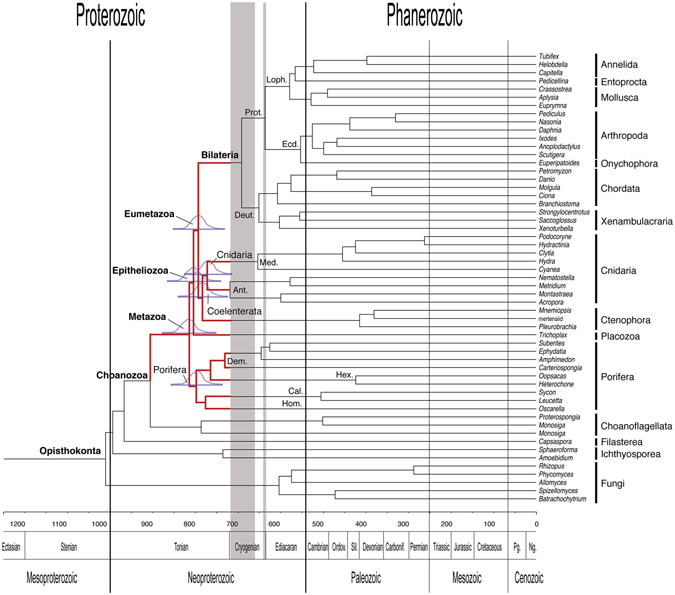
Information about the geological timeframe during which animals radiated into their major subclades is crucial to understanding early animal ecology and evolution. Unfortunately, the pre-Cambrian fossil record is sparse and its interpretation controversial. Relaxed molecular-clock methods provide an alternative means of estimating the timing of cladogenesis deep in the metazoan tree of life. So far, thorough molecular clock studies focusing specifically on Metazoa as a whole have been based on relatively small datasets or incomplete representation of the main non-bilaterian lineages (such as sponges and ctenophores), which are fundamental for understanding early metazoan evolution. Here, we use a previously published phylogenomic dataset that includes a fair sampling of all relevant groups to estimate the timing of early animal evolution with Bayesian relaxed-clock methods. According to our results, all non-bilaterian phyla, as well as total-group Bilateria, evolved in an ancient radiation during a geologically relatively short time span, before the onset of long-term global glaciations ("Snowball Earth"; ~720-635 Ma). Importantly, this result appears robust to alterations of a number of important analytical variables, such as models of among-lineage rate variation and sets of fossil calibrations used.
Overview
CoChat Summary
TL;DR
Using Bayesian relaxed molecular-clock analyses of a 128-protein phylogenomic dataset (30,257 amino acid positions), this study estimates that crown-group Metazoa and all non-bilaterian phyla plus total-group Bilateria originated before the Sturtian glaciation, likely in a geologically short pre-Snowball Earth radiation. The pattern was robust across clock models, fossil calibration sets, root-age priors, and alternative ctenophore placements.
Key findings
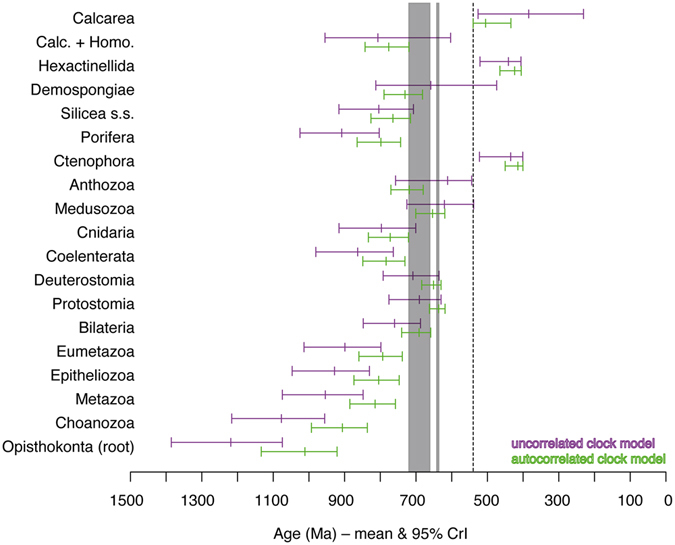
- All non-bilaterian phyla and total-group Bilateria were estimated to have evolved in an ancient radiation before the onset of long-term global glaciations (“Snowball Earth”; ~720–635 Ma). Under both clock models, Metazoa and its deepest subclades—Porifera, Epitheliozoa, Eumetazoa, and total-group Bilateria—as well as crown-groups of Coelenterata, Cnidaria, Porifera, Silicea, and Calcarea + homoscleromorph sponges were estimated to have arisen before the Sturtian glaciation.
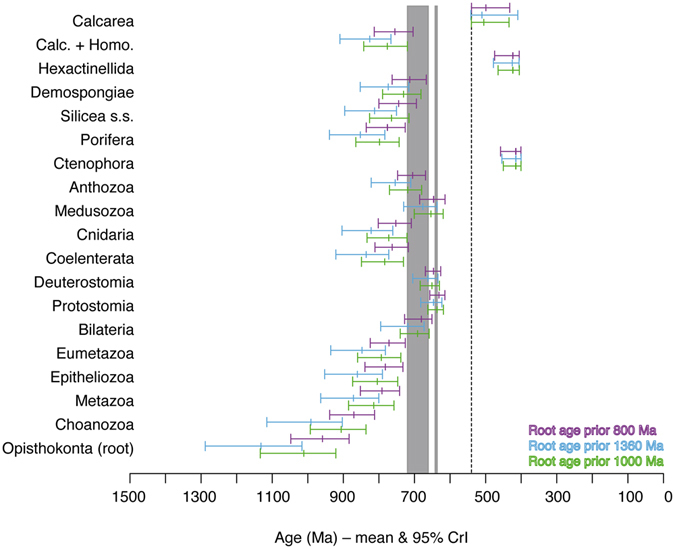
- Root-age prior had limited effect: an “unrealistically young” 800 Ma root prior did not shift the inference to after the Marinoan glaciation; the 1000 Ma prior was used for comparability, while 1360 Ma gave older estimates.
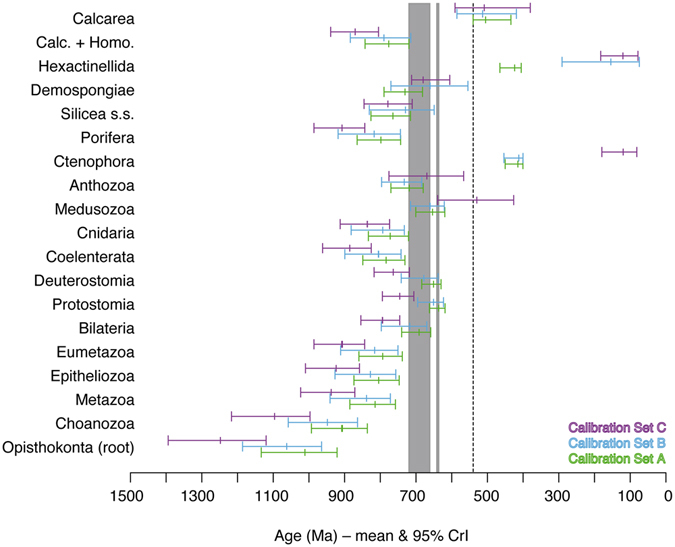
- Across three fossil calibration sets, deepest nodes (Opisthokonta to Eumetazoa) were pre-Sturtian under all sets, with set C yielding the oldest, set A the youngest, and set B intermediate estimates. Set A was considered most plausible and precise, especially for deepest nodes.
- Only three nodes of greatest interest were estimated as Phanerozoic: crown-group Calcarea (mid-Cambrian under all three calibration sets), Hexactinellida (late Silurian under set A; younger and “certainly incorrect” estimates under B and C), and Ctenophora (Lower Devonian with minimum constraint in A and B; Lower Cretaceous without the constraint in C).
Methods
- Bayesian Markov Chain Monte Carlo relaxed molecular-clock analyses in PhyloBayes, using a previously published 128-protein phylogenomic dataset (30,257 amino acid positions) that includes all non-bilaterian phyla and classes, selected bilaterian supergroups, and non-metazoan opisthokont outgroups.
- Analyses varied: autocorrelated vs. uncorrelated relaxed-clock models; three fossil calibration sets (A, B, C); root-age priors of 800, 1000, and 1360 Ma; and three alternative placements of Ctenophora.
- The autocorrelated model had better fit and yielded younger, more precise estimates, so it was retained; calibration set A gave the most plausible and precise results, so the paper focuses on those results.
Limitations
- Stated: the pre-Cambrian fossil record is sparse and its interpretation controversial; claims of pre-Ediacaran animal remains remain controversial; more Proterozoic fossil work and independent phylogenomic datasets are needed; current molecular-clock methodology may not allow high-precision reconstruction of the animal timeline.
- Stated/evident: calibration set C, adopted from Erwin et al., has been heavily criticized and its results must be interpreted with caution; the 1360 Ma root-age prior effectively represents a secondary calibration constraint and renders those results “somewhat dubious.”
- Evident: the Hexactinellida estimate actually represents only Hexasterophora because no Amphidiscophora were included, and the phylogenetic placement of Ctenophora is described as currently debated.
Model-written summary. Check it against the paper before relying on it.
Integrity signals
Registry
Cites
Statistics
Figures
Verification
Claims the paper makes
8 Valid · 0 Not valid · 5 Not checked · 16 Own results and interpretations
The sources with a verdict support this claim; the rest weren’t checked yet, have no full text we could read, or their verdicts aren’t rated yet.
In the paper
“Our estimates are consistent with some palaeontological and geochemical findings interpreted as evidence for Tonian to Cryogenian animal life31–37.”
§ Dating early animal evolution using phylogenomic data > Discussion
What the sources say
- Not checked — no full text of the sourcecites [31] Love GD Fossil steroids record the appearance of Demospongiae during the Cryogenian period Nature 2009 457 718 721 10.1038/nature07673 19194449 source
- Not checked — no full text of the sourcecites [32] Neuweiler F Turner EC Burdige DJ Early Neoproterozoic origin of the metazoan clade recorded in carbonate rock texture Geology 2009 37 475 478 10.1130/G25621A.1 source
- Not checked — no full text of the sourcecites [33] Maloof AC Possible animal-body fossils in pre-Marinoan limestones from South Australia Nat. Geosci. 2010 3 653 659 10.1038/ngeo934 source
- Not checked — no full text of the sourcecites [34] Meert JG Glaciation and ~770 Ma Ediacara (?) fossils from the Lesser Karatau Microcontinent, Kazakhstan Gondwana Res. 2011 19 867 880 10.1016/j.gr.2010.11.008 source
- Not checked — no full text of the sourcecites [35] Wallace MW Hood AS Woon EMS Hoffmann K-H Reed CP Enigmatic chambered structures in Cryogenian reefs: The oldest sponge-grade organisms? Precamb. Res 2014 255 109 123 10.1016/j.precamres.2014.09.020 source
- Not checked — no full text of the sourcecites [36] Brocks JJ Early sponges and toxic protists: possible sources of cryostane, an age diagnostic biomarker antedating Sturtian Snowball Earth Geobiology 2016 14 129 149 10.1111/gbi.12165 26507690 source
- Supportedcites [37] Gold DA Sterol and genomic analyses validate the sponge biomarker hypothesis Proc. Natl. Acad. Sci. USA 2016 113 2684 2689 10.1073/pnas.1512614113 26903629 PMC4790988 source
The introduction (p. 2) describes a sterane in rocks about 650–540 million years old that has been interpreted as the oldest geological evidence for animals. The Conclusion (p. 6) supports a sponge origin for Neoproterozoic occurrences of that sterane. This supports the cited sentence’s reference to geochemical findings interpreted as evidence of Cryogenian animal life. (LLM, conf=0.88)
plainstates an association- Asserted: passes — The authors put it forward as true.
- Checkable: passes — It can be checked against evidence.
- Load-bearing: unclear — It is unclear whether the paper’s conclusions depend on it.
- Based: passes — The paper gives a reason why it holds.
The sources with a verdict support this claim; the rest weren’t checked yet, have no full text we could read, or their verdicts aren’t rated yet.
In the paper
“Indeed, it is now widely agreed that animals existed at least during the later stages of the preceding Ediacaran period (635–541 Ma), as evidenced by trace fossils and some body fossils with likely metazoan affinities5–7.”
§ Dating early animal evolution using phylogenomic data > Introduction
What the sources say
- Not checked — no full text of the sourcecites [5] Gehling JG Runnegar B Droser ML Scratch traces of large Ediacara bilaterian animals J. Paleont 2014 88 284 298 10.1666/13-054 source
- Supportedcites [6] Benton, M. J. et al. Constraints on the timescale of animal evolutionary history. Palaeontol. Electron. 18.1.1FC, 1–106 (2015). source
The CROWN METAZOA section identifies Kimberella as a bilaterian metazoan on the basis of its morphology and feeding behavior, and describes convincing evidence of bioturbation. It also rejects some older proposed traces, but that does not undercut the claim that body and trace fossils support animal existence in the later Ediacaran. The indexed passages do not provide page numbers. (LLM, conf=0.86)
- Supportedcites [7] Cunningham JA Liu AG Bengtson S Donoghue PCJ The origin of animals: Can molecular clocks and the fossil record be reconciled? Bioessays 2017 39 1600120 10.1002/bies.201600120 27918074 source
The Summary of the Neoproterozoic metazoan body fossil record reports good trace-fossil evidence for animals by about 565 Ma and plausible Ediacaran animal body fossils around 555 Ma. The Trace fossils section likewise describes late Ediacaran traces consistent with animal activity. The supplied passages do not give page numbers. (LLM, conf=0.91)
boosted- Asserted: passes — The authors put it forward as true.
- Checkable: passes — It can be checked against evidence.
- Load-bearing: passes — The paper’s conclusions depend on it.
- Based: passes — The paper gives a reason why it holds.
A result the paper reports from its own data — it cites no other source for it, so there is none to check. The quote shows it is in the paper.
In the paper
“Mean age estimates for the nodes of greatest interest were generally older, sometimes considerably so, under the uncorrelated model (Fig. 1).”
§ Dating early animal evolution using phylogenomic data > Results > Influence of molecular-clock model
plainstates an association- Asserted: passes — The authors put it forward as true.
- Checkable: passes — It can be checked against evidence.
- Load-bearing: passes — The paper’s conclusions depend on it.
- Based: passes — The paper gives a reason why it holds.
A result the paper reports from its own data — it cites no other source for it, so there is none to check. The quote shows it is in the paper.
In the paper
“Only three of the nodes of greatest interest were estimated to be Phanerozoic: crown-group Calcarea, Hexactinellida (glass sponges), and Ctenophora.”
§ Dating early animal evolution using phylogenomic data > Results > Influence of different fossil calibration sets
plain- Asserted: passes — The authors put it forward as true.
- Checkable: passes — It can be checked against evidence.
- Load-bearing: unclear — It is unclear whether the paper’s conclusions depend on it.
- Based: passes — The paper gives a reason why it holds.
A result the paper reports from its own data — it cites no other source for it, so there is none to check. The quote shows it is in the paper.
In the paper
“Importantly, the general pattern of a pre-Sturtian radiation of the main animal lineages was recovered under all three alternative tree topologies (Fig. 4, Supplementary Tables S1–S3, Supplementary Figs S1–S2).”
§ Dating early animal evolution using phylogenomic data > Results > Influence of tree topology
plain- Asserted: passes — The authors put it forward as true.
- Checkable: passes — It can be checked against evidence.
- Load-bearing: passes — The paper’s conclusions depend on it.
- Based: passes — The paper gives a reason why it holds.
4 more claims
Create a free account to see all 29 claims and every source verdict.
- It may state two separate claims as one. 17
- Probably not a substantial claim. 4
Claims other papers make about this one
Each is checked against this paper’s own text: does it say what the citing paper says it does?
The source backs part of the claim, not all of it — or backs it for a different population, condition or comparison.
In the citing paper
“Further, if animals were around during the boring billion, they left no fossils, biomarkers, or traces of their ecological impacts, and recent molecular clock studies agree on a Tonian origin (Erwin et al., 2011; Dos Reis et al., 2015; Dohrmann and Wörheide, 2017).”
From Oxygenation, Life, and the Planetary System during Earth's Middle History: An Overview (2021) · cites this paper as Dohrmann and Wörheide, 2017
Experimental — accuracy not yet measuredThe cited source says what the claim attributes to it.
In the citing paper
“although a recent analysis of phylogenomic data suggests relatively rapid radiation of crown-group non-bilaterian animals in the interval leading up to the Cryogenian (Dohrmann and Wörheide, 2017).”
From Oxygenation, Life, and the Planetary System during Earth's Middle History: An Overview (2021) · cites this paper as Dohrmann and Wörheide, 2017
In the citing paper
“However, almost no deposits that have been proposed as maximum calibrations beyond ∼650 Ma (6–9, 14, 15) fulfill all the criteria outlined in our prospectus above.”
From Re-evaluating molecular clock maximum age calibrations revives pre-Ediacaran divergence estimates for animals (2026) · cites this paper as [9]
Citations
Cites
A Neoproterozoic Snowball Earth
Hoffman, P. F., Kaufman, A. J., Halverson, G. P., & Schrag, D. P. (1998) · Science · doi:10.1126/science.281.5381.1342 · Cited by 2,693
Erwin, D. H., Laflamme, M., Tweedt, S. M., Sperling, E. A., Pisani, D., & Peterson, K. J. (2011) · Science · doi:10.1126/science.1206375 · Cited by 1,336
PhyloBayes 3: a Bayesian software package for phylogenetic reconstruction and molecular dating
Lartillot, N., Lepage, T., & Blanquart, S. (2009) · Bioinformatics · doi:10.1093/bioinformatics/btp368 · Cited by 1,297
Estimating the timing of early eukaryotic diversification with multigene molecular clocks
Parfrey, L. W., Lahr, D. J. G., Knoll, A. H., & Katz, L. A. (2011) · Proceedings of the National Academy of Sciences · doi:10.1073/pnas.1110633108 · Cited by 899
Fossil steroids record the appearance of Demospongiae during the Cryogenian period
Love, G. D., Grosjean, E., Stalvies, C., Fike, D. A., Grotzinger, J. P., Bradley, A. S., Kelly, A. E., Bhatia, M., Meredith, W., Snape, C. E., et al. (2009) · Nature · doi:10.1038/nature07673 · Cited by 731
Phylogenomics Revives Traditional Views on Deep Animal Relationships
Philippe, H., Derelle, R., Lopez, P., Pick, K., Borchiellini, C., Boury-Esnault, N., Vacelet, J., Renard, E., Houliston, E., Quéinnec, E., et al. (2009) · Current Biology · doi:10.1016/j.cub.2009.02.052 · Cited by 695
Self-citationContentious relationships in phylogenomic studies can be driven by a handful of genes
Shen, X.-X., Hittinger, C. T., & Rokas, A. (2017) · Nature Ecology & Evolution · doi:10.1038/s41559-017-0126 · Cited by 520
Simion, P., Philippe, H., Baurain, D., Jager, M., Richter, D. J., Di Franco, A., Roure, B., Satoh, N., Quéinnec, É., Ereskovsky, A., et al. (2017) · Current Biology · doi:10.1016/j.cub.2017.02.031 · Cited by 518
Self-citationExplaining the Cambrian "Explosion" of Animals
Marshall, C. R. (2006) · Annual Review of Earth and Planetary Sciences · doi:10.1146/annurev.earth.33.031504.103001 · Cited by 506
Uncertainty in the Timing of Origin of Animals and the Limits of Precision in Molecular Timescales
dos Reis, M., Thawornwattana, Y., Angelis, K., Telford, M. J., Donoghue, P. C. J., & Yang, Z. (2015) · Current Biology · doi:10.1016/j.cub.2015.09.066 · Cited by 471
Research works printed but not linked: 1
- Kirschvink, J. L. in The Proterozoic biosphere: a multidisciplinary study (eds Schopf, J. W. & Klein, C.) 51–52 (Cambridge University Press, Cambridge, 1992).
Cited by
Harnessing genomics to fast-track genetic improvement in aquaculture
Houston, R. D., Bean, T. P., Macqueen, D. J., Gundappa, M. K., Jin, Y. H., Jenkins, T. L., Selly, S. L. C., Martin, S. A. M., Stevens, J. R., Santos, E. M., et al. (2020) · Nature Reviews Genetics · doi:10.1038/s41576-020-0227-y · Cited by 622
Oxygenation, Life, and the Planetary System during Earth's Middle History: An Overview
Lyons, T. W., Diamond, C. W., Planavsky, N. J., Reinhard, C. T., & Li, C. (2021) · Astrobiology · doi:10.1089/ast.2020.2418 · Cited by 211
“One implication is that O2 in the atmosphere and oceans may have dipped following the rise at roughly 800 Ma, perhaps before the onset of glaciation, and stayed relatively low or variable during the Cryogenian and then rose again (Cheng et al., 2018).”
BackgroundInfluentialThe origin of animals: an ancestral reconstruction of the unicellular-to-multicellular transition
Ros-Rocher, N., Pérez-Posada, A., Leger, M. M., & Ruiz-Trillo, I. (2021) · Open Biology · doi:10.1098/rsob.200359 · Cited by 163
Highly fractionated chromium isotopes in Mesoproterozoic-aged shales and atmospheric oxygen
Canfield, D. E., Zhang, S., Frank, A. B., Wang, X., Wang, H., Su, J., Ye, Y., & Frei, R. (2018) · Nature Communications · doi:10.1038/s41467-018-05263-9 · Cited by 184
Holzer, A. S., Bartošová‐Sojková, P., Born‐Torrijos, A., Lövy, A., Hartigan, A., & Fiala, I. (2018) · Molecular Ecology · doi:10.1111/mec.14558 · Cited by 164
Possible poriferan body fossils in early Neoproterozoic microbial reefs
Turner, E. C. (2021) · Nature · doi:10.1038/s41586-021-03773-z · Cited by 159
Coupling of ocean redox and animal evolution during the Ediacaran-Cambrian transition
Wang, D., Ling, H.-F., Struck, U., Zhu, X.-K., Zhu, M., He, T., Yang, B., Gamper, A., & Shields, G. A. (2018) · Nature Communications · doi:10.1038/s41467-018-04980-5 · Cited by 145
On the co‐evolution of surface oxygen levels and animals
Cole, D. B., Mills, D. B., Erwin, D. H., Sperling, E. A., Porter, S. M., Reinhard, C. T., & Planavsky, N. J. (2020) · Geobiology · doi:10.1111/gbi.12382 · Cited by 141
“Recent molecular clock estimates converge on a pre-Cryogenian (>720 Ma) origin of crown-group metazoans, with mean estimates ranging from ca. 855 to 650 Ma (Dohrmann & Wörheide, 2017; dos Reis et al., 2015; Erwin et al., 2011; Lartillot, Lepage, & Blanquart, 2009).”
BackgroundKenny, N. J., Francis, W. R., Rivera-Vicéns, R. E., Juravel, K., de Mendoza, A., Díez-Vives, C., Lister, R., Bezares-Calderón, L. A., Grombacher, L., Roller, M., et al. (2020) · Nature Communications · doi:10.1038/s41467-020-17397-w · Cited by 129
Self-citationThe last common ancestor of animals lacked the HIF pathway and respired in low-oxygen environments
Mills, D. B., Francis, W. R., Vargas, S., Larsen, M., Elemans, C. P., Canfield, D. E., & Wörheide, G. (2018) · eLife · doi:10.7554/elife.31176 · Cited by 114
“Crown-group animals (metazoans) originated around 850 million years ago (Ma) (Dohrmann and Wörheide, 2017), when atmospheric oxygen (O2) was likely 10% of its present level (Lenton and Daines, 2017).”
BackgroundInfluentialSelf-citationDemosponge steroid biomarker 26-methylstigmastane provides evidence for Neoproterozoic animals
Zumberge, J. A., Love, G. D., Cárdenas, P., Sperling, E. A., Gunasekera, S., Rohrssen, M., Grosjean, E., Grotzinger, J. P., & Summons, R. E. (2018) · Nature Ecology & Evolution · doi:10.1038/s41559-018-0676-2 · Cited by 114
Sperling, E. A., & Stockey, R. G. (2018) · Integrative and Comparative Biology · doi:10.1093/icb/icy088 · Cited by 122
Taverne, Y. J., Merkus, D., Bogers, A. J., Halliwell, B., Duncker, D. J., & Lyons, T. W. (2018) · BioEssays · doi:10.1002/bies.201700158 · Cited by 111
Support for a clade of Placozoa and Cnidaria in genes with minimal compositional bias
Laumer, C. E., Gruber-Vodicka, H., Hadfield, M. G., Pearse, V. B., Riesgo, A., Marioni, J. C., & Giribet, G. (2018) · eLife · doi:10.7554/elife.36278 · Cited by 112
“, 2017) and molecular clock estimates (Cunningham et al., 2017; dos Reis et al., 2015; Dohrmann and Wörheide, 2017; Erwin et al., 2011) may require reexamination.”
BackgroundThe origin and evolution of Wnt signalling
Holzem, M., Boutros, M., & Holstein, T. W. (2024) · Nature Reviews Genetics · doi:10.1038/s41576-024-00699-w · Cited by 121
The Role of PPAR Alpha in the Modulation of Innate Immunity
Grabacka, M., Pierzchalska, M., Plonka, P. M., & Pierzchalski, P. (2021) · International Journal of Molecular Sciences · doi:10.3390/ijms221910545 · Cited by 122
Morphological Coordination: A Common Ancestral Function Unifying Neural and Non-Neural Signaling
Fields, C., Bischof, J., & Levin, M. (2020) · Physiology · doi:10.1152/physiol.00027.2019 · Cited by 93
New data from Monoplacophora and a carefully-curated dataset resolve molluscan relationships
Kocot, K. M., Poustka, A. J., Stöger, I., Halanych, K. M., & Schrödl, M. (2020) · Scientific Reports · doi:10.1038/s41598-019-56728-w · Cited by 100
Spontaneous body contractions are modulated by the microbiome of Hydra
Murillo‐Rincón, A. P., Klimovich, A. V., Pemöller, E., Taubenheim, J., Mortzfeld, B. M., Augustin, R., & Bosch, T. C. G. (2017) · Scientific Reports · doi:10.1038/s41598-017-16191-x · Cited by 94
Lamb, T. D. (2022) · The Journal of Physiology · doi:10.1113/jp282058 · Cited by 98
The origin of phagocytosis in Earth history
Mills, D. B. (2020) · Interface Focus · doi:10.1098/rsfs.2020.0019 · Cited by 84
Six Impossible Things before Breakfast: Assumptions, Models, and Belief in Molecular Dating
Bromham, L. D. (2019) · Trends in Ecology & Evolution · doi:10.1016/j.tree.2019.01.017 · Cited by 77
Schuster, A., Vargas, S., Knapp, I. S., Pomponi, S. A., Toonen, R. J., Erpenbeck, D., & Wörheide, G. (2018) · BMC Evolutionary Biology · doi:10.1186/s12862-018-1230-1 · Cited by 68
Self-citationCophylogeny and convergence shape holobiont evolution in sponge–microbe symbioses
Pankey, M. S., Plachetzki, D. C., Macartney, K. J., Gastaldi, M., Slattery, M., Gochfeld, D. J., & Lesser, M. P. (2022) · Nature Ecology & Evolution · doi:10.1038/s41559-022-01712-3 · Cited by 67
A chromosome-scale epigenetic map of the Hydra genome reveals conserved regulators of cell state
Cazet, J. F., Siebert, S., Little, H. M., Bertemes, P., Primack, A. S., Ladurner, P., Achrainer, M., Fredriksen, M. T., Moreland, R. T., Singh, S., et al. (2023) · Genome Research · doi:10.1101/gr.277040.122 · Cited by 66
Suspension feeders: diversity, principles of particle separation and biomimetic potential
Hamann, L., & Blanke, A. (2022) · Journal of The Royal Society Interface · doi:10.1098/rsif.2021.0741 · Cited by 69
Uncovering DNA-PKcs ancient phylogeny, unique sequence motifs and insights for human disease
Lees‐Miller, J. P., Cobban, A., Katsonis, P., Bacolla, A., Tsutakawa, S. E., Hammel, M., Meek, K., Anderson, D. W., Lichtarge, O., Tainer, J. A., et al. (2020) · Progress in Biophysics and Molecular Biology · doi:10.1016/j.pbiomolbio.2020.09.010 · Cited by 69
Paleoenvironmental proxies and what the Xiamaling Formation tells us about the mid‐Proterozoic ocean
Zhang, S., Wang, X., Wang, H., Bjerrum, C. J., Hammarlund, E. U., Haxen, E. R., Wen, H., Ye, Y., & Canfield, D. E. (2019) · Geobiology · doi:10.1111/gbi.12337 · Cited by 66
Animal origins: The record from organic microfossils
Slater, B. J., & Bohlin, M. S. (2022) · Earth-Science Reviews · doi:10.1016/j.earscirev.2022.104107 · Cited by 45
A geological timescale for bacterial evolution and oxygen adaptation
Davín, A., Woodcroft, B. J., Soo, R. M., Morel, B., Murali, R., Schrempf, D., Clark, J., Álvarez-Carretero, S., Boussau, B., Moody, E. R. R., et al. (2025) · Science · doi:10.1126/science.adp1853 · Cited by 83
The terminology of sponge spicules
Łukowiak, M., van Soest, R. W. M., Klautau., M. R. L., Pérez, T., Pisera, A., & Tabachnick, K. R. (2022) · Journal of Morphology · doi:10.1002/jmor.21520 · Cited by 60
Algal origin of sponge sterane biomarkers negates the oldest evidence for animals in the rock record
Bobrovskiy, I., Hope, J. M., Nettersheim, B. J., Volkman, J. K., Hallmann, C., & Brocks, J. J. (2020) · Nature Ecology & Evolution · doi:10.1038/s41559-020-01334-7 · Cited by 59
The role of cnidarian developmental biology in unraveling axis formation and Wnt signaling
Holstein, T. W. (2022) · Developmental Biology · doi:10.1016/j.ydbio.2022.04.005 · Cited by 57
Subglacial meltwater supported aerobic marine habitats during Snowball Earth
Lechte, M. A., Wallace, M. W., Hood, A. V. S., Li, W., Jiang, G., Halverson, G. P., Asael, D., McColl, S. L., & Planavsky, N. J. (2019) · Proceedings of the National Academy of Sciences · doi:10.1073/pnas.1909165116 · Cited by 64
Evidence of Signaling and Adhesion Roles for β-Catenin in the Sponge Ephydatia muelleri
Schippers, K. J., & Nichols, S. A. (2018) · Molecular Biology and Evolution · doi:10.1093/molbev/msy033 · Cited by 49
Convergent and complementary selection shaped gains and losses of eusociality in sweat bees
Jones, B. M., Rubin, B. E. R., Dudchenko, O., Kingwell, C. J., Traniello, I. M., Wang, Z. Y., Kapheim, K. M., Wyman, E. S., Adastra, P. A., Liu, W., et al. (2023) · Nature Ecology & Evolution · doi:10.1038/s41559-023-02001-3 · Cited by 52
Rataj, M., & Vďačný, P. (2018) · European Journal of Protistology · doi:10.1016/j.ejop.2018.03.004 · Cited by 50
Ediacaran origin and Ediacaran-Cambrian diversification of Metazoa
Carlisle, E., Yin, Z., Pisani, D., & Donoghue, P. C. J. (2024) · Science Advances · doi:10.1126/sciadv.adp7161 · Cited by 60
Gastrulation and germ layer formation in the sea anemone Nematostella vectensis and other cnidarians
Technau, U. (2020) · Mechanisms of Development · doi:10.1016/j.mod.2020.103628 · Cited by 49
Babonis, L. S., DeBiasse, M. B., Francis, W. R., Christianson, L. M., Moss, A. G., Haddock, S. H. D., Martindale, M. Q., & Ryan, J. F. (2018) · Molecular Biology and Evolution · doi:10.1093/molbev/msy171 · Cited by 37
Understanding Animal Evolution: The Added Value of Sponge Transcriptomics and Genomics
Renard, E., Leys, S. P., Wörheide, G., & Borchiellini, C. (2018) · BioEssays · doi:10.1002/bies.201700237 · Cited by 52
Self-citationA New Conulariid (Cnidaria, Scyphozoa) From the Terminal Ediacaran of Brazil
Leme, J. D. M., Iten, H. V., & Simões, M. G. (2022) · Frontiers in Earth Science · doi:10.3389/feart.2022.777746 · Cited by 49
Pleše, B., Kenny, N. J., Rossi, M. E., Cárdenas, P., Schuster, A., Taboada, S., Koutsouveli, V., & Riesgo, A. (2020) · Molecular Phylogenetics and Evolution · doi:10.1016/j.ympev.2020.107011 · Cited by 43
Microbial Strategies for Survival in the Glass Sponge Vazella pourtalesii
Bayer, K., Busch, K., Kenchington, E., Beazley, L. I., Franzenburg, S., Michels, J., Hentschel, U., & Slaby, B. M. (2020) · mSystems · doi:10.1128/msystems.00473-20 · Cited by 39
Msweli, S. M., Pakala, S. B., & Syed, K. (2024) · International Journal of Molecular Sciences · doi:10.3390/ijms25189793 · Cited by 51
Spiculogenesis and biomineralization in early sponge animals
Tang, Q., Wan, B., Yuan, X., Muscente, A. D., & Xiao, S. (2019) · Nature Communications · doi:10.1038/s41467-019-11297-4 · Cited by 46
Rataj, M., & Vďačný, P. (2019) · Diseases of Aquatic Organisms · doi:10.3354/dao03366 · Cited by 40
A late-Ediacaran crown-group sponge animal
Wang, X., Liu, A. G., Chen, Z., Wu, C., Liu, Y., Wan, B., Pang, K., Zhou, C., Yuan, X., & Xiao, S. (2024) · Nature · doi:10.1038/s41586-024-07520-y · Cited by 43
Babonis, L. S., Enjolras, C., Ryan, J. F., & Martindale, M. Q. (2022) · Proceedings of the National Academy of Sciences · doi:10.1073/pnas.2113701119 · Cited by 39
Huang, W., Tarduno, J. A., Zhou, T., Ibáñez-Mejía, M., Olmo‐Barbosa, L. D., Koester, E., Blackman, E. G., Smirnov, A. V., Ahrendt, G. C., Cottrell, R. D., et al. (2024) · Communications Earth & Environment · doi:10.1038/s43247-024-01360-4 · Cited by 49
Shimizu, K., Nishi, M., Sakate, Y., Kawanami, H., Bito, T., Arima, J., Leria, L., & Maldonado, M. (2024) · Nature Communications · doi:10.1038/s41467-023-44226-7 · Cited by 36
Keratose sponges in ancient carbonates – A problem of interpretation
Neuweiler, F., Kershaw, S., Boulvain, F., Matysik, M., Sendino, C., McMenamin, M. A. S., & Wood, R. A. (2022) · Sedimentology · doi:10.1111/sed.13059 · Cited by 40
Following the logic behind biological interpretations of the Ediacaran biotas
Runnegar, B. N. (2021) · Geological Magazine · doi:10.1017/s0016756821000443 · Cited by 39
Developmental capacity and the early evolution of animals
Erwin, D. H. (2021) · Journal of the Geological Society · doi:10.1144/jgs2020-245 · Cited by 31
Arrested in Glass: Actin within Sophisticated Architectures of Biosilica in Sponges
Ehrlich, H., Łuczak, M., Ziganshin, R., Mikšík, I., Wysokowski, M., Simon, P., Baranowska‐Bosiacka, I., Kupnicka, P., Ereskovsky, A. V., Galli, R., et al. (2022) · Advanced Science · doi:10.1002/advs.202105059 · Cited by 34
Fossilisation processes and our reading of animal antiquity
Anderson, R. P., Woltz, C. R., Tosca, N. J., Porter, S. M., & Briggs, D. E. G. (2023) · Trends in Ecology & Evolution · doi:10.1016/j.tree.2023.05.014 · Cited by 28
The compact genome of the sponge Oopsacas minuta (Hexactinellida) is lacking key metazoan core genes
Santini, S., Schenkelaars, Q., Jourda, C., Duschene, M., Belahbib, H., Rocher, C., Selva, M., Riesgo, A., Vervoort, M., Leys, S. P., et al. (2023) · BMC Biology · doi:10.1186/s12915-023-01619-w · Cited by 30
The “Dirty Ice” of the McMurdo Ice Shelf: Analogues for biological oases during the Cryogenian
Hawes, I., Jungblut, A. D., Matys, E. D., & Summons, R. E. (2018) · Geobiology · doi:10.1111/gbi.12280 · Cited by 36
Genomic analysis of the tryptome reveals molecular mechanisms of gland cell evolution
Babonis, L. S., Ryan, J. F., Enjolras, C., & Martindale, M. Q. (2019) · EvoDevo · doi:10.1186/s13227-019-0138-1 · Cited by 25
Fortunato, A., Fleming, A., Aktipis, A., & Maley, C. C. (2021) · PLoS Biology · doi:10.1371/journal.pbio.3001471 · Cited by 34
Animal multicellularity and polarity without Wnt signaling
Schenkelaars, Q., Pratlong, M., Kodjabachian, L., Fierro‐Constaín, L., Vacelet, J., Bivic, A. L., Renard, E., & Borchiellini, C. (2017) · Scientific Reports · doi:10.1038/s41598-017-15557-5 · Cited by 32
Origin and Early Evolution of Echinoderms
Rahman, I. A., & Zamora, S. (2024) · Annual Review of Earth and Planetary Sciences · doi:10.1146/annurev-earth-031621-113343 · Cited by 37
Uranium isotope evidence for extensive shallow water anoxia in the early Tonian oceans
Zhang, F., Stockey, R., Xiao, S., Shen, S., Dahl, T. W., Wei, G., Cao, M., Li, Z., Kang, J., Cui, Y., et al. (2022) · Earth and Planetary Science Letters · doi:10.1016/j.epsl.2022.117437 · Cited by 29
Recurrent Loss of Macrodomain Activity in Host Immunity and Viral Proteins
Delgado-Rodriguez, S. E., Ryan, A. P., & Daugherty, M. D. (2023) · Pathogens · doi:10.3390/pathogens12050674 · Cited by 29
Unmack, P. J., Adams, M., Hammer, M. P., Johnson, J. B., Gruber, B., Gilles, A., Young, M., & Georges, A. (2021) · Biological Journal of the Linnean Society · doi:10.1093/biolinnean/blab095 · Cited by 26
The cytochrome P450 (CYP) superfamily in cnidarians
Pankov, K., McArthur, A. G., Gold, D. A., Nelson, D. R., Goldstone, J. V., & Wilson, J. Y. (2021) · Scientific Reports · doi:10.1038/s41598-021-88700-y · Cited by 28
Ice-free tropical waterbelt for Snowball Earth events questioned by uncertain clouds
Braun, C., Hörner, J., Voigt, A., & Pinto, J. G. (2022) · Nature Geoscience · doi:10.1038/s41561-022-00950-1 · Cited by 34
Global Rate Variation in Bony Vertebrates
Takezaki, N. (2018) · Genome Biology and Evolution · doi:10.1093/gbe/evy125 · Cited by 23
The sponge pump as a morphological character in the fossil record
Suárez, P. A., & Leys, S. P. (2022) · Paleobiology · doi:10.1017/pab.2021.43 · Cited by 26
Stern, R. J., & Gerya, T. (2024) · Scientific Reports · doi:10.1038/s41598-024-54700-x · Cited by 37
Mulling and nulling the coeval rise of Ediacaran oxygen and animals
Ostrander, C. M. (2023) · Earth and Planetary Science Letters · doi:10.1016/j.epsl.2023.118187 · Cited by 25
Climate and ocean circulation in the aftermath of a Marinoan snowball Earth
Ramme, L., & Marotzke, J. (2022) · Climate of the past · doi:10.5194/cp-18-759-2022 · Cited by 25
Reitner, J., Luo, C., Suárez-González, P., & Duda, J. (2021) · Geological Magazine · doi:10.1017/s001675682100087x · Cited by 22
Morrow, C. C., Cárdenas, P., Boury‐Esnault, N., PICTON, B. E., McCormack, G. P., van Soest, R. W. M., Collins, A. G., Redmond, N. E., Maggs, C. A., Sigwart, J. D., et al. (2019) · Zoological Journal of the Linnean Society · doi:10.1093/zoolinnean/zlz017 · Cited by 20
Bioluminescence in an Undescribed Species of Carnivorous Sponge (Cladorhizidae) From the Deep Sea
Martini, S., Schultz, D. T., Lundsten, L., & Haddock, S. H. D. (2020) · Frontiers in Marine Science · doi:10.3389/fmars.2020.576476 · Cited by 21
The molecular clock and evolutionary timescales
Luo, A., & Ho, S. Y. W. (2018) · Biochemical Society Transactions · doi:10.1042/bst20180186 · Cited by 20
Dynamic Evolution of the Cthrc1 Genes, a Newly Defined Collagen-Like Family
Leclère, L., Nir, T. S., Bazarsky, M., Braitbard, M., Schneidman‐Duhovny, D., & Gat, U. (2020) · Genome Biology and Evolution · doi:10.1093/gbe/evaa020 · Cited by 22
Schuster, A., Strehlow, B. W., Eckford-Soper, L., McAllen, R., & Canfield, D. E. (2021) · mSphere · doi:10.1128/msphere.00991-20 · Cited by 24
Tarduno, J. A., Zhou, T., Huang, W., & Jodder, J. (2025) · National Science Review · doi:10.1093/nsr/nwaf082 · Cited by 46
Martínez‐Redondo, G. I., Guerrero, C. S., Arístide, L., Balart‐García, P., Tonzo, V., & Fernández, R. (2023) · Molecular Ecology · doi:10.1111/mec.16854 · Cited by 22
Emergence of a Thrombospondin Superfamily at the Origin of Metazoans
Shoemark, D. K., Ziegler, B., Watanabe, H., Strompen, J., Tucker, R. P., Özbek, S., & Adams, J. C. (2019) · Molecular Biology and Evolution · doi:10.1093/molbev/msz060 · Cited by 18
Sterol methyltransferases in uncultured bacteria complicate eukaryotic biomarker interpretations
Brown, M. O., Olagunju, B. O., Giner, J., & Welander, P. V. (2023) · Nature Communications · doi:10.1038/s41467-023-37552-3 · Cited by 19
New sponge spicules from the Ediacaran-Cambrian transition in deep-water facies of South China
Chen, C., Feng, Q., Algeo, T. J., Zhang, L., Chang, S., & Li, M. (2023) · Palaeogeography Palaeoclimatology Palaeoecology · doi:10.1016/j.palaeo.2023.111714 · Cited by 20
Persistent late Tonian shallow marine anoxia and euxinia
Stacey, J., Hood, A. V. S., & Wallace, M. W. (2023) · Precambrian Research · doi:10.1016/j.precamres.2023.107207 · Cited by 16
Animal origins and the Tonian Earth system
Mills, D. B., Francis, W. R., & Canfield, D. E. (2018) · Emerging Topics in Life Sciences · doi:10.1042/etls20170160 · Cited by 16
The slow rise of complex life as revealed through biomarker genetics
Gold, D. A. (2018) · Emerging Topics in Life Sciences · doi:10.1042/etls20170150 · Cited by 17
Botting, J. P. (2021) · Bulletin of Geosciences · doi:10.3140/bull.geosci.1823 · Cited by 15
Tu, C., Diamond, C., Stüeken, E. E., Cao, M., Pan, W., & Lyons, T. W. (2023) · Geochimica et Cosmochimica Acta · doi:10.1016/j.gca.2023.12.005 · Cited by 17
Precambrian Earth: Co-evolution of life and geodynamics
Westall, F., & Xiao, S. (2024) · Precambrian Research · doi:10.1016/j.precamres.2024.107589 · Cited by 23
A Look Back Over 20 Years of Evo-Devo Studies on Sponges: A Challenged View of Urmetazoa
Schenkelaars, Q., Vernale, A., Fierro‐Constaín, L., Borchiellini, C., & Renard, E. (2019) · Springer eBooks · doi:10.1007/978-3-030-30363-1_7 · Cited by 16
Наймарк, Е. Б., Kirpotin, D., Боева, Н. М., Gmoshinskiy, V. I., Kalinina, M. A., Lyupina, Y. V., Markov, A. V., Nikitin, M. Y., Shokurov, A. V., & Volkov, D. S. (2020) · Ecology and Evolution · doi:10.1002/ece3.7120 · Cited by 13
Advanced Cambrian hydroid fossils (Cnidaria: Hydrozoa) extend the medusozoan evolutionary history
Song, X., Ruthensteiner, B., Lyu, M., Liu, X., Wang, J., & Han, J. (2021) · Proceedings of the Royal Society B Biological Sciences · doi:10.1098/rspb.2020.2939 · Cited by 15
β-catenin-driven endomesoderm specification is a Bilateria-specific novelty
Lebedeva, T. S., Boström, J., Kremnyov, S. V., Mörsdorf, D., Niedermoser, I., Genikhovich, E., Hejnol, A., Adameyko, I. I., & Genikhovich, G. (2025) · Nature Communications · doi:10.1038/s41467-025-57109-w · Cited by 20
Gibson, T. M., Kunzmann, M., Poirier, A., Schumann, D., Tosca, N. J., & Halverson, G. P. (2020) · Geochimica et Cosmochimica Acta · doi:10.1016/j.gca.2020.04.013 · Cited by 14
Kleinau, G., Hassan, A., Wiechert, F., Szczepek, M., Schmidt, A., Spahn, C. M. T., Liebscher, I., Schöneberg, T., & Scheerer, P. (2023) · Pharmacological Research · doi:10.1016/j.phrs.2023.106971 · Cited by 19
A Cnidarian Phylogenomic Tree Fitted With Hundreds of 18S Leaves
DeBiasse, M. B., Buckenmeyer, A., Macrander, J., Babonis, L. S., Bentlage, B., Cartwright, P., Prada, C., Reitzel, A. M., Stampar, S. N., Collins, A. G., et al. (2024) · Bulletin of the Society of Systematic Biologists · doi:10.18061/bssb.v3i2.9267 · Cited by 23
Animal survival strategies in Neoproterozoic ice worlds
Griffiths, H. J., Whittle, R. J., & Mitchell, E. G. (2022) · Global Change Biology · doi:10.1111/gcb.16393 · Cited by 14
Integration of 1:1 orthology maps and updated datasets into Echinobase
Foley, S., Ku, C. J., Arshinoff, B., Lotay, V., Karimi, K., Vize, P. D., & Hinman, V. F. (2021) · Database · doi:10.1093/database/baab030 · Cited by 13
Shawar, L., Love, G. D., Uveges, B. T., Zumberge, J. A., Cárdenas, P., Giner, J.-L., & Summons, R. E. (2025) · Proceedings of the National Academy of Sciences · doi:10.1073/pnas.2503009122 · Cited by 13
Kimmig, J., Meyer, R. C., & Lieberman, B. S. (2018) · Geological Magazine · doi:10.1017/s0016756818000389 · Cited by 12
Metadata
- Authors
- Dohrmann, M., & Wörheide, G.
- Affiliations
- Ludwig-Maximilians-Universität München (DE)
- Bavarian Natural History Collections (DE)
- Corresponding author
- Dohrmann, Martin
- ORCID
- Wörheide, Gert
- Venue
- Scientific Reports
- Published
- 2017-06-15
- Volume
- 7
- Issue
- 1
- Pages
- 3599-3599
- ISSN
- 2045-2322 (ISSN-L)
- PMC
- PMC5472626
- OpenAlex
- W2622044767
- Semantic Scholar
- 5f124d42adc0e8e659a41c12c64154839f8bf479
- Cited by
- 217
- References
- 37
- Citations by year
- 2026: 22 · 2025: 21 · 2024: 26 · 2023: 21 · 2022: 28 · 2021: 35 · 2020: 20 · 2019: 15 · 2018: 25 · 2017: 4
- FWCI
- 12.44
- Type
- journal article
- Language
- en
- Open access
- gold
- doi.org
- Licence
- cc-by
- creativecommons.org/licenses/by/4.0 (tdm)
- creativecommons.org/licenses/by/4.0 (vor)
- Locations
- Scientific Reports (publishedVersion, cc-by)
- Europe PMC (PubMed Central) (publishedVersion, cc-by)
- PubMed Central (publishedVersion, cc-by)
- PubMed (publishedVersion)
- DOAJ (DOAJ: Directory of Open Access Journals) (submittedVersion, cc-by-sa)
- Open access LMU (Ludwid Maxmilian's Universitat Munchen) (submittedVersion, cc-by)
- Funders
- Deutsche Forschungsgemeinschaft (DO 1742/1-1, 2, DO 1742/1-1)
- Topics
- Life Sciences › Agricultural and Biological Sciences › Animal Science and Zoology › Marine Invertebrate Physiology and Ecology
- Physical Sciences › Earth and Planetary Sciences › Paleontology › Evolution and Paleontology Studies
- Life Sciences › Biochemistry, Genetics and Molecular Biology › Molecular Biology › Genomics and Phylogenetic Studies
- Keywords
- early animal evolution, divergence time estimation, relaxed molecular clock, phylogenomics, sponges, ctenophores, Bilateria, Cambrian explosion, Snowball Earth, fossil calibration
- MeSH terms
- Animals, Fossils, Phylogeny, Time, Evolution, Molecular, Computational Biology, Genetic Speciation
About these checks
Registry, retraction, Cites and statistics results are computed, not judged, with one exception: a printed reference that no index lists is read once by a model before it counts as a citation error. Claims are extracted by a model and kept only when their quote appears verbatim in the text; each cited source is then checked, with a model’s help, for whether it says what the claim relies on. Those verdicts can be wrong — read the claim’s quote and the cited source before relying on one.
The claim verdicts this report counts are experimental: their accuracy is not yet measured.
A language model drew the claims from the paper on 2026-09-29, under version 3 of the claim definition (model deepseek-v4.1-flash, prompt extract-v3).
A second model labelled each claim on 2026-09-29 (model jev-1.13-20260917, definition revision gold-guideline-v0.2).
Cited sources are checked with a language model’s help (gpt-6-sol).
Statistics and arithmetic are recomputed, not judged.
Confidence bands are shown only for fields calibrated on our annotated test set. None is calibrated yet, so no band is shown.
What counts as a claim ›How we measure confidence ›How we check this ›
Are you an author, or do you see a problem with this page? Request a review
Data sources
Bibliographic data: Semantic Scholar, OpenAlex, Crossref.
Contains information from the Semantic Scholar Academic Graph Datasets, made available under the ODC Attribution License (ODC-BY 1.0).
Semantic Scholar’s data is described in: Kinney, R., et al. (2023). The Semantic Scholar Open Data Platform. arXiv:2301.10140.
