

A portable system for rapid bacterial composition analysis using a nanopore-based sequencer and laptop computer
Open accessPublished version of a preprint
The DOI matches its Crossref record; 17 of the 17 references it cites were found in a registry or an index.
Abstract
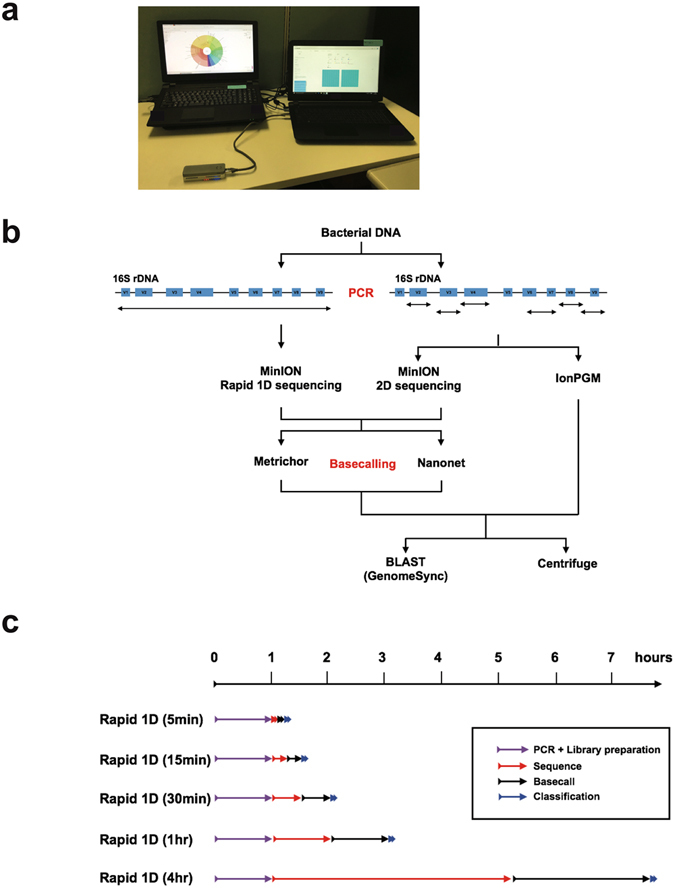
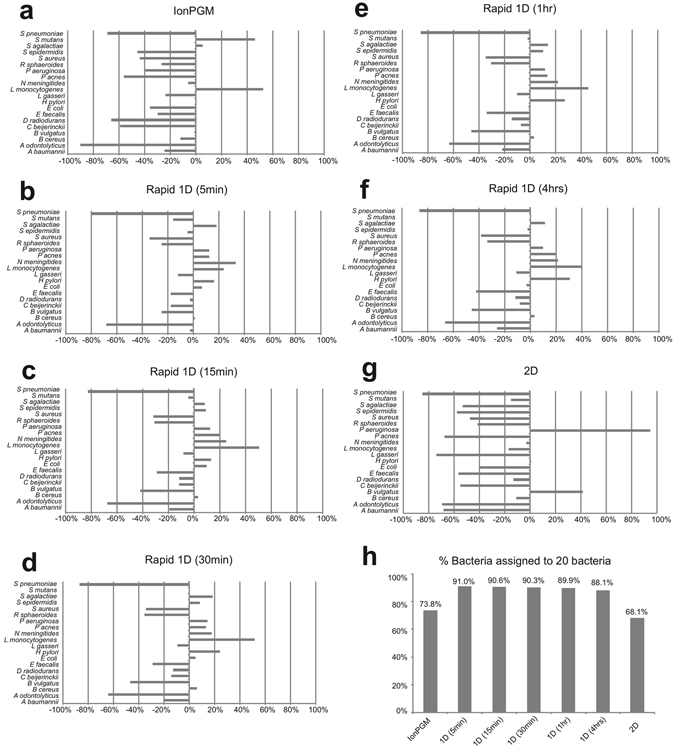
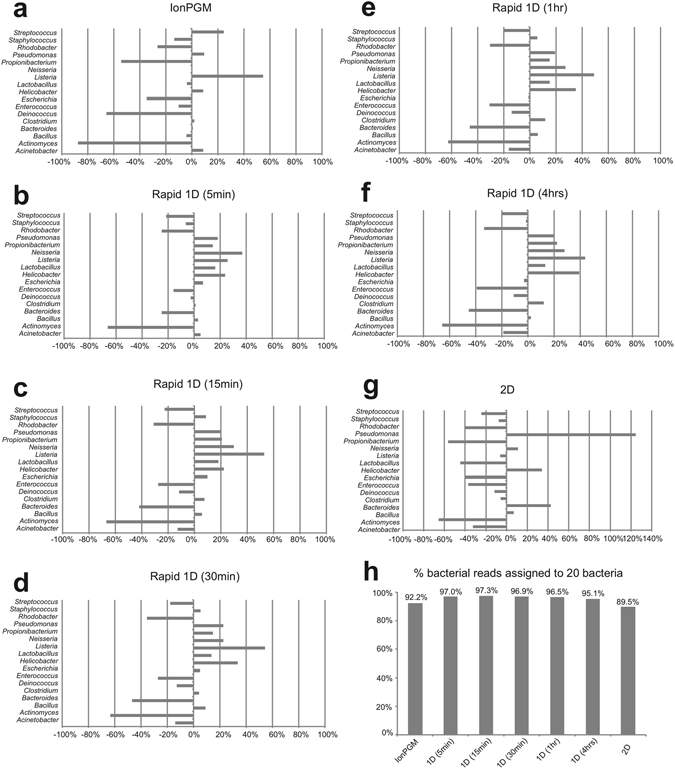
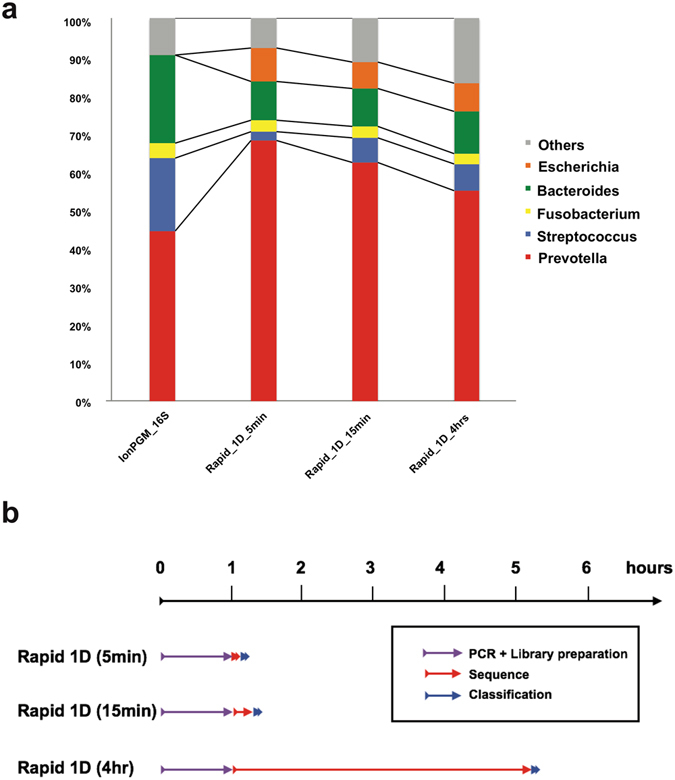
We developed a portable system for 16S rDNA analyses consisting of a nanopore technology-based sequencer, the MinION, and laptop computers, and assessed its potential ability to determine bacterial compositions rapidly. We tested our protocols using a mock bacterial community that contained equimolar 16S rDNA and a pleural effusion from a patient with empyema, for time effectiveness and accuracy. MinION sequencing targeting 16S rDNA detected all 20 of the bacterial species present in the mock bacterial community. Time course analysis indicated that the sequence data obtained during the first 5 minutes of sequencing (1,379 bacterial reads) were enough to detect all 20 bacteria in the mock sample and to determine species composition, consistent with results of those obtained from 4 hours of sequencing (24,202 reads). Additionally, using a clinical sample extracted from the empyema patient’s pleural effusion, we could identify major bacterial pathogens in that effusion using our rapid sequencing and analysis protocol. All results are comparable to conventional 16S rDNA sequencing results using an IonPGM sequencer. Our results suggest that rapid sequencing and bacterial composition determination are possible within 2 hours after obtaining a DNA sample.
Overview
The claims and statistics of this paper haven’t been checked yet.
Free: it reads the open-access text and checks the first 5 claims that cite a source we can check. Create a free account to check every claim.
Integrity signals
Registry
Cites
Statistics
Figures
Verification
Claims the paper makes
The claims and statistics of this paper haven’t been checked yet.
Free: it reads the open-access text and checks the first 5 claims that cite a source we can check. Create a free account to check every claim.
Claims other papers make about this one
Each is checked against this paper’s own text: does it say what the citing paper says it does?
In the citing paper
“Research studies have also demonstrated the clinical potential of nanopore sequencing in targeted universal 16S ribosomal RNA (rRNA) bacterial detection127, microbiome analyses128, whole-genome sequencing of bacteria129 and outbreak viruses44,45,47, RNA sequencing (RNA-seq) using standardized controls130 and diagnosis of prosthetic joint131 and lower respiratory infections99.”
From Clinical metagenomics (2019) · cites this paper as [127]
Self-check
Percentages, sums and reported differences re-computed from the paper’s own numbers.
The self-check needs the paper’s full text.
Citations
Cites
BLAST+: architecture and applications
Camacho, C., Coulouris, G., Avagyan, V., Ma, N., Papadopoulos, J., Bealer, K., & Madden, T. L. (2009) · BMC Bioinformatics · doi:10.1186/1471-2105-10-421 · Cited by 22,074
Klindworth, A., Pruesse, E., Schweer, T., Peplies, J., Quast, C., Horn, M., & Glöckner, F. O. (2013) · Nucleic Acids Research · doi:10.1093/nar/gks808 · Cited by 8,850
Interactive metagenomic visualization in a Web browser
Ondov, B. D., Bergman, N. H., & Phillippy, A. M. (2011) · BMC Bioinformatics · doi:10.1186/1471-2105-12-385 · Cited by 2,144
The Oxford Nanopore MinION: delivery of nanopore sequencing to the genomics community
Jain, M., Olsen, H. E., Paten, B., & Akeson, M. (2016) · Genome Biology · doi:10.1186/s13059-016-1103-0 · Cited by 1,588
Centrifuge: rapid and sensitive classification of metagenomic sequences
Kim, D., Song, L., Breitwieser, F. P., & Salzberg, S. L. (2016) · Genome Research · doi:10.1101/gr.210641.116 · Cited by 1,438 · cited 2×
“Centrifuge is a novel microbial classification software that enables rapid and accurate identification of species, and can even be run on laptop computers 4 .”
BackgroundMethodAdaptive seeds tame genomic sequence comparison
Kiełbasa, S. M., Wan, R., Sato, K., Horton, P., & Frith, M. C. (2011) · Genome Research · doi:10.1101/gr.113985.110 · Cited by 1,281
The Female Urinary Microbiome: a Comparison of Women with and without Urgency Urinary Incontinence
Pearce, M. M., Hilt, E. E., Rosenfeld, A. B., Zilliox, M. J., Thomas-White, K., Fok, C., Kliethermes, S., Schreckenberger, P. C., Brubaker, L., Gai, X., et al. (2014) · mBio · doi:10.1128/mbio.01283-14 · Cited by 725 · cited 1×
“The mock bacterial community contained bacterial genomic DNA at a ratio of equal 16S rDNA copy numbers for each species that we could obtain from the Biodefense and Emerging Infectious Research (BEI) Resources as a mixture 5 .”
MethodAssessing the performance of the Oxford Nanopore Technologies MinION
Laver, T., Harrison, J., O’Neill, P. A., Moore, K., Farbos, A., Paszkiewicz, K., & Studholme, D. J. (2015) · Biomolecular Detection and Quantification · doi:10.1016/j.bdq.2015.02.001 · Cited by 572
Poretools: a toolkit for analyzing nanopore sequence data
Loman, N. J., & Quinlan, A. R. (2014) · Bioinformatics · doi:10.1093/bioinformatics/btu555 · Cited by 383
Puskarich, M. A., Trzeciak, S., Shapiro, N. I., Arnold, R. C., Horton, J. M., Studnek, J. R., Kline, J. A., & Jones, A. E. (2011) · Critical Care Medicine · doi:10.1097/ccm.0b013e31821e87ab · Cited by 376
Cited by
Items 101–116 of 116
Matsuo, Y., Komiya, S., Yasumizu, Y., Yasuoka, Y., Mizushima, K., Takagi, T., Kryukov, K., Fukuda, A., Morimoto, Y., Naito, Y., et al. (2021) · Figshare · doi:10.6084/m9.figshare.13647014
Self-citationMatsuo, Y., Komiya, S., Yasumizu, Y., Yasuoka, Y., Mizushima, K., Takagi, T., Kryukov, K., Fukuda, A., Morimoto, Y., Naito, Y., et al. (2021) · Figshare · doi:10.6084/m9.figshare.13647017
Self-citationFenn, D. W., Abdel‐Aziz, M. I., van Oort, P. M. P., Brinkman, P., Ahmed, W., Felton, T., Artigas, A., Póvoa, P. M. S. R., Martín‐Loeches, I., Schultz, M. J., et al. (2022) · Figshare · doi:10.6084/m9.figshare.20252815
Matsuo, Y., Komiya, S., Yasumizu, Y., Yasuoka, Y., Mizushima, K., Takagi, T., Kryukov, K., Fukuda, A., Morimoto, Y., Naito, Y., et al. (2021) · Figshare · doi:10.6084/m9.figshare.13647002
Self-citationKomiya, S., Matsuo, Y., Nakagawa, S., Morimoto, Y., Kryukov, K., Okada, H., & Hirota, K. (2022) · Figshare · doi:10.6084/m9.figshare.19425059
Self-citationBertolo, A., Valido, E. M., & Stoyanov, J. V. (2024) · Figshare · doi:10.6084/m9.figshare.25237286
Analysis of the association between adult T-cell leukemia/lymphoma and gut microbiome
千葉, の., & Chiba, N. (2025) · Institutional Repositories DataBase (IRDB)
INVESTIGATION OF MICROBIAL BIOAEROSOL DIVERSITY IN POULTRY HOUSES
Tanır, T. (2024) · eArsiv - Adu (Adnan Menderes University)
Characterising drinking water microbiome using Oxford Nanopore MinIONTM sequencer
Xiong, X. (. (2019) · Research Repository (Delft University of Technology)
Variability and diversity in the skin of healthy dogs : microbiome, genome and environment
Cuscó, A., & Aliments, U. A. D. B. D. D. C. A. I. D. (2017) · LA Referencia (Red Federada de Repositorios Institucionales de Publicaciones Científicas)
NANOTAXI: A Shiny-Based GUI for Real-Time Classification and Analysis of 16S rRNA Nanopore ReadsPreprint
Mahar, N. S., Chouhan, K., & Gupta, I. (2026) · bioRxiv (Cold Spring Harbor Laboratory) · doi:10.64898/2026.05.17.725747
“Third-generation sequencing, or long-read sequencing, can overcome both these challenges by generating data in real time and sequencing the full-length 16S rRNA sequence, thereby improving species-level classification 12–14 .”
Duggan, S. (2026) · doi:10.1099/acmi.0.001262.v1.4
Sbampato, V. (2026) · Archive ouverte UNIGE (University of Geneva) · doi:10.13097/archive-ouverte/unige:195755
Bouchiat, C., Ginevra, C., Benito, Y., Gaillard, T., Salord, H., Dauwalder, O., Laurent, F., & Vandenesch, F. (2022) · doi:10.3389/fmicb.2022.943441.s001
Metadata
- Authors
- Mitsuhashi, S., Kryukov, K., Nakagawa, S., Takeuchi, J. S., Shiraishi, Y., Asano, K., & Imanishi, T.
- Affiliations
- Tokai University (JP)
- Corresponding author
- Imanishi, Tadashi
- ORCID
- Venue
- Scientific Reports
- Published
- 2017-07-18
- Volume
- 7
- Issue
- 1
- Pages
- 5657-5657
- ISSN
- 2045-2322 (ISSN-L)
- PMC
- PMC5516037
- OpenAlex
- W2735295550
- Semantic Scholar
- b0b5bdfd8adf0c202d99839b6b9449eaa2d1c4c9
- Cited by
- 97
- References
- 17
- Citations by year
- 2026: 1 · 2025: 4 · 2024: 5 · 2023: 7 · 2022: 11 · 2021: 20 · 2020: 10 · 2019: 19 · 2018: 16 · 2017: 3
- FWCI
- 10.91
- Type
- journal article
- Language
- en
- Open access
- gold
- doi.org
- Licence
- cc-by
- creativecommons.org/licenses/by/4.0 (tdm)
- creativecommons.org/licenses/by/4.0 (vor)
- Locations
- Scientific Reports (publishedVersion, cc-by)
- bioRxiv (Cold Spring Harbor Laboratory) (acceptedVersion)
- PubMed Central (publishedVersion, cc-by)
- PubMed (publishedVersion)
- DOAJ (DOAJ: Directory of Open Access Journals) (submittedVersion, cc-by-sa)
- Funders
- Japan Agency for Medical Research and Development
- National Institutes of Health (HM-782D)
- Japan Society for the Promotion of Science (17H07123, 17K15708, 16J40232)
- National Institute of Allergy and Infectious Diseases
- Topics
- Health Sciences › Medicine › Microbiology (medical) › Bacterial Identification and Susceptibility Testing
- Life Sciences › Biochemistry, Genetics and Molecular Biology › Molecular Biology › Genomics and Phylogenetic Studies
- Physical Sciences › Environmental Science › Ecology › Microbial Community Ecology and Physiology
- Keywords
- nanopore sequencing, Oxford Nanopore MinION, 16S rRNA gene, bacterial community composition, rapid sequencing, pleural effusion, empyema, pathogenic bacteria
- MeSH terms
- Aged, Bacteria, DNA, Bacterial, DNA, Ribosomal, Humans, Male, RNA, Ribosomal, 16S, Time Factors, Empyema, Pleural, Sequence Analysis, DNA, Computers, Molecular, Nanopores, High-Throughput Nucleotide Sequencing
About these checks
Registry, retraction, Cites and statistics results are computed, not judged, with one exception: a printed reference that no index lists is read once by a model before it counts as a citation error. Claims are extracted by a model and kept only when their quote appears verbatim in the text; each cited source is then checked, with a model’s help, for whether it says what the claim relies on. Those verdicts can be wrong — read the claim’s quote and the cited source before relying on one.
Statistics and arithmetic are recomputed, not judged.
Confidence bands are shown only for fields calibrated on our annotated test set. None is calibrated yet, so no band is shown.
What counts as a claim ›How we measure confidence ›How we check this ›
Are you an author, or do you see a problem with this page? Request a review
Data sources
Bibliographic data: Semantic Scholar, OpenAlex, Crossref.
Contains information from the Semantic Scholar Academic Graph Datasets, made available under the ODC Attribution License (ODC-BY 1.0).
Semantic Scholar’s data is described in: Kinney, R., et al. (2023). The Semantic Scholar Open Data Platform. arXiv:2301.10140.
