

A comparison of traditional and novel metrics to quantify resistance training
Open accessThe DOI matches its Crossref record; 37 of the 37 references it cites were found in a registry or an index.
Abstract
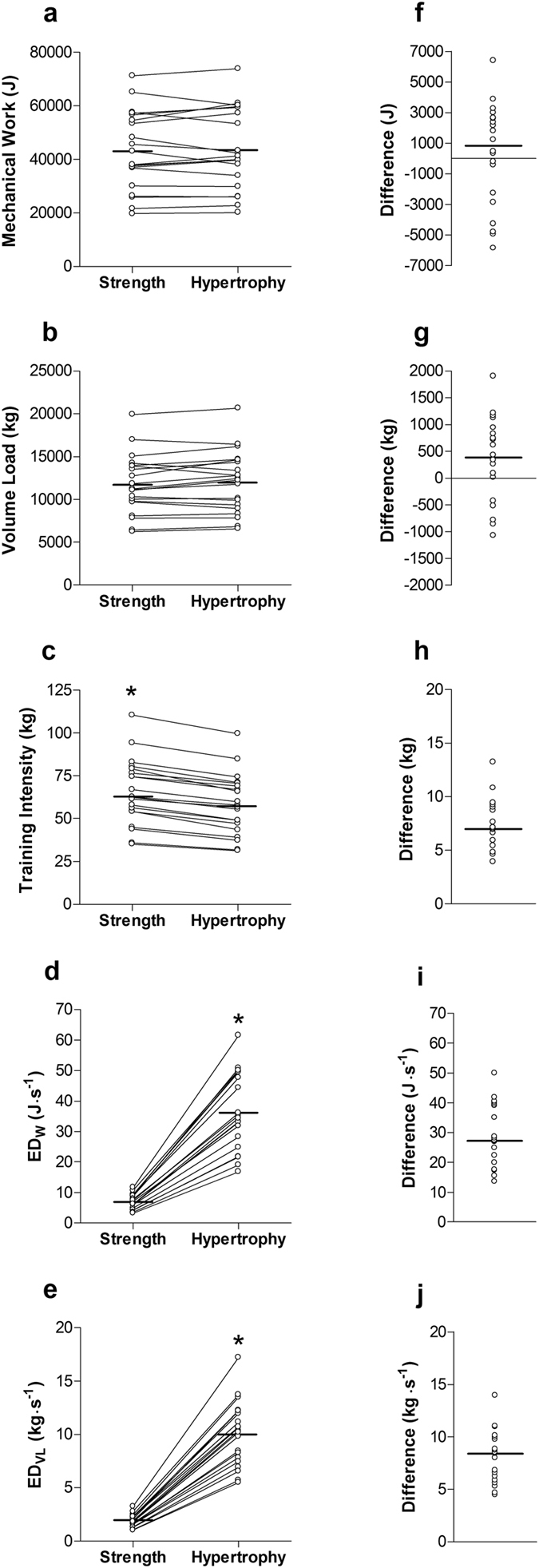
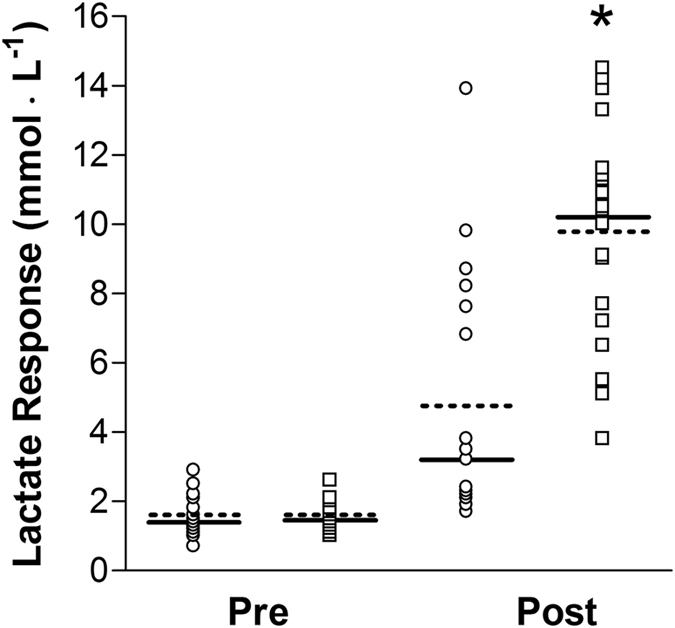
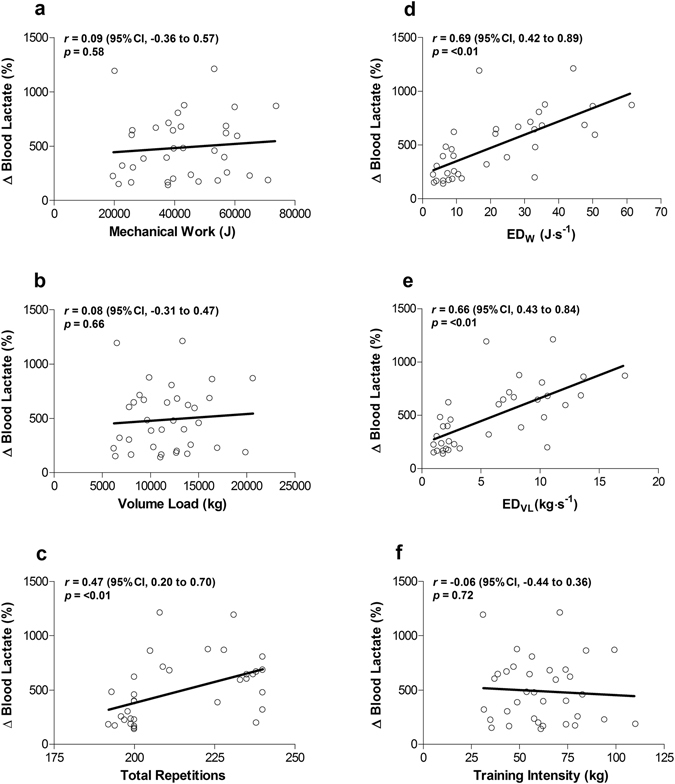
Common estimates of external training intensity for resistance exercise do not incorporate inter-set recovery duration, and might not reflect the overall demands of training. This study aimed to assess novel metrics of exercise density (ED) during resistance exercise, and how these related to a physiological marker of internal training intensity as well as traditional measures of external training intensity and volume. Thirteen males and seven females performed two bouts of resistance exercise focused on developing strength (5 sets of 5 repetitions with 5-repetition maximum; 180 s recovery) and hypertrophy (3 sets of 10 repetitions with 10-repetition maximum; 60 s recovery). Blood lactate concentration was measured to quantify internal training intensity. Specific metrics of external volume (mechanical work, volume load and total repetitions) and intensity (average weight lifted and ED) were calculated. Despite lower average weights and no difference in mechanical work or volume load, blood lactate was greater following hypertrophy compared with the strength condition. This finding was consistent with higher measures of ED in the hypertrophy compared with the strength condition. Greater ED during hypertrophy resistance exercise, along with the significant association with changes in blood lactate, indicates that ED metrics are reflective of the sessional intensity for resistance exercise.
Overview
The claims and statistics of this paper haven’t been checked yet.
Free: it reads the open-access text and checks the first 5 claims that cite a source we can check. Create a free account to check every claim.
Integrity signals
Registry
Cites
Statistics
Figures
Verification
Claims the paper makes
The claims and statistics of this paper haven’t been checked yet.
Free: it reads the open-access text and checks the first 5 claims that cite a source we can check. Create a free account to check every claim.
Claims other papers make about this one
Each is checked against this paper’s own text: does it say what the citing paper says it does?
The cited source doesn’t support the claim as written.
In the citing paper
“This comprehensive process ensured that the total work for MICT, HIIT, and HICT was presented in watts (Figure 1b), which is consistent with the established methodology [24].”
From Isocaloric High-Intensity Interval and Circuit Training Increases Excess Post-Exercise Oxygen Consumption and Lipid Oxidation Compared to Moderate-Intensity Continuous Training (2025) · cites this paper as [24]
Checked by a reasoning model — may be wrong.
Experimental — accuracy not yet measured
Self-check
Percentages, sums and reported differences re-computed from the paper’s own numbers.
The self-check needs the paper’s full text.
Citations
Cites
Nonparametric Statistics for the Behavioral Sciences
Guitton, H., & Siegel, S. (1958) · Revue économique · doi:10.2307/3498751 · Cited by 35,245
Fundamentals of Resistance Training: Progression and Exercise Prescription
KRAEMER, W. J., & RATAMESS, N. A. (2004) · Medicine & Science in Sports & Exercise · doi:10.1249/01.mss.0000121945.36635.61 · Cited by 1,992
Monitoring training in athletes with reference to overtraining syndrome
FOSTER, C. (1998) · Medicine & Science in Sports & Exercise · doi:10.1097/00005768-199807000-00023 · Cited by 1,229 · cited 3×
“Accounting for rotation about the elbow joint, equation (3) calculates mechanical work for the arm curl using torque (N∙m) and θ as range of motion (radians).”
MethodResultFine-Tuning Some Resistant Rules for Outlier Labeling
Hoaglin, D. C., & Iglewicz, B. (1987) · Journal of the American Statistical Association · doi:10.1080/01621459.1987.10478551 · Cited by 1,211
Hormonal and growth factor responses to heavy resistance exercise protocols
Kraemer, W. J., Marchitelli, L., Gordon, S. E., Harman, E., Dziados, J. E., Mello, R., Frykman, P., McCurry, D., & Fleck, S. J. (1990) · Journal of Applied Physiology · doi:10.1152/jappl.1990.69.4.1442 · Cited by 695
The Role of Resistance Exercise Intensity on Muscle Fibre Adaptations
Fry, A. C. (2004) · Sports Medicine · doi:10.2165/00007256-200434100-00004 · Cited by 626
Overtraining in Athletes: An Update
Fry, R. W., Morton, A. R., & Keast, D. (1991) · Sports Medicine · doi:10.2165/00007256-199112010-00004 · Cited by 464 · cited 3×
“The main findings of this study were; (1) both ED metrics indicated greater sessional intensity following the hypertrophy compared with the strength condition, (2) increases in blood lactate were only significantly correlated with ED metrics and total repetitions, and (3) common metrics of resistance training intensit…”
MethodResultHeart rate and blood lactate correlates of perceived exertion during small-sided soccer games
Coutts, A. J., Rampinini, E., Marcora, S. M., Castagna, C., & Impellizzeri, F. M. (2009) · Journal of Science and Medicine in Sport · doi:10.1016/j.jsams.2007.08.005 · Cited by 364
Physiologic Responses to Heavy-Resistance Exercise with Very Short Rest Periods*
Kraemer, W., Noble, B., Clark, M., & Culver, B. (1987) · International Journal of Sports Medicine · doi:10.1055/s-2008-1025663 · Cited by 311
Resistance Exercise Overtraining and Overreaching: Neuroendocrine Responses
Fry, A. C., & Kraemer, W. J. (1997) · Sports Medicine · doi:10.2165/00007256-199723020-00004 · Cited by 286 · cited 2×
“Total sessional VL and total repetitions were calculated using equations (4) and (5), respectively, to provide simple indications of training volume.”
Method
Research works printed but not linked: 7
- Haff GG Quantifying workloads in resistance training: a brief review Prof. Strength Cond 2010 10 31 40
- Haff, G. G. & Triplett, N. T. Essentials of Strength Training and Conditioning (4th ed.) (Human Kinetics, 2016).
- Bompa, T. & Haff, G. G. Periodization (5th ed.) (Human Kinetics, 2009).
- Coombes, J. & Skinner, T. ESSA’s Student Manual for Health, Exercise and Sport Assessment (Elsevier Health Sciences, 2014).
- Hoeger WWK Hopkins DR Barette SL Hale DF Relationship between Repetitions and Selected percentages of One Repetition Maximum: A Comparison between Untrained and Trained Males and Females J. Strength Cond. Res. 1990 4 47 54
- Cohen, J. Statistical Power Analysis for the Behavioral Sciences (2nd ed.) (Lawrence Erlbaum, 1988).
- McGuigan MR Egan AD Foster C Salivary cortisol responses and perceived exertion during high intensity and low intensity bouts of resistance exercise J. Sports Sci. Med 2004 3 8 15 24497815 PMC3896117
Cited by
The role of the neural stimulus in regulating skeletal muscle hypertrophy
Alix‐Fages, C., Vecchio, A. D., Baz-Valle, E., Santos‐Concejero, J., & Balsalobre‐Fernández, C. (2022) · European Journal of Applied Physiology · doi:10.1007/s00421-022-04906-6 · Cited by 68
Marques, D. L., Neiva, H. P., Marinho, D. A., & Marques, M. C. (2022) · Sports Medicine · doi:10.1007/s40279-022-01769-x · Cited by 55
“, if it is considered as the product of sets, repetitions, and load [75]) than multiple sets, which eventually might be beneficial for untrained older adults or those with less resistance to fatigue (e.”
BackgroundMarston, K. J., Peiffer, J. J., Rainey‐Smith, S. R., Gordon, N. A., Teo, S. Y. M., Laws, S. M., Sohrabi, H. R., Martins, R. N., & Brown, B. M. (2019) · Journal of science and medicine in sport · doi:10.1016/j.jsams.2019.06.013 · Cited by 46
“, 80-90% of 1RM) and long inter-set recovery duration.(17) In light of the limited evidence examining the impact of resistance training on cognitive”
BackgroundSelf-citationMartorelli, A., de Lima, F. D., Vieira, A., Tufano, J. J., Ernesto, C., Boullosa, D. A., & Bottaro, M. (2020) · European Journal of Sport Science · doi:10.1080/17461391.2020.1725646 · Cited by 43
Marston, K. J., Brown, B. M., Rainey‐Smith, S. R., Bird, S., Wijaya, L. K., Teo, S. Y. M., Laws, S. M., Martins, R. N., & Peiffer, J. J. (2019) · European Journal of Applied Physiology · doi:10.1007/s00421-019-04202-w · Cited by 34
Self-citationFonseca, F. D. S., Costa, B. D. D. V., Ferreira, M. E. C., Paes, S. T., de Lima-Júnior, D. R. A. A., Kassiano, W., Cyrino, E. S., Gantois, P., & Fortes, L. D. S. (2020) · Journal of Exercise Science & Fitness · doi:10.1016/j.jesf.2020.01.004 · Cited by 35
Equating Resistance-Training Volume Between Programs Focused on Muscle Hypertrophy
Nunes, J. P., Kassiano, W., Costa, B. D. V., Mayhew, J. L., Ribeiro, A. S., & Cyrino, E. S. (2021) · Sports Medicine · doi:10.1007/s40279-021-01449-2 · Cited by 35
“Also, higher volumes do not guarantee greater physiological demand [10, 55] or hypertrophy [56–58].”
BackgroundTolusso, D. V., Dobbs, W. C., MacDonald, H. V., Winchester, L. J., Laurent, C. M., Fedewa, M. V., & Esco, M. R. (2022) · International Journal of Sports Physiology and Performance · doi:10.1123/ijspp.2021-0360 · Cited by 21
Detection of Muscle Activation during Resistance Training Using Infrared Thermal Imaging
Jung, H., Seo, J., Seo, K., Kim, D., & Park, S. (2021) · Sensors · doi:10.3390/s21134505 · Cited by 17
“, number of repetitions and volume load) of external training intensity [2].”
BackgroundWalden, T. P., Girard, O., Jonson, A. M., Dempsey, A. R., Marston, K. J., & Scott, B. R. (2020) · European Journal of Applied Physiology · doi:10.1007/s00421-020-04440-3 · Cited by 14
Self-citationThe intensity of a resistance exercise session can be quantified by the work rate of exercise
Scott, B. R., Marston, K. J., Teo, S. Y. M., Forrest, M. R. L., Jonson, A. M., Walden, T. P., Galna, B., & Peiffer, J. J. (2023) · PLoS ONE · doi:10.1371/journal.pone.0291857 · Cited by 12
Self-citationEnes, A. A. N., Oneda, G., Leonel, D. F., Ramos, R. A., Kvas-Cabral, V. C., Bernardo, M. F., Escalante, G., & de Souza, T. P. (2023) · Perceptual and Motor Skills · doi:10.1177/00315125231176729 · Cited by 10
“Density (kg/s) was calculated using TTV divided by the sum of rest intervals (in seconds) (Marston et al., 2017).”
MethodAdilakshmi, P., Suganthi, V., Rao, K. S., & Mahendran, K. B. (2023) · Cureus · doi:10.7759/cureus.46483 · Cited by 12
“The exercise intensity was determined based on the target heart rate, set at 70% of 1 RM of the maximum heart rate according to the American Heart Association guidelines [10].”
MethodBizjak, D. A., Jacko, D., Zimmer, P., Gehlert, S., Bloch, W., & Grau, M. (2018) · Microvascular Research · doi:10.1016/j.mvr.2018.03.007 · Cited by 6
Examining work-to-rest ratios to optimize upper body sprint interval training
Monica, M. B. L., Fukuda, D. H., Starling‐Smith, T. M., Clark, N. W., Morales, J., Hoffman, J. R., & Stout, J. R. (2019) · Respiratory Physiology & Neurobiology · doi:10.1016/j.resp.2019.01.005 · Cited by 8
Lockie, R. G., Callaghan, S. J., Orjalo, A. J., & Moreno, M. R. (2018) · Facta Universitatis Series Physical Education and Sport · doi:10.22190/fupes180525024l · Cited by 6
Faleiro, V., Gurgel, A. V., Guimarães, T. T., Figueiredo, T. C., Teixeira, F. G., Jotta, B., Monteiro, E. R., Meirelles, A. G., Caldas, C. C. A., de Almeida, M. T., et al. (2025) · Sports · doi:10.3390/sports13100355 · Cited by 4
“This comprehensive process ensured that the total work for MICT, HIIT, and HICT was presented in watts (Figure 1b), which is consistent with the established methodology [24].”
Linzmeyer, A., Coracini, C. A., Bertolini, G. R. F., & de Carvalho, A. R. (2022) · Brazilian Journal Of Pain · doi:10.5935/2595-0118.20220025-en · Cited by 5
Nguyen, T. N., Chun, S., & Kim, J. (2023) · Journal of Industrial Textiles · doi:10.1177/15280837231193450 · Cited by 3
“9 13 Other than that, they are not suitable for muscle activity in real-time and thus, not applied widely in practice.”
BackgroundKassiano, W., Medeiros, A. I. A., Costa, B. D. D. V., Andrade, A. D., Simim, M. A. D. M., Fortes, L. D. S., Cyrino, E. S., & Assumpção, C. D. O. (2020) · The Journal of Sports Medicine and Physical Fitness · doi:10.23736/s0022-4707.20.10612-1 · Cited by 4
Brandão, W. G., Lisboa, R. B., Barros, E. D. S., Silva, I. O., & Pereira, L. C. (2020) · International Journal of Movement Science and Rehabilitation · doi:10.37951/.2020v2i1.p45-54 · Cited by 4
da Silva, G. C. P. S. M., de Castro, J. B. P., Silva, Y. R. L., de Lima, H. R., Bastos, L. R. G. R., Costa, D. M., Lima, V. P., & Vale, R. G. D. S. (2023) · The Journal of Sports Medicine and Physical Fitness · doi:10.23736/s0022-4707.23.14932-2 · Cited by 3
Marston, K. J., Brown, B. M., Rainey‐Smith, S. R., Bird, S., Wijaya, L. K., Teo, S. Y. M., Martins, R. N., & Peiffer, J. J. (2020) · Journal of Aging and Physical Activity · doi:10.1123/japa.2019-0100 · Cited by 3
Self-citationSchmidbauer, M. L., Putz, T., Gehri, L., Ratkovic, L., Maskos, A., Zibold, J., Bauchmüller, J., Imhof, S., Weig, T. G., Wuehr, M., et al. (2024) · Critical Care · doi:10.1186/s13054-024-05067-y · Cited by 5
“In exercise physiology, the volume of exercise is traditionally quantified by the number of repetitions performed, while intensity is commonly measured by the force exerted during exercise [42].”
BackgroundPreventing cognitive decline through resistance training
Marston, K. J. (2019) · Murdoch University Research Portal
Self-citationTraining and Nutritional Habits Before and During COVID-19 Quarantine on Physically Active Women
Perez, J. L., Rosales‐Soto, G., Glaves, A., Echeverry, P., Parada, C., Gómez-López, J., Morales‐Acuna, F. J., & Monsalves‐Álvarez, M. (2022) · Journal of Exercise and Nutrition · doi:10.53520/jen2022.103123 · Cited by 1
A DENSIDADE COMO UMA “NÃO TÃO NOVA” MÉTRICA DA QUANTIFICAÇÃO DE CARGAS NO TREINAMENTO DE FORÇA
Paulo, A. C. (2022) · Revista Brasileira de Ciência e Movimento · doi:10.31501/rbcm.v29i3.13510
A DENSIDADE COMO UMA NOVA MÉTRICA DA QUANTIFICAÇÃO DE CARGAS NO TREINAMENTO DE FORÇA
Reis, C. B. F., Leite, R. D., & Ide, B. N. (2021) · Revista Brasileira de Ciência e Movimento · doi:10.31501/rbcm.v29i1.12750
Dalton-Alves, F., Martins, L., Kassiano, W., Simim, M. A. D. M., Medeiros, A. I. A., & Assumpção, C. D. O. (2023) · International journal of exercise science · doi:10.70252/mwxb1638 · Cited by 1
“(18) may be in the configuration of the RT sessions.”
BackgroundMethodInfluentialKuhn, G. D. C., Bloemer, A., Alves, G. G., Franzen, J. A., Linzmeyer, A., Fréz, A. R., Aragão, F. A., de Carvalho, A. R., & Bertolini, G. R. F. (2024) · Journal of Musculoskeletal Research · doi:10.1142/s0218957724500155
Grek, M., Testa, M., Toussaint, J., Renfree, A., & Desgorces, F.-D. (2024) · The Journal of Sports Medicine and Physical Fitness · doi:10.23736/s0022-4707.24.16428-6
A Muscle Physiology-Based Framework for Quantifying Training Load in Resistance Exercises
Imbach, F., Perrey, S., Brioche, T., & Candau, R. B. (2025) · Sports · doi:10.3390/sports13010013 · Cited by 1
“However, pairwise correlations between common TL indexes (objective and subjective) remain weak or, at best, moderate [20,21].”
InfluentialArsenijević, R., Kojić, F., Bozic, P. R., Matić, M., Bacvarevic, B. B., Jakovljević, S., Stanković, V., & Pažin, N. (2025) · Antropološki i teoantropološki pogled na fizičke aktivnosti · doi:10.5937/atavpa25276a
“CLINICAL-BFR”: An exploratory blood flow restriction protocol focusing on clinical application
Wai, F. E. W. W., Pessôa, K. D. A., Xia, Z., Lauver, J. D., Newmire, D. E., Cholewa, J. M., Machek, S. B., de Siqueira-Filho, M. A., Lira, F. S., Lancha, A. H., et al. (2025) · Sports Medicine and Health Science · doi:10.1016/j.smhs.2025.06.005
Schmidbauer, M. L., Putz, T., Gehri, L., Ratkovic, L., Maskos, A., Zibold, J., Bauchmüller, J., Imhof, S., Weig, T. G., Wuehr, M., et al. (2024) · Figshare · doi:10.6084/m9.figshare.26944638
Meireles, A. S., Nunes, R. D. A. M., da Silva, J. B., de Moura, V. R., da Silva, G. C. P. S. M., Silva, Y. R. L., Lopes, G. C., & Vale, R. G. D. S. (2026) · International Journal of Sports Science & Coaching · doi:10.1177/17479541261417110 · Cited by 1
Practices and Perceptions of Resistance Training Load Quantification
Moriarty, B., Watts, D., Gastin, P. B., Weakley, J. J. S., Huynh, M., & James, L. P. (2026) · International Journal of Sports Physiology and Performance · doi:10.1123/ijspp.2025-0571
Pereira, E., Yamada, Y., Sakazaki, M., Burns, S. F., & Miyashita, M. (2026) · European Journal of Clinical Nutrition · doi:10.1038/s41430-026-01819-x
Metadata
- Authors
- Marston, K. J., Peiffer, J. J., Newton, M. J., & Scott, B. R.
- Affiliations
- Murdoch University (AU)
- Corresponding author
- Marston, Kieran J.
- Venue
- Scientific Reports
- Published
- 2017-07-17
- Volume
- 7
- Issue
- 1
- Pages
- 5606-5606
- ISSN
- 2045-2322 (ISSN-L)
- PMC
- PMC5514046
- OpenAlex
- W2735937628
- Cited by
- 39
- References
- 34
- Citations by year
- 2026: 3 · 2025: 4 · 2024: 4 · 2023: 7 · 2022: 6 · 2021: 3 · 2020: 6 · 2019: 4 · 2018: 2
- FWCI
- 3.61
- Type
- journal article
- Language
- en
- Open access
- gold
- doi.org
- Licence
- cc-by
- creativecommons.org/licenses/by/4.0 (tdm)
- creativecommons.org/licenses/by/4.0 (vor)
- Locations
- Scientific Reports (publishedVersion, cc-by)
- PubMed Central (publishedVersion, cc-by)
- PubMed (publishedVersion)
- Murdoch University Research Portal (submittedVersion, cc-by-nc)
- Murdoch University Research Portal (submittedVersion)
- DOAJ (DOAJ: Directory of Open Access Journals) (submittedVersion, cc-by-sa)
- Topics
- Health Sciences › Medicine › Orthopedics and Sports Medicine › Sports Performance and Training
- Health Sciences › Medicine › Physiology (medical) › Cardiovascular and exercise physiology
- Health Sciences › Medicine › Physiology (medical) › Exercise and Physiological Responses
- Keywords
- resistance training, blood lactate, mechanical work, volume load, hypertrophy training, training volume
- MeSH terms
- Adult, Female, Humans, Male, Exercise, Exercise Tolerance, Muscle, Skeletal, Muscle Strength, Resistance Training, Young Adult
About these checks
Registry, retraction, Cites and statistics results are computed, not judged, with one exception: a printed reference that no index lists is read once by a model before it counts as a citation error. Claims are extracted by a model and kept only when their quote appears verbatim in the text; each cited source is then checked, with a model’s help, for whether it says what the claim relies on. Those verdicts can be wrong — read the claim’s quote and the cited source before relying on one.
Statistics and arithmetic are recomputed, not judged.
Confidence bands are shown only for fields calibrated on our annotated test set. None is calibrated yet, so no band is shown.
What counts as a claim ›How we measure confidence ›How we check this ›
Are you an author, or do you see a problem with this page? Request a review
Data sources
Bibliographic data: Semantic Scholar, OpenAlex, Crossref.
Contains information from the Semantic Scholar Academic Graph Datasets, made available under the ODC Attribution License (ODC-BY 1.0).
Semantic Scholar’s data is described in: Kinney, R., et al. (2023). The Semantic Scholar Open Data Platform. arXiv:2301.10140.
