

A comparison of traditional and novel metrics to quantify resistance training
Open accessThe DOI matches its Crossref record; 37 of the 37 references it cites were found in a registry or an index.
Abstract
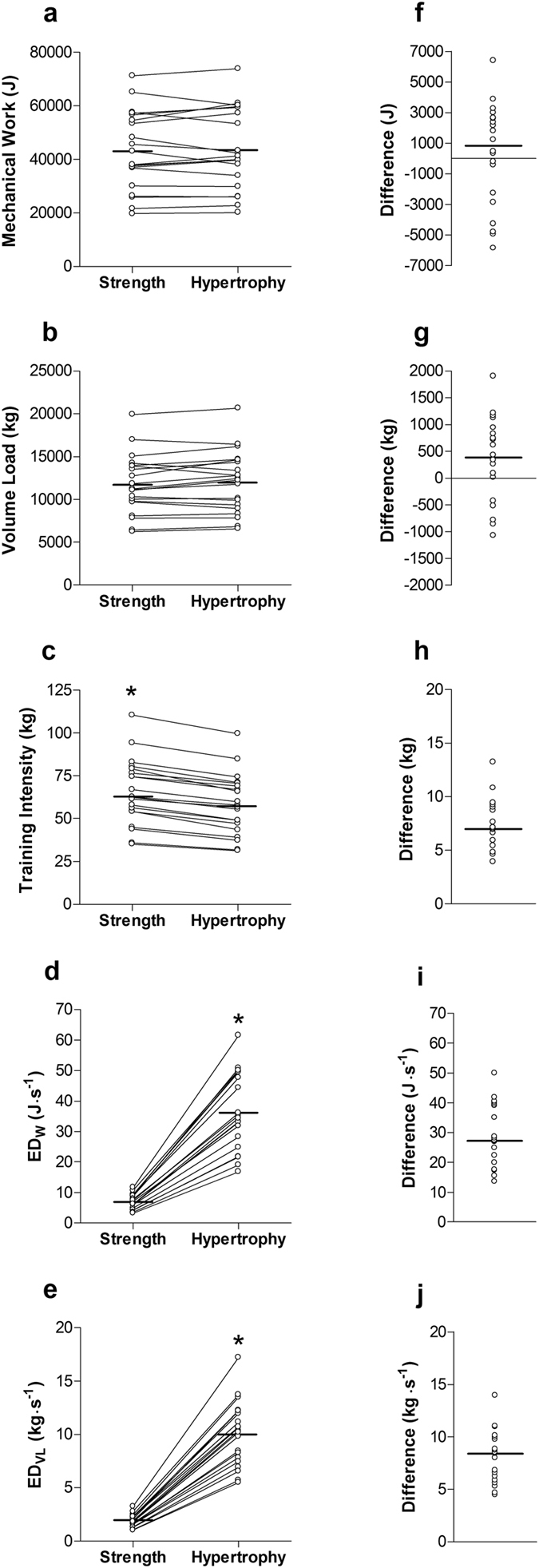
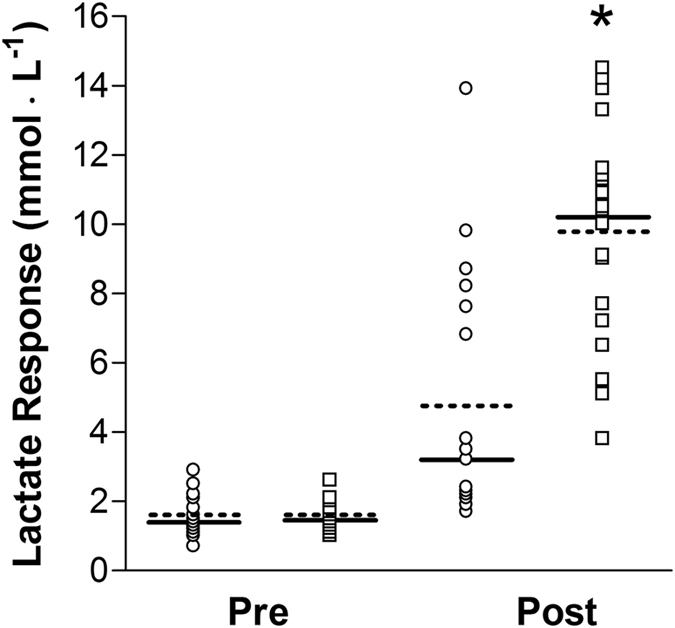
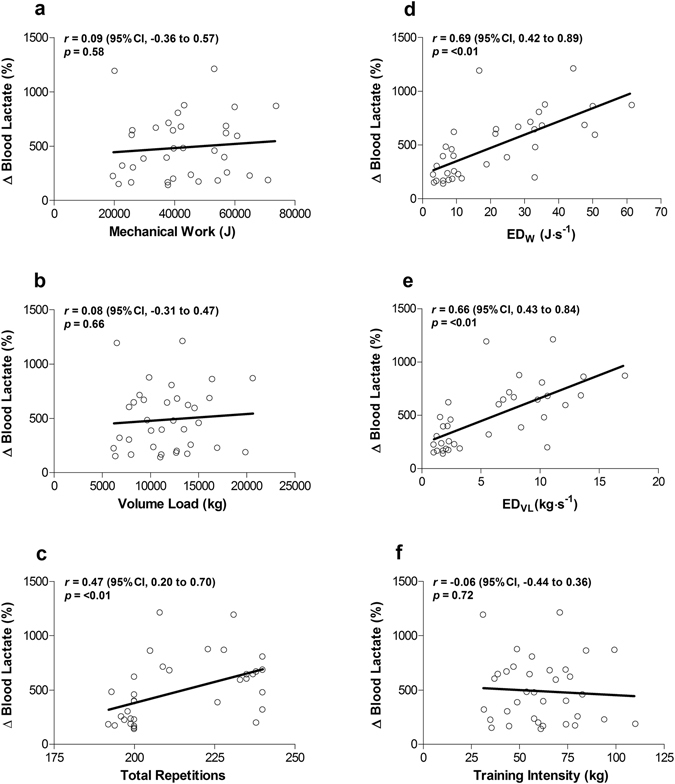
Common estimates of external training intensity for resistance exercise do not incorporate inter-set recovery duration, and might not reflect the overall demands of training. This study aimed to assess novel metrics of exercise density (ED) during resistance exercise, and how these related to a physiological marker of internal training intensity as well as traditional measures of external training intensity and volume. Thirteen males and seven females performed two bouts of resistance exercise focused on developing strength (5 sets of 5 repetitions with 5-repetition maximum; 180 s recovery) and hypertrophy (3 sets of 10 repetitions with 10-repetition maximum; 60 s recovery). Blood lactate concentration was measured to quantify internal training intensity. Specific metrics of external volume (mechanical work, volume load and total repetitions) and intensity (average weight lifted and ED) were calculated. Despite lower average weights and no difference in mechanical work or volume load, blood lactate was greater following hypertrophy compared with the strength condition. This finding was consistent with higher measures of ED in the hypertrophy compared with the strength condition. Greater ED during hypertrophy resistance exercise, along with the significant association with changes in blood lactate, indicates that ED metrics are reflective of the sessional intensity for resistance exercise.
Overview
The claims and statistics of this paper haven’t been checked yet.
Free: it reads the open-access text and checks the first 5 claims that cite a source we can check. Create a free account to check every claim.
Integrity signals
Registry
Cites
Statistics
Figures
Verification
Claims the paper makes
The claims and statistics of this paper haven’t been checked yet.
Free: it reads the open-access text and checks the first 5 claims that cite a source we can check. Create a free account to check every claim.
Claims other papers make about this one
Each is checked against this paper’s own text: does it say what the citing paper says it does?
The cited source doesn’t support the claim as written.
In the citing paper
“This comprehensive process ensured that the total work for MICT, HIIT, and HICT was presented in watts (Figure 1b), which is consistent with the established methodology [24].”
From Isocaloric High-Intensity Interval and Circuit Training Increases Excess Post-Exercise Oxygen Consumption and Lipid Oxidation Compared to Moderate-Intensity Continuous Training (2025) · cites this paper as [24]
Checked by a reasoning model — may be wrong.
Experimental — accuracy not yet measured
Self-check
Percentages, sums and reported differences re-computed from the paper’s own numbers.
The self-check needs the paper’s full text.
Citations
Cites
Nonparametric Statistics for the Behavioral Sciences
Guitton, H., & Siegel, S. (1958) · Revue économique · doi:10.2307/3498751 · Cited by 35,245
Fundamentals of Resistance Training: Progression and Exercise Prescription
KRAEMER, W. J., & RATAMESS, N. A. (2004) · Medicine & Science in Sports & Exercise · doi:10.1249/01.mss.0000121945.36635.61 · Cited by 1,992
Monitoring training in athletes with reference to overtraining syndrome
FOSTER, C. (1998) · Medicine & Science in Sports & Exercise · doi:10.1097/00005768-199807000-00023 · Cited by 1,229 · cited 3×
“Accounting for rotation about the elbow joint, equation (3) calculates mechanical work for the arm curl using torque (N∙m) and θ as range of motion (radians).”
MethodResultFine-Tuning Some Resistant Rules for Outlier Labeling
Hoaglin, D. C., & Iglewicz, B. (1987) · Journal of the American Statistical Association · doi:10.1080/01621459.1987.10478551 · Cited by 1,211
Hormonal and growth factor responses to heavy resistance exercise protocols
Kraemer, W. J., Marchitelli, L., Gordon, S. E., Harman, E., Dziados, J. E., Mello, R., Frykman, P., McCurry, D., & Fleck, S. J. (1990) · Journal of Applied Physiology · doi:10.1152/jappl.1990.69.4.1442 · Cited by 695
The Role of Resistance Exercise Intensity on Muscle Fibre Adaptations
Fry, A. C. (2004) · Sports Medicine · doi:10.2165/00007256-200434100-00004 · Cited by 626
Overtraining in Athletes: An Update
Fry, R. W., Morton, A. R., & Keast, D. (1991) · Sports Medicine · doi:10.2165/00007256-199112010-00004 · Cited by 464 · cited 3×
“The main findings of this study were; (1) both ED metrics indicated greater sessional intensity following the hypertrophy compared with the strength condition, (2) increases in blood lactate were only significantly correlated with ED metrics and total repetitions, and (3) common metrics of resistance training intensit…”
MethodResultHeart rate and blood lactate correlates of perceived exertion during small-sided soccer games
Coutts, A. J., Rampinini, E., Marcora, S. M., Castagna, C., & Impellizzeri, F. M. (2009) · Journal of Science and Medicine in Sport · doi:10.1016/j.jsams.2007.08.005 · Cited by 364
Physiologic Responses to Heavy-Resistance Exercise with Very Short Rest Periods*
Kraemer, W., Noble, B., Clark, M., & Culver, B. (1987) · International Journal of Sports Medicine · doi:10.1055/s-2008-1025663 · Cited by 311
Resistance Exercise Overtraining and Overreaching: Neuroendocrine Responses
Fry, A. C., & Kraemer, W. J. (1997) · Sports Medicine · doi:10.2165/00007256-199723020-00004 · Cited by 286 · cited 2×
“Total sessional VL and total repetitions were calculated using equations (4) and (5), respectively, to provide simple indications of training volume.”
MethodIMPACT OF TRAINING INTENSITY DISTRIBUTION ON PERFORMANCE IN ENDURANCE ATHLETES
ESTEVE-LANAO, J., FOSTER, C., SEILER, S., & LUCIA, A. (2007) · Journal of Strength and Conditioning Research · doi:10.1519/00124278-200708000-00048 · Cited by 250
Training Monitoring for Resistance Exercise: Theory and Applications
Scott, B. R., Duthie, G. M., Thornton, H. R., & Dascombe, B. J. (2016) · Sports Medicine · doi:10.1007/s40279-015-0454-0 · Cited by 248
Self-citationOvertraining effects on immunity and performance in athletes
MACKINNON, L. T. (2000) · Immunology and Cell Biology · doi:10.1046/j.1440-1711.2000.00955.x · Cited by 236 · cited 2×
“Total sessional VL and total repetitions were calculated using equations (4) and (5), respectively, to provide simple indications of training volume.”
MethodGarhammer, J. (1993) · The Journal of Strength and Conditioning Research · doi:10.1519/1533-4287(1993)007<0076:aropos>2.3.co;2 · Cited by 226
Principles and Practice of Resistance Training
Stone, M. H., Stone, M., & Sands, W. A. (2007) · Human Kinetics eBooks · doi:10.5040/9781492596875 · Cited by 208
Terminology and Measurement in Exercise Performance
Knuttgen, H. G., & Kraemer, W. J. (1987) · The Journal of Strength and Conditioning Research · doi:10.1519/1533-4287(1987)001<0001:tamiep>2.3.co;2 · Cited by 202
A modified TRIMP to quantify the in-season training load of team sport players
Stagno, K. M., Thatcher, R., & van Someren, K. A. (2007) · Journal of Sports Sciences · doi:10.1080/02640410600811817 · Cited by 185
An evaluation of the rearfoot posture in individuals with patellofemoral pain syndrome.
(2004) · Europe PMC (PubMed Central) · Cited by 174
The overtraining syndrome in athletes: A stress-related disorder
Angeli, A., Minetto, M., Dovio, A., & Paccotti, P. (2004) · Journal of Endocrinological Investigation · doi:10.1007/bf03347487 · Cited by 169
A Comparison of 3 Different Rest Intervals on the Exercise Volume Completed During a Workout
Willardson, J. M., & Burkett, L. N. (2005) · The Journal of Strength and Conditioning Research · doi:10.1519/r-13853.1 · Cited by 169
GEARHART, R. E., GOSS, F. L., LAGALLY, K. M., JAKICIC, J. M., GALLAGHER, J., GALLAGHER, K. I., & ROBERTSON, R. J. (2002) · Journal of Strength and Conditioning Research · doi:10.1519/00124278-200202000-00013 · Cited by 165
Comparison of Methods to Quantify Volume During Resistance Exercise
McBride, J. M., McCaulley, G. O., Cormie, P., Nuzzo, J. L., Cavill, M. J., & Triplett, N. T. (2009) · The Journal of Strength and Conditioning Research · doi:10.1519/jsc.0b013e31818efdfe · Cited by 136
Effects of different heavy-resistance exercise protocols on plasma beta-endorphin concentrations
Kraemer, W. J., Dziados, J. E., Marchitelli, L. J., Gordon, S. E., Harman, E. A., Mello, R., Fleck, S. J., Frykman, P. N., & Triplett, N. T. (1993) · Journal of Applied Physiology · doi:10.1152/jappl.1993.74.1.450 · Cited by 130
Blazevich, A. J., & Jenkins, D. G. (2002) · Journal of Sports Sciences · doi:10.1080/026404102321011742 · Cited by 103
Effects of Age and Recovery Duration on Peak Power Output During Repeated Cycling Sprints
Ratel, S., Bedu, M., Hennegrave, A., Doré, E., & Duché, P. (2002) · International Journal of Sports Medicine · doi:10.1055/s-2002-33737 · Cited by 102
Hardee, J. P., Lawrence, M. M., Utter, A. C., Triplett, N. T., Zwetsloot, K. A., & McBride, J. M. (2012) · European Journal of Applied Physiology · doi:10.1007/s00421-011-2300-x · Cited by 97
KINEMATIC,KINETIC, AND BLOOD LACTATE PROFILES OF CONTINUOUS AND INTRASET REST LOADING SCHEMES
DENTON, J., & Cronin, J. B. (2006) · The Journal of Strength and Conditioning Research · doi:10.1519/18135.1 · Cited by 82
Ratings of Perceived Exertion during Low- and High-Intensity Resistance Exercise by Young Adults
Lagally, K. M., Gallagher, K. I., Robertson, R. J., Gearhart, R., & Goss, F. L. (2002) · Perceptual and Motor Skills · doi:10.2466/pms.2002.94.3.723 · Cited by 75
Periodization: Effects Of Manipulating Volume And Intensity. Part 1
Stone, M. H., OʼBryant, H. S., Schilling, B. K., Johnson, R. L., Pierce, K., Haff, G. G., Koch, A. J., & STONE, M. E. (1999) · Strength and conditioning journal · doi:10.1519/1533-4295(1999)021<0056:peomva>2.0.co;2 · Cited by 72
Genner, K. M., & Weston, M. (2014) · The Journal of Strength and Conditioning Research · doi:10.1519/jsc.0000000000000432 · Cited by 63
A Review: The Effects of Combined Strength and Endurance Training on Strength Development
Chromiak, J. A., & Mulvaney, D. R. (1990) · The Journal of Strength and Conditioning Research · doi:10.1519/1533-4287(1990)004<0047:rbrasp>2.3.co;2 · Cited by 47
Roos, L., Taube, W., Brandt, M., Heyer, L., & Wyss, T. (2013) · ARBOR - Bern University of Applied Sciences Repository · doi:10.24451/arbor.11081 · Cited by 46
The effects of rest interval on quadriceps torque and perceived exertion in healthy males.
Pincivero, D. M., GEAR, W. S., Moyna, N. M., & Robertson, R. J. (1999) · PubMed · Cited by 42
DAWSON, B., VLADICH, T., & BLANKSBY, B. A. (2002) · Journal of Strength and Conditioning Research · doi:10.1519/00124278-200211000-00001 · Cited by 41
Periodization: Effects of Manipulating Volume and Intensity. Part 2
Stone, M. H., OʼBryant, H. S., Schilling, B. K., Johnson, R. L., Pierce, K., Haff, G. G., Koch, A. J., & STONE, M. E. (1999) · Strength and conditioning journal · Cited by 35
Blood Lipid and Hormonal Changes From Jogging and Weight Training of Middle-Aged Men
Blessing, D., Stone, M., Byrd, R., Wilson, D., Rozenek, R., Pushparani, D., & Lipner, H. (1987) · Journal of Strength and Conditioning Research · doi:10.1519/00124278-198705000-00002 · Cited by 16
Stone, M. H., O`bryant, H. S., Schilling, B. K., Johnson, R. L., Pierce, K. C., Haff, G. G., & Koch, A. J. (1999) · Strength and conditioning journal · doi:10.1519/00126548-199904000-00019 · Cited by 6
Research works printed but not linked: 7
- Haff GG Quantifying workloads in resistance training: a brief review Prof. Strength Cond 2010 10 31 40
- Haff, G. G. & Triplett, N. T. Essentials of Strength Training and Conditioning (4th ed.) (Human Kinetics, 2016).
- Bompa, T. & Haff, G. G. Periodization (5th ed.) (Human Kinetics, 2009).
- Coombes, J. & Skinner, T. ESSA’s Student Manual for Health, Exercise and Sport Assessment (Elsevier Health Sciences, 2014).
- Hoeger WWK Hopkins DR Barette SL Hale DF Relationship between Repetitions and Selected percentages of One Repetition Maximum: A Comparison between Untrained and Trained Males and Females J. Strength Cond. Res. 1990 4 47 54
- Cohen, J. Statistical Power Analysis for the Behavioral Sciences (2nd ed.) (Lawrence Erlbaum, 1988).
- McGuigan MR Egan AD Foster C Salivary cortisol responses and perceived exertion during high intensity and low intensity bouts of resistance exercise J. Sports Sci. Med 2004 3 8 15 24497815 PMC3896117
Cited by
The role of the neural stimulus in regulating skeletal muscle hypertrophy
Alix‐Fages, C., Vecchio, A. D., Baz-Valle, E., Santos‐Concejero, J., & Balsalobre‐Fernández, C. (2022) · European Journal of Applied Physiology · doi:10.1007/s00421-022-04906-6 · Cited by 67
Marques, D. L., Neiva, H. P., Marinho, D. A., & Marques, M. C. (2022) · Sports Medicine · doi:10.1007/s40279-022-01769-x · Cited by 55
“, if it is considered as the product of sets, repetitions, and load [75]) than multiple sets, which eventually might be beneficial for untrained older adults or those with less resistance to fatigue (e.”
BackgroundMarston, K. J., Peiffer, J. J., Rainey‐Smith, S. R., Gordon, N. A., Teo, S. Y. M., Laws, S. M., Sohrabi, H. R., Martins, R. N., & Brown, B. M. (2019) · Journal of science and medicine in sport · doi:10.1016/j.jsams.2019.06.013 · Cited by 46
“, 80-90% of 1RM) and long inter-set recovery duration.(17) In light of the limited evidence examining the impact of resistance training on cognitive”
BackgroundSelf-citationMartorelli, A., de Lima, F. D., Vieira, A., Tufano, J. J., Ernesto, C., Boullosa, D. A., & Bottaro, M. (2020) · European Journal of Sport Science · doi:10.1080/17461391.2020.1725646 · Cited by 43
Marston, K. J., Brown, B. M., Rainey‐Smith, S. R., Bird, S., Wijaya, L. K., Teo, S. Y. M., Laws, S. M., Martins, R. N., & Peiffer, J. J. (2019) · European Journal of Applied Physiology · doi:10.1007/s00421-019-04202-w · Cited by 34
Self-citation
Metadata
- Authors
- Marston, K. J., Peiffer, J. J., Newton, M. J., & Scott, B. R.
- Affiliations
- Murdoch University (AU)
- Corresponding author
- Marston, Kieran J.
- Venue
- Scientific Reports
- Published
- 2017-07-17
- Volume
- 7
- Issue
- 1
- Pages
- 5606-5606
- ISSN
- 2045-2322 (ISSN-L)
- PMC
- PMC5514046
- OpenAlex
- W2735937628
- Cited by
- 39
- References
- 34
- Citations by year
- 2026: 3 · 2025: 4 · 2024: 4 · 2023: 7 · 2022: 6 · 2021: 3 · 2020: 6 · 2019: 4 · 2018: 2
- FWCI
- 3.61
- Type
- journal article
- Language
- en
- Open access
- gold
- doi.org
- Licence
- cc-by
- creativecommons.org/licenses/by/4.0 (tdm)
- creativecommons.org/licenses/by/4.0 (vor)
- Locations
- Scientific Reports (publishedVersion, cc-by)
- PubMed Central (publishedVersion, cc-by)
- PubMed (publishedVersion)
- Murdoch University Research Portal (submittedVersion, cc-by-nc)
- Murdoch University Research Portal (submittedVersion)
- DOAJ (DOAJ: Directory of Open Access Journals) (submittedVersion, cc-by-sa)
- Topics
- Health Sciences › Medicine › Orthopedics and Sports Medicine › Sports Performance and Training
- Health Sciences › Medicine › Physiology (medical) › Cardiovascular and exercise physiology
- Health Sciences › Medicine › Physiology (medical) › Exercise and Physiological Responses
- Keywords
- resistance training, blood lactate, mechanical work, volume load, hypertrophy training, training volume
- MeSH terms
- Adult, Female, Humans, Male, Exercise, Exercise Tolerance, Muscle, Skeletal, Muscle Strength, Resistance Training, Young Adult
About these checks
Registry, retraction, Cites and statistics results are computed, not judged, with one exception: a printed reference that no index lists is read once by a model before it counts as a citation error. Claims are extracted by a model and kept only when their quote appears verbatim in the text; each cited source is then checked, with a model’s help, for whether it says what the claim relies on. Those verdicts can be wrong — read the claim’s quote and the cited source before relying on one.
Statistics and arithmetic are recomputed, not judged.
Confidence bands are shown only for fields calibrated on our annotated test set. None is calibrated yet, so no band is shown.
What counts as a claim ›How we measure confidence ›How we check this ›
Are you an author, or do you see a problem with this page? Request a review
Data sources
Bibliographic data: Semantic Scholar, OpenAlex, Crossref.
Contains information from the Semantic Scholar Academic Graph Datasets, made available under the ODC Attribution License (ODC-BY 1.0).
Semantic Scholar’s data is described in: Kinney, R., et al. (2023). The Semantic Scholar Open Data Platform. arXiv:2301.10140.
