

Heterogenous oceanic redox conditions through the Ediacaran-Cambrian boundary limited the metazoan zonation
Open accessThe DOI matches its Crossref record; 53 of the 53 references it cites were found in a registry or an index; 8 of the 41 sources its claims cite were checked for support.
Abstract
Recent studies have enhanced our understanding of the linkage of oxygenation and metazoan evolution in Early Cambrian time. However, little of this work has addressed the apparent lag of animal diversification and atmospheric oxygenation during this critical period of Earth history. This study utilizes the geochemical proxy and N isotope record of the Ediacaran-Cambrian boundary preserved in intra-shelf basin, slope, and slope basin deposits of the Yangtze Sea to assess the ocean redox state during the Early Cambrian metazoan radiation. Though ferruginous conditions appear to have prevailed through the water column during this time, episodes of local bottom-water anoxia extending into the photic-zone impacted the slope belt of the basin. Heterogenous oceanic redox conditions are expressed by trace element concentrations and Fe speciation, and spatial variation of N isotopes. We propose that the coupling of ocean chemistry and Early Cambrian animal diversification was not a simple cause-and-effect relationship, but rather a complex interaction. Specifically, it is likely that animal diversification expanded not only temporally but also spatially from the shallow shelf to deep-water environments in tandem with progressive oxygenation of the extensive continental margin.
Overview
CoChat Summary
## TL;DR
This study uses nitrogen isotopes, trace metals, and Fe speciation from Yangtze Sea Ediacaran–Cambrian boundary deposits to argue that redox conditions were strongly heterogeneous across shallow shelf, intra-shelf basin, slope, and deep-water settings. The authors conclude that Early Cambrian metazoan diversification was not controlled by a simple oxygenation “on/off” event, but likely expanded from oxygenated shallow shelf into deeper settings as oxygenation progressed.
## Key findings
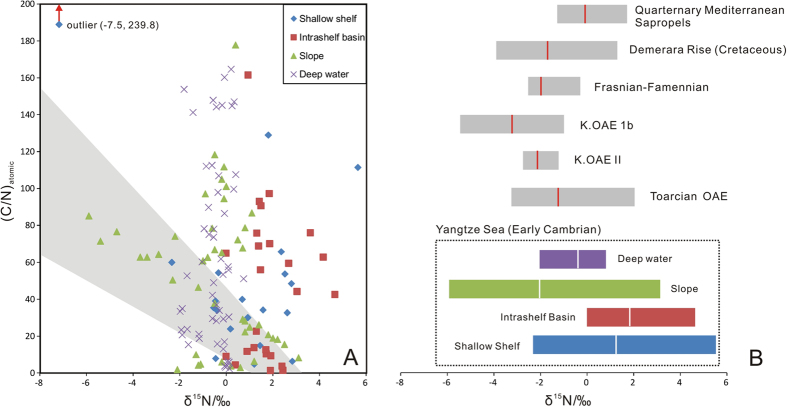
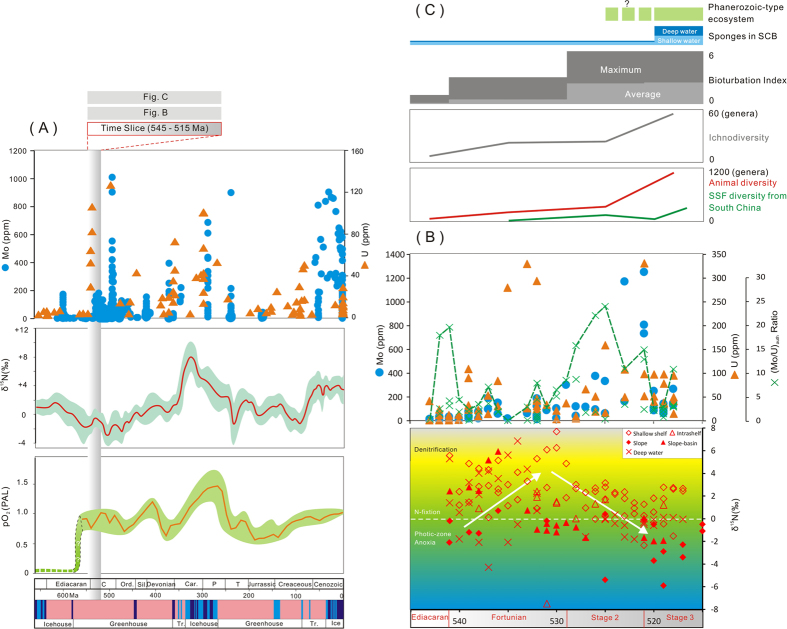
- Sedimentary δ15N values across the studied sections ranged from −7.5‰ to +5.9‰, with the largest variation near the Ediacaran–Cambrian boundary.
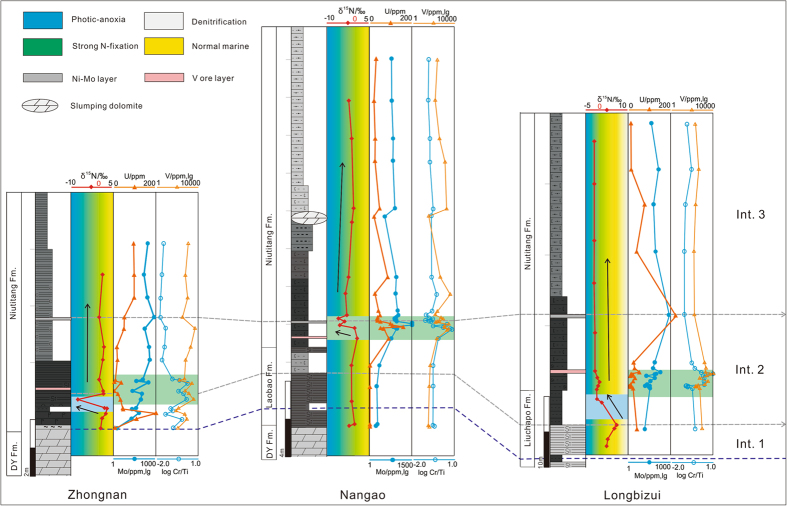
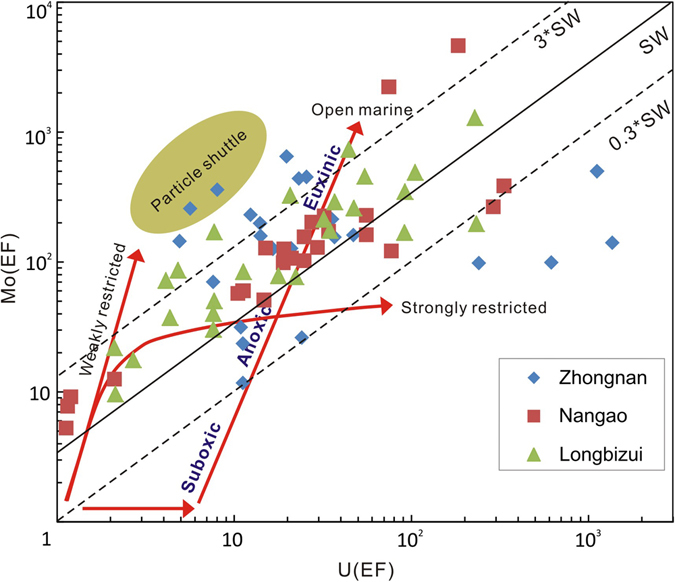
- In the Zhongnan section, Mo ranged from 1.8 ppm to 735 ppm, U from about 300 ppm in phosphate-rich basal Cambrian deposits to about 30 ppm in overlying chert-bearing deposits, and black shale averaged about 300 ppm Mo.
- In the Nangao section, black shale had lower enrichments than Zhongnan, with Mo max = 149 ppm and U max = 85 ppm; in the Longbizui section, Mo reached 808 ppm and U 331 ppm near the sulfide layer, while V and Cr reached 10,389 ppm and 2,034 ppm, respectively.
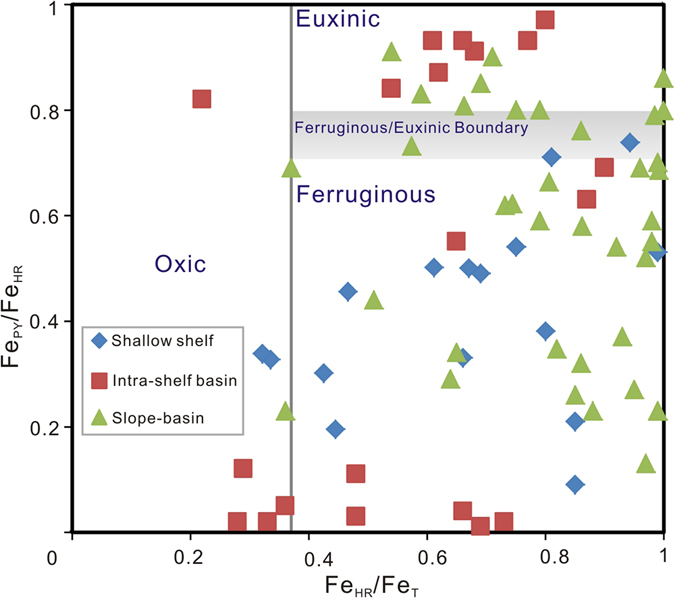
- The authors interpret the combined δ15N, Mo, U, V, Cr, and Fe-speciation patterns as evidence for ferruginous water columns with local anoxia/euxinia, including photic-zone anoxia in some slope and intra-shelf settings.
## Methods
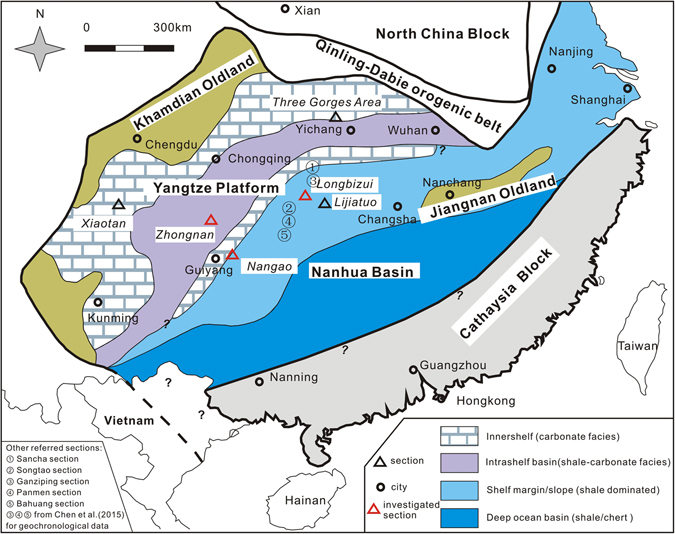
- The study sampled Ediacaran–Cambrian boundary to Cambrian Stage 3 deposits from Yangtze Sea sections chosen to represent different paleoenvironmental settings (intra-shelf basin, slope, and deep-water deposits).
- Dozens of samples were analyzed for nitrogen isotopes, trace element concentrations, and TOC; samples were taken from fresh exposures free of nodules and were powdered before analysis.
- δ15N was measured on a Finnigan MAT-253 stable isotope mass spectrometer after TN screening (TN > 0.012 mg for reliable isotope work); major elements were measured by XRF, trace elements by ICP-MS, and enrichment/authigenic factors were calculated relative to PAAS and upper continental crust values.
## Limitations
- The paper explicitly notes that photic-zone euxinia cannot be ruled out and says it should be addressed by further study.
- The text states that iron speciation data suggest bottom-water conditions were seldom euxinic in the slope-to-basin region, which complicates a straightforward euxinia interpretation.
- Evident from the text: the study relies on geochemical proxies from selected sections, so conclusions about basin-wide redox evolution are inferred rather than directly observed across the whole Yangtze Sea.
Model-written summary. Check it against the paper before relying on it.
Integrity signals
Registry
Cites
Statistics
Figures
Verification
Claims the paper makes
6 Valid · 2 Not valid · 21 Not checked · 86 Own results and interpretations
At least one cited source doesn’t support this claim or points to a different paper, and none confirmed it — see the verdicts below.
In the paper
“Spatial variation of δ15N values appears inconsistent with widespread N cycling in late-Neoproterozoic ocean25, 26.”
§ Heterogenous oceanic redox conditions through the Ediacaran-Cambrian boundary limited the metazoan zonation > Results > Sedimentary N isotope records
What the sources say
- Not checked yetcites [25] Zerkle AL Onset of the aerobic nitrogen cycle during the Great Oxidation Event Nature 2017 542 465 467 10.1038/nature20826 28166535 source
Checked before — its earlier verdict is held back until a new check runs.
- Disputedcites [26] Ader M Ocean redox structure across the Late Neoproterozoic Oxygenation Event: A nitrogen isotope perspective Earth Planet. Sci. Lett. 2014 396 1 13 10.1016/j.epsl.2014.03.042 sourceExperimental — accuracy not yet measured
Section 5.2 interprets the late-Neoproterozoic δ15N distribution as evidence for a nitrogen cycle similar to the modern ocean’s, with nitrate stable throughout most of the ocean. The Conclusions likewise say the global nitrogen cycle operated similarly to today’s. The paper argues against a globally redox-stratified ocean, not against widespread nitrogen cycling. (LLM, conf=0.88)
Checked by a reasoning model — may be wrong.
hedged- Asserted: passes — The authors put it forward as true.
- Checkable: passes — It can be checked against evidence.
- Load-bearing: passes — The paper’s conclusions depend on it.
- Based: passes — The paper gives a reason why it holds.
- Not checked yet
The cited sources support only part of this claim — read each source’s verdict below.
In the paper
“Increasing δ98/95Mo from +1.7‰ at ~540 Ma to +2.3‰ (similar to modern seawater composition) by ~520 Ma suggests that bottom waters were fully oxygenated by Cambrian stage 314.”
§ Heterogenous oceanic redox conditions through the Ediacaran-Cambrian boundary limited the metazoan zonation > Introduction
What the sources say
- Partly supportedcites [14] Chen X Rise to modern levels of ocean oxygenation coincided with the Cambrian radiation of animals Nat. Commun. 2015 6 7142 10.1038/ncomms8142 25980960 PMC4479002 sourceExperimental — accuracy not yet measured
The Results (Mo isotopes; page unavailable) place values near +2.3‰ around the Stage 2/3 boundary (~521 Ma), and the Discussion says ocean oxygenation reached modern-like levels then. But the paper does not establish +1.7‰ specifically at ~540 Ma, and its model estimates that strongly and moderately oxic waters covered >97% of the seafloor at least episodically—not that all bottom waters were fully oxygenated. (LLM, conf=0.87)
hedgedstates a cause- Asserted: passes — The authors put it forward as true.
- Checkable: passes — It can be checked against evidence.
- Load-bearing: unclear — It is unclear whether the paper’s conclusions depend on it.
- Based: passes — The paper gives a reason why it holds.
- Partly supported
The cited sources support only part of this claim — read each source’s verdict below.
In the paper
“The Cambrian explosion was accompanied by increasing ichnodiversity that appears to have been unrelated to the appearance of body-fossil assemblages, including the Chengjiang Fauna13.”
§ Heterogenous oceanic redox conditions through the Ediacaran-Cambrian boundary limited the metazoan zonation > Discussion
What the sources say
- Partly supportedcites [13] Mangano MG Buatois LA Decoupling of body-plan diversification and ecological structuring during the Ediacaran-Cambrian transition: evolutionary and geobiological feedbacks Proc. Biol. Sci. 2014 281 20140038 10.1098/rspb.2014.0038 24523279 PMC4027402 sourceExperimental — accuracy not yet measured
The Introduction (page unavailable) identifies Chengjiang as a Cambrian Stage 3 body-fossil assemblage and says the trace-fossil record is more continuous than the body-fossil record. The Discussion (page unavailable) places the onset of trace-fossil diversification earlier than the appearance of major phyla in body fossils. But the Cambrian Stage 3 section says a further increase in ichnodiversity was roughly coincident with the radiation recorded by skeletonized animals, so describing increasing ichnodiversity as unrelated to body-fossil appearances is too broad. (LLM, conf=0.84)
hedged- Asserted: passes — The authors put it forward as true.
- Checkable: passes — It can be checked against evidence.
- Load-bearing: unclear — It is unclear whether the paper’s conclusions depend on it.
- Based: passes — The paper gives a reason why it holds.
- Partly supported
The cited sources support only part of this claim — read each source’s verdict below.
In the paper
“However, these conditions may have persisted for only several million years before the ocean, except for the mixed surface layer, returned to anoxic and ferruginous conditions that persisted well into the Early Cambrian36.”
§ Heterogenous oceanic redox conditions through the Ediacaran-Cambrian boundary limited the metazoan zonation > Discussion
What the sources say
- Partly supportedcites [36] Lenton TM Boyle RA Poulton SW Shields-Zhou GA Butterfield NJ Co-evolution of eukaryotes and ocean oxygenation in the Neoproterozoic era Nat. Geosci. 2014 7 257 265 10.1038/ngeo2108 sourceExperimental — accuracy not yet measured
In “Deep ocean oxygenation and its causes” (page unavailable), the paper says a short-lived oxygenation signal after the Marinoan glaciation may have been followed by a return to anoxic, ferruginous conditions. But it also reports widespread deep-ocean oxygenation after the Gaskiers glaciation; only other parts of the deep ocean remained anoxic and ferruginous into the Palaeozoic. It therefore does not support the claim that the ocean apart from its mixed surface layer remained in those conditions into the Early Cambrian. (LLM, conf=0.88)
hedged- Asserted: passes — The authors put it forward as true.
- Checkable: passes — It can be checked against evidence.
- Load-bearing: passes — The paper’s conclusions depend on it.
- Based: passes — The paper gives a reason why it holds.
- Partly supported
A result the paper states — it cites no source for it, so there is none to check. The quote shows it is in the paper.
In the paper
“Though ferruginous conditions appear to have prevailed through the water column during this time”
§ Heterogenous oceanic redox conditions through the Ediacaran-Cambrian boundary limited the metazoan zonation > Abstract
hedged- Asserted: passes — The authors put it forward as true.
- Checkable: passes — It can be checked against evidence.
- Load-bearing: passes — The paper’s conclusions depend on it.
- Based: passes — The paper gives a reason why it holds.
69 more claims
Create a free account to see all 115 claims and to verify the 4 references still open.
- The quote only partly states this claim. 1
- It may state two separate claims as one. 25
- Probably not a substantial claim. 18
Claims other papers make about this one
Each is checked against this paper’s own text: does it say what the citing paper says it does?
The source backs part of the claim, not all of it — or backs it for a different population, condition or comparison.
In the citing paper
“In the deeper ocean setting of northern Siberia and South China, multi-proxy analyses reveal broadly similar oceanic redox fluctuations 4,47-49 , which coincide with the positive carbon isotope excursions in the early Cambrian 16,46,50 .”
From Possible links between extreme oxygen perturbations and the Cambrian radiation of animals (2019) · cites this paper as [48]
Experimental — accuracy not yet measured
Citations
Cites
(1985) · Academic Commons (Stony Brook University) · Cited by 12,330
The rise of oxygen in Earth's early ocean and atmosphere
Lyons, T. W., Reinhard, C. T., & Planavsky, N. J. (2014) · Nature · doi:10.1038/nature13068 · Cited by 2,810
Relationships between the trace element composition of sedimentary rocks and upper continental crust
McLennan, S. M. (2001) · Geochemistry, Geophysics, Geosystems · doi:10.1029/2000gc000109 · Cited by 2,457
Environmental analysis of paleoceanographic systems based on molybdenum–uranium covariation
Algeo, T. J., & Tribovillard, N. (2009) · Chemical Geology · doi:10.1016/j.chemgeo.2009.09.001 · Cited by 1,631
GEOCARBSULF: A combined model for Phanerozoic atmospheric O2 and CO2
Berner, R. A. (2006) · Geochimica et Cosmochimica Acta · doi:10.1016/j.gca.2005.11.032 · Cited by 1,120
Li, X.-H., Li, W.-X., Li, Z.-X., Lo, C.-H., Wang, J., Ye, M.-F., & Yang, Y.-H. (2009) · Precambrian Research · doi:10.1016/j.precamres.2009.07.004 · Cited by 1,056
Ferruginous Conditions Dominated Later Neoproterozoic Deep-Water Chemistry
Canfield, D. E., Poulton, S. W., Knoll, A. H., Narbonne, G. M., Ross, G., Goldberg, T., & Strauss, H. (2008) · Science · doi:10.1126/science.1154499 · Cited by 789
Low Mid-Proterozoic atmospheric oxygen levels and the delayed rise of animals
Planavsky, N. J., Reinhard, C. T., Wang, X., Thomson, D., McGoldrick, P., Rainbird, R. H., Johnson, T., Fischer, W. W., & Lyons, T. W. (2014) · Science · doi:10.1126/science.1258410 · Cited by 763
Statistical analysis of iron geochemical data suggests limited late Proterozoic oxygenation
Sperling, E. A., Wolock, C. J., Morgan, A. S., Gill, B. C., Kunzmann, M., Halverson, G. P., Macdonald, F. A., Knoll, A. H., & Johnston, D. T. (2015) · Nature · doi:10.1038/nature14589 · Cited by 637
Li, Z.-X., Evans, D. A. D., & Halverson, G. P. (2013) · Sedimentary Geology · doi:10.1016/j.sedgeo.2013.05.016 · Cited by 556
Proterozoic ocean redox and biogeochemical stasis
Reinhard, C. T., Planavsky, N. J., Robbins, L. J., Partin, C. A., Gill, B. C., Lalonde, S. V., Bekker, A., Konhauser, K. O., & Lyons, T. W. (2013) · Proceedings of the National Academy of Sciences · doi:10.1073/pnas.1208622110 · Cited by 532
Shu, L.-S., Faure, M., Yu, J.-H., & Jahn, B.-M. (2011) · Precambrian Research · doi:10.1016/j.precamres.2011.03.003 · Cited by 427
Co-evolution of eukaryotes and ocean oxygenation in the Neoproterozoic era
Lenton, T. M., Boyle, R. A., Poulton, S. W., Shields-Zhou, G. A., & Butterfield, N. J. (2014) · Nature Geoscience · doi:10.1038/ngeo2108 · Cited by 424
Rise to modern levels of ocean oxygenation coincided with the Cambrian radiation of animals
Chen, X., Ling, H.-F., Vance, D., Shields-Zhou, G. A., Zhu, M., Poulton, S. W., Och, L. M., Jiang, S.-Y., Li, D., Cremonese, L., et al. (2015) · Nature Communications · doi:10.1038/ncomms8142 · Cited by 413
Partin, C. A., Bekker, A., Planavsky, N. J., Scott, C. T., Gill, B. C., Li, C., Podkovyrov, V., Maslov, A., Konhauser, K. O., Lalonde, S. V., et al. (2013) · Earth and Planetary Science Letters · doi:10.1016/j.epsl.2013.03.031 · Cited by 404
Zhu, M.-Y., Babcock, L. E., & Peng, S.-C. (2006) · Palaeoworld · doi:10.1016/j.palwor.2006.10.016 · Cited by 392
Oxygen, ecology, and the Cambrian radiation of animals
Sperling, E. A., Frieder, C. A., Raman, A. V., Girguis, P. R., Levin, L. A., & Knoll, A. H. (2013) · Proceedings of the National Academy of Sciences · doi:10.1073/pnas.1312778110 · Cited by 367
New model for molybdenum behavior in euxinic waters
Helz, G. R., Bura-Nakić, E., Mikac, N., & Ciglenečki, I. (2011) · Chemical Geology · doi:10.1016/j.chemgeo.2011.03.012 · Cited by 358
Oxygen requirements of the earliest animals
Mills, D. B., Ward, L. M., Jones, C., Sweeten, B., Forth, M., Treusch, A. H., & Canfield, D. E. (2014) · Proceedings of the National Academy of Sciences · doi:10.1073/pnas.1400547111 · Cited by 355
Oceanic oxygenation events in the anoxic Ediacaran ocean
Sahoo, S. K., Planavsky, N. J., Jiang, G., Kendall, B., Owens, J. D., Wang, X., Shi, X., Anbar, A. D., & Lyons, T. W. (2016) · Geobiology · doi:10.1111/gbi.12182 · Cited by 352
Payne, J. L., Boyer, A. G., Brown, J. H., Finnegan, S., Kowalewski, M., Krause, R. A., Lyons, S. K., McClain, C. R., McShea, D. W., Novack-Gottshall, P. M., et al. (2009) · Proceedings of the National Academy of Sciences · doi:10.1073/pnas.0806314106 · Cited by 325
Pi, D.-H., Liu, C.-Q., Shields-Zhou, G. A., & Jiang, S.-Y. (2013) · Precambrian Research · doi:10.1016/j.precamres.2011.07.004 · Cited by 285
Jin, C., Li, C., Algeo, T. J., Planavsky, N. J., Cui, H., Yang, X., Zhao, Y., Zhang, X., & Xie, S. (2016) · Earth and Planetary Science Letters · doi:10.1016/j.epsl.2016.02.019 · Cited by 263
Hydrogen sulphide release to surface waters at the Precambrian/Cambrian boundary
Wille, M., Nägler, T. F., Lehmann, B., Schröder, S., & Kramers, J. D. (2008) · Nature · doi:10.1038/nature07072 · Cited by 259
The cycling and redox state of nitrogen in the Archaean ocean
Godfrey, L. V., & Falkowski, P. G. (2009) · Nature Geoscience · doi:10.1038/ngeo633 · Cited by 243
Mángano, M. G., & Buatois, L. A. (2014) · Proceedings of the Royal Society B: Biological Sciences · doi:10.1098/rspb.2014.0038 · Cited by 243
Remobilization of authigenic uranium in marine sediments by bioturbation
Zheng, Y., Anderson, R. F., van Geen, A., & Fleisher, M. Q. (2002) · Geochimica et Cosmochimica Acta · doi:10.1016/s0016-7037(01)00886-9 · Cited by 234
Isotope Fractionation and Atmospheric Oxygen: Implications for Phanerozoic O 2 Evolution
Berner, R. A., Petsch, S. T., Lake, J. A., Beerling, D. J., Popp, B. N., Lane, R. S., Laws, E. A., Westley, M. B., Cassar, N., Woodward, F. I., et al. (2000) · Science · doi:10.1126/science.287.5458.1630 · Cited by 227
Nitrogen isotopes in bulk marine sediment: linking seafloor observations with subseafloor records
(2013) · doi:10.5194/bg-10-101-2013 · Cited by 197
Feng, L., Li, C., Huang, J., Chang, H., & Chu, X. (2014) · Precambrian Research · doi:10.1016/j.precamres.2014.03.002 · Cited by 193
Higgins, M. B., Robinson, R. S., Husson, J. M., Carter, S. J., & Pearson, A. (2012) · Proceedings of the National Academy of Sciences · doi:10.1073/pnas.1104313109 · Cited by 193
Wang, J., Chen, D., Yan, D., Wei, H., & Xiang, L. (2012) · Chemical Geology · doi:10.1016/j.chemgeo.2012.03.005 · Cited by 192
Nitrogen cycling during the Cretaceous, Cenomanian‐Turonian Oceanic Anoxic Event II
Junium, C. K., & Arthur, M. A. (2007) · Geochemistry, Geophysics, Geosystems · doi:10.1029/2006gc001328 · Cited by 187
New U–Pb zircon ages of the Ediacaran–Cambrian boundary strata in South China
Chen, D., Zhou, X., Fu, Y., Wang, J., & Yan, D. (2015) · Terra Nova · doi:10.1111/ter.12134 · Cited by 181
Ader, M., Sansjofre, P., Halverson, G. P., Busigny, V., Trindade, R. I. F., Kunzmann, M., & Nogueira, A. C. R. (2014) · Earth and Planetary Science Letters · doi:10.1016/j.epsl.2014.03.042 · Cited by 180
Lingang, X., Lehmann, B., Jingwen, M., Wenjun, Q., & Andao, D. (2011) · Economic Geology · doi:10.2113/econgeo.106.3.511 · Cited by 170
Early Cambrian ocean anoxia in South China
Jiang, S.-Y., Pi, D.-H., Heubeck, C., Frimmel, H., Liu, Y.-P., Deng, H.-L., Ling, H.-F., & Yang, J.-H. (2009) · Nature · doi:10.1038/nature08048 · Cited by 167
Icehouse–greenhouse variations in marine denitrification
Algeo, T. J., Meyers, P. A., Robinson, R. S., Rowe, H., & Jiang, G. Q. (2014) · Biogeosciences · doi:10.5194/bg-11-1273-2014 · Cited by 163
Birth and early evolution of metazoans
Shu, D., Isozaki, Y., Zhang, X., Han, J., & Maruyama, S. (2014) · Gondwana Research · doi:10.1016/j.gr.2013.09.001 · Cited by 159 · cited 1×
“The Cambrian explosion of diverse bilaterian clades is considered to have proceeded in three phases preserved in the fossil record: (1) the first phase is recognized by the appearance of basal metazoan phyla in Late Ediacaran time; (2) the second phase begins with the first occurrence of biomineralization of plates, s…”
BackgroundFurther SHRIMP geochronology on the early Cambrian of South China
Compston, W., Zhang, Z., Cooper, J. A., Ma, G., & Jenkins, R. J. F. (2008) · American Journal of Science · doi:10.2475/04.2008.01 · Cited by 159
Onset of the aerobic nitrogen cycle during the Great Oxidation Event
Zerkle, A. L., Poulton, S. W., Newton, R. J., Mettam, C., Claire, M. W., Bekker, A., & Junium, C. K. (2017) · Nature · doi:10.1038/nature20826 · Cited by 151
Early Cambrian metazoan fossil record of South China: Generic diversity and radiation patterns
Li, G., Steiner, M., Zhu, X., Yang, A., Wang, H., & Erdtmann, B. D. (2007) · Palaeogeography Palaeoclimatology Palaeoecology · doi:10.1016/j.palaeo.2007.03.017 · Cited by 142
Oxygen and animal evolution: Did a rise of atmospheric oxygen "trigger" the origin of animals?
Mills, D. B., & Canfield, D. E. (2014) · BioEssays · doi:10.1002/bies.201400101 · Cited by 141
Cremonese, L., Shields-Zhou, G., Struck, U., Ling, H.-F., Och, L., Chen, X., & Li, D. (2013) · Precambrian Research · doi:10.1016/j.precamres.2011.12.004 · Cited by 141
Reconstruction of early Cambrian ocean chemistry from Mo isotopes
Wen, H., Fan, H., Zhang, Y., Cloquet, C., & Carignan, J. (2015) · Geochimica et Cosmochimica Acta · doi:10.1016/j.gca.2015.05.008 · Cited by 131
Self-citationOch, L. M., Cremonese, L., Shields‐Zhou, G. A., Poulton, S. W., Struck, U., Ling, H., Li, D., Chen, X., Manning, C., Thirlwall, M., et al. (2016) · Sedimentology · doi:10.1111/sed.12220 · Cited by 118
Diversity partitioning during the Cambrian radiation
Na, L., & Kiessling, W. (2015) · Proceedings of the National Academy of Sciences · doi:10.1073/pnas.1424985112 · Cited by 95
Wang, D., Struck, U., Ling, H.-F., Guo, Q.-J., Shields-Zhou, G. A., Zhu, M.-Y., & Yao, S.-P. (2015) · Precambrian Research · doi:10.1016/j.precamres.2015.06.009 · Cited by 88
Cremonese, L., Shields-Zhou, G. A., Struck, U., Ling, H.-F., & Och, L. M. (2014) · Palaeogeography, Palaeoclimatology, Palaeoecology · doi:10.1016/j.palaeo.2013.12.016 · Cited by 86
Paleo-marine environments of the Early Cambrian Yangtze Platform
Zhang, J., Fan, T., Algeo, T. J., Li, Y., & Zhang, J. (2016) · Palaeogeography, Palaeoclimatology, Palaeoecology · doi:10.1016/j.palaeo.2015.11.029 · Cited by 72
Self-citationNew Applications of Trace Metals as Proxies in Marine Paleoenvironments
Algeo, T. J., Morford, J., & Cruse, A. (2012) · Chemical Geology · doi:10.1016/j.chemgeo.2012.03.009 · Cited by 39
Xinglian, Y., Maoyan, Z., Qingjun, G., & Yuanlong, Z. (2007) · Acta Geologica Sinica - English Edition · doi:10.1111/j.1755-6724.2007.tb00944.x · Cited by 21
Cited by
Integrated records of environmental change and evolution challenge the Cambrian Explosion
Wood, R., Liu, A. G., Bowyer, F., Wilby, P. R., Dunn, F. S., Kenchington, C. G., Cuthill, J. F. H., Mitchell, E. G., & Penny, A. (2019) · Nature Ecology & Evolution · doi:10.1038/s41559-019-0821-6 · Cited by 337
Possible links between extreme oxygen perturbations and the Cambrian radiation of animals
He, T., Zhu, M., Mills, B. J. W., Wynn, P. M., Zhuravlev, A. Y., Tostevin, R., Pogge von Strandmann, P. A. E., Yang, A., Poulton, S. W., & Shields, G. A. (2019) · Nature Geoscience · doi:10.1038/s41561-019-0357-z · Cited by 193
Coupling of ocean redox and animal evolution during the Ediacaran-Cambrian transition
Wang, D., Ling, H.-F., Struck, U., Zhu, X.-K., Zhu, M., He, T., Yang, B., Gamper, A., & Shields, G. A. (2018) · Nature Communications · doi:10.1038/s41467-018-04980-5 · Cited by 145
The redox structure of Ediacaran and early Cambrian oceans and its controls
Li, C., Shi, W., Cheng, M., Jin, C., & Algeo, T. J. (2020) · Science Bulletin · doi:10.1016/j.scib.2020.09.023 · Cited by 140
Gao, P., He, Z., Li, S., Lash, G. G., Li, B., Huang, B., & Yan, D. (2018) · Palaeogeography Palaeoclimatology Palaeoecology · doi:10.1016/j.palaeo.2018.06.019 · Cited by 128
Self-citation
Metadata
- Authors
- Zhang, J., Fan, T., Zhang, Y., Lash, G. G., Li, Y., & Wu, Y.
- Affiliations
- Chinese Academy of Sciences (CN)
- China University of Geosciences (CN)
- SUNY Fredonia (US)
- Sinopec (China) (CN)
- Corresponding author
- Zhang, Junpeng
- Venue
- Scientific Reports
- Published
- 2017-08-17
- Volume
- 7
- Issue
- 1
- Pages
- 8550-8550
- ISSN
- 2045-2322 (ISSN-L)
- PMC
- PMC5561082
- OpenAlex
- W2744504156
- Cited by
- 39
- References
- 53
- Citations by year
- 2026: 1 · 2025: 3 · 2024: 6 · 2023: 1 · 2022: 2 · 2021: 9 · 2020: 5 · 2019: 7 · 2018: 5
- FWCI
- 3.31
- Type
- journal article
- Language
- en
- Open access
- gold
- doi.org
- Licence
- cc-by
- creativecommons.org/licenses/by/4.0 (tdm)
- creativecommons.org/licenses/by/4.0 (vor)
- Locations
- Scientific Reports (publishedVersion, cc-by)
- PubMed Central (publishedVersion, cc-by)
- PubMed (publishedVersion)
- DOAJ (DOAJ: Directory of Open Access Journals) (submittedVersion, cc-by-sa)
- Funders
- University of Cincinnati
- Chinese Academy of Sciences (XDPB05, XDB10010100)
- China Postdoctoral Science Foundation (2017M610958)
- Ministry of Land and Resources of the People's Republic of China
- Nanjing University
- China National Nuclear Corporation
- Topics
- Physical Sciences › Earth and Planetary Sciences › Paleontology › Paleontology and Stratigraphy of Fossils
- Physical Sciences › Earth and Planetary Sciences › Geochemistry and Petrology › Geochemistry and Elemental Analysis
- Physical Sciences › Earth and Planetary Sciences › Paleontology › Evolution and Paleontology Studies
- Keywords
- Ediacaran-Cambrian boundary, ocean redox conditions, atmospheric oxygenation, nitrogen isotopes, ferruginous ocean, bottom water anoxia, trace elements
About these checks
Registry, retraction, Cites and statistics results are computed, not judged, with one exception: a printed reference that no index lists is read once by a model before it counts as a citation error. Claims are extracted by a model and kept only when their quote appears verbatim in the text; each cited source is then checked, with a model’s help, for whether it says what the claim relies on. Those verdicts can be wrong — read the claim’s quote and the cited source before relying on one.
The claim verdicts this report counts are experimental: their accuracy is not yet measured.
A language model drew the claims from the paper on 2026-10-10, under version 3 of the claim definition (model deepseek-v4.1-flash, prompt extract-v3).
A second model labelled each claim on 2026-10-10 (model jev-1.13-20260917, definition revision gold-guideline-v0.2).
Cited sources are checked with a language model’s help (gpt-6-sol).
Statistics and arithmetic are recomputed, not judged.
Confidence bands are shown only for fields calibrated on our annotated test set. None is calibrated yet, so no band is shown.
What counts as a claim ›How we measure confidence ›How we check this ›
Are you an author, or do you see a problem with this page? Request a review
Data sources
Bibliographic data: Semantic Scholar, OpenAlex, Crossref.
Contains information from the Semantic Scholar Academic Graph Datasets, made available under the ODC Attribution License (ODC-BY 1.0).
Semantic Scholar’s data is described in: Kinney, R., et al. (2023). The Semantic Scholar Open Data Platform. arXiv:2301.10140.
