

HPLC-based quantification of bacterial housekeeping nucleotides and alarmone messengers ppGpp and pppGpp.
Open accessThe DOI matches its Crossref record; 61 of the 61 references it cites were found in a registry or an index.
Abstract
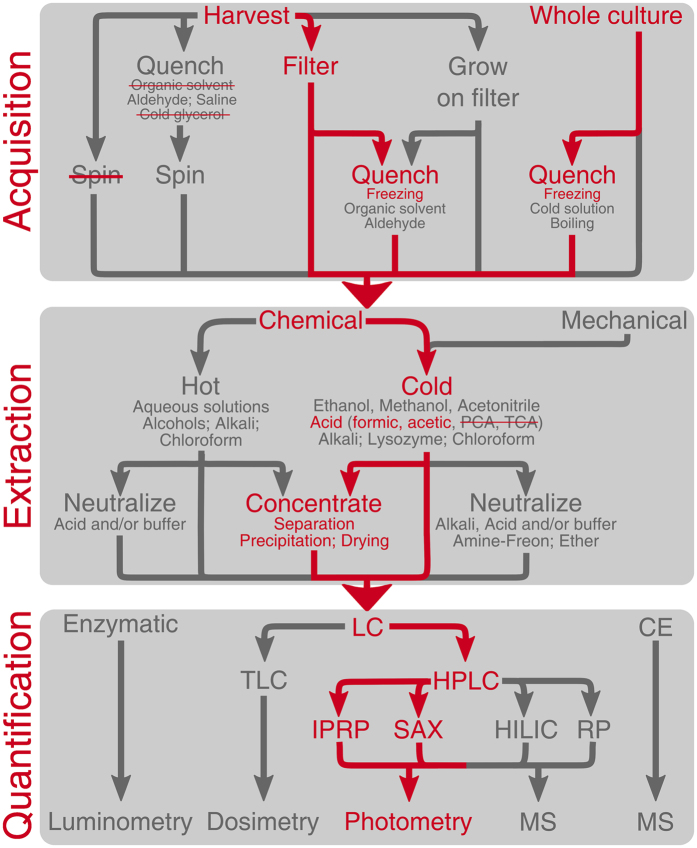
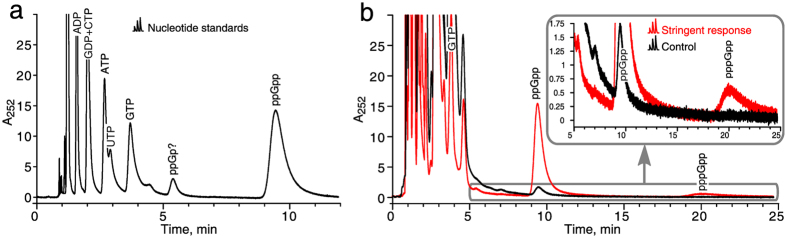
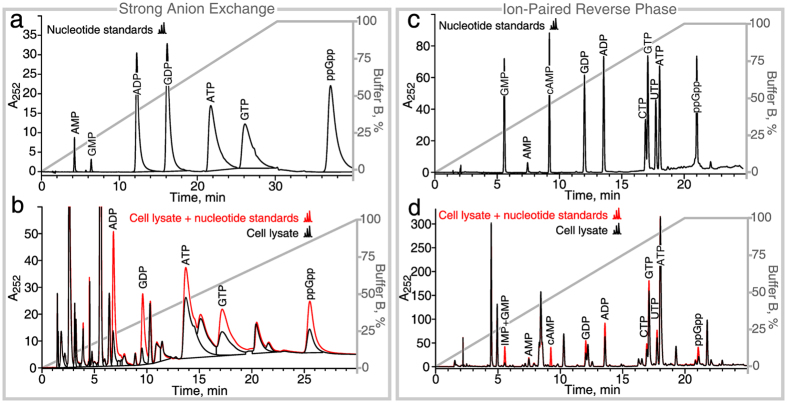
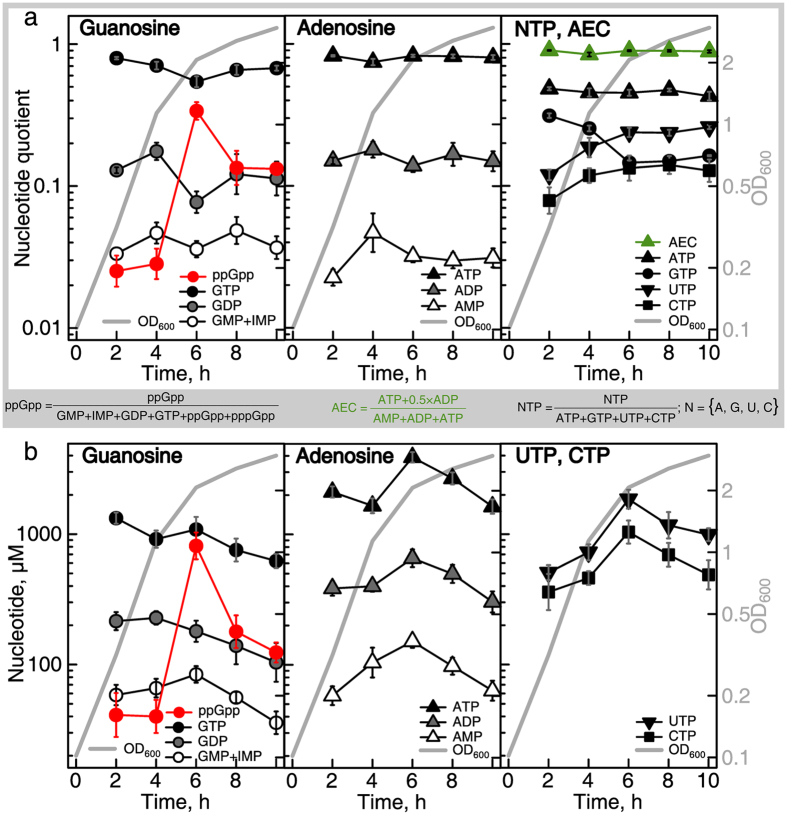
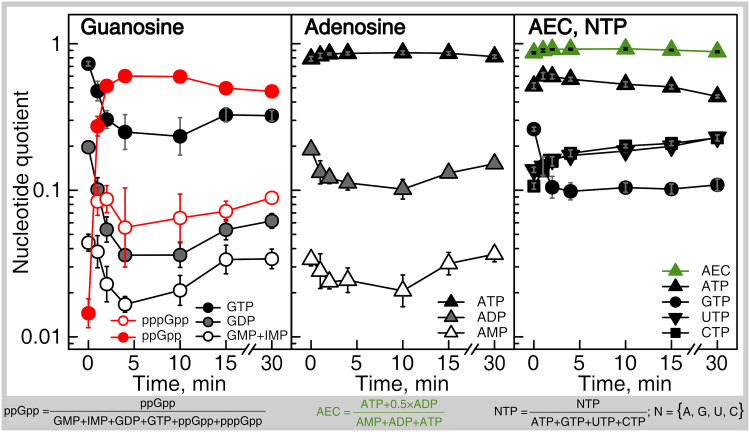
Here we describe an HPLC-based method to quantify bacterial housekeeping nucleotides and the signaling messengers ppGpp and pppGpp. We have replicated and tested several previously reported HPLC-based approaches and assembled a method that can process 50 samples in three days, thus making kinetically resolved experiments feasible. The method combines cell harvesting by rapid filtration, followed by acid extraction, freeze-drying with chromatographic separation. We use a combination of C18 IPRP-HPLC (GMP unresolved and co-migrating with IMP; GDP and GTP; AMP, ADP and ATP; CTP; UTP) and SAX-HPLC in isocratic mode (ppGpp and pppGpp) with UV detection. The approach is applicable to bacteria without the requirement of metabolic labelling with 32P-labelled radioactive precursors. We applied our method to quantify nucleotide pools in Escherichia coli BW25113 K12-strain both throughout the growth curve and during acute stringent response induced by mupirocin. While ppGpp and pppGpp levels vary drastically (40- and ≥8-fold, respectively) these changes are decoupled from the quotients of the housekeeping pool and guanosine and adenosine housekeeping nucleotides: NTP/NDP/NMP ratio remains stable at 6/1/0.3 during both normal batch culture growth and upon acute amino acid starvation.
Overview
The claims and statistics of this paper haven’t been checked yet.
Free: it reads the open-access text and checks the first 5 claims that cite a source we can check. Create a free account to check every claim.
Integrity signals
Registry
Cites
Statistics
Figures
Verification
Claims the paper makes
The claims and statistics of this paper haven’t been checked yet.
Free: it reads the open-access text and checks the first 5 claims that cite a source we can check. Create a free account to check every claim.
Claims other papers make about this one
Each is checked against this paper’s own text: does it say what the citing paper says it does?
In the citing paper
“The (p)ppGpp levels raise from approx. 40 μM during exponential phase up to approx. 1 mM at the transition into stationary phase or upon amino acid starvation (Varik et al., 2017; Haas et al., 2020; Steinchen et al., 2020).”
From The Dynamic SecYEG Translocon (2021) · cites this paper as Varik et al., 2017
Self-check
Percentages, sums and reported differences re-computed from the paper’s own numbers.
The self-check needs the paper’s full text.
Citations
Cites
NIH Image to ImageJ: 25 years of image analysis
Schneider, C. A., Rasband, W. S., & Eliceiri, K. W. (2012) · Nature Methods · doi:10.1038/nmeth.2089 · Cited by 64,638
Construction of Escherichia coli K‐12 in‐frame, single‐gene knockout mutants: the Keio collection
Baba, T., Ara, T., Hasegawa, M., Takai, Y., Okumura, Y., Baba, M., Datsenko, K. A., Tomita, M., Wanner, B. L., & Mori, H. (2006) · Molecular Systems Biology · doi:10.1038/msb4100050 · Cited by 7,858
Culture Medium for Enterobacteria
Neidhardt, F. C., Bloch, P. L., & Smith, D. F. (1974) · Journal of Bacteriology · doi:10.1128/jb.119.3.736-747.1974 · Cited by 2,958
Energy charge of the adenylate pool as a regulatory parameter. Interaction with feedback modifiers
Atkinson, D. E. (1968) · Biochemistry · doi:10.1021/bi00851a033 · Cited by 2,401 · cited 1×
“Luciferase assay of adenosine nucleotides, however, established the concept of adenylate energy charge (Atkinson 1968) and laid the foundations for all nucleotide quantifications that followed: energy charge is a crucial measure of sample acquisition, extraction and/or storage quality.”
Absolute metabolite concentrations and implied enzyme active site occupancy in Escherichia coli
Bennett, B. D., Kimball, E. H., Gao, M., Osterhout, R., Van Dien, S. J., & Rabinowitz, J. D. (2009) · Nature Chemical Biology · doi:10.1038/nchembio.186 · Cited by 1,830
Recent functional insights into the role of (p)ppGpp in bacterial physiology
Hauryliuk, V., Atkinson, G. C., Murakami, K. S., Tenson, T., & Gerdes, K. (2015) · Nature Reviews Microbiology · doi:10.1038/nrmicro3448 · Cited by 790
Self-citationAdenylate Energy Charge in Escherichia coli During Growth and Starvation
Chapman, A. G., Fall, L., & Atkinson, D. E. (1971) · Journal of Bacteriology · doi:10.1128/jb.108.3.1072-1086.1971 · Cited by 779
Complete analysis of cellular nucleotides by two-dimensional thin layer chromatography.
Bochner, B. R., & Ames, B. N. (1982) · Journal of Biological Chemistry · doi:10.1016/s0021-9258(18)34138-3 · Cited by 530 · cited 14×
“Centrifugation is not applicable for bacterial nucleotide measurements since it dramatically alters the nucleotide levels, i.e. highly phosphorylated compounds are converted to less phosphorylated species (Cole, Wimpenny et al. 1967, Chapman, Fall et al. 1971, Lowry, Carter et al. 1971, Lundin and Thore 1975, Payne an…”
BackgroundMethodInfluentialThe Control of Ribonucleic Acid Synthesis in Escherichia coli
Cashel, M. (1969) · Journal of Biological Chemistry · doi:10.1016/s0021-9258(18)93106-6 · Cited by 449 · cited 9×
“Finally, volatile acids—such as TCA, formic, and acetic acid—can be removed by freeze-drying.”
BackgroundMethodInfluentialCharacterization of Nucleotide Pools as a Function of Physiological State in Escherichia coli
Buckstein, M. H., He, J., & Rubin, H. (2008) · Journal of Bacteriology · doi:10.1128/jb.01020-07 · Cited by 370 · cited 1×
“5;12] 14[11;17] 16[13;20] 18[15;21] 20[19;22] 21[19;23] 23[21;25]”
Cited by
Items 101–124 of 124
Cayuela, N. C., Gatnau‐Civardi, C., & Riera‐Codina, M. (2025) · Physiological Reports · doi:10.14814/phy2.70419
“…et al., 1993; Letcher et al., 2010; Lorke et al., 2004; Mayr, 1988; Singh & Jiang, 1995) or nucleotides (Chida et al., 2012; Liu et al., 2006; Varik et al., 2017; zur Nedden et al., 2009) do not give overall information of the cellular physiology because they use specific methodologies for…”
The thermophilic route to succinic acid
Koendjbiharie, J. G. (2020) · doi:10.18174/510683 · Cited by 1
Natriashvili, A., Mohammadsadeghi, N., Milanov, M., Smudde, E., Prucker, I., Jessen, H. J., Carabadjac, I., Heerklotz, H. H., Franco, P. H. C., Langer, J. D., et al. (2025) · bioRxiv (Cold Spring Harbor Laboratory) · doi:10.1101/2025.05.06.652344 · Cited by 1
van Ede, J. M., Páez-Watson, T., van Loosdrecht, M. C. M., & Pabst, M. (2025) · bioRxiv (Cold Spring Harbor Laboratory) · doi:10.1101/2025.08.27.672571 · Cited by 1
“Although other studies have reported improved triphosphate recovery using similar cold acidic 38 or acidic acetonitrile/methanol/water (40:40:20) 28 extractions, those analyses were performed on planktonic E. coli cells and did also not include an extraction with boiling water.”
Bennison, D. J., Nakamoto, J. A., Craggs, T. D., Milón, P., Rafferty, J. B., & Corrigan, R. M. (2021) · bioRxiv (Cold Spring Harbor Laboratory) · doi:10.1101/2021.01.19.427108
“Upon induction of the stringent response, levels of (p)ppGpp in the cell rise, swiftly becoming the dominant guanosine nucleotide in the cell (12,51), causing (p)ppGpp to out-compete GTP for occupancy of the nucleotide binding site (Figure 1C, Supplementary Figure S2D-F), and resulting in reduced association of RAGTPa…”
BackgroundKnejzlı́k, Z., Doležal, M., Herkommerová, K., Clarová, K., Klíma, M., Dedola, M., Zbornı́ková, E., Rejman, D., & Pichová, I. (2021) · bioRxiv (Cold Spring Harbor Laboratory) · doi:10.1101/2021.08.05.455185
Sun, Z., Wu, R., Zhao, B., Zeinert, R., Chien, P., & You, M. (2021) · Angewandte Chemie · doi:10.1002/ange.202111170
Lamprecht, O., Ratnikava, M., Jacek, P., Kaganovitch, E., Buettner, N., Fritz, K., Biazruchka, I., Köhler, R., Pietsch, J. M., & Sourjik, V. (2022) · bioRxiv (Cold Spring Harbor Laboratory) · doi:10.1101/2022.05.23.493020
Expanding the analytical toolbox for synthesis and characterization of ribonucleic acids
Strezsak, S. R. (2022) · Digital Repository Service (Northeastern University) · doi:10.17760/d20429148
Efeito do glifosato sobre a susceptibilidade a antibióticos em Escherichia coli
Ospino, K. (2022) · Digital Library of Theses and Dissertations (Universidade de São Paulo) · doi:10.11606/d.42.2022.tde-07122022-152116
5’-NADylation of RNA is well-tolerated by bacterial cellPreprint
Wiedermannová, J., Babu, R., & Yuzenkova, Y. (2023) · bioRxiv (Cold Spring Harbor Laboratory) · doi:10.1101/2023.03.31.535138 · Cited by 1
“coli Orn under IPTG inducible T7 promoter), pJW370 (pACYC184: p_RNAI CI (1-30) lacZ), pJW371 (pACYC184: p_RNAI RNAI), pJW399 (pACYC184: p_RNAI RNAI, antisense p_trc RNAII(1-128) T7 terminator) were constructed in this work.”
BackgroundPrucker, I., Milanov, M., Moser, P., Popp, C., Haas, T., Qiu, D., Koch, H., & Jessen, H. J. (2026) · bioRxiv (Cold Spring Harbor Laboratory) · doi:10.64898/2026.01.08.698462
Максимова, Е. М., Корепанов, А. П., & Столбоушкина, Е. А. (2025) · Bulletin of Udmurt University Series Biology Earth Sciences · doi:10.35634/2412-9518-2025-35-4-483-491
Adriaans, I. E., Álvarez‐Mena, A., Dinet, C., Morvan, E., Lim, K., Dufourc, É. J., Wong, R. W.-C., Chastanet, A., Michelot, A., Carballido‐López, R., et al. (2026) · bioRxiv (Cold Spring Harbor Laboratory) · doi:10.64898/2026.02.13.705564
Liu, Z.-J., Wu, J., Chen, X.-Y., & Mao, L. (2026) · Journal of physiological investigation · doi:10.4103/ejpi.ejpi-d-25-00074
Patacq, C. (2018) · theses.fr (ABES) · doi:10.70675/451fbd29z663bz45cazb3c8zdb8b4ff84ec4
Romand, S. (2023) · theses.fr (ABES) · doi:10.70675/61e124afz82a7z460fzb62dz4c9f72cd29bf
Bosnar, L. M., Petrovski, S., Shindler, A. E., & Franks, A. E. (2026) · bioRxiv (Cold Spring Harbor Laboratory) · doi:10.64898/2026.06.02.729653
Sustained ppGpp production underpins months-long survival of a bacterium in growth arrest
Fones, E. M., Yin, L., Whittington, D., & Harwood, C. S. (2026) · mBio · doi:10.1128/mbio.01079-26 · Cited by 1
“Bacterial nucleotides (ATP, GTP, and ppGpp) were quantified using an ultra-high performance liquid chromatography–tandem mass spectrometry (UHPLC-MS/MS) approach modified from Varik et al. (37).”
Bacterial dynamin homolog regulates growth phase-dependent c-di-GMP production
Chen, X., Offer, R., Suchanek, V. M., Hengge, R., & Sourjik, V. (2026) · mBio · doi:10.1128/mbio.00668-26
“A 15%–30% inhibition occurred at a 10:1 ratio of (p)ppGpp to GTP (1 mM vs. 100 µM), which is physiologically relevant during the stationary phase (33).”
Falling asleep: the importance of ribosome hibernation in bacteria
Njenga, R. K., & Koch, H. (2026) · Microbiology and Molecular Biology Reviews · doi:10.1128/mmbr.00159-25 · Cited by 4
“However, during prolonged incubation under stationary phase conditions, the (p)ppGpp levels drop (194), and this is also observed for the rmf expression (87).”
Engineering ATP homeostasis to enhance robustness and productivity in microbial cell factories
Ding, H., Lu, M., Zhang, H., Zheng, P., Zhu, Y., & Sun, J. (2026) · Critical Reviews in Biotechnology · doi:10.1080/07388551.2026.2726280
“Chromatography and mass spectrometry (MS)-based methods, including HPLC and LC-MS, enable quantification of ATP, ADP, AMP and related nucleotides in cell extracts (Figure 3B) [87,88].”
Rich, J. D., Wardell, S. J. T., Martins, D., Khakhimova, M., Sampathkumar, G., Chan, T., Nguyen, T. T. M., McKay, G. A., Taylor, L., Pletzer, D., et al. (2026) · mSystems · doi:10.1128/msystems.01742-25
Measuring Temporal Variations of Nucleotide Pools in Microbial Granular Biofilm
van Ede, J. M., Páez-Watson, T., van Loosdrecht, M. C. M., & Pabst, M. (2026) · Helvetica Chimica Acta · doi:10.1002/hlca.70103 · Cited by 1
Metadata
- Authors
- Varik, V., Oliveira, S. R. A., Hauryliuk, V., & Tenson, T.
- Affiliations
- University of Tartu (EE)
- Corresponding author
- Varik, Vallo
- Hauryliuk, Vasili
- Tenson, Tanel
- Venue
- Scientific Reports
- Published
- 2017-09-08
- Volume
- 7
- Issue
- 1
- Pages
- 11022-11022
- ISSN
- 2045-2322 (ISSN-L)
- PMC
- PMC5591245
- OpenAlex
- W2752128520
- Semantic Scholar
- a7f52d2dea5929c751d2035b8e2c7389d6cf5f38
- Cited by
- 124
- References
- 61
- Citations by year
- 2026: 15 · 2025: 18 · 2024: 8 · 2023: 15 · 2022: 13 · 2021: 11 · 2020: 20 · 2019: 14 · 2018: 10
- FWCI
- 7.97
- Type
- journal article
- Language
- en
- Open access
- gold
- doi.org
- Licence
- cc-by
- creativecommons.org/licenses/by/4.0 (tdm)
- creativecommons.org/licenses/by/4.0 (vor)
- Locations
- Scientific Reports (publishedVersion, cc-by)
- PubMed Central (publishedVersion, cc-by)
- PubMed (publishedVersion)
- KTH Publication Database DiVA (KTH Royal Institute of Technology) (submittedVersion, other-oa)
- DOAJ (DOAJ: Directory of Open Access Journals) (submittedVersion)
- Funders
- Kempe Foundation
- Eesti Teadusagentuur (IUT2-22)
- Vetenskapsrådet (2013-04680)
- European Regional Development Fund
- Topics
- Life Sciences › Biochemistry, Genetics and Molecular Biology › Genetics › Bacterial Genetics and Biotechnology
- Life Sciences › Biochemistry, Genetics and Molecular Biology › Molecular Biology › Biochemical and Molecular Research
- Life Sciences › Biochemistry, Genetics and Molecular Biology › Molecular Biology › Microbial Metabolic Engineering and Bioproduction
- Keywords
- ppGpp, pppGpp, nucleotide quantification, stringent response, mupirocin, amino acid starvation, Escherichia coli, nucleotide pools, acid extraction
- MeSH terms
- Chromatography, High Pressure Liquid, Escherichia coli, Guanosine Pentaphosphate, Guanosine Tetraphosphate, Nucleotides, Protein Synthesis Inhibitors, Mupirocin
About these checks
Registry, retraction, Cites and statistics results are computed, not judged, with one exception: a printed reference that no index lists is read once by a model before it counts as a citation error. Claims are extracted by a model and kept only when their quote appears verbatim in the text; each cited source is then checked, with a model’s help, for whether it says what the claim relies on. Those verdicts can be wrong — read the claim’s quote and the cited source before relying on one.
Statistics and arithmetic are recomputed, not judged.
Confidence bands are shown only for fields calibrated on our annotated test set. None is calibrated yet, so no band is shown.
What counts as a claim ›How we measure confidence ›How we check this ›
Are you an author, or do you see a problem with this page? Request a review
Data sources
Bibliographic data: Semantic Scholar, OpenAlex, Crossref.
Contains information from the Semantic Scholar Academic Graph Datasets, made available under the ODC Attribution License (ODC-BY 1.0).
Semantic Scholar’s data is described in: Kinney, R., et al. (2023). The Semantic Scholar Open Data Platform. arXiv:2301.10140.
