

HPLC-based quantification of bacterial housekeeping nucleotides and alarmone messengers ppGpp and pppGpp.
Open accessThe DOI matches its Crossref record; 61 of the 61 references it cites were found in a registry or an index.
Abstract
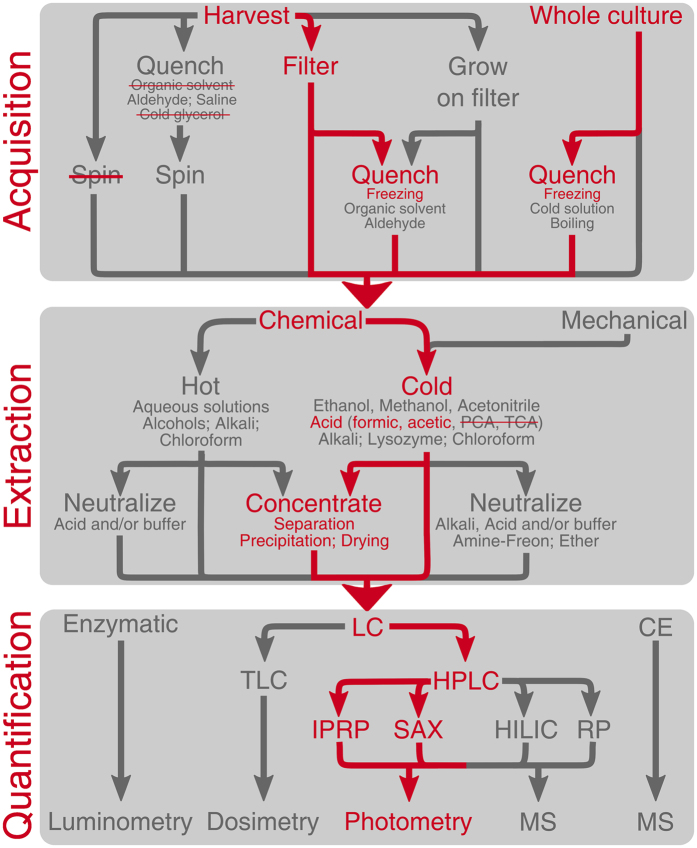
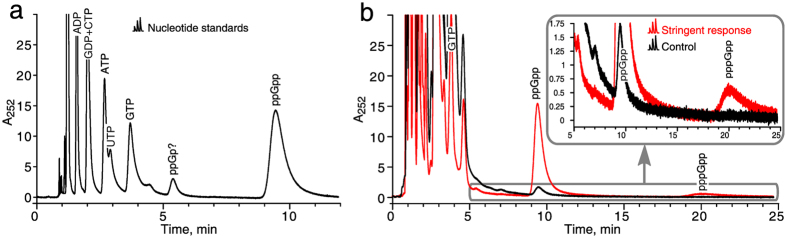
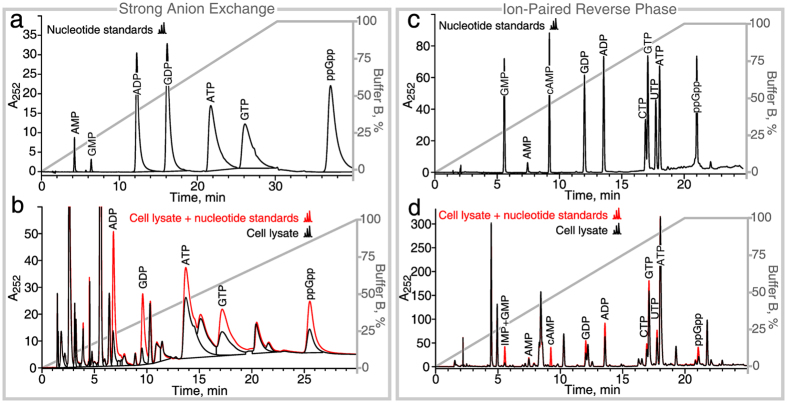
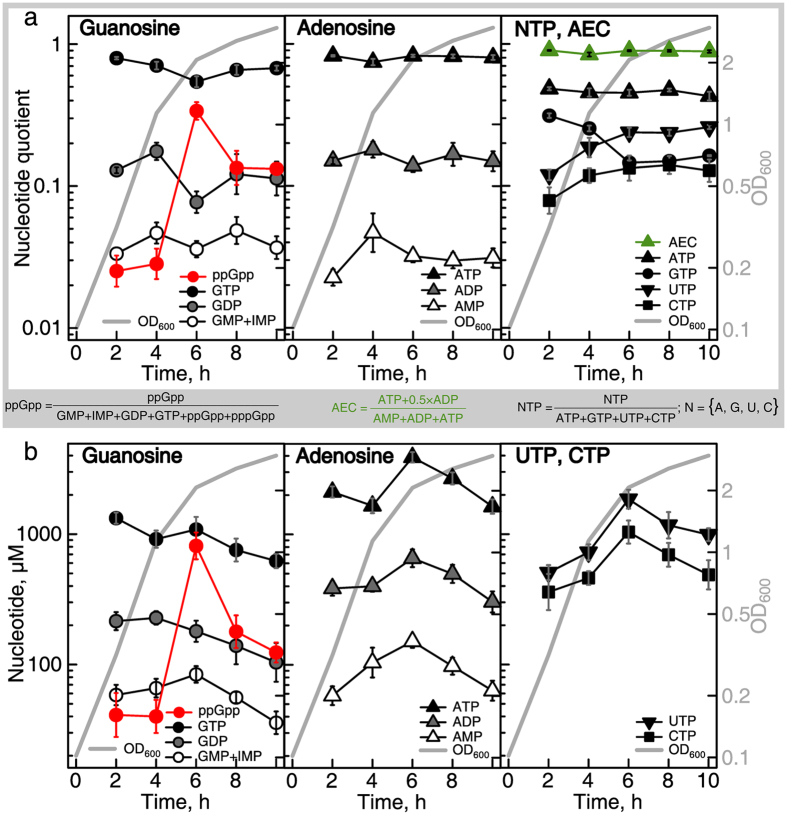
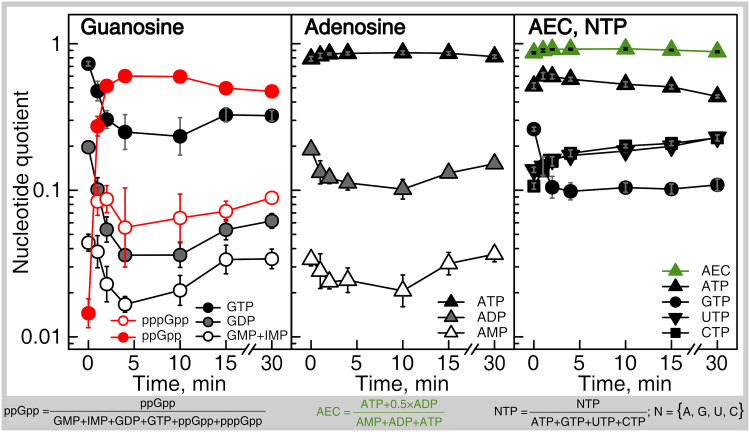
Here we describe an HPLC-based method to quantify bacterial housekeeping nucleotides and the signaling messengers ppGpp and pppGpp. We have replicated and tested several previously reported HPLC-based approaches and assembled a method that can process 50 samples in three days, thus making kinetically resolved experiments feasible. The method combines cell harvesting by rapid filtration, followed by acid extraction, freeze-drying with chromatographic separation. We use a combination of C18 IPRP-HPLC (GMP unresolved and co-migrating with IMP; GDP and GTP; AMP, ADP and ATP; CTP; UTP) and SAX-HPLC in isocratic mode (ppGpp and pppGpp) with UV detection. The approach is applicable to bacteria without the requirement of metabolic labelling with 32P-labelled radioactive precursors. We applied our method to quantify nucleotide pools in Escherichia coli BW25113 K12-strain both throughout the growth curve and during acute stringent response induced by mupirocin. While ppGpp and pppGpp levels vary drastically (40- and ≥8-fold, respectively) these changes are decoupled from the quotients of the housekeeping pool and guanosine and adenosine housekeeping nucleotides: NTP/NDP/NMP ratio remains stable at 6/1/0.3 during both normal batch culture growth and upon acute amino acid starvation.
Overview
The claims and statistics of this paper haven’t been checked yet.
Free: it reads the open-access text and checks the first 5 claims that cite a source we can check. Create a free account to check every claim.
Integrity signals
Registry
Cites
Statistics
Figures
Verification
Claims the paper makes
The claims and statistics of this paper haven’t been checked yet.
Free: it reads the open-access text and checks the first 5 claims that cite a source we can check. Create a free account to check every claim.
Claims other papers make about this one
Each is checked against this paper’s own text: does it say what the citing paper says it does?
In the citing paper
“The (p)ppGpp levels raise from approx. 40 μM during exponential phase up to approx. 1 mM at the transition into stationary phase or upon amino acid starvation (Varik et al., 2017; Haas et al., 2020; Steinchen et al., 2020).”
From The Dynamic SecYEG Translocon (2021) · cites this paper as Varik et al., 2017
Self-check
Percentages, sums and reported differences re-computed from the paper’s own numbers.
The self-check needs the paper’s full text.
Citations
Cites
NIH Image to ImageJ: 25 years of image analysis
Schneider, C. A., Rasband, W. S., & Eliceiri, K. W. (2012) · Nature Methods · doi:10.1038/nmeth.2089 · Cited by 64,638
Construction of Escherichia coli K‐12 in‐frame, single‐gene knockout mutants: the Keio collection
Baba, T., Ara, T., Hasegawa, M., Takai, Y., Okumura, Y., Baba, M., Datsenko, K. A., Tomita, M., Wanner, B. L., & Mori, H. (2006) · Molecular Systems Biology · doi:10.1038/msb4100050 · Cited by 7,858
Culture Medium for Enterobacteria
Neidhardt, F. C., Bloch, P. L., & Smith, D. F. (1974) · Journal of Bacteriology · doi:10.1128/jb.119.3.736-747.1974 · Cited by 2,958
Energy charge of the adenylate pool as a regulatory parameter. Interaction with feedback modifiers
Atkinson, D. E. (1968) · Biochemistry · doi:10.1021/bi00851a033 · Cited by 2,401 · cited 1×
“Luciferase assay of adenosine nucleotides, however, established the concept of adenylate energy charge (Atkinson 1968) and laid the foundations for all nucleotide quantifications that followed: energy charge is a crucial measure of sample acquisition, extraction and/or storage quality.”
Absolute metabolite concentrations and implied enzyme active site occupancy in Escherichia coli
Bennett, B. D., Kimball, E. H., Gao, M., Osterhout, R., Van Dien, S. J., & Rabinowitz, J. D. (2009) · Nature Chemical Biology · doi:10.1038/nchembio.186 · Cited by 1,830
Recent functional insights into the role of (p)ppGpp in bacterial physiology
Hauryliuk, V., Atkinson, G. C., Murakami, K. S., Tenson, T., & Gerdes, K. (2015) · Nature Reviews Microbiology · doi:10.1038/nrmicro3448 · Cited by 790
Self-citationAdenylate Energy Charge in Escherichia coli During Growth and Starvation
Chapman, A. G., Fall, L., & Atkinson, D. E. (1971) · Journal of Bacteriology · doi:10.1128/jb.108.3.1072-1086.1971 · Cited by 779
Complete analysis of cellular nucleotides by two-dimensional thin layer chromatography.
Bochner, B. R., & Ames, B. N. (1982) · Journal of Biological Chemistry · doi:10.1016/s0021-9258(18)34138-3 · Cited by 530 · cited 14×
“Centrifugation is not applicable for bacterial nucleotide measurements since it dramatically alters the nucleotide levels, i.e. highly phosphorylated compounds are converted to less phosphorylated species (Cole, Wimpenny et al. 1967, Chapman, Fall et al. 1971, Lowry, Carter et al. 1971, Lundin and Thore 1975, Payne an…”
BackgroundMethodInfluentialThe Control of Ribonucleic Acid Synthesis in Escherichia coli
Cashel, M. (1969) · Journal of Biological Chemistry · doi:10.1016/s0021-9258(18)93106-6 · Cited by 449 · cited 9×
“Finally, volatile acids—such as TCA, formic, and acetic acid—can be removed by freeze-drying.”
BackgroundMethodInfluentialCharacterization of Nucleotide Pools as a Function of Physiological State in Escherichia coli
Buckstein, M. H., He, J., & Rubin, H. (2008) · Journal of Bacteriology · doi:10.1128/jb.01020-07 · Cited by 370 · cited 1×
“5;12] 14[11;17] 16[13;20] 18[15;21] 20[19;22] 21[19;23] 23[21;25]”
The Control of Ribonucleic Acid Synthesis in Escherichia coli
Cashel, M., & Kalbacher, B. (1970) · Journal of Biological Chemistry · doi:10.1016/s0021-9258(18)63153-9 · Cited by 369 · cited 3×
“UTP 14[13;15] 15[13;17] 16[14;19] 17[16;19] 19[18;19] 20[18;22] 23[22;24]”
BackgroundAtkinson, D. E. (1969) · Annual Review of Microbiology · doi:10.1146/annurev.mi.23.100169.000403 · Cited by 366 · cited 1×
“ATP 52[46;57] 60[51;71] 60[53;67] 57[52;63] 53[47;59] 51[46;56] 44[42;46]”
Lowry, O. H., Carter, J., Ward, J. B., & Glaser, L. (1971) · Journal of Biological Chemistry · doi:10.1016/s0021-9258(19)34144-4 · Cited by 350
Krásný, L., & Gourse, R. L. (2004) · The EMBO Journal · doi:10.1038/sj.emboj.7600423 · Cited by 302
Comparison of Methods for Extraction of Bacterial Adenine Nucleotides Determined by Firefly Assay
Lundin, A., & Thore, A. (1975) · Applied Microbiology · doi:10.1128/aem.30.5.713-721.1975 · Cited by 299 · cited 25×
“…lysis in a combination with quenching by aldehyde results, though not always (Lundin and Thore 1975), in relatively weak signal of nucleotides (Lundin and Thore 1975, CserjanPuschmann, Kramer et al. 1999, Schneider, Gaal et al. 2002, Schneider, Murray et al. 2003) and substantial variance…”
BackgroundInfluentialThe ATP pool in Escherichia coli. I. Measurement of the pool using a modified luciferase assay
Cole, H. A., Wimpenny, J. W. T., & Hughes, D. E. (1967) · Biochimica et Biophysica Acta (BBA) - Bioenergetics · doi:10.1016/0005-2728(67)90050-3 · Cited by 229 · cited 1×
“5;12] 14[11;17] 16[13;20] 18[15;21] 20[19;22] 21[19;23] 23[21;25]”
The Separation of Purine and Pyrimidine Bases and of Nucleotides by Ion Exchange
Cohn, W. E. (1949) · Science · doi:10.1126/science.109.2833.377 · Cited by 215 · cited 1×
“Ion exchange is the first LC approach developed for nucleotides (Cohn 1949), has gained a lot of popularity and works especially fine for highly charged nucleotides (tri-, tetra- and pentaphosphates).”
BackgroundCorrigan, R. M., Bellows, L. E., Wood, A., & Gründling, A. (2016) · Proceedings of the National Academy of Sciences · doi:10.1073/pnas.1522179113 · Cited by 212
Control of rRNA Expression by Small Molecules Is Dynamic and Nonredundant
Murray, H. D., Schneider, D. A., & Gourse, R. L. (2003) · Molecular Cell · doi:10.1016/s1097-2765(03)00266-1 · Cited by 191 · cited 4×
“Alkali lysis in a combination with quenching by aldehyde results, though not always (Lundin and Thore 1975), in relatively weak signal of nucleotides (Lundin and Thore 1975, CserjanPuschmann, Kramer et al. 1999, Schneider, Gaal et al. 2002, Schneider, Murray et al. 2003) and substantial variance (Schneider and Gourse…”
BackgroundInfluentialResistance to and synthesis of the antibiotic mupirocin
Thomas, C. M., Hothersall, J., Willis, C. L., & Simpson, T. J. (2010) · Nature Reviews Microbiology · doi:10.1038/nrmicro2278 · Cited by 187 · cited 2×
“5;12] 14[11;17] 16[13;20] 18[15;21] 20[19;22] 21[19;23] 23[21;25]”
The nucleotide-binding site of bacterial translation initiation factor 2 (IF2) as a metabolic sensor
Milon, P., Tischenko, E., Tomšic, J., Caserta, E., Folkers, G., La Teana, A., Rodnina, M. V., Pon, C. L., Boelens, R., & Gualerzi, C. O. (2006) · Proceedings of the National Academy of Sciences · doi:10.1073/pnas.0606384103 · Cited by 177 · cited 2×
“ATP 52[46;57] 60[51;71] 60[53;67] 57[52;63] 53[47;59] 51[46;56] 44[42;46]”
Adenylate energy charge in Saccharomyces cerevisiae during starvation
Ball, W. J., & Atkinson, D. E. (1975) · Journal of Bacteriology · doi:10.1128/jb.121.3.975-982.1975 · Cited by 176
Structural and Biochemical Analysis of the Obg GTP Binding Protein
Buglino, J., Shen, V., Hakimian, P., & Lima, C. D. (2002) · Structure · doi:10.1016/s0969-2126(02)00882-1 · Cited by 176 · cited 1×
“ATP 52[46;57] 60[51;71] 60[53;67] 57[52;63] 53[47;59] 51[46;56] 44[42;46]”
Walsh, K., & Koshland, D. E. (1984) · Journal of Biological Chemistry · doi:10.1016/s0021-9258(17)42750-5 · Cited by 175 · cited 2×
“UTP 14[13;15] 15[13;17] 16[14;19] 17[16;19] 19[18;19] 20[18;22] 23[22;24]”
Bacterial nucleotide-based second messengers
Pesavento, C., & Hengge, R. (2009) · Current Opinion in Microbiology · doi:10.1016/j.mib.2009.01.007 · Cited by 171
Villas-Bôas, S. G., & Bruheim, P. (2007) · Analytical Biochemistry · doi:10.1016/j.ab.2007.06.028 · Cited by 170
Andersen, K. B., & von Meyenburg, K. (1977) · Journal of Biological Chemistry · doi:10.1016/s0021-9258(17)40245-6 · Cited by 166
High-pressure liquid chromatography-ultraviolet analysis of intracellular nucleotides
Pogolotti, A. L., & Santi, D. V. (1982) · Analytical Biochemistry · doi:10.1016/0003-2697(82)90524-3 · Cited by 157
Taymaz‐Nikerel, H., Mey, M. D., Ras, C., ten Pierick, A., Seifar, R. M., van Dam, J. C., Heijnen, J. J., & van Gulik, W. M. (2008) · Analytical Biochemistry · doi:10.1016/j.ab.2008.11.018 · Cited by 148 · cited 1×
“ATP 52[46;57] 60[51;71] 60[53;67] 57[52;63] 53[47;59] 51[46;56] 44[42;46]”
The Mechanism of Amino Acid Control of Guanylate and Adenylate Biosynthesis
Gallant, J., Irr, J. D., & Cashel, M. (1971) · Journal of Biological Chemistry · doi:10.1016/s0021-9258(18)61877-0 · Cited by 138
Intersection of the stringent response and the CodY regulon in low GC Gram-positive bacteria
Geiger, T., & Wolz, C. (2013) · International Journal of Medical Microbiology · doi:10.1016/j.ijmm.2013.11.013 · Cited by 138
The ABC-F protein EttA gates ribosome entry into the translation elongation cycle
Boël, G., Smith, P. C., Ning, W., Englander, M. T., Chen, B., Hashem, Y., Testa, A. J., Fischer, J. J., Wieden, H.-J., Frank, J., et al. (2014) · Nature Structural & Molecular Biology · doi:10.1038/nsmb.2740 · Cited by 135
Ochi, K., Kandala, J. C., & Freese, E. (1981) · Journal of Biological Chemistry · doi:10.1016/s0021-9258(19)69072-1 · Cited by 134
Payne, S. M., & Ames, B. N. (1982) · Analytical Biochemistry · doi:10.1016/0003-2697(82)90636-4 · Cited by 130 · cited 17×
“Centrifugation is not applicable for bacterial nucleotide measurements since it dramatically alters the nucleotide levels, i.e. highly phosphorylated compounds are converted to less phosphorylated species (Cole, Wimpenny et al. 1967, Chapman, Fall et al. 1971, Lowry, Carter et al. 1971, Lundin and Thore 1975, Payne an…”
BackgroundMethodInfluentialComparison of the Acid-soluble Nucleotides in Escherichia coli at Different Growth Rates
Franzen, J. S., & Binkley, S. B. (1961) · Journal of Biological Chemistry · doi:10.1016/s0021-9258(18)64395-9 · Cited by 123 · cited 8×
“…et al. 2010), acetonitrile (Au, Su et al. 1989), acidic acetonitrilemethanol-water (Rabinowitz and Kimball 2007), sodium formate at pH 3.4 (Cashel and Gallant 1968), and various acids (Franzen and Binkley 1961, Bagnara and Finch 1968, Nazar, Lawford et al. 1970, Fischer, Zimmerman et al. 1982).”
BackgroundMethodInfluentialPierro, D. D., Tavazzi, B., Perno, C. F., Bartolini, M., Balestra, E., Caliò, R., Giardina, B., & Lazzarino, G. (1995) · Analytical Biochemistry · doi:10.1006/abio.1995.0071 · Cited by 104
Huang, D., Zhang, Y., & Chen, X. (2002) · Journal of Chromatography B · doi:10.1016/s1570-0232(02)00780-8 · Cited by 103
Fiil, N. P., Willumsen, B. M., Friesen, J. D., & von Meyenburg, K. (1977) · Molecular and General Genetics MGG · doi:10.1007/bf02425329 · Cited by 102
Molecular Mechanism and Evolution of Guanylate Kinase Regulation by (p)ppGpp
Liu, K., Myers, A. R., Pisithkul, T., Claas, K. R., Satyshur, K. A., Amador-Noguez, D., Keck, J. L., & Wang, J. D. (2015) · Molecular Cell · doi:10.1016/j.molcel.2014.12.037 · Cited by 100
Metabolic approaches for the optimisation of recombinant fermentation processes
Cserjan‐Puschmann, M., Kramer, W., Dürrschmid, E., Striedner, G., & Bayer, K. (1999) · Applied Microbiology and Biotechnology · doi:10.1007/s002530051612 · Cited by 99
On the Turnover of ppGpp in Escherichia coli
Gallant, J., Margason, G., & Finch, B. (1972) · Journal of Biological Chemistry · doi:10.1016/s0021-9258(19)44762-5 · Cited by 98 · cited 3×
“UTP 14[13;15] 15[13;17] 16[14;19] 17[16;19] 19[18;19] 20[18;22] 23[22;24]”
Gaca, A. O., Kudrin, P., Colomer-Winter, C., Beljantseva, J., Liu, K., Anderson, B., Wang, J. D., Rejman, D., Potrykus, K., Cashel, M., et al. (2015) · Journal of Bacteriology · doi:10.1128/jb.00324-15 · Cited by 98
Self-citationNeuhard, J., & Munch‐Petersen, A. (1966) · Biochimica et Biophysica Acta (BBA) - Nucleic Acids and Protein Synthesis · doi:10.1016/0005-2787(66)90253-x · Cited by 97
Mitkevich, V. A., Ermakov, A., Kulikova, A. A., Tankov, S., Shyp, V., Soosaar, A., Tenson, T., Makarov, A. А., Ehrenberg, M., & Hauryliuk, V. (2010) · Journal of Molecular Biology · doi:10.1016/j.jmb.2010.08.016 · Cited by 95
Self-citationppGpp inhibition of elongation factors Tu, G and Ts during polypeptide synthesis
Rojas, A.-M., Ehrenberg, M., Andersson, S. G. E., & Kurland, C. G. (1984) · Molecular and General Genetics MGG · doi:10.1007/bf00327920 · Cited by 94 · cited 1×
“5] 27[14;53] 52[37;72] 60[49;74] 60[45;78] 50[40;61] 47[43;52]”
Regulation of nucleoside triphosphate pools in Escherichia coli
Edlin, G. J., & Neuhard, J. (1967) · Journal of Molecular Biology · doi:10.1016/0022-2836(67)90328-2 · Cited by 94 · cited 4×
“Note that stringent response, for example, is known to interfere with the uptake of phosphate and thus incorporation of the radioactive label (Edlin and Neuhard 1967, Gallant and Cashel 1967, Cashel and Gallant 1968, Irr and Gallant 1969).”
BackgroundResultInfluentialSynthesis and turnover of basal level guanosine tetraphosphate in Escherichia coli.
Friesen, J. D., Fiil, N. P., & von Meyenburg, K. (1975) · Journal of Biological Chemistry · doi:10.1016/s0021-9258(19)42015-2 · Cited by 68 · cited 1×
“UTP 14[13;15] 15[13;17] 16[14;19] 17[16;19] 19[18;19] 20[18;22] 23[22;24]”
HOLMS, W. H., Hamilton, I. D., & Robertson, A. G. (1972) · Archives of Microbiology · doi:10.1007/bf00425016 · Cited by 67 · cited 2×
“UTP 14[13;15] 15[13;17] 16[14;19] 17[16;19] 19[18;19] 20[18;22] 23[22;24]”
Extraction of intracellular nucleosides and nucleotides with acetonitrile.
Au, J. L. ‐., Su, M., & Wientjes, M. G. (1989) · Clinical Chemistry · doi:10.1093/clinchem/35.1.48 · Cited by 64 · cited 1×
“UTP 14[13;15] 15[13;17] 16[14;19] 17[16;19] 19[18;19] 20[18;22] 23[22;24]”
Structural insights into the function of a unique tandem GTPase EngA in bacterial ribosome assembly
Zhang, X., Yan, K., Zhang, Y., Li, N., Ma, C., Li, Z., Zhang, Y., Feng, B., Liu, J., Sun, Y., et al. (2014) · Nucleic Acids Research · doi:10.1093/nar/gku1135 · Cited by 61 · cited 2×
“ATP 52[46;57] 60[51;71] 60[53;67] 57[52;63] 53[47;59] 51[46;56] 44[42;46]”
An improved procedure for extraction and analysis of cellular nucleotides
Nazar, R. N., Lawford, H. G., & Wong, J. T.-F. (1970) · Analytical Biochemistry · doi:10.1016/0003-2697(70)90189-2 · Cited by 60
The Survival of Peptococcus prevotii in Relation to the Adenylate Energy Charge
Montague, M. D., & DAWES, E. A. (1974) · Journal of General Microbiology · doi:10.1099/00221287-80-1-291 · Cited by 54
Little, R., & Bremer, H. J. (1982) · Analytical Biochemistry · doi:10.1016/0003-2697(82)90531-0 · Cited by 50 · cited 4×
“To increase the retention of highly charged nucleotides on reversed phase column, a zwitterion, customarily tetrabutylammonium, is added to the mobile phase and the result is called ion-paired reverse phase (Hoffman and Liao 1977, Little and Bremer 1982, Payne and Ames 1982, Mack, Reed et al. 1985).”
BackgroundMethodInfluentialLive, T. R., & Kaminskas, E. (1975) · Journal of Biological Chemistry · doi:10.1016/s0021-9258(19)41763-8 · Cited by 49 · cited 1×
“5;12] 14[11;17] 16[13;20] 18[15;21] 20[19;22] 21[19;23] 23[21;25]”
Cross, D. R., Miller, B., & James, S. J. (1993) · Cell Proliferation · doi:10.1111/j.1365-2184.1993.tb00328.x · Cited by 40
Arezzo, F. (1987) · Analytical Biochemistry · doi:10.1016/0003-2697(87)90613-0 · Cited by 35 · cited 3×
“…and Santi 1979, Tanaka, Yoshioka et al. 1984, Harmenberg, Cox et al. 1990) and/or boronate affinity chromatography (Payne and Ames 1982)—to resolve both dNTPs and NTPs in one run (Supplementary Figure 3b and 3c; see also (Arezzo 1987, Cross, Miller et al. 1993, Di Pierro, Tavazzi et al. 1995)).”
BackgroundMethodUnique roles of the rrn P2 rRNA promoters in Escherichia coli
Murray, H. D., & Gourse, R. L. (2004) · Molecular Microbiology · doi:10.1111/j.1365-2958.2004.04060.x · Cited by 35 · cited 1×
“ATP 52[46;57] 60[51;71] 60[53;67] 57[52;63] 53[47;59] 51[46;56] 44[42;46]”
Guanosine 5‘-diphosphate-3‘-diphosphate inhibition of adenylosuccinate synthetase.
Stayton, M. M., & Fromm, H. J. (1979) · Journal of Biological Chemistry · doi:10.1016/s0021-9258(17)30108-4 · Cited by 33
Ribonucleoside triphosphate accumulation on amino acid starvation of “strincent” Escherichia coli
Bagnara, A. S., & Finch, L. R. (1968) · Biochemical and Biophysical Research Communications · doi:10.1016/0006-291x(68)90247-7 · Cited by 28 · cited 1×
“…et al. 2010), acetonitrile (Au, Su et al. 1989), acidic acetonitrilemethanol-water (Rabinowitz and Kimball 2007), sodium formate at pH 3.4 (Cashel and Gallant 1968), and various acids (Franzen and Binkley 1961, Bagnara and Finch 1968, Nazar, Lawford et al. 1970, Fischer, Zimmerman et al. 1982).”
BackgroundInfluentialVogel, U. B., Pedersen, S. B., & Jensen, K. F. (1991) · Journal of Bacteriology · doi:10.1128/jb.173.3.1168-1174.1991 · Cited by 26 · cited 1×
“5] 27[14;53] 52[37;72] 60[49;74] 60[45;78] 50[40;61] 47[43;52]”
Schneider, D. A., Murray, H. D., & Gourse, R. L. (2003) · Methods in enzymology on CD-ROM/Methods in enzymology · doi:10.1016/s0076-6879(03)70051-2 · Cited by 25
Cited by
Novel (p)ppGpp Binding and Metabolizing Proteins of Escherichia coli
Zhang, Y., Zborníková, E., Rejman, D., & Gerdes, K. (2018) · mBio · doi:10.1128/mbio.02188-17 · Cited by 152
“Analysis of E. coli revealed that (p)ppGpp levels dramatically increased 10-to 100-fold during shifts to amino acid starvation (4, 14–16).”
Background(p)ppGpp: magic modulators of bacterial physiology and metabolism.
Steinchen, W., Zegarra, V., & Bange, G. (2020) · Frontiers in Microbiology · doi:10.3389/fmicb.2020.02072 · Cited by 130
Coping with stress: How bacteria fine-tune protein synthesis and protein transport
Njenga, R. K., Boele, J., Öztürk, Y., & Koch, H. (2023) · Journal of Biological Chemistry · doi:10.1016/j.jbc.2023.105163 · Cited by 119
A widespread toxin−antitoxin system exploiting growth control via alarmone signaling
Jimmy, S., Saha, C. K., Kurata, T., Stavropoulos, C., Oliveira, S. R. A., Koh, A., Cepauskas, A., Takada, H., Rejman, D., Tenson, T., et al. (2020) · Proceedings of the National Academy of Sciences · doi:10.1073/pnas.1916617117 · Cited by 102
“Our approach utilizes strong anion exchange (SAX) for detection and quantification of ppGpp and pppGpp, while all of the other nucleotide species are analyzed by ion-paired reverse-phase (IPRP) chromatography (24).”
InfluentialSelf-citationOswald, J., Njenga, R., Natriashvili, A., Sarmah, P., & Koch, H.-G. (2021) · Frontiers in Molecular Biosciences · doi:10.3389/fmolb.2021.664241 · Cited by 88
“N-terminal, cleavable signal sequences in secretory proteins and non-cleavable signal anchor sequences in inner membrane proteins provide the means to identify those proteins that have to be exported (Pugsley, 1990; von Heijne, 1994; Hegde and Bernstein, 2006; Steinberg et al., 2018).”
Background
Metadata
- Authors
- Varik, V., Oliveira, S. R. A., Hauryliuk, V., & Tenson, T.
- Affiliations
- University of Tartu (EE)
- Corresponding author
- Varik, Vallo
- Hauryliuk, Vasili
- Tenson, Tanel
- Venue
- Scientific Reports
- Published
- 2017-09-08
- Volume
- 7
- Issue
- 1
- Pages
- 11022-11022
- ISSN
- 2045-2322 (ISSN-L)
- PMC
- PMC5591245
- OpenAlex
- W2752128520
- Cited by
- 124
- References
- 61
- Citations by year
- 2026: 15 · 2025: 18 · 2024: 8 · 2023: 15 · 2022: 13 · 2021: 11 · 2020: 20 · 2019: 14 · 2018: 10
- FWCI
- 7.97
- Type
- journal article
- Language
- en
- Open access
- gold
- doi.org
- Licence
- cc-by
- creativecommons.org/licenses/by/4.0 (tdm)
- creativecommons.org/licenses/by/4.0 (vor)
- Locations
- Scientific Reports (publishedVersion, cc-by)
- PubMed Central (publishedVersion, cc-by)
- PubMed (publishedVersion)
- KTH Publication Database DiVA (KTH Royal Institute of Technology) (submittedVersion, other-oa)
- DOAJ (DOAJ: Directory of Open Access Journals) (submittedVersion)
- Funders
- Kempe Foundation
- Eesti Teadusagentuur (IUT2-22)
- Vetenskapsrådet (2013-04680)
- European Regional Development Fund
- Topics
- Life Sciences › Biochemistry, Genetics and Molecular Biology › Genetics › Bacterial Genetics and Biotechnology
- Life Sciences › Biochemistry, Genetics and Molecular Biology › Molecular Biology › Biochemical and Molecular Research
- Life Sciences › Biochemistry, Genetics and Molecular Biology › Molecular Biology › Microbial Metabolic Engineering and Bioproduction
- Keywords
- ppGpp, pppGpp, nucleotide quantification, stringent response, mupirocin, amino acid starvation, Escherichia coli, nucleotide pools, acid extraction
- MeSH terms
- Chromatography, High Pressure Liquid, Escherichia coli, Guanosine Pentaphosphate, Guanosine Tetraphosphate, Nucleotides, Protein Synthesis Inhibitors, Mupirocin
About these checks
Registry, retraction, Cites and statistics results are computed, not judged, with one exception: a printed reference that no index lists is read once by a model before it counts as a citation error. Claims are extracted by a model and kept only when their quote appears verbatim in the text; each cited source is then checked, with a model’s help, for whether it says what the claim relies on. Those verdicts can be wrong — read the claim’s quote and the cited source before relying on one.
Statistics and arithmetic are recomputed, not judged.
Confidence bands are shown only for fields calibrated on our annotated test set. None is calibrated yet, so no band is shown.
What counts as a claim ›How we measure confidence ›How we check this ›
Are you an author, or do you see a problem with this page? Request a review
Data sources
Bibliographic data: Semantic Scholar, OpenAlex, Crossref.
Contains information from the Semantic Scholar Academic Graph Datasets, made available under the ODC Attribution License (ODC-BY 1.0).
Semantic Scholar’s data is described in: Kinney, R., et al. (2023). The Semantic Scholar Open Data Platform. arXiv:2301.10140.
