

HPLC-based quantification of bacterial housekeeping nucleotides and alarmone messengers ppGpp and pppGpp.
Open accessThe DOI matches its Crossref record; 61 of the 61 references it cites were found in a registry or an index.
Abstract
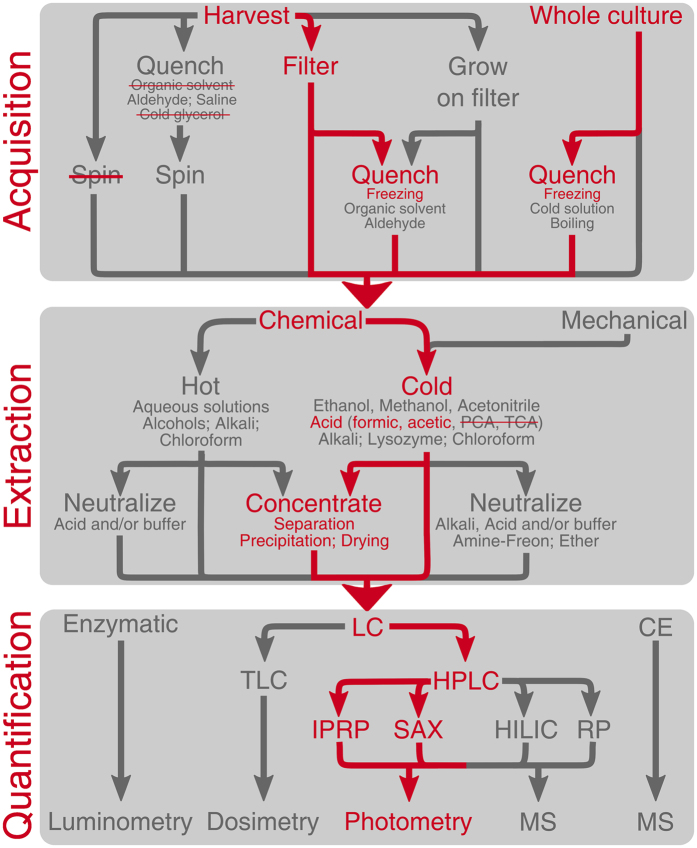
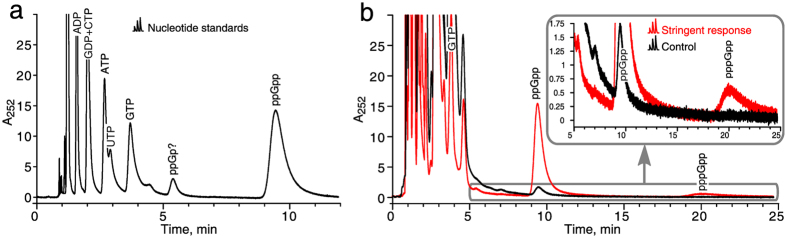
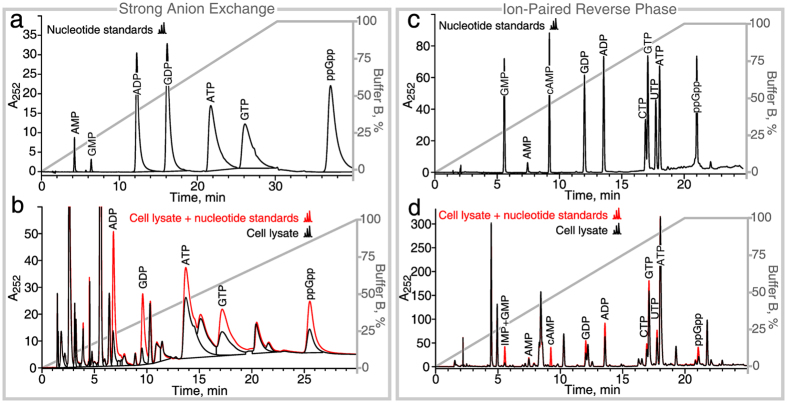
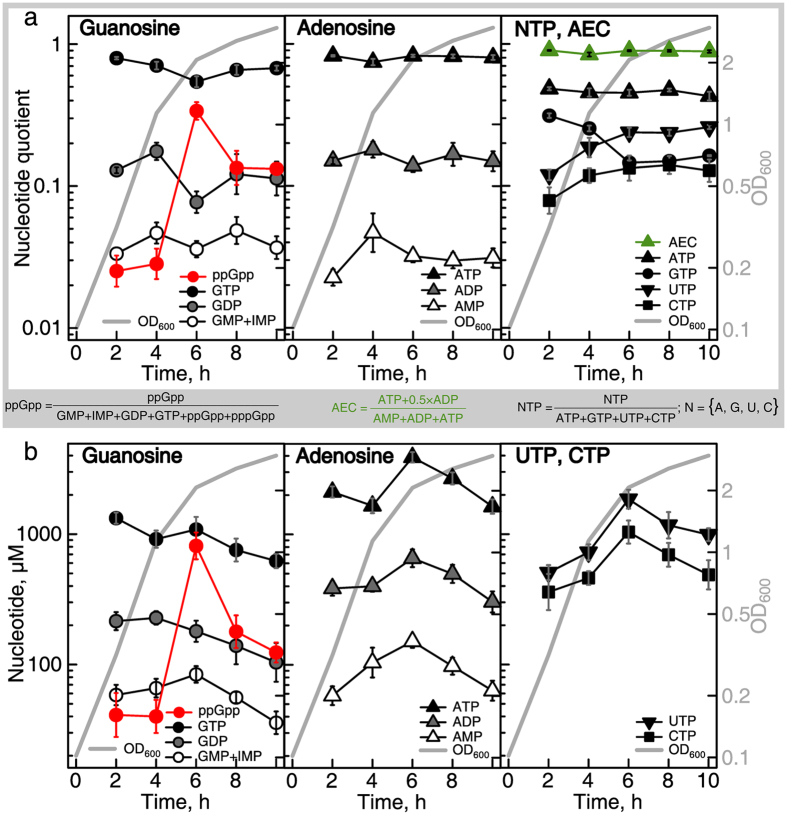
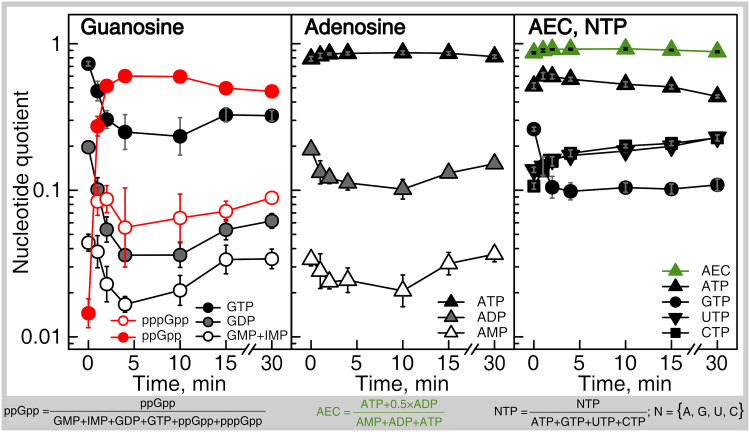
Here we describe an HPLC-based method to quantify bacterial housekeeping nucleotides and the signaling messengers ppGpp and pppGpp. We have replicated and tested several previously reported HPLC-based approaches and assembled a method that can process 50 samples in three days, thus making kinetically resolved experiments feasible. The method combines cell harvesting by rapid filtration, followed by acid extraction, freeze-drying with chromatographic separation. We use a combination of C18 IPRP-HPLC (GMP unresolved and co-migrating with IMP; GDP and GTP; AMP, ADP and ATP; CTP; UTP) and SAX-HPLC in isocratic mode (ppGpp and pppGpp) with UV detection. The approach is applicable to bacteria without the requirement of metabolic labelling with 32P-labelled radioactive precursors. We applied our method to quantify nucleotide pools in Escherichia coli BW25113 K12-strain both throughout the growth curve and during acute stringent response induced by mupirocin. While ppGpp and pppGpp levels vary drastically (40- and ≥8-fold, respectively) these changes are decoupled from the quotients of the housekeeping pool and guanosine and adenosine housekeeping nucleotides: NTP/NDP/NMP ratio remains stable at 6/1/0.3 during both normal batch culture growth and upon acute amino acid starvation.
Overview
The claims and statistics of this paper haven’t been checked yet.
Free: it reads the open-access text and checks the first 5 claims that cite a source we can check. Create a free account to check every claim.
Integrity signals
Registry
Cites
Statistics
Figures
Verification
Claims the paper makes
The claims and statistics of this paper haven’t been checked yet.
Free: it reads the open-access text and checks the first 5 claims that cite a source we can check. Create a free account to check every claim.
Claims other papers make about this one
Each is checked against this paper’s own text: does it say what the citing paper says it does?
In the citing paper
“The (p)ppGpp levels raise from approx. 40 μM during exponential phase up to approx. 1 mM at the transition into stationary phase or upon amino acid starvation (Varik et al., 2017; Haas et al., 2020; Steinchen et al., 2020).”
From The Dynamic SecYEG Translocon (2021) · cites this paper as Varik et al., 2017
Self-check
Percentages, sums and reported differences re-computed from the paper’s own numbers.
The self-check needs the paper’s full text.
Citations
Cites
NIH Image to ImageJ: 25 years of image analysis
Schneider, C. A., Rasband, W. S., & Eliceiri, K. W. (2012) · Nature Methods · doi:10.1038/nmeth.2089 · Cited by 64,638
Construction of Escherichia coli K‐12 in‐frame, single‐gene knockout mutants: the Keio collection
Baba, T., Ara, T., Hasegawa, M., Takai, Y., Okumura, Y., Baba, M., Datsenko, K. A., Tomita, M., Wanner, B. L., & Mori, H. (2006) · Molecular Systems Biology · doi:10.1038/msb4100050 · Cited by 7,858
Culture Medium for Enterobacteria
Neidhardt, F. C., Bloch, P. L., & Smith, D. F. (1974) · Journal of Bacteriology · doi:10.1128/jb.119.3.736-747.1974 · Cited by 2,958
Energy charge of the adenylate pool as a regulatory parameter. Interaction with feedback modifiers
Atkinson, D. E. (1968) · Biochemistry · doi:10.1021/bi00851a033 · Cited by 2,401 · cited 1×
“Luciferase assay of adenosine nucleotides, however, established the concept of adenylate energy charge (Atkinson 1968) and laid the foundations for all nucleotide quantifications that followed: energy charge is a crucial measure of sample acquisition, extraction and/or storage quality.”
Absolute metabolite concentrations and implied enzyme active site occupancy in Escherichia coli
Bennett, B. D., Kimball, E. H., Gao, M., Osterhout, R., Van Dien, S. J., & Rabinowitz, J. D. (2009) · Nature Chemical Biology · doi:10.1038/nchembio.186 · Cited by 1,830
Recent functional insights into the role of (p)ppGpp in bacterial physiology
Hauryliuk, V., Atkinson, G. C., Murakami, K. S., Tenson, T., & Gerdes, K. (2015) · Nature Reviews Microbiology · doi:10.1038/nrmicro3448 · Cited by 790
Self-citationAdenylate Energy Charge in Escherichia coli During Growth and Starvation
Chapman, A. G., Fall, L., & Atkinson, D. E. (1971) · Journal of Bacteriology · doi:10.1128/jb.108.3.1072-1086.1971 · Cited by 779
Complete analysis of cellular nucleotides by two-dimensional thin layer chromatography.
Bochner, B. R., & Ames, B. N. (1982) · Journal of Biological Chemistry · doi:10.1016/s0021-9258(18)34138-3 · Cited by 530 · cited 14×
“Centrifugation is not applicable for bacterial nucleotide measurements since it dramatically alters the nucleotide levels, i.e. highly phosphorylated compounds are converted to less phosphorylated species (Cole, Wimpenny et al. 1967, Chapman, Fall et al. 1971, Lowry, Carter et al. 1971, Lundin and Thore 1975, Payne an…”
BackgroundMethodInfluentialThe Control of Ribonucleic Acid Synthesis in Escherichia coli
Cashel, M. (1969) · Journal of Biological Chemistry · doi:10.1016/s0021-9258(18)93106-6 · Cited by 449 · cited 9×
“Finally, volatile acids—such as TCA, formic, and acetic acid—can be removed by freeze-drying.”
BackgroundMethodInfluentialCharacterization of Nucleotide Pools as a Function of Physiological State in Escherichia coli
Buckstein, M. H., He, J., & Rubin, H. (2008) · Journal of Bacteriology · doi:10.1128/jb.01020-07 · Cited by 370 · cited 1×
“5;12] 14[11;17] 16[13;20] 18[15;21] 20[19;22] 21[19;23] 23[21;25]”
Cited by
Novel (p)ppGpp Binding and Metabolizing Proteins of Escherichia coli
Zhang, Y., Zborníková, E., Rejman, D., & Gerdes, K. (2018) · mBio · doi:10.1128/mbio.02188-17 · Cited by 152
“Analysis of E. coli revealed that (p)ppGpp levels dramatically increased 10-to 100-fold during shifts to amino acid starvation (4, 14–16).”
Background(p)ppGpp: magic modulators of bacterial physiology and metabolism.
Steinchen, W., Zegarra, V., & Bange, G. (2020) · Frontiers in Microbiology · doi:10.3389/fmicb.2020.02072 · Cited by 130
Coping with stress: How bacteria fine-tune protein synthesis and protein transport
Njenga, R. K., Boele, J., Öztürk, Y., & Koch, H. (2023) · Journal of Biological Chemistry · doi:10.1016/j.jbc.2023.105163 · Cited by 119
A widespread toxin−antitoxin system exploiting growth control via alarmone signaling
Jimmy, S., Saha, C. K., Kurata, T., Stavropoulos, C., Oliveira, S. R. A., Koh, A., Cepauskas, A., Takada, H., Rejman, D., Tenson, T., et al. (2020) · Proceedings of the National Academy of Sciences · doi:10.1073/pnas.1916617117 · Cited by 102
“Our approach utilizes strong anion exchange (SAX) for detection and quantification of ppGpp and pppGpp, while all of the other nucleotide species are analyzed by ion-paired reverse-phase (IPRP) chromatography (24).”
InfluentialSelf-citationOswald, J., Njenga, R., Natriashvili, A., Sarmah, P., & Koch, H.-G. (2021) · Frontiers in Molecular Biosciences · doi:10.3389/fmolb.2021.664241 · Cited by 88
“N-terminal, cleavable signal sequences in secretory proteins and non-cleavable signal anchor sequences in inner membrane proteins provide the means to identify those proteins that have to be exported (Pugsley, 1990; von Heijne, 1994; Hegde and Bernstein, 2006; Steinberg et al., 2018).”
BackgroundMurina, V., Kasari, M., Hauryliuk, V., & Atkinson, G. C. (2018) · Nucleic Acids Research · doi:10.1093/nar/gky050 · Cited by 78
“To characterize the NTP specificity of VgaALC, we titrated GTP, the second most-abundant NTP species in bacteria after ATP (49) (Supplementary Figure S4B).”
BackgroundMethodSelf-citationAnalysis of nucleotide pools in bacteria using HPLC-MS in HILIC mode
Zborníková, E., Knejzlík, Z., Hauryliuk, V., Krásný, L., & Rejman, D. (2019) · Talanta · doi:10.1016/j.talanta.2019.120161 · Cited by 65
Self-citation(p)ppGpp Regulates a Bacterial Nucleosidase by an Allosteric Two-Domain Switch
Zhang, Y. E., Bærentsen, R. L., Fuhrer, T., Sauer, U., Gerdes, K., & Brodersen, D. E. (2019) · Molecular Cell · doi:10.1016/j.molcel.2019.03.035 · Cited by 58
How the initiating ribosome copes with ppGpp to translate mRNAs
Vinogradova, D. S., Zegarra, V., Maksimova, E. M., Nakamoto, J. A., Kasatsky, P. S., Paleskava, A., Konevega, A. L., & Milón, P. (2020) · PLoS Biology · doi:10.1371/journal.pbio.3000593 · Cited by 63
“Although GDP and ppGpp could compete with GTP for IF2, cellular concentrations of GDP are low at any cell growth condition [30,31], whereas (p)ppGpp accumulate to millimolar concentrations during bacterial stringent response [30,32].”
BackgroundStructural and mechanistic divergence of the small (p)ppGpp synthetases RelP and RelQ
Steinchen, W., Vogt, M. S., Altegoer, F., Giammarinaro, P. I., Horvatek, P., Wolz, C., & Bange, G. (2018) · Scientific Reports · doi:10.1038/s41598-018-20634-4 · Cited by 51
The ribosomal A-site finger is crucial for binding and activation of the stringent factor RelA
Kudrin, P., Dzhygyr, I., Ishiguro, K., Beljantseva, J., Maksimova, E., Oliveira, S. R. A., Varik, V., Payoe, R., Konevega, A. L., Tenson, T., et al. (2018) · Nucleic Acids Research · doi:10.1093/nar/gky023 · Cited by 54
“In the test tube, RelA efficiently uses both GDP and GTP as substrates, possibly with a moderate preference for GDP (12–14), while in the cell during acute stringent response the predominantly accumulated product is ppGpp (15,16).”
BackgroundMethodInfluentialSelf-citationSun, Z., Wu, R., Zhao, B., Zeinert, R., Chien, P., & You, M. (2021) · Angewandte Chemie International Edition · doi:10.1002/anie.202111170 · Cited by 45
RelA-SpoT Homolog toxins pyrophosphorylate the CCA end of tRNA to inhibit protein synthesis
Kurata, T., Brodiazhenko, T., Oliveira, S. R. A., Roghanian, M., Sakaguchi, Y., Turnbull, K. J., Bulvas, O., Takada, H., Tamman, H., Ainelo, A., et al. (2021) · Molecular Cell · doi:10.1016/j.molcel.2021.06.005 · Cited by 50
Self-citationMetabolic Reprogramming and Longevity in Quiescence
Dworkin, J. E., & Harwood, C. S. (2022) · Annual Review of Microbiology · doi:10.1146/annurev-micro-041320-111014 · Cited by 52
Roghanian, M., Semsey, S., Løbner‐Olesen, A., & Jalalvand, F. (2019) · Scientific Reports · doi:10.1038/s41598-019-39371-3 · Cited by 50
“4% of the ATP concentration in mid log phase 30 .”
BackgroundStructural basis for (p)ppGpp-mediated inhibition of the GTPase RbgA
Pausch, P., Steinchen, W., Wieland, M., Klaus, T., Freibert, S.-A., Altegoer, F., Wilson, D. N., & Bange, G. (2018) · Journal of Biological Chemistry · doi:10.1074/jbc.ra118.003070 · Cited by 44
“Accordingly, inhibition of RbgA by (p)ppGpp should only occur in the context of high (p)ppGpp concentrations during the peak of stringent response signaling, when high (p)ppGpp concentrations arise in the millimolar range (24, 25).”
BackgroundTakada, H., Roghanian, M., Caballero-Montes, J., Nerom, K. V., Jimmy, S., Kudrin, P., Trebini, F., Murayama, R., Akanuma, G., García-Pino, A., et al. (2020) · Nucleic Acids Research · doi:10.1093/nar/gkaa1187 · Cited by 41
“HPLC-based nucleotide quantification was performed as per Varik et al. (39).”
Self-citationInhibition of SRP-dependent protein secretion by the bacterial alarmone (p)ppGpp
Czech, L., Mais, C.-N., Kratzat, H., Sarmah, P., Giammarinaro, P. I., Freibert, S., Esser, H., Musial, J., Berninghausen, O., Steinchen, W., et al. (2022) · Nature Communications · doi:10.1038/s41467-022-28675-0 · Cited by 44
Bacteriophage antidefense genes that neutralize TIR and STING immune responses
Ho, P., Chen, Y., Biswas, S., Canfield, E. J., Abdolvahabi, A., & Feldman, D. E. (2023) · Cell Reports · doi:10.1016/j.celrep.2023.112305 · Cited by 47
Diversity in E. coli (p)ppGpp Levels and Its Consequences
Spira, B., & Ospino, K. (2020) · Frontiers in Microbiology · doi:10.3389/fmicb.2020.01759 · Cited by 42
“It is worth mentioning that in this as well as in other studies that analyzed (p)ppGpp in exponentially growing bacteria or in response to stresses other than amino acid starvation, pppGppwas below the detection level (Varik et al., 2017; Cruvinel et al., 2019).”
BackgroundMethodResultInfluentialFung, D. K. C., Yang, J., Stevenson, D. M., Amador‐Noguez, D., & Wang, J. D. (2020) · Frontiers in Microbiology · doi:10.3389/fmicb.2020.02083 · Cited by 38
A hyperpromiscuous antitoxin protein domain for the neutralization of diverse toxin domains
Kurata, T., Saha, C. K., Buttress, J. A., Mets, T., Brodiazhenko, T., Turnbull, K. J., Awoyomi, O. F., Oliveira, S. R. A., Jimmy, S., Ernits, K., et al. (2022) · Proceedings of the National Academy of Sciences · doi:10.1073/pnas.2102212119 · Cited by 38
“Nucleotide extraction and HPLC analyses were performed as described previously (34).”
MethodSelf-citationTakada, H., Mandell, Z. F., Yakhnin, H., Glazyrina, A., Chiba, S., Kurata, T., Wu, K. J. Y., Tresco, B. I. C., Myers, A. G., Atkinson, G. C., et al. (2022) · Nucleic Acids Research · doi:10.1093/nar/gkac497 · Cited by 40
“Since incomplete, but significant inhibition of translation is the key to induction of VmlR expression, we reasoned that, similarly to VmlR induction in the translationally compromised cshA background, VmlR might be induced in the stationary phase when bacteria experience nutrient limitation and accumulate (p)ppGpp (7…”
BackgroundSelf-citationRomand, S., Abdelkefi, H., Lecampion, C., Belaroussi, M., Dussenne, M., Ksas, B., Citerne, S., Caïus, J., D’Alessandro, S., Fakhfakh, H., et al. (2022) · eLife · doi:10.7554/elife.75041 · Cited by 34
Shyp, V., Dubey, B. N., Böhm, R., Hartl, J., Nesper, J., Vorholt, J. A., Hiller, S., Schirmer, T., & Jenal, U. (2020) · Nature Microbiology · doi:10.1038/s41564-020-00809-4 · Cited by 34
Stringent response governs the oxidative stress resistance and virulence of Francisella tularensis
Ma, Z., King, K., Alqahtani, M., Worden, M., Muthuraman, P., Cioffi, C. L., Bakshi, C. S., & Malik, M. (2019) · PLoS ONE · doi:10.1371/journal.pone.0224094 · Cited by 35
Ratiometric fluorescence detection of stringent ppGpp using Eu-MoS2 QDs test paper
Rong, M., Ye, J., Chen, B., Wen, Y., Deng, X., & Liu, Z. (2020) · Sensors and Actuators B Chemical · doi:10.1016/j.snb.2020.127807 · Cited by 29
How to save a bacterial ribosome in times of stress
Zegarra, V., Bedrunka, P., Bange, G., & Czech, L. (2022) · Seminars in Cell and Developmental Biology · doi:10.1016/j.semcdb.2022.03.015 · Cited by 35
Functional Characterization of a Small Alarmone Hydrolase in Corynebacterium glutamicum
Ruwe, M., Rückert, C., Kalinowski, J., & Persicke, M. (2018) · Frontiers in Microbiology · doi:10.3389/fmicb.2018.00916 · Cited by 26
“Using recently established HPLC-based methods for the quantification of messenger nucleotides it is possible to analyze the basal level of ppGpp in Staphylococcus aureus, Ralstonia eutropha, and E. coli (Kästle et al., 2015; Juengert et al., 2017; Varik et al., 2017).”
MethodPatacq, C., Chaudet, N., & Létisse, F. (2018) · Analytical Chemistry · doi:10.1021/acs.analchem.8b00829 · Cited by 28
CMPK2 restricts Zika virus replication by inhibiting viral translation
Pawlak, J. B., Hsu, J. C.-C., Xia, H., Han, P., Suh, H., Grove, T. L., Morrison, J. M., Shi, P., Cresswell, P., & Laurent-Rolle, M. (2023) · PLoS Pathogens · doi:10.1371/journal.ppat.1011286 · Cited by 26
“Cells were doxycycline-treated for 24 h, and then collected, washed, lyophilized and resuspended in diH2O before high-performance liquid chromatography (HPLC) analysis [81,82].”
MethodMultiplexed sequential imaging in living cells with orthogonal fluorogenic RNA aptamer/dye pairs
Zheng, R., Wu, R., Liu, Y., Sun, Z., Xue, Z., Bagheri, Y., Khajouei, S., Mi, L., Tian, Q., Pho, R., et al. (2024) · Nucleic Acids Research · doi:10.1093/nar/gkae551 · Cited by 33
The Ps and Qs of alarmone synthesis in Staphylococcus aureus
Yang, N., Xie, S., Tang, N. Y., Choi, M. Y., Wang, Y., & Watt, R. M. (2019) · PLoS ONE · doi:10.1371/journal.pone.0213630 · Cited by 26
Haas, T. M., Qiu, D., Häner, M., Angebauer, L., Ripp, A., Singh, J., Koch, H.-G., Jessen-Trefzer, C., & Jessen, H. J. (2020) · The Journal of Organic Chemistry · doi:10.1021/acs.joc.0c00841 · Cited by 25
Riber, L., & Løbner‐Olesen, A. (2020) · Molecular Microbiology · doi:10.1111/mmi.14531 · Cited by 25
“An increased ATP level during the stringent response and during rifampicin treatment (Lobritz et al., 2015; Varik et al., 2017) could add to the increase.”
BackgroundImholz, N. C. E., Noga, M. J., van den Broek, N. J. F., & Bokinsky, G. (2020) · Frontiers in Microbiology · doi:10.3389/fmicb.2020.574872 · Cited by 27
Tipping, M. J., & Gibbs, K. A. (2019) · PLoS Pathogens · doi:10.1371/journal.ppat.1007885 · Cited by 27
“Therefore, we directly measured total ppGpp quantities in cells harvested from clonal wildtype, clonal Δ ids , and clonal Δ idsE swarms experiencing Ids mismatch using a recently described high performance liquid chromatography (HPLC)-based technique (42).”
MethodAt the Crossroad of Nucleotide Dynamics and Protein Synthesis in Bacteria
Leiva, L. E., Zegarra, V., Bange, G., & Ibba, M. (2023) · Microbiology and Molecular Biology Reviews · doi:10.1128/mmbr.00044-22 · Cited by 27
“8 mM (15) (Table 1), significantly above the dissociation constants (Kds) of ribosome biogenesis and translation-associated enzymes and at sufficiently high levels at which enzymes associated with carbon metabolism and fatty acid biosynthesis can be targeted (14).”
BackgroundMagic spot nucleotides: tunable target-specific chemoenzymatic synthesis
Haas, T., Ebensperger, P., Eisenbeis, V. B., Nopper, C., Dürr‐Mayer, T., Jork, N., Steck, N., Jessen‐Trefzer, C., & Jessen, H. J. (2019) · Chemical Communications · doi:10.1039/c9cc01688k · Cited by 25
Bacterial Chromosome Replication and DNA Repair During the Stringent Response
Sinha, A. K., Løbner‐Olesen, A., & Riber, L. (2020) · Frontiers in Microbiology · doi:10.3389/fmicb.2020.582113 · Cited by 24
Bartoli, J., Citerne, S., Mouille, G., Bouveret, E., & Field, B. (2019) · Talanta · doi:10.1016/j.talanta.2020.121261 · Cited by 21
“Ion exchange HPLC methods with UV detection have also been developed for the quantification of G4P and G5P in bacteria, and these methods have the advantage of allowing the simultaneous quantification of other nucleotides [3,4].”
MethodChen, J., Huang, Y., Yang, X., Zhang, H., Li, Z., Qin, B. Q., Chen, X., & Qiu, H. (2018) · Analytica Chimica Acta · doi:10.1016/j.aca.2018.02.082 · Cited by 20
Understanding the Stringent Response: Experimental Context Matters
Dworkin, J. E. (2023) · mBio · doi:10.1128/mbio.03404-22 · Cited by 27
GTPase Era at the heart of ribosome assembly
Gruffaz, C., & Smirnov, A. (2023) · Frontiers in Molecular Biosciences · doi:10.3389/fmolb.2023.1263433 · Cited by 20
Bennison, D. J., Nakamoto, J. A., Craggs, T. D., Milón, P., Rafferty, J. B., & Corrigan, R. M. (2021) · mBio · doi:10.1128/mbio.02679-21 · Cited by 19
Pokhrel, A., Poudel, A., Castro, K. B., Celestine, M. J., Oludiran, A., Rinehold, A. J., Resek, A. M., Mhanna, M. A., & Purcell, E. B. (2020) · Journal of Bacteriology · doi:10.1128/jb.00377-20 · Cited by 17
“GDP levels remain more stable during phase transition (91, 92).”
BackgroundLamprecht, O., Ratnikava, M., Jacek, P., Kaganovitch, E., Buettner, N., Fritz, K., Biazruchka, I., Köhler, R., Pietsch, J. M., & Sourjik, V. (2023) · PLoS Genetics · doi:10.1371/journal.pgen.1010750 · Cited by 17
“In both cases the onset of induction apparently 170 coincided with the reduction of the growth rate, which might occur due to depletion of amino 171 acids in the medium and induction of the stringent response [36, 37], consistent with the 172 proposed role of the stringent response in the regulatory cascade leading to…”
Ruwe, M., Persicke, M., Busche, T., Muller, B. Z., & Kalinowski, J. (2019) · Frontiers in Microbiology · doi:10.3389/fmicb.2019.02769 · Cited by 16
Nucleotide-induced hyper-oligomerization inactivates transcription termination factor ρ
Wang, B., Said, N., Hilal, T., Finazzo, M., Wahl, M. C., & Artsimovitch, I. (2025) · Nature Communications · doi:10.1038/s41467-025-56824-8 · Cited by 14
Stevens, C. E., Deventer, A. T., Johnston, P. R., Lowe, P. T., Boraston, A. B., & Hobbs, J. K. (2025) · Molecular Microbiology · doi:10.1111/mmi.70000 · Cited by 14
Principles of RNA and nucleotide discrimination by the RNA processing enzyme RppH
Gao, A., Vasilyev, N., Kaushik, A., Duan, W., & Serganov, A. (2020) · Nucleic Acids Research · doi:10.1093/nar/gkaa024 · Cited by 14
“Stressful environmental conditions also elevate the biosynthesis of the alarmone (p)ppGpp to similarly high concentrations (5).”
BackgroundInfluentialWood, W. N., Mohler, K., Rinehart, J., & Ibba, M. (2021) · mBio · doi:10.1128/mbio.01132-21 · Cited by 19
“coli cell growing in exponential phase equals 1 10(215) liter (58, 59).”
BackgroundStrezsak, S. R., Beuning, P. J., & Skizim, N. J. (2021) · Journal of Chromatography B · doi:10.1016/j.jchromb.2021.123044 · Cited by 15
Glyphosate induces the synthesis of ppGpp
Cruvinel, G. T., Neves, H., & Spira, B. (2018) · Molecular Genetics and Genomics · doi:10.1007/s00438-018-1499-1 · Cited by 15
Myers, A. R., Thistle, D. P., Ross, W., & Gourse, R. L. (2020) · Frontiers in Microbiology · doi:10.3389/fmicb.2020.587098 · Cited by 13
“…induction of RelA in response Frontiers in Microbiology | www.frontiersin.org 2 November 2020 | Volume 11 | Article 587098 to the accumulation of deacylated tRNA(s) increases the ppGpp concentration 100–1,000-fold, dramatically changing gene expression (Ryals et al., 1982; Varik et al., 2017).”
BackgroundFung, D. K. C., Bai, K., Yang, J., Xu, X., Stevenson, D. M., Amador‐Noguez, D., Luo, L., & Wang, J. D. (2022) · mBio · doi:10.1128/mbio.02422-22 · Cited by 14
“to low millimolar levels in cells (4, 5) to directly regulate many central cellular proc-”
BackgroundBiochemical determinants of ObgE‐mediated persistence
Verstraeten, N., Gkekas, S., Kint, C. I., Deckers, B., den Bergh, B. V., Herpels, P., Louwagie, E., Knapen, W., Wilmaerts, D., Dewachter, L., et al. (2019) · Molecular Microbiology · doi:10.1111/mmi.14382 · Cited by 13
“5 mM), a small fraction of GTP-bound mutant ObgE could still exist, which is sufficient to sustain viability (Buckstein et al., 2008; Varik et al., 2017).”
BackgroundInfluentialBrückner, S., Müller, F., Schadowski, L., Kalle, T., Weber, S., Marino, E. C., Kutscher, B., Möller, A., Adler, S., Begerow, D., et al. (2023) · microLife · doi:10.1093/femsml/uqad031 · Cited by 12
Stochastic nature and physiological implications of 5′-NAD RNA cap in bacteria
Wiedermannová, J., Babu, R., & Yuzenkova, Y. (2024) · Nucleic Acids Research · doi:10.1093/nar/gkae813 · Cited by 12
“This concentration falls within the physiological range of ppGpp concentration—around 100 μ M during the stationary phase and transiently higher during the transition from exponential to stationary phase ( 68 ).”
Bacterial transcriptional repressor NrdR – a flexible multifactorial nucleotide sensor
Grinberg, I. R., Bimaï, O., Shahid, S., Philipp, L., Martínez‐Carranza, M., Banerjee, I., Lundin, D., Stenmark, P., Sjöberg, B., & Logan, D. T. (2025) · FEBS Journal · doi:10.1111/febs.70037 · Cited by 9
“S2), the physiological relevance of the combination ADP-dADP is questionable, since the intracellular concentration of dNDP in general is very low [17,18].”
(p)ppGpp-dependent activation of gene expression during nutrient limitation
Nagarajan, S. N., Rosenthal, A., & Dworkin, J. E. (2025) · mBio · doi:10.1128/mbio.01288-25 · Cited by 9
“However, evidence that decreases in GTP levels are not necessarily correlated with increases in (p)ppGpp levels (11) suggests that this mechanism may not be sufficient.”
Milewska, K., Krause, K., & Szalewska-Pałasz, A. (2019) · Journal of Applied Genetics · doi:10.1007/s13353-019-00531-w · Cited by 9
Optimized Loopable Translation as a Platform for the Synthesis of Repetitive Proteins
Lee, S. O., Xie, Q., & Fried, S. D. (2021) · ACS Central Science · doi:10.1021/acscentsci.1c00574 · Cited by 9
Julius, C., Salgado, P. S., & Yuzenkova, Y. (2020) · Nucleic Acids Research · doi:10.1093/nar/gkaa447 · Cited by 9
Gut microbes modulate (p)ppGpp during a time-restricted feeding regimen
Ontai, A., Hamchand, R., Crawford, J. M., & Goodman, A. L. (2023) · mBio · doi:10.1128/mbio.01907-23 · Cited by 11
“Chromatography was performed as described (31) with modifications.”
MethodPletnev, P. I., Pupov, D., Pshanichnaya, L., Esyunina, D., Petushkov, I., Nesterchuk, M. V., Osterman, I. А., Rubtsova, M. P., Mardanov, A. V., Ravin, N. V., et al. (2020) · Nucleic Acids Research · doi:10.1093/nar/gkaa798 · Cited by 8
“coli cells may be as high as 1–2 mM (83), so it may be speculated that saturating levels of ppGpp in combination with DksA are able to efficiently suppress transcription in the mutant strain.”
BackgroundAnalysis of (p)ppGpp metabolism and signaling using a dynamic luminescent reporter
Hydorn, M. A., Nagarajan, S. N., Fones, E. M., Harwood, C. S., & Dworkin, J. E. (2025) · PLoS Genetics · doi:10.1371/journal.pgen.1011691 · Cited by 7
“However, GTP levels do not significantly fall during the time of RsFluc activity (S2B Fig), similar to that observed when (p)ppGpp and GTP abundances were monitored by HPLC during E. coli growth [24].”
Loon, J. C. V., Whitfield, G. B., Wong, N., O’Neal, L., Henrickson, A., Demeler, B., O’Toole, G. A., Parsek, M. R., & Howell, P. L. (2024) · Journal of Bacteriology · doi:10.1128/jb.00331-23 · Cited by 10
“Journal of Bacteriology Month XXXX Volume 0 Issue 0 10.1128/jb.00331-23 16 In general, the basal level of GTP in Gram-negative bacterial cells growing under optimal conditions is in the low millimolar range (38, 55–58).”
BackgroundInfluentialCabrer‐Panes, J. D., Fernández‐Coll, L., Fernández‐Vázquez, J., Gaviria-Cantin, T., Mouali, Y. E., Åberg, A., & Balsalobre, C. (2020) · Environmental Microbiology Reports · doi:10.1111/1758-2229.12860 · Cited by 10
Wang, M., Tang, N. Y., Xie, S., & Watt, R. M. (2023) · Microbiology Spectrum · doi:10.1128/spectrum.05100-22 · Cited by 7
Wu, L., Piedade, G. J., Moore, R. M., Harrison, A. O., Martins, A. M., Bidle, K. D., Polson, S. W., Sakowski, E. G., Nissimov, J. I., Dums, J. T., et al. (2023) · ISME Communications · doi:10.1038/s43705-023-00306-9 · Cited by 10
A widespread toxin-antitoxin system exploiting growth control via alarmone signallingPreprint
Jimmy, S., Saha, C. K., Stavropoulos, C., Oliveira, S. R. A., Kurata, T., Koh, A., Čepauskas, A., Takada, H., Tenson, T., Strahl, H., et al. (2019) · bioRxiv (Cold Spring Harbor Laboratory) · doi:10.1101/575399 · Cited by 6
Self-citationBonar, C. D., Han, J. M., Wang, R., Panchapakesan, S. S. S., & Unrau, P. J. (2022) · RNA · doi:10.1261/rna.079356.122 · Cited by 5
Kataoka, N., Matsutani, M., Matsumoto, N., Oda, M., Mizumachi, Y., Ito, K., Tanaka, S., Kanesaki, Y., Yakushi, T., & Matsushita, K. (2022) · Frontiers in Microbiology · doi:10.3389/fmicb.2022.802010 · Cited by 4
Liu, S., Fang, Z., Li, Y., Kang, L., Cong, H., Shen, Y., & Yu, B. (2023) · Journal of Chromatographic Science · doi:10.1093/chromsci/bmad006 · Cited by 5
How to quantify magic spots - a brief overview of (p)ppGpp detection and quantitation methods
Gąsior, F., Klasa, W., & Potrykus, K. (2025) · Frontiers in Molecular Biosciences · doi:10.3389/fmolb.2025.1574135 · Cited by 4
The stringent response does not influence ribosome pausing in Bacillus subtilis
Han, Y., Agnolin, A., van der Kloet, F. M., Sauer, C., Costea, P. I., Felle, M. F., Appelbaum, M., & Hamoen, L. W. (2025) · Nucleic Acids Research · doi:10.1093/nar/gkaf1088 · Cited by 3
“The stringent response reduces GTP levels and blocks synthesis of purine nucleotides [ 6 ], and it is assumed that the absence of a functional stringent response interferes with a healthy nucleotide balance during the stationary phase [ 61 ].”
Fernández‐Vázquez, J., Cabrer‐Panes, J. D., Åberg, A., Juárez, A., Madrid, C., Gaviria-Cantin, T., Fernández‐Coll, L., Vargas-Sinisterra, A. F., Jiménez, C. J., & Balsalobre, C. (2022) · International Journal of Molecular Sciences · doi:10.3390/ijms232012256 · Cited by 3
(p)ppGpp is required for virulence of Shigella flexneri
Kago, G., Turnbough, C. L., Salazar, J. C., & Payne, S. M. (2023) · Infection and Immunity · doi:10.1128/iai.00334-23 · Cited by 6
“…guanosine pentaphos phate (pppGpp) (39) collectively referred to as (p)ppGpp. Intracellular concentrations of (p)ppGpp increase from micromolar to millimolar levels upon nutrient limitation (40–42), and they are synthesized by proteins which belong to the RelA/SpoT Homologue (RSH) family (43–45).”
BackgroundScharf, A., La‐Rostami, F., Illarionov, B. A., Nemes, V., Feldmann, A. M., Höft, L. S., Lösel, H., Bacher, A., & Fischer, M. J. (2024) · ChemBioChem · doi:10.1002/cbic.202400165 · Cited by 2
Diribonuclease activity eliminates toxic diribonucleotide accumulation
Kim, S.-K., Orr, M. W., Turdiev, H., Jenkins, C. C., Lormand, J. D., Myers, T. M., Burnim, A. A., Carter, J., Kung, W. C., Jiang, X., et al. (2024) · Cell Reports · doi:10.1016/j.celrep.2024.114759 · Cited by 3
“…analyses were performed using Prism 7 software. cytosine, and uracil) includes mono-, di-, and tri-phosphate versions and has been measured in E. coli for a combined total of 5.2 mM. 36,37 In this estimate, there would be ~5.2 × 10 6 nt in the cell as mononucleotides for WT P. aeruginosa and Δ orn.”
MethodInfluentialFernández‐Coll, L., & Cashel, M. (2019) · Journal of Visualized Experiments · doi:10.3791/59595 · Cited by 3
Comparison of Five Extraction Methods for Intracellular Metabolites of Salmonella typhimurium
Tian, S., Wang, C., Yang, L., Zhang, Y., & Tang, T. (2019) · Current Microbiology · doi:10.1007/s00284-019-01750-4 · Cited by 3
Takada, H., Roghanian, M., Caballero-Montes, J., Nerom, K. V., Jimmy, S., Kudrin, P., Trebini, F., Murayama, R., Akanuma, G., García-Pino, A., et al. (2020) · bioRxiv (Cold Spring Harbor Laboratory) · doi:10.1101/2020.01.17.910273 · Cited by 3
“As bacteria enter the stationary phase and nutrients become limiting, the ribosome-associated 190 RSHs RelA/Rel are activated and the intracellular concentration of (p)ppGpp increases (35).”
BackgroundMethodSelf-citationGenome-wide ribonucleotide detection in Archaea
Moalic, Y., Reveil, M., Kundnani, D. L., Balachander, S., Yang, T., Gombolay, A., Ranjbarian, F., Brizard, R., Durand, P., Myllykallio, H., et al. (2025) · Nucleic Acids Research · doi:10.1093/nar/gkaf1231 · Cited by 2
“7 ) [ 69 ].”
Metabolic silencing induced by the small bacterial membrane protein YohP
Natriashvili, A., Mohammadsadeghi, N., Milanov, M., Smudde, E., Prucker, I., Jessen, H. J., Carabadjac, I., Heerklotz, H. H., Franco, P. H. C., Langer, J. D., et al. (2025) · iScience · doi:10.1016/j.isci.2025.114123 · Cited by 4
Varik, V., Wang, G., Kritikos, G., Banzhaf, M., Drouot, E., Koumoutsi, A., & Bambeke, F. V. (2025) · Antimicrobial Agents and Chemotherapy · doi:10.1128/aac.01319-25 · Cited by 2
“Fast-growing bacteria have a set of genes transcribed at a high rate, which RelA rapidly curtails upon perturbations (57–59), driving the accumulation of (p)ppGpp (61).”
Self-citationPravdová, A., Kleinert, M., Henderson, J., Kafkia, E., Pladevall‐Morera, D., Yonamine, C. Y., Treebak, J. T., Brodiazhenko, T., Terenin, I. M., Żylicz, J. J., et al. (2026) · Analytical Chemistry · doi:10.1021/acs.analchem.6c00721 · Cited by 3
Translation factors that keep the ribosome Pro-active
Feaga, H. A. (2026) · Microbiology and Molecular Biology Reviews · doi:10.1128/mmbr.00017-26 · Cited by 3
“However, ATP/ADP ratios are extremely stable, even during starvation (134–136).”
Regulation of the transcription factor CdnL promotes adaptation to nutrient stress in Caulobacter
Smith, E. L., Panis, G., Woldemeskel, S. A., Viollier, P. H., Chien, P., & Goley, E. D. (2024) · PNAS Nexus · doi:10.1093/pnasnexus/pgae154 · Cited by 2
“(p)ppGpp levels peak upon entry into the stationary phase, and then dip to stabilize at levels that are higher than basal levels occurring during logarithmic growth (28).”
BackgroundDirect detection of stringent alarmones (pp)pGpp using malachite green
Schicketanz, M. L., Petrová, M., Rejman, D., Sosio, M., Donadio, S., & Zhang, Y. E. (2024) · Microbial Cell · doi:10.15698/mic2024.08.834 · Cited by 3
Liu, N. B., Vita, N., Holmière, M., Gagnot, S., Brasseur, G., de Philip, P., Pagès, S., Perret, S., & Fierobe, H. (2025) · Communications Biology · doi:10.1038/s42003-025-07971-7 · Cited by 2
Live-Cell Imaging of (p)ppGpp with RNA-based Fluorescent SensorsPreprint
Sun, Z., Wu, R., Zhao, B., Zeinert, R., Chien, P., & You, M. (2021) · bioRxiv (Cold Spring Harbor Laboratory) · doi:10.1101/2021.05.12.443921 · Cited by 2
Green, R., Richards, H., Ozbilek, D., Tyrrell, F., Barton, V., Lovell, S. C., Gifford, D. R., Lagator, M., McBain, A. J., Krašovec, R., et al. (2025) · bioRxiv (Cold Spring Harbor Laboratory) · doi:10.1101/2025.01.28.635215 · Cited by 2
Green, R., Richards, H., Ozbilek, D., Tyrrell, F., Barton, V., Zhang, Z., Lovell, S. C., Gifford, D. R., Lagator, M., McBain, A. J., et al. (2025) · Molecular Biology and Evolution · doi:10.1093/molbev/msaf182 · Cited by 4
“We suggest that future work should measure individual nucleotide, dNDP, dNTP and NTP molecule concentrations in Δ nudJ and the wildtype to specifically quantify any imbalance in these nucleotide pools potentially using HPLC-based methods as in Buckstein et al. (2008) and Varik et al. (2017) .”
Functional diversity and molecular interactions of small membrane proteins in bacteria
Yuan, J., Koch, H., & Berghoff, B. A. (2025) · microLife · doi:10.1093/femsml/uqaf035 · Cited by 4
“This then raises the question on how stress-induced membrane proteins are inserted into the membrane, when the SRP system is inactivated by accumulating (p)ppGpp, which can reach a cellular concentration of up to 1 mM (Potrykus and Cashel 2008 , Varik et al. 2017 ).”
Sinha, A. R., & Goulian, M. (2026) · Cell Reports · doi:10.1016/j.celrep.2025.116813 · Cited by 1
Adriaans, I. E., Álvarez‐Mena, A., Dinet, C., Morvan, E., Lim, K., Dufourc, É. J., Wong, R. W.-C., Chastanet, A., Michelot, A., Carballido‐López, R., et al. (2026) · Biophysical Journal · doi:10.1016/j.bpj.2026.06.003 · Cited by 3
“Although the intracellular ATP/ADP ratio ([ATP] = 2–2.6 mM and [ADP] = 0.4–0.8 mM measured in Escherichia coli 49,50 ) would imply that most MreB Gs monomers are ATP bound, this ratio is known to vary depending on growth conditions such as nutrient availability, growth rate, or environmental stress.”
InfluentialPhage portal proteins counteract stringent-response–mediated restriction
Kronborg, K., Wang, L., Schicketanz, M. L., Gerdes, K., & Zhang, Y. E. (2026) · Nature Communications · doi:10.1038/s41467-026-75532-5 · Cited by 3
“(p)ppGpp is a very labile molecule not suited for analysis by HPLC or mass spectrometry 55 .”
Chrenková, A., Bisiak, F., & Brodersen, D. E. (2024) · Trends in Microbiology · doi:10.1016/j.tim.2023.12.011 · Cited by 2
Metadata
- Authors
- Varik, V., Oliveira, S. R. A., Hauryliuk, V., & Tenson, T.
- Affiliations
- University of Tartu (EE)
- Corresponding author
- Varik, Vallo
- Hauryliuk, Vasili
- Tenson, Tanel
- Venue
- Scientific Reports
- Published
- 2017-09-08
- Volume
- 7
- Issue
- 1
- Pages
- 11022-11022
- ISSN
- 2045-2322 (ISSN-L)
- PMC
- PMC5591245
- OpenAlex
- W2752128520
- Semantic Scholar
- a7f52d2dea5929c751d2035b8e2c7389d6cf5f38
- Cited by
- 124
- References
- 61
- Citations by year
- 2026: 15 · 2025: 18 · 2024: 8 · 2023: 15 · 2022: 13 · 2021: 11 · 2020: 20 · 2019: 14 · 2018: 10
- FWCI
- 7.97
- Type
- journal article
- Language
- en
- Open access
- gold
- doi.org
- Licence
- cc-by
- creativecommons.org/licenses/by/4.0 (tdm)
- creativecommons.org/licenses/by/4.0 (vor)
- Locations
- Scientific Reports (publishedVersion, cc-by)
- PubMed Central (publishedVersion, cc-by)
- PubMed (publishedVersion)
- KTH Publication Database DiVA (KTH Royal Institute of Technology) (submittedVersion, other-oa)
- DOAJ (DOAJ: Directory of Open Access Journals) (submittedVersion)
- Funders
- Kempe Foundation
- Eesti Teadusagentuur (IUT2-22)
- Vetenskapsrådet (2013-04680)
- European Regional Development Fund
- Topics
- Life Sciences › Biochemistry, Genetics and Molecular Biology › Genetics › Bacterial Genetics and Biotechnology
- Life Sciences › Biochemistry, Genetics and Molecular Biology › Molecular Biology › Biochemical and Molecular Research
- Life Sciences › Biochemistry, Genetics and Molecular Biology › Molecular Biology › Microbial Metabolic Engineering and Bioproduction
- Keywords
- ppGpp, pppGpp, nucleotide quantification, stringent response, mupirocin, amino acid starvation, Escherichia coli, nucleotide pools, acid extraction
- MeSH terms
- Chromatography, High Pressure Liquid, Escherichia coli, Guanosine Pentaphosphate, Guanosine Tetraphosphate, Nucleotides, Protein Synthesis Inhibitors, Mupirocin
About these checks
Registry, retraction, Cites and statistics results are computed, not judged, with one exception: a printed reference that no index lists is read once by a model before it counts as a citation error. Claims are extracted by a model and kept only when their quote appears verbatim in the text; each cited source is then checked, with a model’s help, for whether it says what the claim relies on. Those verdicts can be wrong — read the claim’s quote and the cited source before relying on one.
Statistics and arithmetic are recomputed, not judged.
Confidence bands are shown only for fields calibrated on our annotated test set. None is calibrated yet, so no band is shown.
What counts as a claim ›How we measure confidence ›How we check this ›
Are you an author, or do you see a problem with this page? Request a review
Data sources
Bibliographic data: Semantic Scholar, OpenAlex, Crossref.
Contains information from the Semantic Scholar Academic Graph Datasets, made available under the ODC Attribution License (ODC-BY 1.0).
Semantic Scholar’s data is described in: Kinney, R., et al. (2023). The Semantic Scholar Open Data Platform. arXiv:2301.10140.
