

The DOI matches its Crossref record; 50 of the 50 references it cites were found in a registry or an index.
Comparative effectiveness of telemedicine strategies on type 2 diabetes management: A systematic review and network meta-analysis
Open accessAbstract
The effects of telemedicine strategies on the management of diabetes is not clear. This study aimed to investigate the impact of different telemedicine strategies on glycaemic control management of type 2 diabetes patients. A search was performed in 6 databases from inception until September 2016 for randomized controlled studies that examined the use of telemedicine in adults with type 2 diabetes. Studies were independently extracted and classified according to the following telemedicine strategies: teleeducation, telemonitoring, telecase-management, telementoring and teleconsultation. Traditional and network meta-analysis were performed to estimate the relative treatment effects. A total of 107 studies involving 20,501 participants were included. Over a median of 6 months follow-up, telemedicine reduced haemoglobin A1c (HbA1c) by a mean of 0.43% (95% CI: −0.64% to −0.21%). Network meta-analysis showed that all telemedicine strategies were effective in reducing HbA1c significantly compared to usual care except for telecase-management and telementoring, with mean difference ranging from 0.37% and 0.71%. Ranking indicated that teleconsultation was the most effective telemedicine strategy, followed by telecase-management plus telemonitoring, and finally teleeducation plus telecase-management. The review indicates that most telemedicine strategies can be useful, either as an adjunct or to replace usual care, leading to clinically meaningful reduction in HbA1c.
Overview
The claims and statistics of this paper haven’t been checked yet.
Run the check — free, no account needed. It reads the open-access text and checks the sources it cites.
Integrity signals
Registry
Cites
Statistics
Figures
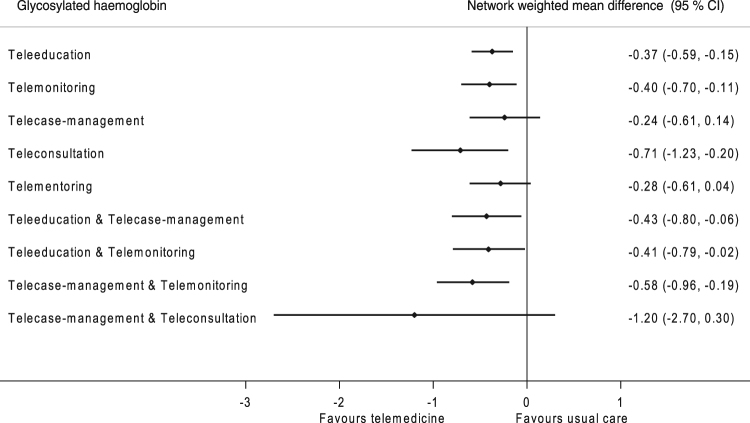
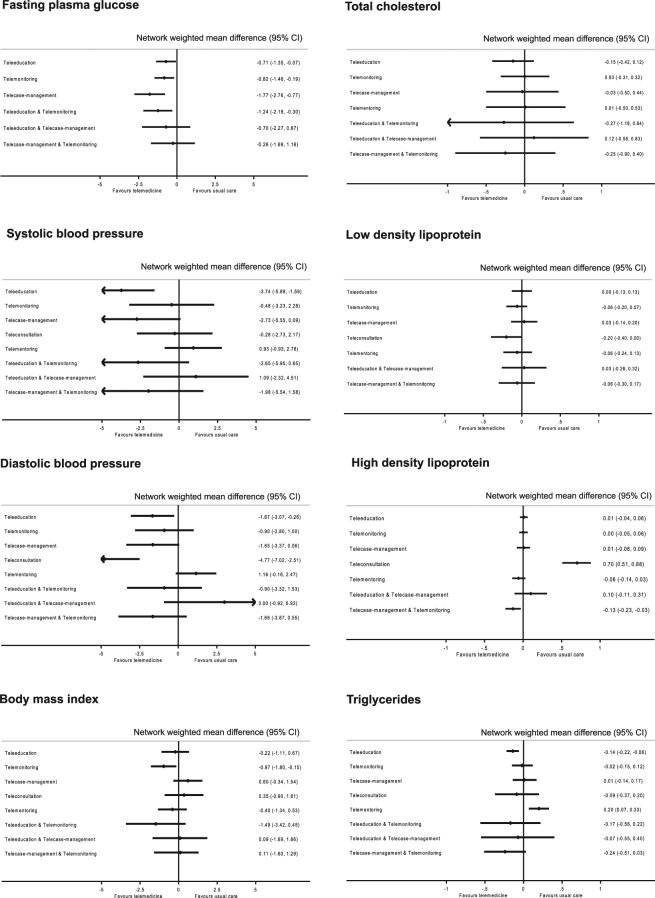
Verification
Claims the paper makes
The claims and statistics of this paper haven’t been checked yet.
Run the check — free, no account needed. It reads the open-access text and checks the sources it cites.
Claims other papers make about this one
Each is checked against this paper’s own text: does it say what the citing paper says it does?
The source backs part of the claim, not all of it — or backs it for a different population, condition or comparison.
In the citing paper
“Although previous research has compared the effectiveness of 5 strategies for T2DM management, it has primarily focused on telemedicine within DHIs and compared several independent strategies, without providing a systematic summary of the strategies used in DHIs [37].”
From Assessing the Effectiveness of Digital Health Behavior Strategies on Type 2 Diabetes Management: Systematic Review and Network Meta-Analysis (2025) · cites this paper as [37]
Experimental — accuracy not yet measuredThe source backs part of the claim, not all of it — or backs it for a different population, condition or comparison.
In the citing paper
“However, there is currently a lack of categorization and summarization of the strategies used in DHIs for T2DM.”
From Assessing the Effectiveness of Digital Health Behavior Strategies on Type 2 Diabetes Management: Systematic Review and Network Meta-Analysis (2025) · cites this paper as [37]
Experimental — accuracy not yet measuredThe cited source says what the claim attributes to it.
In the citing paper
“Two reviews compared different virtual care strategies and found that no single strategy was superior for reducing HbA1c [20, 48].”
From Effect of virtual care in type 2 diabetes management – a systematic umbrella review of systematic reviews and meta-analysis (2025) · cites this paper as [20]
The cited source says what the claim attributes to it.
In the citing paper
“Of the 3 reviews that analysed the effect of teleconsultation interventions vs usual care, all reported significant effects on lowering HbA1c levels [20, 21, 29].”
From Effect of virtual care in type 2 diabetes management – a systematic umbrella review of systematic reviews and meta-analysis (2025) · cites this paper as [20]
The check wasn’t confident either way, so it gives no verdict — never disputed.
In the citing paper
“Those persons with lower socioeconomic status have a higher risk for developing T2D, worse DM control, and more DM-related complications.1661–1663”
From American Association of Clinical Endocrinology Clinical Practice Guideline: Developing a Diabetes Mellitus Comprehensive Care Plan-2022 Update. (2022) · cites this paper as [1663]
Experimental — accuracy not yet measured
In the citing paper
“According to another network meta-analysis, teleconsultation was significantly more effective over conventional care at lowering HbA1c (−0.64, 95% CI −3.74 to −0.02; I2=98%).4”
From Effectiveness of synchronous teleconsultation for patients with type 2 diabetes mellitus: a systematic review and meta-analysis (2023) · cites this paper as [4]
In the citing paper
“According to a previous review, the most effective telemedicine technique is teleconsultation.4”
From Effectiveness of synchronous teleconsultation for patients with type 2 diabetes mellitus: a systematic review and meta-analysis (2023) · cites this paper as [4]
In the citing paper
“Thus, teleconsultation is a complex intervention, and the heterogeneity of the studies included in this meta-analysis is significant, as previous meta-analyses have also demonstrated.4 6 8”
From Effectiveness of synchronous teleconsultation for patients with type 2 diabetes mellitus: a systematic review and meta-analysis (2023) · cites this paper as [4]
Self-check
Percentages, sums and reported differences re-computed from the paper’s own numbers.
The self-check needs the paper’s full text.
Citations
Cites
Measuring inconsistency in meta-analyses
Higgins, J. P. T., Thompson, S. G., Deeks, J. J., & Altman, D. G. (2003) · BMJ · doi:10.1136/bmj.327.7414.557 · Cited by 63,139
Cochrane Handbook for Systematic Reviews of Interventions: Cochrane Book Series
(2008) · doi:10.1002/9780470712184 · Cited by 25,048
International Diabetes Federation 2017
Carracher, A. M., Marathe, P. H., & Close, K. L. (2018) · Journal of Diabetes · doi:10.1111/1753-0407.12644 · Cited by 13,379
Graphical tools for network meta-analysis in STATA
Chaimani, A., Higgins, J. P. T., Mavridis, D., Spyridonos, P., & Salanti, G. (2013) · PLoS ONE · doi:10.1371/journal.pone.0076654 · Cited by 2,473
Consistency and inconsistency in network meta-analysis: concepts and models for multi-arm studies
Higgins, J. P. T., Jackson, D., Barrett, J. K., Lu, G., Ades, A. E., & White, I. R. (2012) · Research Synthesis Methods · doi:10.1002/jrsm.1044 · Cited by 2,098
Diabetes in Asia: Epidemiology, Risk Factors, and Pathophysiology
Chan, J. C. N., Malik, V., Jia, W., Kadowaki, T., Yajnik, C. S., Yoon, K.-H., & Hu, F. B. (2009) · JAMA · doi:10.1001/jama.2009.726 · Cited by 1,997
Advanced methods in meta‐analysis: multivariate approach and meta‐regression
van Houwelingen, H. C., Arends, L. R., & Stijnen, T. (2002) · Statistics in Medicine · doi:10.1002/sim.1040 · Cited by 1,599
Controlling the risk of spurious findings from meta-regression
Higgins, J. P. T., & Thompson, S. G. (2004) · Statistics in Medicine · doi:10.1002/sim.1752 · Cited by 1,267
White, I. R., Barrett, J. K., Jackson, D., & Higgins, J. P. T. (2012) · Research Synthesis Methods · doi:10.1002/jrsm.1045 · Cited by 1,114
Journal of the College of Physicians and Surgeons Pakistan
(2017) · Journal of College of Physicians And Surgeons Pakistan · doi:10.29271/jcpsp · Cited by 919
Research works printed but not linked: 1
- Liang, X. H., et al. Effect of mobile phone intervention for diabetes self-management support on glycemic control: A meta-analysis. Cardiology. Conference: International Heart Forum Beijing China. Conference Start 117 (2010).
Cited by
Sorted by citations
Items 101–200 of 204
Modeling the Economic Value of Cardiometabolic Virtual-First Care Programs
Noble, M. L. (2024) · The American Journal of Managed Care · doi:10.37765/ajmc.2024.89549 · Cited by 6
Te, V., Ma, S., Ir, P., Damme, W. V., Wouters, E., & van Olmen, J. (2023) · BMJ Open · doi:10.1136/bmjopen-2022-071427 · Cited by 6
Kelly, F. A., de Moraes, F. C. A., Lôbo, A. D. O. M., Sano, V. K. T., Souza, M. E. C., de Almeida, A. M., Kreuz, M., Laurinavicius, A. G., & Consolim‐Colombo, F. M. (2024) · Journal of Telemedicine and Telecare · doi:10.1177/1357633x241298169 · Cited by 6
Job Related Burnout among Emergency Physicians and Nurses in Dammam City, Saudi Arabia
Alshahrani, A., Alhotheyfa, A. M., Alkhiraisy, S. Z., Abugad, H., & Alshahrani, B. F. (2022) · World Family Medicine Journal/Middle East Journal of Family Medicine · doi:10.5742/mewfm.2022.95219 · Cited by 7
Bashir Fadl, A. F., Al-Towerqi, A. M., Alharbi, A., kabrah, D. K., Almalki, A. A., Algethami, B. N., & Albogami, A. F. (2022) · World Family Medicine Journal/Middle East Journal of Family Medicine · doi:10.5742/mewfm.2022.95216 · Cited by 6
Moreira, A. M., Marobin, R., Escott, G. M., Rados, D. R. V., & Silveiro, S. P. (2022) · Journal of Telemedicine and Telecare · doi:10.1177/1357633x221102257 · Cited by 5
Telenephrology: A Resource for Universalizing Access to Kidney Care, Perspectives from Latin America
Martín, C. Z.-S. (2022) · Springer eBooks · doi:10.1007/978-3-031-11570-7_20 · Cited by 5
Touzani, R., Dembele, E., Schultz, É., Rouquette, A., Seguin, L., Dufour, J.-C., Bannier, M., & Mancini, J. (2023) · Journal of Medical Internet Research · doi:10.2196/45822 · Cited by 5
Maaitah, W., Abdelhay, O., Tourkmani, A. M., Azzeh, M., Abu-Soud, M. S., & Atiani, S. (2024) · BMJ Open · doi:10.1136/bmjopen-2023-078100 · Cited by 5
Implementing Team-Based Telemedicine Workflows in Safety-Net Primary Care
Kong, M. (2024) · The American Journal of Managed Care · doi:10.37765/ajmc.2024.89550 · Cited by 6
Baba, M. A. K., Khan, S. E., Hasnain, F., Sakina, R., Talat, A., & Irfan, A. B. (2022) · World Family Medicine Journal/Middle East Journal of Family Medicine · doi:10.5742/mewfm.2022.95202 · Cited by 5
CHANDRAN, S. R., Tan, H. C., Chen, Q., Lee, P. C., Gardner, D. S.-L., Chin, Y. A., Lam, A. Y. R., Teh, M. M., & Bee, Y. M. (2023) · Journal of Diabetes Science and Technology · doi:10.1177/19322968231157387 · Cited by 5
Cuenca, A. M. C., Moreno-Pérez, O., Campuzano-Ruiz, R., Soler, M. J., de Lucas, M. D. G., & Orozco‐Beltrán, D. (2023) · Archives of Medical Research · doi:10.1016/j.arcmed.2023.102923 · Cited by 5
Alshahrani, M. M., Alwabel, H. H. A., Alabisi, H. D., Alshehr, M. A., Alqahtani, A. M., Asiri, A. A., & Alqahtani, M. (2022) · World Family Medicine Journal/Middle East Journal of Family Medicine · doi:10.5742/mewfm.2022.95211 · Cited by 6
Yogesh, M., Nagda, J., Babaria, D. L., & Misra, S. (2024) · Journal of Education and Health Promotion · doi:10.4103/jehp.jehp_1951_23 · Cited by 4
Spaggiari, S., Bassi, G., Salcuni, S., & Riso, D. D. (2025) · Frontiers in Clinical Diabetes and Healthcare · doi:10.3389/fcdhc.2025.1659146 · Cited by 4
Buddrus, U., Kutza, J.-O., Thye, J., Esdar, M., Hübner, U. H., & Liebe, J.-D. (2026) · Frontiers in Digital Health · doi:10.3389/fdgth.2026.1755598 · Cited by 4
MacPherson, M., Khaleghi, R., Rourke, S., Ramanaidu, R., & Montenegro, M. (2024) · BMC Digital Health · doi:10.1186/s44247-024-00119-3 · Cited by 4
Morris-Murray, M., & Frazzitta, M. A. (2024) · Journal of Managed Care & Specialty Pharmacy · doi:10.18553/jmcp.2024.30.10-b.s30 · Cited by 5
Socioeconomic factors: access to and use of diabetes technologies
Barry, S., Wagner, D. V., Stoeckel, M., & Harris, M. A. (2020) · Elsevier eBooks · doi:10.1016/b978-0-12-817485-2.00011-0 · Cited by 4
Guideline Development for Medical Device Technology: Issues for Consideration
Battelino, T., Brosius, F. C., Ceriello, A., Cosentino, F., Green, J., Kellerer, M., Koob, S., Kosiborod, M., Lalic, N. M., Marx, N., et al. (2022) · Journal of Diabetes Science and Technology · doi:10.1177/19322968221093355 · Cited by 4
Lefaucheur, J. (2025) · Frontiers in Neurology · doi:10.3389/fneur.2025.1679277 · Cited by 3
Ngo, H. L., Sokolovic, N., Hu, J., & Jenkins, J. M. (2025) · BMC Medical Education · doi:10.1186/s12909-025-07917-x · Cited by 3
Alzunidi, M. A., Alowayyid, J. A., Benhadi, R. A., Farouk, H. H., Alshammari, M. H., Sultan, A. S., Almojil, R. A., Alshathri, A. A., Alsalman, N. N., Alshaya, S. S., et al. (2022) · World Family Medicine Journal/Middle East Journal of Family Medicine · doi:10.5742/mewfm.2022.95223 · Cited by 3
Physicians in ACOs Report Greater Documentation Burden
Apathy, N. C. (2024) · The American Journal of Managed Care · doi:10.37765/ajmc.2024.89552 · Cited by 3
Almarzooq, M. A., Almarzoug, H. A., Alhassan, M. J., Alrashed, M. I., Alnajjar, J. S., Albejais, N. A., Albahrani, S. J., Alibrahim, I., & Almaqhawi, A. (2025) · Medicina · doi:10.3390/medicina61020234 · Cited by 3
Wang, C. C. L., Estacio, R., Coronel-Mockler, S., Flattery, N., Hanson, P. D., Adams, R. N., McKenzie, A. L., Harrison, D., & Bonaca, M. P. (2025) · Endocrine Practice · doi:10.1016/j.eprac.2025.03.013 · Cited by 3
Ogrin, R., Aylen, T., Thurgood, L., Neoh, S. L., Audehm, R. G., Steel, P., Churilov, L. P., Zajac, J. D., & Ekinci, E. I. (2021) · Clinical Diabetes · doi:10.2337/cd20-0129 · Cited by 4
Clarke, M. (2021) · IntechOpen eBooks · doi:10.5772/intechopen.101183 · Cited by 3
Angelino, S., CARUSO, P., Longo, M., Barrasso, M., Castaldo, F., Pontillo, A., Arena, S., Palmieri, A., Bellastella, G., Maiorino, M. I., et al. (2024) · Minerva Endocrinology · doi:10.23736/s2724-6507.23.04096-4 · Cited by 3
Zink, A. (2024) · The American Journal of Managed Care · doi:10.37765/ajmc.2024.89556 · Cited by 3
Gao, Y., & Fan, Q. (2022) · Computational Intelligence and Neuroscience · doi:10.1155/2022/1686219 · Cited by 3
RetractedWhy patients go to private health care facilities? Perspectives from Qassim, Saudi Arabia
Sulaiman, A. A., Rabbani, U., AlShaya, S. S., Alyahya, M., Al-Gabbany, S. A., Kalevaru, C. S., Jahan, S., Aljubeilan, R. A., Almeman, A., & AlAhajji, B. A. (2022) · World Family Medicine Journal/Middle East Journal of Family Medicine · doi:10.5742/mewfm.2022.95212 · Cited by 3
Physicians’ Perceptions and Attitudes toward Use of Electronic Medical Record Systems in Riyadh
AlOtaib, Y. H., & AlSaedi, M. (2022) · World Family Medicine Journal/Middle East Journal of Family Medicine · doi:10.5742/mewfm.2022.95218 · Cited by 4
Motaib, I., Elamari, S., Khalis, M., Eloudghiri, M. D., Laidi, S., & Chadli, A. (2021) · Diabetes Metabolic Syndrome and Obesity · doi:10.2147/dmso.s318871 · Cited by 3
Bonner, T. J. (2024) · The American Journal of Managed Care · doi:10.37765/ajmc.2024.89547 · Cited by 3
Macrodominios de competencias en telesalud de los profesionales del área de la salud
Peso, J. I., Monje-Vidal, C., Martín, C. Z.-S., & Hechenleitner-Carvallo, M. I. (2024) · Revista Médica Clínica Las Condes · doi:10.1016/j.rmclc.2024.05.014 · Cited by 2
Mobile Apps to Improve Diabetes Mellitus Self-care: A Scoping Review
Pérez-Osorio, K.-C., Nieto, Y. A. J., González-Diaz, J.-E., Rodríguez-Vásquez, G., Parada, A. R., & Juárez-Rivera, O. (2025) · Studies in computational intelligence · doi:10.1007/978-3-031-90310-6_26 · Cited by 2
Telehealth for Integrated Cardiovascular and Diabetes Management: A Scoping Review
Estêvão, M. D., Fernandes, M. T., Sousa‐Coelho, A. L. D., Espírito‐Santo, M., & Nascimento, T. (2025) · Journal of Diabetes Research · doi:10.1155/jdr/1093671 · Cited by 2
Naddeh, D., & Alsharei, A. S. A. (2022) · World Family Medicine Journal/Middle East Journal of Family Medicine · doi:10.5742/mewfm.2022.95221 · Cited by 2
Ibrahem, A. M. A., Omran, A. M. A., Alaithan, D. T., Aldandan, K. A., Al-Shaghab, M. A., Alkhudhayr, A. M., Ramadhan, B. A., Alshehab, S. J., Alkhudhair, M., Alamer, A. A., et al. (2023) · Cureus · doi:10.7759/cureus.50045 · Cited by 2
The Effects of Paternalistic Policies During COVID-19 on Vulnerable Populations
Egeolu, M., Stoff, B. K., & Blalock, T. W. (2021) · Journal of the National Medical Association · doi:10.1016/j.jnma.2020.11.013 · Cited by 2
Masarit, A. M., Alhafithi, M., Alsanna, H., & Almaghaslah, S. (2022) · World Family Medicine Journal/Middle East Journal of Family Medicine · doi:10.5742/mewfm.2022.95201 · Cited by 3
Alhafithi, M., Al‐Dubai, S. A. R., Alalwan, S. S., & Masarit, A. M. (2022) · World Family Medicine Journal/Middle East Journal of Family Medicine · doi:10.5742/mewfm.2022.95204 · Cited by 3
Sahu, R. K., Jena, H., & Chakraborty, D. (2024) · International Journal of Health Sciences and Research · doi:10.52403/ijhsr.20240216 · Cited by 2
Makan, H., Makan, L., Lubbe, J., Alami, S., Lancman, G., Schaller, M., Delval, C., & Kok, A. (2022) · JMIR Formative Research · doi:10.2196/35790 · Cited by 2
Kojima, M. (2022) · Statistics in Medicine · doi:10.1002/sim.9626 · Cited by 2
Investigating Patient Uncertainty in Virtual Consultation: A Content Analysis Study
Shi, Y. V., & Komiak, S. (2024) · International Journal of Business & Management Studies · doi:10.56734/ijbms.v5n6a3 · Cited by 1
López-Huamanrayme, E., Salsavilca, E., Garate, D., & Taype-Rondán, Á. (2024) · ACTA MEDICA PERUANA · doi:10.35663/amp.2024.412.2962 · Cited by 1
López-Saldarriaga, C., & Briceño, J. C. (2025) · International Journal of Diabetes in Developing Countries · doi:10.1007/s13410-025-01494-x · Cited by 1
Lee, J. H., Kim, H. J., & Lee, K. H. (2026) · Nutrients · doi:10.3390/nu18040682 · Cited by 1
Zhang, Q., Zhang, C., Zheng, J., Xu, H., Sun, S., Jiang, S., Gao, P., Wu, Y., & Chu, M. (2026) · BMC Geriatrics · doi:10.1186/s12877-026-07703-4 · Cited by 1
Documentation of paediatric observations in an urgent care setting; a Quality Improvement Project
Ali, R. Y. (2022) · World Family Medicine Journal/Middle East Journal of Family Medicine · doi:10.5742/mewfm.2022.95210 · Cited by 1
khmour, H. Y., Al-Rabeei, Y., Deen, N. Z., Elnour, S., Al-Karbi, K., Rashed, M. H., Al-Muhannadi, M., Elmahdi, M., Shamari, H. A., abugesiesa, M. A., et al. (2022) · World Family Medicine Journal/Middle East Journal of Family Medicine · doi:10.5742/mewfm.2022.95233 · Cited by 1
Impact of Telemedicine on the Clinical Outcomes among Elderly Patients: A Systematic Review
Hossain, M. A. (2024) · Archives of Pharmacy Practice · doi:10.51847/2tavelw0xj · Cited by 1
Status of Telemonitoring Services in Diabetes Care in Germany: A Narrative Review
Verfürth, M. (2021) · Telemedicine Reports · doi:10.1089/tmr.2020.0012 · Cited by 1
Zahrani, L. M., Abdulhaq, M. I., Shams, T. M., & Farahat, F. M. (2022) · World Family Medicine Journal/Middle East Journal of Family Medicine · doi:10.5742/mewfm.2022.95206 · Cited by 1
Savoy, M., Haller, D. M., Rytz, R., & Mueller, Y. K. (2021) · Primary and hospital care médecine interne générale · doi:10.4414/phc-f.2021.10335 · Cited by 1
Tebbe, J. J., Kulamadayil-Heidenreich, N. S. A., Heidenreich, H., Bongartz, H.-G., & Tebbe, S. (2021) · Clinical Case Reports · doi:10.1002/ccr3.4970 · Cited by 1
Hnish, M. A. J., Deen, N. Z., Snoussi, S., Mohamad, H., Abdalla, M., & Abdelbagi, I. (2022) · World Family Medicine Journal/Middle East Journal of Family Medicine · doi:10.5742/mewfm.2022.95234 · Cited by 1
Greeviroj, P., Thavaraputta, S., Buranasupkajorn, P., & Laichuthai, N. (2023) · Asia Pacific Journal of Public Health · doi:10.1177/10105395231158458 · Cited by 1
Mohamad, O. M. (2023) · INTERNATIONAL JOURNAL OF HEALTH & MEDICAL RESEARCH · doi:10.58806/ijhmr.2023.v2i8n07 · Cited by 1
Evaluation of performance of diabetes care initiatives implemented in Cambodia
Te, V. (2024) · doi:10.63028/10067/2029940151162165141 · Cited by 1
Iadarola, C., Lovati, E., Lucotti, P., Cutti, S., Santacroce, G., Sprio, E., & Sabatino, A. D. (2020) · JMIR Diabetes · doi:10.2196/20787
COVID-19 und Telekonsultationen
Savoy, M., Haller, D. M., Rytz, R., & Mueller, Y. K. (2021) · Primary and Hospital Care Allgemeine Innere Medizin · doi:10.4414/phc-d.2021.10335
Ambulatory Telemedicine: Home-Based COPD Management
Romero, G. A. F., & Criner, G. J. (2021) · Respiratory medicine · doi:10.1007/978-3-030-64050-7_9
Telemonitoring for Patients with Complex Chronic Conditions in Nurse-led Integrated Care
Gordon, K. (2021) · TSpace (University of Toronto)
Hayn, D., Falgenhauer, M., Czerny, S., Hoffmann, F., & Kästner, P. (2022) · Studies in health technology and informatics · doi:10.3233/shti220365
The Quality of Life among the Adult Population during COVID-19 in Saudi Arabia
Goweda, R. A., Hammad, T. N., Khan, Z. A., Alghamdi, A. A., Alyazidi, A. O., Alharbi, A. G., Almalki, K. A., Alzahrani, M. A., & Alzubaidi, A. A. (2022) · World Family Medicine Journal/Middle East Journal of Family Medicine · doi:10.5742/mewfm.2022.95238
Al-Saiari, A. S., Alsaedi, S., Alzahran, E., Kutbi, L., Alsahafi, B. A. A., alharbi, G. G., Abdelsalam, M., & Bakhsh, A. A. (2022) · World Family Medicine Journal/Middle East Journal of Family Medicine · doi:10.5742/mewfm.2022.95235
Rare presentation of lower limb weakness, a case report
khmour, H. Y., el Nour, S., & Elmahdi, M. (2022) · World Family Medicine Journal/Middle East Journal of Family Medicine · doi:10.5742/mewfm.2022.95231
Insulin Resistance Related to Metabolic Syndrome
Shamery, H. T. A., & Sait, N. S. (2022) · World Family Medicine Journal/Middle East Journal of Family Medicine · doi:10.5742/mewfm.2022.95237
Shamery, H. T. A., Abouamer, W., & Sait, N. S. (2022) · World Family Medicine Journal/Middle East Journal of Family Medicine · doi:10.5742/mewfm.2022.95229
Jimoh, I., Owolabi, F. A., & Ifeoluwa, O. (2022) · International Journal of Diabetes and Technology · doi:10.4103/ijdt.ijdt_15_22
Senkevičiūtė, O., Šuminienė, J., & Istomina, N. (2023) · Health Sciences · doi:10.35988/sm-hs.2023.058
Dughmosh, R., Mahmood, S., Othman, M. M., Abune'meh, E. A., Islam, N., Hamad, N. A., & Al-Jayyousi, G. F. (2023) · Telemedicine Journal and e-Health · doi:10.1089/tmj.2023.0080
Shiraz, M., Little, E. E., & Moyeen, F. (2024) · Elsevier eBooks · doi:10.1016/b978-0-443-22106-4.00027-9
Manjula, S., & Krishna Kumar, M. (2024) · World Journal of Advanced Research and Reviews · doi:10.30574/wjarr.2024.22.2.1408
Interventional Analytics in Skilled Nursing Facilities Associated With Reduced Readmissions
Kaknes, D. (2024) · The American Journal of Managed Care · doi:10.37765/ajmc.2024.89557
Shared Decision-Making for Lung Cancer Screening: More Straw for the Camel’s Back
Green, J. (2024) · The American Journal of Managed Care · doi:10.37765/ajmc.2024.89548
Alghanim, W. I., Alghamdi, J. S., Alkharji, N. A., Aldosary, N. M., Alyami, D. A., Alharbi, A. F., Alshaibani, . S., Alanazi, M. S., Alsoulaimi, . M., Alshuraim, N. F., et al. (2022) · International Journal of Health Sciences · doi:10.53730/ijhs.v6ns10.14998
(2021) · American Diabetes Association eBooks · doi:10.2337/9781580407694.ch02
Martín, C. Z.-S. (2024) · Springer eBooks · doi:10.1007/978-3-031-65236-3_20
Teleconsulta e a Satisfação: O Impacto numa População com Diabetes Mellitus
Vasques, A., Evangelista, D., Barroso, M., Medo, C., Gonçalves, C., & Sintra, I. (2024) · Revista Portuguesa de Endocrinologia Diabetes e Metabolismo · doi:10.26497/ao230035
Mirasghari, F., Ayatollahi, H., & Velayati, F. (2025) · Elsevier eBooks · doi:10.1016/b978-0-443-30168-1.00025-6
Remote monitoring of blood glucose self-control: Potential in the treatment of type 2 diabetes
Суплотова, Л. А., Alieva, O. O., Golubeva, A. A., & Lyapunova, A. I. (2025) · Meditsinskiy sovet = Medical Council · doi:10.21518/ms2025-052
Telemedicine-Based Diabetes Education: A Systematic Review
Mangaron, B. A. V., Saniel, S. V., Tan, D. J., Cruz, C. J. D., & Mariano, I. (2025) · International Journal For Multidisciplinary Research · doi:10.36948/ijfmr.2025.v07i03.45362
Sanan, Y. C. U., & Nitsae, V. (2025) · JKEP · doi:10.32668/jkep.v10i1.1939
การเปรยบเทยบผลการดแลผปวยเบาหวานแบบโทรเวชกบแบบมปฏสมพนธโดยตรงกบผปวยในโรงพยาบาลสงเสรมสขภาพประจำตำบล
มโนศักดิ์เสรี, ธ. (2025) · Ramathibodi Medical Journal · doi:10.33165/rmj.48.03.e271798
Inglin, L., Wikström, K., Lamidi, M.-L., & Laatikainen, T. (2022) · Figshare · doi:10.6084/m9.figshare.19959746
Inglin, L., Wikström, K., Lamidi, M.-L., & Laatikainen, T. (2022) · Figshare · doi:10.6084/m9.figshare.19959731
Inglin, L., Wikström, K., Lamidi, M.-L., & Laatikainen, T. (2022) · Figshare · doi:10.6084/m9.figshare.19959734
Inglin, L., Wikström, K., Lamidi, M.-L., & Laatikainen, T. (2022) · Figshare · doi:10.6084/m9.figshare.19959737
Inglin, L., Wikström, K., Lamidi, M.-L., & Laatikainen, T. (2022) · Figshare · doi:10.6084/m9.figshare.19959743
Rivera, B. D., Nurse, C., Shah, V., Roldan, C., Jumbo, A. E., Faysel, M. A., Levine, S. R., Kaufman, D., & Afable, A. (2024) · Figshare · doi:10.6084/m9.figshare.26657170
Inglin, L., Wikström, K., Lamidi, M.-L., & Laatikainen, T. (2022) · Figshare · doi:10.6084/m9.figshare.19959728
Effectiveness of telemedicine in bronchial asthma: a network meta-analysis
Alhazmi, A., Alanazi, A. S. K., Alsuogaih, M. S. F., Alanazi, S. S. A., Alenezi, Y. A. T., Alnasr, S. E. S., Alanazi, S. F. B., Alruwaili, A. T. H., Alanazi, A. A. H., Alanazi, I. F. B., et al. (2026) · Journal of Asthma · doi:10.1080/02770903.2026.2623434
Savitskaya, D., Solyanik, E. A., Ibragimova, L. I., Gerasimova, K. V., & Omelyanovskiy, V. V. (2026) · Russian Journal of Preventive Medicine · doi:10.17116/profmed202629031116
zhu, Z., Xie, L., Mao, Y., Huang, C., Zhu, Z., Zhang, H., & Jian, M. (2026) · doi:10.2196/preprints.104337
Metadata
- Authors
- Lee, S. W. H., Chan, C. K. Y., Chua, S. S., & Chaiyakunapruk, N.
- Affiliations
- Monash University Malaysia (MY)
- Australian Catholic University (AU)
- University of Malaya (MY)
- Corresponding author
- Lee, Shaun Wen Huey
- Chaiyakunapruk, Nathorn
- Venue
- Scientific Reports
- Published
- 2017-10-04
- Volume
- 7
- Issue
- 1
- Pages
- 12680-12680
- ISSN
- 2045-2322 (ISSN-L)
- PMC
- PMC5627243
- OpenAlex
- W2757460696
- Cited by
- 200
- References
- 50
- Citations by year
- 2026: 10 · 2025: 14 · 2024: 30 · 2023: 19 · 2022: 52 · 2021: 31 · 2020: 18 · 2019: 11 · 2018: 15
- FWCI
- 1.96
- Type
- journal article
- Language
- en
- Open access
- gold
- doi.org
- Locations
- Scientific Reports (publishedVersion, cc-by)
- Europe PMC (PubMed Central) (publishedVersion, cc-by)
- PubMed Central (publishedVersion, cc-by)
- PubMed (publishedVersion)
- Monash University Research Portal (Monash University) (submittedVersion, cc-by)
- Research Bank (Australian Catholic University) (submittedVersion, cc-by)
- Funders
- Kementerian Sains, Teknologi dan Inovasi
- Ministério da Ciência, Tecnologia e Inovação
- Topics
- Health Sciences › Medicine › Public Health, Environmental and Occupational Health › Telemedicine and Telehealth Implementation
- Health Sciences › Medicine › Endocrinology, Diabetes and Metabolism › Diabetes Management and Education
- Health Sciences › Medicine › Endocrinology, Diabetes and Metabolism › Diabetes Management and Research
- Keywords
- telemedicine, type 2 diabetes, glycemic control, HbA1c, remote patient monitoring, teleconsultation, distance education, telementoring, diabetes management
- MeSH terms
- Diabetes Mellitus, Type 2, Female, Humans, Male, Middle Aged, Outcome Assessment, Health Care, Telemedicine, Publication Bias
About these checks
Registry, retraction, Cites and statistics results are computed, not judged, with one exception: a printed reference that no index lists is read once by a model before it counts as a citation error. Claims are extracted by a model and kept only when their quote appears verbatim in the text; each cited source is then checked, with a model’s help, for whether it says what the claim relies on. Those verdicts can be wrong — read the claim’s quote and the cited source before relying on one.
Statistics and arithmetic are recomputed, not judged.
Confidence bands are shown only for fields calibrated on our annotated test set. None is calibrated yet, so no band is shown.
What counts as a claim ›How we measure confidence ›How we check this ›
Are you an author, or do you see a problem with this page? Request a review
