

Acute Psychological Stress Disrupts Attentional Bias to Threat-Related Stimuli
Open accessThe DOI matches its Crossref record; 52 of the 53 references it cites were found in a registry or an index.
Abstract
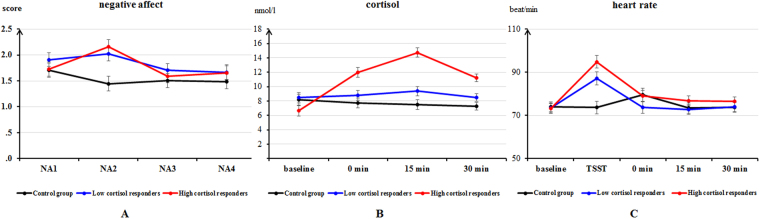
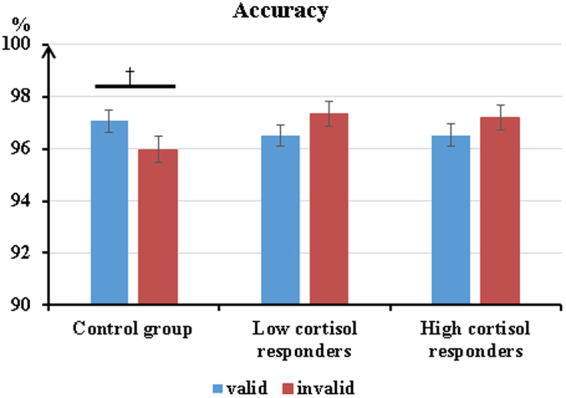
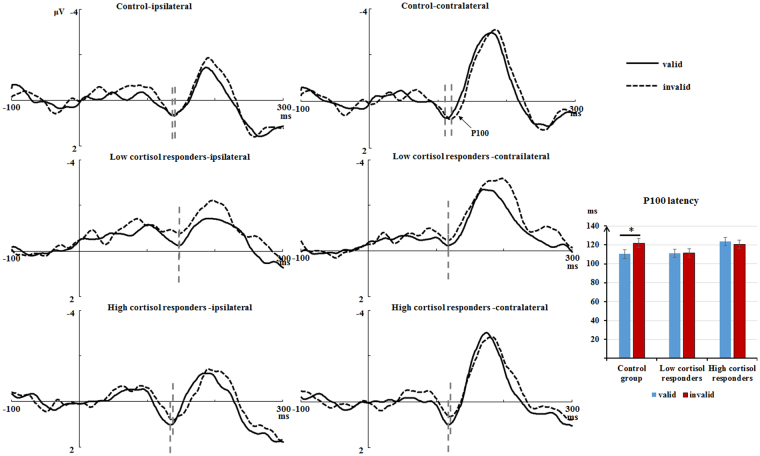
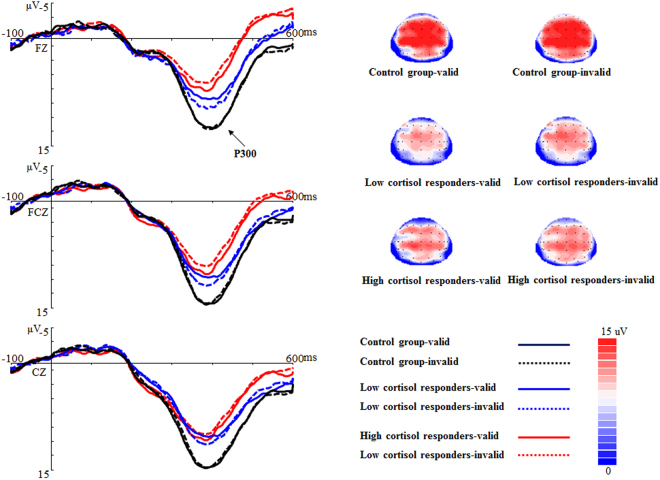
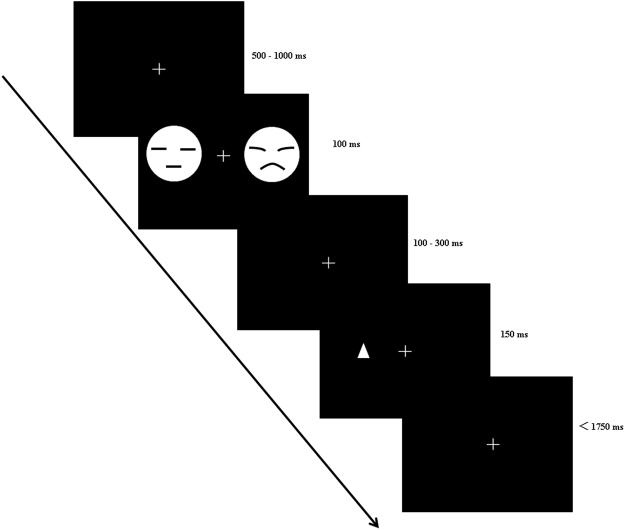
The present study investigated the effect of acute stress on attentional bias to threat using behavioral and ERP methods. Sixty-two male participants were randomly assigned to a stress condition (Trier Social Stress Test) or a control condition. To examine the impact of stress-induced cortisol on attentional bias to threat, participants in the stress group were split into Low- and High cortisol responders. All participants were then administered a modified dot probe task in which the cues were neutral and angry faces. Behavioral results showed a pattern of attentional bias toward threat in the Control group but not in the stress group. For the ERPs, the P100 peaked earlier for the angry-cued targets than the neutral-cued targets in the Control group, which suggests a rapid, adaptive response toward threat. However, this effect was not observed in the stress group, suggesting a suppressed attentional bias under stress. In addition, the stress group (including both Low and High cortisol responders) showed reduced P300 amplitude to target onset than the Control group. These results suggest that acute stress disrupts attentional bias to threat including a reduction in early bias to threat in addition to a subsequent change of attention allocation.
Overview
The claims and statistics of this paper haven’t been checked yet.
Free: it reads the open-access text and checks the first 5 claims that cite a source we can check. Create a free account to check every claim.
Integrity signals
Registry
Cites
Statistics
Figures
Verification
Claims the paper makes
The claims and statistics of this paper haven’t been checked yet.
Free: it reads the open-access text and checks the first 5 claims that cite a source we can check. Create a free account to check every claim.
Claims other papers make about this one
Each is checked against this paper’s own text: does it say what the citing paper says it does?
The cited source says what the claim attributes to it.
In the citing paper
“Other forms of stress have produced opposing patterns, whereby attentional biases to threatening faces were suppressed after acute psychosocial stress (Jiang et al., 2017), in contrast to the aforementioned effects observed after physical stress.”
From Toward objective characterizations of suicide risk: A narrative review of laboratory-based cognitive and behavioral tasks (2023) · cites this paper as Jiang et al., 2017
Self-check
Percentages, sums and reported differences re-computed from the paper’s own numbers.
The self-check needs the paper’s full text.
Citations
Cites
Development and validation of brief measures of positive and negative affect: The PANAS scales.
Watson, D., Clark, L. A., & Tellegen, A. (1988) · Journal of Personality and Social Psychology · doi:10.1037/0022-3514.54.6.1063 · Cited by 32,433
(1970) · Cited by 24,983
Kirschbaum, C., Pirke, K.-M., & Hellhammer, D. H. (2008) · Neuropsychobiology · doi:10.1159/000119004 · Cited by 6,093
Dickerson, S. S., & Kemeny, M. E. (2004) · Psychological Bulletin · doi:10.1037/0033-2909.130.3.355 · Cited by 5,881
Neural regulation of endocrine and autonomic stress responses
Ulrich-Lai, Y. M., & Herman, J. P. (2009) · Nature Reviews Neuroscience · doi:10.1038/nrn2647 · Cited by 3,318
Stress signalling pathways that impair prefrontal cortex structure and function
Arnsten, A. F. T. (2009) · Nature Reviews Neuroscience · doi:10.1038/nrn2648 · Cited by 3,299
Attentional bias in emotional disorders
MacLeod, C., Mathews, A., & Tata, P. (1986) · Journal of Abnormal Psychology · doi:10.1037/0021-843x.95.1.15 · Cited by 3,152
Electrophysiological Studies of Face Perception in Humans
Bentin, S., Allison, T., Puce, A., Perez, E., & McCarthy, G. (1996) · Journal of Cognitive Neuroscience · doi:10.1162/jocn.1996.8.6.551 · Cited by 3,076
A Solution for Reliable and Valid Reduction of Ocular Artifacts, Applied to the P300 ERP
Semlitsch, H. V., Anderer, P., Schuster, P., & Presslich, O. (1986) · Psychophysiology · doi:10.1111/j.1469-8986.1986.tb00696.x · Cited by 2,020
Kirschbaum, C., Kudielka, B. M., Gaab, J., Schommer, N. C., & Hellhammer, D. H. (1999) · Psychosomatic Medicine · doi:10.1097/00006842-199903000-00006 · Cited by 1,890
Research works printed but not linked: 1
- Zheng XH State-Trait test report in Changchun Chin. Mental. Health. J. 1993 7 2 60 62
Cited by
Narvaez Linares, N. F., Charron, V., Ouimet, A. J., Labelle, P. R., & Plamondon, H. (2020) · Neurobiology of Stress · doi:10.1016/j.ynstr.2020.100235 · Cited by 147
Stress, working memory, and academic performance: a neuroscience perspective
Almarzouki, A. F. (2024) · Stress · doi:10.1080/10253890.2024.2364333 · Cited by 136
von Dawans, B., Strojny, J., & Domes, G. (2021) · Neuroscience & Biobehavioral Reviews · doi:10.1016/j.neubiorev.2020.11.026 · Cited by 91
Quantitative Personality Predictions From a Brief EEG Recording
Li, W., Wu, C., Hu, X., Chen, J., Fu, S., Wang, F., & Zhang, D. (2020) · IEEE Transactions on Affective Computing · doi:10.1109/taffc.2020.3008775 · Cited by 39
Rojas‐Thomas, F., Artigas, C., Wainstein, G., Morales, J.-P., Arriagada, M., Soto, D., Dagnino‐Subiabre, A., Silva, J., & López, V. (2023) · Neurobiology of Stress · doi:10.1016/j.ynstr.2023.100551 · Cited by 31
Gu, H., Ma, X., Zhao, J., & Liu, C. (2022) · Comprehensive Psychoneuroendocrinology · doi:10.1016/j.cpnec.2022.100125 · Cited by 27
Acute Psychosocial Stress Modulates the Detection Sensitivity for Facial Emotions
von Dawans, B., Spenthof, I., Zimmer, P., & Domes, G. (2020) · Experimental Psychology (formerly Zeitschrift für Experimentelle Psychologie) · doi:10.1027/1618-3169/a000473 · Cited by 23
Resting-State-Based Spatial Filtering for an fNIRS-Based Motor Imagery Brain-Computer Interface
Zheng, Y., Zhang, D., Wang, L., Wang, Y., Deng, H. J., Zhang, S., Li, D., & Wang, D. (2019) · IEEE Access · doi:10.1109/access.2019.2936434 · Cited by 19
Attentional bias to threat: an investigation of psychological predictors beyond trait anxiety
Williams, M. M., Honan, C. A., & Matthews, A. J. (2024) · Current Psychology · doi:10.1007/s12144-024-05641-1 · Cited by 19
Kan, Y., Duan, H., Chen, X., Wang, X., Xue, W., & Hu, W. (2019) · Consciousness and Cognition · doi:10.1016/j.concog.2019.102796 · Cited by 19
Wang, P.-C., Rajput, D., Wang, X., Huang, C., & Chen, C. (2024) · Scientific Reports · doi:10.1038/s41598-024-57649-z · Cited by 16
Luo, Y., Nian, J., Wei, B. A. O., ZHANG, J., Shouying, Z. H. A. O., Yun, P. A. N., Shuang, X. U., & ZHANG, Y. (2020) · Acta Psychologica Sinica · doi:10.3724/sp.j.1041.2020.00026 · Cited by 14
Stress effects on the oddball P300 and N2 in males and females
Kamp, S., Forester, G., Vatheuer, C. C., & Domes, G. (2021) · Biological Psychology · doi:10.1016/j.biopsycho.2021.108095 · Cited by 13
Lamontagne, S. J., Zabala, P. K., Zarate, C. A., & Ballard, E. D. (2023) · Neuroscience & Biobehavioral Reviews · doi:10.1016/j.neubiorev.2023.105361 · Cited by 12
Zhu, H. Y., Chen, H., & Lin, C. (2024) · PLoS ONE · doi:10.1371/journal.pone.0301052 · Cited by 11
Blekić, W., Rossignol, M., Wauthia, E., & Felmingham, K. L. (2021) · International Journal of Psychophysiology · doi:10.1016/j.ijpsycho.2021.09.009 · Cited by 9
Perceived impacts of stressful events on train driver performance
Liddell, N. T., Salmon, P. M., Naweed, A., & Read, G. J. M. (2024) · Applied Ergonomics · doi:10.1016/j.apergo.2024.104335 · Cited by 7
Human creativity escapes in the struggle against threat: Evidence from neural mechanisms
Yin, J., Hu, Y., Li, Q., & Luo, J. (2022) · Biological Psychology · doi:10.1016/j.biopsycho.2022.108359 · Cited by 7
Effects of hydrocortisone and yohimbine on selective attention to emotional cues
Metz, S., Chae, W. R., Deuter, C. E., Otte, C., & Wingenfeld, K. (2021) · Journal of Psychopharmacology · doi:10.1177/0269881121997100 · Cited by 6
The relationship between acute stress and risk taking: The moderating effect of ease of excitation
Peishan, W. A. N. G., Gu, R., & ZHANG, L. (2022) · Acta Psychologica Sinica · doi:10.3724/sp.j.1041.2023.00045 · Cited by 6
Self-citationHu, J., Liu, Y., Zheng, Q., & Liu, F. (2023) · Journal of Social Computing · doi:10.23919/jsc.2023.0005 · Cited by 5
The impact of threats on creativity based on cognitive and emotional processes
Junting, Y. I. N., Wang, G., & Luo, J. (2021) · Advances in Psychological Science · doi:10.3724/sp.j.1042.2021.00815 · Cited by 5
(A lack of) effects of acute social stress on attentional bias to threat
Hunter, C. L., & Shields, G. S. (2023) · Comprehensive Psychoneuroendocrinology · doi:10.1016/j.cpnec.2023.100195 · Cited by 4
The Role of Cortisol in Cognitive Emotion Regulation Failure
Tsumura, H. (2023) · Integrated science · doi:10.1007/978-3-031-15959-6_15 · Cited by 3
Wu, Y. F., Luo, M., & Zhang, Y. (2023) · Biological Psychology · doi:10.1016/j.biopsycho.2023.108649 · Cited by 2
The effect of repeated acute stress on aggressive behavior and its regulation mechanisms
Wu, L., CHENG, G., & Zhang, D. (2021) · Advances in Psychological Science · doi:10.3724/sp.j.1042.2021.01358 · Cited by 2
Linares, N. F. N., Charron, V., Ouimet, A. J., Labelle, P., & Plamondon, H. (2020) · PsyArXiv (OSF Preprints) · doi:10.31234/osf.io/9wtre · Cited by 2
The effects of yohimbine and hydrocortisone on selective attention to fearful faces: An fMRI study
Metz, S., Mengering, L., Lipka, R., Rosada, C., Otte, C., Heekeren, H. R., & Wingenfeld, K. (2024) · Psychoneuroendocrinology · doi:10.1016/j.psyneuen.2024.107031 · Cited by 1
Li, X., Wu, S. J., Wang, Y., Yasin, Y., Gupta, A. K., Huang, H., & Lee, K. (2025) · Journal of Ambient Intelligence and Smart Environments · doi:10.1177/18761364241305552 · Cited by 1
Do We View Robots as We Do Ourselves? Examining Robotic Face Processing Using EEG
Pérez-Arenas, X., Rivera-Rei, Á. A., Huepe, D., & Soto, V. (2025) · Brain Sciences · doi:10.3390/brainsci16010009 · Cited by 1
The Effects of Physiological Stress on Brain-Computer Interface Systems
Zhu, H. Y. (2022) · OPUS - Open Publications of UTS Scholars (University of Technology Sydney) · Cited by 1
Changing Evidence Accumulation and Sharing Behaviour Through Incentives
Globig, L. K. (2024) · UCL Discovery (University College London)
Acute stress impairs attentional control and emotional processing in social anxiety
Li, M., Wong, A. H. K., von Dawans, B., Domes, G., & Wieser, M. J. (2026) · iScience · doi:10.1016/j.isci.2026.115767
Mathew, J. J. (2026) · Scholar Works at UT Tyler (The University of Texas at Tyler)
von Haugwitz, L., Sadr, R., Wascher, E., & Larra, M. F. (2026) · bioRxiv (Cold Spring Harbor Laboratory) · doi:10.64898/2026.10.18.759627
Relationship Between Acute Stress Disorder and Academic Performance of Students in Abuja, Nigeria
Enokela, A. E., & Ojugo, A. I. (2026) · East African Journal of Arts and Social Sciences · doi:10.37284/eajass.9.4.6085
Zhu, H. Y., Chen, H.-T., & Lin, C.-T. (2024) · doi:10.1371/journal.pone.0301052.r003
Metadata
- Authors
- Jiang, C., Buchanan, T. W., Yao, Z., Zhang, K., Wu, J., & Zhang, L.
- Affiliations
- Chinese Academy of Sciences (CN)
- Saint Louis University (US)
- Shenzhen University (CN)
- Corresponding author
- Zhang, Liang
- Venue
- Scientific Reports
- Published
- 2017-11-03
- Volume
- 7
- Issue
- 1
- Pages
- 14607-14607
- ISSN
- 2045-2322 (ISSN-L)
- PMC
- PMC5668362
- OpenAlex
- W2766076014
- Semantic Scholar
- 28ee6f55f6b805da379b151b2531cc4038b02d8c
- Cited by
- 30
- References
- 53
- Citations by year
- 2026: 1 · 2025: 2 · 2024: 6 · 2023: 6 · 2022: 3 · 2021: 4 · 2020: 5 · 2019: 3
- FWCI
- 1.19
- Type
- journal article
- Language
- en
- Update notices
- Open access
- gold
- doi.org
- Licence
- cc-by
- creativecommons.org/licenses/by/4.0 (tdm)
- creativecommons.org/licenses/by/4.0 (vor)
- Locations
- Scientific Reports (publishedVersion, cc-by)
- Europe PMC (PubMed Central) (publishedVersion, cc-by)
- PubMed Central (publishedVersion, cc-by)
- PubMed (publishedVersion)
- Institutional Repository of Institute of Psychology, Chinese Academy of Sciences (Institute of Psychology, Chinese Academy of Sciences) (submittedVersion)
- Funders
- National Natural Science Foundation of China (81371203)
- Topics
- Life Sciences › Neuroscience › Behavioral Neuroscience › Stress Responses and Cortisol
- Life Sciences › Neuroscience › Cognitive Neuroscience › Neural and Behavioral Psychology Studies
- Social Sciences › Psychology › Experimental and Cognitive Psychology › Anxiety, Depression, Psychometrics, Treatment, Cognitive Processes
- Keywords
- acute psychological stress, attentional bias to threat, threat processing, cortisol, Trier Social Stress Test, P100, P300, dot-probe task, angry faces, event-related potentials, attention allocation
- MeSH terms
- Attentional Bias, Brain, Electroencephalography, Emotions, Evoked Potentials, Heart Rate, Humans, Hydrocortisone, Male, Neuropsychological Tests, Random Allocation, Saliva, Social Behavior, Stress, Psychological, Visual Perception, Resilience, Psychological, Young Adult
About these checks
Registry, retraction, Cites and statistics results are computed, not judged, with one exception: a printed reference that no index lists is read once by a model before it counts as a citation error. Claims are extracted by a model and kept only when their quote appears verbatim in the text; each cited source is then checked, with a model’s help, for whether it says what the claim relies on. Those verdicts can be wrong — read the claim’s quote and the cited source before relying on one.
Statistics and arithmetic are recomputed, not judged.
Confidence bands are shown only for fields calibrated on our annotated test set. None is calibrated yet, so no band is shown.
What counts as a claim ›How we measure confidence ›How we check this ›
Are you an author, or do you see a problem with this page? Request a review
Data sources
Bibliographic data: Semantic Scholar, OpenAlex, Crossref.
Contains information from the Semantic Scholar Academic Graph Datasets, made available under the ODC Attribution License (ODC-BY 1.0).
Semantic Scholar’s data is described in: Kinney, R., et al. (2023). The Semantic Scholar Open Data Platform. arXiv:2301.10140.
