

People with higher interoceptive sensitivity are more altruistic, but improving interoception does not increase altruism
Open accessThe DOI matches its Crossref record; 36 of the 36 references it cites were found in a registry or an index.
Abstract
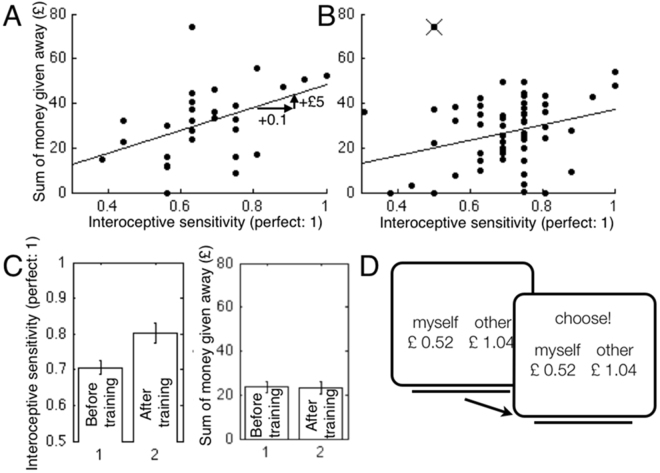
People consistently show preferences and behaviors that benefit others at a cost to themselves, a phenomenon termed altruism. We investigated if perception of one’s body signals – interoception - may be underlying such behaviors. We tested if participants’ sensitivity to their own heartbeat predicted their decision on a choice between self-interest and altruism, and if improving this sensitivity through training would make participants more altruistic. Across these two experiments, interoceptive sensitivity predicted altruism measured through monetary generosity. Improving interoceptive sensitivity did, however, not lead to more altruistic behaviour. We conclude that there is a unique link between interoception and altruistic behaviour, likely established over an individual’s history of altruistic acts, and the body responses they elicit. The findings suggest that humans might literally ‘listen to their heart’ to guide their altruistic behavior.
Overview
The claims and statistics of this paper haven’t been checked yet.
Free: it reads the open-access text and checks the first 5 claims that cite a source we can check. Create a free account to check every claim.
Integrity signals
Registry
Cites
Statistics
Figures
Verification
Claims the paper makes
The claims and statistics of this paper haven’t been checked yet.
Free: it reads the open-access text and checks the first 5 claims that cite a source we can check. Create a free account to check every claim.
Claims other papers make about this one
Each is checked against this paper’s own text: does it say what the citing paper says it does?
The cited source says what the claim attributes to it.
In the citing paper
“Increased empathy in those with higher interoceptive awareness may explain why higher interoceptive accuracy has also been found to correlate positively with altruism (Piech et al., 2017).”
From Atypical interoception as a common risk factor for psychopathology: A review (2021) · cites this paper as Piech et al., 2017
Self-check
Percentages, sums and reported differences re-computed from the paper’s own numbers.
The self-check needs the paper’s full text.
Citations
Cites
An experimental analysis of ultimatum bargaining
Güth, W., Schmittberger, R., & Schwarze, B. (1982) · Journal of Economic Behavior & Organization · doi:10.1016/0167-2681(82)90011-7 · Cited by 4,816
Baron-Cohen, S., & Wheelwright, S. (2004) · Journal of Autism and Developmental Disorders · doi:10.1023/b:jadd.0000022607.19833.00 · Cited by 4,093
Behavioral Game Theory: Experiments in Strategic Interaction
Camerer, C. F. (2003) · Cited by 3,722
JAMES, W. (1884) · Mind · doi:10.1093/mind/os-ix.34.188 · Cited by 3,446
Further Examining the American Dream: Differential Correlates of Intrinsic and Extrinsic Goals
Kasser, T., & Ryan, R. M. (1996) · Personality and Social Psychology Bulletin · doi:10.1177/0146167296223006 · Cited by 2,745
The relation of empathy to prosocial and related behaviors
Eisenberg, N., & Miller, P. A. (1987) · Psychological Bulletin · doi:10.1037/0033-2909.101.1.91 · Cited by 2,672
Putting the Altruism Back into Altruism: The Evolution of Empathy
de Waal, F. B. M. (2008) · Annual Review of Psychology · doi:10.1146/annurev.psych.59.103006.093625 · Cited by 2,483
A framework for studying the neurobiology of value-based decision making
Rangel, A., Camerer, C., & Montague, P. R. (2008) · Nature Reviews Neuroscience · doi:10.1038/nrn2357 · Cited by 2,184
Knowing your own heart: Distinguishing interoceptive accuracy from interoceptive awareness
Garfinkel, S. N., Seth, A. K., Barrett, A. B., Suzuki, K., & Critchley, H. D. (2015) · Biological Psychology · doi:10.1016/j.biopsycho.2014.11.004 · Cited by 1,624
Heart beat perception and emotional experience
Schandry, R. (1981) · Psychophysiology · doi:10.1111/j.1469-8986.1981.tb02486.x · Cited by 1,335
Cited by
An Active Inference Approach to Interoceptive Psychopathology
Paulus, M. P., Feinstein, J. S., & Khalsa, S. S. (2019) · Annual Review of Clinical Psychology · doi:10.1146/annurev-clinpsy-050718-095617 · Cited by 349
“Interoceptive sensitivity has also been associated with greater altruism (Piech et al. 2017), greater feeling of knowing (Fiacconi et al. 2017), better prospective memory performance (Umeda et al. 2016), better sleep (Ewing et al. 2017), and less ruminative processing (Lackner & Fresco 2016).”
BackgroundAtypical interoception as a common risk factor for psychopathology: A review
Brewer, R., Murphy, J., & Bird, G. (2021) · Neuroscience & Biobehavioral Reviews · doi:10.1016/j.neubiorev.2021.07.036 · Cited by 180
Going at the heart of social cognition: is there a role for interoception in self-other distinction?
Palmer, C. E., & Tsakiris, M. (2018) · Current Opinion in Psychology · doi:10.1016/j.copsyc.2018.04.008 · Cited by 96
Altered interoceptive processing in smokers: Evidence from the heartbeat tracking task
Todd, J., Hina, F., & Aspell, J. E. (2019) · International Journal of Psychophysiology · doi:10.1016/j.ijpsycho.2019.05.012 · Cited by 44
Self-citationEggart, M., & Valdés‐Stauber, J. (2020) · Journal of Psychosomatic Research · doi:10.1016/j.jpsychores.2020.110331 · Cited by 38
Interoceptive influences on the production of self-serving lies in reputation risk conditions
Vabba, A., Porciello, G., Panasiti, M. S., & Aglioti, S. M. (2022) · International Journal of Psychophysiology · doi:10.1016/j.ijpsycho.2022.04.001 · Cited by 30
Reduced ownership over a virtual body modulates dishonesty
Scattolin, M., Panasiti, M. S., Villa, R., & Aglioti, S. M. (2022) · iScience · doi:10.1016/j.isci.2022.104320 · Cited by 28
Neural representations of vicarious rewards are linked to interoception and prosocial behaviour
Contreras-Huerta, L. S., Coll, M., Bird, G., Yu, H., Prosser, A. M. B., Lockwood, P. L., Murphy, J., Crockett, M. J., & Apps, M. A. J. (2023) · NeuroImage · doi:10.1016/j.neuroimage.2023.119881 · Cited by 28
“Indeed, previous research has suggested that people‟s propensity to rely on interoceptive signals is linked to their levels of altruism (16), although this evidence has not been consistent (55).”
Vabba, A., Porciello, G., Monti, A., Panasiti, M. S., & Aglioti, S. M. (2023) · Heliyon · doi:10.1016/j.heliyon.2023.e14951 · Cited by 29
Feruglio, S., Panasiti, M. S., Crescentini, C., Aglioti, S. M., & Ponsi, G. (2023) · Mindfulness · doi:10.1007/s12671-023-02233-1 · Cited by 28
“In addition, Piech et al. (2017) proposed that heightened interoceptive sensitivity may enhance the representation of recipients’ distress, increasing participants’ altruistic behavior.”
BackgroundResultInteroceptive training with real‐time haptic versus visual heartbeat feedback
Dobrushina, O. R., Tamim, Y., Wald, I. Y., Maimon, A., & Amedi, A. (2024) · Psychophysiology · doi:10.1111/psyp.14648 · Cited by 21
Fusaro, M., Lisi, M. P., Era, V., Porciello, G., Candidi, M., Aglioti, S. M., & Boukarras, S. (2025) · Topoi · doi:10.1007/s11245-025-10216-1 · Cited by 31
“…disposition, altruistic behavior, moral decision-making, and importantly mental health (e.g. Azzalini et al. 2019; Monti et al. 2020; Monti et al. 2021; Monti et al. 2022; Porciello et al. 2024; Ferri et al. 2013; Piech et al. 2017; Vabba et al. 2022; Nord and Garfinkel 2022; Khalsa et al. 2018).”
Eggart, M., Valdés-Stauber, J., Müller-Oerlinghausen, B., & Heinze, M. (2023) · BMC Psychiatry · doi:10.1186/s12888-023-05168-y · Cited by 13
“Beyond physiological regulation, a growing body of research has shown that bodily sensations contribute to affect, cognition, and social functioning [16–18].”
BackgroundA cost-benefit framework for prosocial motivation—Advantages and challenges
Contreras-Huerta, L. S. (2023) · Frontiers in Psychiatry · doi:10.3389/fpsyt.2023.1170150 · Cited by 15
Vabba, A., Scattolin, M., Porciello, G., Panasiti, M. S., & Aglioti, S. M. (2025) · Neuroscience & Biobehavioral Reviews · doi:10.1016/j.neubiorev.2024.105992 · Cited by 12
Angioletti, L., Tormen, F., & Balconi, M. (2022) · Frontiers in Psychology · doi:10.3389/fpsyg.2022.853342 · Cited by 14
A qualitative study on nursing professionalism: safeguarding life through a conceptual model
Cao, H., Cao, Z., Mao, Y., Li, L., Song, Y., He, X., Wu, Y., Chen, Y., Wang, Q., & Yang, H. (2025) · BMC Medical Education · doi:10.1186/s12909-025-07595-9 · Cited by 14
“Drawing on the researchers’ clinical nursing and management experience, the data analysis was conducted reflectively, ensuring that any preconceived assumptions did not influence the analysis or results of the study [19].”
Vabba, A., Panasiti, M. S., Scattolin, M., Spitaleri, M., Porciello, G., & Aglioti, S. M. (2023) · Journal of Neurophysiology · doi:10.1152/jn.00014.2023 · Cited by 9
Todd, J., Hina, F., & Aspell, J. E. (2020) · Experimental Brain Research · doi:10.1007/s00221-020-05740-y · Cited by 9
Self-citationPropuesta de tres Dimensiones Complementarias al Inventario del Espectro Autista de Rivière
Gómez, A. G. (2021) · Psicología Educativa · doi:10.5093/psed2020a24 · Cited by 16
“…importancia que tienen en la homeostasis personal y en la vida de relación la discriminación de sensaciones interoceptivas, tales como el hambre, el dolor, el cansancio, etc. y la discriminación de los estados emocionales (Dunn et al., 2013; Piech et al., 2017; Riquelme et al., 2016; Shah, 2016).”
BackgroundTamura, K., Kobayashi, Y., & Ohira, H. (2022) · Frontiers in Psychology · doi:10.3389/fpsyg.2021.746897 · Cited by 6
Vabba, A., Suzuki, K., Doric, M., Möller, T. J., Garfinkel, S. N., & Critchley, H. (2025) · Psychophysiology · doi:10.1111/psyp.70040 · Cited by 4
“…(Shah et al. 2017), empathic response (Ainley et al. 2015; Ernst et al. 2013; Fukushima et al. 2011; Heydrich et al. 2021), altruistic behavior (Piech et al. 2017), and moral decision-making (Ditto et al. 2006; Lenggenhager et al. 2013; Mancini et al. 2011; Nicolardi et al. 2020; Vabba et al.…”
A cost-benefit framework for prosocial motivation – advantages and challengesPreprint
Contreras-Huerta, L. S. (2023) · doi:10.31234/osf.io/kfbt6 · Cited by 1
Todd, J., Hina, F., & Aspell, J. E. (2019) · bioRxiv (Cold Spring Harbor Laboratory) · doi:10.1101/830141
Self-citationPump, person and Parfit: why the constitutive heart matters
McIntyre, H. F. (2020) · Medical Humanities · doi:10.1136/medhum-2020-011849
“Piech et al. (2017), "People with higher interoceptive sensitivity are more altruistic, but improving interoception does not increase altruism.”
BackgroundKöteles, F. G. (2021) · Springer eBooks · doi:10.1007/978-3-030-63201-4_8
Rivera, M. D. C. M. C. T., Espinoza, M., & Cerić, F. (2023) · Springer eBooks · doi:10.1007/978-3-031-31709-5_28
Tejada Rivera, M. D. C. (2024) · doi:10.52611/11447/9072
Rivera, M. D. C. M. C. T., Espinoza, M., & Cerić, F. (2024) · Springer eBooks · doi:10.1007/978-3-031-58979-9_28
Sustainable Altruism: Simulating the Future of Prosociality and Peacebuilding—A Conceptual Review
Shults, F. L., Lane, J. E., Gantley, M., & O’Lone, K. (2025) · Journal of Sustainability Research · doi:10.20900/jsr20250033 · Cited by 1
“…one’s own group varies in relation to individual psychological differences such as higher global consciousness, interoception, and non-religiosity [51–54], and appears to be promoted in secular cultural contexts that have higher existential security and broader social welfare programs [55–58].”
РАЗРАБОТКА ИНТЕРОЦЕПТИВНОГО ТРЕНИНГА С ИСПОЛЬЗОВАНИЕМ БИОЛОГИЧЕСКОЙ ОБРАТНОЙ СВЯЗИ
Русинова, А., Володина, М., Aksiotis, V., & Осадчий, А. (2025) · Nanoindustry Russia · doi:10.22184/1993-8578.2025.18.11s.1161.1167
Cuadros, Z., Escobar-Falla, M. J., Correa, M., & Herrera, E. (2026) · Brain Sciences · doi:10.3390/brainsci16060630
“Positive correlations between interoception and prosocial behavior have been reported [25,26], although causal relationships have not been established.”
I sync, therefore I am: brain–body synchrony in typical and disordered consciousness
Young, A., Ericson, M., & Schooler, J. W. (2026) · Neuroscience of Consciousness · doi:10.1093/nc/niag028 · Cited by 1
“Greater accuracy in detecting one’s heartbeat is associated with higher estimated pain intensity and greater reported compassion when viewing another in pain ( Grynberg and Pollatos 2015), as well as increased monetary generosity in the dictator-game ( Piech et al. 2017).”
Metadata
- Authors
- Piech, R. M., Strelchuk, D., Knights, J., Hjälmheden, J. V., Olofsson, J. K., & Aspell, J. E.
- Affiliations
- Stockholm University (SE)
- Anglia Ruskin University (GB)
- Corresponding author
- Piech, Richard M.
- Venue
- Scientific Reports
- Published
- 2017-11-15
- Volume
- 7
- Issue
- 1
- Pages
- 15652-15652
- ISSN
- 2045-2322 (ISSN-L)
- PMC
- PMC5688159
- OpenAlex
- W2767624006
- Semantic Scholar
- e9d0cc03116e8fc8bb81b7fbee1df184e06450b9
- Cited by
- 33
- References
- 36
- Citations by year
- 2026: 2 · 2025: 6 · 2024: 3 · 2023: 8 · 2022: 4 · 2021: 3 · 2020: 3 · 2019: 3 · 2018: 1
- FWCI
- 4.39
- Type
- journal article
- Language
- en
- Open access
- gold
- doi.org
- Licence
- cc-by
- creativecommons.org/licenses/by/4.0 (tdm)
- creativecommons.org/licenses/by/4.0 (vor)
- Locations
- Scientific Reports (publishedVersion, cc-by)
- Europe PMC (PubMed Central) (publishedVersion, cc-by)
- PubMed Central (publishedVersion, cc-by)
- PubMed (publishedVersion)
- Anglia Ruskin Research Online (Anglia Ruskin University) (submittedVersion)
- Figshare (submittedVersion, cc-by-nc-nd)
- Bristol Research (University of Bristol) (submittedVersion)
- Funders
- Anglia Ruskin University
- Leverhulme Trust
- British Academy
- Topics
- Social Sciences › Economics, Econometrics and Finance › Economics and Econometrics › Experimental Behavioral Economics Studies
- Health Sciences › Medicine › Psychiatry and Mental health › Psychosomatic Disorders and Their Treatments
- Social Sciences › Sociology and Political Science › Evolutionary Game Theory and Cooperation
- Keywords
- interoception, altruism, interoceptive sensitivity, heartbeat perception, interoceptive training, self-interest, body signals, prosocial behavior
- MeSH terms
- Altruism, Decision Making, Female, Heart Rate, Humans, Male, Perception, Social Behavior, Video Games, Interoception
About these checks
Registry, retraction, Cites and statistics results are computed, not judged, with one exception: a printed reference that no index lists is read once by a model before it counts as a citation error. Claims are extracted by a model and kept only when their quote appears verbatim in the text; each cited source is then checked, with a model’s help, for whether it says what the claim relies on. Those verdicts can be wrong — read the claim’s quote and the cited source before relying on one.
Statistics and arithmetic are recomputed, not judged.
Confidence bands are shown only for fields calibrated on our annotated test set. None is calibrated yet, so no band is shown.
What counts as a claim ›How we measure confidence ›How we check this ›
Are you an author, or do you see a problem with this page? Request a review
Data sources
Bibliographic data: Semantic Scholar, OpenAlex, Crossref.
Contains information from the Semantic Scholar Academic Graph Datasets, made available under the ODC Attribution License (ODC-BY 1.0).
Semantic Scholar’s data is described in: Kinney, R., et al. (2023). The Semantic Scholar Open Data Platform. arXiv:2301.10140.
