

Caffeine affects autonomic control of heart rate and blood pressure recovery after aerobic exercise in young adults: a crossover study
Open accessThe DOI matches its Crossref record; 29 of the 30 references it cites were found in a registry or an index; 12 of the 32 sources its claims cite were checked for support.
Abstract
The post-exercise recovery period is associated with changes in autonomic modulation, which can promote an intercurrent-favorable environment. Caffeine has the ability to release catecholamines, but its effects after exercises is little explored. The present study aims to evaluate the acute effects of caffeine on the autonomic control and cardiorespiratory parameters after moderate intensity aerobic exercise. 32 young males (23,59 ± 3,45 years) were submitted to two protocols: Placebo and Caffeine, consisting of 15 minutes of rest, 30 minutes of exercise on a treadmill to 60% on VO2peak, followed by 60 minutes of recovery. Heart rate variability indices and cardiorespiratory parameters were determined at different times during the protocols. The RMSSD and SD1 indices recovered faster in placebo (p < 0.05). The systolic blood pressure differences were found from the 1st to the 5th minute of recovery with the caffeine protocol and from the 1st and 3rd minute with the placebo, whereas, for diastolic blood pressure, significant differences (p < 0.0001) were observed only for the caffeine protocol at the 1st and 3rd minutes of recovery. Caffeine was shown to be capable of delaying parasympathetic recovery but did not influence the behavior of the respiratory rate, oxygen saturation or frequency-domain HRV indices.
Overview
CoChat Summary
TL;DR
In a randomized crossover trial in 32 healthy young men, 300 mg caffeine before moderate-intensity treadmill exercise delayed post-exercise parasympathetic heart-rate recovery and slowed blood-pressure return toward baseline. Caffeine did not alter heart rate, respiratory rate, oxygen saturation, or frequency-domain HRV indices overall.
Key findings
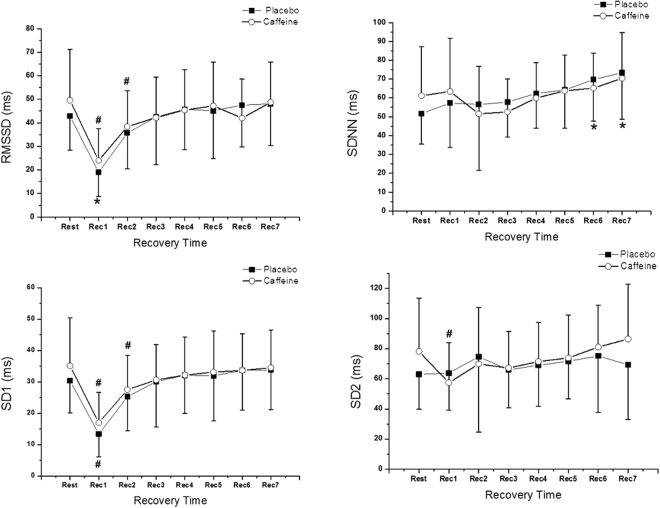
- Caffeine delayed parasympathetic reactivation: RMSSD and SD1 showed significant recovery differences in Rec1 and Rec2 for caffeine but only in Rec1 for placebo (p < 0.05), indicating faster recovery with placebo.
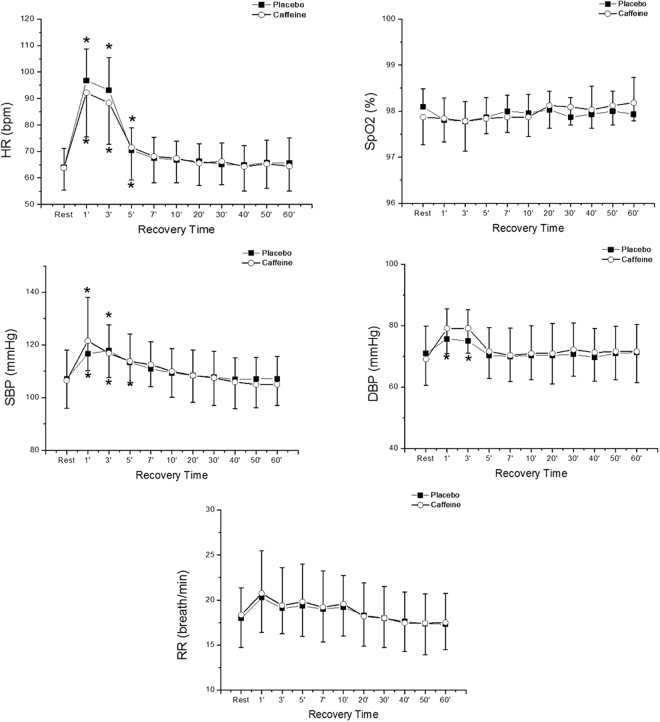
- Blood-pressure recovery was slower with caffeine: SBP differed from rest at the 1st–5th minute of recovery with caffeine and at the 1st and 3rd minutes with placebo; DBP differed only with caffeine at the 1st and 3rd minutes (p < 0.0001).
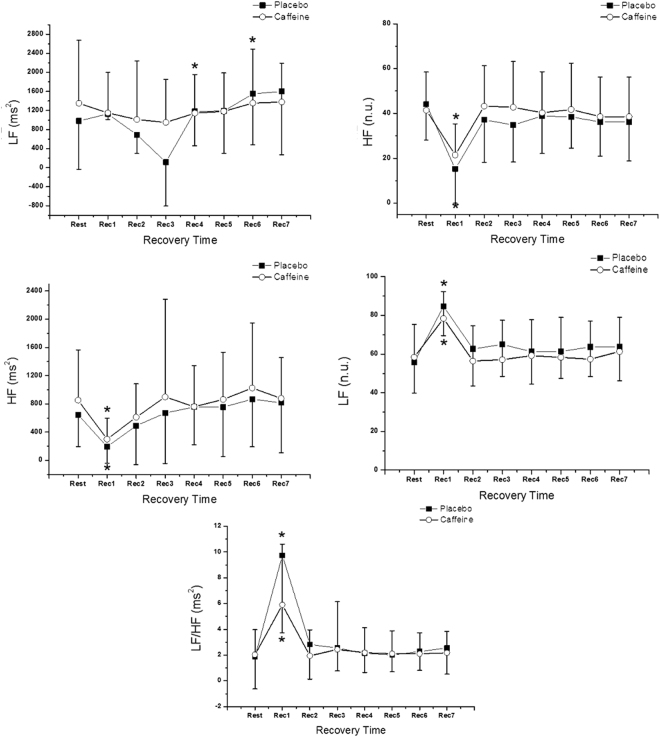
- No between-protocol effects were found for HR (p = 0.666), SBP (p = 0.991), DBP (p = 0.610), RR (p = 0.790), or SpO2 (p = 0.279); frequency-domain HRV indices also showed no effect among protocols (p > 0.05), though LF/HF had a protocol interaction (p = 0.005).
- The authors conclude that caffeine ingestion before moderate aerobic exercise delays recovery of the parasympathetic component of autonomic heart-rate control and delays BP recovery to baseline in young male participants.
Methods
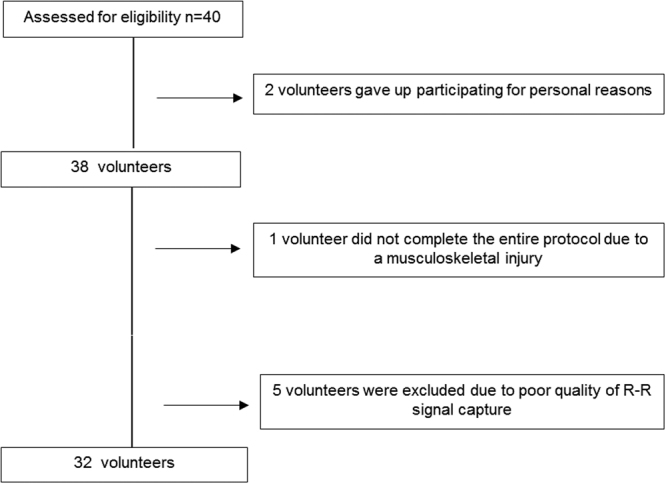
- Randomized, participant-blinded crossover clinical trial (NCT02917889) in 32 healthy young male volunteers (23.59 ± 3.45 years); 15 started with placebo and 17 with caffeine.
- Three stages separated by at least 48 hours: a maximal cardiopulmonary exercise test to determine VO2peak, then placebo and caffeine protocols. Each protocol involved 300 mg caffeine or 300 mg starch, 15 minutes supine rest, 30 minutes treadmill exercise (5 minutes warm-up at 5 km/h and 1% slope, then 25 minutes at 60% VO2peak HR), and 60 minutes recovery.
- HRV was analyzed in time domain (RMSSD, SDNN), frequency domain (LF, HF, LF/HF), and Poincaré plot (SD1, SD2); cardiorespiratory parameters included HR, SBP, DBP, RR, and SpO2. Two-way repeated-measures ANOVA, Mauchly’s test with Greenhouse-Geisser correction, and Bonferroni or Friedman/Dunn post-tests were used, with significance at 5%.
Limitations
- The authors state the sample was healthy young men only, so results cannot be applied to female groups because of menstrual-cycle changes in caffeine metabolism or to individuals with cardiac diseases using drugs that affect the ANS.
- The authors state they did not evaluate plasma catecholamine concentrations or sympathetic nerve activity, did not control respiration, and did not consider body weight or habitual caffeine consumption when dosing.
- The text makes evident that the researcher was not blinded at any time, although volunteers were blinded to protocol order.
Model-written summary. Check it against the paper before relying on it.
Integrity signals
Registry
Cites
Statistics
Figures
Verification
Claims the paper makes
6 Valid · 1 Not valid · 11 Not checked · 26 Own results and interpretations
The cited sources support only part of this claim — read each source’s verdict below.
In the paper
“However, few studies have evaluated its effects during post-exercise recovery7–10”
§ Caffeine affects autonomic control of heart rate and blood pressure recovery after aerobic exercise in young adults: a crossover study > Introduction
What the sources say
- Supportedcites [7] Bunsawat K White DW Kappus RM Baynard T Caffeine delays autonomic recovery following acute exercise Eur. J. Prev. Cardiol. 2015 22 1473 1479 10.1177/2047487314554867 25297344 source
The Discussion (page not provided) describes this as the first study, to the authors’ knowledge, of caffeine’s prolonged effects on autonomic recovery after acute exercise. The section on autonomic function during post-exercise recovery also says caffeine’s influence in that phase remained unclear, supporting the claim that few studies had evaluated it. (LLM, conf=0.88)
- Partly supportedcites [8] An SM Park JS Kim SH Effect of energy drink dose on exercise capacity, heart rate recovery and heart rate variability after high-intensity exercise J. Exerc. Nutr. Biochem. 2014 18 31 9 10.5717/jenb.2014.18.1.31 PMC4241927 25566437 sourceExperimental — accuracy not yet measured
The study’s Methods and Discussion passages show that it evaluated heart-rate recovery and heart-rate variability after exercise following consumption of caffeine-containing energy drinks. Our copy does not establish that few studies had evaluated caffeine’s effects during post-exercise recovery, so it supports this paper as an example, but not the claim about the amount of prior research. (LLM, conf=0.78)
- Not checked — no full text of the sourcecites [9] Yeragani VK Krishnan S Engels HJ Gretebeck R Effects of caffeine on linear and nonlinear measures of heart rate variability before and after exercise Depress. Anxiety 2005 21 130 134 10.1002/da.20061 15965989 source
- Partly supportedcites [10] Lopes-Silva JP Caffeine ingestion increases estimated glycolytic metabolism during taekwondo combat simulation but does not improve performance or parasympathetic reactivation PLoS One 2015 10 1 16 10.1371/journal.pone.0142078 PMC4634755 26539982 sourceExperimental — accuracy not yet measured
The Results and Discussion describe this paper’s evaluation of caffeine and post-exercise recovery, and the Discussion mentions a previous study of autonomic recovery. The paper does not state that few studies have evaluated caffeine’s effects during post-exercise recovery, so it supports the subject of the claim but not its assertion about how much research exists. (LLM, conf=0.73)
plain- Asserted: passes — The authors put it forward as true.
- Checkable: passes — It can be checked against evidence.
- Load-bearing: passes — The paper’s conclusions depend on it.
- Based: passes — The paper gives a reason why it holds.
- Supported
The sources with a verdict support this claim; the rest weren’t checked yet, have no full text we could read, or their verdicts aren’t rated yet.
In the paper
“most of the studies that have evaluated the effects of caffeine supplementation on post-exercise recovery were performed with protocols of progressive and exhaustive exercises7–9”
§ Caffeine affects autonomic control of heart rate and blood pressure recovery after aerobic exercise in young adults: a crossover study > Introduction
What the sources say
- Supportedcites [7] Bunsawat K White DW Kappus RM Baynard T Caffeine delays autonomic recovery following acute exercise Eur. J. Prev. Cardiol. 2015 22 1473 1479 10.1177/2047487314554867 25297344 source
The Maximum oxygen uptake test section describes a continuous incremental treadmill test to volitional exhaustion. The Experimental design section confirms that the study gave caffeine or placebo before exercise and measured post-exercise recovery. This paper therefore fits the type of study the citation is used to exemplify; it does not, by itself, establish how common that protocol was across studies. (LLM, conf=0.91)
- Could not verifycites [8] An SM Park JS Kim SH Effect of energy drink dose on exercise capacity, heart rate recovery and heart rate variability after high-intensity exercise J. Exerc. Nutr. Biochem. 2014 18 31 9 10.5717/jenb.2014.18.1.31 PMC4241927 25566437 sourceExperimental — accuracy not yet measured
The Methods (Exercise load method; page unavailable) describe this paper’s own exercise protocol, including a preliminary maximal treadmill test and a subsequent run at 80% of VO₂ max. The Discussion mentions other caffeine studies but does not say that most studies of post-exercise recovery used progressive and exhaustive protocols. I searched for that characterization and for descriptions of the protocols used in prior studies. (LLM, conf=0.74)
- Not checked — no full text of the sourcecites [9] Yeragani VK Krishnan S Engels HJ Gretebeck R Effects of caffeine on linear and nonlinear measures of heart rate variability before and after exercise Depress. Anxiety 2005 21 130 134 10.1002/da.20061 15965989 source
plain- Asserted: passes — The authors put it forward as true.
- Checkable: passes — It can be checked against evidence.
- Load-bearing: passes — The paper’s conclusions depend on it.
- Based: passes — The paper gives a reason why it holds.
- Supported
A result the paper reports from its own data — it cites no other source for it, so there is none to check. The quote shows it is in the paper.
In the paper
“The RMSSD and SD1 indices recovered faster in placebo (p < 0.05).”
- Also stated in: § Differences between HRV indices · plain
“For the RMSSD and SD1 indices, significant differences were observed in Rec1 and Rec2 for the caffeine protocol but only in Rec1 for the placebo protocol.”
§ Caffeine affects autonomic control of heart rate and blood pressure recovery after aerobic exercise in young adults: a crossover study > Abstract
plainstates a cause- Asserted: passes — The authors put it forward as true.
- Checkable: passes — It can be checked against evidence.
- Load-bearing: passes — The paper’s conclusions depend on it.
- Based: passes — The paper gives a reason why it holds.
- Also stated in: § Differences between HRV indices · plain
A result the paper reports from its own data — it cites no other source for it, so there is none to check. The quote shows it is in the paper.
In the paper
“for diastolic blood pressure, significant differences (p < 0.0001) were observed only for the caffeine protocol at the 1st and 3rd minutes of recovery.”
- Also stated in: § Cardiorespiratory Parameters · plain
“for the DBP significant differences can be observed only for the caffeine protocol at the 1st and 3rd minute of recovery.”
§ Caffeine affects autonomic control of heart rate and blood pressure recovery after aerobic exercise in young adults: a crossover study > Abstract
plain- Asserted: passes — The authors put it forward as true.
- Checkable: passes — It can be checked against evidence.
- Load-bearing: unclear — It is unclear whether the paper’s conclusions depend on it.
- Based: passes — The paper gives a reason why it holds.
- Also stated in: § Cardiorespiratory Parameters · plain
A result the paper reports from its own data — it cites no other source for it, so there is none to check. The quote shows it is in the paper.
In the paper
“Significant differences were observed for HR in both protocols up to the 5th minute of recovery compared to rest.”
§ Caffeine affects autonomic control of heart rate and blood pressure recovery after aerobic exercise in young adults: a crossover study > Results > Cardiorespiratory Parameters
plain- Asserted: passes — The authors put it forward as true.
- Checkable: passes — It can be checked against evidence.
- Load-bearing: unclear — It is unclear whether the paper’s conclusions depend on it.
- Based: passes — The paper gives a reason why it holds.
8 more claims
Create a free account to see all 44 claims and every source verdict.
- It may state two separate claims as one. 16
- Probably not a substantial claim. 20
Claims other papers make about this one
Each is checked against this paper’s own text: does it say what the citing paper says it does?
The source backs part of the claim, not all of it — or backs it for a different population, condition or comparison.
In the citing paper
“Em ambos os protocolos, todos os indivíduos apresentaram valores adequados dessas variáveis, o que seria esperado para indivíduos sadios sem diagnóstico de doença cardiopulmonar. 11”
From Efeitos Agudos da Bebida Energética sobre Parâmetros Autonômicos e Cardiovasculares em Indivíduos com Diferentes Capacidades Cardiorrespiratórias: Um Ensaio Controlado, Randomizado, Crossover e Duplo Cego (2022) · cites this paper as [11]
Experimental — accuracy not yet measuredThe source backs part of the claim, not all of it — or backs it for a different population, condition or comparison.
In the citing paper
“Evidência científica tem mostrado que o consumo moderado de cafeína isolada (por exemplo, 3-6mg/kg ou 300-400mg em uma única dose) pode atrasar a recuperação da FC após o exercício. 11 , 12”
From Efeitos Agudos da Bebida Energética sobre Parâmetros Autonômicos e Cardiovasculares em Indivíduos com Diferentes Capacidades Cardiorrespiratórias: Um Ensaio Controlado, Randomizado, Crossover e Duplo Cego (2022) · cites this paper as [11]
Experimental — accuracy not yet measuredThe source backs part of the claim, not all of it — or backs it for a different population, condition or comparison.
In the citing paper
“These disturbances have the potential to contribute to the onset of rhythm disorders and abnormal HRV responses [ 18 ].”
From Impact of Caffeine Intake Strategies on Heart Rate Variability during Post-Exercise Recovery: A Systematic Review and Meta-Analysis (2024) · cites this paper as [18]
Experimental — accuracy not yet measuredThe source backs part of the claim, not all of it — or backs it for a different population, condition or comparison.
In the citing paper
“The safety of CAF intake, as evaluated through HRV parameters, may be significantly affected when intake is less than 60 minutes prior to exercise.”
From Impact of Caffeine Intake Strategies on Heart Rate Variability during Post-Exercise Recovery: A Systematic Review and Meta-Analysis (2024) · cites this paper as [18]
Experimental — accuracy not yet measuredThe source backs part of the claim, not all of it — or backs it for a different population, condition or comparison.
In the citing paper
“Based on the studies by Gonzaga et al. [ 18 ] and Bunsawat et al. [ 19 ], the impact of CAF on post-exercise recovery after treadmill endurance exercises is particularly pronounced.”
From Impact of Caffeine Intake Strategies on Heart Rate Variability during Post-Exercise Recovery: A Systematic Review and Meta-Analysis (2024) · cites this paper as [18]
Experimental — accuracy not yet measured
4 more claims about this paper
Create a free account to see every claim other papers make about this one.
Self-check
Percentages, sums and reported differences re-computed from the paper’s own numbers.
Each contradiction between two passages listed here was confirmed by an independent check.
Rated major: it would touch a result — a value a result rests on, reported and recomputed p-values on opposite sides of the significance level, two passages that conflict with no sign which is right, or a cited work retracted before this paper was published.
In the paper
§ Caffeine affects autonomic control of heart rate and blood pressure recovery after aerobic exercise in young adults: a crossover study > Discussion
“No significant differences were found in the frequency domain indices when the values of the recovery moments with the resting value were compared, suggesting that these indices are not sensitive to identifying the changes observed using HRV indexes in the time domain.”
§ Caffeine affects autonomic control of heart rate and blood pressure recovery after aerobic exercise in young adults: a crossover study > Results > Differences between HRV indices
“For HF ms², LF n.u., HF n.u. and LF/HF indices, significant differences were observed only in Rec1 for both protocols. For LF ms2, significant differences were observed in the caffeine protocol in Rec4 and Rec6 compared to rest.”
Rated minor: it would not touch a result — a value no result rests on, a p-value that stays on the same side of the significance level, or a conflict that is clerical, resolved elsewhere in the paper, or outside its own findings.
In the paper
§ Caffeine affects autonomic control of heart rate and blood pressure recovery after aerobic exercise in young adults: a crossover study > Abstract
“Caffeine was shown to be capable of delaying parasympathetic recovery but did not influence the behavior of the respiratory rate, oxygen saturation or frequency-domain HRV indices.”
§ Caffeine affects autonomic control of heart rate and blood pressure recovery after aerobic exercise in young adults: a crossover study > Results > Differences between HRV indices
“We noted protocol interaction only for the LF/HF ratio (p = 0.005).”
Citations
Cites
Garber, C. E., Blissmer, B., Deschenes, M. R., Franklin, B. A., Lamonte, M. J., Lee, I.-M., Nieman, D. C., & Swain, D. P. (2011) · Medicine & Science in Sports & Exercise · doi:10.1249/mss.0b013e318213fefb · Cited by 9,319
Kubios HRV–heart rate variability analysis software.
Tarvainen, M. P., Niskanen, J.-P., Lipponen, J. A., Ranta-aho, P. O., & Karjalainen, P. A. (2014) · Computer Methods and Programs in Biomedicine · doi:10.1016/j.cmpb.2013.07.024 · Cited by 2,720
Heart-rate Recovery Immediately After Exercise as a Predictor of Mortality
Cole, C. R., Blackstone, E. H., Pashkow, F. J., Snader, C. E., & Lauer, M. S. (1999) · New England Journal of Medicine · doi:10.1056/nejm199910283411804 · Cited by 1,935
Effects of Caffeine on Plasma Renin Activity, Catecholamines and Blood Pressure
Robertson, D., Frölich, J. C., Carr, R. K., Watson, J. T., Hollifield, J. W., Shand, D. G., & Oates, J. A. (1978) · New England Journal of Medicine · doi:10.1056/nejm197801262980403 · Cited by 757
Vanderlei (2009) · doi:10.1590/s0102-76382009000200018 · Cited by 744
Beverage caffeine intakes in the U.S.
Mitchell, D. C., Knight, C. A., Hockenberry, J., Teplansky, R., & Hartman, T. J. (2014) · Food and Chemical Toxicology · doi:10.1016/j.fct.2013.10.042 · Cited by 565
Os arquivos e a publicação de seu primeiro fator de impacto
Moreira, L. F. P. (2010) · Arquivos Brasileiros de Cardiologia · doi:10.1590/s0066-782x2010001100001 · Cited by 370
Exercise and Sport Performance with Low Doses of Caffeine
Spriet, L. L. (2014) · Sports Medicine · doi:10.1007/s40279-014-0257-8 · Cited by 347
Corti, R., Binggeli, C., Sudano, I., Spieker, L., Hänseler, E., Ruschitzka, F., Chaplin, W. F., Lüscher, T. F., & Noll, G. (2002) · Circulation · doi:10.1161/01.cir.0000046228.97025.3a · Cited by 264
James, J. E. (2004) · Psychosomatic Medicine · doi:10.1097/10.psy.0000107884.78247.f9 · Cited by 232
Research works printed but not linked: 3
- Nobre F IV Brazilian Guidelines on Arterial Hypertension Arq Bras Cardiol 2010 95 1 51
- Brum PC Negrão CE Acute and chronic adaptations of resistance exercises in the cardiovascular system Rev Paul Educ Fís 2004 18 21 31
- Lima JRP Oliveira TP Ferreira-Júnior AJ Post-exercise cardiovascular autonomic recovery: Review of the underlying autonomic mechanisms and clinical and sports relevance Motricidade 2012 8 419 430
Cited by
Caffeine and Exercise: What Next?
Pickering, C., & Grgic, J. (2019) · Sports Medicine · doi:10.1007/s40279-019-01101-0 · Cited by 158
Delleli, S., Ouergui, I., Messaoudi, H., Trabelsi, K., Ammar, A., Glenn, J. M., & Chtourou, H. (2022) · Nutrients · doi:10.3390/nu14142996 · Cited by 50
Karayigit, R., Naderi, A., Akca, F., Cruz, C. J. G. D., Sarshin, A., Yasli, B. C., Ersoz, G., & Kaviani, M. (2020) · Nutrients · doi:10.3390/nu13010002 · Cited by 47
International society of sports nutrition position stand: coffee and sports performance
Lowery, L. M., Anderson, D. E., Scanlon, K. F., Stack, A., Escalante, G., Campbell, S. C., Kerksick, C. M., Nelson, M. T., Ziegenfuss, T. N., VanDusseldorp, T. A., et al. (2023) · Journal of the International Society of Sports Nutrition · doi:10.1080/15502783.2023.2237952 · Cited by 58
“This is in some contrast to studies using caffeine alone, in which acute parasympathetic recovery was delayed within the hour after aerobic and strength exercise [175,176].”
ResultBenjamim, C. J. R., Kliszczewicz, B., Garner, D. M., Cavalcante, T. C. F., da Silva, A. A. M., Santana, M. D. R., & Valenti, V. E. (2020) · Journal of the American College of Nutrition · doi:10.1080/07315724.2019.1705201 · Cited by 39
Self-citationA COMPREHENSIVE REVIEW ON PHARMACOLOGICAL POTENTIALS OF CAFFEINE
Sharma, V. K., Sharma, A., Verma, K. K., Gaur, P. K., Kaushik, R., & Abdali, B. (2023) · Journal of Applied Pharmaceutical Sciences and Research · doi:10.31069/japsr.v6i3.04 · Cited by 44
A method to quantify autonomic nervous system function in healthy, able-bodied individuals
Debnath, S., Levy, T. J., Bellehsen, M. H., Schwartz, R. M., Barnaby, D. P., Zanos, S. P., Volpe, B. T., & Zanos, T. P. (2021) · Bioelectronic Medicine · doi:10.1186/s42234-021-00075-7 · Cited by 33
“…Lambert, 2008; Martinez et al., 2010; Thayer et al., 2010; Castiglioni et al., 2011; Rossi et al. 2015; Bellenger et al., 2016; Radtke et al., 2016; Gonzaga et al. 2017; Michael et al., 2017), but there is a dearth of studies that measure many of the remaining signals simultaneously and during…”
BackgroundBenjamim, C. J. R., Júnior, F. W. S., de Figueiredo, M. Í. L. S., Benjamim, C. J. R., Cavalcante, T. C. F., da Silva, A. A. M., Monteiro, L. R. L., Santana, M. D. R., Garner, D. M., & Valenti, V. E. (2020) · Journal of the American College of Nutrition · doi:10.1080/07315724.2020.1774441 · Cited by 35
“Likewise, HRV has been enforced to assess the effect of certain conditions or interventions on the autonomic and cardiovascular functions on physical exertion (17).”
BackgroundSelf-citationCaffeine slows heart rate autonomic recovery following strength exercise in healthy subjects
Benjamim, C. J. R., Monteiro, L. R. L., Pontes, Y. M. D. M., Silva, A. A. M. D., Souza, T. K. M. D., Valenti, V. E., Garner, D. M., & Cavalcante, T. C. F. (2021) · Revista Portuguesa de Cardiologia (English Edition) · doi:10.1016/j.repce.2020.07.021 · Cited by 24
“Yet, even with 300 mg administered in the study by Gonzaga et al.(3) (2017), no significant changes were observed between the two groups at rest.”
BackgroundMethodResultInfluentialSelf-citationFontes, A. M. G. G., de Oliveira, L. S., Vanderlei, F. M., Garner, D. M., & Valenti, V. E. (2018) · Scientific Reports · doi:10.1038/s41598-018-34246-5 · Cited by 41
Self-citationGłówka, N., Malik, J., Podgórski, T., Stemplewski, R., Maciaszek, J., Ciążyńska, J., Zawieja, E. E., Chmurzyńska, A., Nowaczyk, P. M., & Durkalec‐Michalski, K. (2024) · Journal of the International Society of Sports Nutrition · doi:10.1080/15502783.2023.2301384 · Cited by 36
“Other studies [56,57], similarly to our results, found no differences in HR max between CAF and PLA groups.”
ResultSarshin, A., Naderi, A., da Cruz, C. J. G., Feizolahi, F., Forbes, S. C., Candow, D. G., Mohammadgholian, E., Amiri, M., Jafari, N., Rahimi, A., et al. (2020) · Journal of the International Society of Sports Nutrition · doi:10.1186/s12970-020-00373-6 · Cited by 21
“The ingestion of caffeine influences the ANS via an increase in catecholamine secretion, which subsequently increases heart rate and mean arterial blood pressure at rest and during exercise [12].”
BackgroundResultPorto, A. A., Benjamim, C. J. R., Gonzaga, L. A., Luciano de Almeida, M., Bueno Júnior, C. R., Garner, D. M., & Valenti, V. E. (2022) · Nutrition, Metabolism and Cardiovascular Diseases · doi:10.1016/j.numecd.2022.01.015 · Cited by 20
“This scenario was noticed in our review, where the majority of the nominated articles were conducted solely in males [21,22,24,27,29-31,33].”
BackgroundSelf-citationThe Cardiac Effects of Performance-Enhancing Medications: Caffeine vs. Anabolic Androgenic Steroids
Sivalokanathan, S., Małek, Ł. A., & Malhotra, A. (2021) · Diagnostics · doi:10.3390/diagnostics11020324 · Cited by 31
“For both female and male athletes, for a given dose of caffeine, it appears that the concentration of caffeine and its metabolites are the same [22,23].”
BackgroundWang, L., Sun, H., Yang, M., Xu, Y., Hou, L., Yu, H., Wang, X., Zhang, Z., & Han, J. (2022) · Frontiers in Pharmacology · doi:10.3389/fphar.2022.948173 · Cited by 19
“Previous studies have found that taking a certain amount of caffeine before aerobic exercise can delay the recovery of autonomic control of heart rate in young adults (Gonzaga et al., 2017).”
BackgroundSampaio-Jorge, F., Morales, A. P., Pereira, R., Barth, T., & Ribeiro, B. G. (2021) · Scientific Reports · doi:10.1038/s41598-021-03158-2 · Cited by 15
Lee, H. S., Lee, S. H., Kim, J. W., Lee, Y. S., Lee, B. C., Oh, H. J., & Kim, J.-H. (2020) · The Scientific World JOURNAL · doi:10.1155/2020/3029591 · Cited by 19
“In order to evaluate the programs in this study, we checked the HR, as it is an essential indicator to assess the effects of exercise in humans [27, 28].”
BackgroundDornbierer, D., Yerlikaya, F., Wespi, R., Boxler, M. I., Voegel, C. D., Schnider, L. K., Arslan, A., Baur, D. M., Baumgartner, M. R., Binz, T. M., et al. (2021) · Scientific Reports · doi:10.1038/s41598-021-98376-z · Cited by 17
Jakobsdottir, G., Stefansdottir, R. S., Gestsdóttir, S., Stefansson, V., Jóhannsson, E., Rögnvaldsdóttir, V., & Gísladóttir, Þ. (2023) · PLoS ONE · doi:10.1371/journal.pone.0286345 · Cited by 21
Porto, A. A., Valenti, V. E., Tonon do Amaral, J. A., Benjamim, C. J. R., Garner, D. M., & Ferreira, C. (2021) · Journal of the American College of Nutrition · doi:10.1080/07315724.2020.1768175 · Cited by 13
“Previous studies have supported the relevance of HRV to deliver autonomic dysfunction and related syndromes [13-17].”
BackgroundSelf-citationInvolvement of Cardiorespiratory Capacity on the Acute Effects of Caffeine on Autonomic Recovery
Gonzaga, L. A., Vanderlei, L. C. M., Gomes, R. L., Garner, D. M., & Valenti, V. E. (2019) · Medicina · doi:10.3390/medicina55050196 · Cited by 13
“For this reason, our results cannot be applied to females owing to variations in caffeine metabolism during the menstrual cycle [32] or to individuals with cardiac diseases who are prescribed medications that affect the ANS.”
BackgroundResultSelf-citationJurado‐Castro, J. M., Casanova‐Rodríguez, D., Campos-Pérez, J., Llorente‐Cantarero, F. J., Florida-Villagran, C. A. D. L., Diaz-Bernier, V. M., & Ranchal‐Sánchez, A. (2022) · Nutrients · doi:10.3390/nu14235119 · Cited by 20
“In this regard, other commonly used supplements such us creatine limits the parasympathetic modulation of the RT exercise [87], whereas caffeine has contradictory results by increasing the parasympathetic modulation after anaerobic exercise [88] but delaying parasympathetic recovery after aerobic exercise [89].”
BackgroundA Drug Repurposing Method Based on Drug-Drug Interaction Networks and Using Energy Model Layouts
Udrescu, M., & Udrescu, L. (2018) · Methods in molecular biology · doi:10.1007/978-1-4939-8955-3_11 · Cited by 15
da Silva Rolim, P., da Costa Matos, R. A., Von Koenig Soares, E. D. M. K., Molina, G. E., & da Cruz, C. J. G. (2019) · European Journal of Sport Science · doi:10.1080/17461391.2018.1532532 · Cited by 12
“In opposition to our results, Gonzaga et al. (2017) demonstrated that the ingestion of 300 mg of caffeine promotes a delay on the parasympathetic reactivation after 30 minutes of Caffeine increases parasympathetic reactivation without altering resting and exercise cardiac parasympathetic modulation…”
ResultMartino, G. D., Giovanni, P. D., Vaccaro, F., Cedrone, F., Trebbi, E., Tognaccini, L., Romano, F., & Staniscia, T. (2024) · Nutrients · doi:10.3390/nu16081131 · Cited by 18
Sousa, F. H., Valenti, V. E., Pereira, L. C. M., Bueno, R. R., Prates, S., Akimoto, A., Kaviani, M., Garner, D. M., do Amaral, J. A. T., & de Abreu, L. C. (2020) · Scientific Reports · doi:10.1038/s41598-020-67577-3 · Cited by 18
Self-citationCaliskan, S. G., & Bilgin, M. D. (2020) · Cardiology in the Young · doi:10.1017/s1047951120001481 · Cited by 10
Moraes, M. M., Mendes, T. T., & Arantes, R. M. E. (2021) · Sensors · doi:10.3390/s21041303 · Cited by 13
“During HR and HRV measures, it is necessary to consider the psychostimulant effects of caffeine [15,16], nicotine [17], and alcohol [18].”
BackgroundAlmeida, B. A., Morales, A. P., Ribeiro, J. R. C., Sampaio-Jorge, F., Ribeiro, Y. G., Barth, T., & Ribeiro, B. G. (2024) · Current Cardiology Reviews · doi:10.2174/011573403x289842240307114736 · Cited by 9
A Worldwide Survey on the Practices and Perceptions of Submaximal Fitness Tests in Team Sports
Shushan, T., Norris, D., McLaren, S. J., Buchheit, M., Scott, T. J., Barrett, S., Iacono, A. D., & Lovell, R. J. (2023) · International Journal of Sports Physiology and Performance · doi:10.1123/ijspp.2023-0004 · Cited by 9
Using caffeine as a chemical means to induce flow states
Reich, N., Mannino, M., & Kotler, S. (2024) · Neuroscience & Biobehavioral Reviews · doi:10.1016/j.neubiorev.2024.105577 · Cited by 9
“By contrast, in untrained individuals, 300 - 400 mg caffeine prolonged RMSSD rebound following exercise (Bunsa-wat et al., 2015; Gonzaga et al., 2019; Gonzaga et al., 2017).”
de Oliveira, L. S., Fontes, A. M. G. G., Ricci‐Vitor, A. L., Vanderlei, F. M., Garner, D. M., & Valenti, V. E. (2020) · Scientific Reports · doi:10.1038/s41598-020-58031-5 · Cited by 12
Self-citationThe complexity of caffeine's effects on regular coffee consumers
Lesar, M., Sajovic, J., Novaković, D., Primožič, M., Vetrih, E., Sajovic, M., Žnidaršič, A., Rogelj, P., Daffertshofer, A., Levnajić, Z., et al. (2025) · Heliyon · doi:10.1016/j.heliyon.2024.e41471 · Cited by 9
Connections between Different Sports and Ergogenic Aids—Focusing on Salivary Cortisol and Amylase
Honceriu, C., Curpăn, A.-Ș., Ciobica, A. S., Ciobîcă, A., Truş, C., & Timofte, D. V. (2021) · Medicina · doi:10.3390/medicina57080753 · Cited by 13
“An increased sympathetic nerve activity may lead to a disruption in the post-exercise autonomic recovery following caffeine ingestion [80], and also caffeine delays parasympathetic recovery [81] and does not prevent the decline in performance in the morning nor improve performance in the afternoon in repeated spring e…”
BackgroundMenezes, J. L., Aidar, F. J., Bădicu, G., Cataldi, S., Carvutto, R., Silva, A. F., Clemente, F. M., Cerulli, C., de Jesus, J. B., Souza, L. M. V., et al. (2022) · Biology · doi:10.3390/biology11121843 · Cited by 7
“This finding can be explained by the fact that, during physical exercise, the hydrolysis of adenosine triphosphate occurs, leading to the accumulation of adenosine in the first moments after exercise, resulting in vasodilation of the arteries by the reduction in peripheral vascular resistance [7,38].”
Dufner, T. J., Iacono, A. D., Wheeler, J. R., Lanier, N. B., Gillespie, G., Proper, A. E., Moon, J. M., Fretti, S. K., Stout, J. R., Beato, M., et al. (2024) · European Journal of Applied Physiology · doi:10.1007/s00421-024-05656-3 · Cited by 8
“Researchers often utilize crossover design studies when examining recovery interventions (Gonzaga et al. 2017; Roengrit et al. 2014) as they provide a more robust assessment of the efficacy of the examined intervention (Senn 2002).”
Porto, A. A., Gonzaga, L. A., Benjamim, C. J. R., Bueno, C. R., Garner, D. M., Vanderlei, L. C. M., Ferreira, C., & Valenti, V. E. (2022) · Arquivos Brasileiros de Cardiologia · doi:10.36660/abc.20210625 · Cited by 5
Self-citation(2022) · International Journal of Exercise Science · doi:10.70252/yimf3962 · Cited by 5
“(20) who reported that caffeine delayed HRV recovery following a bout of moderate exercise comparable to the exercise used in the current study.”
BackgroundMethodResultInfluentialYu, J.-H., Lim, J.-H., Seo, S.-W., Lee, D.-Y., Hong, J.-H., Kim, J.-S., Kim, S.-G., Nekar, D. M., & Kang, H.-Y. (2022) · BioMed Research International · doi:10.1155/2022/3170947 · Cited by 7
“In this study, SBP gradually decreased with rest time, and DBP value remained high for 15 minutes of the recovery period, which can be explained by the induced sympathetic stimulation through caffeine.”
BackgroundInfluentialRetractedPrevalence and awareness of caffeine consumption among the medical students.
Hassan, U. (2020) · The Professional Medical Journal · doi:10.29309/tpmj/2020.27.12.4631 · Cited by 5
Bezuglov, E., Vakhidov, T., Malyakin, G. I., Kapralova, E., Emanov, A., Koroleva, E., Manina, M. A., Ильинична, Э. С., & Talibov, O. B. (2024) · Journal of Human Nutrition and Dietetics · doi:10.1111/jhn.70002 · Cited by 5
Association Between Hospital Anxiety Depression Scale and Autonomic Recovery Following Exercise
Santana, M. D. R., Garner, D. M., de Moraes, Y. M., Mangueira, L. B., Alcântara, G. C., da Silva, J. R. A., Raimundo, R. D., Oliveira, F. R., & Valenti, V. E. (2019) · Journal of Clinical Psychology in Medical Settings · doi:10.1007/s10880-019-09683-7 · Cited by 5
“Previous studies provided precise details of HRV analysis (Gonzaga et al. 2017; Carvalho et al. 2014).”
Self-citationInfluence of daytime blue-enriched bright light on heart rate variability in healthy subjects
Luo, X., Ru, T., Chen, Q., Li, Y., Chen, Y., & Zhou, G. (2022) · Chronobiology International · doi:10.1080/07420528.2022.2040526 · Cited by 5
“…(HRV) is an indicator of the autonomic nervous system which affects the modulation of cardiac rhythm, representing changes in the parasympathetic nervous system and the balance of parasympathetic and sympathetic nerves (Gonzaga et al. 2017; Laborde et al. 2017; Mackersie and CalderonMoultrie 2016).”
BackgroundJin, Y.-B., Kim, J., Song, C.-H., Park, C., & Kang, C. (2024) · Nutrients · doi:10.3390/nu16020228 · Cited by 5
“Based on the results of this study, establishing a safe caffeine consumption environment using various approaches, including monitoring and formulating an acceptable amount of caffeine that can be ingested considering the age of consumption, is necessary.”
BackgroundPorto, A. A., Gonzaga, L. A., Gomes, R. L., Candeloro, B. M., Raimundo, R. D., Vanderlei, L. C. M., & Valenti, V. E. (2025) · Nitric Oxide · doi:10.1016/j.niox.2025.05.003 · Cited by 5
Self-citationClinical Effect of Gyeongok-go: A Systematic Review of Randomized Controlled Trials
Kang, H., & Han, C. (2022) · The Journal of Internal Korean Medicine · doi:10.22246/jikm.2022.43.3.423 · Cited by 5
Santana, M. D. R., Pontes, Y. M. D. M., Benjamim, C. J. R., Rodrigues, G. D. S., Liberalino, G. A., Mangueira, L. B., Feitosa, M. E. M., Leal, J. M. S., Akimoto, A., Garner, D. M., et al. (2022) · International Journal of Environmental Research and Public Health · doi:10.3390/ijerph192013330 · Cited by 4
“HRV was recorded at the following times: Rest—10th to 15th minute of resting, during exercise (15th to 20th minute of exercise)—and during recovery from exercise –Rec 15th to 20th minute, Rec 25th to 30th minute, Rec 35th to 40th minute, Rec 45th to 50th minute and, Rec 55th to 60th minute [40,41] (Figure 2).”
MethodSelf-citationEffect of caffeine on the cardiovascular system and performance: A systematic review
Bjelica, B., Aksović, N., Zelenović, M., Pržulj, R., & Radenković, O. (2023) · Turkish Journal of Kinesiology · doi:10.31459/turkjkin.1263307 · Cited by 4
Costa, B. M., Ferreira, G., & Okuno, N. M. (2023) · Sport Sciences for Health · doi:10.1007/s11332-022-01037-5 · Cited by 3
“There is no general agreement about the effect of caffeine on cardiac autonomic indexes, since some studies have shown an autonomic imbalance during recovery [43, 44], and others have not demonstrated any effects [22].”
BackgroundGeng, H., Zhou, Z., Meng, L., Zhuang, M., & Zhao, Y. (2026) · Metabolites · doi:10.3390/metabo16070478 · Cited by 2
“Similarly, Gonzaga et al. [66] observed that caffeine can delay autonomic recovery during specific post-exercise phases, an effect that may be more pronounced in individuals with lower cardiorespiratory fitness.”
Acute Cardiovascular Effects of Turkish Coffee Assessed by VO2 Test: A Randomized Crossover Trial
Elsahoryi, N. A., Ibrahim, M. O., Alhaj, O. A., & Hammouh, F. (2025) · Nutrients · doi:10.3390/nu17050823 · Cited by 4
“Most of the earlier studies investigating coffee’s cardiovascular effects have averaged long-term consumption [11–14], with a limited investigation of acute responses [5].”
Effects of Blood Flow Restriction Training on Cognitive Flexibility in Adolescent Volleyball Players
Liu, X., Xiao, J., & Chen, H. (2025) · Perceptual and Motor Skills · doi:10.1177/00315125251328726 · Cited by 3
Choi, M.-K., Ahn, H. K., Kim, D.-E., Lee, D. W., Park, C., & Kang, C. (2025) · Applied Sciences · doi:10.3390/app15041703 · Cited by 4
Rodrigues, F. L. N., Diogo, J., Rodrigues, C., Figueira, C., & Rosa, P. J. (2021) · Journal of Applied Cognitive Neuroscience · doi:10.17981/jacn.2.1.2021.02 · Cited by 2
Fagan, S. (2021) · VTechWorks (Virginia Tech) · Cited by 3
Fujii, N., Hirayama, T., Matsutake, R., Ohki, S., Nabekura, Y., Hiroyama, T., & Nishiyasu, T. (2025) · International Journal of Sport Nutrition and Exercise Metabolism · doi:10.1123/ijsnem.2024-0191 · Cited by 1
Malović, I., Zeković, M., Zeković, J., Mazic, S. D., & Platiša, M. M. (2024) · Applied Sciences · doi:10.3390/app14125170 · Cited by 2
Gillet, F., Gault, M., Dussault, V., Cheggour, S., Grinand, M., & Martinez, P. (2025) · Journal of Osteopathic Medicine · doi:10.1515/jom-2024-0240 · Cited by 1
Birth weight and heart rate autonomic recovery following exercise in healthy term-born adults
Vidigal, G. D. P., Garner, D. M., Akimoto, A., & Valenti, V. E. (2021) · Scientific Reports · doi:10.1038/s41598-020-80109-3 · Cited by 2
Self-citationLopes‐Silva, J. P., Soares, G. D. S. S., Rocha, J. C. C., da Rocha, A. L. S., & Correia‐Oliveira, C. R. (2021) · Journal of Caffeine and Adenosine Research · doi:10.1089/caff.2021.0005 · Cited by 1
“20,25 In fact, Bunsawat et al. 34 showed that 300 mg of caffeine was effective to elevate the HR during the first 2 minutes of active recovery after an incremental test when compared with placebo condition.”
Influence of Stretch Speed and Arousal State on Passive Ankle Joint Mechanics
Lima, C. D., Ruas, C. V., & Blazevich, A. J. (2024) · Scandinavian Journal of Medicine and Science in Sports · doi:10.1111/sms.14774 · Cited by 2
A Worldwide Survey on The Practices and Perceptions of Submaximal Fitness Tests in Team SportsPreprint
Shushan, T., Norris, D., McLaren, S. J., et al. (2023) · doi:10.31219/osf.io/5ankf · Cited by 1
Spada, J. E. M., Oliveira, F. R., Garner, D. M., & Valenti, V. E. (2019) · bioRxiv (Cold Spring Harbor Laboratory) · doi:10.1101/521500
Self-citationComparing Ventilatory Thresholds in Combination Trained and Untrained Healthy, College-Aged Males
Henry, J., Mullins, W., & Reames, A. (2019) · Digital Commons - Gardner-Webb University (Gardner–Webb University)
Stédile, N. L. R., Claus, S. M., Mendes, K. G., Bonatto, S., de Macedo, E., & da Silva, E. R. (2021) · doi:10.22533/at.ed.59721090812
Nogueira, A. M., de Almeida, N. S., Bonato, G. S. L., da Costa, A. L., Costa, M. M., Araújo, B. C. G. D., & Toledo, A. C. C. G. (2021) · Revista Contexto & Saúde · doi:10.21527/2176-7114.2021.44.11721
A Ação da Bebida Energética na Frequência Cardíaca de Recuperação Independe da Capacidade Funcional
Dutra, R. F., Marques, F. E. M., & de Matos, L. D. N. J. (2022) · Arquivos Brasileiros de Cardiologia · doi:10.36660/abc.20220596 · Cited by 1
APLICAÇÃO DA VARIABILIDADE DA FREQUÊNCIA CARDÍACA NO ESPORTE: SONHO OU REALIDADE?
Júnior, C. P. D. S., Fernandes, V. R., & Neto, O. B. (2022) · Editora Científica Digital eBooks · doi:10.37885/230312511
Pradhan, B. K., Jaiswal, A., Mishra, C. R., Neelapu, B. C., Sivaraman, J., Jarzębski, M., & Pal, K. (2024) · Elsevier eBooks · doi:10.1016/b978-0-443-19073-5.00017-3
Piermatei, Á. L. M., Reis, H. H. T., José, V. P. B. D. S., Dias, F. A. M., Fortini, T. V. L., Pinto, A. T., Valente, J. S., da Silva, B. P., & Marins, J. C. B. (2024) · Cuadernos de Educación y Desarrollo · doi:10.55905/cuadv16n6-196 · Cited by 3
Sleep and the impact of high caffeine consumption: Implications for coffee consumption
Conde, S. V., Sacramento, J. F., & Martins, F. O. (2024) · Elsevier eBooks · doi:10.1016/b978-0-443-13868-3.00052-1
The Effect of caffeine on cognitive processes, sleep and sports performance
Szydłowski, R., Bodera, M., Porwolik, H., Porwolik, A., Porwolik, A., Kaźmierska, A., Hamerla, A., & Gawron, J. (2024) · Journal of Education Health and Sport · doi:10.12775/jehs.2024.75.56541 · Cited by 1
The Clinical Utility of a Novel Multimodal Assessment Battery for Acute Sport-Related Concussion
Bertagnolli, J., Dukelow, S. P., Smith, D. J., et al. (2026) · Clinical Journal of Sport Medicine · doi:10.1097/jsm.0000000000001402
Amjad, G., Saif, R., & Hussain, M. G. (2026) · Futuristic Biotechnology · doi:10.54393/fbt.v6i1.225 · Cited by 2
Barbosa Mezavila Abdelmur, S., Henrique Torres da Silva, G., Gasel Khodr Campos, R., José Souza dos Santos, J., Rodrigues de Araujo Leonardo, A. K., Silva de Souza, N., Rabelo Mota, M., & Medeiros Leite, M. (2026) · Journal of Health & Biological Sciences · doi:10.12662/2317-3076jhbs.v14i1.6382.pe6382.2026
Metadata
- Authors
- Gonzaga, L. A., Vanderlei, L. C. M., Gomes, R. L., & Valenti, V. E.
- Affiliations
- Universidade Estadual Paulista (Unesp) (BR)
- Corresponding author
- Gonzaga, Luana Almeida
- Venue
- Scientific Reports
- Published
- 2017-10-26
- Volume
- 7
- Issue
- 1
- Pages
- 14091-14091
- ISSN
- 2045-2322 (ISSN-L)
- PMC
- PMC5658389
- OpenAlex
- W2767159461
- Cited by
- 75
- References
- 30
- Citations by year
- 2026: 4 · 2025: 7 · 2024: 13 · 2023: 7 · 2022: 13 · 2021: 13 · 2020: 9 · 2019: 6 · 2018: 3
- FWCI
- 3.80
- Type
- journal article
- Language
- en
- Open access
- gold
- doi.org
- Licence
- cc-by
- creativecommons.org/licenses/by/4.0 (tdm)
- creativecommons.org/licenses/by/4.0 (vor)
- Locations
- Scientific Reports (publishedVersion, cc-by)
- PubMed Central (publishedVersion, cc-by)
- PubMed (publishedVersion)
- Americanae (AECID Library) (submittedVersion, other-oa)
- DOAJ (DOAJ: Directory of Open Access Journals) (submittedVersion, cc-by-sa)
- LA Referencia (Red Federada de Repositorios Institucionales de Publicaciones Científicas) (submittedVersion, other-oa)
- Funders
- Fundação de Amparo à Pesquisa do Estado de São Paulo (17/14800-0, 16/02994-1)
- Topics
- Health Sciences › Medicine › Cardiology and Cardiovascular Medicine › Heart Rate Variability and Autonomic Control
- Health Sciences › Medicine › Pharmacology (medical) › Coffee research and impacts
- Health Sciences › Medicine › Physiology (medical) › Cardiovascular and exercise physiology
- Keywords
- caffeine, autonomic regulation, heart rate recovery, blood pressure recovery, post-exercise recovery, aerobic exercise, heart rate variability, catecholamines, young men
- MeSH terms
- Adult, Central Nervous System Stimulants, Autonomic Nervous System, Blood Pressure, Caffeine, Exercise Test, Heart Rate, Humans, Male, Respiration, Exercise, Single-Blind Method, Cross-Over Studies, Young Adult
About these checks
Registry, retraction, Cites and statistics results are computed, not judged, with one exception: a printed reference that no index lists is read once by a model before it counts as a citation error. Claims are extracted by a model and kept only when their quote appears verbatim in the text; each cited source is then checked, with a model’s help, for whether it says what the claim relies on. Those verdicts can be wrong — read the claim’s quote and the cited source before relying on one.
The claim verdicts this report counts are experimental: their accuracy is not yet measured.
A language model drew the claims from the paper on 2026-09-30, under version 3 of the claim definition (model deepseek-v4.1-flash, prompt extract-v3).
A second model labelled each claim on 2026-09-30 (model jev-1.13-20260917, definition revision gold-guideline-v0.2).
Cited sources are checked with a language model’s help (gpt-6-sol).
Statistics and arithmetic are recomputed, not judged.
Confidence bands are shown only for fields calibrated on our annotated test set. None is calibrated yet, so no band is shown.
What counts as a claim ›How we measure confidence ›How we check this ›
Are you an author, or do you see a problem with this page? Request a review
Data sources
Bibliographic data: Semantic Scholar, OpenAlex, Crossref.
Contains information from the Semantic Scholar Academic Graph Datasets, made available under the ODC Attribution License (ODC-BY 1.0).
Semantic Scholar’s data is described in: Kinney, R., et al. (2023). The Semantic Scholar Open Data Platform. arXiv:2301.10140.
