

The DOI matches its Crossref record; 1 of the 1 references it cites were found in a registry or an index.
Association of rs6983267 at 8q24, HULC rs7763881 polymorphisms and serum lncRNAs CCAT2 and HULC with colorectal cancer in Egyptian patients
Abstract
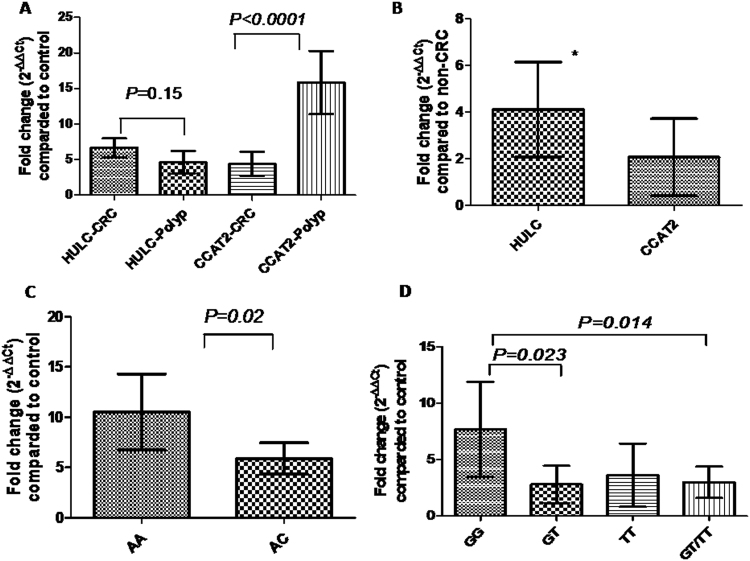
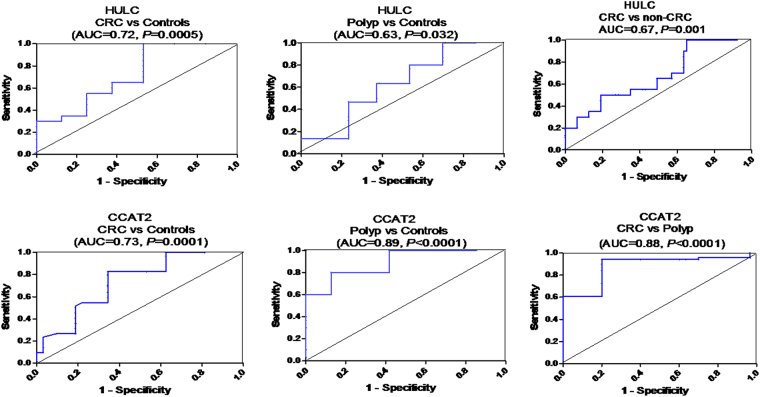
The impact of HULC rs7763881 on colorectal cancer (CRC) susceptibility is not yet known. Also, the biological function of the cancer-related rs6983267 remains unclear. We investigated the association of these SNPs with the risk of CRC and adenomatous polyps (AP), their correlation with CCAT2 and HULC expression, and the potential of serum CCAT2 and HULC as biomarkers for CRC. 120 CRC patients, 30 AP patients, and 96 healthy controls were included. Genotyping and serum lncRNAs were assayed by qPCR. Studied SNPs were not associated with AP susceptibility. rs6983267 GG was associated with increased CRC risk, whereas rs7763881 AC was protective. rs7763881 and rs6983267 CT haplotype was protective. Serum CCAT2 and HULC were upregulated in CRC and AP patients versus controls and discriminated these groups by ROC analysis. rs6983267 GG and rs7763881 AA patients demonstrated higher serum CCAT2 and HULC compared with GT/TT and AC, respectively. rs6983267 and serum HULC predicted CRC diagnosis among non-CRC groups (AP + controls) by multivariate analysis. Studied SNPs or serum long noncoding RNAs weren’t correlated with nodal or distant metastasis. In conclusion, rs6983267 and rs7763881 are potential genetic markers of CRC predisposition and correlate with serum CCAT2 and HULC, two novel potential non-invasive diagnostic biomarkers for CRC.
Overview
The claims and statistics of this paper haven’t been checked yet.
Run the check — free, no account needed. It reads the open-access text and checks the sources it cites.
Integrity signals
Registry
Cites
Statistics
Figures
Verification
Claims the paper makes
The claims and statistics of this paper haven’t been checked yet.
Run the check — free, no account needed. It reads the open-access text and checks the sources it cites.
Claims other papers make about this one
Each is checked against this paper’s own text: does it say what the citing paper says it does?
The source backs part of the claim, not all of it — or backs it for a different population, condition or comparison.
In the citing paper
“The expression levels of the studied lncRNAs were evaluated using GAPDH, which is widely used as an internal control for serum lncRNAs in numerous studies [98,99] according to the manufacturer’s protocol.”
From Targeted Nano-Drug Delivery of Colchicine against Colon Cancer Cells by Means of Mesoporous Silica Nanoparticles (2020) · cites this paper as [98]
Experimental — accuracy not yet measured
Self-check
Percentages, sums and reported differences re-computed from the paper’s own numbers.
The self-check needs the paper’s full text.
Citations
Cites
the CORGI Consortium, Tomlinson, I., Webb, E., Carvajal-Carmona, L., Broderick, P., Kemp, Z., Spain, S., Penegar, S., Chandler, I., Gorman, M., et al. (2007) · Nature Genetics · doi:10.1038/ng2085 · Cited by 808
Research works printed but not linked: 44
- Ferlay, J. et al. Cancer incidence and mortality worldwide: Sources, methods and major patterns in GLOBOCAN 2012. Int J Cancer. 136, E359–E386 (2015). · DOI · Paper page
- Gado, A., Ebeid, B., Abdelmohsen, A. & Axon, A. Colorectal cancer in Egypt is commoner in young people: Is this cause for alarm? Alexandria Journal of Medicine. 50, 197–201 (2014). · DOI
- Edwards, B. K. et al. Annual report to the nation on the status of cancer, 1975–2006, featuring colorectal cancer trends and impact of interventions (risk factors, screening, and treatment) to reduce future rates. Cancer. 116, 544–73 (2010). · DOI · Paper page
- Mimori, K., Tanaka, F., Shibata, K. & Mori, M. Review: Single nucleotide polymorphisms associated with the oncogenesis of colorectal cancer. Surg Today. 42, 215–9 (2012). · DOI
- Han, D. et al. Long noncoding RNAs: Novel players in colorectal cancer. Cancer letters. 361, 13–21 (2015). · DOI
- Cheetham, S. W., Gruhl, F., Mattick, J. S. & Dinger, M. E. Long noncoding RNAs and the genetics of cancer. Br J Cancer. 108, 2419–25 (2013). · DOI
- Haiman, C. A. et al. A common genetic risk factor for colorectal and prostate cancer. Nat Genet. 39, 954–6 (2007). · DOI
- Cui, R. et al. Common variant in 6q26-q27 is associated with distal colon cancer in an Asian population. Gut. 60, 799–805 (2011). · DOI
- Ling, H. et al. CCAT2, a novel noncoding RNA mapping to 8q24, underlies metastatic progression and chromosomal instability in colon cancer. Genome Res. 23, 1446–61 (2013). · DOI
- Kasagi, Y. et al. The Expression of CCAT2, a Novel Long Noncoding RNA Transcript, and rs6983267 Single-Nucleotide Polymorphism Genotypes in Colorectal Cancers. Oncology. 92, 48–54 (2017). · DOI
- Tuupanen, S. et al. The common colorectal cancer predisposition SNP rs6983267 at chromosome 8q24 confers potential to enhanced Wnt signaling. Nat Genet. 41, 885–90 (2009). · DOI
- Takatsuno, Y. et al. The rs6983267 SNP is associated with MYC transcription efficiency, which promotes progression and worsens prognosis of colorectal cancer. Ann Surg Oncol. 20, 1395–402 (2013). · DOI
- Prokunina-Olsson, L. & Hall, J. L. No effect of cancer-associated SNP rs6983267 in the 8q24 region on co-expression of MYC and TCF7L2 in normal colon tissue. Mol Cancer. 8, 96 (2009). · DOI
- Panzitt, K. et al. Characterization of HULC, a novel gene with striking up-regulation in hepatocellular carcinoma, as noncoding RNA. Gastroenterology. 132, 330–42 (2007). · DOI
- Yang, X. J., Huang, C. Q., Peng, C. W., Hou, J. X. & Liu, J. Y. Long noncoding RNA HULC promotes colorectal carcinoma progression through epigenetically repressing NKD2 expression. Gene. 592, 172–8 (2016). · DOI
- Liu, Y. et al. A genetic variant in long non-coding RNA HULC contributes to risk of HBV-related hepatocellular carcinoma in a Chinese population. PLoS One. 7, e35145 (2012). · DOI
- Kang, M. et al. Long noncoding RNAs POLR2E rs3787016 C/T and HULC rs7763881 A/C polymorphisms are associated with decreased risk of esophageal cancer. Tumour Biol. 36, 6401–8 (2015). · DOI
- Secco, G. B. et al. Primary mucinous adenocarcinomas and signet-ring cell carcinomas of colon and rectum. Oncology. 51, 30–4 (1994). · DOI
- Yu, X., Zheng, H., Chan, M. T. & Wu, W. K. HULC: an oncogenic long non-coding RNA in human cancer. J. Cell Mol Med. 21, 410–17 (2017). · DOI
- Daraei, A. et al. Effect of rs6983267 polymorphism in the 8q24 region and rs4444903 polymorphism in EGF gene on the risk of sporadic colorectal cancer in Iranian population. Med Oncol. 29, 1044–9 (2012). · DOI
- Ishimaru, S. et al. Increased risk for CRC in diabetic patients with the nonrisk allele of SNPs at 8q24. Ann Surg Oncol. 19, 2853–8 (2012). · DOI
- Wokolorczyk, D. et al. A range of cancers is associated with the rs6983267 marker on chromosome 8. Cancer Res. 68, 9982–6 (2008). · DOI
- Zhao, X. et al. Thers6983267 SNP and long non-coding RNA CARLo-5 are associated with endometrial carcinoma. Environ Mol Mutagen. 57, 508–15 (2016). · DOI
- Zhu, H. S., Zhang, J. F., Zhou, J. D., Zhang, M. J. & Hu, H. X. Association between the 8q24 rs6983267 T/G polymorphism and prostate cancer risk: a meta-analysis. Genet Mol Res. 14, 19329–41 (2015). · DOI
- Guo, Y. et al. Association between polymorphism rs6983267 and gastric cancer risk in Chinese population. World J Gastroenterol. 17, 1759–65 (2011). · DOI
- Sugimachi, K. et al. Allelic imbalance at an 8q24 oncogenic SNP is involved in activating MYC in human colorectal cancer. Ann Surg Oncol. 21(Suppl 4), S515–21 (2014). · DOI
- Sur, I. K. et al. Mice lacking a Myc enhancer that includes human SNP rs6983267 are resistant to intestinal tumors. Science. 338, 1360–3 (2012). · DOI
- Papanikolopoulou, A. et al. The multi-cancer marker, rs6983267, located at region 3 of chromosome 8q24, is associated with prostate cancer in Greek patients but does not contribute to the aggressiveness of the disease. Clin Chem Lab Med. 50, 379–85 (2011).
- Bertucci, F. et al. 8q24 Cancer risk allele associated with major metastatic risk in inflammatory breast cancer. PLoS One. 7, e37943 (2012). · DOI
- Graham, L. D. et al. Colorectal Neoplasia Differentially Expressed (CRNDE), a Novel Gene with Elevated Expression in Colorectal Adenomas and Adenocarcinomas. Genes Cancer. 2, 829–840 (2011). · DOI
- Svoboda, M. et al. HOTAIR long non-coding RNA is a negative prognostic factor not only in primary tumors, but also in the blood of colorectal cancer patients. Carcinogenesis. 35, 1510–1515 (2014). · DOI
- Gezer, U., Ozgur, E., Cetinkaya, M., Isin, M. & Dalay, N. Long non-coding RNAs with low expression levels in cells are enriched in secreted exosomes. Cell Biol Int. 38, 1076–79 (2014). · DOI
- Chen, X. et al. AlncRNA HULC as an effective biomarker for surveillance of the outcome of cancer: A meta-analysis. PLoS One. 12, e0171210 (2017). · DOI
- Jin, C. et al. Long non-coding RNA HULC as a novel serum biomarker for diagnosis and prognosis prediction of gastric cancer. Oncotarget. 7, 51763–72 (2016). · DOI
- Wang, C. Y. et al. Long non-coding RNA CCAT2 is up-regulated in gastric cancer and associated with poor prognosis. Int J Clin Exp Pathol. 8, 779–85 (2015).
- Huang, S., Qing, C., Huang, Z. & Zhu, Y. The long non-coding RNA CCAT2 is up-regulated in ovarian cancer and associated with poor prognosis. Diagnostic Pathology. 11, 49 (2016). · DOI
- Wang, J. et al. Long noncoding RNA CCAT2 correlates with smoking in esophageal squamous cell carcinoma. Tumour Biol. 36, 5523–8 (2015). · DOI
- Uzan, V. R. et al. High Expression of HULC Is Associated with Poor Prognosis in Osteosarcoma Patients. PLoS One. 11, e0156774 (2016). · DOI
- Leslie, A., Carey, F. A., Pratt, N. R. & Steele, R. J. The colorectal adenoma-carcinoma sequence. Br J Surg. 89, 845–60 (2002). · DOI
- Winder, T. & Lenz, H. J. Molecular predictive and prognostic markers in colon cancer. Cancer Treat Rev. 36, 550–6 (2010). · DOI
- Zhao, Y. et al. Role of long non-coding RNA HULC in cell proliferation, apoptosis and tumor metastasis of gastric cancer: a clinical and in vitro investigation. Oncol Rep. 31, 358–64 (2014). · DOI
- Xin, Y. et al. CCAT2: A novel oncogenic long non-coding RNA in human cancers. Cell Prolif. 50, https://doi.org/10.1111/cpr.12342 (2017). · DOI
- American Joint Committee on Cancer, American Cancer Society (ed. Edge, S. B.) AJCC cancer staging handbook: from the AJCC cancer staging manual, 7th ed. (Springer, 2010).
- Livak, K. J. & Schmittgen, T. D. Analysis of relative gene expression data using real-time quantitative PCR and the 2(-Delta Delta C(T)) Method. Methods. 25, 402–8 (2001). · DOI · Paper page
Cited by
Sorted by citations
AbouAitah, K., Hassan, H. A., Swiderska-Sroda, A., Gohar, L., Shaker, O. G., Wojnarowicz, J., Opalinska, A., Smalc-Koziorowska, J., Gierlotka, S., & Lojkowski, W. (2020) · Cancers · doi:10.3390/cancers12010144 · Cited by 105
Self-citation
Metadata
- Authors
- Shaker, O. G., Senousy, M. A., & Elbaz, E. M.
- Venue
- Scientific Reports
- Published
- 2017-11-24
- Volume
- 7
- Issue
- 1
- ISSN
- 2045-2322
- PMC
- PMC5701156
- Cited by
- 72
- References
- 1
- Language
- en
About these checks
Registry, retraction, Cites and statistics results are computed, not judged, with one exception: a printed reference that no index lists is read once by a model before it counts as a citation error. Claims are extracted by a model and kept only when their quote appears verbatim in the text; each cited source is then checked, with a model’s help, for whether it says what the claim relies on. Those verdicts can be wrong — read the claim’s quote and the cited source before relying on one.
Statistics and arithmetic are recomputed, not judged.
Confidence bands are shown only for fields calibrated on our annotated test set. None is calibrated yet, so no band is shown.
What counts as a claim ›How we measure confidence ›How we check this ›
Are you an author, or do you see a problem with this page? Request a review
