

A hippocampo-cerebellar centred network for the learning and execution of sequence-based navigation
Open accessThe DOI matches its Crossref record; 87 of the 88 references it cites were found in a registry or an index, and 1 are not checked yet.
Abstract
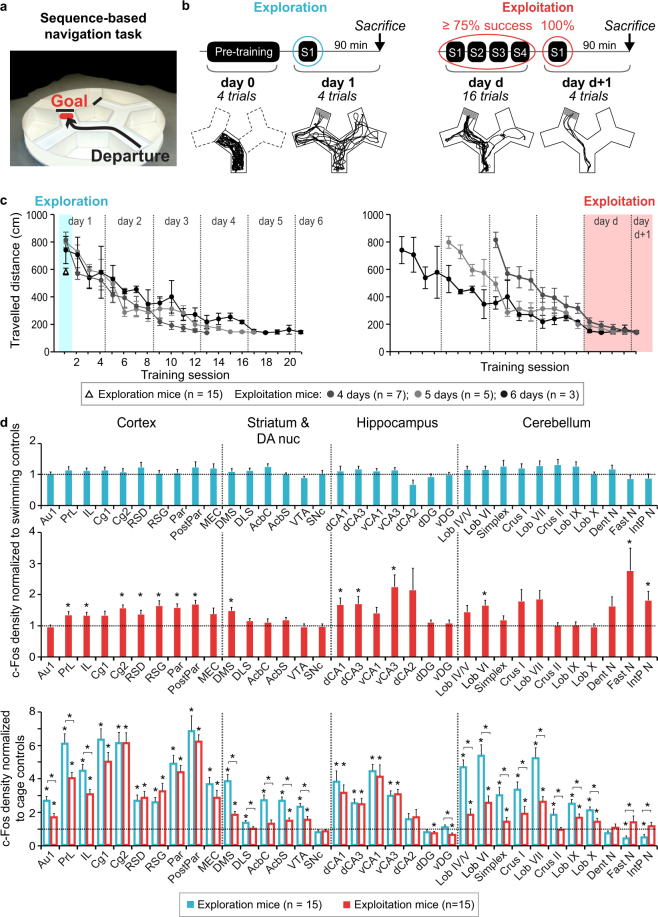
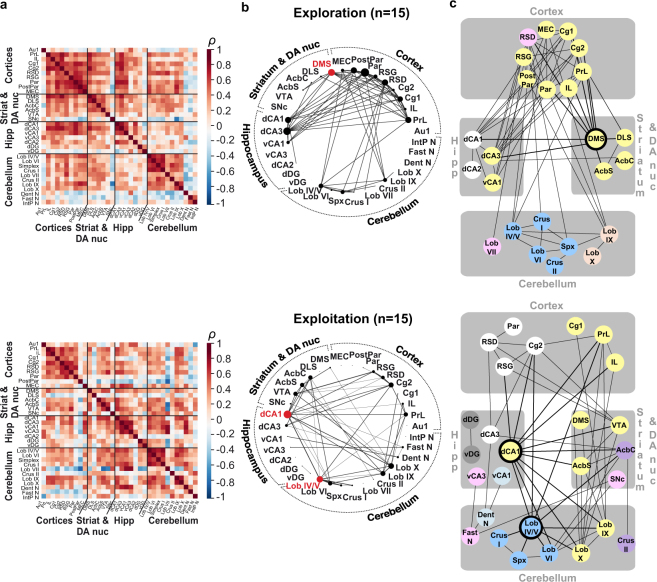
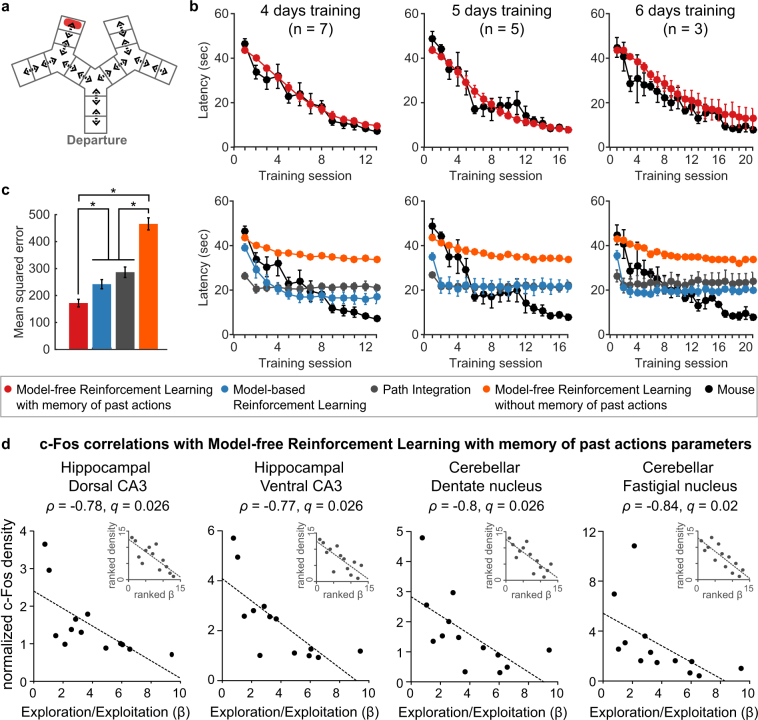
How do we translate self-motion into goal-directed actions? Here we investigate the cognitive architecture underlying self-motion processing during exploration and goal-directed behaviour. The task, performed in an environment with limited and ambiguous external landmarks, constrained mice to use self-motion based information for sequence-based navigation. The post-behavioural analysis combined brain network characterization based on c-Fos imaging and graph theory analysis as well as computational modelling of the learning process. The study revealed a widespread network centred around the cerebral cortex and basal ganglia during the exploration phase, while a network dominated by hippocampal and cerebellar activity appeared to sustain sequence-based navigation. The learning process could be modelled by an algorithm combining memory of past actions and model-free reinforcement learning, which parameters pointed toward a central role of hippocampal and cerebellar structures for learning to translate self-motion into a sequence of goal-directed actions.
Overview
The claims and statistics of this paper haven’t been checked yet.
Free: it reads the open-access text and checks the first 5 claims that cite a source we can check. Create a free account to check every claim.
Integrity signals
Registry
Cites
Statistics
Figures
Verification
Claims the paper makes
The claims and statistics of this paper haven’t been checked yet.
Free: it reads the open-access text and checks the first 5 claims that cite a source we can check. Create a free account to check every claim.
Claims other papers make about this one
Each is checked against this paper’s own text: does it say what the citing paper says it does?
The cited source says what the claim attributes to it.
In the citing paper
“Further, a network relying on hippocampal-cerebellar interactions is involved in learning sequence-based navigation in mice (Babayan et al., 2017).”
From Cerebellum, Predictions and Errors (2019) · cites this paper as Babayan et al., 2017
Self-check
Percentages, sums and reported differences re-computed from the paper’s own numbers.
The self-check needs the paper’s full text.
Citations
Cites
Controlling the False Discovery Rate: A Practical and Powerful Approach to Multiple Testing
Benjamini, Y., & Hochberg, Y. (1995) · Journal of the Royal Statistical Society Series B: Statistical Methodology · doi:10.1111/j.2517-6161.1995.tb02031.x · Cited by 109,482
Complex network measures of brain connectivity: Uses and interpretations
Rubinov, M., & Sporns, O. (2010) · NeuroImage · doi:10.1016/j.neuroimage.2009.10.003 · Cited by 11,522 · cited 2×
“Hub structures were identified using two measures of centrality: degree and betweenness 38 , computed with the Brain Connectivity Toolbox (https://sites.google.com/site/bctnet/) 84 .”
A neural substrate of prediction and reward
Schultz, W., Dayan, P., & Montague, P. R. (1997) · Science · doi:10.1126/science.275.5306.1593 · Cited by 9,388
(1978) · UA Campus Repository (The University of Arizona) · Cited by 8,010
Introduction to Reinforcement Learning
Sutton, R. S., & Barto, A. G. (1998) · The MIT Press eBooks · Cited by 6,855
An efficient algorithm for large-scale detection of protein families
Enright, A. J. (2002) · Nucleic Acids Research · doi:10.1093/nar/30.7.1575 · Cited by 3,588
Marr, D. (1969) · The Journal of Physiology · doi:10.1113/jphysiol.1969.sp008820 · Cited by 3,253
The role of the basal ganglia in habit formation
Yin, H. H., & Knowlton, B. J. (2006) · Nature Reviews Neuroscience · doi:10.1038/nrn1919 · Cited by 2,402 · cited 1×
“η ← + − + + + T N a N T N a N T N a N ( , , ) ( , , ) (1 ( , , )) (2) k i m k i m k i m 1 1 1”
Path integration and the neural basis of the 'cognitive map'
McNaughton, B. L., Battaglia, F. P., Jensen, O., Moser, E. I., & Moser, M.-B. (2006) · Nature Reviews Neuroscience · doi:10.1038/nrn1932 · Cited by 2,024 · cited 1×
“η η ← − + P Goal P Goal P Pos ( ) (1 ) ( ) ( ) (11) t”
Cerebellum and nonmotor function
Strick, P. L., Dum, R. P., & Fiez, J. A. (2009) · Annual Review of Neuroscience · doi:10.1146/annurev.neuro.31.060407.125606 · Cited by 1,777 · cited 1×
“It is noteworthy that c-Fos activity is reported as a ratio between exploitation and motor control, therefore suggesting that the activation of this cluster is not due to motor execution only 58 (but see in monkeys 59 and in humans 60 ).”
Research works printed but not linked: 1
- Paxinos, G. & Franklin, K. The Mouse Brain in Stereotaxic Coordinates, Compact | 978-0-12-374244-5|Elsevier. Mouse Brain Stereotaxic Coord. (2008).
Cited by
Vestibular processing during natural self-motion: implications for perception and action
Cullen, K. E. (2019) · Nature Reviews Neuroscience · doi:10.1038/s41583-019-0153-1 · Cited by 322
Cerebellum, Predictions and Errors
Popa, L. S., & Ebner, T. J. (2019) · Frontiers in Cellular Neuroscience · doi:10.3389/fncel.2018.00524 · Cited by 191
“Further, a network relying on hippocampalcerebellar interactions is involved in learning sequence-based navigation in mice (Babayan et al., 2017).”
BackgroundNeuronal circuitry for recognition memory of object and place in rodent models
Chao, O. Y.-H., Nikolaus, S., Yang, Y., & Huston, J. P. (2022) · Neuroscience & Biobehavioral Reviews · doi:10.1016/j.neubiorev.2022.104855 · Cited by 189
Anatomical and physiological foundations of cerebello-hippocampal interaction
Watson, T. C., Obiang, P., Torres-Herraez, A., Watilliaux, A., Coulon, P., Rochefort, C., & Rondi-Reig, L. (2019) · eLife · doi:10.7554/elife.41896 · Cited by 117
Self-citationThe Complex Nature of Hippocampal-Striatal Interactions in Spatial Navigation
Goodroe, S. C., Starnes, J., & Brown, T. I. (2018) · Frontiers in Human Neuroscience · doi:10.3389/fnhum.2018.00250 · Cited by 96
“Specifically, the DMS is a key network node alongside the VS and hippocampus for egocentric route-based navigation (Babayan et al., 2017), and DeCoteau et al.”
HippoBellum: Acute Cerebellar Modulation Alters Hippocampal Dynamics and Function
Zeidler, Z., Hoffmann, K., & Krook-Magnuson, E. I. (2020) · Journal of Neuroscience · doi:10.1523/jneurosci.0763-20.2020 · Cited by 100
“Moreover, our findings reveal that two different sites of cerebellar modulation, the simplex and lobule IV/V of the vermis, exhibit broadly similar effects on gross hippocampal function, yet differ with respect to duration and strength of modulation.”
BackgroundInfluentialCerebellar modulation of synaptic input to freezing-related neurons in the periaqueductal gray
Vaaga, C. E., Brown, S. T., & Raman, I. M. (2020) · eLife · doi:10.7554/elife.54302 · Cited by 97
“, 2000; Brown and Raman, 2018); the cerebellum also forms multisynaptic loops with the cerebral cortex and hippocampus to modulate complex behaviors, including sensory discrimination and navigation (Popa et al., 2013; Proville et al., 2014; Rochefort et al., 2011; Babayan et al., 2017).”
BackgroundKatsumi, Y., Kamona, N., Zhang, J., Bunce, J. G., Hutchinson, J. B., Yarossi, M., Tunik, E., Quigley, K. S., Dickerson, B. C., & Barrett, L. F. (2021) · doi:10.1101/2021.09.01.456844 · Cited by 89
(2023) · doi:10.1038/s42003-023-04796-0 · Cited by 89
Allostasis as a core feature of hierarchical gradients in the human brain
Katsumi, Y., Theriault, J. E., Quigley, K. S., & Barrett, L. F. (2022) · Network Neuroscience · doi:10.1162/netn_a_00240 · Cited by 88
“…al., 2017), Network Neuroscience 1022 hippocampo-isocortical (Buzsáki & Tingley, 2018; Kumaran et al., 2016), and even cerebellohippocampal (e.g., Babayan et al., 2017; Onuki et al., 2015; Watson et al., 2019) interactions, and a computational understanding of their implications for various…”
BackgroundMoreno-Rius, J. (2019) · Frontiers in Neuroendocrinology · doi:10.1016/j.yfrne.2019.100774 · Cited by 83
Li, A., & King, J. A. (2019) · Neuroscience & Biobehavioral Reviews · doi:10.1016/j.neubiorev.2019.05.005 · Cited by 67
“Risk and protective factors such as hypertension (Korf, White, Scheltens, & Launer, 2004), cognitive reserve (Buckner, 2004; Tucker & Stern, 2011) and genetic variation (Beaudet et al., 2015) can greatly affect hippocampal integrity and functioning and subsequently, episodic, spatial memory and navigation with ageing.”
BackgroundBehavioural and histological changes in cuprizone-fed mice
Sen, M. K., Almuslehi, M. S. M., Coorssen, J. R., Mahns, D. A., & Shortland, P. J. (2020) · Brain, Behavior, and Immunity · doi:10.1016/j.bbi.2020.01.021 · Cited by 62
Bernard, J. A. (2021) · Neuroscience & Biobehavioral Reviews · doi:10.1016/j.neubiorev.2022.104639 · Cited by 62
Recent Advances in the Understanding of Specific Efferent Pathways Emerging From the Cerebellum
Kang, S., Jun, S., Baek, S. J., Park, H., Yamamoto, Y., & Tanaka, K. (2021) · Frontiers in Neuroanatomy · doi:10.3389/fnana.2021.759948 · Cited by 58
Spatial navigation signals in rodent visual cortex
Floßmann, T., & Rochefort, N. L. (2020) · Current Opinion in Neurobiology · doi:10.1016/j.conb.2020.11.004 · Cited by 58
Torres-Herraez, A., Watson, T., & Rondi‐Reig, L. (2022) · Journal of Neuroscience · doi:10.1523/jneurosci.1479-21.2021 · Cited by 57
Self-citationCerebellar Prediction of the Dynamic Sensory Consequences of Gravity
Mackrous, I., Carriot, J., Jamali, M., & Cullen, K. E. (2019) · Current Biology · doi:10.1016/j.cub.2019.07.006 · Cited by 56
“, place cells) during goal-directed navigation [84].”
Antonioni, A., Raho, E. M., Straudi, S., Granieri, E., Koch, G., & Fadiga, L. (2024) · Neuroscience & Biobehavioral Reviews · doi:10.1016/j.neubiorev.2024.105830 · Cited by 48
“…’ s proposition, it also appears that the hippocampus might provide contextual cues, such as recalling past actions, to the cerebellum, which could execute a learning mechanism based on model-free reinforcement learning driven by sensory predictions (Babayan et al., 2017; Rondi-Reig et al., 2022).”
A Liaison Brought to Light: Cerebellum-Hippocampus, Partners for Spatial Cognition
Rondi‐Reig, L., Paradis, A., & Fallahnezhad, M. (2022) · The Cerebellum · doi:10.1007/s12311-022-01422-3 · Cited by 51
“In mice, the combination of a behavioral task in the aquatic Starmaze with cellular fos imaging further revealed the central involvement of the functional connectivity between the hippocampus and the cerebellum, including Crus1, lobules VI, IV/V, and lobules IX and X, during sequence learning and execution [39].”
BackgroundInfluentialSelf-citationCerebellar contribution to the cognitive alterations in SCA1: evidence from mouse models
Asher, M. J., Rosa, J. S., Rainwater, O., Duvick, L. A., Bennyworth, M., Lai, R., CRC-SCA, Kuo, S., & Cvetanović, M. (2019) · Human Molecular Genetics · doi:10.1093/hmg/ddz265 · Cited by 38
The little brain and the seahorse: Cerebellar-hippocampal interactions
Froula, J. M., Hastings, S. D., & Krook-Magnuson, E. I. (2023) · Frontiers in Systems Neuroscience · doi:10.3389/fnsys.2023.1158492 · Cited by 37
“Combined with the findings of specifically strong increases in coordinated activity in this task between lobule IV/V and CA1 (Babayan et al., 2017), this raises the interesting possibility of additional cerebellarCA1 connectivity not captured by the initial rabies tracing work.”
BackgroundInfluentialOpioid addiction and the cerebellum
Moreno, J. M. M. (2019) · Neuroscience & Biobehavioral Reviews · doi:10.1016/j.neubiorev.2019.09.015 · Cited by 31
Using virtual global landmark to improve incidental spatial learning
Liu, J., Singh, A. K., & Lin, C. (2022) · Scientific Reports · doi:10.1038/s41598-022-10855-z · Cited by 28
Redesigning navigational aids using virtual global landmarks to improve spatial knowledge retrieval
Liu, J., Singh, A. K., Wunderlich, A., Gramann, K., & Lin, C. (2022) · npj Science of Learning · doi:10.1038/s41539-022-00132-z · Cited by 29
Addiction and the cerebellum with a focus on actions of opioid receptors
Ranjbar, H., Soti, M., Banazadeh, M., Saleki, K., Kohlmeier, K. A., & Shabani, M. (2021) · Neuroscience & Biobehavioral Reviews · doi:10.1016/j.neubiorev.2021.09.021 · Cited by 28
Irving, S., Schöberl, F., Pradhan, C., Brendel, M., Bartenstein, P., Dieterich, M., Brandt, T., & Zwergal, A. (2018) · Journal of Neurology · doi:10.1007/s00415-018-8987-4 · Cited by 26
Reynolds-Lallement, N. C., Zhong, J. Y., Clendinen, C., Moffat, S. D., & Magnusson, K. R. (2019) · NeuroImage · doi:10.1016/j.neuroimage.2019.116069 · Cited by 26
Banker, S. M., Ramphal, B., Pagliaccio, D., Thomas, L. V., Rosen, E., Sigel, A. N., Zeffiro, T. A., Marsh, R., & Margolis, A. E. (2020) · Scientific Reports · doi:10.1038/s41598-019-56003-y · Cited by 24
Rabellino, D., Thome, J., Densmore, M., Théberge, J., McKinnon, M. C., & Lanius, R. A. (2022) · The Cerebellum · doi:10.1007/s12311-022-01467-4 · Cited by 21
Schiavone, S., Tucci, P., Trabace, L., & Morgese, M. G. (2019) · Molecules · doi:10.3390/molecules24213993 · Cited by 21
“Moreover, in good agreement with our findings, previous evidence has reported a crucial role of TNF-α in regulating ketamine-induced neurotoxicity in the hippocampus [112,113], which is known to be functionally connected with the cerebellum [114,115].”
ResultThe Implementation of Predictions During Sequencing
Molinari, M., & Masciullo, M. (2019) · Frontiers in Cellular Neuroscience · doi:10.3389/fncel.2019.00439 · Cited by 21
“Moreover, previous findings (Konczak and Timmann, 2007; Bastian, 2011; Goodworth and Peterka, 2012; Timmann et al., 2013) suggest that lesions of the cerebellum may induce abnormalities in the spatial and temporal pattern of muscle activation resulting in specification gait impairments.”
Prolonged allocentric navigation deficits indicate hippocampal damage in TGA
Schöberl, F., Irving, S., Pradhan, C., Bardins, S., Trapp, C., Schneider, E., Kugler, G., Bartenstein, P., Dieterich, M., Brandt, T., et al. (2018) · Neurology · doi:10.1212/wnl.0000000000006779 · Cited by 20
Cerebellum-Cortical Interaction in Spatial Navigation and Its Alteration in Dementias
Mirino, P., Pecchinenda, A., Boccia, M., Capirchio, A., D’Antonio, F., & Guariglia, C. (2022) · Brain Sciences · doi:10.3390/brainsci12050523 · Cited by 21
“A study on navigational skills and navigational memory in mice revealed a widespread network centered around the cerebral cortex and basal ganglia during the exploration of an arena, as well as a network dominated by hippocampal and cerebellar activity, which sustains sequence-based, goal-directed navigation but also…”
BackgroundBanker, S. M., Pagliaccio, D., Ramphal, B., Thomas, L. V., Dranovsky, A., & Margolis, A. E. (2020) · Hippocampus · doi:10.1002/hipo.23264 · Cited by 19
“This discrepancy may reflect the fact that hippocampal functional connectivity with the cerebellum is more strongly associated with dynamic, navigation-based aspects of visual-spatial reasoning (Babayan et al., 2017; Berthoz et al., 2014) than the static, perceptual reasoning aspects indexed by performance IQ.”
BackgroundInfluentialTerrier, C., Greco-Vuilloud, J., Cavelius, M., Thévenet, M., Mandairon, N., Didier, A., & Richard, M. B. (2024) · Neurobiology of Aging · doi:10.1016/j.neurobiolaging.2024.01.011 · Cited by 18
“To go further into the analysis of these networks ’ reorganization and describe the networks ’ topology, we performed a graph theory analysis (Babayan et al., 2017; Rubinov and Sporns, 2010; Wheeler et al., 2013).”
InfluentialThe Role of the Cerebellum in Drug Reward: A Review
Wang, Y., & Yan, L. (2023) · Journal of Integrative Neuroscience · doi:10.31083/j.jin2206147 · Cited by 17
Castilla, A., Borst, G., Cohen, D., Fradin, J., Lefrançois, C., Houdé, O., Zaoui, M., & Berthoz, A. (2021) · Frontiers in Psychiatry · doi:10.3389/fpsyt.2021.708378 · Cited by 16
“The cortical areas and striatum are involved in the exploration phase and the hippocampus and cerebellum are involved in the exploitation phase (40).”
Laidi, C., Neu, N., Watilliaux, A., Teruel, A. M., Razafinimanana, M., Boisgontier, J., Hotier, S., d’Albis, M.-A., Delorme, R., Amestoy, A., et al. (2022) · Autism Research · doi:10.1002/aur.2865 · Cited by 15
“We further reported that a hippocampocerebellar-prefrontal centered network sustained the learning and execution of goal-directed navigation based on route memory (Babayan et al., 2017).”
BackgroundSelf-citationChik, M. W., Affandi, M. M. R. M. M., & Singh, G. K. S. (2022) · Journal of Pharmacy And Bioallied Sciences · doi:10.4103/jpbs.jpbs_464_21 · Cited by 13
Route sequence knowledge supports the formation of cognitive maps
Hilton, C., & Wiener, J. (2023) · Hippocampus · doi:10.1002/hipo.23574 · Cited by 11
“For navigation-based sequence learning in rodents, the hippocampus has been shown to be involved in learning sequences of places (Foster & Knierim, 2012), and is recruited during sequence-based navigation, but not during exploration behavior (Babayan et al., 2017).”
MethodAngius, F., Piras, E., Uda, S., Madeddu, C., Serpe, R., Bigi, R., Chen, W., Dittmer, D. P., Pompei, R., & Ingianni, A. (2017) · The Journal of Antibiotics · doi:10.1038/ja.2017.67 · Cited by 12
The Effect of Prenatal and Neonatal Fluoride Exposure to Morphine-Induced Neuroinflammation
Kupnicka, P., Listos, J., Tarnowski, M., Kolasa, A., Kapczuk, P., Surówka, A., Kwiatkowski, J., Janawa, K., Chlubek, D., & Baranowska‐Bosiacka, I. (2024) · International Journal of Molecular Sciences · doi:10.3390/ijms25020826 · Cited by 9
Cwerman‐Thibault, H., Malko-Baverel, V., Guilloux, G. L., Ratcliffe, E., Mouri, D., Torres-Cuevas, I., Millán, I., Saubaméa, B., Mignon, V., Boespflug‐Tanguy, O., et al. (2024) · Molecular Therapy · doi:10.1016/j.ymthe.2024.05.030 · Cited by 9
“79,80 Spatial reference memory is reduced in Hq mice suggesting that the hippocampo-cerebellar network is impaired; indeed GFP -treated Hq mice attained only 23.1% of the value measured in the GFP - treated control mice for the time spent in the novel arm of the Y-Maze; such as these mice did not…”
InfluentialHaberman, R. P., Monasterio, A., Branch, A., & Gallagher, M. (2019) · Behavioral Neuroscience · doi:10.1037/bne0000332 · Cited by 9
“Correlational analysis of activity dependent gene expression has been used previously as a proxy for functional connectivity (Babayan et al., 2017).”
MethodBadea, A., Li, D., Niculescu, A. R., Anderson, R. J., Stout, J. A., Williams, C. L., Colton, C. A., Maeda, N., & Dunson, D. B. (2022) · Frontiers in Neuroscience · doi:10.3389/fnins.2022.848654 · Cited by 9
“More recently the cerebellum has emerged as also having a role in learning, and it has been suggested it may interact with the hippocampus (Babayan et al. 2017), perhaps via other regions, including the retrosplenial cortex (Rochefort, Lefort, and Rondi-Reig 2013).”
BackgroundCooper, C. P., Shafer, A. T., Armstrong, N. M., An, Y., Erus, G., Davatzikos, C. A., Ferrucci, L., Rapp, P. R., & Resnick, S. M. (2023) · NeuroImage · doi:10.1016/j.neuroimage.2023.120048 · Cited by 9
Zhang, L., Fournier, J., Fallahnezhad, M., Paradis, A., Rochefort, C., & Rondi‐Reig, L. (2023) · iScience · doi:10.1016/j.isci.2023.106200 · Cited by 9
Self-citationCerebello-Hippocampal Interactions in the Human Brain: A New Pathway for Insights Into Aging
Bernard, J. A. (2024) · The Cerebellum · doi:10.1007/s12311-024-01670-5 · Cited by 8
“…linking the cerebellum to the prefrontal cortex and has focused on fluid domains such as working memory, there is a growing literature suggesting that other non-motor domains, including spatial navigation and long-term memory may also rely upon cerebellar processing for task performance [6, 20–23].”
Role of the Cerebellum in the Construction of Functional and Geometrical Spaces
Torkhani, E., Bennequin, D., & de Marco, G. (2024) · The Cerebellum · doi:10.1007/s12311-024-01693-y · Cited by 10
“As well, different parts of the cerebellum are likely to be involved in different motor spaces [219, 220].”
Cooper, C. P., Shafer, A. T., Armstrong, N. M., Rossi, S. L., Young, J., Herold, C., Gu, H., Yang, Y., Stein, E. A., Resnick, S. M., et al. (2021) · Cerebral Cortex · doi:10.1093/cercor/bhab257 · Cited by 8
Does the Cerebellum Implement or Select Geometries? A Speculative Note
Habas, C., Berthoz, A., Flash, T., & Bennequin, D. (2020) · The Cerebellum · doi:10.1007/s12311-019-01095-5 · Cited by 7
Dopamine receptors of the rodent fastigial nucleus support skilled reaching for goal-directed action
Caragea, V.-M., Méndez‐Couz, M., & Manahan‐Vaughan, D. (2023) · Brain Structure and Function · doi:10.1007/s00429-023-02685-0 · Cited by 5
“Participation in goal-directed behavior has been ascribed to the cerebellum (Babayan et al. 2017; Verschure et al. 2014) and the deep cerebellar nuclei (DCN) (Callu et al. 2013; Xiao et al. 2018).”
BackgroundChai, J., Ruan, X., & Huang, J. (2021) · Brain Sciences · doi:10.3390/brainsci11060803 · Cited by 5
Froula, J. M., Rose, J. J., Krook-Magnuson, C., & Krook-Magnuson, E. I. (2024) · Journal of Neuroscience · doi:10.1523/jneurosci.0887-24.2024 · Cited by 4
Wu, Z., Wang, D., & Liu, L. (2024) · Cognitive Systems Research · doi:10.1016/j.cogsys.2024.101302 · Cited by 3
Shallie, P. D., Sulaiman, A. I., Oladejo, M. K., Shallie, O. F., & Naicker, T. (2021) · IBRO Neuroscience Reports · doi:10.1016/j.ibneur.2021.02.003 · Cited by 3
“The hippocampus and the cerebellar network is implicated in the emergence of goal-directed actions from the Spatio-temporal organization of self-motion information (Babayan et al., 2017).”
BackgroundA Common Multiplicity of Action Spaces in the Brain and in the arts? The 4/5 Spaces Theory
Berthoz, A. (2021) · Lecture notes in morphogenesis · doi:10.1007/978-3-030-57227-3_2 · Cited by 3
Discovering the Neuroanatomical Correlates of Music with Machine Learning
Daikoku, T. (2021) · Springer eBooks · doi:10.1007/978-3-030-72116-9_6 · Cited by 3
Spatial maps in the mind: An integrative review of mobility’s role in wayfinding
Chargo, A. N., Fritz, N. E., & Daugherty, A. M. (2025) · Neuropsychologia · doi:10.1016/j.neuropsychologia.2025.109298 · Cited by 2
Mapping hippocampal-cerebellar functional connectivity across the human adult lifespan
Apasamy, K., Berry, S. C., Read, M., Ramnani, N., & Hodgetts, C. J. (2025) · Communications Biology · doi:10.1038/s42003-025-08972-2 · Cited by 3
“V, VI, lobule VIIA (Crus I) and other including lobule IX, X — are differentially connected with dorsal hippocampal CA1 neurons during spatial exploration 42 .”
Govoni, P., & Romańczuk, P. (2024) · arXiv (Cornell University) · doi:10.48550/arxiv.2407.13535 · Cited by 2
“Described in this way, model-based learning appears to reflect map-based strategies and model-free to response sequences, coordinated through associative memory, [52, 42], though the two perspectives may not fully align [56, 57, 44].”
Molinari, M. (2023) · Springer eBooks · doi:10.1007/978-3-031-15070-8_57 · Cited by 1
Establishment of an optimized and automated workflow for whole brain probing of neuronal activity
Cabrera, S., Vachoud, N., Maciel, R. M., Breuilly, M., Desmercieres, S., Cataldi, A., Meyer-Dilhet, G., Ellouze, S., Courchet, J., Luppi, P., et al. (2026) · F1000Research · doi:10.12688/f1000research.171627.1 · Cited by 1
Bidirectional interactions between neuromodulatory systems and the cerebellum in brain function
Kim, T., Park, H., Jun, S., Park, J., Yamamoto, Y., & Tanaka, K. (2026) · Neuroscience & Biobehavioral Reviews · doi:10.1016/j.neubiorev.2026.106716 · Cited by 1
Latéralisation du traitement des informations olfactives chez la souris
Cavelius, M. (2021) · theses.fr (ABES) · doi:10.70675/34629633zb9e2z42b0zbf50z759096d1000e · Cited by 1
Olfaction : marqueur et outil pour bien vieillir
Greco-Vuilloud, J. (2021) · theses.fr (ABES) · doi:10.70675/c6cb9892zfc7bz4db9z9993z0550708692cb · Cited by 1
McKeown, D. J., Cruzado, O. S., Colombo, G., Angus, D. J., & Schinazi, V. R. (2026) · medRxiv · doi:10.64898/2026.04.09.26350542 · Cited by 1
Lew, A. R. (2019) · Durham e-Theses (Durham University)
Schmitt, J. (2018) · theses.fr (ABES) · doi:10.70675/771598d3zc308z4c40zbad3z3994abcd07db · Cited by 1
Gaze behaviour and brain activation patterns during real-space navigation in hippocampal dysfunction
Irving, S. (2019) · Elektronische Hochschulschriften der LMU München (Ludwig-Maximilians-Universität München) · doi:10.5282/edoc.24820
Orihuel, J., Capellán, R., Roura‐Martínez, D., Ucha, M., Gómez-Rubio, L., Valverde, C., Casquero‐Veiga, M., Soto‐Montenegro, M. L., Desco, M., Oteo, M., et al. (2020) · bioRxiv (Cold Spring Harbor Laboratory) · doi:10.1101/2020.10.19.345322 · Cited by 1
Zeidler, Z. (2020) · University of Minnesota Digital Conservancy (University of Minnesota)
White, A. (2021) · Deep Blue (University of Michigan) · doi:10.7302/2940
In vivo and in vitro study of the role of cerebellar interneurons in a motor learning task
Kassa, M. (2019) · theses.fr (ABES) · doi:10.70675/7fe90fd1za78ez454fz8debzd6c1b0a8e734
Involvement of posterior cerebellar molecular layer interneurons in reward-oriented behavior
Lehericy, C. (2023) · theses.fr (ABES) · doi:10.70675/3e8a0b38z072fz4f73z8570z8fce7510feb7
Sodoma, M. (2023) · Iowa Research Online (The University of Iowa) · doi:10.25820/etd.006987
Time Between Learning Events Shapes Functional Connectivity in Spatial Memory: A Brain-Wide Analysis
di Sturmeck, T. G., Bergamo, S., Mastrorilli, V., Patrizi, A., Nuzzi, D., Pezzulo, G., Ferraro, G. D., Rinaldi, A., & Mele, A. (2026) · Molecular Neurobiology · doi:10.64898/2026.02.12.705541
Torres-Herraez, A. (2019) · theses.fr (ABES) · doi:10.70675/c2c08c6fzad3ez4051zaa90z0935f26ce422
Pourquoi aimons-nous tant le parfum de la rose ?
Adrar, I. (2023) · theses.fr (ABES) · doi:10.70675/40a94106z14b5z4bbdza30fz4485bdc8fc10
Archimbaud, J., Lehericy, C., Auger, C., Rochefort, C., & Rondi‐Reig, L. (2026) · eNeuro · doi:10.1523/eneuro.0126-26.2026
Self-citation
Metadata
- Authors
- Babayan, B. M., Watilliaux, A., Viejo, G., Paradis, A.-L., Girard, B., & Rondi-Reig, L.
- Affiliations
- Centre National de la Recherche Scientifique (FR)
- Venue
- Scientific Reports
- Published
- 2017-12-19
- Volume
- 7
- Issue
- 1
- Pages
- 17812-17812
- ISSN
- 2045-2322 (ISSN-L)
- PMC
- PMC5736633
- OpenAlex
- W2773861673
- Semantic Scholar
- a310e853a865633b3ff179c67fa0b0e1a73ffa8b
- Cited by
- 70
- References
- 88
- Citations by year
- 2026: 2 · 2025: 2 · 2024: 9 · 2023: 9 · 2022: 13 · 2021: 9 · 2020: 10 · 2019: 12 · 2018: 3 · 2017: 1
- FWCI
- 4.08
- Type
- journal article
- Language
- en
- Update notices
- correction (2019-12-20)
- Open access
- gold
- doi.org
- Licence
- cc-by
- creativecommons.org/licenses/by/4.0 (tdm)
- creativecommons.org/licenses/by/4.0 (vor)
- Locations
- Scientific Reports (publishedVersion, cc-by)
- Europe PMC (PubMed Central) (publishedVersion, cc-by)
- PubMed Central (publishedVersion, cc-by)
- PubMed (publishedVersion)
- HAL (submittedVersion, other-oa)
- DOAJ (DOAJ: Directory of Open Access Journals) (submittedVersion)
- Funders
- Agence Nationale de la Recherche (ANR–11–LABX–65, ANR-11IDEX-0004-02, ANR-11-IDEX, IDEX-0004-02, ANR-11-IDEX-0004, ANR-10, ANR-10-LABX, ANR-11-LABX-0065)
- Fondation pour la Recherche Médicale (ANR-11-IDEX-0004-02)
- Ministère de l'Enseignement Supérieur et de la Recherche (ANR-11-IDEX-0004-02)
- CHIST-ERA
- Topics
- Life Sciences › Neuroscience › Cognitive Neuroscience › Memory and Neural Mechanisms
- Social Sciences › Psychology › Experimental and Cognitive Psychology › Spatial Cognition and Navigation
- Life Sciences › Neuroscience › Neurology › Vestibular and auditory disorders
- Keywords
- hippocampus, cerebellum, goal-directed behavior, exploration, basal ganglia, cerebral cortex, graph theory, model-free reinforcement learning, mouse behavior, brain networks
- MeSH terms
- Animals, Basal Ganglia, Cerebellum, Cerebral Cortex, Computer Simulation, Hippocampus, Learning, Male, Memory, Mice, Inbred C57BL, Models, Neurological, Neural Pathways, Orientation, Space Perception, Mice
About these checks
Registry, retraction, Cites and statistics results are computed, not judged, with one exception: a printed reference that no index lists is read once by a model before it counts as a citation error. Claims are extracted by a model and kept only when their quote appears verbatim in the text; each cited source is then checked, with a model’s help, for whether it says what the claim relies on. Those verdicts can be wrong — read the claim’s quote and the cited source before relying on one.
Statistics and arithmetic are recomputed, not judged.
Confidence bands are shown only for fields calibrated on our annotated test set. None is calibrated yet, so no band is shown.
What counts as a claim ›How we measure confidence ›How we check this ›
Are you an author, or do you see a problem with this page? Request a review
Data sources
Bibliographic data: Semantic Scholar, OpenAlex, Crossref.
Contains information from the Semantic Scholar Academic Graph Datasets, made available under the ODC Attribution License (ODC-BY 1.0).
Semantic Scholar’s data is described in: Kinney, R., et al. (2023). The Semantic Scholar Open Data Platform. arXiv:2301.10140.
