

An application of machine learning to haematological diagnosis
Open accessThe DOI matches its Crossref record; 42 of the 42 references it cites were found in a registry or an index.
Abstract
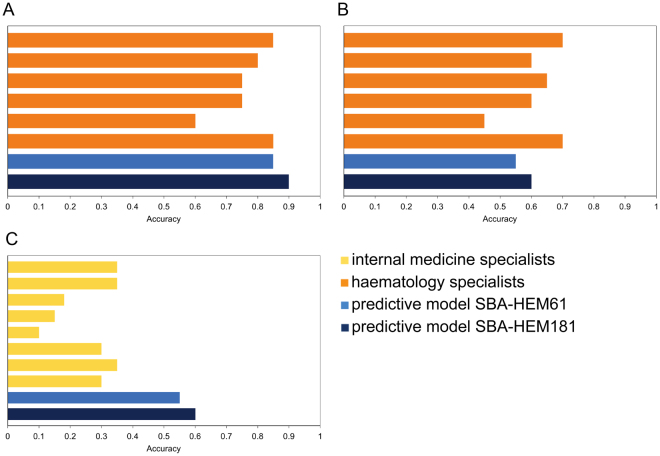
Quick and accurate medical diagnoses are crucial for the successful treatment of diseases. Using machine learning algorithms and based on laboratory blood test results, we have built two models to predict a haematologic disease. One predictive model used all the available blood test parameters and the other used only a reduced set that is usually measured upon patient admittance. Both models produced good results, obtaining prediction accuracies of 0.88 and 0.86 when considering the list of five most likely diseases and 0.59 and 0.57 when considering only the most likely disease. The models did not differ significantly, which indicates that a reduced set of parameters can represent a relevant “fingerprint” of a disease. This knowledge expands the model’s utility for use by general practitioners and indicates that blood test results contain more information than physicians generally recognize. A clinical test showed that the accuracy of our predictive models was on par with that of haematology specialists. Our study is the first to show that a machine learning predictive model based on blood tests alone can be successfully applied to predict haematologic diseases. This result and could open up unprecedented possibilities for medical diagnosis.
Overview
The claims and statistics of this paper haven’t been checked yet.
Free: it reads the open-access text and checks the first 5 claims that cite a source we can check. Create a free account to check every claim.
Integrity signals
Registry
Cites
Statistics
Figures
Verification
Claims the paper makes
The claims and statistics of this paper haven’t been checked yet.
Free: it reads the open-access text and checks the first 5 claims that cite a source we can check. Create a free account to check every claim.
Claims other papers make about this one
Each is checked against this paper’s own text: does it say what the citing paper says it does?
The cited source says what the claim attributes to it.
In the citing paper
“Hematology and serology can benefit from microscope-integrated AIs 42 that diagnose common conditions 43 or count blood cells of various types 44 -repetitive tasks that are easy to augment with CNNs.”
From Deep learning-enabled medical computer vision (2021) · cites this paper as [43]
Self-check
Percentages, sums and reported differences re-computed from the paper’s own numbers.
The self-check needs the paper’s full text.
Citations
Cites
Breiman, L. (2001) · Machine Learning · doi:10.1023/a:1010933404324 · Cited by 133,538
LIBSVM: A library for support vector machines
Chang, C.-C., & Lin, C.-J. (2011) · ACM Transactions on Intelligent Systems and Technology · doi:10.1145/1961189.1961199 · Cited by 40,918
The Nature of Statistical Learning Theory
Vapnik, V. N. (1995) · doi:10.1007/978-1-4757-2440-0 · Cited by 39,138
SMOTE synthetic minority over-sampling technique
Chawla, N. V., Bowyer, K. W., Hall, L. O., & Kegelmeyer, W. P. (2002) · Journal of Artificial Intelligence Research · doi:10.1613/jair.953 · Cited by 32,865
UCI Machine Learning Repository
Asuncion, A. (2007) · Medical Entomology and Zoology · Cited by 25,385
An introduction to ROC analysis
Fawcett, T. (2006) · Pattern Recognition Letters · doi:10.1016/j.patrec.2005.10.010 · Cited by 21,879 · cited 1×
“For two-class problems and scoring classifiers (i.e., a classifier that produces a score for each possible class and predicts the class with the maximum score), ROC curves are produced in a straightforward manner by ordering the maximum scores and varying the decision threshold 25 .”
BackgroundDermatologist-level classification of skin cancer with deep neural networks
Esteva, A., Kuprel, B., Novoa, R. A., Ko, J., Swetter, S. M., Blau, H. M., & Thrun, S. (2017) · Nature · doi:10.1038/nature21056 · Cited by 14,362 · cited 1×
“Recently, a model capable of classifying skin cancers based on images of the skin was presented that achieves a level of competence comparable to that of a dermatologist 7 .”
BackgroundMachine learning: Trends, perspectives, and prospects
Jordan, M. I., & Mitchell, T. M. (2015) · Science · doi:10.1126/science.aaa8415 · Cited by 9,955 · cited 1×
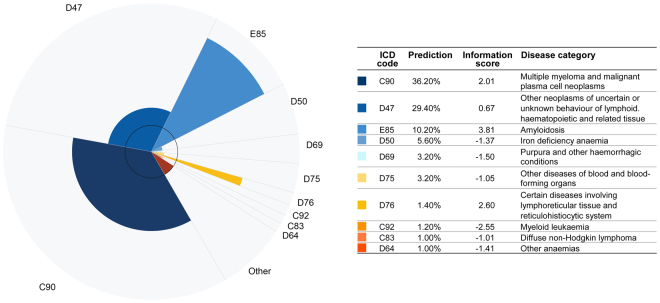
“In these two equations (1, 2), r is the radius (information score) and ø the angle (predicted probability) of disease x.”
BackgroundEnsemble methods in machine learning
Dietterich, T. G. (2000) · Lecture Notes in Computer Science · doi:10.1007/3-540-45014-9_1 · Cited by 8,408
A systematic analysis of performance measures for classification tasks
Sokolova, M., & Lapalme, G. (2009) · Information Processing & Management · doi:10.1016/j.ipm.2009.03.002 · Cited by 7,515 · cited 1×
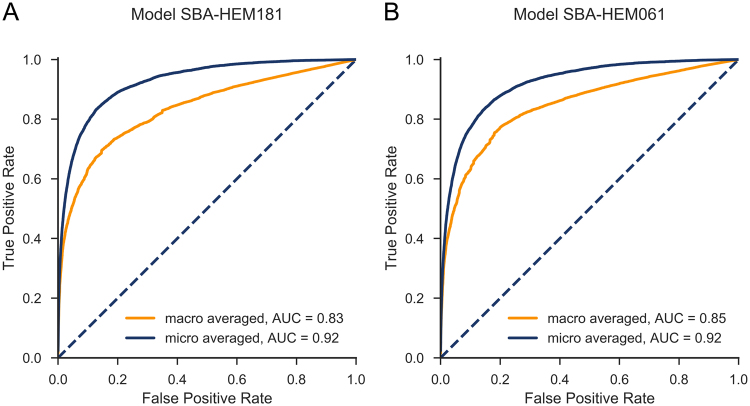
“We applied two approaches suitable for observing overall classifier performance in multi-class problems: macro-averaging and micro-averaging 26 .”
MethodADASYN: Adaptive synthetic sampling approach for imbalanced learning
He, H., Bai, Y., Garcia, E. A., & Li, S. (2008) · 2008 IEEE International Joint Conference on Neural Networks (IEEE World Congress on Computational Intelligence) · doi:10.1109/ijcnn.2008.4633969 · Cited by 4,521
A Practical Approach to Feature Selection
Kira, K., & Rendell, L. A. (1992) · Machine Learning Proceedings 1992 · doi:10.1016/b978-1-55860-247-2.50037-1 · Cited by 2,978 · cited 1×
“We estimated the importance of all blood parameters with the ReliefF algorithm 22,23 and ordered them in decreasing fashion.”
MethodEstimating attributes: Analysis and extensions of RELIEF
Kononenko, I. (1994) · Lecture Notes in Computer Science · doi:10.1007/3-540-57868-4_57 · Cited by 2,958 · cited 1×
“We estimated the importance of all blood parameters with the ReliefF algorithm 22,23 and ordered them in decreasing fashion.”
MethodPopular Ensemble Methods: An Empirical Study
Opitz, D., & Maclin, R. (1999) · Journal of Artificial Intelligence Research · doi:10.1613/jair.614 · Cited by 2,953
Multiple imputation of discrete and continuous data by fully conditional specification
van Buuren, S. (2007) · Statistical Methods in Medical Research · doi:10.1177/0962280206074463 · Cited by 2,827
The Nature of Statistical Learning
Vapnik, V. N. (1995) · Medical Entomology and Zoology · Cited by 2,295
Graph-based approach for airborne light detection and ranging segmentation
Vilariño, D. L., Cabaleiro, J. C., Martínez, J., Rivera, F. F., & Pena, T. F. (2017) · Journal of Applied Remote Sensing · doi:10.1117/1.jrs.11.015020 · Cited by 1,721
The Case against Accuracy Estimation for Comparing Induction Algorithms
Provost, F. J., Fawcett, T. E., & Kohavi, R. (1998) · International Conference on Machine Learning · Cited by 1,302
Boulesteix, A., Janitza, S., Kruppa, J., & König, I. R. (2012) · WIREs Data Mining and Knowledge Discovery · doi:10.1002/widm.1072 · Cited by 924 · cited 1×
“Several authors have shown that random forest algorithms perform well in most problem domains 17 , including medical diagnostics 18,19 .”
BackgroundProceedings of the Fifteenth International Conference on Machine Learning
SHAVLIK, J. W. (1998) · Cited by 462
PETERSON, M. C., HOLBROOK, J. M., HALES, D. V., SMITH, N. L., & STAKER, L. V. (1992) · Obstetrical & Gynecological Survey · doi:10.1097/00006254-199210000-00013 · Cited by 388
Machine learning approaches in medical image analysis: From detection to diagnosis
de Bruijne, M. (2016) · Medical Image Analysis · doi:10.1016/j.media.2016.06.032 · Cited by 347
(2019) · doi:10.33176/cbr · Cited by 294
OpitzDavid, & MaclinRichard (1999) · doi:10.5555/3013545.3013549 · Cited by 293
Peterson, M. C., Holbrook, J. H., Hales, D., Smith, N. L., & Staker, L. V. (1992) · PubMed Central · Cited by 262
Fifty years of computer analysis in chest imaging: rule-based, machine learning, deep learning
van Ginneken, B. (2017) · Radiological Physics and Technology · doi:10.1007/s12194-017-0394-5 · Cited by 177 · cited 2×
“φ π = x predicted x angle in radians ( ) 2 ( ) ( ) (2)”
BackgroundÖzçift, A. (2011) · Computers in Biology and Medicine · doi:10.1016/j.compbiomed.2011.03.001 · Cited by 164
Using Machine Learning to Predict Laboratory Test Results
Luo, Y., Szolovits, P., Dighe, A. S., & Baron, J. M. (2016) · American Journal of Clinical Pathology · doi:10.1093/ajcp/aqw064 · Cited by 162
Primary Care Physicians' Challenges in Ordering Clinical Laboratory Tests and Interpreting Results
Hickner, J., Thompson, P. J., Wilkinson, T., Epner, P., Shaheen, M., Pollock, A. M., Lee, J., Duke, C. C., Jackson, B. R., & Taylor, J. R. (2014) · The Journal of the American Board of Family Medicine · doi:10.3122/jabfm.2014.02.130104 · Cited by 160
Using random forest for reliable classification and cost-sensitive learning for medical diagnosis
Yang, F., Wang, H.-Z., Mi, H., Lin, C.-D., & Cai, W.-W. (2009) · BMC Bioinformatics · doi:10.1186/1471-2105-10-s1-s22 · Cited by 130 · cited 1×
“Several authors have shown that random forest algorithms perform well in most problem domains 17 , including medical diagnostics 18,19 .”
BackgroundEnsemble clustering in medical diagnostics
Greene, D., Tsymbal, A., Bolshakova, N., & Cunningham, P. (2004) · Proceedings - IEEE Symposium on Computer-Based Medical Systems · doi:10.1109/cbms.2004.1311777 · Cited by 99 · cited 1×
“Ensemble methods 15,16 combine weak learners to form a strong learner .”
Ensemble clustering in medical diagnostics
Greene, D., Tsymbal, A., Bolshakova, N., & Cunningham, P. (2004) · Cited by 90
A similarity measure to assess the stability of classification trees
Briand, B., Ducharme, G. R., Parache, V., & Mercat-Rommens, C. (2008) · Computational Statistics & Data Analysis · doi:10.1016/j.csda.2008.10.033 · Cited by 53
Relative Entropy as a Measure of Diagnostic Information
Benish, W. A. (1999) · Medical Decision Making · doi:10.1177/0272989x9901900211 · Cited by 52
Yamamoto, Y., Saito, A., Tateishi, A., Shimojo, H., Kanno, H., Tsuchiya, S., Ito, K.-I., Cosatto, E., Graf, H. P., Moraleda, R. R., et al. (2017) · Scientific Reports · doi:10.1038/srep46732 · Cited by 52 · cited 1×
“For a physician to determine a differential diagnosis and make quick treatment plans, medical knowledge, skills and experience all play a significant role 8 .”
BackgroundEvidence-based laboratory medicine
Badrick, T. C. (2017) · Clinical Chemistry and Laboratory Medicine (CCLM) · doi:10.1515/cclm-2017-7051 · Cited by 48
Proceedings. 17th IEEE Symposium on Computer-Based Medical Systems
(2004) · Proceedings - IEEE Symposium on Computer-Based Medical Systems · doi:10.1109/cbms.2004.1311674 · Cited by 48
Image processing and machine learning for fully automated probabilistic evaluation of medical images
Šajn, L., & Kukar, M. (2010) · Computer Methods and Programs in Biomedicine · doi:10.1016/j.cmpb.2010.06.021 · Cited by 37 · cited 1×
“Several examples of successful applications of machine learning methods in specialized medical fields exsist 2–6 .”
BackgroundSelf-citationThe future of medical diagnostics: large digitized databases.
Kerr, W. T., Lau, E. P., Owens, G. E., & Trefler, A. (2012) · PubMed Central · Cited by 36
Kukar, M., Kononenko, I., & Grošelj, C. (2011) · Artificial Intelligence in Medicine · doi:10.1016/j.artmed.2011.04.009 · Cited by 25
Self-citationEvidence Based Laboratory Medicine
Horvath, A. R. (2014) · Clinical Chemistry and Laboratory Medicine (CCLM) · doi:10.1515/cclm-2014-4025 · Cited by 16
Evaluation and Comparison of Diagnostic Test Performance Based on Information Theory
Oruç, Ö. E., & Kanca, A. (2012) · International journal of statistics and applications · doi:10.5923/j.statistics.20110101.03 · Cited by 3 · cited 1×
“If we look at the graph as a whole, it is strongly (although not identically) related to the Kullback-Leibler 27,28 divergence between posttest (predicted) and pretest (prevalence) probability distributions.”
Result
Research works printed but not linked: 2
- Kononenko, I. In Proc. 4th European Working Session on Learning. 91–98 (1989).
- Conover, W. Statistics of the Kolmogorov-Smirnov type in Practical nonparametric statistics, 428–473 (John Wiley & Sons, 1999).
Cited by
Deep learning-enabled medical computer vision
Esteva, A., Chou, K., Yeung, S., Naik, N., Madani, A., Mottaghi, A., Liu, Y., Topol, E., Dean, J., & Socher, R. (2021) · npj Digital Medicine · doi:10.1038/s41746-020-00376-2 · Cited by 1,406
Artificial intelligence in drug development: Present status and future prospects
Mak, K.-K., & Pichika, M. R. (2019) · Drug Discovery Today · doi:10.1016/j.drudis.2018.11.014 · Cited by 1,018
A Structure-Based Drug Discovery Paradigm
Batool, M., Ahmad, B., & Choi, S. (2019) · International Journal of Molecular Sciences · doi:10.3390/ijms20112783 · Cited by 744
Deep learning in drug discovery: opportunities, challenges and future prospects
Lavecchia, A. (2019) · Drug Discovery Today · doi:10.1016/j.drudis.2019.07.006 · Cited by 353
Translational AI and deep learning in diagnostic pathology
Serag, A., Ion-Margineanu, A., Qureshi, H., McMillan, R., Saint Martin, M.-J., Diamond, J., O'Reilly, P., & Hamilton, P. (2019) · Frontiers in Medicine · doi:10.3389/fmed.2019.00185 · Cited by 274
“There are AI apps being researched and developed in health care from emergency call assessment of myocardial risk (6) to blood test analysis (7) to drug discovery (8).”
Background
Metadata
- Authors
- Gunčar, G., Kukar, M., Notar, M., Brvar, M., Černelč, P., Notar, M., & Notar, M.
- Affiliations
- Ljubljana University Medical Centre (SI)
- Venue
- Scientific Reports
- Published
- 2018-01-11
- Volume
- 8
- Issue
- 1
- Pages
- 411-411
- ISSN
- 2045-2322 (ISSN-L)
- PMC
- PMC5765139
- OpenAlex
- W2741016737
- Cited by
- 237
- References
- 41
- Citations by year
- 2026: 11 · 2025: 22 · 2024: 31 · 2023: 41 · 2022: 46 · 2021: 29 · 2020: 32 · 2019: 15 · 2018: 9
- FWCI
- 26.80
- Type
- journal article
- Language
- en
- Open access
- gold
- doi.org
- Licence
- cc-by
- creativecommons.org/licenses/by/4.0 (tdm)
- creativecommons.org/licenses/by/4.0 (vor)
- Locations
- Scientific Reports (publishedVersion, cc-by)
- PubMed Central (publishedVersion, cc-by)
- PubMed (publishedVersion)
- arXiv (Cornell University) (submittedVersion)
- DOAJ (DOAJ: Directory of Open Access Journals) (submittedVersion, cc-by-sa)
- arXiv (Cornell University)
- Topics
- Health Sciences › Health Professions › Health Information Management › Artificial Intelligence in Healthcare
- Physical Sciences › Computer Science › Computer Vision and Pattern Recognition › Digital Imaging for Blood Diseases
- Health Sciences › Medicine › Hematology › Hematological disorders and diagnostics
- Keywords
- laboratory diagnosis, disease classification, clinical decision support, general practitioners, diagnostic accuracy
- MeSH terms
- Machine Learning, Adult, Bayes Theorem, Hematologic Diseases, Humans, Models, Theoretical
About these checks
Registry, retraction, Cites and statistics results are computed, not judged, with one exception: a printed reference that no index lists is read once by a model before it counts as a citation error. Claims are extracted by a model and kept only when their quote appears verbatim in the text; each cited source is then checked, with a model’s help, for whether it says what the claim relies on. Those verdicts can be wrong — read the claim’s quote and the cited source before relying on one.
Statistics and arithmetic are recomputed, not judged.
Confidence bands are shown only for fields calibrated on our annotated test set. None is calibrated yet, so no band is shown.
What counts as a claim ›How we measure confidence ›How we check this ›
Are you an author, or do you see a problem with this page? Request a review
Data sources
Bibliographic data: Semantic Scholar, OpenAlex, Crossref.
Contains information from the Semantic Scholar Academic Graph Datasets, made available under the ODC Attribution License (ODC-BY 1.0).
Semantic Scholar’s data is described in: Kinney, R., et al. (2023). The Semantic Scholar Open Data Platform. arXiv:2301.10140.
