

A Tet-Off gene expression system for validation of antifungal drug targets in a murine invasive pulmonary aspergillosis model
Open accessThe DOI matches its Crossref record; 34 of the 34 references it cites were found in a registry or an index.
Abstract
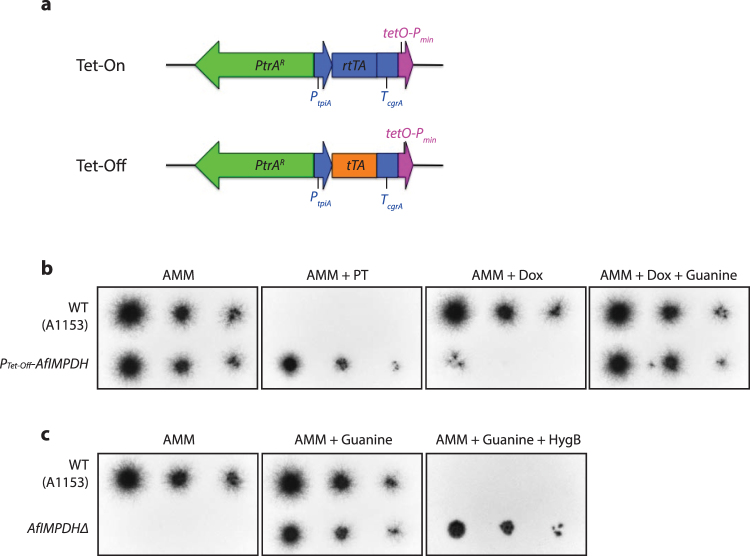
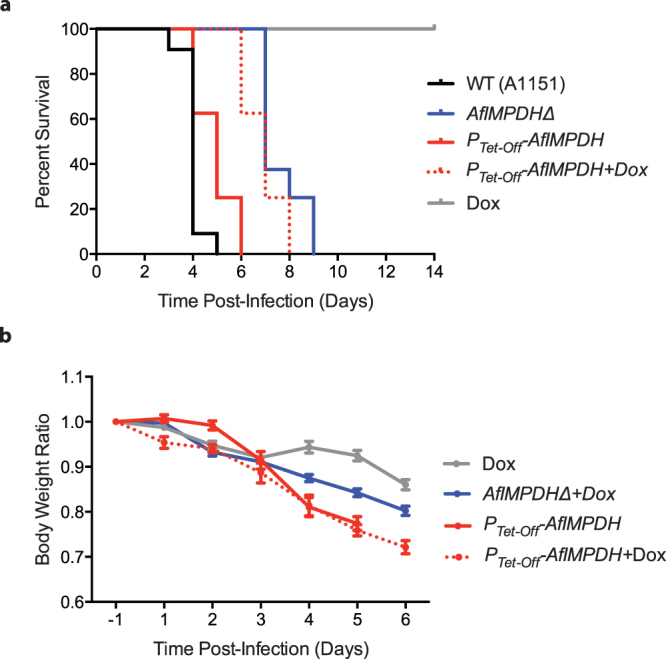
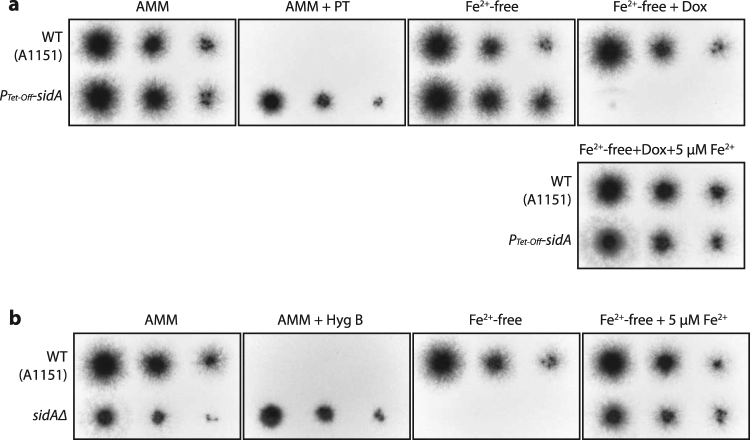
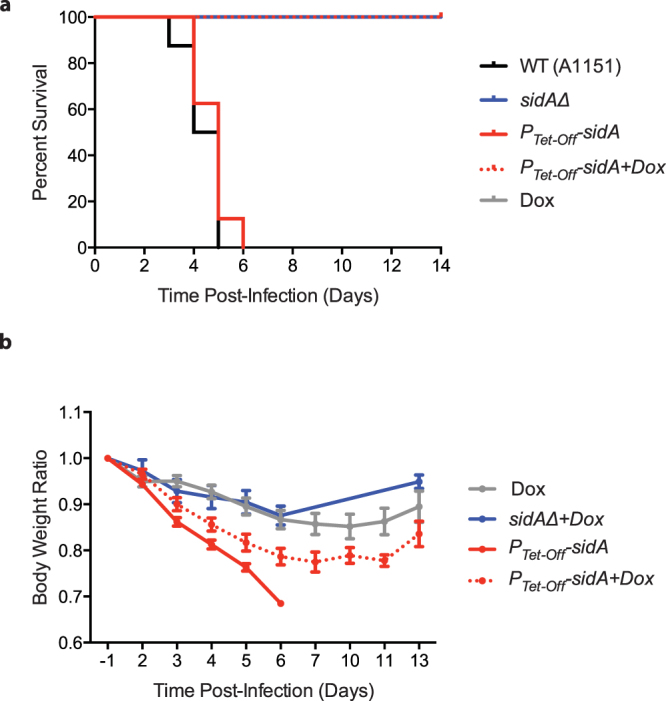
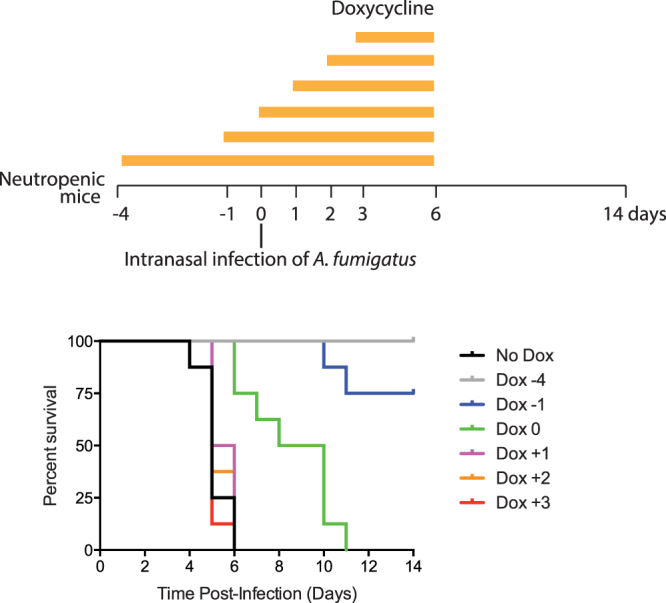
Aspergillus fumigatus is one of the major causes of invasive pulmonary aspergillosis in immunocompromised patients. Novel antifungal therapy is in urgent need due to emerging resistance and adverse toxicity of current antifungal drugs. Gene products that are essential for Aspergillus viability during infection are attractive drug targets. To characterize these genes in vivo we developed a Tet-Off gene expression system in A. fumigatus, whereby the administration of doxycycline resulted in down regulation of the gene whose expression is under the control of the Tet-Off promoter. We tested the system on two potential drug targets, inosine 5′-monophosphate dehydrogenase (IMPDH) and L-ornithine N 5-oxygenase (sidA) in a murine invasive pulmonary aspergillosis model. We show that depletion of IMPDH attenuated but did not completely abolish virulence in vivo whereas turning off the expression of sidA, which is required for iron acquisition, resulted in avirulence. We also investigated whether sidA expression could be controlled in a time-dependent manner in mice. Our results demonstrated that timing of doxycycline administration dramatically affects survival rate, suggesting that this genetic system can be used for testing whether an antifungal drug target is critical for fungal growth post-infection.
Overview
The claims and statistics of this paper haven’t been checked yet.
Free: it reads the open-access text and checks the first 5 claims that cite a source we can check. Create a free account to check every claim.
Integrity signals
Registry
Cites
Statistics
Figures
Verification
Claims the paper makes
The claims and statistics of this paper haven’t been checked yet.
Free: it reads the open-access text and checks the first 5 claims that cite a source we can check. Create a free account to check every claim.
Claims other papers make about this one
Each is checked against this paper’s own text: does it say what the citing paper says it does?
The cited source says what the claim attributes to it.
In the citing paper
“However, the TET-on and TET-off systems are now operational to investigate the role of genes during infection in animal models (160, 161).”
From Aspergillus fumigatus and Aspergillosis in 2019 (2019) · cites this paper as [161]
In the citing paper
“However, the TET-on and TET-off systems are now operational to investigate the role of genes during infection in animal models (160, 161).”
From Aspergillus fumigatus and Aspergillosis in 2019 (2019) · cites this paper as [161]
Self-check
Percentages, sums and reported differences re-computed from the paper’s own numbers.
The self-check needs the paper’s full text.
Citations
Cites
Tight control of gene expression in mammalian cells by tetracycline-responsive promoters.
Gossen, M., & Bujard, H. (1992) · Proceedings of the National Academy of Sciences · doi:10.1073/pnas.89.12.5547 · Cited by 4,943
Transcriptional Activation by Tetracyclines in Mammalian Cells
Gossen, M., Freundlieb, S., Bender, G., Müller, G., Hillen, W., & Bujard, H. (1995) · Science · doi:10.1126/science.7792603 · Cited by 2,488
Physiological concentrations of purines and pyrimidines
Traut, T. W. (1994) · Molecular and Cellular Biochemistry · doi:10.1007/bf00928361 · Cited by 1,867
Schrettl, M., Bignell, E., Kragl, C., Joechl, C., Rogers, T., Arst, H. N., Haynes, K., & Haas, H. (2004) · The Journal of Experimental Medicine · doi:10.1084/jem.20041242 · Cited by 493
Emerging Threats in Antifungal-Resistant Fungal Pathogens
Sanglard, D. (2016) · Frontiers in Medicine · doi:10.3389/fmed.2016.00011 · Cited by 416
da Silva Ferreira, M. E., Kress, M. R. V. Z., Savoldi, M., Goldman, M. H. S., Härtl, A., Heinekamp, T., Brakhage, A. A., & Goldman, G. H. (2006) · Eukaryotic Cell · doi:10.1128/ec.5.1.207-211.2006 · Cited by 403
Hissen, A. H. T., Wan, A. N. C., Warwas, M. L., Pinto, L. J., & Moore, M. M. (2005) · Infection and Immunity · doi:10.1128/iai.73.9.5493-5503.2005 · Cited by 243
Doxycycline-regulated gene expression in the opportunistic fungal pathogen Aspergillus fumigatus
Vogt, K., Bhabhra, R., Rhodes, J. C., & Askew, D. S. (2005) · BMC Microbiology · doi:10.1186/1471-2180-5-1 · Cited by 242
Essential Gene Identification and Drug Target Prioritization in Aspergillus fumigatus
Hu, W., Sillaots, S., Lemieux, S., Davison, J., Kauffman, S., Breton, A., Linteau, A., Xin, C., Bowman, J., Becker, J., et al. (2007) · PLoS Pathogens · doi:10.1371/journal.ppat.0030024 · Cited by 237
Prall, A. K., Longo, G. M., Mayhan, W. G., Waltke, E. A., Fleckten, B., Thompson, R. W., & Baxter, B. T. (2002) · Journal of Vascular Surgery · doi:10.1067/mva.2002.123757 · Cited by 227
Cited by
Aspergillus fumigatus and Aspergillosis in 2019
Latgé, J.-P., & Chamilos, G. (2019) · Clinical Microbiology Reviews · doi:10.1128/cmr.00140-18 · Cited by 1,400
Kluge, J., Terfehr, D., & Kück, U. (2018) · Applied Microbiology and Biotechnology · doi:10.1007/s00253-018-9115-1 · Cited by 116
Xie, J., Rybak, J. M., Martín‐Vicente, A., Guruceaga, X., Thorn, H. I., Nywening, A. V., Ge, W., Parker, J. E., Kelly, S. L., Rogers, P. D., et al. (2024) · Nature Communications · doi:10.1038/s41467-024-48767-3 · Cited by 43
Binder, J., Shadkchan, Y., Osherov, N., & Krappmann, S. (2020) · Frontiers in Microbiology · doi:10.3389/fmicb.2020.01383 · Cited by 43
Structure-guided approaches to targeting stress responses in human fungal pathogens
LeBlanc, E. V., Polvi, E. J., Veri, A. O., Privé, G. G., & Cowen, L. E. (2020) · Journal of Biological Chemistry · doi:10.1074/jbc.rev120.013731 · Cited by 37
Metadata
- Authors
- Peng, Y., Zhang, H., Xu, M., & Tan, M.-W.
- Affiliations
- Genentech (US)
- Corresponding author
- Peng, Yutian
- Tan, Man-Wah
- Venue
- Scientific Reports
- Published
- 2018-01-11
- Volume
- 8
- Issue
- 1
- Pages
- 443-443
- ISSN
- 2045-2322 (ISSN-L)
- PMC
- PMC5765126
- OpenAlex
- W2782268725
- Cited by
- 14
- References
- 34
- Citations by year
- 2025: 1 · 2024: 2 · 2022: 3 · 2021: 2 · 2020: 3 · 2019: 2 · 2018: 1
- FWCI
- 1.51
- Type
- journal article
- Language
- en
- Open access
- gold
- doi.org
- Licence
- cc-by
- creativecommons.org/licenses/by/4.0 (tdm)
- creativecommons.org/licenses/by/4.0 (vor)
- Locations
- Scientific Reports (publishedVersion, cc-by)
- PubMed Central (publishedVersion, cc-by)
- PubMed (publishedVersion)
- DOAJ (DOAJ: Directory of Open Access Journals) (submittedVersion)
- Topics
- Health Sciences › Medicine › Infectious Diseases › Antifungal resistance and susceptibility
- Life Sciences › Biochemistry, Genetics and Molecular Biology › Molecular Biology › Fungal and yeast genetics research
- Health Sciences › Medicine › Infectious Diseases › Fungal Infections and Studies
- Keywords
- Aspergillus fumigatus, invasive pulmonary aspergillosis, antifungal drug targets, doxycycline, inosine 5'-monophosphate dehydrogenase, Sida, iron acquisition, fungal virulence, time-dependent gene expression, immunocompromised patients
- MeSH terms
- Animals, Aspergillus fumigatus, Disease Models, Animal, Doxycycline, Fungal Proteins, Humans, Mixed Function Oxygenases, IMP Dehydrogenase, Promoter Regions, Genetic, Virulence, Down-Regulation, Gene Expression Regulation, Fungal, Genes, Essential, Mice, Invasive Pulmonary Aspergillosis
About these checks
Registry, retraction, Cites and statistics results are computed, not judged, with one exception: a printed reference that no index lists is read once by a model before it counts as a citation error. Claims are extracted by a model and kept only when their quote appears verbatim in the text; each cited source is then checked, with a model’s help, for whether it says what the claim relies on. Those verdicts can be wrong — read the claim’s quote and the cited source before relying on one.
Statistics and arithmetic are recomputed, not judged.
Confidence bands are shown only for fields calibrated on our annotated test set. None is calibrated yet, so no band is shown.
What counts as a claim ›How we measure confidence ›How we check this ›
Are you an author, or do you see a problem with this page? Request a review
How to cite
Cite CoChat for the checks on this page, and the paper for its own findings.
- This page
- CoChat. (2026). Citation check: A Tet-Off gene expression system for validation of antifungal drug targets in a murine invasive pulmonary aspergillosis model. https://app.cochat.ai/papers/10.1038/s41598-017-18868-9
- The paper
- Peng, Y., Zhang, H., Xu, M., & Tan, M.-W. (2018). A Tet-Off gene expression system for validation of antifungal drug targets in a murine invasive pulmonary aspergillosis model. Scientific Reports. https://doi.org/10.1038/s41598-017-18868-9
Data sources
Bibliographic data: Semantic Scholar, OpenAlex, Crossref.
Contains information from the Semantic Scholar Academic Graph Datasets, made available under the ODC Attribution License (ODC-BY 1.0).
Semantic Scholar’s data is described in: Kinney, R., et al. (2023). The Semantic Scholar Open Data Platform. arXiv:2301.10140.
