

Peripheral iron levels in children with attention-deficit hyperactivity disorder: a systematic review and meta-analysis
Open accessThe DOI matches its Crossref record; 66 of the 66 references it cites were found in a registry or an index.
Abstract
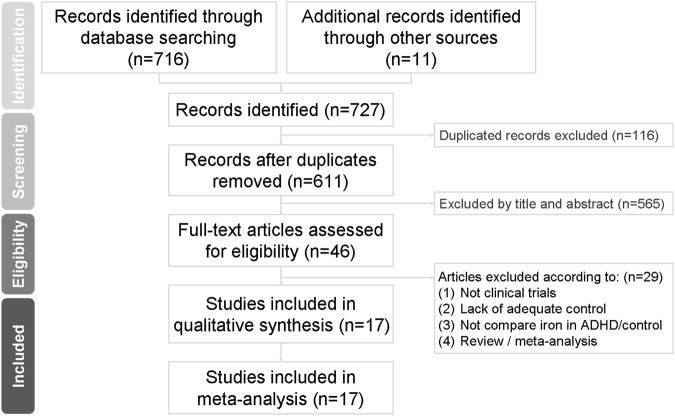
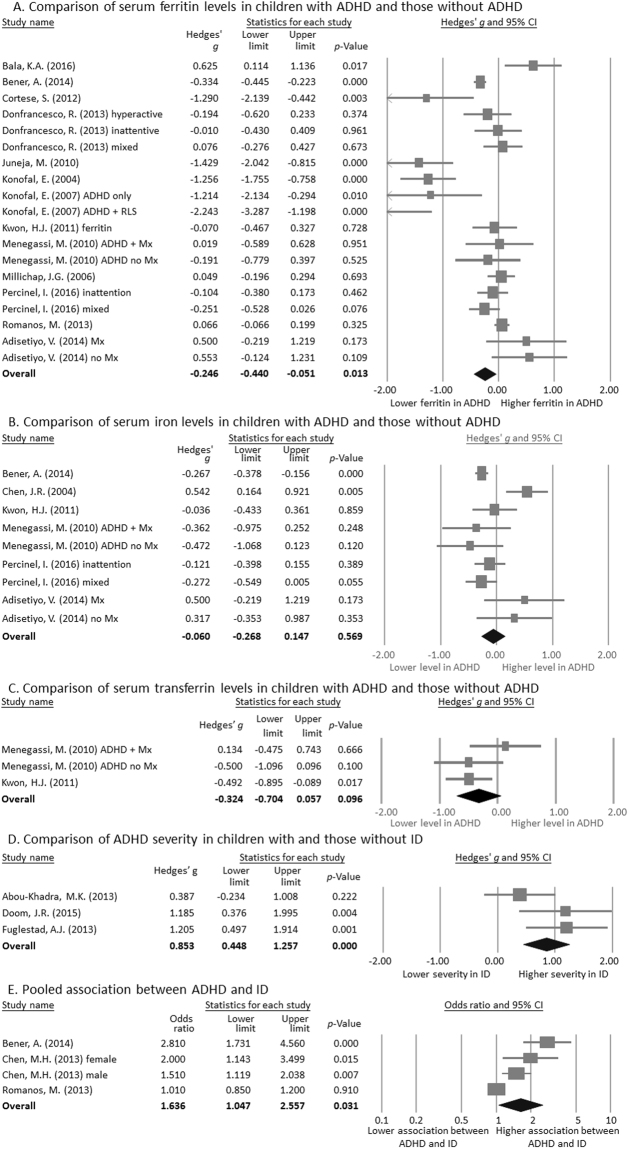
There is growing recognition that the risk of attention-deficit hyperactivity disorder (ADHD) in children may be influenced by micronutrient deficiencies, including iron. We conducted this meta-analysis to examine the association between ADHD and iron levels/iron deficiency (ID). We searched for the databases of the PubMed, ScienceDirect, Cochrane CENTRAL, and ClinicalTrials.gov up to August 9 th , 2017. Primary outcomes were differences in peripheral iron levels in children with ADHD versus healthy controls (HCs) and the severity of ADHD symptoms in children with/without ID (Hedges’ g ) and the pooled adjusted odds ratio (OR) of the association between ADHD and ID. Overall, seventeen articles met the inclusion criteria. Peripheral serum ferritin levels were significantly lower in ADHD children (children with ADHD = 1560, HCs = 4691, Hedges’ g = −0.246, p = 0.013), but no significant difference in serum iron or transferrin levels. In addition, the severity of ADHD was significantly higher in the children with ID than those without ID (with ID = 79, without ID = 76, Hedges’ g = 0.888, p = 0.002), and there was a significant association between ADHD and ID (OR = 1.636, p = 0.031). Our results suggest that ADHD is associated with lower serum ferritin levels and ID. Future longitudinal studies are required to confirm these associations and to elucidate potential mechanisms.
Overview
The claims and statistics of this paper haven’t been checked yet.
Free: it reads the open-access text and checks the first 5 claims that cite a source we can check. Create a free account to check every claim.
Integrity signals
Registry
Cites
Statistics
Figures
Verification
Claims the paper makes
The claims and statistics of this paper haven’t been checked yet.
Free: it reads the open-access text and checks the first 5 claims that cite a source we can check. Create a free account to check every claim.
Claims other papers make about this one
Each is checked against this paper’s own text: does it say what the citing paper says it does?
The source backs part of the claim, not all of it — or backs it for a different population, condition or comparison.
In the citing paper
“A pair of meta-analyses found no difference in serum iron levels in youths with ADHD (six studies, 617 participants) but small-to-moderate reductions in serum ferritin, a protein that stores iron (ten studies, over 2,100 participants)”
From The World Federation of ADHD International Consensus Statement: 208 Evidence-based conclusions about the disorder (2021) · cites this paper as Tseng et al., 2018
Experimental — accuracy not yet measuredThe source backs part of the claim, not all of it — or backs it for a different population, condition or comparison.
In the citing paper
“Obesity and nutritional deficiencies (deficiency in the intake of essential fatty acids), lower serum levels of ferritin, and iron deficiency, as postnatal factors, have been suggested to promote abnormalities in the brain and thereby influence the onset of ADHD [66–69].”
From Molecular Characterisation of the Mechanism of Action of Stimulant Drugs Lisdexamfetamine and Methylphenidate on ADHD Neurobiology: A Review (2022) · cites this paper as [69]
Experimental — accuracy not yet measured
Self-check
Percentages, sums and reported differences re-computed from the paper’s own numbers.
The self-check needs the paper’s full text.
Citations
Cites
Bias in meta-analysis detected by a simple, graphical test
Egger, M., Smith, G. D., Schneider, M., & Minder, C. (1997) · BMJ · doi:10.1136/bmj.315.7109.629 · Cited by 56,722
Quantifying heterogeneity in a meta‐analysis
Higgins, J. P. T., & Thompson, S. G. (2002) · Statistics in Medicine · doi:10.1002/sim.1186 · Cited by 36,763
Dermyshi, E., Wang, Y., Yan, C., Hong, W., Qiu, G., Gong, X., & Zhang, T. (2017) · Neonatology · doi:10.1159/000454668 · Cited by 24,451
Meta-analysis of Observational Studies in Epidemiology<SUBTITLE>A Proposal for Reporting</SUBTITLE>
Stroup, D. F. (2000) · JAMA · doi:10.1001/jama.283.15.2008 · Cited by 20,623
Stang, A. (2010) · European Journal of Epidemiology · doi:10.1007/s10654-010-9491-z · Cited by 17,396
Duval, S., & Tweedie, R. (2000) · Biometrics · doi:10.1111/j.0006-341x.2000.00455.x · Cited by 14,099
A basic introduction to fixed-effect and random-effects models for meta-analysis
Borenstein, M., Hedges, L. V., Higgins, J. P. T., & Rothstein, H. R. (2010) · Research Synthesis Methods · doi:10.1002/jrsm.12 · Cited by 6,793
A Re-Evaluation of Random-Effects Meta-Analysis
Higgins, J. P. T., Thompson, S. G., & Spiegelhalter, D. J. (2009) · Journal of the Royal Statistical Society Series A: Statistics in Society · doi:10.1111/j.1467-985x.2008.00552.x · Cited by 2,569
Molecular genetics of attention-deficit/hyperactivity disorder
Faraone, S. V., Perlis, R. H., Doyle, A. E., Smoller, J. W., Goralnick, J. J., Holmgren, M. A., & Sklar, P. (2005) · Biological Psychiatry · doi:10.1016/j.biopsych.2004.11.024 · Cited by 2,357
The Hazards of Scoring the Quality of Clinical Trials for Meta-analysis
Jüni, P. (1999) · JAMA · doi:10.1001/jama.282.11.1054 · Cited by 1,981
Cited by
Faraone, S. V., Banaschewski, T., Coghill, D., Zheng, Y., Biederman, J., Bellgrove, M. A., Newcorn, J. H., Gignac, M., Al Saud, N. M., Manor, I., et al. (2021) · Neuroscience & Biobehavioral Reviews · doi:10.1016/j.neubiorev.2021.01.022 · Cited by 1,545
“Another pair of meta-analyses likewise found no difference in serum iron levels (six studies, over 1700 participants) but small-to-moderate reductions in serum ferritin (12 studies, over 6000 participants) (Tseng et al., 2018).”
Iron Deficiency, Cognitive Functions, and Neurobehavioral Disorders in Children
Pivina, L., Semenova, Y., Doşa, M. D., Dauletyarova, M., & Bjørklund, G. (2019) · Journal of Molecular Neuroscience · doi:10.1007/s12031-019-01276-1 · Cited by 263
Kim, J. H., Kim, J. Y., Lee, J., Jeong, G. H., Lee, E., Lee, S., Lee, K. H., Kronbichler, A., Stubbs, B., Solmi, M., et al. (2020) · The Lancet Psychiatry · doi:10.1016/s2215-0366(20)30312-6 · Cited by 258
Self-citationAdvancements in 2D layered material memristors: unleashing their potential beyond memory
Nirmal, K. A., Kumbhar, D. D., Kesavan, A. V., Dongale, T. D., & Kim, T. G. (2024) · npj 2D Materials and Applications · doi:10.1038/s41699-024-00522-4 · Cited by 156
Current and future directions in network biology
Žitnik, M., Li, M. M., Wells, A., Glass, K., Gysi, D. M., Krishnan, A., Murali, T. M., Radivojac, P., Roy, S., Baudot, A., et al. (2024) · Bioinformatics Advances · doi:10.1093/bioadv/vbae099 · Cited by 158
“Other studies have delved into molecular biomarkers, their regulatory pathways, and age-related modifications [404].”
Backgroundon behalf of the SPOG Pediatric Hematology Working Group, Mattiello, V., Schmugge, M., Hengartner, H., von der Weid, N., & Renella, R. (2020) · European Journal of Pediatrics · doi:10.1007/s00431-020-03597-5 · Cited by 119
A systematic meta-review of systematic reviews on attention deficit hyperactivity disorder
Chaulagain, A., Lyhmann, I., Halmøy, A., Widding‐Havneraas, T., Nyttingnes, O., Bjelland, I., & Mykletun, A. (2023) · European Psychiatry · doi:10.1192/j.eurpsy.2023.2451 · Cited by 112
Attention-deficit/hyperactive disorder updates
Kessi, M., Duan, H., Xiong, J., Chen, B., He, F., Yang, L., Ma, Y., Bamgbade, O. A., Peng, J., & Yin, F. (2022) · Frontiers in Molecular Neuroscience · doi:10.3389/fnmol.2022.925049 · Cited by 103
“To date, four metaanalyses have evaluated peripheral iron levels in children with ADHD (Biederman, 2005; Bonvicini et al., 2016; Wang et al., 2017; Tseng et al., 2018).”
BackgroundMagnesium, Iron, Zinc, Copper and Selenium Status in Attention-Deficit/Hyperactivity Disorder (ADHD)
Robberecht, H. J., Verlaet, A. A. J., Breynaert, A., Bruyne, T. D., & Hermans, N. (2020) · Molecules · doi:10.3390/molecules25194440 · Cited by 96
Immunotherapy for colorectal cancer: Rational strategies and novel therapeutic progress
Rastin, F., Javid, H., Oryani, M. A., Rezagholinejad, N., Afshari, A. R., & Karimi‐Shahri, M. (2023) · International Immunopharmacology · doi:10.1016/j.intimp.2023.111055 · Cited by 99
Quintero, J., Gutiérrez-Casares, J. R., & Álamo, C. (2022) · Neurology and Therapy · doi:10.1007/s40120-022-00392-2 · Cited by 70
Iron deficiency and common neurodevelopmental disorders—A scoping review
McWilliams, S., Singh, I., Leung, W., Stöckler, S., & Ipsiroglu, O. (2022) · PLoS ONE · doi:10.1371/journal.pone.0273819 · Cited by 96
“Tseng et al ASD Descriptive 2018 [70] Scoping Review No association of iron indices (including SF) with ASD N = 25 Cohort and cross sectional studies Multiple iron indices (SF< SI< TSAT, TIBC, hair iron, iron in food) Meta-analysis Levels of SF in children with ASD did not differ significantly from children without AS…”
BackgroundRationale for Dietary Antioxidant Treatment of ADHD
Verlaet, A., Maasakkers, C., Hermans, N., & Savelkoul, H. (2018) · Nutrients · doi:10.3390/nu10040405 · Cited by 65
Scassellati, C., Bonvicini, C., Benussi, L., Ghidoni, R., & Squitti, R. (2020) · Journal of Trace Elements in Medicine and Biology · doi:10.1016/j.jtemb.2020.126499 · Cited by 73
Migueis, D. P., Lopes, M. C., Casella, E. B., Soares, P. V., Soster, L. A., & Spruyt, K. (2023) · Sleep Medicine Reviews · doi:10.1016/j.smrv.2023.101770 · Cited by 56
Baj, J., Bargieł, J., Cabaj, J., Skierkowski, B., Hunek, G., Portincasa, P., Flieger, J., & Smoleń, A. (2023) · International Journal of Molecular Sciences · doi:10.3390/ijms242015071 · Cited by 53
“Thus, the articles most relevant to the possible role of trace elements in the context of depression were selected.”
BackgroundSim, J. H., Kwon, J., Chae, H., Kim, S.-B., Cho, H., Lee, W., Kim, S. H., Byun, C., Hahn, S., Park, D. H., et al. (2023) · Science Advances · doi:10.1126/sciadv.adh8619 · Cited by 50
Porras, C. A.-M., & Rouault, T. A. (2022) · International Journal of Molecular Sciences · doi:10.3390/ijms23094490 · Cited by 45
“The severity of ADHD also corelated with ID [84].”
BackgroundFarahinia, A., Zhang, W., & Badea, I. (2023) · Sensors · doi:10.3390/s23115300 · Cited by 44
Beyond the Mind—Serum Trace Element Levels in Schizophrenic Patients: A Systematic Review
Baj, J., Forma, A., Sitarz, R., Karakuła, K. H., Flieger, W., Sitarz, M., Grochowski, C., Maciejewski, R., & Karakuła‐Juchnowicz, H. (2020) · International Journal of Molecular Sciences · doi:10.3390/ijms21249566 · Cited by 42
“…processes, inducing various diseases of the CNS or exacerbate already existing symptoms of autism spectrum disorder (ASD), neurodegenerative disorders (Alzheimer, Parkinson, Huntington diseases), dementia, major depressive disorder, or attention deficit hyperactivity disorder (ADHD) [144–150].”
Environmental Metal Exposure, Neurodevelopment, and the Role of Iron Status: a Review
Schildroth, S., Kordas, K., Bauer, J. A., Wright, R. O., & Henn, B. C. (2022) · Current Environmental Health Reports · doi:10.1007/s40572-022-00378-0 · Cited by 40
Önder, A., Çoban, Ö. G., & Adanır, A. S. (2020) · International Journal of Psychiatry in Clinical Practice · doi:10.1080/13651501.2020.1804940 · Cited by 44
East, P. L., Doom, J. R., Blanco, E., Burrows, R., Lozoff, B., & Gahagan, S. (2023) · Journal of Clinical Child & Adolescent Psychology · doi:10.1080/15374416.2021.1969653 · Cited by 36
“Such persistent relations also support recent discussions that the neurobiological alterations that stem from early-life iron deficiency are involved in the pathogenesis of ADHD (Cortese, Angriman et al., 2012; Georgieff, 2011; Tseng et al., 2018).”
BackgroundDegremont, A., Jain, R., Philippou, E., & Latunde-Dada, G. O. (2020) · Nutrition Reviews · doi:10.1093/nutrit/nuaa065 · Cited by 42
A Brief Overview of Recent Pediatric Physical Therapy Practices and Their Importance
Sudhir, C. S., & Sharath, H. V. (2023) · Cureus · doi:10.7759/cureus.47863 · Cited by 33
“In 2018 [25] The current study's aim was to conduct an updated systematic review and meta-analysis taking into account variations in peripheral iron levels and all other aspects of iron status between kids with ADHD and HCs.”
Huang, Y., Wang, L., Huo, J., Wu, Q., Wang, W., Chang, S., & Zhang, Y. (2019) · BMJ Open · doi:10.1136/bmjopen-2019-031021 · Cited by 34
Restless sleep disorder in children with attention-deficit/hyperactivity disorder
Kapoor, V., Ferri, R., Stein, M. A., Ruth, C., Reed, J., & DelRosso, L. M. (2020) · Journal of Clinical Sleep Medicine · doi:10.5664/jcsm.8984 · Cited by 33
“Furthermore, it has been documented that children with ADHD have low ferritin levels.(20) Iron supplementation may improve restless sleep in children with ADHD and has been shown to improve sleep in RSD.”
Neurobiology of Attention Deficit Hyperactivity Disorder
Faraone, S. V., & Radonjić, N. V. (2023) · Springer eBooks · doi:10.1007/978-3-030-42825-9_33-1 · Cited by 35
Adisetiyo, V., Gray, K. M., Jensen, J. H., & Helpern, J. A. (2019) · NeuroImage Clinical · doi:10.1016/j.nicl.2019.101993 · Cited by 34
“Brain iron homeostasis is a critical dopamine-related mechanism, and its dysregulation has been implicated in ADHD (Adisetiyo et al., 2014; Cortese et al., 2012; Lozoff, 2011; Tseng et al. 2018; Wang et al., 2017; Yazici et al., 2019).”
BackgroundInteraction between iron and omega-3 fatty acids metabolisms: where is the cross-link?
Ogłuszka, M., Lipiński, P., & Starzyński, R. R. (2020) · Critical Reviews in Food Science and Nutrition · doi:10.1080/10408398.2020.1862047 · Cited by 30
Approach to Evaluating and Managing Adult Attention-Deficit/Hyperactivity Disorder in Primary Care
Huang, H. Y., Huang, H., Spottswood, M., & Ghaemi, S. N. (2020) · Harvard Review of Psychiatry · doi:10.1097/hrp.0000000000000248 · Cited by 28
Yang, W., Liu, B., Gao, R., Snetselaar, L., Strathearn, L., & Bao, W. (2020) · The Journal of Pediatrics · doi:10.1016/j.jpeds.2020.09.039 · Cited by 28
Self-citationChen, Y., Su, S., Dai, Y., Zou, M., Lin, L., Qian, L., Zhou, Q., Zhang, H., Liu, M., Zhao, J., et al. (2022) · European Radiology · doi:10.1007/s00330-021-08516-2 · Cited by 29
“Recent studies indicated that the ADHD might associate with the iron deficiency, for the serum ferritin level was found to be significantly lower in ADHD children [4, 5].”
BackgroundSelf-citationIron deficiency in children with a focus on inflammatory conditions
Lee, N. H. (2024) · Korean Journal of Pediatrics · doi:10.3345/cep.2023.00521 · Cited by 30
“41 ) In addition, breath-holding spells increase in ID, and the frequency of which decreases with iron therapy.”
BackgroundLuo, J., Mo, Y., & Liu, M. (2019) · Asian Journal of Psychiatry · doi:10.1016/j.ajp.2019.09.023 · Cited by 23
García‐Marín, L. M., Campos, A. I., Cuéllar-Partida, G., Medland, S. E., Kollins, S. H., & Rentería, M. E. (2021) · Scientific Reports · doi:10.1038/s41598-021-01517-7 · Cited by 24
Schildroth, S., Friedman, A., Bauer, J. A., & Henn, B. C. (2022) · New Directions for Child and Adolescent Development · doi:10.1002/cad.20457 · Cited by 21
The Influence of Intensive Nutritional Education on the Iron Status in Infants
Woźniak, D., Podgórski, T., Krzyżanowska-Jankowska, P., Dobrzyńska, M., Wichłacz-Trojanowska, N., Przysławski, J., & Drzymała-Czyż, S. (2022) · Nutrients · doi:10.3390/nu14122453 · Cited by 21
MSMA: A multi-stage and multi-attention algorithm for the classification of multimodal skin lesions
Shu, C., Yu, L., Tian, S., & Shi, X. (2024) · Biomedical Signal Processing and Control · doi:10.1016/j.bspc.2024.106180 · Cited by 22
Food Components with the Potential to be Used in the Therapeutic Approach of Mental Diseases
Fernández, M. J. F., Valero‐Cases, E., & Frutos‐Rincón, L. (2018) · Current Pharmaceutical Biotechnology · doi:10.2174/1389201019666180925120657 · Cited by 21
Shvarzman, R., Crocetti, D., Rosch, K. S., Li, X., & Mostofsky, S. H. (2022) · Experimental Brain Research · doi:10.1007/s00221-022-06484-7 · Cited by 22
“Some studies suggest an association between increased ADHD symptom severity and reduced serum ferritin levels, supporting links of iron content and resulting dopaminergic system dysfunction in children with ADHD (Konofal et al. 2004; Sever et al. 1997; Tseng et al. 2018).”
BackgroundPongpitakdamrong, A., Chirdkiatgumchai, V., Ruangdaraganon, N., Roongpraiwan, R., Sirachainan, N., Soongprasit, M., & Udomsubpayakul, U. (2021) · Journal of Developmental & Behavioral Pediatrics · doi:10.1097/dbp.0000000000000993 · Cited by 27
“The severity of ADHD is significantly higher in children with iron deficiency compared with those without.(12,13) Furthermore, serum ferritin levels are inversely correlated with weight-adjusted doses of amphetamine used to optimize the clinical response.”
BackgroundIs there a place for dietetic interventions in adult ADHD?
Breda, V., Cerqueira, R. O., Ceolin, G., Koning, E., Fabe, J., McDonald, A., Gomes, F. A., & Brietzke, E. M. (2022) · Progress in Neuro-Psychopharmacology and Biological Psychiatry · doi:10.1016/j.pnpbp.2022.110613 · Cited by 25
Normal weight central obesity and hypertension in India: Cross-sectional finding from LASI, 2017-19
Das, S., Goswami, V., & Chandel, S. (2023) · Nutrition Metabolism and Cardiovascular Diseases · doi:10.1016/j.numecd.2023.06.022 · Cited by 21
The Metallome as a Link Between the “Omes” in Autism Spectrum Disorders
Stanton, J. E., Malijauskaite, S., McGourty, K., & Grabrucker, A. M. (2021) · Frontiers in Molecular Neuroscience · doi:10.3389/fnmol.2021.695873 · Cited by 17
“Although a recent meta-analysis investigating iron levels in individuals with and without ASD found no significant differences between the two groups (Tseng et al., 2018), a Chinese cohort study with 254 children that investigated whole blood trace metal levels demonstrated a significant difference between individuals…”
ResultLukovac, T., Hil, O. A., Popović, M., Jovanović, V., Savić, T., Pavlovic, A. M., & Pavlović, D. M. (2024) · Children · doi:10.3390/children11040497 · Cited by 19
“While some studies found no significant difference in ferritin levels between ADHD patients and healthy controls [83–85], others reported significantly lower ferritin levels in ADHD patients compared to their unaffected counterparts [79,80,86,87].”
BackgroundResultGao, X., Zheng, X., Wang, X., Li, Z., & Yang, L. (2025) · Journal of Hazardous Materials · doi:10.1016/j.jhazmat.2025.137832 · Cited by 21
Gupta, K., Soni, N., Nema, R. K., Sahu, N., Srivastava, R. K., Ratre, P., & Mishra, P. K. (2024) · Toxicology Reports · doi:10.1016/j.toxrep.2024.101745 · Cited by 18
“For MC-LR, the TriPleXTM has a detection limit of 0.22 g/L [117,118].”
InfluentialRegulatory T cells in children with attention deficit hyperactivity disorder: A case-control study
Çetin, F. H., Uçaryılmaz, H., Uçar, H. N., Artaç, H., Güler, H. A., Ersoy, S. A., Kılınç, K., & Türkoğlu, S. (2022) · Journal of Neuroimmunology · doi:10.1016/j.jneuroim.2022.577848 · Cited by 17
Petti, T. A., Gupta, M., Fradkin, Y., & Gupta, N. (2023) · BJPsych Open · doi:10.1192/bjo.2023.589 · Cited by 20
Restless Legs Syndrome - Clinical Features
García-Malo, C., Romero-Peralta, S., & Pumarega, I. C. (2021) · Sleep Medicine Clinics · doi:10.1016/j.jsmc.2021.02.002 · Cited by 14
Santa‐Marina, L., Lertxundi, N., Andiarena, A., Irizar, A., Sunyer, J., Molinuevo, A., Llop, S., Júlvez, J., Beneíto, A., Ibarluzea, J. M., et al. (2020) · International Journal of Environmental Research and Public Health · doi:10.3390/ijerph17217704 · Cited by 15
“Two recent systematic reviews and meta-analyses suggest that ADHD is related to lower serum ferritin levels in children [33,34].”
BackgroundMartinelli, M., Fioretti, M. T., Aloi, M., Alvisi, P., Arrigo, S., Banzato, C., Bramuzzo, M., Campanozzi, A., Civitelli, F. S., Knafelz, D., et al. (2024) · Digestive and Liver Disease · doi:10.1016/j.dld.2024.02.016 · Cited by 13
Tohidi, S., Bidabadi, E., Khosousi, M., Amoukhteh, M., Kousha, M., Mashouf, P., & Shahraki, T. (2021) · Clinical Psychopharmacology and Neuroscience · doi:10.9758/cpn.2021.19.4.712 · Cited by 14
High prevalence of ADHD symptoms in unmedicated youths with post-H1N1 narcolepsy type 1
Hansen, B. H., Juvodden, H. T., Nordstrand, S. E. H., Viste, R., Thorsby, P. M., Swanson, D. M., Nilsen, K. B., Nærland, T., & Knudsen, S. (2020) · Sleep Medicine · doi:10.1016/j.sleep.2020.06.014 · Cited by 13
Schildroth, S., Friedman, A., White, R. F., Kordas, K., Placidi, D., Bauer, J. A., Webster, T. F., Coull, B. A., Cagna, G., Wright, R. O., et al. (2023) · Environmental Research · doi:10.1016/j.envres.2023.115457 · Cited by 12
Ehlinger, J. V., Goodrich, J. M., Dolinoy, D. C., Watkins, D. J., Cantoral, A., Mercado‐García, A., Téllez‐Rojo, M. M., & Peterson, K. E. (2023) · Epigenomics · doi:10.2217/epi-2023-0169 · Cited by 12
Lei, W., Hsu, C., Chen, P., Tseng, P., Kuo, H., Guo, M. M., Tu, Y., Lin, P., Kao, Y.-H., & Chang, L. (2021) · Frontiers in Pediatrics · doi:10.3389/fped.2021.746856 · Cited by 10
Self-citationAtteia, H. H., AlFaris, N. A., Alshammari, G. M., Alamri, E. S., Ahmed, S. F., Albalwi, R. A., & Abdel-Sattar, S. A.-L. (2023) · Foods · doi:10.3390/foods12234214 · Cited by 10
Mehta, S., Shah, V., Patel, G. M., Conte‐Júnior, C. A., & Joshi, N. (2024) · Journal of Nanoparticle Research · doi:10.1007/s11051-024-06000-8 · Cited by 11
Akhtarshenas, B., Kowsar, R., Hajian, M., Vash, N. T., Soltani, L., Mahdavi, A. H., & Nasr‐Esfahani, M. H. (2024) · Scientific Reports · doi:10.1038/s41598-024-83585-z · Cited by 9
Local iron deficiency in the substantia nigra directly contributes to hyperlocomotion phenotypes
Wang, Z., Huang, Y., Zhou, Z., Huang, J. A., He, Y., & Qiu, P. (2022) · Neurobiology of Disease · doi:10.1016/j.nbd.2022.105693 · Cited by 10
“These disorders are often accompanied by iron deficiency in the whole body or in specific brain regions, and iron-related drugs are common treatment strategies for these diseases (Earley et al., 2006; Kim et al., 2018; Tseng et al., 2018; Xu et al., 2021).”
Schildroth, S., Valeri, L., Kordas, K., Shi, B., Friedman, A., Smith, D. R., Placidi, D., Wright, R. O., Lucchini, R. G., White, R. F., et al. (2023) · The Science of The Total Environment · doi:10.1016/j.scitotenv.2023.167435 · Cited by 9
Iron Supplementation for Hypoferritinemia-Related Psychological Symptoms in Children and Adolescents
Mikami, K., Akama, F., Kimoto, K., Okazawa, H., Orihashi, Y., Onishi, Y., Takahashi, Y., Yabe, H., Yamamoto, K., & Matsumoto, H. (2021) · Journal of Nippon Medical School · doi:10.1272/jnms.jnms.2022_89-216 · Cited by 9
Liu, J., Huo, J., Liu, Z., Sun, J., & Huang, J. J. (2021) · International Journal of Environmental Research and Public Health · doi:10.3390/ijerph18042041 · Cited by 8
Effect of Oral Iron Administration on Mental State in Children With Low Serum Ferritin Concentration
Mikami, K., Okazawa, H., Kimoto, K., Akama, F., Onishi, Y., Takahashi, Y., Yamamoto, K., & Matsumoto, H. (2019) · Global Pediatric Health · doi:10.1177/2333794x19884816 · Cited by 9
Gumma, S. D., Elotla, S. F., Ibrahim, O., & Rizkalla, N. H. (2023) · European Journal of Clinical Nutrition · doi:10.1038/s41430-023-01345-0 · Cited by 7
“Recent evidence has supported the hypothesis that not only do speci fi c nutrient intake variations affect ADHD occurrence but also the entire diet does [21].”
ResultSchildroth, S., Kordas, K., White, R. F., Friedman, A., Placidi, D., Smith, D. R., Lucchini, R. G., Wright, R. O., Horton, M. K., & Henn, B. C. (2024) · Environmental Health Perspectives · doi:10.1289/ehp12988 · Cited by 7
Yoldaş, T. Ç., Huri, M., Kayıhan, H., Karakaya, J., & Özmert, E. N. (2020) · The Turkish Journal of Pediatrics · doi:10.24953/turkjped.2020.06.008 · Cited by 9
Attention Deficit Hyperactivity Disorder
Katzinger, J. J., Murray, M. T., & Lyon, M. R. (2020) · Elsevier eBooks · doi:10.1016/b978-0-323-43044-9.00151-5 · Cited by 7
Molecular Alterations in Ferroptosis and the Effects of Resveratrol: A Systematic Review
dos Santos, A. B., Santos‐Terra, J., Carletti, J. V., Deckmann, I., & Gottfried, C. (2025) · Journal of Biochemical and Molecular Toxicology · doi:10.1002/jbt.70384 · Cited by 8
Niu, Q., Wang, W., Liang, Y., Fang, S., Wan, L., & Yang, G. (2025) · Molecular Nutrition & Food Research · doi:10.1002/mnfr.70234 · Cited by 7
Díaz‐López, A., Canals, J., Júlvez, J., Fernández‐Barrés, S., Llop, S., Rebagliato, M., Lertxundi, N., Santa‐Marina, L., Guxens, M., Sunyer, J., et al. (2022) · Scientific Reports · doi:10.1038/s41598-022-23432-1 · Cited by 6
Rosenau, P. T., van den Hoofdakker, B. J., Matthijssen, A. M., van de Loo-Neus, G. H. H., Buitelaar, J. K., Hoekstra, P. J., & Dietrich, A. (2022) · Journal of Psychiatric Research · doi:10.1016/j.jpsychires.2022.06.014 · Cited by 7
Whole Brain MRI Assessment of Age and Sex‐Related R2 * Changes in the Human Fetal Brain
Ji, L., Duffy, M., Chen, B., Majbri, A., Trentacosta, C. J., & Thomason, M. E. (2025) · Human Brain Mapping · doi:10.1002/hbm.70073 · Cited by 5
Iv, N., Herbein, M., Heude, B., van der Waerden, J. E. B., Melchior, M., Féart, C., Delcourt, C., Côté, S. M., de Lauzon‐Guillain, B., Lioret, S., et al. (2021) · Journal of Nutrition · doi:10.1093/jn/nxab398 · Cited by 5
Bogdańska-Chomczyk, E., Rowniak, M., Wojtacha, P., Tsai, M. L., Huang, A. C. W., & Kozłowska, A. (2024) · Frontiers in Molecular Neuroscience · doi:10.3389/fnmol.2024.1414457 · Cited by 5
Attention-Deficit/Hyperactivity Disorder Patients May Have Undiagnosed Narcolepsy
Wilenius, L., & Partinen, M. (2020) · Cureus · doi:10.7759/cureus.8436 · Cited by 6
Bogdańska-Chomczyk, E., Wojtacha, P., Tsai, M.-L., Huang, A. C. W., & Kozłowska, A. (2024) · International Journal of Molecular Sciences · doi:10.3390/ijms252413652 · Cited by 4
Msfusenet: a multi-stage information fusion network for multi-modal skin lesion diagnosis
Xiao, Y., Yu, L., Tian, S., Yu, S., Zhang, D., Kang, X., Wu, W., & Rui, L. (2025) · Multimedia Systems · doi:10.1007/s00530-025-01788-4 · Cited by 4
“Compared to traditional machine learning methods, CNNs, with their capability to adaptively select and learn features, have shown superior performance, leading to a significant focus on developing effective CNNs for the classification of skin images [29–31].”
Xiong, W., Jin, L., Zhao, Y., Wu, Y. H., Dong, J.-H., Guo, Z., Zhu, M., Dai, Y., Pan, Y., & Zhu, X. (2023) · Journal of Neuroscience · doi:10.1523/jneurosci.2277-22.2023 · Cited by 4
Long-term Effects of Iron Deficiency in Early Infancy on Neurodevelopment
Korczak, A., Wójcik, E., Olek, E., Łopacińska, O., Stańczyk, K., Korn, A., Jędrzejczyk, J., Szewczyk, O., Burda, K., & Czarnecka, K. (2024) · Journal of Education Health and Sport · doi:10.12775/jehs.2024.70.51104 · Cited by 11
Iron Metabolism and Related Disorders
Ginzburg, Y. Z., & Finberg, K. E. (2021) · Elsevier eBooks · doi:10.1016/b978-0-12-812535-9.00012-1 · Cited by 4
Attention-Deficit/Hyperactivity Disorder
Leffa, D. T., & Rohde, L. A. (2021) · Springer eBooks · doi:10.1007/978-3-030-76136-3_28 · Cited by 4
Assessing the Impact of Serum Ferritin on Life Skills in Children with ADHD
Okuyucu, M., Kavakcı, M., Terzioğlu, M., Gökler, M. E., & Tarakçıoğlu, M. C. (2025) · Children · doi:10.3390/children12080972 · Cited by 5
“Consistent with prior meta-analyses [11,16], our results showed significantly lower ferritin levels in children with ADHD compared to HCs.”
Nixon, G. M. (2019) · Elsevier eBooks · doi:10.1016/b978-0-12-814180-9.00010-7 · Cited by 3
Ilnicka-Borowczyk, K., Woźniak, D., Dobrzyńska, M., Podgórski, T., Szymanowski, K., Blask‐Osipa, A., Mieloszyk, K., & Drzymała-Czyż, S. (2025) · Nutrients · doi:10.3390/nu17193103 · Cited by 2
The impact of trans fatty acids on ADHD in relation to the gut microbiome
He, N., Zhong, J., Deng, S., Liang, J., Li, Q., & Chen, K. G. (2025) · Frontiers in Nutrition · doi:10.3389/fnut.2025.1641574 · Cited by 2
Fornaro, M., Lorenzo, C. D., Steardo, L., Veronese, N., Stubbs, B., Vancampfort, D., Siskind, D. J., & Solmi, M. (2026) · European Neuropsychopharmacology · doi:10.1016/j.euroneuro.2026.112880 · Cited by 3
Self-citationNeuroimaging Human Dopamine-Related Neurophysiology Across Development
Parr, A. C., Larsen, B., Calabro, F. J., Tervo‐Clemmens, B., & Luna, B. (2022) · Neuromethods · doi:10.1007/978-1-0716-2799-0_13 · Cited by 2
Wang, X., Wang, Q., & Huang, J. (2023) · World Journal of Clinical Cases · doi:10.12998/wjcc.v11.i28.6744 · Cited by 2
Bringing nutritional ketosis to the table as an option for healing the pediatric brain
Gertler, T. S., & Blackford, R. (2024) · Frontiers in Nutrition · doi:10.3389/fnut.2024.1408327 · Cited by 3
Neurobiology of Attention Deficit Hyperactivity Disorder
Faraone, S. V., & Radonjić, N. V. (2024) · Springer eBooks · doi:10.1007/978-3-030-51366-5_33 · Cited by 2
Hou, J., Lin, L., Huang, J., Chai, Q., Wang, S., Liu, X., & Liu, Q. (2025) · European Journal of Pharmacology · doi:10.1016/j.ejphar.2025.177838 · Cited by 2
Taner, H. A., Çetin, F. H., Sal, E., Işık, Y., Şener, Ş., & Gursel, T. (2020) · Van Medical Journal · doi:10.5505/vtd.2020.93276 · Cited by 1
“Studies that investigated the relationship between ADHD and iron parameters have established promising results that clarify the etiopathogenesis of ADHD (31-34).”
BackgroundDeterioro cognitivo en niños preescolares asociado a deficiencia de hierro
Sánchez, J. P. O., & Espinoza, E. A. R. (2023) · Revista Ecuatoriana de Ciencia Tecnología e Innovación en Salud Pública · doi:10.31790/inspilip.v7i22.426 · Cited by 1
Stevenson, J. (2023) · Springer eBooks · doi:10.1007/978-3-031-45787-6_9 · Cited by 1
Bakather, O. Y. (2024) · Physica Scripta · doi:10.1088/1402-4896/ad2d9e · Cited by 1
Leme, M. I. D. M., Pinto, C. G. R., & Santos, A. C. D. C. P. (2025) · Research Society and Development · doi:10.33448/rsd-v14i6.48977 · Cited by 1
Araújo, T., Rodrigues, M., & Campos, D. (2026) · Cureus · doi:10.7759/cureus.103196 · Cited by 1
“Tseng et al. [18] concluded that children with serum iron deficiency were more likely to have ADHD and exhibited greater symptom severity.”
Influential
Metadata
- Authors
- Tseng, P.-T., Cheng, Y.-S., Yen, C.-F., Chen, Y.-W., Stubbs, B., Whiteley, P., Carvalho, A. F., Li, D.-J., Chen, T.-Y., Yang, W.-C., Tang, C.-H., Chu, C.-S., Yang, W.-C., Liang, H.-Y., Wu, C.-K., & Lin, P.-Y.
- Affiliations
- Kaohsiung Medical University (TW)
- King's College London (GB)
- Scottish Environment Protection Agency (GB)
- Universidade Federal do Ceará (BR)
- Tri-Service General Hospital (TW)
- Kaohsiung Municipal Kai-Syuan Psychiatric Hospital (TW)
- Tainan Hospital (TW)
- Kaohsiung Veterans General Hospital (TW)
- Chang Gung University (TW)
- Corresponding author
- Lin, Pao-Yen
- ORCID
- Venue
- Scientific Reports
- Published
- 2018-01-15
- Volume
- 8
- Issue
- 1
- Pages
- 788-788
- ISSN
- 2045-2322 (ISSN-L)
- PMC
- PMC5768671
- OpenAlex
- W2783143899
- Cited by
- 126
- References
- 65
- Citations by year
- 2026: 9 · 2025: 12 · 2024: 20 · 2023: 24 · 2022: 19 · 2021: 15 · 2020: 19 · 2019: 6 · 2018: 2
- FWCI
- 1.62
- Type
- journal article
- Language
- en
- Open access
- gold
- doi.org
- Licence
- cc-by
- creativecommons.org/licenses/by/4.0 (tdm)
- creativecommons.org/licenses/by/4.0 (vor)
- Locations
- Scientific Reports (publishedVersion, cc-by)
- PubMed Central (publishedVersion, cc-by)
- PubMed (publishedVersion)
- DOAJ (DOAJ: Directory of Open Access Journals) (submittedVersion)
- Research Portal (King's College London) (submittedVersion, cc-by)
- Topics
- Health Sciences › Medicine › Psychiatry and Mental health › Attention Deficit Hyperactivity Disorder
- Health Sciences › Medicine › Hematology › Iron Metabolism and Disorders
- Health Sciences › Nursing › Nutrition and Dietetics › Trace Elements in Health
- Keywords
- attention deficit hyperactivity disorder, iron deficiency, serum ferritin, micronutrient deficiency, ADHD symptom severity, children
- MeSH terms
- Attention Deficit Disorder with Hyperactivity, Child, Ferritins, Humans, Iron, Severity of Illness Index, Odds Ratio, Databases, Factual
About these checks
Registry, retraction, Cites and statistics results are computed, not judged, with one exception: a printed reference that no index lists is read once by a model before it counts as a citation error. Claims are extracted by a model and kept only when their quote appears verbatim in the text; each cited source is then checked, with a model’s help, for whether it says what the claim relies on. Those verdicts can be wrong — read the claim’s quote and the cited source before relying on one.
Statistics and arithmetic are recomputed, not judged.
Confidence bands are shown only for fields calibrated on our annotated test set. None is calibrated yet, so no band is shown.
What counts as a claim ›How we measure confidence ›How we check this ›
Are you an author, or do you see a problem with this page? Request a review
Data sources
Bibliographic data: Semantic Scholar, OpenAlex, Crossref.
Contains information from the Semantic Scholar Academic Graph Datasets, made available under the ODC Attribution License (ODC-BY 1.0).
Semantic Scholar’s data is described in: Kinney, R., et al. (2023). The Semantic Scholar Open Data Platform. arXiv:2301.10140.
