

Peripheral iron levels in children with attention-deficit hyperactivity disorder: a systematic review and meta-analysis
Open accessThe DOI matches its Crossref record; 66 of the 66 references it cites were found in a registry or an index.
Abstract
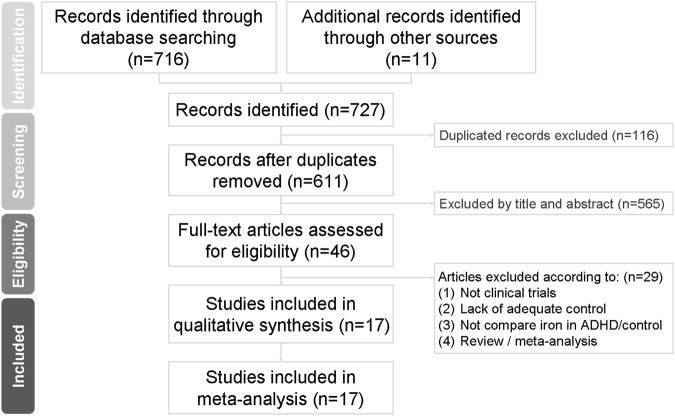
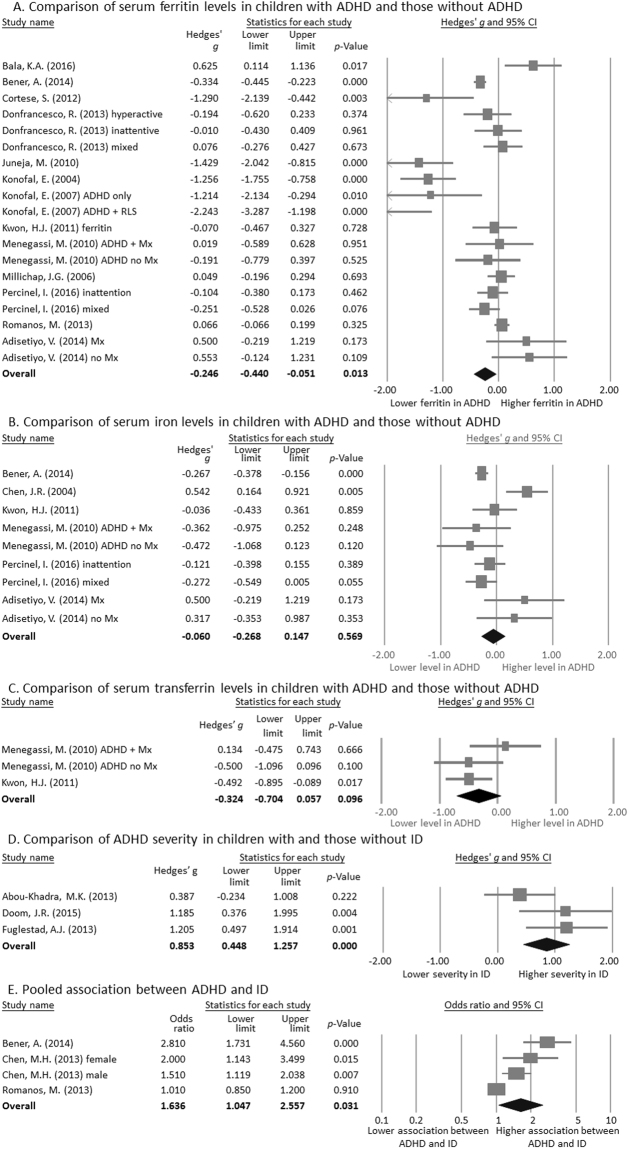
There is growing recognition that the risk of attention-deficit hyperactivity disorder (ADHD) in children may be influenced by micronutrient deficiencies, including iron. We conducted this meta-analysis to examine the association between ADHD and iron levels/iron deficiency (ID). We searched for the databases of the PubMed, ScienceDirect, Cochrane CENTRAL, and ClinicalTrials.gov up to August 9 th , 2017. Primary outcomes were differences in peripheral iron levels in children with ADHD versus healthy controls (HCs) and the severity of ADHD symptoms in children with/without ID (Hedges’ g ) and the pooled adjusted odds ratio (OR) of the association between ADHD and ID. Overall, seventeen articles met the inclusion criteria. Peripheral serum ferritin levels were significantly lower in ADHD children (children with ADHD = 1560, HCs = 4691, Hedges’ g = −0.246, p = 0.013), but no significant difference in serum iron or transferrin levels. In addition, the severity of ADHD was significantly higher in the children with ID than those without ID (with ID = 79, without ID = 76, Hedges’ g = 0.888, p = 0.002), and there was a significant association between ADHD and ID (OR = 1.636, p = 0.031). Our results suggest that ADHD is associated with lower serum ferritin levels and ID. Future longitudinal studies are required to confirm these associations and to elucidate potential mechanisms.
Overview
The claims and statistics of this paper haven’t been checked yet.
Free: it reads the open-access text and checks the first 5 claims that cite a source we can check. Create a free account to check every claim.
Integrity signals
Registry
Cites
Statistics
Figures
Verification
Claims the paper makes
The claims and statistics of this paper haven’t been checked yet.
Free: it reads the open-access text and checks the first 5 claims that cite a source we can check. Create a free account to check every claim.
Claims other papers make about this one
Each is checked against this paper’s own text: does it say what the citing paper says it does?
The source backs part of the claim, not all of it — or backs it for a different population, condition or comparison.
In the citing paper
“A pair of meta-analyses found no difference in serum iron levels in youths with ADHD (six studies, 617 participants) but small-to-moderate reductions in serum ferritin, a protein that stores iron (ten studies, over 2,100 participants)”
From The World Federation of ADHD International Consensus Statement: 208 Evidence-based conclusions about the disorder (2021) · cites this paper as Tseng et al., 2018
Experimental — accuracy not yet measuredThe source backs part of the claim, not all of it — or backs it for a different population, condition or comparison.
In the citing paper
“Obesity and nutritional deficiencies (deficiency in the intake of essential fatty acids), lower serum levels of ferritin, and iron deficiency, as postnatal factors, have been suggested to promote abnormalities in the brain and thereby influence the onset of ADHD [66–69].”
From Molecular Characterisation of the Mechanism of Action of Stimulant Drugs Lisdexamfetamine and Methylphenidate on ADHD Neurobiology: A Review (2022) · cites this paper as [69]
Experimental — accuracy not yet measured
Self-check
Percentages, sums and reported differences re-computed from the paper’s own numbers.
The self-check needs the paper’s full text.
Citations
Cites
Bias in meta-analysis detected by a simple, graphical test
Egger, M., Smith, G. D., Schneider, M., & Minder, C. (1997) · BMJ · doi:10.1136/bmj.315.7109.629 · Cited by 56,722
Quantifying heterogeneity in a meta‐analysis
Higgins, J. P. T., & Thompson, S. G. (2002) · Statistics in Medicine · doi:10.1002/sim.1186 · Cited by 36,763
Dermyshi, E., Wang, Y., Yan, C., Hong, W., Qiu, G., Gong, X., & Zhang, T. (2017) · Neonatology · doi:10.1159/000454668 · Cited by 24,451
Meta-analysis of Observational Studies in Epidemiology<SUBTITLE>A Proposal for Reporting</SUBTITLE>
Stroup, D. F. (2000) · JAMA · doi:10.1001/jama.283.15.2008 · Cited by 20,623
Stang, A. (2010) · European Journal of Epidemiology · doi:10.1007/s10654-010-9491-z · Cited by 17,396
Duval, S., & Tweedie, R. (2000) · Biometrics · doi:10.1111/j.0006-341x.2000.00455.x · Cited by 14,099
A basic introduction to fixed-effect and random-effects models for meta-analysis
Borenstein, M., Hedges, L. V., Higgins, J. P. T., & Rothstein, H. R. (2010) · Research Synthesis Methods · doi:10.1002/jrsm.12 · Cited by 6,793
A Re-Evaluation of Random-Effects Meta-Analysis
Higgins, J. P. T., Thompson, S. G., & Spiegelhalter, D. J. (2009) · Journal of the Royal Statistical Society Series A: Statistics in Society · doi:10.1111/j.1467-985x.2008.00552.x · Cited by 2,569
Molecular genetics of attention-deficit/hyperactivity disorder
Faraone, S. V., Perlis, R. H., Doyle, A. E., Smoller, J. W., Goralnick, J. J., Holmgren, M. A., & Sklar, P. (2005) · Biological Psychiatry · doi:10.1016/j.biopsych.2004.11.024 · Cited by 2,357
The Hazards of Scoring the Quality of Clinical Trials for Meta-analysis
Jüni, P. (1999) · JAMA · doi:10.1001/jama.282.11.1054 · Cited by 1,981
Cited by
Items 101–131 of 131
Corkum, P. V., Bertrand, M., Ilie, A., & Rajda, M. (2023) · Autism and child psychopathology series · doi:10.1007/978-3-031-41709-2_10 · Cited by 1
Yackobovitch‐Gavan, M., Ben-Hefer, D., Feldhamer, I., & Meyerovitch, J. (2024) · Heliyon · doi:10.1016/j.heliyon.2024.e33430 · Cited by 4
“A meta-analysis that included 17 observational studies found that ferritin levels, which were measured in children aged 6.7 – 13.3 years, were lower in those who diagnosed with ADHD than in a healthy control group [21].”
MethodInfluentialAttention deficit hyperactivity disorder
Lazar, S. M., & Voigt, R. G. (2024) · Elsevier eBooks · doi:10.1016/b978-0-12-824060-1.00017-1 · Cited by 1
Yackobovitch‐Gavan, M., Ben-Hefer, D., & Meyerovitch, J. (2022) · Research Square · doi:10.21203/rs.3.rs-1567781/v1 · Cited by 1
Foroughi, S., Shahanipour, K., Monajemi, R., & Ahadi, A. M. (2023) · Research Square · doi:10.21203/rs.3.rs-3081949/v1 · Cited by 1
RLS with PLMS in a child with hemolytic anemia caused by pyruvate kinase deficiency
Peraita‐Adrados, R., Medrano‐Martínez, P., Peirano, P. D., Algarín, C. R., & Lillo-Triguero, L. (2020) · Sleep Medicine · doi:10.1016/j.sleep.2020.01.013
Iron status of children with attention deficit/hyperactivity disorder: A systematic review
Degremont, A., Jain, R., Philippou, E., & Latunde-Dada, G. O. (2020) · Proceedings of The Nutrition Society · doi:10.1017/s0029665119001484
Socioeconomic impact, comorbid conditions and consequences of sleep-related movement disorders
Grigg-Damberger, M. M., & Earl, D. C. (2021) · Elsevier eBooks · doi:10.1016/b978-0-12-822963-7.00193-6
Relación entre el estado nutricional de hierro y los niveles de plomo en sangre en niños
Disalvo, L. (2022) · El Servicio de Difusión de la Creación Intelectual (National University of La Plata) · doi:10.35537/10915/138965 · Cited by 6
Bhogaraju, A., & Sireesha, C. V. (2022) · Archives of Mental Health · doi:10.4103/amh.amh_19_22
Iron and Neurodevelopmental Disorders
Bakthavatchalam, P., & Thangarajan, R. (2022) · Nutritional neurosciences · doi:10.1007/978-981-19-7327-7_12 · Cited by 1
Rôle de la nutrition et de la micronutrition dans le TDAH
Juzanx, K. (2023) · Actualités Pharmaceutiques · doi:10.1016/j.actpha.2023.03.049 · Cited by 1
Rivas, L. A. C. (2021) · Universidad Privada San Juan Bautista · doi:10.59590/upsjb/fcs.med.hum/tesis/3141
Gornik, A. E., Northrup, R. A., & Pritchard, A. E. (2024) · Elsevier eBooks · doi:10.1016/b978-0-443-13552-1.00024-2 · Cited by 1
Marcotulli, D., Salvalaggio, A., Zardini, A., & Vitiello, B. (2025) · Springer eBooks · doi:10.1007/978-3-031-81802-8_12 · Cited by 2
Ketogenic Metabolic Therapy as a Treatment for Mental Health Disorders
(2025) · Frontiers research topics · doi:10.3389/978-2-8325-6338-0
Li, F.-J., Li, J.-Y., Zhang, R.-Y., Liu, X.-J., Lv, B., Zhang, T., Liu, Y.-N., Zhang, Z.-X., Zhang, W., Cui, G., et al. (2025) · Sleep Medicine · doi:10.1016/j.sleep.2025.106631
Harrington, K. (2024) · The Conversation · doi:10.64628/aai.3a6ae94dg
Zavala, E., Murray‐Kolb, L. E., Hurley, K. M., Khatry, S. K., LeClerq, S. C., Wu, L. S. F., Katz, J., Tielsch, J. M., & Christian, P. S. (2025) · PLOS Global Public Health · doi:10.1371/journal.pgph.0005495
de la Cruz, M. C. (2020) · Dipòsit Digital de Documents de la UAB (Universitat Autònoma de Barcelona)
Farran, C. (2023) · Archipel (Université du Québec à Montréal)
Robinette, L. M., Hatsu, I. E., Wu, C.-M., Adetona, O., Bruton, A. M., Ast, H. K., Odei, J. B., Leung, B. M. Y., Johnstone, J. M., & Ziouzenkova, O. (2026) · Biological Trace Element Research · doi:10.1007/s12011-026-05017-5 · Cited by 1
“Consistent evidence has shown that children with ADHD have lower serum ferritin, an iron-binding storage protein, compared to typically developing children, indicating altered iron metab - olism [21, 23 ].”
Self-citationLi, Y., Ma, Z., Falchi, W., Huang, L., Chen, Z., & Hai, W. (2026) · Complementary Medicine Research · doi:10.1159/000552870 · Cited by 1
Piceatannol attenuates thoracic aortic aneurysm progression by targeting STK33
Liu, Y., Liu, J., Shi, R., & Tan, L. (2026) · Biology Direct · doi:10.1186/s13062-026-00858-5
“To evaluate heterogeneity across genetic variants, we conducted the Cochran Q test [18].”
Kamış, B., Kamış, Ş. Ç., YÜKSEKKAYA, C., Vural, S. A., & Güneş, S. (2026) · Frontiers in Psychiatry · doi:10.3389/fpsyt.2026.1875919
From Cause to Treatment: Brain Metallomics in Neuropsychiatric Disorders
Bederska‐Łojewska, D., Turek, J., & Szewczyk, B. (2026) · Neuromethods · doi:10.1007/978-1-0716-5468-2_10
Hauck, S., & de Oliveira, L. T. (2026) · Neuroscience & Biobehavioral Reviews · doi:10.1016/j.neubiorev.2026.106992
Şen, N., & Tek, N. A. (2026) · Nutrients · doi:10.3390/nu18193176
“A meta-analysis similarly reported lower serum ferritin concentrations in children with ADHD but no significant differences in serum iron or transferrin [60]; however, a subsequent systematic review found that results for peripheral ferritin and serum iron were inconsistent across studies [59].”
Pediatric Physical Therapies and Rehabilitation: Recent Advances and Technologies
Alhamdan, N. A. (2024) · Review of Contemporary Philosophy
Essential Trace Elements in Psychiatric Disorders: Mechanistic Pathways and Therapeutic Implications
Ertuğrul, S., & Uzun, Ö. (2026) · Medical Research Reports · doi:10.55517/mrr.1949717
Metadata
- Authors
- Tseng, P.-T., Cheng, Y.-S., Yen, C.-F., Chen, Y.-W., Stubbs, B., Whiteley, P., Carvalho, A. F., Li, D.-J., Chen, T.-Y., Yang, W.-C., Tang, C.-H., Chu, C.-S., Yang, W.-C., Liang, H.-Y., Wu, C.-K., & Lin, P.-Y.
- Affiliations
- Kaohsiung Medical University (TW)
- King's College London (GB)
- Scottish Environment Protection Agency (GB)
- Universidade Federal do Ceará (BR)
- Tri-Service General Hospital (TW)
- Kaohsiung Municipal Kai-Syuan Psychiatric Hospital (TW)
- Tainan Hospital (TW)
- Kaohsiung Veterans General Hospital (TW)
- Chang Gung University (TW)
- Corresponding author
- Lin, Pao-Yen
- ORCID
- Venue
- Scientific Reports
- Published
- 2018-01-15
- Volume
- 8
- Issue
- 1
- Pages
- 788-788
- ISSN
- 2045-2322 (ISSN-L)
- PMC
- PMC5768671
- OpenAlex
- W2783143899
- Semantic Scholar
- c1172108026a6feaa7f55a6551c88c0a21e9e346
- Cited by
- 126
- References
- 65
- Citations by year
- 2026: 9 · 2025: 12 · 2024: 20 · 2023: 24 · 2022: 19 · 2021: 15 · 2020: 19 · 2019: 6 · 2018: 2
- FWCI
- 1.62
- Type
- journal article
- Language
- en
- Open access
- gold
- doi.org
- Licence
- cc-by
- creativecommons.org/licenses/by/4.0 (tdm)
- creativecommons.org/licenses/by/4.0 (vor)
- Locations
- Scientific Reports (publishedVersion, cc-by)
- PubMed Central (publishedVersion, cc-by)
- PubMed (publishedVersion)
- DOAJ (DOAJ: Directory of Open Access Journals) (submittedVersion)
- Research Portal (King's College London) (submittedVersion, cc-by)
- Topics
- Health Sciences › Medicine › Psychiatry and Mental health › Attention Deficit Hyperactivity Disorder
- Health Sciences › Medicine › Hematology › Iron Metabolism and Disorders
- Health Sciences › Nursing › Nutrition and Dietetics › Trace Elements in Health
- Keywords
- attention deficit hyperactivity disorder, iron deficiency, serum ferritin, micronutrient deficiency, ADHD symptom severity, children
- MeSH terms
- Attention Deficit Disorder with Hyperactivity, Child, Ferritins, Humans, Iron, Severity of Illness Index, Odds Ratio, Databases, Factual
About these checks
Registry, retraction, Cites and statistics results are computed, not judged, with one exception: a printed reference that no index lists is read once by a model before it counts as a citation error. Claims are extracted by a model and kept only when their quote appears verbatim in the text; each cited source is then checked, with a model’s help, for whether it says what the claim relies on. Those verdicts can be wrong — read the claim’s quote and the cited source before relying on one.
Statistics and arithmetic are recomputed, not judged.
Confidence bands are shown only for fields calibrated on our annotated test set. None is calibrated yet, so no band is shown.
What counts as a claim ›How we measure confidence ›How we check this ›
Are you an author, or do you see a problem with this page? Request a review
Data sources
Bibliographic data: Semantic Scholar, OpenAlex, Crossref.
Contains information from the Semantic Scholar Academic Graph Datasets, made available under the ODC Attribution License (ODC-BY 1.0).
Semantic Scholar’s data is described in: Kinney, R., et al. (2023). The Semantic Scholar Open Data Platform. arXiv:2301.10140.
